
A Case Report of Recurrent Flash Pulmonary Edema: The Pickering Syndrome
Flash Pulmonary Edema (FPE) is a type of recurrent pulmonary edema that usually develops in patients with critical bilateral renal artery stenosis (RAS) or renal artery stenosis to a solitary kidney. A recent recommendation from the 20th European Meeting on Hypertension proposes naming this clinical entity Pickering Syndrome. Currently, it is one of the few clear indications for endovascular procedures in atherosclerotic renovascular disease. We present a case of a 45-year old female with Pickering syndrome and good outcome after revascularization.
Introduction
In 1988 Thomas Pickering, et al. [1] reported in the Lancet 11 hypertensive patients with renovascular disease who presented with episodes of pulmonary edema. Since the initial observation of this clinical entity numerous case reports and clinical studies have described the sporadic occurrence of FPE in patients with bilateral RAS and the underlying pathophysiologic mechanisms have been delineated. Because FPE and bilateral RAS are a unique clinical entity with distinct pathophysiologic, clinical and therapeutic features, Pickering Syndrome was named [1]. Successful revascularization of one or both renal arteries eliminated pulmonary oedema in 77% of patients with bilateral RAS [2]. It differs from usual cases of left ventricular failure with pulmonary edema in that this condition is usually not associated with severe left ventricular systolic dysfunction. It is mostly nocturnal and comes rather suddenly. Although it is usually responsive to standard methods of treatment including diuretics occasionally it can be more serious and even may require ventilation [3]. Characteristically it recurs after some time. There have been many reports ever since [3-
5]. We describe here a case of bilateral renal artery stenosis presenting as flash pulmonary edema and was successfully treated with angioplasty.
Case Summary
45Years old female presented with complains of acute onset shortness of breath since last 2 days, present even at rest, aggravated by lying down position and decrease by sitting up position but didn’t relieved completely. She hadPast history of similar two episodes of shortness of breath 1 year back, history of hypertension since last 5 years and history of abnormal renal function test 6 months back which was later found to be normal. She was receiving Tab Amlodipine 10 mg POOD and Tab Atenolol 25 mg PO BD for blood pressure control. On examination she was tachypneic with use of accessory muscle of respiration, Pulse was 86 / min regular normal volume character, all peripheral pulses palpable, no radio radial or no radio femoral delay, blood pressure was 160 /100 mm Hg on right arm supine position and 150 /100 mm Hg on left arm on supine position, 170/100 mm Hg on right Lower limb and 160/100 mm Hg On Left
lower limb, respiratory rate was 28 /min. Patient didn’t have pallor, edema, cyanosis and Jugular venous pulse was not elevated. On systemic examination we found fine inspiratory Crepitation’s over bilateral infra scapular and infra axillary area and renal bruit was heard on left side. We made clinical diagnosis of Acute Pulmonary Edema probably secondary toacute left ventricular failure secondary to Hypertensive heart disease or Acute Pulmonary Edema secondary to left renal artery stenosis.
Investigation revealed Haemoglobin of 11 gm/dl, Total Leukocyte Count 11,000/microl, Neutrophil 75%, Lymphocyte 25%, Platelet was 2,66,000/microl, Random blood Sugar 104 mg/dl, Urea 123 mg/dl, Creatinine 6.8 mg/ dl, Sodium 141meq/l, potassium 5.8meq/l, Arterial blood gas analysis revealed Metabolic acidosis and calcium and phosphorus level was within normal limit. Urine routine microscopy revealed WBC 10-12/hpf, Albumin was ++. Electrocardiography showed left ventricular hypertrophy (LVH) and Chest x-ray revealed cardiomegaly, bilateral infiltrates over mid and lower zone. Echocardiography showed Concentric LVH, grade I Left ventricular diastolic dysfunction, Ejection Fraction 55%. Ultrasonography abdomen pelvis showed small sized left kidney with left nephrolithiasis size of 6mm, and right kidney normal in size.
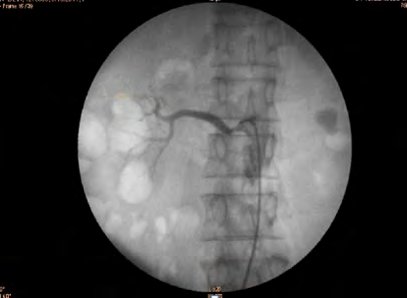
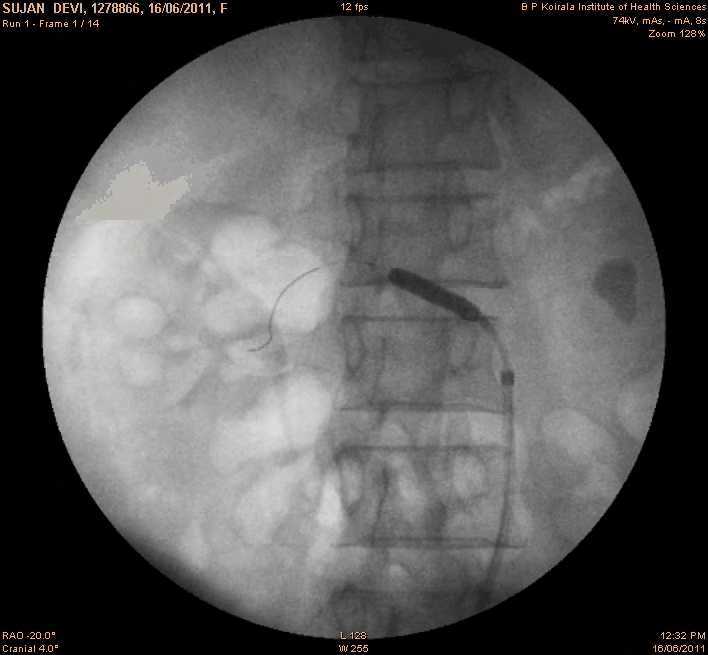
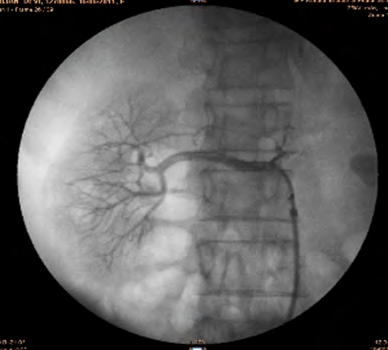
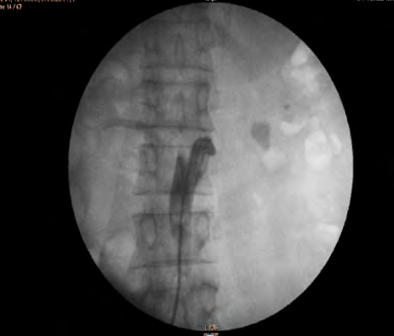
After detailed clinical examinations and laboratory investigation we made the provisional diagnosis of Acute on chronic Kidney Disease Stage V with eGFR =8.25ml/ min) secondary to hypertensive nephropathy presented with acute pulmonary edema with hyperkalemia, metabolic acidosis with left nephrolithiasis with left small kidney to r/o Renal artery stenosis with acute component being urinary tract infection. Patient was treated with IV diuretics, anti hyperkalemic treatment, antihypertensive, IV antibiotics and underwent 3 session of hemodialysis. Patient improved and finally patient was discharged after 3 days and asked for follow up in medicine OPD with repeat renal function test and renal doppler study. But patient lost for follow up and came back 6 months later with complains of 2 similar episodes of shortness of breath, swelling of bilateral lower limb and was advice for renal function test and Doppler study of renal artery and Renal function test showed urea 56 mg/dl, Creatinine 1.4 mg/d and Renal CT angiography showed Bilateral proximal renal artery stenosis (70% of right renal artery and near total stenosis of left renal artery) with small left kidney and left nephrolithiasis. Contrast excretion was normal on right side and no immediate contrast excretion seen by the left kidney and Patient advised for renal angiography and angioplasty Patient was admitted for renal angiography and right renal artery angioplasty and Renal angiography revealed 80 % stenosis right renal artery and 100 % stenosis left renal artery and Underwent renal angiography and angioplasty for 80 % stenosis of right renal artery and Bare metal stent(BMS) was kept (Figures 1-4) and discharged on antihypertensive, antiplatelet medications. We made the final diagnosis of Secondary hypertension etiology B/L atherosclerotic renal artery stenosis: 80% stenosis right renal artery –percutaneous transluminal angioplasty - BMS, and 100 % stenosis left renal artery with recurrent flash pulmonary edema (The pickering syndrome).
Discussion
Pickering et al get the credit for highlighting the occurrence of acute recurrent pulmonary edema secondary to bilateral renal artery stenosis.1In their first series they described 11 patients with history of multiple episodes of pulmonary edema, 7 of them had bilateral renal artery stenosis, 2 had stenosis of artery to a solitary kidney and 2 had unilateral stenosis. Successful revascularization improved blood pressure and renal function and virtually eliminated pulmonary edema which was also found true in our patient. They propose that the cause of pulmonary edema in renal artery stenosis is due to reduced pressure natriuresis. An acute increase of renal artery pressure leads to decreased tubular sodium reabsorption [6, 7]. Which would tend to counter the development of pulmonary edema but in patients with bilateral stenosis this effect would be reduced because the kidneys would not be exposed to the systemic pressure? (Figure 5) [8]. It is only because the specific symptom of pulmonary edema was improved by angioplasty or renal artery bypass graft that the relationship between the renal artery narrowing and the pathophysiological condition was established. The abrupt nature of the condition gives it its usual name ‘flash pulmonary oedema’. Prevalence of FPO in patients with B/L RAS 15.3% and 3.4 % in Unilateral RAS. Pickering syndrome can present a diagnostic conundrum. In the series described by Pickering1, the mean number of attacks of FPE before a diagnosis of RAS was made was 2.3 which was similar as found in our patient.
The therapeutic approach to the Pickering Syndrome can be divided into two distinct phases. Phase 1 is characterized by the occurrence of FPO which represents a hypertensive emergency requiring immediate therapeutic intervention. Haemodynamic unloading by antihypertensive drugs usually result in prompt resolution of FPO. In Phase 2, once the patient is out of pulmonary oedema and has been stabilized, renal revascularization is the treatment of choice, since the pathophysiology of the Pickering Syndrome is characterized by the inability to generate a pressure natriuresis due to renal hypoperfusion [2, 8]. The fact that the response to renal artery angioplasty has been excellent and patient became asymptomatic strongly supports the argument that the pulmonary edema was secondary to bilateral renal artery stenosis and not due to left ventricular dysfunction which in fact has improved following renal angioplasty. A suspicion of renal artery stenosis is usually raised under the circumstances of uncontrolled hypertension despite several medications, recurrent pulmonary edemain the absence of or out of proportion to left ventricular dysfunction, renal insufficiency, presence of renal artery bruit/peripheral vascular disease and rising renal parameters in serum in response to ACE inhibitors.
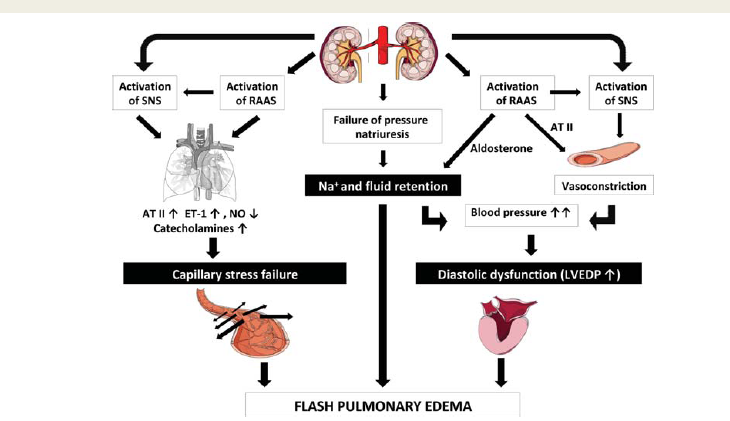
Figure 5: The Pickering Syndrome. Three main pathophysiological mechanisms contribute to the development of flash pulmonary edema defective pressure natriuresis with sodium and fluid retention, increased left ventricular end-diastolic pressure associated with left ventricular hypertrophy and stiffening, and failure of the pulmonary capillary blood-gas barrier. RAAS: Renin- Angiotensin-Aldosterone System; SNS: Sympathetic Nervous System; Na+: Sodium; AII: Angiotensin II; ET-1: Endothelin-1; NO: Nitric Oxide.
Conclusion
An important cause of sudden pulmonary edema is bilateral renal artery stenosis as exemplified by our case. Timely recognition and angioplasty with stent leads to a satisfactory result.
References
-
Pickering TG, Herman L, Devereux RB, Sotelo JE, James GD, et al. (1988) Recurrent pulmonary oedema in hypertension due to bilateral renal artery stenosis: treatment by angioplasty or surgical revascularisation. Lancet 2(8610): 551-552.
-
Bloch MJ, Trost DW, Pickering TG, Sos TA, August P (1999) Prevention of recurrent pulmonary edema in patients with bilateral renovascular disease through renal artery stent placement. Am J Hypertens 12(1Pt1): 1-7.
-
Weatherford DA, Freeman MA, Regester RF, Serrell PF, Sievens SL, et al. (1997) Surgical management of flash pulmonary edema secondary to renovascular hypertension. Am J Surg 174(2): 160-163.
-
Kwan T, Feit A, Alam M, Mandawat MK, Clark LT (1997) Pulsus alternans in diastolic left ventricular dysfunction-a case report. Angiology 48(12): 1079-1085.
-
Missouris CG, Buckenham T, Vallance PJT, MacGregor GA (1993) Renal artery stenosis masquerading as congestive heart failure. Lancet 341(8859): 1521-1522.
-
Selkurt EE, Womack I, Dailey WN (1965) Mechanism of natriuresisand diuresis during elevated renal artery pressure. Am J Physiol 209: 95-99.
-
Koch KM, Aynedjian HS, Bank N (1968) Effect of acute hypertension on sodium reabsorption by the proximal tubule. J Clin Invest 47: 1696-1709.
-
Franz HM, Sripal B, Harikrishna M, Stefano F, Yves Allemann, et al. (2011) Flash pulmonary oedema and bilateral renal artery stenosis: the Pickering Syndrome. Eur Heart J 32(18): 2231-2235.
- Anomalous Origin of the Left Coronary System from the Right Coronary Cusp: A Rare Coronary Anomaly in a Patient Undergoing Aortic Stenosis Workup
- Optimizing the Therapeutic Potential of Sacubitril/Valsartan: The Promise of Co-Crystal Engineering
- Association between Mortality and Topography of Peripheral Arterial Disease due to Atherosclerosis Obliterans
- Mitral Valve Replacement vs Mitral Valve Repair
- Characteristics and Evolution of Patients with Heart Failure Hospitalized in the Cardiology Department of Dalal Jamm Hospital
- Distribution of Association between Basic Knowledge of Chest Pain and Myocardial Infarction (Heart Attack) and Demographic Variables: A Survey-Based Study