
Identification of Endothelin-1 and Nitric Oxide Activity in Aorta, Lung and Kidney after Treatment with the Biofield Energy Treated Proprietary Test Formulation on L-Name and High Fat Diet-Induced Cardiovascular Disorders in Sprague Dawley Rats
The study was aimed to investigate the impact of the Trivedi Effect® on high fat diet (HFD) and NG-nitro-L-arginine methyl ester hydrochloride (L-NAME)-induced Sprague Dawley rats using various functional organ (aorta, lung, and kidney) biomarkers. The functional biomarkers like endothelin-1 and nitric oxide (NO) were evaluated in all the three tissue homogenate using ELISA. The proprietary test formulation including minerals (selenium, magnesium, zinc, calcium, iron, and copper), vitamins (vitamin B9, ascorbic acid, cyanocobalamin, cholecalciferol, and pyridoxine HCl), cannabidiol isolate, β-carotene, and Panax ginseng extract. The each constituents of the proprietary test formulation were divided into two parts; one was denoted as untreated without any Blessing, while the other part received Biofield Treatment by Mr. Mahendra Kumar Trivedi. The results showed that the level of endothelin-1 in the aorta tissue homogenate was decreased by 52.41%, 50.92%, 42.71%, 32.20%, and 45.66% in the G5, G6, G7, G8, and G9 groups, respectively than disease control (G2) group. The level of NO in the aorta tissue homogenate was increased by 30.77%, 11.02%, 13.96%, and 22.57% in the G5, G6, G7, and G8 than G2. Moreover, the expression of endothelin-1 in the lung tissue homogenate was decreased by 40.95%, 19.69%, 39.94%, 24.09%, and 18.85% in the G5, G6, G7, G8, and G9 groups, respectively than G2. The level of NO in the lung tissue homogenate was increased by 25.29% and 29.16% in the G6 and G7 groups, respectively than G2. Further, the level of endothelin-1 in the kidney tissue homogenate was decreased by 18.65%, 11.27%, 22.84%, 19.44%, and 30.32% in the G5, G6, G7, G8, and G9 groups, respectively than G2. Overall, data suggested a significant improvement of endothelin-1 and nitric oxide activity in different organs. Therefore, the current outcomes could able to envisage a remarkable reduction of cardiovascular complications in the preventive treatment viz. G6, G7, G8, and G9 and might be beneficial various types of cardiovascular disorders and overall health.
Introduction
Cardiovascular diseases (CVDs) are one of the leading cause of death worldwide [1]. World health organization (WHO) reported that approximately 17.9 million people died due to CVDs per year [2]. The mechanistic biomarker is basically used in the clinical diagnosis of symptomatic disease such as, the presence of infectious diseases could be detected by analysing the antibodies directed against specific pathogens; diagnosis of certain cancers by detecting the specific genetic aberrations (including myelodysplastic syndrome and chronic myelocytic leukemia) [3]. Endothelin is a peptide hormone generated from vascular endothelial cells plays an important role in heart failure. During heart failure both tissue as well as circulatory levels of endothelin become elevated. In both humans and animal studies reported that inhibition of the endothelin function (anti- endothelin strategy) with an improvement of cardiovascular functions [4]. Nitric oxide (NO) plays an important role in the protection against cardiovascular disease by regulating blood pressure, vascular tone, and inhibition of platelet aggregation and prevention of smooth muscle cell proliferation. The most cardiovascular diseases like atherosclerosis, which is also associated with the dysfunction of endothelial system [5]. Therefore, some standard mechanistic biomarkers like endothelin-1 and NO of healthy ageing correlating with the overall health are the current utility as surrogate endpoints of research. Various pre-clinical and clinical trials have been focused to develop a novel formulation that works to improve the overall health. There is currently no universally accepted test formulation, which improve the organ health biomarkers. Therefore, in order to study the change in functional tissue biomarkers in presence of high fat diet (HFD) and NG-nitro-L-arginine methyl ester hydrochloride (L-NAME)-induced cardiovascular disorders in Sprague Dawley rats, a novel test formulation was designed with the combination of vital minerals (iron, calcium, selenium, zinc, magnesium, and copper), essential vitamins (cholecalciferol, cyanocobalamin, pyridoxine HCl, ascorbic acid, and vitamin B9), and nutraceuticals (Ginseng, β-carotene, and cannabidiol isolate (CBD)). All the minerals and vitamins used in the test formulation have significant functional role to provide vital physiological effects [6, 7, 8]. Besides, cannabidiol itself has wide range of pharmacological profile and has been reported to role in different disorders [9, 10], while ginseng extract is regarded as the one of the best immune booster for overall immunity and antioxidative activity [11].
Biofield Therapy has been reported with significant effects against various disorders, and defined as one of the best Complementary and Alternative Medicine (CAM) treatment approach [12, 13, 14]. National Center for Complementary/ Alternative Medicine (NCCAM) recommended CAM with several clinical benefits as compared with the conventional treatment approach [15]. National Centre of Complementary and Integrative Health (NCCIH) accepted Biofield Energy Healing as a CAM health care approach in addition to other therapies such as therapeutic touch, deep breathing, natural products, guided imagery, Tai Chi, yoga, Johrei, Reiki, homeopathy, pranic healing, massage, movement therapy, chiropractic/osteopathic manipulation, Ayurvedic medicine, relaxation techniques, meditation, special diets, mindfulness, hypnotherapy, traditional Chinese herbs and medicines in biological systems [16, 17]. The Trivedi Effect® was scientifically reported on several disciplines such as in the nutraceuticals [18], agriculture science [19], cardiac health [20], materials science [21, 22], antiaging [23], Gut health [24], pharmaceuticals [25], and overall human health and wellness. In this study, the authors want to investigate the effect of the Biofield Energy Treatment (the Trivedi Effect®) on the given novel test formulation and Biofield Energy Treatment (Blessing) per se to the animals on various mechanistic tissue biomarkers such as endothelin-1 and nitric oxide (NO) in the aorta, lungs, and kidneys in presence of HFD and L-NAME-induced cardiovascular disorders in Sprague Dawley rats.
Material and Methods
Chemicals and Reagents
Magnesium (II) gluconate, zinc chloride, pyridoxine hydrochloride (vitamin B6), atorvastatin, and β-carotene (retinol, provit A) were purchased from TCI, Japan. Cyanocobalamin (vitamin B12), copper chloride, cholecalciferol (vitamin D3), calcium chloride, L-NAME, iron (II) sulfate, sodium carboxymethyl cellulose (Na-CMC), and captopril, were procured from Sigma-Aldrich, USA. Sodium selenate, ascorbic acid (vitamin C), and vitamin B⁹ (folic acid) were obtained from Alfa Aesar, India. Panax ginseng extract and cannabidiol isolate were obtained from Panacea Phytoextracts, India and Standard Hemp Company, USA, correspondingly. High fat diet (HFD) and standard normal chow diet were purchased from Altromin, USA and Research Diets, USA. ELISA kits were procured from CUSABIO, USA.
Experimental Animal
The animals were obtained from M/s. HYLASCO Biotechnology (India) Pvt. Ltd., India. The male Sprague Dawley (SD) rats (randomly breed) as per body weight (200 to 300gm) were divided into nine groups. They were maintain in animal house as individual sterilized polypropylene cages with the capacity of pellet feed and drinking water bottle.
Consciousness Energy Healing Strategies
Each ingredient of the novel test formulation was divided into two parts. One part of the test compound did not receive any sort of treatment and were defined as the untreated or control sample. The second part of the test formulation was treated with the Trivedi Effect® - Energy of Consciousness Healing Treatment (Biofield Energy Treatment) by a renowned Biofield Energy Healer, Mr. Mahendra Kumar Trivedi under laboratory conditions for ~3 minutes. Besides, three group of animals also received Biofield Energy Healing Treatment (known as the Trivedi Effect®) by Mr. Mahendra Kumar Trivedi under similar laboratory conditions for ~3 minutes. The Biofield Energy Healer was located in the USA, however the test formulation were located in the research laboratory of Dabur Research Foundation, New Delhi, India. The Biofield Energy Healing Therapy/Blessing (Prayer) was done remotely, for about 3 minutes via online web-conferencing platform. After that, the Biofield Energy Treated samples was kept in the similar sealed condition and used as per the study plan. In the same manner, the control test formulation group was subjected to “sham” healer for ~3 minutes treatment, under the same laboratory conditions. The “sham” healer did not has any knowledge about the Biofield Energy Treatment/Blessing. The Biofield Energy Treated/Blessed animals were also taken back to experimental room for further proceedings.
Experimental Procedure
The animals were randomized and grouped based on the body weight after acclimatization for 7 days. The test formulation was prepared freshly prior to dosing and administered to the animals using an oral intubation needle attached to an appropriately graduated disposable syringe. The dose volume was 10 mL/kg in morning and evening based on body weight. The experimental groups were divided as G1 as normal control (vehicle, 0.5% w/v CMC-Na); G2 as disease control (L-NAME + HFD + 0.5% CMC); G3 as reference item (L-NAME + HFD + Captopril + Atorvastatin); G4 includes L-NAME + HFD along with untreated test formulation; G5 as L-NAME + HFD along with the Biofield Energy Treated test formulation; G6 group includes L-NAME + HFD along with Biofield Energy Treatment per se to animals from day -15; G7 as L-NAME + HFD along with the Biofield Energy Treated test formulation from day -15; G8 group includes L-NAME + HFD along with Biofield Energy Treatment per se plus the Biofield Energy Treated test formulation from day -15, and G9 group denoted L-NAME + HFD along with Biofield Energy Treatment per se animals plus the untreated test formulation. The normal control animals’ group (G1) was received normal drinking water and a normal diet throughout the experimental period. The animals in groups G2-G9 were received L-NAME (20 mg/kg, i.p.) and a HFD throughout the experimental period. At the end of the experimental period (8 weeks treatment), the animals were humanely sacrificed by CO2 euthanasia and vital organs (aorta, lung, and kidney) were collected and homogenate. A portion of the each tissues homogenate was used for the estimation of endothelin-1 and nitric oxide (NO) using suitable ELISA method.
Preparation of Tissue Homogenate
About 100 mg of the aorta, lung, and kidney homogenate was rinsed with 1X PBS. Homogenized using 1 mL of 1X PBS and then stored at -20°C overnight. In this way, two freeze- thaw cycles were performed to break the cell membranes. The homogenates were centrifuged @5000g for 5 minutes at 2 to 8°C. The supernatant was removed and assayed within short period of time. An aliquot of sample was stored at -20°C or -80°C for further analysis, if required.
Estimation of Endothelin-1 and NO (Aorta, Lung, and Kidney)
The tissue homogenate (aorta, lung, and kidney) from all the animals after experimental period was subjected for the estimation of endothelin-1 and NO. The assay was done using ELISA as per manufacturer’s recommended standard procedure.
Statistical Analysis
The obtained study results were shown as mean ± standard error of means (SEM). Data were analysed using Sigma-Plot statistical software (Version 11.0). For two group’s comparison Student’s t-test and for comparison of multiple groups one-way analysis of variance (ANOVA) was used followed by post-hoc analysis by Dunnett’s test. The p≤0.05 was considered as statistically significant.
Results and Discussion
Estimation of Endothelin-1 and NO in Aorta Homogenate
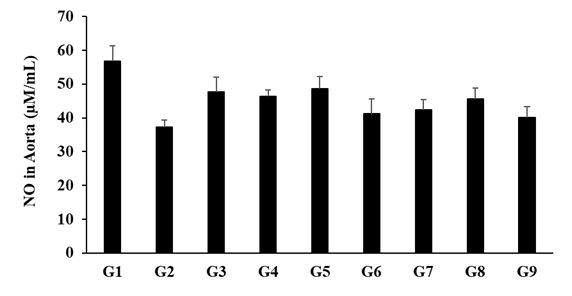
The level of endothelin-1 and NO in aorta homogenate was measured in all the experimental groups and the data were shown in Figures 1 and 2, respectively.
Endothelin-1 in Aorta Homogenate: In the aorta tissue homogenate, the disease control (L-NAME + high fat diet (HFD) + 0.5% CMC) group (G2) showed the level of endothelin-1 as 93.66 ± 12.39 pg/mL, which was increased by 114.33% as compared with the normal control (G1, 43.70 ± 7.48 pg/ mL) group. The level of endothelin-1 in aorta homogenate was decreased by 54.48% i.e., 42.63 ± 4.93 pg/mL in positive control (captopril + atorvastatin) group (G3) than G2 group. The level of endothelin-1 was decreased by 34.14%, 52.41%, 50.92%, 42.71%, 32.20%, and 45.66% in the G4 (L-NAME + HFD + untreated test formulation), G5 (L-NAME + HFD + the Biofield Energy Treated test formulation) and G6 (L-NAME + HFD + Biofield Energy Treatment per se to animals from day -15), G7 (L-NAME + HFD + the Biofield Energy Treated test formulation from day -15), G8 (L-NAME + HFD + Biofield Energy Treatment per se + Biofield Energy Treated test formulation from day -15), and G9 (L-NAME + HFD + Biofield Energy Treatment per se animals + untreated test formulation) groups, respectively than G2 group. Further, the level of endothelin-1 expression was decreased by 27.75%,
25.48%, 13.01%, and 17.50% in the G5, G6, G7, and G9 groups, respectively as compared to the untreated test formulation (G4) group (Figure 1). Endothelin-1 is a vasoactive and mitogenic polypeptide secreted from endothelial cells, which acts on specific receptor on vascular smooth muscle, causing sustained powerful vasoconstriction [26]. Increase level of endothelin-1 can leads to many vascular diseases such as pulmonary hypertension, vascular disease, atherosclerosis, ischemic heart disease, stroke, and vasculitis, etc. [27]. Here, Mr. Trivedi’s Biofield Energy (Blessing) Treatment has significantly reduced the level of endothelin-1 in the aorta tissue, which might be helpful for the prophylactic management of cardiovascular disorders.
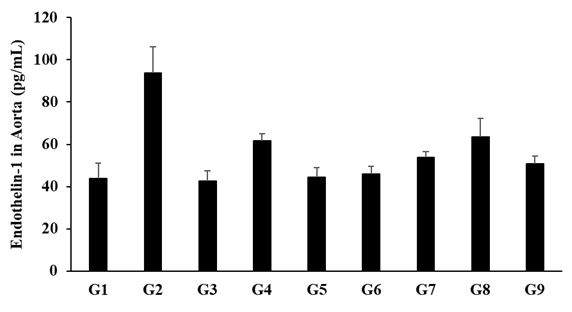
Figure 1: The expression of endothelin-1 on aorta tissue homogenate after administration of Biofield Energy Treated (Blessed)/untreated test formulation and Biofield Energy Healing (Blessing) per se to the Sprague Dawley rats. G1 as normal control (vehicle, 0.5% w/v CMC-Na); G2 as disease control (L-NAME + high fat diet (HFD) + 0.5% CMC); G3 as reference item (L-NAME + HFD + Captopril + Atorvastatin); G4 includes L-NAME + HFD + untreated test formulation; G5 as L-NAME + HFD + Biofield Energy Treated test formulation; G6 group includes L-NAME + HFD + Biofield Energy Treatment per se to animals from day -15; G7 as L-NAME + HFD + Biofield Energy Treated test formulation from day -15; G8 group includes L-NAME + HFD + Biofield Energy Treatment per se + Biofield Energy Treated test formulation from day -15, and G9 group denoted L-NAME + HFD + Biofield Energy Treatment per se animals + untreated test formulation. All the values are shown as mean ± SEM (n=10).
Nitric Oxide (NO) in Aorta Homogenate: Nitric oxide (NO) has wide range of biological activities such as protection of blood vessels, vascular homeostasis, cell growth, etc. Besides, it is the soluble gas synthesized by endothelium and showed an importance in coronary diseases such as hypertension and hypercholesterolemia. Different therapies were reported to improve the NO level and regulate the endothelial dysfunction by increasing the NO synthesis or protection of NO from oxidative inactivation [28, 29]. In aorta tissue homogenate, the level of NO was decreased by 34.46% (37.23 ±2.05 µM/mL) in the disease control group (G2) than normal control (G1, 56.81 ± 4.58 µM /mL) group. The level of NO in aorta homogenate was increased by 28.24% i.e. 47.75 ± 4.32 µM/mL in the positive control (captopril + atorvastatin) group (G3) than G2. The level of NO was increased by 24.4%, 30.77%, 11.02%, 13.96%, 22.57%, and 7.99% in the G4 (L-NAME + HFD + untreated test formulation), G5, G6, G7, G8, and G9 groups, respectively than G2 group. Further, the level of NO expression was increased by 5.13% in the G5 group than untreated test formulation (G4) group (Figure 2).
Estimation of Endothelin-1 and NO in Lung Homogenate
control group (G2) showed the value of endothelin-1 as 36.03 ± 1.30 pg/mL, which was increased by 85.54% as compared with the normal control (G1, 19.42 ± 1.20 pg/mL) group in the lung tissue. A decreased the level of endothelin-1 was observed by 25.66% i.e., 26.78 ± 1.74 pg/mL in positive control (captopril + atorvastatin) group (G3) than G2 group. The level of endothelin-1 in the lung tissues was decreased by 40.07%, 40.95%, 19.69%, 39.94%, 24.09%, and 18.85% in G4, G5, G6, G7, G8, and G9 groups, respectively than G2 group. Further, the level of endothelin-1 expression was decreased by 1.46% in the G5 group than untreated test formulation (G4) group (Figure 3).
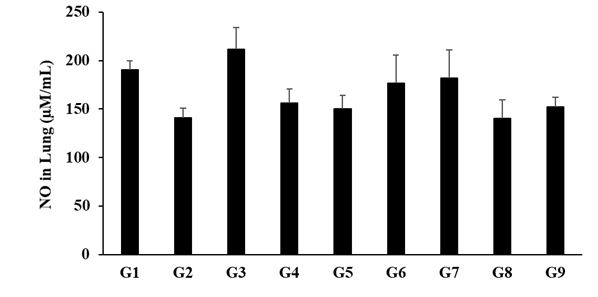
The level of endothelin-1 and NO in lung homogenate was measured in all the experimental groups and the data were shown in Figures 3 and 4, respectively.
Endothelin-1 in Lung Homogenate: The expression of endothelin-1 on lung tissue homogenate after administration of Biofield Treated/untreated test formulation and Biofield Energy Healing (Blessing) Treatment to the Sprague Dawley rats and the data are shown in Figure 3. The disease
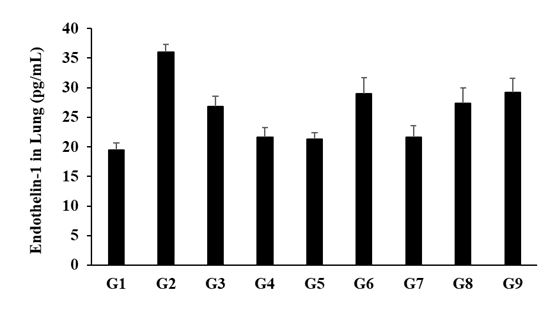
Endothelin-1 is a potent mitogen regulator of smooth muscle tone and inflammatory mediator that are responsible for development of many respiratory diseases related to airways, pulmonary circulation, and inflammatory lung diseases, etc [30]. Pulmonary hypertension is also characterized by an increase in vascular tone of the small pulmonary arteries. As endothelin-1 is a potent vasoconstrictor peptide with important mitogenic properties. Therefore, endothelin-1 is also responsible for the development of pulmonary hypertension [31]. However, here the Biofield Treated test item and Biofield Treatment per se significantly improved the level of endothelin-1 in the pulmonary tissue, which might be beneficial for the management of both respiratory and cardiovascular ailments with special reference to pulmonary hypertension.
Nitric Oxide (NO) in Lung Homogenate: Nitric oxide (NO) derived from neuronal nitric oxide synthase (nNOS) and endothelial NOS (eNOS) has been used as a modulators of bronchomotor tone. Besides, NO derived from inducible NOS (iNOS) to be used as a proinflammatory mediator with immunomodulatory effects [32]. The level of NO activity in lung tissues are shown in Figure 4. The level of NO in the disease control group (G2) was 140.96 ± 9.94 µM/mL, which was decreased by 26.07% as compared with the normal control (G1, 190.67 ± 8.83 µM/mL) group. An increased the level of NO was observed by 49.94% i.e., 211.36 ± 22.91 µM/mL in positive control (captopril + atorvastatin) group (G3) than G2 group. The level of NO in the lung tissue was significantly increased by 10.91%, 6.74%, 25.29%, 29.16%, and 8.13% in the G4 (L-NAME + HFD + untreated test formulation), G5 (L-NAME + HFD + Biofield Energy Treated test formulation) and G6, G7, and G9 groups, respectively than G2 group. Further, the level of NO was increased by 12.97% and 16.45% in the G6 and G7 groups, respectively than untreated test formulation (G4) group (Figure 4). In this experiment, Biofield Energy Treated (Blessed) test formulation and Biofield Energy Healing (Blessing) Treatment per se to the animals has significantly increased the level of NO in lung tissue, which could be beneficial in the both respiratory and cardiac patients.
Estimation of Endothelin-1 and NO in Kidney Homogenate
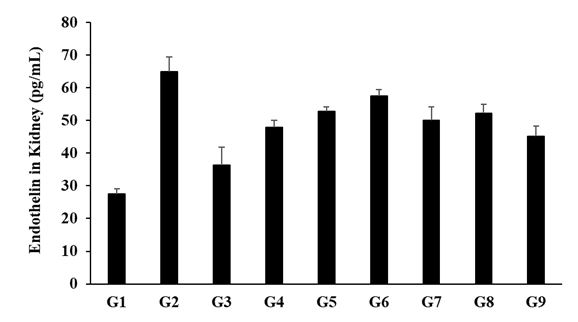
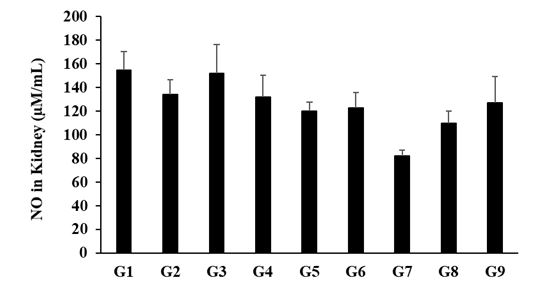
The level of endothelin-1 and NO in kidney homogenate was measured in all the experimental groups and the data were shown in Figures 5 & 6, respectively.
Endothelin-1 in Kidney Homogenate: The levels of endothelin-1 activity in kidney tissues was measured in all the experimental groups and the data are shown in Figure 5. The disease control group (G2) group showed the value of endothelin-1 as 64.92 ± 4.53 pg/mL, which was increased by
136.29% as compared with the normal control (G1, 27.48 ± 1.64 pg/mL) group in the kidney tissue. A decreased the level of endothelin-1 was observed by 43.90% i.e., 36.42 ± 5.43 pg/mL in positive control (captopril + atorvastatin) group (G3) than G2 group. The level of endothelin-1 in the kidney tissues was decreased by 26.31%, 18.65%, 11.27%, 22.84%, 19.44%, and 30.32% in G4 (L-NAME + HFD + untreated test formulation), G5 (L-NAME + HFD + Biofield Energy Treated test formulation) and G6, G7, G8, and G9 groups, respectively as compared to the G2 group. Further, the level of endothelin-1 expression was decreased by 5.44% in the G9 group than untreated test formulation (G4) group (Figure
5). Endothelin-1 is responsible for the development and progression of chronic kidney disease (CKD). Another study reported that podocytes have been recently identified as a target of endothelial 1 receptor in the glomerular filtration barrier [33, 34]. In this experiment, Biofield Energy Treated (Blessed) test formulation and Biofield Energy Healing Treatment (Blessing) per se significantly reduced the level of endothelin-1 in the kidney tissue, which might be helpful in both renal as well as cardiovascular disorders.
Nitric Oxide (NO) in Kidney Homogenate: The expression of nitric oxide (NO) on kidney homogenate after administration of Biofield Treated (Blessed) the test formulation and Biofield Energy Treatment to the Sprague Dawley rats, and the data are shown in Figure 6. In the kidney tissue homogenate, the level of NO in disease control group (G2) was 134.37 ± 12.36 µM/mL, which was decreased by 13.21% as compared with the normal control (G1, 154.81 ± 15.38 µM/mL) group. An increased the level of NO was observed by 13% i.e., 151.84 ± 24.29 µM/mL in positive control (captopril + atorvastatin) group (G3) than G2 group. The level of NO in the kidney tissue homogenate was altered in all the treatment groups as compared to both the disease control and untreated test formulation group (Figure 6).
Preventive maintenance groups such as G6, G7, G8 and G9 were included in this experiment. The results showed remarkable decline endothelin-1 and increased the level of NO in various organs, which could reduce the chances of disease susceptibility. Therefore, it suggests that Mr. Trivedi’s Biofield Therapy (Blessing) was noticed to be very effective to prevent existing ailments and simultaneously improve the overall health and quality of life in human.
Conclusion
Based on the study outcomes, expression of endothelin-1 in aorta was increased by 52.41%, 50.92%, 42.71%, and 45.66% in G5, G6, G7, and G9, correspondingly than G2. Level of NO in aorta was increased by 30.77% and 22.57% in the G5 and G8 groups, respectively than G2. Besides, endothelin-1 expression in lung was decreased by 40.95%, 39.94%, and 24.09% in G5, G7, and G8 groups, respectively than G2. NO in lung was increased by 25.29% and 29.16% in G6 and G7, respectively than G2. Endothelin-1 was decreased by 22.84% and 30.32% in G7 and G9, respectively than G2. Taken together, Biofield Energy Healing (Blessing) Treatment (the Trivedi Effect®) showed significant outcomes of different tissue biomarkers in the preventive treatment groups like G6, G7, G8, and G9. Mr. Trivedi’s Blessing (prayer) also slowdown the cardiovascular disease progression and its complications and would be one of the important treatment approach in order to prevent from diseases. Therefore, the Biofield Treatment might act as a preventive maintenance therapy to maintain overall health and quality of life. This therapy also can be useful in other disorders viz. rheumatoid arthritis (RA), goiter, Graves’ disease, Parkinson’s, Crohn’s disease, ulcerative colitis (UC), psoriasis, thyroid cancer, fibromyalgia, Addison disease (AD), multiple sclerosis, myasthenia gravis, aplastic anemia, and stroke, etc.
Acknowledgements
The authors are grateful to Dabur Research Foundation, Trivedi Science, Trivedi Global, Inc., and Trivedi Master Wellness for the assistance and support during the work.
References
-
Szekely Y, Arbel Y (2018) A review of interleukin-1 in heart disease: Where do we stand today? Cardiol Ther 7(1): 25-44.
-
WHO (2021) Cardiovascular diseases. World Health Organization.
-
Robinson WH, Lindstrom TM, Cheung RK, Sokolove J (2013) Mechanistic biomarkers for clinical decision making in rheumatic diseases. Nat Rev Rheumatol 9(5): 267-276.
-
Giannessi D, Del Ry S, Vitale RL (2001) The role of endothelins and their receptors in heart failure. Pharmacol Res 43(2): 111-126.
-
Naseem KM (2005) The role of nitric oxide in cardiovascular diseases. Mol Aspects Med 26(1-2): 33- 65.
-
Byrne JH, Voogt M, Turner KM, Eyles DW, McGrath JJ, et al. (2013) The impact of adult vitamin D deficiency on behaviour and brain function in male Sprague-Dawley rats. PLoS One 8(8): e71593.
-
Rayman MP (2000) The importance of selenium to human health. Lancet 356(9225): 233-241.
-
Beard JL, Connor JR (2003) Iron status and neural functioning. Ann Rev Nutr 23: 41-58.
-
Peres FF, Lima AC, Hallak JEC, Crippa JA, Silva RH, et al. (2018) Cannabidiol as a promising strategy to treat and prevent movement disorders? Front Pharmacol 9: 482.
-
Nagarkatti P, Pandey R, Rieder SA, Hegde VL, Nagarkatti M (2009) Cannabinoids as novel anti-inflammatory drugs. Future Med Chem 1(7): 1333-1349.
-
Kang S, Min H (2012) Ginseng, the ‘Immunity Boost’: The effects of Panax ginseng on immune system. J Ginseng Res 36(4): 354-368.
-
Maizes V, Rakel D, Niemiec C (2009) Integrative medicine and patient-centered care. Explore (NY) 5(5): 277-289.
-
Bischof M, Del Giudice E (2013) Communication and the emergence of collective behavior in living organisms: a quantum approach. Mol Biol Int 2013: 987549.
-
Cassidy CM (2004) What does it mean to practice an energy medicine? J Altern Complement Med 10(1): 79- 81.
-
Barnes PM, Bloom B, Nahin RL (2008) Complementary and alternative medicine use among adults and children: United States, 2007. Natl Health Stat Report 12: 1-23.
-
Fan K wai (2005) National Center for Complementary and Alternative Medicine Website. J Med Libr Assoc 93(3): 410-412.
-
Wisneski L, Anderson L (2009) The Scientific Basis of Integrative Medicine. Boca Raton, FL, CRC Press, pp: 205.
-
Trivedi MK, Branton A, Trivedi D, Jana S (2021) Isotopic abundance ratio analysis of consciousness energy healing treated folic acid. Food Nutr Current Res 4(2): 290-295.
-
Trivedi MK, Branton A, Trivedi D, Nayak G, Mondal SC, et al. (2015) Morphological characterization, quality, yield and DNA fingerprinting of biofield energy treated alphonso mango (Mangifera indica L.). Journal of Food and Nutrition Sciences 3(6): 245-250.
-
Trivedi MK, Jana S (2019) In vitro assessment of the biofield treated test item on cardiac function using rat cardiomyocytes cell line (H9c2) via multiparametric analysis. Journal of Hypertension and Cardiology 2(4): 1-12.
-
Trivedi MK, Branton A, Trivedi D, Jana S (2021) Effect of consciousness energy healing treatment on the metal profile and properties of tellurium. Eng Technol Open Acc 3(5): 555623.
-
Mahendra KT, Alice B, Dahryn T, Snehasis J (2021) Consciousness energy healing treatment impacted the isotopic abundance ratio of 6-Mercaptopurine (6-MP). Nov Appro Drug Des Dev 5(5): 555673.
-
Trivedi MK, Jana S (2021) Anti-aging activity of biofield energy treated novel proprietary test formulation by assessment of vital biomarkers in cerebrospinal fluid (CSF) in Sprague Dawley rats. On J Neur & Br Disord 5(2).
-
Trivedi MK, Jana S (2021) Evaluation of biofield energy healing treatment based proprietary test formulation on gut health potential in colon cancer cell line (HT-29). J Pharmacol Clin Res 8(4).
-
Trivedi MK, Branton A, Trivedi D, Jana S (2020) The consciousness energy healing treatment and its impact on the isotopic abundance ratio analysis of flutamide. Drug Des Int Prop Int J 3(5).
-
Chan EA, Buckley B, Farraj AK, Thompson LC (2016) The heart as an extravascular target of endothelin-1 in particulate matter-induced cardiac dysfunction. Pharmacol Ther 165: 63-78.
-
Schiffrin EL (2001) Role of endothelin-1 in hypertension and vascular disease. Am J Hypertens 14(6 Pt 2): 83S-89S.
-
Richard OC (1998) Role of nitric oxide in cardiovascular disease: Focus on the endothelium. Clin Chem 44 (8 pt 2): 1809-1819.
-
Tousoulis D, Kampoli AM, Tentolouris C, Papageorgiou N, Stefanadis C (2012) The role of nitric oxide on endothelial function. Curr Vasc Pharmacol 10(1): 4-18.
-
Fagan KA, McMurtry IF, Rodman DM (2001) Role of endothelin-1 in lung disease. Respir Res 2(2): 90-101.
-
Giaid A, Yanagisawa M, Langleben D, Michel RP, Levy R, et al. (1993) Expression of endothelin-1 in the lungs of patients with pulmonary hypertension. N Engl J Med 328(24): 1732-1739.
-
Ricciardolo FLM, Sterk PJ, Benjamin G, Folkerts G (2004) Nitric oxide in health and disease of the respiratory system. Physiol Rev 84(3): 731-765.
-
Dhaun N, Webb DJ, Kluth DC (2012) Endothelin-1 and the kidney--beyond BP. Br J Pharmacol 167(4): 720-731.
-
De Miguel C, Speed JS, Kasztan M, Gohar EY, Pollock DM (2016) Endothelin-1 and the kidney: New perspectives and recent findings. Curr Opin Nephrol Hypertens 25(1): 35-41.
- Anomalous Origin of the Left Coronary System from the Right Coronary Cusp: A Rare Coronary Anomaly in a Patient Undergoing Aortic Stenosis Workup
- Optimizing the Therapeutic Potential of Sacubitril/Valsartan: The Promise of Co-Crystal Engineering
- Association between Mortality and Topography of Peripheral Arterial Disease due to Atherosclerosis Obliterans
- Mitral Valve Replacement vs Mitral Valve Repair
- Characteristics and Evolution of Patients with Heart Failure Hospitalized in the Cardiology Department of Dalal Jamm Hospital
- Distribution of Association between Basic Knowledge of Chest Pain and Myocardial Infarction (Heart Attack) and Demographic Variables: A Survey-Based Study