
Dunaliella salina and Haloferax Volcanii Synergistically Attenuate Skin Cancer in Vitro
Skin cancer, including both melanoma and non-melanoma, is the most common type of malignancy, which causes substantial morbidities and mortalities. Although significant increase in the understanding of skin cancer formation and the development of novel personalized drug regimens has occurred, new treatment options are always of need. The use of natural compounds to alleviate the symptoms or even to prevent and treat cancer has long been proposed. Specifically, the use of marine-based organisms as a source for cancer cure and remedy is being evaluated extensively. The objective of the current study was to assess the ability of the green microalgae Dunaliella salina, the Dead-Sea-derived Haloferax volcanii, and its combinations to treat skin cancer in vitro. The results demonstrate the Dunaliella and Haloferax can reduce sarcoma and basal cell carcinoma cellular growth. Importantly, their combination act synergistically in a caspase3 independent manner. Moreover, a synergistic action was found when evaluated sarcoma cell invasion rate, which was completely blocked at pharmacological relevant amounts of the compounds. Collectively, the results demonstrate that the combination of Haloferax volcanii and Dunaliella salina can be used as a new treatment for skin cancer. The specific mechanism of action and further in vivo validation studies are of need.
Guy Cohen1*, Oren Raz1, Ahmad Fahham1, Nona Kuchina2 and Zvi Bentwich1,3
Tropical Diseases and
AIDS, Ben Gurion University of the Negev, Israel
Park, 86910 M.P. Dead Sea, Israel, Tel: +972-8-944-8739, Email: guy@adssc.org mechanism of action and further in vivo validation studies are of need.
Keywords: Skin Cancer; Sarcoma; Dunaliella salina; Haloferax Volcanii
Introduction
In the last decade, the reported incidence of melanoma and non-melanoma skin cancer has been consistently Dunaliella salina and Haloferax Volcanii Synergistically Attenuate Skin Cancer in Vitro growing worldwide [1, 2]. These have been primarily ascribed to genetic predisposition and increased exposure to environmental factors, such as solar radiation, and in particular to ultraviolet (UV) range. The latter induces J Cancer Oncol
direct damage to macromolecules within the cells, including proteins, membranes, and DNA, and regarded as the major risk factors for skin cancers formation [3]. UVB- induced carcinogenesis is related to UV absorption by the cell’s DNA, which results in DNA breakdown, and production of mutagenic dimeric photoproducts, namely cyclobutane-pyrimidine dimers (CPDs) and 6-4 photoproducts (6-4PPs) [4]. Both genetic and environmental factors converge eventually to an imbalance between proliferation and differentiation states of the cells and alter their ability to migrate and escape the immune system [5].
Squamous cell carcinoma (SCC) is one of the most common life-threatening cancers worldwide [6]. This malignancy also exhibits high recurrence rate following therapy. Thus, the use of SCC in screening assays to novel treatments is superior to other skin cancer models. Skin sarcomas comprise a heterogeneous group of malignant mesenchymal tumors that originated in the dermis or subcutis [7]. Recreant studies have provided a better understanding of the pathogenesis at the molecular level, identifying new therapeutic target, typically resulting in a good prognosis. However, if surgical removal is incomplete or without sufficient excisional margin, distant metastases are rare but extremely lethal [8].
Herbal- and marine-based natural compounds have long been used as a source for cure and remedies [9]. Several active compounds were previously harnessed to alleviate symptoms of cancer, adverse chemotherapy effect, or even as part of the treatment regimen [10].
Dunaliella salina is a green microalga that had been reported to possess several health beneficial effects [11, 12]. In addition to its importance as a nutritional source, studies have found neuromodulator, antibacteria, reduce cardiac aging and even anti-cancer properties [13, 14, 15, 16]. These observations were attributed to several active compounds, such as phytosterols, glycerol, carotene, and second metabolites. Isolated from the Dead Sea, Haloferax volcanii (formerly Halobacterium volcanii) flourishes in high salinity and has emerged as an important archaeal model system for life in extreme conditions [17]. However, the possibility to harness this organism as a source of novel natural medicinal compound has not been explored.
In the current study, we investigated the therapeutic properties of Dunaliella and Haloferax volcanii. The results indicate that their combination acts synergistically and can be used as a novel treatment option for skin cancer.
Materials and Methods
Cell culture media and supplementation were purchased from Biological Industries. Unless specified, all other chemicals were from Sigma-Aldrich. Dunaliella salina powder was generously given by Clinic Lenom LTD. Haloferax volcanii was from ATCC.
Cell Culture
Human skin sarcoma cell line (WS1-CLS) was purchase from CLS Cell Lines Service GmbH. The cells were grown in RPMI 1640 medium supplemented with 2 mM L-glutamine and 10% fetal bovine serum, and 1% (v/v) penicillin/streptomycin and maintained at 37°C in a humidified 5% CO2 incubator. SCC cell lines were purchased from ATCC and grown similarly in DMEM.
Cytotoxicity Assay
The ability of the compounds to reduced cancer cell viability was evaluated by an MTT assay, as previously reported, with minor modifications [4]. Briefly, the cells were incubated with 3-(4, 5- dimethylthiazol-2-yl)-2,5- diphenyltetrazolium bromide (MTT) (0.5 mg/ml) in PBS for 1 hr at 37°C. The medium was then aspirated, and isopropanol was added to solubilize the colored crystals. The absorbance at 570 nm was measured in an ELISA reader.
Determination of Apoptosis (Caspase-3 Activity Assay)
Following treatment, the cells were exposed to caspase-3 substrate solution (10 µM Caspase 3 substrate II – Fluorogenic (Calbiochem), 0.02% Triton X-100, and 10 mM DTT). The enzyme’s fluorescent product was measured kinetically (20 times at 2-min intervals) using the Thermo Scientific Fluoroskan Ascent™ microplate reader (Ex. 355 nm, Em. 460 nm) [18].
Invasion Assay
The cancer cell lines were treated without or with the maximal dose for the Synergy extract that did not reduce the cell's viability. After 24 hr, the cells were harvested and 50,000 cells were mounted into the invasion chamber (Trevigen), in serum-free conditions. The invasive rate of the tumor cells was determined fluorescently, following the manufacturer’s instructions.
Results
The impact of Haloferax volcanii and Dunaliella was investigated on human skin sarcoma cells and in squamous cell carcinoma cells (SCC). The cancerous cells were treated without or with the compounds. As shown in Figure 1A, Dunaliella was more potent and rescued the viability of the cells at a low concentration of 0.46 µg. importantly, their combinations show synergistic action, resulting in a significant cytotoxic effect (Figures 1A & B). Of note, the combined effect was also higher than double of each individual compound.
Next, the ability of the compounds to reduce the ability of the human sarcoma cells and SCC for invasion and migration was evaluated. Thus, the cells were harvested and mounted and treated with one selected non-toxic concentrations of the compounds or combination. As shown in Figure 2, similar synergistic action was seen for sarcoma cells. However, no added value was observed in SCC (data not shown). To gain insight into the molecular mechanism underlining the effect of the compound, the hypothesis that the induction of programmed cell death was investigated. In Figure 3, a small but significant enhancement of apoptosis by Dunaliella in both cancer cell lines is demonstrates. However, the supplementation of Haloferax volcanii did not show any further increase in caspase-3 activation.
Similarly, when the SCC cells were exposed to the compounds, a dose-dependent reduction was observed. Haloferax volcanii treatment was more potent, but Dunaliella was more effective, resulting in 100% cytotoxic effect at high concentrations. Importantly, a mild but significant synergic action was observed (Figure 1C & D).
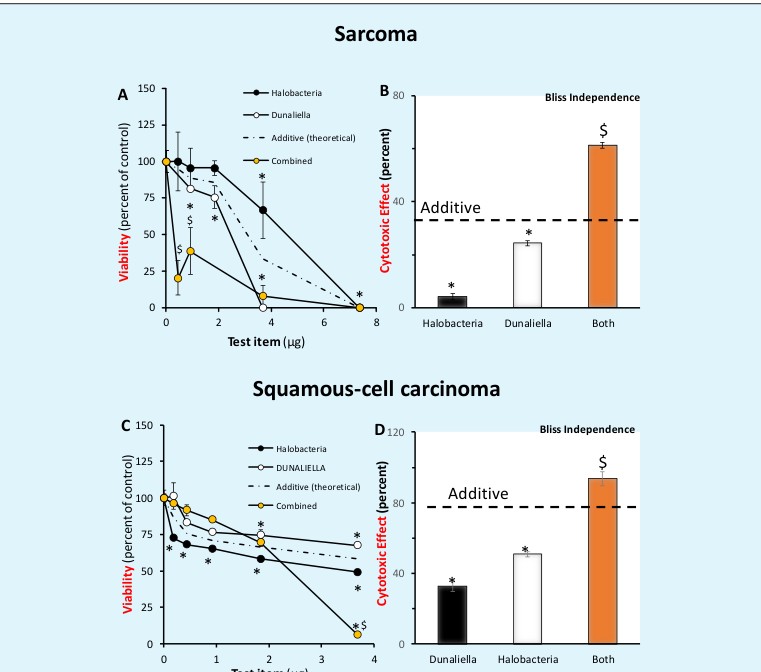
Figure 1: Haloferax volcanii and Dunaliella synergistic act against human skin cancer cells. A. Sarcoma cells were treated w/o or with increasing concentrations of Haloferax volcanii, Dunaliella, or both. 24 hr later, the impact on sarcoma cell viability was determined by MTT. B. Cytotoxic impact of selected amount (0.92 µg). C&D, similar procedure in SCC. n=4, *p<0.05 in comparison to control; $ indicates synergy.
Sarcoma
120 Invasion assay (percent inhibition)
80 Additive
40 $$ \square $$
0 Halobacteria Dunaliella Both
Bliss Independence
$ * Figure 2: Haloferax volcanii and Dunaliella synergistic reduce human skin cancer cells invasion.
manufacturer’s instructions. Inhibition of invasion rate is depicted. n=4, *p<0.05 in comparison to control; $ indicates synergy.
Sarcoma
A B
Squamous-cell carcinoma
* ns Figure 3: The impact of the compound on induction of apoptosis.
The ability of the compounds to induce programmed cell death was evaluated by caspase-3 activity assay. n=4, *p<0.05 in comparison to control; $ indicates synergy.
The current study was aimed at elucidating the impact of Dunaliella and Haloferax volcanii on human skin cancer. The results clearly show synergistic action in two independent models. The increased prevalence of skin cancer in the last years have been linked to environmental stress, such as UV. Like other forms of cancer, two main aspects defined their harmful potential: the ability to fast increase in mass and their migration capacity, to forms metastasis [5]. Here we show that the combination of Dunaliella and Haloferax volcanii can reduce both. However, the active compound(s) should be elucidated prior to drug development.
Microalgae are the richest source of natural compounds and have been repeatedly shown as healthy foods and medicinal properties. Dunaliella has been previously demonstrated to have high antioxidant capacity and to be used as health-promoting food supplementation [19]. Of importance, Dunaliella has been recently shown to possess anti-cancer properties [20]. Pasquet, et al. [21] have reported that Dunaliella extracts cause reduction in proliferation of human mammary cancer cell lines [21]. The authors attribute this action to violaxanthin induced apoptosis. Our data support this phenomenon, as Dunaliella induced caspase-3 actively in both skin cancer cell lines. Another interesting study reported once more on the antiproliferative action of Dunaliella [22]; However, that group attributed the antiproliferative action of Dunaliella on skin carcinoma cells to its high β-carotene content. They have also reported that the growth conditions and in particular stressful culture can increase the potency of the extract with correlation to carotene amount. Interestingly, the uses of Dunaliella to even treat radiation damage (such in chemotherapy) have also been reported [23].
Not enough is known on the possible medicinal properties of Haloferax volcanii. This organism can survive at high salinity and was isolated originally at the Dead Sea [24, 25]. In the current study, we have shown that when combined with Dunaliella, synergistic action is noticeable. However, this action is not due to induction of apoptosis, as caspase-3 activity remains unchanged by Haloferax. Thus, the mechanism of action (MOA) of the synergistic impact is still unknown.
Acknowledgment
This study was supported by an ADSSC faculty grant for G.C. O.R and G.C. are partially supported by the ministry of science and technology (Israel), ICA foundation and Clinic Lenom donations.
References
-
Seebode C, Lehmann J, Emmert S (2016) Photocarcinogenesis and Skin Cancer Prevention Strategies. Anticancer Res 36(3): 1371-1378.
-
Martens MC, Seebode C, Lehmann J, Emmert S (2018) Photocarcinogenesis and Skin Cancer Prevention Strategies: An Update. Anticancer Res 38(2): 1153- 1158.
-
Armstrong BK, Kricker A (2001) The epidemiology of UV induced skin cancer. J Photochem Photobiol B Biol 63(1-3): 8-18.
-
Kahremany S, Babaev I, Gvirtz R, Ogen-Stern N, Azoulay-Ginsburg S, et al. (2019) Nrf2 Activation by SK-119 Attenuates Oxidative Stress, UVB, and LPS- Induced Damage. Skin Pharmacol Physiol 32(4): 173- 181.
-
Wineman E, Douglas I, Wineman V, Sharova K, Jaspars M, et al. (2015) Commiphora gileadensis sap extract induces cell cycle-dependent death in immortalized keratinocytes and human dermoid carcinoma cells. J Herb Med 5(4): 199-206.
-
Apalla Z, Nashan D, Weller RB, Castellsagué X (2017) Skin Cancer: Epidemiology, Disease Burden, Pathophysiology, Diagnosis, and Therapeutic Approaches. Dermatol. Ther(Heidelb) 7(S1): 5-19.
-
Kohlmeyer J, Steimle-Grauer SA, Hein R (2017) Kutane Sarkome. J Dtsch Dermatol Ges 15(6): 630- 649.
-
Mentzel T (2011) Sarcomas of the skin in the elderly. Clin Dermatol 29(1): 80-90.
-
Wargovich MJ, Woods C, Hollis DM, Zander ME (2018) Herbals, Cancer Prevention and Health. J Nutr 131(11): S3034-S3036.
-
Yin SY, Wei WC, Jian FY, Yang NS (2013) Therapeutic applications of herbal medicines for cancer patients. Evidence-Based Complement. Altern Med 2013: 1-15.
-
Mishra A, Kavita K, Jha B (2011) Characterization of extracellular polymeric substances produced by micro-algae Dunaliella salina. Carbohydr. Polym 83(2): 852-857.
-
Oren A (2005) A hundred years of Dunaliella research: 1905-2005. Saline Systems 1: 2.
-
Francavilla M, Colaianna M, Zotti M, Morgese MG, Trotta P, et al. (2012) Extraction, Characterization and In Vivo Neuromodulatory Activity of Phytosterols from Microalga Dunaliella Tertiolecta. Curr Med Chem 19(18): 3058-3067.
-
Jafari S, Mobasher MA, Najafipour S, Ghasemi Y, Mohkam M, et al. (2018) Antibacterial potential of Chlorella vulgaris and Dunaliella salina extracts against Streptococcus mutans. Jundishapur J Nat Pharm Prod 13(2): 13226.
-
El-Baz F, Abdel Jaleel G, Saleh D, Hussein R (2018) Protective and therapeutic potentials of Dunaliella salina on aging-associated cardiac dysfunction in rats. Asian Pac J Trop Biomed 8(8): 403-410.
-
Srinivasan R, Chaitanyakumar A, Mageswari A, Gomathi A, Pavan Kumar JGS, et al. (2017) Oral administration of lyophilized Dunaliella salina, a carotenoid-rich marine alga, reduces tumor progression in mammary cancer induced rats. Food Funct 8(12):4517-4527.
-
Pohlschroder M, Schulze S (2019) Haloferax volcanii. Trends Microbiol 27(1): 86-87.
-
Wineman E, Douglas I, Wineman V, Sharova K, Jaspars M, et al. (2015) Commiphora gileadensis sap extract induces cell cycle-dependent death in immortalized keratinocytes and human dermoid carcinoma cells. J Herb Med 5(4):199-206.
-
El-Baz FK, Abdo SM, Hussein AMS (2017) Microalgae Dunaliella salina for use as Food Supplement to improve Pasta Quality. Int J Pharm Sci Rev 46(2): 45- 51.
-
Martínez Andrade KA, Lauritano C, Romano G, Ianora A (2018) Marine microalgae with anti-cancer properties. Mar Drugs 16(5): 165.
-
Pasquet V, Morisset P, Ihammouine S, Chepied A, Aumailley L, et al. (2011) Antiproliferative activity of violaxanthin isolated from bioguided fractionation of Dunaliella tertiolecta extracts. Mar Drugs 9(5): 819- 31.
-
Emtyazjoo Mo, Moghadasi Z, Rabbani M, Emtyazjoo Ma, Samadi S (2012) Anticancer effect of Dunaliella salina under stress and normal conditions against skin carcinoma cell line A431 in vitro. Iran J Fish Sci 11(2) 283-293.
-
Mohamed T Khayyal, Farouk K El-Baz, Meselhy R Meselhy, Gamila H Ali, Rania M El-Hazeke (2019) Intestinal injury can be effectively prevented by Dunaliella salina in gamma irradiated rats. Heliyon 5(5): e01814.
-
Oren A (1999) Benjamin Elazari Volcani (1915- 1999): Sixty-three years of studies of the microbiology of the Dead Sea. Int Microbiol 2(3): 195- 198.
-
Oren A, Ventosa A (1999) In Memoriam-Benjamin Elazari Volcani. Int J Salt Lake Res 8(1): 2-6.
- Cancer Diagnosis from RNA Sequence of Blood Cells by Using AI
- Field Cancerization in Oral Cavity, Case Report and Review of Literature. Oncologic Program Salud Integral Hospital, Managua, Nicaragua
- Identification of B Lymphocytes in Cancer Patient’s Blood
- A Case Report of a Breast Cancer Patient Developing Pneumonitis as a Result of Abemaciclib Therapy
- Immune Checkpoint Therapeutics for Today’s Fight and Beyond
- The Amalgamated Sophomore-Gonadoblastoma