
Isotopic Abundance Ratio Analysis of the Consciousness Energy Healing Treated Flutamide using LC-MS and GC-MS Spectrometry
Flutamide is used to treat prostate cancer, which acts by blocking the action of exogenous testosterone binding through its androgen receptor. This study was designed and performed to investigate the impact of the Trivedi Effect®-Consciousness Energy Healing Treatment on the structural properties and the isotopic abundance ratio of flutamide using LC-MS and GC-MS spectroscopy. Flutamide sample was divided into control and treated parts. Only the treated flutamide received the Trivedi Effect®-Consciousness Energy Healing Treatment remotely by a famous Biofield Energy Healer, Dahryn Trivedi. The LC-MS spectra of both the samples at retention time (Rt ) 3.4 minutes exhibited the mass of the deprotonated molecular ion peak at m/z 275.08 [M-H]-. The peak area of the treated sample was significantly increased by 92.42% compared to the control sample, which indicated that the solubility profile of the treated sample was significantly increased compared to the control sample. The LC-MS based isotopic abundance ratio of PM+1/PM (2 H/1 H or 13C/12C or 15N/14N or 17O/16O) in the treated flutamide was significantly increased by 59.48% compared with the control sample. The GC-MS based isotopic abundance ratio of PM+1/ PM in the treated flutamide sample was increased by 10.39% compared with the control sample. The results indicated that the 13C, 2 H, 15N, and 17O contributions from (C11H11F3 N2 O3 )+ to m/z 277 in the treated sample were significantly increased compared with the control sample. The isotopic abundance ratio of PM+1/PM (2 H/1 H or 13C/12C or 15N/14N or 17O/16O) in the treated flutamide was significantly increased compared to the control sample. The changes in the peak area and isotopic abundance could be due to changes in nuclei possibly through the interference of neutrino via the Trivedi Effect®-Consciousness Energy Healing Treatment. The new form of treated flutamide was formed that might have increase the chemical bond strength, stability, solubility, bioavailability, and efficacy, which could be very much useful to design more efficacious pharmaceutical formulations against prostate cancer, androgen-dependent skin and hair conditions including acne, seborrhea, hirsutism, and scalp hair loss, hyperandrogenism, as well useful for feminizing hormone therapy aimed at transgender women.
Introduction
Flutamide is a nonsteroidal antiandrogen (NSAA) which blocks the action of both endogenous and exogenous testosterone by inhibiting the androgen receptor. Further, it is a potent inhibitor of testosterone-stimulated prostatic DNA synthesis and it is capable of inhibiting prostatic nuclear uptake of androgen [1, 2, 3]. Flutamide can be used independently for the treatment or in combination with other medications and radiation treatments [4]. It is used primarily to treat men with prostate cancer [5]. The testosterone hormone aids prostate cancer to grow and spread [6]. It is also used in the treatment of androgen-dependent problems, i.e., acne, seborrhea, hirsutism, scalp hair loss, and hyperandrogenism. It can be used as a constituent of feminizing hormone therapy for transgender women [7]. Overdose of flutamide may cause anorexia, ataxia, piloerection, hypoactivity, slow respiration, and/or lacrimation, emesis, tranquilization, and methemoglobinemia [8].
The physicochemical properties of a pharmaceutical compound in the formulation is very much important and decide the rate of dissolution, absorption, bioavailability, and efficacy in the body [9]. It was observed that the Trivedi Effect®-Consciousness Energy Healing Treatment (Biofield Energy Healing Treatment) has the significant impact on solubility and bioavailability by directly altering the isotope composition, physicochemical and thermal behaviours of various nutraceutical and pharmaceutical compounds [10, 11, 12]. The Trivedi Effect® is a natural and only technically established phenomenon in which an individual can harness this inherently intelligent energy from the “Universal Energy Field” and transfer it anywhere on the planet via the possible mediation of neutrinos [13]. “Biofield” is the electromagnetic energy field which exists surrounding the living organisms, generated by the continuous movement of the electrically charged particles (ions, cells, etc.) inside the body. It can transmit the electromagnetic energy in the form of bio-photons and this process is called Biofield Energy Healing Treatment [14, 15]. Biofield Therapies (Energy Medicine) have been reported with significant outcomes against various disease conditions [16]. The National Center for Complementary and Alternative Medicine (NCCAM) has recognized and accepted Biofield Energy Healing as a Complementary and Alternative Medicine (CAM) health care approach along with other therapies, medicines, and practices such as yoga, Qi Gong, Tai Chi, hypnotherapy, Reiki, etc. [17]. These CAM therapies have been accepted by most of the U.S.A. population with several advantages [18].
The significant outcome of the Trivedi Effect®- Consciousness Energy Healing Treatment has been widely reported. It has been reported altering the characteristic properties of the several non-living materials and living object(s), i.e., organic compounds [19, 20], metals and ceramic [21, 22], polymer [23], crops [24], nutraceuticals [25, 26], microbes [27, 28], etc.
The stable isotope ratio and its analysis have various applications in different field of science for understanding the isotope effects resulting from the variation of the isotopic composition of the molecule [29, 30]. Isotope ratio analysis can be performed by using the conventional mass spectrometry (MS) techniques such as gas chromatography- mass spectrometry (GC-MS) and liquid chromatography- mass spectrometry (LC-MS) in low micromolar concentration with sufficient precision [30, 31]. The Trivedi Effect®- Consciousness Energy Healing Treatment could be an economical approach for designing better pharmaceuticals formulations. Therefore, in this study, special attention was taken to improve the physicochemical parameters of the pharmaceutical product, e.g., flutamide. Hence, LC-MS and GC-MS were used in this study to characterize the structural properties and evaluate the isotopic abundance ratio analysis of PM+1/PM (2H/1H or 13C/12C or 15N/14N or 17O/16O) in the Trivedi Effect®-Consciousness Energy Healing Treated flutamide compared to the control sample.
Materials and Methods
Chemicals and Reagents
The test sample flutamide was purchased from Tokyo Chemical Industry Co., Ltd., Japan. Whereas, other chemicals and solvents used during the experiments were of analytical grade purchased in India.
Consciousness Energy Healing Treatment Strategies
The flutamide powder sample was divided into two parts. One part of flutamide powder sample was considered as a control sample, which did not receive the Biofield Energy Treatment. Further, the control flutamide was treated with a “sham” healer, did not have any knowledge about the Biofield Energy and its treatment procedure. However, the other part of flutamide was received the Trivedi Effect®-Consciousness Energy Healing Treatment remotely under standard laboratory conditions for 3 minutes by the renowned Biofield Energy Healer, Dahryn Trivedi, USA, and known as the Biofield Energy Treated flutamide. After completion of the treatment by the Biofield Energy Healer and “sham” healer, both the samples were kept in sealed conditions and characterized using sophisticated analytical techniques.
Characterization
Liquid Chromatography-Mass Spectrometry (LC-MS) analysis and calculation of iIsotopic abundance ratio: The LC-MS analysis of the control and Biofield Energy Treated flutamide was carried out with the help of LC-MS Thermo Fisher Scientific, the USA equipped with an ion trap detector connected with a triple-stage quadrupole mass spectrometer. The column used here was a reversed phase Thermo Scientific Synchronis C18 (Length-250 mm X ID 4.6 mm X 5 micron), maintained at 25˚C. Methanol was the diluent for the sample preparation. 10 µL of flutamide solution was injected, and the analyte was eluted using 92% acetonitrile + 8% 10 mM ammonium acetate pumped at a constant flow rate of 1 mL/min. Chromatographic separation was achieved using gradient condition and the total run time was 10 min. Peaks were monitored at 300 nm using the PDA detector and were performed under -ve ESI mode. The total ion chromatogram, peak area% and mass spectrum of the individual peak which was appeared in LC along with the full scan (m/z 50-500) were recorded.
The natural abundance of each isotope (C, O, H, N, and F) can be predicted from the comparison of the height of the isotope peak with respect to the base peak. The values of the natural isotopic abundance of the common elements are obtained from the literature [30, 32, 33, 34]. The LC-MS based isotopic abundance ratios (PM+1/PM) for the control and Biofield Energy Treated flutamide was calculated using equation 1.
% Change in isotopic abundance ratio = [(IARTreated – IARControl)/ IARControl] x 100 (1) Where IARTreated = isotopic abundance ratio in the treated flutamide and IARControl = isotopic abundance ratio in the control flutamide.
Gas Chromatography-Mass Spectrometry (GC-MS) analysis: GC-MS of the control and treated flutamide were analyzed with the help of Perkin Elmer Gas chromatograph equipped with a PE-5MS (30M x 250 micros x 0.250 microns) capillary column and coupled to a single quadrupole mass detector was operated with electron impact (EI) ionization (+ve ion mode). The oven temperature was programmed from 80°C (14 min hold) to 250°C (3 min hold) @ 10°C / min (total run time 25 min). The sample was prepared taking 60 mg of the flutamide is in 2 mL methanol as a diluent. Mass spectra were scanned from m/z 20 to 400. The identification of analyte was done by GC retention times and by a comparison of the mass spectra of samples. The GC-MS based isotopic abundance ratios (PM+1/PM) for the control and treated flutamide was calculated.
Results and Discussion
Liquid Chromatography-Mass Spectrometry (LC-MS)
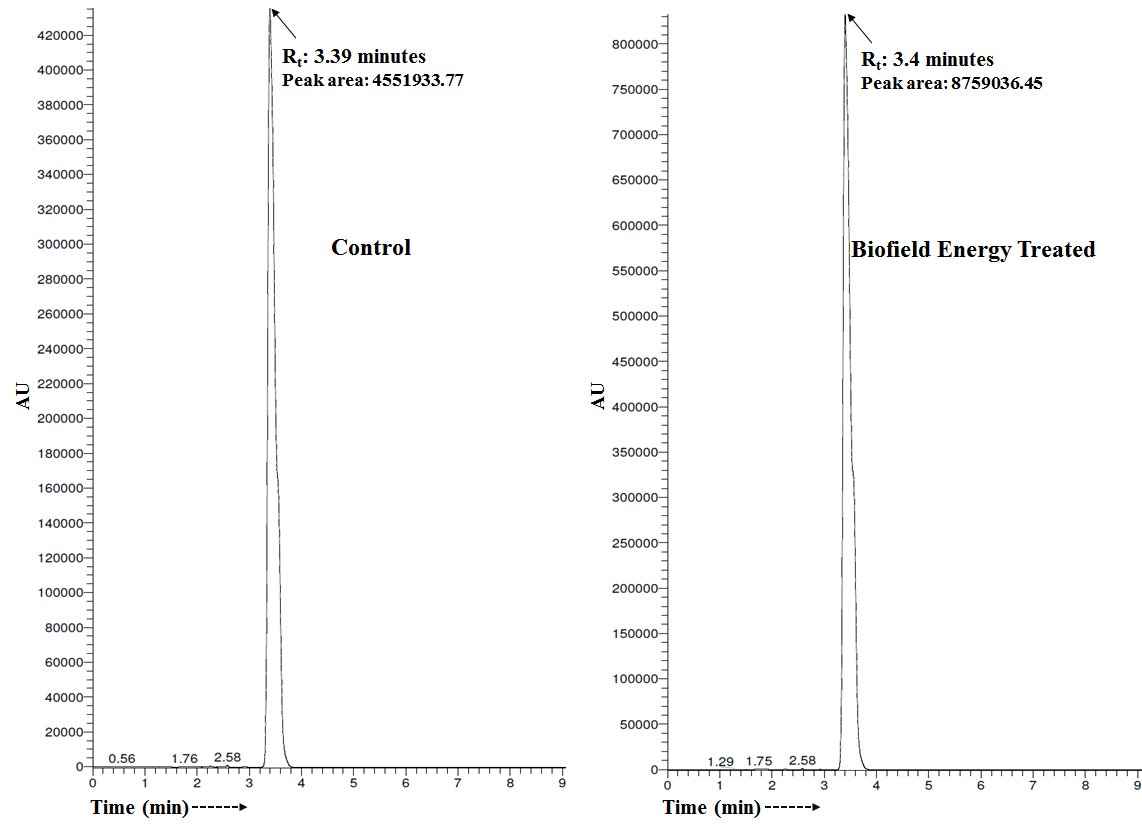
The chromatograms and mass spectra of both the samples of flutamide are shown in Figures 1 and 2, respectively. The control and Biofield Energy Treated flutamide showed the single major chromatographic peak at the retention time (Rt) of 3.39 and 3.4 minutes in the chromatograms (Figure 1). The peak area of the Biofield Energy Treated flutamide was significantly increased by 92.42% compared to the control sample, which indicated that the solubility profile of the Biofield Energy Treated sample was significantly increased after the Biofield Energy Treatment compared to the control sample.
The molecular mass peak [M]+ of flutamide found to be at m/z 276 in the mass spectrum [35]. In this case, the mass spectra of both the samples (Figure 2) showed the deprotonated molecular ion peak at m/z 275.08 [M-H]- (calculated for C11H10F3N2O3 -, 175.06) along with other fragmentation peaks (Figure 2).
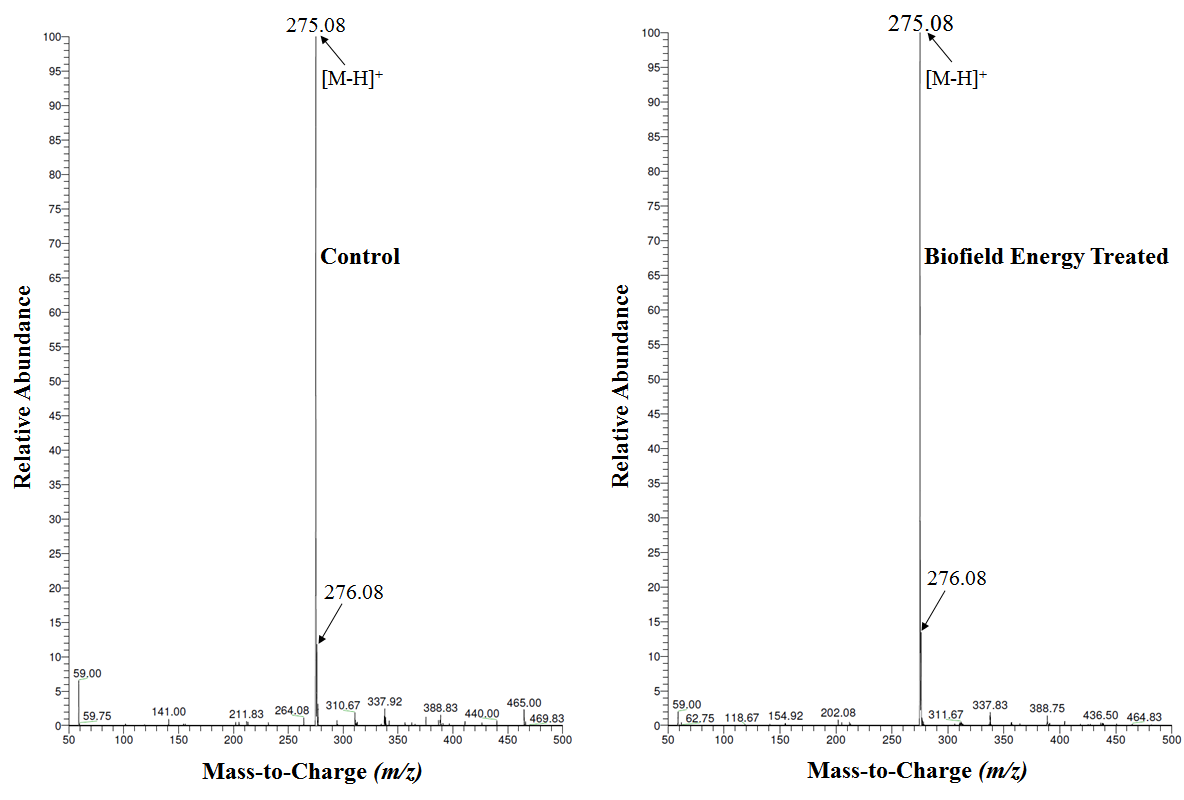
The LC-MS spectra of both the samples showed the mass of the molecular ion peak at m/z 275.08 [M-H]- (calculated for C11H10F3N2O3 -, 275.06) with relative intensity of 100%.
The theoretical calculation of PM+1 for flutamide was presented as below:
P (13C) = [(11 x 1.1%) x 100% (the actual size of the M- peak)] / 100% = 12.1%
P (2H) = [(10 x 0.015%) x 100%] / 100%= 0.15% P (15N) = [(2 x 0.4%) x 100%] / 100% = 0.8% P (17O) = [(3 x 0.04%) x 100%] / 100% = 0.12% PM+1, i.e. 13C, 2H, 15N, and 17O contributions from (C11H10F3N2O3)- to m/z 276.08 = 13.17% From the above calculation, it has been found that 13C and 15N have major contributions from (C11H10F3N2O3)- to m/z 276.08.
| Control sample | Biofield Energy Treated sample | |
|---|---|---|
| $P_{M at m/z 275.08 (%) | 100 | 100 |
| PM+1 at m/z 276.08 (%) | 8.39 | 13.41 |
| PM+1/PM}$ | $0.08 | 0.13 |
| % Change of isotopic abundance ratio (PM+1/PM) with respect to the control sample | 59.48 |
Table 1: LC-MS based isotopic abundance analysis results in Biofield Energy Treated flutamide compared to the control sample. PM:
The LC-MS based isotopic abundance ratio analysis PM and PM+1 for flutamide near m/z 275.08 and 276.08, respectively of the control and Biofield Energy Treated samples, which were obtained from the observed relative peak intensities of [M-] and [(M+1)-] peaks, respectively (Table 1). The % change of the isotopic abundance ratio (PM+1/PM) in the treated flutamide was significantly increased by 59.48% compared with the control sample (Table 1). Therefore, it was concluded that the 13C, 2H, 15N, and 17O contributions from (C11H10F3N2O3)- to m/z 276.08 in the treated flutamide were significantly increased compared to the control sample.
Gas Chromatography-Mass Spectrometry (GC- MS) Analysis
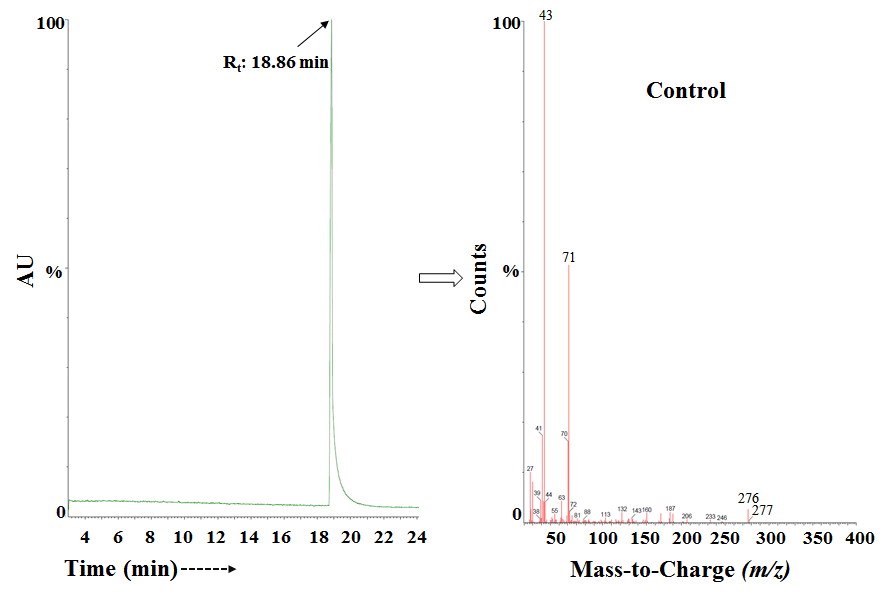
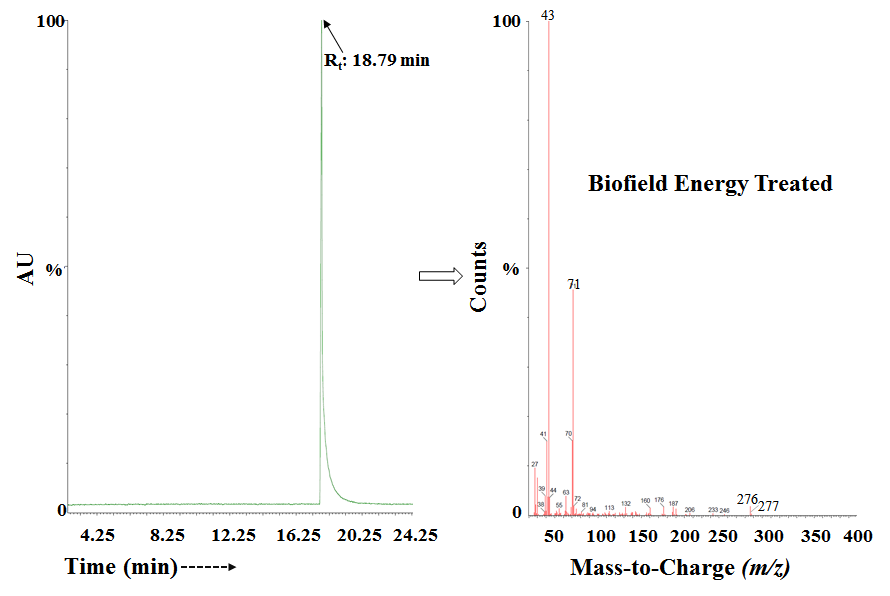
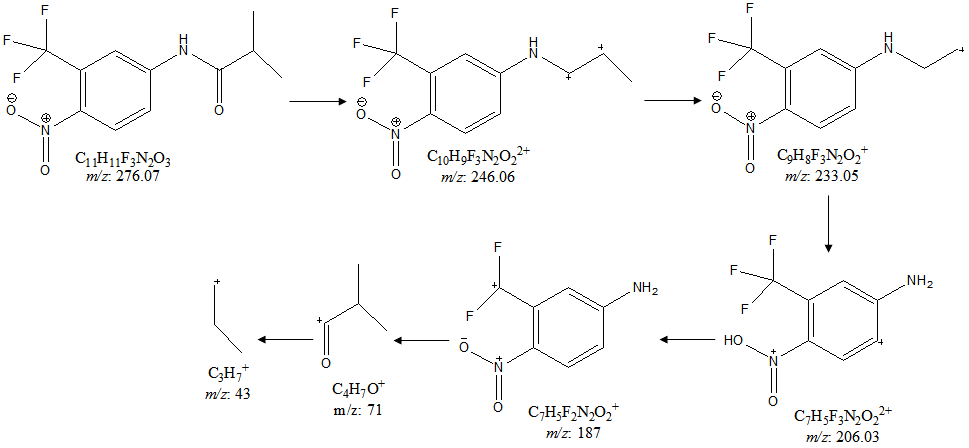
The GC-MS chromatograms showed the presence of a single chromatographic peak at the retention time of 18.8 minutes in both the samples of flutamide (Figures 3 and 4). The parent molecular ion peak of flutamide at m/z 276 [M]+ (calculated for C11H11F3N2O3 +, 276.07) in the control sample and Biofield Energy Treated sample, along with the fragment ion peaks near m/z 246, 233, 206, 187, 71, and 43 (Figures 3 and 4) which corresponded to the molecular formula C10H9F3N2O2 2+, C9H8F3N2O2 +, C7H5F3N2O2 2+, C7H5F2N2O2 +, C4H7O+, and C3H7 +, respectively were proposed (Figure 5).
The GC-MS spectra of both the control and Biofield Energy Treated flutamide showed the mass of the molecular ion peak [M]+ at m/z 276 (calculated for C11H11F3N2O3 +, 276.07).
The theoretical calculation of PM+1 for flutamide was presented as below:
P (13C) = [(11 x 1.1%) x 2.62% (the actual size of the M+ peak)] / 100% = 0.32%
P (2H) = [(11 x 0.015%) x 2.62%] / 100%= 0.004%
P (15N) = [(2 x 0.4%) x 2.62%] / 100% = 0.02%
P (17O) = [(3 x 0.04%) x 2.62%] / 100% = 0.003%
PM+1, i.e. 13C, 2H, 15N, and 17O contributions from (C11H11F3N2O3)+ to m/z 277 = 0.37% The calculated isotope abundance (0.37%) was close to the experimental value 0.32% (Table 2). From the above calculation, it has been found that 13C and 15N have major contribution to m/z 277.
| Parameter | Control sample | Biofield Energy Treated sample |
|---|---|---|
| P at m/z 276 (%) M | 2.62 | 1.78 |
| P at m/z 277 (%) M+1 | 0.32 | 0.24 |
| P /P M+1 M | 0.12 | 0.13 |
| % Change of isotopic abundance ratio (P /P ) with M+1 M respect to the control sample | 10.39 |
The GC-MS based isotopic abundance ratio of PM+1/PM in the Biofield Energy Treated flutamide was significantly increased by 10.39% compared with the control sample (Table 2). Hence, 13C, 2H, 15N, and 17O contributions from (C11H11F3N2O3)+ to m/z 277 in the Biofield Energy Treated sample were increased compared with the control sample.
The data confirmed the structure of the sample as flutamide. The peak area and isotopic abundance ratio of PM+1/PM (2H/1H or 13C/12C or 15N/14N or 17O/16O) in the Biofield Energy Treated flutamide were significantly increased compared to the control sample. According to modern physics, the neutrino is an elementary particle which changes identities. It is only possible if the neutrinos possess mass and have the ability to interchange their phase from one phase to another internally. Therefore, the neutrinos have the capability to interact with protons and neutrons in the nucleus, which indicated a close relation between neutrino and the isotope formation [12, 30, 31]. The altered isotopic composition in the molecular level of the treated flutamide might have altered the neutron to proton ratio in the nucleus. It can be assumed that the alterations in the isotopic abundance could be due to the change in nuclei by the interference of neutrino particles via the Trivedi Effect®- Consciousness Energy Healing Treatment.
The improved isotopic abundance ratios 2H/1H or 13C/12C or 15N/14N or 17O/16O would highly influence the atomic bond vibration of treated flutamide. The increased isotopic abundance ratio of the Consciousness Energy Healing Treated flutamide would stronger the chemical bond and increase the stability [36, 37]. The Trivedi Effect®- Consciousness Energy Healing Treated flutamide might improve the solubility, bioavailability, and therapeutic efficacy compared to the control sample. The new form of Biofield Energy Treated flutamide would be very much useful to design better pharmaceutical formulations against prostate cancer, androgen-dependent skin and hair conditions including acne, seborrhea, hirsutism, and scalp hair loss, hyperandrogenism, as well useful for feminizing hormone therapy aimed at transgender women.
Conclusion
The Trivedi Effect®-Consciousness Energy Healing Treatment showed a significant impact on the isotopic abundance ratios and peak area of flutamide. The LC-MS spectra of both the samples at retention time (Rt) 3.4 minutes exhibited the mass of the deprotonated molecular ion peak at m/z 275.08 [M-H]-. The peak area of the Biofield Energy Treated flutamide was significantly increased by 92.42% compared to the control sample, which indicated that the solubility profile of the Biofield Energy Treated flutamide was significantly increased compared to the control sample.
The LC-MS based isotopic abundance ratio of PM+1/PM (2H/1H or 13C/12C or 15N/14N or 17O/16O) in the Biofield Energy Treated flutamide was significantly increased by 59.48% compared with the control sample. The GC-MS based isotopic abundance ratio of PM+1/PM in the Biofield Energy Treated flutamide was increased by 10.39% compared with the control sample. The results indicated that the 13C, 2H, 15N, and 17O contributions from (C11H11F3N2O3)+ to m/z 277 in the Biofield Energy Treated flutamide were significantly increased compared with the control sample. The isotopic abundance ratio of PM+1/PM (2H/1H or 13C/12C or 15N/14N or 17O/16O) in the Biofield Energy Treated flutamide was significantly increased compared to the control sample. The changes in the peak area and isotopic abundance could be due to changes in nuclei possibly through the interference of neutrino via the Trivedi Effect®-Consciousness Energy Healing Treatment. The new form of treated flutamide was formed that might have increase the chemical bond strength, stability, solubility, bioavailability, and efficacy, which could be very much useful to design more efficacious pharmaceutical formulations against prostate cancer, androgen-dependent skin and hair conditions including acne, seborrhea, hirsutism, and scalp hair loss, hyperandrogenism, as well useful for feminizing hormone therapy aimed at transgender women.
Acknowledgement
The authors are grateful to Sophisticated Instrumentation Centre for Applied Research & Testing (SICART) India, Trivedi Science, Trivedi Global, Inc., Trivedi Testimonials, and Trivedi Master Wellness for their assistance and support during this work.
References
-
Elks J (1990) The Dictionary of Drugs: Chemi- cal Data: Chemical Data, Structures and Bibliographies. Springer, pp: 2062.
-
Index Nominum (2000) International Drug Directory. Taylor & Francis, pp: 466.
-
Budavari S (2003) The Merck index. Whitehouse Station, Merck and Co Inc, USA.
-
Salgado HRN, Menezes M, Storti MPB (2005) Determination of flutamide in tablets by high- performance liquid chromatography. Acta Farm Bonaer 24(2): 246-249.
-
Goldspiel BR, Kohler DR (1990) Flutamide: An antiandrogen for advanced prostate cancer. DICP 24(6): 616-623.
-
Sufrin G, Coffey DS (1976) Flutamide. Mechanism of action of a new nonsteroidal antiandrogen. Invest Urol 13(6): 429-434.
-
(2019) Flutamide.
-
Mizuno K, Hayashi Y, Kojima Y, Kurokawa S, Sasaki S, et al. (2007) Influence for testicular development and histological peculiarity in the testes of flutamide- induced cryptorchid rat model. International Journal of Urology 14(1): 67-72.
-
Chereson R (2009) Bioavailability, bioequivalence, and drug selection. In: Makoid CM, Vuchetich PJ, Banakar UV, (Eds.), Basic pharmacokinetics, 1st (Edn.), Pharmaceutical Press, London.
-
Branton A, Jana S (2017) Effect of The biofield energy healing treatment on the pharmacokinetics of 25-hydroxyvitamin D3 [25(OH)D3] in rats after a single oral dose of vitamin D3. American Journal of Pharmacology and Phytotherapy 2(1): 11-18.
-
Trivedi MK, Branton A, Trivedi D, Nayak G, Wellborn BD, et al. (2017) Effect of the energy of consciousness (the Trivedi Effect®) on the structural properties and isotopic abundance ratio of magnesium gluconate using LC-MS and NMR spectroscopy. Advances in Biochemistry 5(1): 7-15.
-
Trivedi MK, Branton A, Trivedi D, Nayak G, Lee AC, et al. (2016) Impact of biofield energy treated herbomineral formulation (the Trivedi Effect®) on mouse dendritic and splenocyte cells for modulation of pro-inflammatory cytokines. International Journal of Immunology 4(5): 35-45.
-
Trivedi MK, Mohan TRR (2016) Biofield energy signals, energy transmission and neutrinos. American Journal of Modern Physics 5(6): 172-176.
-
Rubik B (2002) The biofield hypothesis: Its biophysical basis and role in medicine. J Altern Complement Med 8(6): 703-717.
-
Nemeth L (2008) Energy and biofield therapies in practice. Beginnings 28(3): 4-5.
-
Rubik B, Muehsam D, Hammerschlag R, Jain S (2015) Biofield science and healing: history, terminology, and concepts. Glob Adv Health Med 4: 8-14.
-
Koithan M (2009) Introducing complementary and alternative therapies. J Nurse Pract 5(1): 18-20.
-
Barnes PM, Bloom B, Nahin RL (2008) Complementary and alternative medicine use among adults and children: United States, 2007. Natl Health Stat Report 12: 1-23.
-
Trivedi MK, Branton A, Trivedi D, Nayak G, Jana S, et al. (2016) Determination of isotopic abundance ratio of biofield energy treated 1,4-dichlorobenzene using gas chromatography-mass spectrometry (GC-MS). Modern Chemistry 4(3): 30-37.
-
Trivedi MK, Branton A, Trivedi D, Nayak G, Jana S, et al. (2016) Gas chromatography-mass spectrometric analysis of isotopic abundance of 13C, 2H, and 18O in biofield energy treated _p_-tertiary butylphenol (PTBP). American Journal of Chemical Engineering 4(4): 78-86.
-
Nayak G, Trivedi MK, Branton A, Trivedi D, Jana S (2018) Evaluation of the effect of consciousness energy healing treatment on the physicochemical and thermal properties of selenium. Journal of New Developments in Chemistry 2(1): 14-23.
-
Nayak G, Trivedi MK, Branton A, Trivedi D, Jana S (2018) Evaluation of the physicochemical and thermal properties of chromium trioxide (CrO3): Impact of consciousness energy healing treatment. Research & Development in Material Science 8(3): 1-6.
-
Nayak G, Trivedi MK, Branton A, Trivedi D, Jana S (2018) Evaluation of the physicochemical and thermal properties of consciousness energy healing treated polylactic-co-glycolic acid (PLGA). Journal of Food Science and Technology 5(3): 117-125.
-
Trivedi MK, Branton A, Trivedi D, Nayak G, Gangwar M, et al. (2015) Evaluation of vegetative growth parameters in biofield treated bottle gourd (_Lagenaria siceraria_) and okra (_Abelmoschus esculentus_). International Journal of Nutrition and Food Sciences 4(6): 688-694.
-
Nayak G, Trivedi MK, Branton A, Trivedi D, Jana S (2018) Evaluation of the consciousness energy healing treated berberine chloride using PXRD, PSA, and DSC Analysis. Food Sci Nutr Technol 3(6): 000168.
-
Nayak G, Trivedi MK, Branton A, Trivedi D, Jana S (2018) Impact of Consciousness energy healing treatment on the physicochemical and thermal properties of vitamin D3 (cholecalciferol). Food Sci Nutr Technol 3(5): 000162.
-
Trivedi MK, Branton A, Trivedi D, Nayak G, Mondal SC, et al. (2015) Antimicrobial sensitivity, biochemical characteristics and biotyping of _Staphylococcus_ _saprophyticus_: An impact of biofield energy treatment. J Women’s Health Care 4(6): 1000271.
-
Trivedi MK, Branton A, Trivedi D, Nayak G, Jana S, et al. (2015) Antibiogram of multidrug-resistant isolates of _Pseudomonas_ _aeruginosa_ after biofield treatment. J Infect Dis Ther 3(5): 244.
-
Schellekens RC, Stellaard F, Woerdenbag HJ, Frijlink HW, Kosterink JG (2011) Applications of stable isotopes in clinical pharmacology. Br J Clin Pharmacol 72(6): 879- 897.
-
Weisel CP, Park S, Pyo H, Mohan K, Witz G (2003) Use of stable isotopically labeled benzene to evaluate environmental exposures. J Expo Anal Environ Epidemiol 13(5): 393-402.
-
Muccio Z, Jackson GP (2009) Isotope ratio mass spectrometry. Analyst 134(2): 213-222.
-
Rosman KJR, Taylor PDP (1998) Isotopic compositions of the elements 1997 (Technical Report). Pure Appl Chem 70(1): 217-235.
-
Smith RM (2004) Understanding Mass Spectra: A Basic Approach, 2nd (Edn.), John Wiley & Sons, Inc, USA, pp: 392.
-
Jürgen H (2004) Gross Mass Spectrometry: A Textbook, 2nd (Edn.), Springer, Berlin.
-
Yamada K, RN El-Shaheny (2015) The influence of pH and temperature on the stability of flutamide. An HPLC investigation and identification of the degradation product by EI+-MS. RSC Adv 5: 3206-3214.
-
Coplen TB, Böhlke JK, De bièvre P, Ding T, Holden NE, et al. (2002) Isotope-abundance variations of selected elements. Pure Appl Chem 74(10): 1987-2017.
-
Wiederhold JG (2015) Metal stable isotope signatures as tracers in environmental geochemistry. Environ Sci Technol 49(5): 2606-2624.
- Cancer Diagnosis from RNA Sequence of Blood Cells by Using AI
- Field Cancerization in Oral Cavity, Case Report and Review of Literature. Oncologic Program Salud Integral Hospital, Managua, Nicaragua
- Identification of B Lymphocytes in Cancer Patient’s Blood
- A Case Report of a Breast Cancer Patient Developing Pneumonitis as a Result of Abemaciclib Therapy
- Immune Checkpoint Therapeutics for Today’s Fight and Beyond
- The Amalgamated Sophomore-Gonadoblastoma