
Immediate Effect of Continuous Running on Red Blood Cells (RBC), Packed Cell Volume (PCV) and Red Blood Cell Distribution Width (RDW) Among Physically Trained Boys
Introduction: During physical exercise, the level of haematological parameters changes depending on the intensity and duration of exercise and the individual's physical fitness. Research results, based on samples taken before and after exercise, suggest that haematological parameters increase during incremental exercise. The purpose of the research work was to evaluate the acute effect of continuous running on Red Blood Cell (RBC), Red blood cell distribution width (RDW) and Packed Cell Volume (PCV)of physically trained boys has been aimed. Methods: Ten (10) physical education male students with an average age of 23.16±1.85 years participated in this study on voluntary basis. Red blood cell (RBC), Red blood cell distribution width (RDW) and Packed Cell volume (PCV) of the students were analyzed before running (BR) and just after 35 minutes of continuous running (AR). To find out the effect of contentious running ‘t’ test was calculated for each variable. In order to determine all those hematological parameters, blood samples with 5 ml EDTA were taken from the forearm antecubical area before and after contentious running, and analyzed in laboratory with using auto-analyzer (Sysmex XP- 100). Result: Measurement results were presented as average and standard deviation. Student T-test for dependent samples was used in order to make a comparison between BE and AE values. P<-0.01 value was considered to be significant. The result of the study revealed that, the increase in AR than BR values for Red Blood Cell (RBC) and packed cell volume (PCV) significantly but no significant changes shown in case of Red Blood Cell distribution width (RDW). Conclusion: Conclusively Red blood cell (RBC) and Packed Cell Volume (PCV) displayed significant incensement and insignificant decrease of RBC distribution width (RDW) in relation to acute effect of continuous running.
Introduction
Red blood cells (RBC; erythrocytes) perform numerous important functions, especially during physical workout. RBC plays an important role by carrying oxygen (O2) from the lungs to the contracting muscle mass. Furthermore, the release of adenosine triphosphate (ATP) and nitric oxide (NO) contributes to the dilation of blood vessels and complements blood drift through working muscular tissues. Hemoglobin (Hb) contributes to buffering pH changes in blood by way of mixed delivery of carbon dioxide (CO2) and hydrogen ions (H+) in form of bicarbonate ions (HCO3 −). All of this depends on adequate RBC count [1].
It’s far typically regarded that both acute and chronic physical games result in numerous hematological changes in people. It also has been ascertained that exercise- precipitated hematological modifications are dependent on the type, intensity and period of exercise. Moreover, several factors which include training popularity, gender, age, environmental conditions and dietary popularity of the subjects also play a crucial function [2]. It’s been reported that acute workout has a full-size effect at the rheological properties of the blood, and after acute exercise there may be an incensement in plasma viscosity and erythrocyte stress however a lower in sedimentation rate [3].
Very short and excessive instance exercise, lasting from some seconds to a few minutes, will increase the hematocrit (Hct) and Hb concentration by approximately 6–8% [4]. Workout carried on a treadmill or bicycle ergometer, lasting longer than ten minutes, can able to increase in Hb concentration, RBC count, and Hct by means of 4 to10% [4, 5, 6]. In the bloodstream of an active healthy person, the values of those above hematological parameters are extensively better after severe exercise than at relaxation [7, 8]. This is due to the result of dehydration, excessive blood viscosity, and fluid displacement within intracellular and extracellular areas. During post exercise recovery, erythrocyte status indices return to baseline levels, and sometimes drop under resting values [4, 5, 6, 7, 8].
The magnitude of the exercise related changes in hematological parameters depends on environmental outside conditions (temperature, humidity), the depth and period of workout, and the extent of bodily fitness of the client. Lower Hct became found in athletes than in healthy untrained people [9]. High Hct facilitate the increment of blood viscosity, which may additionally put more stress at the heart and, therefore, increase the danger of cardiac overload [1]. Athletes commonly have a higher plasma volume (PV) than sedentary human beings [10], and this is the primary cause of their decrease Hct values. Oxygen delivery to exercising muscles in especially trained individuals depends on speedy diastolic filling of the heart, which is feasible with a sufficiently larger blood volume [11]. A high overall mass of RBC and Hb in trained people, with a sufficiently large blood volume (BV), increases the O2 shipping ability [12].
With this view in mind the researcher conducted the present study to investigate the acute effect of resistance exercise on Red Blood Cell (RBC), Red blood cell distribution width (RDW) and Packed Cell Volume (PCV) of physically trained boys.
Materials and Method
Participants
Ten (10) Physical Education male trainees with an average age of 23.16±1.85 years participated in this study on voluntary basis. These subjects were healthy, nonsmokers, without history of hematological disease and free from infection.
Study design
Blood was taken from all the samples before and just after the resistance exercise. Total 35min exercise season was administrated as 15min exercise then 5min rest and again 15 min exercise. Single group design was adopted for the study and the samples of the study were selected randomly (Figure 1).
Data collection
Blood samples were taken in the morning from 7:00 to 8:00 am. Blood samples with 5 ml EDTA (Ethylenediaminetetraacetic acid) were taken from players in the forearm ante cubical area, in line with hygiene rules before (BR) and immediate after (AR) the continuous running. Hemoglobin levels were analyzed by the expert pathologist at standard laboratory with Sixmex auto- hemato analyzer.
Statistics analysis
Student t-test for dependent samples was used in order to make a comparison between BE and AE values. P<0.01 value was considered to be significant.
Blood taken immediate after finish Blood taken just before running Figure 1: Diagrammatic representation of blood sample collection from the samples
Result
The findings of the study indicate that Red Blood Cell (RBC) and mean corpuscular volume (MCV) of physically trained boys were significantly increase immediate after 35 minutes of continuous running but in case of Red Blood Cell distribution width (RDW) shown statistically insignificant change. Though pre-exercise and post-exercise both values of those hematological parameters are in between the normal pathological range. Tables 1-3 indicates the comparison of RBC Level, PCV and RDW before and after the continuous running programme.
- Status of Red Blood Cell level (million/cmm.)
- Mean
- SD
- “t” value
- “p” value
- RBC
- Pre exercise
- 5.26
- 0.71
- 8.953
- 0.000009*
- Post exercise
- 5.54
- 0.78
- P<0.01* or gm/dl
Table 3: Comparison of RBC before and after running.
Interpretation of Table- 1 Significant change in RBC was evident in pre and post continuous running (t=8.953, p<0.01)
- Status of Packed cell volume level (%)
- Mean
- SD
- “t” value
- “p” value
- PCV
- Pre exercise
- 43.6
- 2.5
- 14.328
- 0.000000*
- Post exercise
- 46.1
- 2.06
- P<0.01* or gm/dl
Table 1: Comparison of PCV Level before and after running.
- Interpretation of Table 2
- Significant change in PCV was evident in pre and post continuous running (t=14.328, p<0.01)
- Status of Red Cell distribution width level (%)
- Mean
- SD
- “t” value
- “p” value
- RDW
- Pre exercise
- 47.2
- 3.82
- 1.689
- 0.125
- Post exercise
- 45.9
- 3.9
- P<0.01* or gm/dl
Table 2: Comparison of RDW Level before and after running.
| Pre-Test | Post-Test | Mean Difference | % Change | |
|---|---|---|---|---|
| RBC Level(million/cmm.) | 5.256 | 5.542 | 0.286 | 5.44 |
| Pact Cell Volume (%) | 43.64 | 46.12 | 2.48 | 5.68 |
| RDW(%) | 47.2 | 45.92 | 1.28 | 2.71 |
Table 4: Percentage change of RBC, PCV &RDW before and after running. Indicates the percentage change of the variables before and
Discussion
It is found that the mean RBC and PCV of the students was increased significantly whereas no significant changes found in red blood cell distribution width (RDW) after exercise (Figures 2-4) respectively.
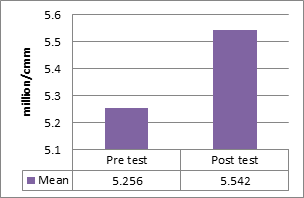
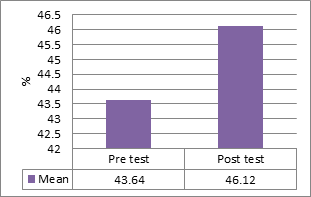
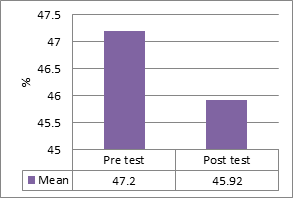
At the start of exercise, a moderate growth (1–2%) in Hct and Hb may be triggered by way of the ejection of blood from the capillaries of formerly inactive muscular tissues. Moreover Laub, et al. [5], referred to that erythrocytes launched from contracting spleenal through intense workout will also be chargeable for an increase in hematocrit which is same as our study (figure 3), but taking into the attention the noticeably small size of the human spleen this upward push is lower than 2% [13]. In the course of exercising, there is a decrease in plasma volume with the aid of10–20%, which reasons hemo-concentration [14]. This sort of great reduction in plasma volume for the duration of quick-term exercise cannot be the end result of excessive sweating. Rather, there is a phenomenon of water moving from the vessels to the extra vascular space. Increases in hydrostatic strain in capillaries, within the filtration floor (result of blood redistribution to vascular regions previously poorly perfuse), within the stroke volume and in osmotic stress within the muscle tissues (result of somatically active metabolites of operating muscles) are the primary reasons for the displacement of fluid from intra- to extra-vascular area [15]. Though in the present study there was no scope of measuring the degree of hydration and sweating at any stage of exercise.
It’s been generally shown that blood parameter values again to resting tiers 30 min after the single Wingate check or acute sub maximal exercising test [16]. Kordie, MR, et al. [17]. Contemporary studies [18, 19] showed multiplied blood and plasma viscosity in reaction to different exercise protocols. On this study, red cell counts appreciably elevated immediately after workout (figure 2). In a take a look at of Halson, et al. [20], 4 weeks of intensive exercise significantly reduced red blood cell counts (10%). In comparison, inexperienced [21] did not find any sizeable difference after a 4-week exercise software in the red blood cell counts of the sedentary people. In a current look at, [22] suggested a good amount of growth in the mean cell volume at once after fairly long-distance half marathon running which also support our study (Figure 3). Strenuous exercise is thought to reason structural harm inside the erythrocyte, resulting in hemolysis. Growing the quantity of erythrocytes deformed by way of exercise can be meditated as an increase of mean cell quantity inside the blood circulation [23].
So, the growth in RBC count and PCV values throughout physical workout in participates can be partially defined by using fluid shifts between vessels and extra-vascular space. These outcomes are in line with in advance studies indicating a decrease in plasma volume of about 10% after heavy workout [18]. Changes in plasma volume all through workout are induced, among others, by means of the increase in hydrostatic stress in capillaries, and an increase in osmotic stress within the muscle groups. It is a result of accumulation of somatically lively metabolites in running muscular tissues, mainly lactate [15].
Exercising can increase the HBG and red blood cell mass, which will increase oxygen wearing ability in order that with dependent exercising the hemoglobin level within the blood which functions to bind oxygen within the blood and loosen up it for the duration of the frame can even growth. For the duration of workout, the body wishes more oxygen than ordinary every day work. All the demand for oxygen is obtained from the blood stream inside the muscular tissues. This is according which explains that, at some stage in exercising the extended demand for oxygen is met with the aid of active muscle blood flow.
Conclusions
From the results of the study, it can be concluded that (RBC) and packed cell volume (PCV) displayed significant incensement in relation to acute continuous running. Though there is some controversy with the other studies, researcher thought that experiment with a greater number of subjects and with various intensity of exercise may throw more light on this problem [24, 25].
References
-
Mairbaurl H (2013) Red blood cells in sports: effects of exercise and training on oxygen supply by red blood cells. Frontiers in Physiology 4: 332.
-
Gibala MJ, McGee SL (2008) Metabolic adaptations to short-term high-intensity interval training: A little pain for a lot of gain. Exerc Sport Sci Rev 36(2): 58-63.
-
Ajmani RS, Fleg JL, Demehin AA, Wright JG, Heim JM, et al. (2003) Oxidative stress and hemorheological changes induced by acute treadmill exercise. Clin Hemorheol Microcirc 28(1): 29-40.
-
Freund BJ, Claybaugh JR, Dice MS, Hashiro GM (1987) Hormonal and vascular fluid responses to maximal exercise in trained and untrained males. Journal of Applied Physiology 63(2): 669-675.
-
Laub M, Jacobsen HK, Hovind P, Kanstrup IL, Christensen NJ, et al. (1993) Spleen emptying and venous hematocrit in humans during exercise. Journal of Applied Physiology 74(3): 1024-1026.
-
Neuhaus D, Gaehtgens P (1994) Haemorrheology and long term exercise. Sports Medicine 18(1): 10-21.
-
Davidson RJ, Robertson JD, Galea G, Maughan RJ (1987) Hematological changes associated with marathon running. International Journal of Sports Medicine 8(1): 19-25.
-
Szygula Z (1990) Erythrocytic system under the influence of physical exercise and training. Sports Medicine 10(3): 181-197.
-
Sharpe K, Hopkins W, Emslie KR, Howe C, Trout GJ, et al. (2002) Development of reference ranges in elite athletes for markers of altered erythropoiesis. Haematologica 87(12): 1248-1257.
-
Heinicke K, Wolfarth B, Winchenbach P, Biermann B, Schmid A, et al. (2001) Blood volume and hemoglobin mass in elite athletes of different disciplines. International Journal of Sports Medicine 22(7): 504-512.
-
Levine BD (2008) VO2max: what do we know, and what do we still need to know. The Journal of Physiology 586(1): 25-34.
-
Schmidt W, Prommer N, Schmidt W, Prommer N (2010) Impact of alterations in total hemoglobin mass on VO2 max. Exercise & Sport Sciences Reviews 38(2): 68-75.
-
Shephard RJ (2016) Responses of the human spleen to exercise. Journal of Sports Sciences 34(10): 929-936.
-
El-Sayed MS, Ali N, El-Sayed Ali Z (2005) Haemorheology in exercise and training. Sports Medicine 35(8): 649-670.
-
Connes P, Simmonds MJ, Brun JF, Baskurt OK (2013) Exercise hemorheology: classical data, recent findings and unresolved issues. Clinical Hemorheology and Microcirculation 53(1,2): 187-199.
-
Whittlesey MJ, Maresh CM, Armstrong LE, Morocco TS, Hannon DR, et al. (1996) Plasma volume responses to consecutive anaerobic exercise tests. Int J Sports Med 17: 268-271.
-
Kordie MR, Chobineh S, Hematinafar M, Molaesmaeili Z (2012) The effect of acute anaerobic exercise on blood rheology agents’ response in active young women. Appl Manag Res Life Sci Sports pp: 45-52.
-
Ahmadizad S, Bassami M, Hadian M, Eslami M (2016) Influences of two high intensity interval exercise protocols on the main determinants of blood fluidity in overweight men. Clin Hemorheol Microcirc 64(4): 827- 835.
-
Varlet Marie E, Brun JF, Raynaud de Mauverger E, Fédou C (2016) Exercise-induced changes in hematocrit and hematocrit/viscosity ratio in male rugby players. Clin Hemorheol Microcirc 64(4): 817-826.
-
Halson SL, Lancaster GI, Jeukendrup AE, Gleeson M (2003) Immunological responses to overreaching in cyclists. Med Sci Sports Exerc 35(5): 854-861.
-
Green HJ, Sutton JR, Coates G, Ali M, Jones S (1991) Response of red cell and plasma volume to prolonged training in humans. J Appl Physiol 70(4): 1810-1815.
-
Lippi G, Salvagno GL, Danese E, Tarperi C, Guidi GC, et al. (2014) Variation of red blood cell distribution width and mean platelet volume after moderate endurance exercise. Adv Hematol 2014: 192173.
-
Gnanou J, Caszo B, Khalin I, Leong S, Knight VF, et al. (2014) The Effect of 6-weeks military training on blood hematological parameters in untrained recruits in a military university. Med Sci 3(3): 1479-1490.
-
Szygula Z (1990) Erythrocytic system under the influence of physical exercise and training. Sports Medicine 10(3): 181-197.
-
Hu M, Finni T, Sedliak M, Zhou W, Alen M, et al. (2008) Seasonal variation of red blood cell variables in physically inactive men: effects of strength training. International Journal of Sports Medicine 29(7): 564-568.
- An Evaluation of Distraction Control in Experienced Cyclists During a 20 Minute Time-Trial Performance
- Do Games Missed Predict Rankings in the NBA A Machine Learning Approach
- Elite Taekwondo Athletes: The Relationship among Sport Psychology, Mental Health, and the National Sport Organization
- Echocardiographic Insights into Left Ventricular Functional Adaptation in Track and Field Athletes: A Comprehensive Review
- Could there be a Relationship between early Specialization and Load Management Practices in Professional Athletes
- Potentiality of Resveratrol in Mitigating Exercise-Induced Inflammation - A Bioinformatic Study on Interleukin-6 (IL-6) in Athletes