
Drug Designing and Repositioning against Severe Acute Respiratory Coronavirus 2 (SARS-Cov-2) through Computational Simulation: Current Progress and Hopes
This is already well known that after the entry of the sever acute respiratory β-coronavirus-2 (SARS-CoV-2) into the host, the replication-associated proteins serve as the major targets of the currently used drugs. However, despite the rigorous effort, still no appropriate and specific drug against SARS-CoV-2 has been developed. Such a situation may worsen the current COVID-19 pandemic situation in near future. In this circumstance, the rapid drug application strategy can be addressed only by the drug repurposing approach which is solely based on the genomics functional analysis through computational simulation or the in silico study. Such a dry experimental strategy using the specialized databases and software allows identifying novel uses for the sanctioned drugs for other viruses. Based on the recently published reports, current review highlighted some promising drugs identified through such bioinformatic or molecular docking analysis.
Introduction
The current pandemic (coronavirus disease 2019, COVID-19) caused by the severe acute respiratory syndrome β-coronavirus 2 (SARS-CoV-2) is being observed with its high transmission dynamics originating from pangolins or bats to humans followed by the further rapid propagation into the human population worldwide resulting in 686703 deaths with 17918582 infected cases [1]. While sneezing and coughing have been known as the major mode of viral dispersal among the community, an array of molecular studies showed that the SARS-CoV-2 takes entry into the host cells by the angiotensin-converting enzyme 2 (ACE2) along with the serine protease TMPRSS2 which is responsible for the S protein cleavage [2, 3]. ACE2, lying within the renin- angiotensin-aldosterone system (RAAS), plays significant roles in the homeostasis of blood pressure, electrolyte balance and the inflammatory responses as happens in case of COVID-19 cases [4]. Additionally, the protease renin cleaves angiotensinogen to generate angiotensin I (AngI) which is cleaved by the ACE2 (the terminal carboxypeptidase, a type I transmembrane glycoprotein, localized on the airway epithelia) to produce Ang II, which is known to be the negative regulator of RAAS thereby reducing the lung inflammation [4]. After entry into the nasopharyngeal tract along the airway epithelial cells, the viral infection stimulates the huge rush of the cells of innate immunity as well as the pro-inflammatory cytokines which may serve as a major target for the immunomodulatory agents or the antiviral drugs through hindering the Janus kinase (JAK) signal transduction; deterrence of the viral RNA synthesis by blocking the RNA dependent RNA polymerase (RdRp) as well as the viral assembly; and most importantly by blocking the binding of SARS-CoV-2 S protein to the host ACE 2 receptor on the receptor binding site (RBD) [2, 5, 6, 7].
Although the genomic structure of SARS-CoV-2 has been deeply understood and the associated host-pathogen relationship has been well deciphered, till date no specific drug against this virus has been announced for the sole commercial application let alone the vaccine development [8, 9]. Nevertheless, several candidate vaccines are under trial; and a few broad-spectrum antiviral drugs (principally remdesivir) have been being used to mitigate the disease [2, 6]. Indeed, the intensive experimental methods for the study of interactions between the candidate antivirals and the target proteins of the virus are consuming time as has been noticed so far with the involvement of huge expense [4]. The strategies for the development of antiviral drugs underlie within the in silico (computational modeling and simulation) studies, assessment of the molecular databases for screening special molecules providing the therapeutic effects; and on the study of viral genomics along with the predictive exploration of the structures/ structural motifs of the probable proteins imparting the viral pathogenesis potential [2, 10]. Prior to the cell culture model experiments as well as patient trials, the computational analysis of drug targets proposes methods (Figure 1) to test the hypotheses (for example, the identification of virus-associated protein- protein interactions required for reducing the viral shedding) for the novel and presumed drugs which in turn is economic regarding both time and cost [4, 11, 12]. Since the SARS-CoV-2 is assumed to employ ACE-2 protein for the entry into the lung airway cells, the network of the co-expressed proteins with ACE2 has been analyzed by Cava and colleagues (in 2020) facilitating the identification of different target genes on which the known drugs might act on [4, 13, 14]. Current review therefore illustrated such computational simulation study on the basis of the recently published literature in order to focus on all the probable drug target sites within SARS-CoV-2.
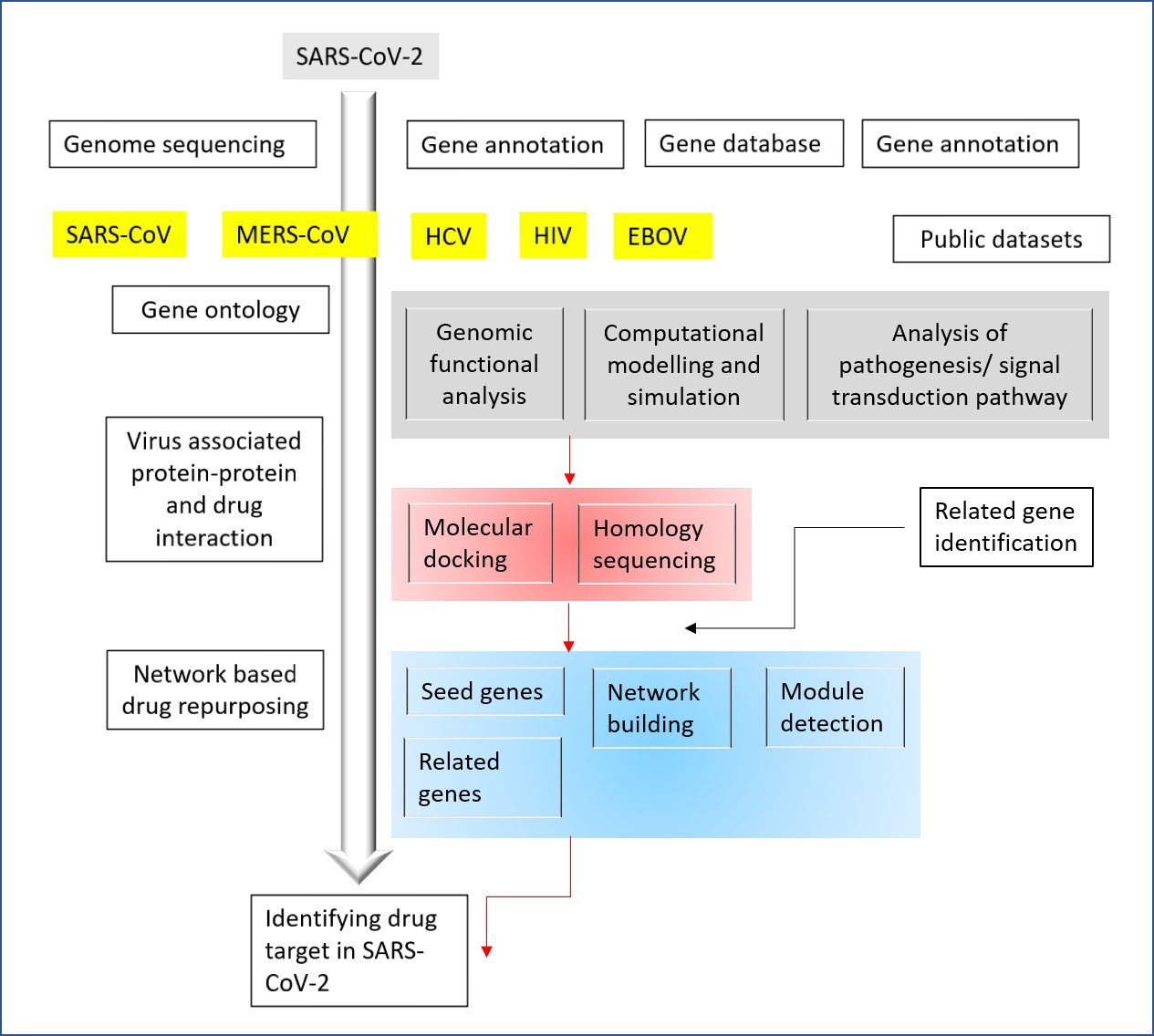
Drug Repurposing/ Repositioning
Within the pandemic, extensive research and development on new molecules required to counteract the SARS-CoV-2 is being conducted by several groups around the world [15, 16, 17]. While the wet experiments involving cell culture, animal model followed by the patient trial appears really to be labor-intensive, costly and monotonous, prior to such intense time-consuming trials, drug repurposing facilitates to identify the therapeutically effective molecule from the archive of the pre-existing antivirals [15, 16, 17, 18, 19]. Thus, assessment of the drug repositioning candidates with the corresponding targets is significant for the viral mitigation [2, 16]. Wu and his group analyzed all the possible target proteins of SARS-CoV-2, anticipated their structures, and found 19 potential targets through homology modeling, 21 targets applying the virtual ligand screening; constructed a database of 78 commonly used antivirals along with the prediction of possible drug targets; and finally their work derived several major drug-targets including the 3-chymotrypsin-like protease (3CLpro), Spike protein, the RdRp, and the papain like protease (PLpro) [2, 16]. Some known broad-spectrum antiviral drugs like the nucleoside analogues, the HIV-protease inhibitors; and among the drug targets, the RdRp and ACE2 have so far been well projected through the drug repositioning [4, 15, 17]. Indeed, since no accurate treatment for COVID-19 is available, the use of derivatives of the existing antiviral drugs can be an expedient strategy which is achievable through the initiation of several approaches included in the drug repurposing [2, 4, 15, 16, 17, 18]. This is interesting to ponder the possible antiviral potential of the drugs which are already in use for the treatment against other viruses; and such a tactic requires the computational tools like the molecular docking or other forms of bioinformatic analysis using specific software and databases especially (1) to depict the affinity between the viral proteins and the candidate inhibitors; and (2) to identify the drug binding sites [19].
Major Candidate Drugs Identified Through Computational Simulation: Highlights
Nimesulide, fluticasone propionate, thiabendazole, photofrin, didanosine and flutamide were identified (out of 36 candidate drugs) as potential drugs by Cava and colleagues (in 2020) through ACE-2 gene expression profiles collected from several public datasets like The Cancer Genome Atlas, Gene Expression Omnibus and Genotype- Tissue Expression, Gene Ontology [4]. A protein- protein interaction network (222 interactions) consisting of 193 genes co-expressed with ACE2 revealed that those genes may be linked even with the known drugs [4]. The molecular docking, a structure-based drug designing approach, showed that favinapir, ritoavir, oseltamivir, lopinavir, ganciclovir and remdesivir were effective in the treatment of COVID-19 [15]. The molecular docking approach conducted by Calligari and colleagues (in 2020) unraveled several inhibitors against SARS-CoV-2 spike protein and 3C-like protease which were originally developed for the treatment against hepatitis C virus (HCV) and the human immunodeficiency virus (HIV) [19]. The HCV NS3/4A protease inhibitor simeprevir and the HIV fusion inhibitor enfuvirtide are good examples in this regard [19]. A promising drug is saikosaponin which has been shown to interfere with the viral penetration as well as early stage of viral replication [20]. In another in silico assay, the computational data discovered the dynamics of the viral RNA-dependent RNA polymerase (RdRp) protein as well as its binding affinity to several existing antiviral drugs including the currently acceptable drug remdesivir for the treatment of the COVID-19 patients as well as the other potential drugs like ribavirin, favipiravir, cefuroxime, hydroxychloroquine, and IDX-184 [21]. Some unique examples of drug repositioning also cover lopinavir, an HIV- drug; Bonducellpin D which was found to possess the anti- viral activity against MERS-CoV; and atazanavir, a general antiretroviral drug [22, 23, 24].
In fine, as stated earlier, proteins; i.e., 3C-like proteinase, the RdRp, 3′-5′ exonuclease, endo RNAse, and 2′-O-ribose methyltransferase, facilitating the SARS-CoV-2 replication are the principal target sites for the antiviral drugs; however, still no specific drug could be developed which in turn initiated the drug repurposing strategy based on the computational modeling and simulation [2, 24]. As revealed from the recent research, such a genomics functional analytical strategy is really helpful to launch a drug to treat the COVID-19 patients which was originally used against another viral infection [2, 4, 5, 6, 10, 24]. Indeed, repurposing the existing antiviral drugs against the COVID-2019 epidemic may add the extra advantage regarding the drug safety since their preclinical, pharmacokinetic, pharmacodynamic, and toxicity profiles are already known which in turn also helps to go for the Phase 3 or 4 trials directly [25].
Conclusion
The emergence of SARS-CoV-2 induced scientists to discover drugs and to initiate the vaccine development; however, besides the cell culture experiments the bioinformatics analysis is really supportive for the study of the viral molecular elements in order to design appropriate drugs during this pandemic. The computational approach with the objective of drug repositioning really goes a long way to identify the candidate therapeutic targets for SARS- CoV-2 within a relatively short time span. Current review briefly discussed the possible scopes of such computational analysis of the existing drugs which can be used for the COVID-19 treatment although a lot of literature is currently available in this context. However, the information gathered here can reinforce the existing knowledge on the drug designing approaches for COVID-19.
References
-
World Health Organization (WHO) (2020) WHO Coronavirus Disease (COVID-19) Dashboard.
-
Noor R (2020) Anti-viral drugs against severe acute respiratory syndrome coronavirus 2 (SARS- CoV-2) infections triggering the COVID-19 pandemic. Tzu Chi Med J.
-
Maniha SM, Haque SN, Akhter M, Noor R (2020) Ongoing COVID-19 Pandemics by the Severe Acute Respiratory Syndrome Coronavirus 2 (SARS-CoV-2) and the Host Protective Immunity Response: A Simple Outline. EC Emergency Medicine and Critical Care 4(6): 103-108.
-
Cava C, Bertoli G, Castiglioni I (2020) In Silico Discovery of Candidate Drugs against Covid- 19. Viruses 12(4): 404.
-
Chen L, Zhong Li (2020) Genomics functional analysis and drug screening of SARS-CoV-2. Genes Dis
-
Rabby M (2020) Current Drugs with Potential for Treatment of COVID-19: A Literature Review: Drugs for the Treatment Process of COVID-19. J Pharm Pharm Sci 23(1): 58-64.
-
Wang M, Cao R, Zhang L, Yang X, Liu J, et al. (2020) Remdesivir and chloroquine effectively inhibit the recently emerged novel coronavirus (2019-nCoV) in vitro. Cell Res 30(3): 269-271.
-
Khuroo MS, Khooro M, Khooro MS, Sofi AA, Khuroo NS (2020) COVID-19 vaccines: A race against time in the middle of death and devastation! Journal of Clinical and Experimental Hepatology.
-
Le TT, Andreadakis Z, Kumar A, Román RG, Tollefsen S, et al. (2020) The COVID-19 vaccine development landscape. Nat Rev Drug Discov 19(5): 305-306.
-
Fan HH, Wang LQ, Liu WL, An XP, Liu ZD, et al. (2020) Repurposing of clinically approved drugs for treatment of coronavirus disease 2019 in a 2019-novel coronavirus (2019-nCoV) related coronavirus model. Chin Med J (Engl) 133(9): 1051-1056.
-
Cava C, Bertoli G, Castiglioni I (2018) In silico identification of drug target pathways in breast cancer subtypes using pathway cross-talk inhibition. J Transl Med16(1): 154.
-
Zhou Y, Hou Y, Shen J, Huang Y, Martin W, et al. (2020) Network-based drug repurposing for novel coronavirus 2019-nCoV/SARS-CoV-2. Cell Discov 6: 14.
-
Hoffmann M, Kleine-Weber H, Schroeder S, Krüger N, Herrler T, et al. (2020) SARS-CoV-2 Cell Entry Depends on ACE2 and TMPRSS2 and Is Blocked by a Clinically Proven Protease Inhibitor. Cell 181(2): 271-280.
-
Chen J, Jiang Q, Xia X, Liu K, Yu Z, et al. (2020) Individual Variation of the SARS-CoV2 Receptor ACE2 Gene Expression and Regulation. Aging Cell 19(7).
-
Shah B, Modi P, Sagar SR (2020) In silico studies on therapeutic agents for COVID-19: Drug repurposing approach. Life Sci 252: 117652.
-
Wu C, Liu Y, Yang Y, Zhang P, Zhong W, et al. (2020) Analysis of therapeutic targets for SARS-CoV-2 and discovery of potential drugs by computational methods. Acta Pharm Sin B 10(5): 766-788.
-
Liu C, Zhou Q, Li Y, Garner LV, Watkins SP, et al. (2020) Research and Development on therapeutic agents and vaccines for COVID-19 and related human coronavirus diseases. ACS Cent Sci 6(3): 315-331.
-
Christian AD, Jean-Marc R, Philippe C, Raoult D (2020) New insights on the antiviral effects of chloroquine against coronavirus: what to expect for COVID-19? Int J Antimicrob Agents 55(5): 105938.
-
Calligari P, Bobone S, Ricci G, Bocedi (2020) A Molecular Investigation of SARS-CoV-2 Proteins and Their Interactions with Antiviral Drugs. Viruses 12(4): 445.
-
Sinha SK, Shakya A, Prasad SK, Singh S, Gurav NS, et al. (2020) An in- silico evaluation of different Saikosaponins for their potency against SARS-CoV-2 using NSP15 and fusion spike glycoprotein as targets. J Biomol Struct Dyn, pp: 1-12.
-
Elfiky AA (2020) SARS-CoV-2 RNA dependent RNA polymerase (RdRp) targeting: An in silico perspective. J Biomol Struct Dyn, pp: 1-9.
-
Peele KA, Chandrasai PD, Srihansa T, Krupanidhi S, Sai AV, et al. (2020) Molecular docking and dynamic simulations for antiviral compounds against SARS- CoV-2: A computational study. Informatics in Medicine Unlocked 19: 100345.
-
Gurung AB, Ali MA, Lee J, Farah MA, Al-Anazi KM, et al. (2020) Unravelling lead antiviral phytochemicals for the inhibition of SARS-CoV-2 Mpro enzyme through in silico approach. Life Sci 255: 117831.
-
Beck BR, Shin B, Choi Y, Park S, Kang K (2020) Predicting commercially available antiviral drugs that may act on the novel coronavirus (SARS-CoV-2) through a drug- target interaction deep learning model. Comput Struct Biotechnol J 18: 784-790.
-
Li X, Yu J, Zhang Z, Ren J, Peluffo AE, et al. (2020) Network Bioinformatics Analysis Provides Insight into Drug Repurposing for COVID-2019.
- Antifungal Activity of New Acetophenone Derivatives
- Interconnected Microbiomes Human Health Within an Environmental Framework
- Silkworm-Based Vaccine Production for H5N1: A One Health Approach to Pandemic Preparedness
- Microbial Diversity and Lipolytic Activity of Bacteria and Fungi from Oil-Contaminated Sites in Makurdi Metroplois
- Antibiotic Resistance Profile of Bacteria Isolated at the Central Laboratory of the National Hospital Center of Nouakchott
- Epidemiology and Sensitivity to Antibiotics of Germs Isolated from Blood Cultures in the Laboratory of the National Hospital Center of Nouakchott-Mauritania