
Potentially Beneficial Comamonas Testosteroni Bacteria for Plants Growing in HCB Polluted Soil
The bioaugmantation effect of bacterial strains on plant development in organochlorine pesticides (OCP) polluted soil has been in the focus of attention, however there is little information about Comamonas testosteroni strains influence. The investigation was performed by classic methods. The results of the research showed that Comamonas testosteroni UCM B-400 and B-401has a high destroying potential to xenobiotics in the soil, and also has a positive effect on plant development. The tomato plants ability to develop under conditions with Comamonas testosteroni UCM B-400 and B-401 bioaugmentation in HCB - contaminated and uncontaminated soil were studied. Comamonas testosteroni UCM B-400 and B-401 promoted the increasing of photosynthetic activity, biometric parametrs and increase the resistance to phytopathogens, such as Clavibacter michiganensis subs. michiganensis UCM Ас-629 (up to 36%) and Alternaria alternata UCM F-16866 (up to 32%). Comamonas testosteroni UCM B-400 and B-401 can be used as an inoculant to improve plant development conditions in HCB load soils.
Introduction
Bioremediation of pesticide-polluted soil ecosystems via themicroorganisms - xenobiotics potential destructors has significant advantages in application compared to chemical and physical methods due to safety, economy and prolonged effect. Bioaugmentation is one of the most effective methods of bioremediation [1]. Due to the intensive activity of agro-industrial production, a large amount of pesticides has accumulated in the soil that need to be removed. One of the dangerous toxicants is a group of organochlorine pesticides, which includes hexachlorobenzene (HCB), which is prohibited by the Stockholm Convention [2]. Bacteria Comamonas testosteroni are known to be destructors of aromatic compounds, such as nitrobenzenes, chlorobenzenes and pentachlorophenol [3, 4, 5]. Due to the high destructive potential of these bacteria, many studies have been conducted as remediates of contaminated soils. The using Comamonas strains were carryed out in combination with plants, such as alfalfa [6], as well as with Bacillus sp. bacteria [5, 7] and as a monoculture [8, 9] for the removal of xenobiotics from soils. In all cases, high remediation capacity of the studied bacteria was reported. Studying Comamonas-alfalfa system was applied for remediation of tetrachloronitrobenzene (4CNB) polluted soil demonstrated 4CNB degradation and 4CNB phytotoxicity elimination by Comamonas sp. strain CNB-1 [6].
The capacity of Bacillus subtilis strain DKT and Comamonas testosteroni KT5 to fomate the biofilm and degradate chlorobenzenes and toluenes were determined. Studying the dual-species biofilm of C. testosteroni KT5 and B. subtilis DKT demonstrated high degradability effect of chlorobenzene and 2-chlorotoluene and the possibility to remove from polluted ecotops mixture of toxic organic compounds that cannot be metabolized by single-organism biofilms [5]. Biodegradation of pentachlorophenol (PCP) by Comamonas testosteroni CCM 7530 in three chernozem soil types was investigated and showed the PCP content decreasing in soil, thatprovided reducing toxic effect for resident microbiotanumber, as soil quality and fertility characteristic [8]. Therefore, researchers have shown the ability of Comamonas testosteronibacteria to destroy chlorobenzenes and other aromatic compounds, as well as reduce the toxic effect on microbiota and plants in the soil. It is important to study the effect as potentially hexachlorobenzene (HCB) degrading Comamonas testosteroni strains on plant development and their resistance to biotic factors. The aim of the study was to determine the effectiveness of the introducing Comamonas testosteroni strains UCM B-400 and UCM B-401 on the developing tomato plants and their resistance to phytopathogens under cultivating conditions in HCB-contaminated gray podzolic soil.
Methods
Experiment Design
The experiment was performed in the laboratory conditions in the following variants: 1 - uncontaminated soil; 2, 3 - introducing the C. testosteroni UCM B-400 and B-401 culture liquidinto the unpolluted soil; 4,5-HCB contaminated soil at doses of 30 and 100 mg / kg; 6, 7 - HCB loaded soil at 30 mg / kg doses, which which was inoculated by C. testosteroni UCM B-400 and C. testosteroni UCM B-401 culture liquid, respectively; 8 and 9 - HCB contaminated soil at 100 mg / kg doses, which was inoculated by C. testosteroni UCM B-400 and C. testosteroni UCM B-401 culture liquid. Tomato plants of the cultivar «Lagidniy» were grown in all experimental variants. Biometric parameters were determined at the 3-4 leaf formation stage. Resistance to phytopathogens was studied by the Krayntsburg-Eggert method under artificial infection conditions of leaf plates with the micromycete Alternaria alternata UCM F-16866 and bacteria Clavibacter michiganensis subs. michiganensis UCM Ас-629.
Microbial Quantity
The microorganisms number was assessed by sowing ten-fold dilutions of the soil suspension on agarified nutrient media and assessing the colony-forming units (CFUs) amount per gram of dry soil, taking into account its moisture content. The selective media used to determine certain ecological- trophic group have been described previously [10].
Biometric Parameters
There are plant length, root length, root mass, plant mass were determined at the 3-4 leaf formation stage.
Chlorophyll Content Measurement
Leaf samples were crushed and grinded with a pestle in a mortar. Extractions were done using 96% ethanol. The extract aliquots were used to spectrophotometrically determine total chlorophyll and chlorophylls a and b contents. Absorbance readings were carried out at 649, 654 and 665 nm, and the results are expressed as mg of chlorophyll/ g leaf tissue. Equations for calculate chlorophyll content are following: Chl a = 13.70×D665-5.76×D649; Chl b = 25.80×D649-7.60×D665 ; Total Chl (Chl a + Chl b) = 6.10×D665 + 20.04×D649 = 25.10×D654 [11].
Resistance to Phytopathogens
Determination of tomatoes leaves infestation level was conducted by the Krayntsburg-Eggert method under artificial infection conditions of leaf plates with the micromycete Alternaria alternata UCM F-16866 and bacterium Clavibacter michiganensis subs. michiganensis UCM B-629.
Statistical Analysis
Data are presented as means ± SEM. Statistical analysis were performed by using GraphPad Prism 8.0.1 software. The data were analyzed with Student’s t-test and P ≤ 0.05 was considered to indicate significance difference. Significant differences between variants and the control are indicated by *p < 0.05; p < 0.01 and *p < 0.001.
Results
The ecology-functional number of soil microbial groups made it possible to assess the soil quality andbiochemical processes direction in which the tomato plants ofcultivar «Lagidnii» developed. The positive effect of Comamonas testosteroni strains UCM B-400 and B-401 culture liquid introducing into the soil was demonstrated in all structural- functional and systematic groups of microbiocenoses. The results obtained (Table 1) showed relative sensitivity to HCB, especially in the version with a higher toxicant dose. However, in contaminated soil, but with following bioaugmentation of Comamonas testosteroni UCM B-400 and B-401, there were a certain increase in the number of most ecology- functional groups inmicrobiocenoses, which suggests the destructive xenobiotics processes, namely HCB. Pedotrophic microorganisms to be representatives of the indigenous soil microbiota, showed the degree of microbialdevelopment and showed an increase in the number and, consequently, soil quality under conditions of HCB contamination with following introducing Comamonas testosteroni UCM B-400 and B-401 culture liquid. However, the quantity value of this group was lower compared to the uncontaminated control, but the amount inhancing dynamics of populationwas observed. Increasing the ammonifying bacteria amount showed the nitrogen mineralization intensity in the soil, which also improved its quality. This in the variant with bioaugmentation in uncontaminated soil was demonstrated.
Nitrogen-fixing and oligonitrophilicand amylolytic bacteria take part in the nitrogen cycle, the value of which reflects the nitrogen balance in the soil, which is very important for plant development. The oligotrophic bacteria number capable to grown on poor substrates, in all variants where culture liquids of the studied strains were introduced, decreased significantly, as emphasizing the active processes of organic matter transformation. Soil streptomycetes are known to be producers of important biochemical compounds for plant development. Micromycetes are also involved in humus formation, which isdirect indicator of soil fertility. Thus, the number of ecology-functional groups showed a positive trend in the development of microbiocenosis, which had a positive effect on plant development.
| Microbi- al group | 1 | 2 | 3 | 4 | 5 | 6 | 7 | 8 | 9 |
|---|---|---|---|---|---|---|---|---|---|
| P | 5.3±05×107 | 3.6±0.2×10⁷** | 3.7±0.2×10⁷** | 6.7±0.3×10⁷* | 7.1±0.3×10⁷** | 4.4±0.1×10⁷* | 4.4±0.3×10⁷* | 3.9±0.2×10⁷** | 4.0±0.2×10⁷* |
| Amm | 3.9±0.2×10⁷ | 2.7±0.3×10⁷** | 3.3±0.2×10⁷* | 4.5±0.2×10⁷* | 5.4±0.5×10⁷** | 2.9±0.4×10⁷* | 5.0±0.7×10⁷* | 4.5±0.2×10⁷* | 4.6±0.1×10⁷* |
| Amy | 3.0±0.2×10⁷ | 2.6±0.5×10⁷* | 2.5±0.1×10⁷* | 4.2±0.5×10⁷* | 3.6±0.2×10⁷* | 3.9±0.3×10⁷** | 3.6±0.2×10⁷* | 3.9±0.3×10⁷** | 3.9±0.2×10⁷** |
| N O- nitrophil | 3.6±0.2×10⁷ | 2.7±0.2×10⁷** | 2.6±0.2×10⁷** | 5.0±0.6×10⁷** | 5.6±0.7×10⁷* | 3.9±0.01×10⁷** | 4.1±0.1×10⁷* | 4.8±0.2×10⁷** | 3.9±0.01×10⁷* |
| Ph | 1.2±0.06×10⁶ | 0.8±0.07×10⁶** | 0.7±0.05×10⁶*** | 1.6±0.07×10⁶** | 1.5±0.1×10⁶** | 1.0±0.05×10⁶* | 0.7±0.2×10⁶* | 0.8±0.07×10⁶** | 0.8±0.07×10⁶** |
| Oligotr | 3.4±0.1×10⁷ | 2.6±0.2×10⁷** | 3.0±0.2×10⁷** | 1.5±0.01×10⁷* | 1.3±0.1×10⁷** | 1.4±0.1×10⁷** | 1.3±0.01×10⁷**** | 1.2±0.01×10⁷**** | 1.2±0.1×10⁷** |
| S | 1.6±0.4×10⁵ | 1.0±0.01×10⁵* | 0.9±0.1×10⁵* | 3.0±0.3×10⁵** | 2.9±0.5×10⁵* | 2.7±0.3×10⁵* | 2.5±0.2×10⁵* | 2.7±0.4×10⁵* | 2.4±0.2×10⁵* |
| M | 4.8±0.5×10⁴ | 3.9±0.2×10⁴* | 3.3±0.3×10⁴* | 3.9±0.01×10⁴* | 4.0±0.4×10⁴*** | 3.5±0.3×10⁴* | 3.1±0.4×10⁴** | 3.2±0.3×10⁴* | 3.2±0.6×10⁴* |
Table 1: Microbial amount in HCB- polluted soil with/out biaugmentation. P – Pedotrophics, Amm – Ammonifyings, Amy – Amylolytics,
Table 1: Microbial amount in HCB- polluted soil with/out biaugmentation. P – Pedotrophics, Amm – Ammonifyings, Amy – Amylolytics, N+Onitrophil – Nitrogen-fixing and Oligonitrophilics, Ph – Phosphate-mobilizings, Oligotr – Oligotrophics, S – Streptomycetes, M – Micromycetes;1 – uncontaminated soil; 2 – 30 mg/kg HCB-contaminated soil; 3 – 100 mg/kg HCB- contaminated soil; 4 – introducing C. testosteroni UCM B-400; 5 – introducingC. testosteroni UCM B-401 culture liquid into unpolluted soil; 6 – 30 mg/kg HCB-loaded soil followed by inoculating C. testosteroni UCM B-400 culture liquid;7 – 30 mg/kg HCB-loaded soil followed by inoculating C. testosteroni UCM B-401 culture liquid;8 – 100 mg/kg HCB-contaminated soil followed by inoculating C. testosteroni UCM B-400 culture liquid 9 – 100 mg/kg HCB-contaminated soil followed by inoculating C. testosteroni UCM B-401 culture liquid. Notes: Significant differences between variants and the control are indicated by *p < 0.05; p < 0.01 and *p < 0.001.
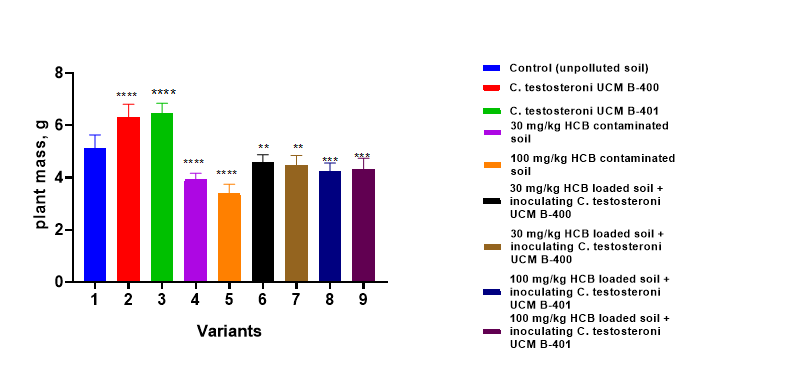
The obtained results demonstrate that introduction of studied strains in polluted soil exert the phytostimulating effect on plants, which is confirmed by the increasing of all biometric parameters, especially plant mass: by 17.5 and 20%, respectively for strains B-400 and B-401. In plants growing in HCB contaminated soil, growth inhibition was observed, it was most pronounced in the variants with 100 mg / kg HCB: the plant mass was decreased by 46% compared to control plants without HCB-loading (Figure 1).
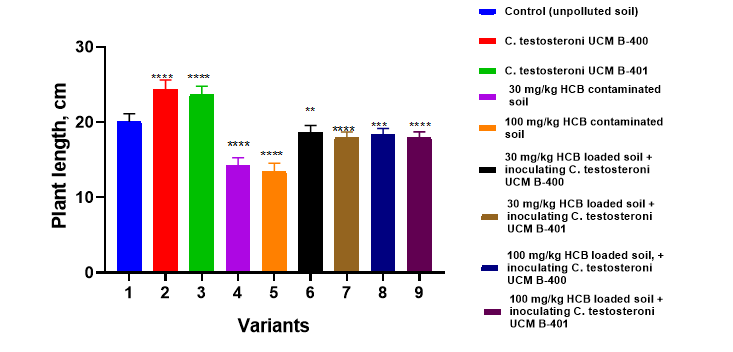
The plant length increased to 15 –18% compared to control. Also, in the variants from polluted soil, the plant length decreased by 29 and 33%. At the same time, in the variants with biougmentation, this value decreased by 3 – 8% (Figure 2).
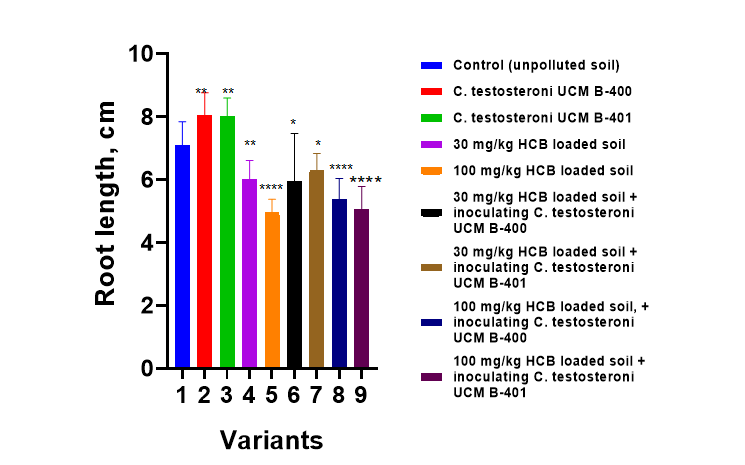
The maximum increase in root length, which was 10% in the variant with the introduction of C. testosteroni UCM B-400 without contamination was observed. The greatest suppression by this indicator - 27%in the variant with 100 mg / kg HCB polluted soil was observed (Figure 3).
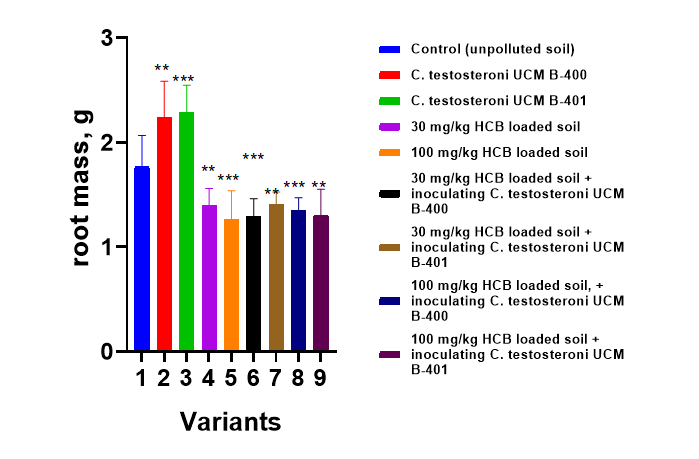
The C. testosteroni culture liquid introducing into the polluted soil reduced the negative impact of the pesticide load. Thus, compared to plantsgrowing in contaminated soil withoutbacterial introducing, under using C. testosteroni UCM B-400, the root mass increased by 19 and 24%, respectively, for 30 and 100 mg / kg HCB. UsingC. testosteroni UCM B-401 strain increased the roots mass, in the variant with 30 mg / kg up to 24.4%, and in the variantwith 100 mg / kg HCB up to 14.6% (Figure 4).
Nevertheless, all biometric indicators were lower to 7.5 – 23% compared to plants growing in unpolluted soil.
Chlorophyll content is one of the main indicators of the leaf ability to photosynthesis and plant health. Under conditions with Comamonas testosteroni biougmentation, the level of chlorophyll increased by 65%, which indicates an inhance in the photosynthesis level. However, under conditions with HCB contamination, the chlorophyll content decreased by almost 40% compared to the control. Under the conditions of tomato germination in HCB-loaded soil with following inroducing C. testosteroni, the level of chlorophyll was equality to control plants from uncontaminated soil. That is, Comamonas testosteroni UCM B-400 and B-401 promotes stress resistance of plants, and on the other hand reduces the pesticide load, which also improves the conditions for plant development. Regarding the tomatoes resistance level to phytopathogens, it nesessery to note that it was observed both to Alternaria alternata UCM F-16866 and to Clavibacter michiganensis subs. michiganensis UCM Ac-629. Under conditions of inoculating C. testosteroni strains, resistance to Clavibacter michiganensis increased to 28 – 36% compared to control. In variants with HCB loading followed by thebacterial suspensions introducing, an increase in resistance to Clavibacter michiganensis UCM B-629 to 8 – 16% was observed. Resistance to Alternaria alternata UCM F-16866 up to 32% in variants with biougmentation without contamination was observed. Also, tomato leaves resistance in variants with bioaugmentation of HCB-contaminated soil, up to 20 – 28% compared to control was observed.
Discussion
The studing results showed a positive effect of twoC. testosteroni strains on plant development. Determining the number of ecology-functional groups in soil microbiocenosis showed that C. testosteroni influences its structure. Thus, a study Sun X, et al. [12] reported the introducing these bacteria into soil contaminated with polycyclic aromatic hydrocarbons (PAHs) and as a result showed that C. testosteroni increases the interaction between bacteria capable to destroy PAHs. Gentry and co-authors Tan WA, et al. [13] studied the effectiveness of bioaugmentation of C. testosteroni in 3-chlorobenzoate contaminated soil and showed that the target strains not only reduced the toxicant content but also reduced the negative impact on the resident soil microbiota. Theour study results also showed a change in the structure of the microbiocenosis after the introducing strains into the soil, even contaminated with HCB, which promoted to improving soil quality.
Khalofah and co-authors Vítková, et al. [14] showed a positive effect on the development of Linum usitatissimum L. plants under oxidative stress. C. testosteroni increased the level of photosynthetic pigments. C. testosteroni also promoted to the formation of soluble sugars, proline and soluble proteins, and oxidative stress levels such as H2O2 and malonic dialdehyde decreased.C. testosteroni bacteria were isolated from durum wheat fields [15] and after studying their biological properties, found that they are able to transform insolublephosphate forms, potassium and zinc and were recommended as inoculants to increase plant productivity. Our study also showed an increase in biometric indicators of tomatoes, as well as chlorophyll in the presence of C. testosteroni bacteria in the soil [16].
Conclusions
- Biougmentation of C. testosteroni UCM B-400 and B-401 strains into the HCB-polluted soil improves conditions for plant development, has a phytostimulating and protective effects on tomatoes of cultivar “Lagidniy”.
- The C. testosteroni B-400 and B-401 strains culture liquid introducing into the HCB-polluted soil reduced the negative impact of the pesticide load on tomato plants.
- The introducing bacterial cultures liquids into the HCB-loaded soil increased the plant resistance to phytopathogens Alternaria alternata UCM F-16866 and Clavibacter michiganensis subs. michiganensis UCM Ac- 629.
References
-
Cheng Z, Chen M, Xie L, Peng L, Yang M, et al. (2015) Bioaugmentation of a sequencing batch biofilm reactor with Comamonas testosteroni and Bacillus cereus and their impact on reactor bacterial communities. Biotechnol Lett 37(2): 367-373.
-
Dimova MI, Yamborko NA, Iutynska GO (2020) Hexachlorobenzene Effect on Microbiocenoses of Different Soil Types. Mikrobiol Z 82(4): 13-22.
-
Geng Z, Yu Y, Zhu S, Yu H, Liu J, et al. (2017) Comparing polyethersulfone and polyurethane-immobilized cells of Comamonas testosteroni QYY in treatment of an accidental dye wastewater. Chem Res Chin Univ 33(1): 36-43.
-
Gentry TJ, Newby DT, Josephson KL, Pepper IL (2001) Soil microbial population dynamics following bioaugmentation with a 3-chlorobenzoate-degrading bacterial culture. Bioaugmentation effects on soil microorganisms. Biodegradation 12(5): 349-357.
-
Gritsayenko ZM, Gritsayenko AO, Karpenko VP (2003) Methods of biological and agrochemical studies of plants and soils. Kyiv CJSC «Nichlava», pp: 320.
-
Ghosal D, Ghosh S, Dutta T, Ahn Y (2016) Current State of Knowledge in Microbial Degradation of Polycyclic Aromatic Hydrocarbons (PAHs): A Review. Front Microbiol 7: 1369.
-
Khalofah A, Kilany M, Migdadi H (2021) Phytostimulatory Influence of Comamonas testosteroni and Silver Nanoparticles on Linum usitatissimum L. under Salinity Stress. Plants (Basel) 10(4): 790.
-
Krayntsburg-Eggert D (1973) Novyy metod opredeleniya effektivnosti fungitsidov protiv fitoftoroza kartofelya [A new method for determining the effectiveness of fungicides against potato late blight]. Sel’skoye khozyaystvo za rubezhom 5: S52-S56 (in Russian).
-
Liu L, Jiang CY, Liu XY, Wu JF, Han JG, et al. (2007) Plant and microbe association for rhizoremediation of chloronitroaromatic pollutants with Comamonas sp. strain CNB-1. Environ Microbiol 9(2): 465-473.
-
Nguyen OT, Ha DD (2019) Degradation of chlorotoluenes and chlorobenzenes by the dual-species biofilm of Comamonas testosteroni strain KT5 and Bacillus subtilis strain DKT. Ann Microbiol 69: 267-277.
-
UN environment programme (2019) Stockholm Convention on persistent organic pollutions (POPs).
-
Sun X, Li X, Cui Y, Jiang Z, Wang Q, et al. (2021) Interaction with Edogenous microorganisms, Comamonas testosteroni enchanced the degradation of polycyclic aromatic hydrocarbon in soil. Research Square.
-
Tan WA, Parales RE (2019) Hydrocarbon Degradation by Betaproteobacteria. In: McGenity T (Ed.), Taxonomy, Genomics and Ecophysiology of Hydrocarbon-Degrading Microbes, Handbook of Hydrocarbon and Lipid Microbiology. Springer Cham 96: 9-18
-
Marianna V, Katarína D, Jana M, Lívia T (2011) The Effect of Lignite and Comamonas testosteroni on Pentachlorophenol Biodegradation and Soil Ecotoxicity. Water, Air Soil Pollut 218(1-4): 145-155.
-
Wu Y, Zaiden N, Liu X, Mukherjee M, Cao B (2020) Responses of Exogenous Bacteria to Soluble Extracellular Polymeric Substances in Wastewater: A Mechanistic Study and Implications on Bioaugmentation. Environ Sci Technol 54(11): 6919-6928.
-
Khanghahi MY, Strafella S, Allegretta I, Crecchio C (2021) Isolation of Bacteria with Potential Plant-Promoting Traits and Optimization of Their Growth Conditions. Curr Microbiol **78**: 464-478.
- Antifungal Activity of New Acetophenone Derivatives
- Interconnected Microbiomes Human Health Within an Environmental Framework
- Silkworm-Based Vaccine Production for H5N1: A One Health Approach to Pandemic Preparedness
- Microbial Diversity and Lipolytic Activity of Bacteria and Fungi from Oil-Contaminated Sites in Makurdi Metroplois
- Antibiotic Resistance Profile of Bacteria Isolated at the Central Laboratory of the National Hospital Center of Nouakchott
- Epidemiology and Sensitivity to Antibiotics of Germs Isolated from Blood Cultures in the Laboratory of the National Hospital Center of Nouakchott-Mauritania