
Assessment of the Availability of Public Health Veterinary Services towards Rabies, Namibia 2020
Background: Rabies is a neglected zoonotic viral disease that occurs worldwide expects Antarctica. Rabies is an endemic throughout the world and they mostly affect poor and vulnerable population who live in remote areas. Death is rarely reported and human vaccine and immunoglobulins exist for rabies, however they are not accessible to the needy people. About 60 000 people die per year mostly in Africa. Domestic animal especially dogs are responsible for transmission of the virus through bites, scratches or saliva. Clinical symptoms may include unexplained tingling, fever, headache, and confusion. As the virus spreads to the central nervous system fatal inflammation of the spinal cord and brain develops. Rabies cause short and long term illness such as paralytic, hydrophobia. Methods: a scoping reviewed and data were collected from five databases namely: PubMed central, biomedical central, HINARI, Google scholar and EBS Cohost. Only articles from 2010-2020 were used and only ten articles were search or meet the objectives of the study. Results: The studies conducted revealed that more effort was done on delivering vaccine to the communities, the educational campaigns were done accordingly. Although educational programs were provided and other public health services it’s discovered that 74% of dog’s owners expressed their knowledge and 24% have never heard about rabies and never took their dogs for vaccine. Conclusion: Local vaccination campaign should make an effort to eliminate the spread of rabies between dogs and human, dog to dogs. Awareness campaign and educational programs should focus more on providing the right and updated information in order to reduce the spread of rabies in human and dogs. In a view of the Public Health importance of rabies, the government, NGOs and community people need to put more effort on the prevention and controlling rabies by making sure dogs are vaccinated against rabies, dog’s owners are given all the information on rabies so that they can help meet the government halfway on fighting rabies.
Introduction
Rabies is a deadly virus spread to people from the saliva of infected animals. The rabies virus is usually transmitted though bite, and are the common causes of rabies worldwide. Mostly rabies virus is spread through the saliva if infected animals, infected animals can spread the virus by biting another animal or person and in rare cases rabies can be spread when infected saliva gets into an open wound or the mucous membrane such us mouth or eyes. Any animal can transmit rabies but there ones mostly transmit rabies to human are cats, dog’s goats and cows. Once a person is bitten by an animal with rabies she or he can show symptoms such as flu that last for days, fever, headache, nausea, vomiting, confusion, hallucinations, insomnia, hyperactivity, agitation and difficult to swallow [1, 2, 3].
About 99 % of cases, domestic dogs are responsible for rabies virus transmission to human, although rabies affect both domestic and wild animals. Rabies can be transmitted to animals and people through bites or scratches, usually in saliva. More than 29 million people worldwide receive a post –bite vaccination every year, and this is estimated to prevent hundreds of thousands of rabies death annually. There are prevention measure toward rabies are such follows, eliminating rabies in dogs this is by vaccinating dogs and this is the most effective strategy for preventing rabies in people. Awareness on rabies and preventing dogs bite, this is by giving health education about rabies and immunizations of people this is used to immunize people after an exposure or before exposure to rabies. Furious rabies and paralytic rabies are two forms of rabies diseases and they are part of signs and symptoms of rabies. Furious rabies is characterized by hyperactivity and hallucinations, while paralytic characterized by paralysis and coma [4].
Rabies in human in Namibia is mostly occurs in the northern part of the country. Children up to the age of 16 are most affected, representing 83 % of all human rabies cases [5]. According to the data that was submitted to SEARG, in 2012 a total number of 177 cases of animal with rabies were laboratory confirmed, of which of 50 was dogs, 87 other domestic animals and 40 wildlife [6]. In January 2012 57 dogs died of rabies, 174 domestic animals of which `145were cattle and 24 wildlife [7]. Between 2007and 2012 62 people died from rabies in Namibia, with the Okavango region having highest number of 15 cases [8]. Data submitted to the OIE reported that 13 human rabies cases from the year 2010 and 2011. According to the data that was collected, there was a reduction of cases from over 90 cases in 2015 and 2016 and to 34 cases in 2018. Human rabies death showed also a declining trend, from 23 cases in 2015, 13 cases in 2016, six cases in 2017 to only one cases in 2018. During the year 2017 and 2018 61. 3 % and 52. 6 % dogs were vaccinated.
The vaccination coverage year 2017 was estimated to range between 26 % and 74 % depending on the region, with the highest coverage. According to Ohangwena region state veterinary annual vaccination reported that (2011-2013) there was 74 % of vaccination coverage was recorded in the region. In addition, 112 deaths of animal and 13 humans respectively in Ohangwena. About 77 % of dogs in 2017 received their first time vaccine and for the second time was about 19 percent.
Methods
Databases such as PubMed central, EBSCohost, Google scholar, HINARI and Biomedical central were used for article that were published in 2010-2020.Arksey and O’ Malley framework was used to identify relevant studies. PRISMA flow diagram was used, quantitative and qualitative study as well as systematic reviews was conducted to address the research questions. The researcher identifies the articles that met the inclusion criteria. The study areas was Africa, therefore the researcher searched all the articles that were published in Africa. The population was the articles that were published on Africa about the availability of Public Health veterinary services toward rabies. The population of the study was 5,485 articles that were identified on the databases. In this study the samples are the 10 articles that met the eligibility criteria. Sampling was done using the PRISMA flow diagram
Data Collections
Data was collected using inclusions criteria and data extraction tool and different search study as follows: Public Health veterinary services AND rabies in Africa, Availability of Public Health veterinary services AND rabies, Rabies AND the availability of Public Health veterinary service in Africa, Assessing the availability of Public Health veterinary services towards rabies in Africa.
Results
The search strategies were used and was collected from five databases namely Biomedical Central, Google scholar, HINARI, EBSChost Web and PubMed central. The database search reveal 5485 research articles and after removing the duplicate and that did not meet the eligibility criteria, 30 articles remained for data extraction and data analysis. Most of the articles indicate that the educational program regarding rabies is not always provided however one study indicates that veterinary workers always try to provide information or health education to people especially school kids. Some articles indicate that more effort was done when it comes to deliver vaccine to the communities from 2015- 2017. Number of domestic dogs vaccinated increased each year from 743 in 2015 to 4080 and 8332 in 2016 and 2017 respectively.
From 2015- 2017 vaccination campaign were active and was financed to make sure outreach point were reached for both vaccine and educational health. Through community outreach health education was discovered that 74% of dog’s owners expressed their knowledge while 24% have never heard of rabies and never vaccinated their dogs, therefore a total of 4 human deaths were recorded in every five communities they visited. The prevalence of rabies positive cases was recorded as follows, 62% were recorded from the dogs with rabies, and 60.6% was recorded from female and 69.8 % from male, dog’s owner 55.7% and stray 74.3%. This was recorded from June – December 2011 by demographic characteristics. Most of the public health services are available especially the vaccine and campaign, people are ignorant and fewer of them do not understand Table 1.
| Female | Male | |
|---|---|---|
| Positive cases | 69.80% | 60.60% |
| Dogs owners | 27% | 23% |
| Dogs positive cases | 62% | |
| stray | 74.30% | |
Table 2: Percentage of rabies cases among dog’s owner, stray and dog’s owners.
It was founded that not all studies achieve or use the public health veterinary services toward rabies in terms of availability of vaccine, trained personnel, educational program and rabies campaign. Some studies indicated that some only use one or more of this public health veterinary services as shown in the Table 2 below.
| Number of studies (n=10) | |
|---|---|
| Availability of vaccine | 10 |
| Trained personnel | 10 |
| Educational programs | 5 |
| Campaigns (education vaccine) | 3 |
Table 1: Number of studies used Public Health veterinary services.
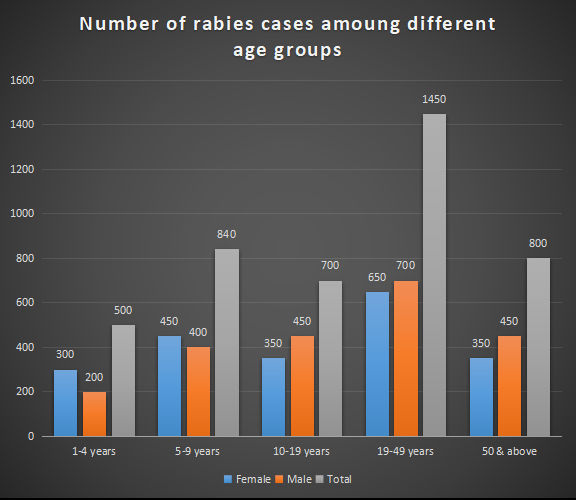
The Figure 1 below shows the number of people got bitten by rabid dogs from the age 1-4 years and 50 and above, and their total number of each age group.
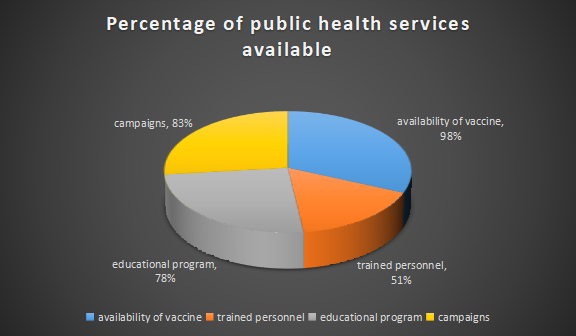
The Figure 2 below shows the overall total percentage of public health veterinary services towards rabies from the ten studies that were screened. Its indicated that the availability of vaccine was available 98 % and that what most of the study indicates as a best and effective way of preventing rabies among dogs to human or dogs to dogs. Campaign are not seemed to be done only about 4 (51%) study that indicates them and help them easily identify rabid dogs in the community and also do health promotion and education.
Discussion
Rabies remains a public health problem therefore it needs to be considered in order to eliminate the spread of rabies. The aim of this study was to find out the public health veterinary services towards rabies that available and if they are available are they useful and are the people make use of them. Studies indicate the public health services being offered and how useful they were. Studies shows that dog’s owner are ignorant because the studies stated that about 50% of dog’s owner know about rabies and some of them have experience confirmed rabies cases among their dog however the seemed to be careless about the danger of rabies. Even though the services are available community people are not using the services and services providers are mostly only available for campaigns. The studies show that the purpose of keeping dogs is for safety by protecting their houses or business premises.
A finding indicates that children aged less than 10 years were the affected. this can be explained by the fact that children tend to be curious and have inadequate knowledge about dog behavior, although overall we found more men (51.2 5%) to be bitten by dogs than women, with age were observed a consistent progressive, similar trend was reported in studies in Nigeria and South Africa it might be due to increased dog ownership or outdoor activities. A well-coordinated effort at Public education, mass dog vaccination and strategic deployment of PEP should lead early elimination of rabies. Some dogs are poorly fed and are forced to move around and searched for food in the neighbor. The dog’s owners know about the vaccination against rabies but do not take their dogs to veterinary clinics for rabies vaccination which is indicative of the low rabies vaccination coverage and is to be said they prefer traditional treatment which is not effectives, people and dos end up dying. From 2015- 2017 vaccination campaign were active and was financed to make sure outreach point were reached for both vaccine and educational health.
Most of the study indicate available of vaccine as the most effective way of eliminating rabies and educational program and campaign are mostly done when they start doing outreach points for vaccine, county such as Ghana indicated that health promotion and campaign was the main target in year 2015-2017 in order to fight against rabies virus, therefore it was easy for them to know what are the contributing factors and it was founded that dog’s owner are ignorant and some never heard about rabies before.
Conclusion and Recommendation
In conclusion local vaccination campaign should make an effort to eliminate the spread of rabies between dogs and human, dog to dogs. Most of the studies find out that knowledge, attitude and practice toward rabies are the most that are contributing to rabies. It’s also included that most of the dog’s owners only keep dogs for protection and do not really mind about taking them for vaccine it’s indicated that about 46 % of the dogs do not get vaccine. Awareness campaign and educational programs should focus more on providing the right and updated information in order to reduce the spread of rabies in human and dogs. In a view of the Public Health importance of rabies, the government, NGOs and community people need to put more effort on the prevention and controlling rabies by making sure dogs are vaccinated against rabies, dog’s owners are given all the information on rabies so that they can help meet the government halfway on fighting rabies. Education is indicated to be useful method to improve attitude toward dogs and animal welfare. Education can also increase awareness of rabies and it is contributor that could reduce the incidence of the diseases in human and dogs by the increases of people knowledge about the important of vaccine. Community people should volunteer so they help the government in order to fight against rabies in people and dogs. Simple massages such as “vaccinate your dogs against rabies, immediately wash your wound with soap and running water and seek for anti-rabies vaccine after a bite from a dog, burn or burn the carcasses the rabid dog” and this can be done through government and community network. All public veterinary services need to be provided and making sure the community people make use of it. The ministry of health and social services and the veterinary workers need to use different channels to reach the community people. Health promotion at school should be done regularly.
References
-
Ferri FF (2019) Ferris Clinical Advisor 2020. 1st(Edn.), Elsevier, USA.
-
CDC (2020) Rabies vaccine information statements. Centers for Disease Control and Prevention.
-
Rabies. Centers for Disease Control and Prevention.
-
Namibia: Rabies Cost Farmers Millions.
-
SEARG (2013) Namibia country report.
-
OIE World Animal Health Information System, World Organization for animal health.
-
Namibian Broadcasting Corporation (2013) Rabies, a concern in Namibia.
- Antifungal Activity of New Acetophenone Derivatives
- Interconnected Microbiomes Human Health Within an Environmental Framework
- Silkworm-Based Vaccine Production for H5N1: A One Health Approach to Pandemic Preparedness
- Microbial Diversity and Lipolytic Activity of Bacteria and Fungi from Oil-Contaminated Sites in Makurdi Metroplois
- Antibiotic Resistance Profile of Bacteria Isolated at the Central Laboratory of the National Hospital Center of Nouakchott
- Epidemiology and Sensitivity to Antibiotics of Germs Isolated from Blood Cultures in the Laboratory of the National Hospital Center of Nouakchott-Mauritania