
Role of Rhizosphere Microbiota of Plants Growing in Heavy Metal Contaminated Environments as Ecofriendly Decontamination Bio-Tools and their Role in the Context of Human Health – A Short Review
Air, soil and water resources of our world are contaminated by heavy metals (HMs) via agricultural, urban, industrial, mining and smelting human activities which are threatening human health causing various human health issues such as sleeping disorders, kidney damage, tubular damage in various human organs, stomach cancer, heart diseases, brain damage and various neurological disorders, lung damage, anxiety/depression, etc. Various physio-chemical and biological decontamination mechanisms and strategies are being proposed for decontamination purposes, involving habitat-adapted plants growing on such contaminated sites and their rhizosphere associated microbiota, i.e. Phyto degradations or breakdown of HMs by Nanoparticles (NPs) synthesised by plant-root tissues and their associated symbiotic microbiota including Plant Growth Promoting Microbes (PGPM) and universal and ubiquitous Arbuscular Mycorrhizal Fungi (Nano-Mycorrhizo-Phyto- Remediation-NMPR). This phenomenon has recently attracted much research attention and it could be adapted for a variety of environments with no added cost or any special requirements to remediate land and water ecosystems, including indoor closed areas like high rise buildings, Gardens, and Parks, aquaria, etc. Plants growing in the HM-contaminated soil or water ecosystems and their root-associated microbiota offer an environmentally green-clean technology for air, soil and water purification and bio-decontamination measures. This short review discusses the use of plants and their root associated microbiota as a novel line of inquiry, i.e. use of ecofriendly bio-tools for bio-decontamination of heavy metal contaminated ecosystems and their role in the context of human health.
Introduction
During the last century, the Earth’s spheres (Biosphere, Lithosphere, Hydrosphere, and Atmosphere) are being contaminated at an alarming rate by several contaminants such as organic and organometallic contaminants, radioactive isotopes, gaseous pollutants and nanomaterials, etc. due to man’s mining, agriculture, industrial practices and processes activities, in addition to the natural anthropogenic sources [1]. Among the pollutants, the heavy metals (HMs) such as chromium, nickel, cadmium, lead, etc. and metalloids such as arsenic are the major cause of threats to our environments due to them being non-biodegradable, persistent, and accumulative [2]. These elements are naturally present in the earth’s crust as well but, due to human activities, their concentrations in all kind of environments have increased to alarming levels and upon their entry into food chain these heavy metals affect the metabolic processes of organs and organelles like mitochondria, nuclei, endoplasmic reticulum, etc. of living organisms [2]. However, a few of these elements such as iron, zinc, cobalt, copper, etc. also act as micronutrients for animals and plants and their deficiencies may cause diseases in plants and animals. On the contrary, an access of these elements may have toxic effects.in living organisms.
Roots of plants growing in agricultural, industrial, polluted, aquatic (creeks, river "banks" in stationary or slow flowing fresh or brackish waters in swamps, creaks, drains and channels, and in seeping areas), derelict terrestrial habitats (industrial sites, deserts, aquatic habitats, etc) are found to be occupied by universal and ubiquitous symbiotic arbuscular mycorrhizal fungi (AMF) and AMF spores were recovered from the sediments and soil [3, 4]. These beneficial Plant Growth Promoting Rhizobia (PGPR, and AMF rhizosphere microbes), effect plant growth directly by N-fixation, P-solubilization, siderphores / phytohormones production or indirectly by biocontrol activities and tolerance to abiotic stresses. PGPR and AMF are well researched by scientists over the last few decades and their role as biological fertilizers in reducing the utilization of chemical fertilisers and as bioinoculants, and their effectiveness in improving plant production and yield are now well established. This minireview aims at exploring [1] the potential sources of HMs pollutants in the environment [2]. This mini review aims at (1) exploring the potential sources of HMs pollutants in the environment; (2) the role of the rhizosphere microbiota of the plants growing on these HM-contaminated sites in human health; and (3) various biotechnology strategies involved in decontamination of such polluted ecosystems.
Potential Sources of HM-Pollutants
HM-pollution in the air, water, and soil environments is caused by both natural (volcanic activity, erosion and weathering of minerals, forest fire, etc) and man-initiated anthropogenic activities such as industrial, mining and smelting of metalliferous ores, and using HM-containing compound for domestic, agricultural and horticultural applications such as pesticides, paints and pigments, tanneries, coal combustion, domestic, municipal and industrial effluents, aerial emissions from combustion of leaded fuels, batteries waste, etc.) . Human population growth in the world demanded more food which was met by intensive use of chemical fertiliser and protection of horticultural and agricultural products from pathogens by use of chemicals such as pesticides worldwide. These practices resulted in agrochemical residues in soil, water and air environments, which had toxic effects on human and non- human biota [5]. HMs can enter the ecosystem by deliberate/ unintended anthropogenic actions such as oil spills, mining and smelting, fires, application of sewage sludge, coal combustion, etc. Various physical and chemical factors such as pH, temperature, speciation, temperature, movement, speed and direction of wind or waters, solubility, availability, mobility, etc., influence the mobility and distribution of HMs [6]. These contaminants are a significant threat to all aquatic, terrestrial and aerial environments and affect the overall dynamics of the atmosphere.
HMs and Human Health
HMs are non-biodegradable and their abundance play an important but on binding with the active element within a cellular protein, they bioaccumulate in human systems and become toxic in large amounts causing physiological complications and damage to nucleic acids (i.e. neurotoxicity of nervous system damaging neurons and inhibiting neurotransmitter), and their repair mechanisms, misfolding or aggregation of proteins (enzymes), and damaging cell membrane lipids, i.e. resulting in cell damage, cellular function loss, and even carcinogenesis [7, 8]. These authors have tabulated the classification, uses, properties of various HMs and their thresholds and provided a detailed description of the toxicology and pharmacokinetic processes of various HMs such as Aluminium, Vanadium, Chromium, Manganese, Cobalt, Nickle, Zinc, Copper, Molybdenum, Arsenic, Silver, Cadmium, Selenium, Mercury, etc [7]. The chemistry of HMs contributes important implications within the human- ecological context. Recently, Nkwunonwo, et al. [9] reviewed the health implications of HMs in food chain in Nigeria and reported that the major staple foods are the major host of carcinogenic and mutagenic components of HMs. Recently, Ali, et al. [6] reviewed the sources of HMs in the environments and stated that the rising degree of environmental pollution with HMs raises a concern and need to be recognised and addressed by public authorities as prolonged exposure and increased accumulation of toxic HMs in our environments is a Public Health issue.
Rhizosphere Microbiota of Plants Growing on HM-Contaminated Sites
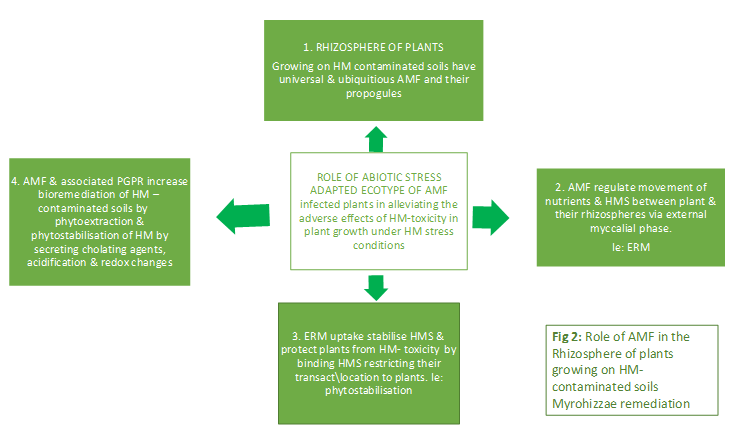
In addition to providing nutrients to plants, rhizospheres of plants growing on contaminated sites, the microbes such as AM Fungi and Plant Growth Promoting Rhizobia (PGPR), can improve the soil structure, increase decompositions rates, act as bio-protectant against phytopathogens by producing cell wall lysing enzymes and antibiotics. Extrametrical fungal hyphae of AMF also play a role in absorption, sequestration, and translocation of substrate contaminants such as Heavy Metals (HMs) in mycorrhizal plants [10]. Besides various free- living N-fixing bacteria (Pseudomonas, Bacillus spp.), many symbiotic bacteria (Rhizobium, Frankia spp.),P-solubilizing/ mobilising bacteria (Pseudomonas, Bacillus sp.), and fungi (AMF, ectomycorrhizal fungi, Orchid fungi), act as beneficial rhizosphere microbiota capable of converting unavailable forms of N and P into available forms of nutrients, and acting as biofertilizers [5, 11]. They occur in the rhizoplanes and rhizospheres, or even in the roots and exert beneficial effects on plant growth, and cause N-fixing root nodules in legumes where symbiotic biological N-fixation occurs via their enzyme reducing N-gas into nutrients. In addition to N-fixation, these microbes cause P-solubilisation, produce phytohormones and siderophores. Indirectly, these rhizobia microbiota assist their associated plants in reducing abiotic stresses, controlling soil/root pathogens by producing antibiotics.
Although rhizobia commonly existing within the root-nodules of the leguminous plants growing on HM contaminated sites is a common phenomenon, but it is also now becoming evident that, besides Rhizobium, there are many other bacteria co-existing within the nodules, but their significance or role in biological N-fixation is still unclear [12] and papers cited therein. These non-pathogenic microbes within leguminous root nodules as endophytes could be enhancing the N-fixing processes in legumes [13].
HMs Decontamination Strategies
HM contaminants are notoriously persistent in the environment and various physio-chemical and bio-remedial strategies are employed to decontaminate as below [14]:
Physio-Chemical Strategies
Excavation and Land Filling: It is a “suck, muck and truck strategy” involving removing HM-contaminated solid waste, trucking it, dumping it in low value land, and leaving it to decompose. After completion of the landfill the site becomes useable for recreation and eventually for construction.
However, exposed waste causes various aesthetic and public health problems.
Physical Separation of Contaminants: Physically separation technique has been used commonly in the mining industry for many years. It involves the physical separation of discrete particles of HMs in the soil from each other based on certain particle characteristics such as density, size, surface properties, and magnetic properties.
High Temperature Thermal Treatments: These technologies apply high temperature treatment primarily to reduce the mobility of metals by their incorporation in a vitreous material such as stable oxide solid.
Polymer Microencapsulation: This involves application of asphalt and similar organic binders to treat HM contaminated substrate.
Pyrometallurgical Separation: It involves processing metals at high temperature to treat a metal contaminated solid for recovery of metals or other useful forms. It is an old established type of metal processing to extract useful metals from waste materials.
Slurry Reactors: In this strategy of remediation, the HM contaminated soil is excavated and treated as water-based slurry in a bioreactor. The potential for optimisation and the possibility for continuous-mode operation can minimise time and make it as an attractive remediation alternative.
Hydrolysis: HMs those are reactive with water like metal carbides, hydrides, amides, alkoxides, and halides, and non- metal oxyhalides and sulphides, are allowed to react with water under controlled conditions.
Chemical Extraction and Leaching: Chemical treatment of HMs in the contaminated substrates in co-precipitated forms with insoluble iron manganese oxides, to produce soluble forms which are then removed with the water.
Electrolysis: Electrolytic removal of contaminants, particularly reduced metals such as cadmium and nickel from wastewater contaminated by nickel/cadmium battery manufacturers using fibrous carbon electrodes from solutions, can be removed by this process.
Bio-strategies
Traditional physico-chemical strategies of clean up described above are often expensive, difficult and inefficient. Further-more these methods are detrimental to sediment and soil structures and fertility. The alternative biological approaches have arisen because these bio-strategies described below are safer, inexpensive, and environmentally clean.
Bioremediation: The ability of HM biodegrading microbes to remediate contaminated substrates can be exploited for remedial purposes. Several microbes such as Pseudomonas putida, Thiobacillus ferrooxidans have been tested and successfully applied.
Composting: Decomposition of organic matter in a heap by microbes is a microbial process that converts putrefiable organic waste materials into a stable, sanitary, humus-like product that is reduced in bulk and can be used for soil improvement. Compositing can be accomplished in static piles, aerated piles, or continuous feed reactors.
Phytoremediation: In Situ use of plants and their rhizosphere-associated microbiota to restore the derelict and polluted ecological ecosystems is an alternative strategy for decontamination of HM-polluted ecosystems and has been widely projected as environmentally safer and aesthetically acceptable option for remediation of HM contaminated ecosystems and is the focus of many recent studies. This is not a new concept; constructed wetlands, reed beds and floating-plant systems have been common for many years. There is now a need to promote the use of plants and their root associated microbiota under field conditions using site specific and environmentally adaptive plants and their rhizosphere microbiota to demonstrate the practicability and the efficiency of phytoremediation technology in remediation of HM-contaminated ecosystems [15, 16].
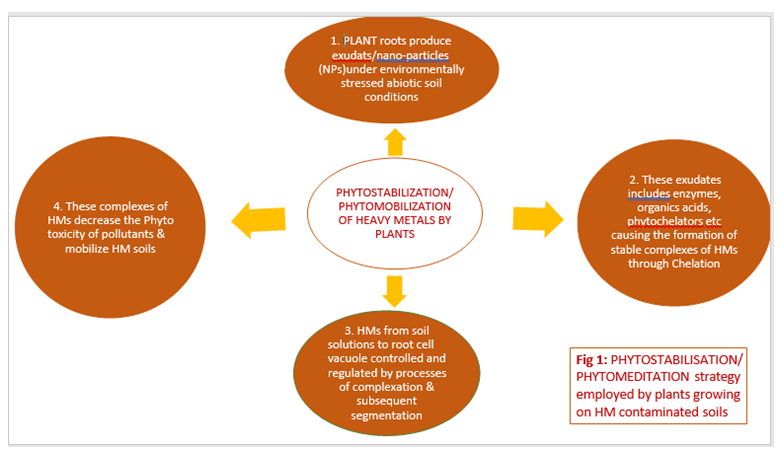
Phyto-decontamination strategies involve (1) Phytoextraction – where plants accumulates the contaminants and are harvested for processing to recover the metals; (2) Phyto-degradation – where plants and/or plant-associated microbiota convert pollutants into non- toxic materials; [3] Phytostabilization – where pollutants precipitate from solutions or are absorbed or entrapped in either plant tissues or the soil matrix. Sequestration can be enhanced either by amendments to the soil or through the action of plant and its microbiota [18].
Contaminated terrestrial and aquatic areas often support characteristic HM tolerant/adapted plant species growing in such HM-enriched environments. The potential exploitation of metal uptake and tolerance by plants can be enhanced by symbiotic and non-symbiotic rhizosphere microbiota (Plant Growth Promoting Rhizobia and Mycorrhizal Fungi) as a means of decontamination can be enhanced by inoculating plants with site specific-rhizosphere-microbiota. Application of such microbes in combination with plants increase plant growth and biomass and increase HM-extraction rates. The HM-tolerant plants and their rhizosphere microbiota work together to remediate soils contaminated with metals and metalloids and may also be employed for revegetation of HM-contaminated derelict lands such as mine wastes and tailings. This would also prevent further contamination of nearby soils by wind and water erosion. Rhizosphere ecotype PGPR and AMF from HM-contaminated site seem to be more tolerant to HMs than reference strains from un- contaminated soils. In recent years, many researchers have provided evidence in support of this (Zhu, et al.) [17].
Phytoremediation strategies basically involves (1) Phytofilteration – where plants accumulate contaminants and are harvested for processing; (2) Phytodegradation – where plants and/or plant associated microbes, convert contaminants into nontoxic materials; and (3) Phytostabilization-- where pollutants precipitate from solution or are absorbed or entrapped in either plant tissues or in soil matrix (Figure 1 & 2). Sequestration can be enhanced either by amendments to the soil or through the action of the plant and its microbiota.
Microbe-assisted Phyto-management Strategies
Phytoremediation and the microbes associated with roots, either symbiotically or free-living in the rhizospheres of the plants used for this purpose, has emerged an alternate strategy. 'Khan and Mohammad [18] reviewed the principles and application of this strategy, and provided an overview of the use of fast growing, non- food bioenergy plants, like hemp and vetiver grass, and their associated microbiota that can both tolerate and immobilize HMs in the roots, i.e. sequestrate contaminant HMs thereby protecting plants from metal toxicity. Various microbe-assisted Phyto management strategies, such as Crop Rotation, Co Cropping or Mixed Cropping, etc., have been proposed to employ rhizosphere microbiota for enhancing growth of plants used for nano- phytoremediation, increasing their biomass for bioenergy production purposes and thereby stabilizing heavy metal polluted terrestrial and aquatic ecosystems [18].
Crop Rotation
It is the planting of different crops sequentially on the same land to improve the physicochemical properties of the soil. An example of this strategy is growing leguminous root-nodule bearing crop like beans by fixing atmospheric nitrogen through rhizobacterial microbes in the root nodules, which is available for subsequent non-leguminous crops like wheat, oats, etc [19].
Co-Cropping or Mixed Cropping or Intercropping Strategy
Co cropping or mixed cropping involves plant two or more crops simultaneously in the same field to increase productivity and maximise use of land resources including their rhizosphere microbiome community. Fuksova, et al. [20] reported that co-cropped treatments in HM-contaminated soils resulted in abundant rhizosphere-associated microbes than their monocultures. These findings suggest that co-cropping strategies improve phytoremediation of contaminated soils. Under a greenhouse conditions these authors found that co-cropping enhanced phytoextraction potential of a co-cropping system. The potential of co- cropping in phytoremediation of agricultural soils has rarely been studied due to this strategy being labour-intensive and costly practice.
Cropping with Native HM-adapted Biota for In Situ Phytoemediation
Plant based bioremediation can further be enhanced with the use of Rhizosphere microbiota. The integration of (1) high biomass producing bioenergy crops, (2) HM- adapted site-specific rhizosphere microbiota, and (3) soil, will synergistically further improves the process of phytoremediation. As pointed out by Khan [5], role of indigenous microbiota play in the biodiversity and sustainability of soil an aquatic ecosystems is not fully explored and exploited for their enhanced phytoremediation [19].
Conclusion
- Globally, our air, water, and soil are subject to increasing heavy metal contamination due to natural and man’s anthropogenic activities. Although some of the HMs are essential elements, their deficiency in the ecosystem may cause diseases in plants and animal, including man. On the contrary, an access of these elements may have toxic effects in living organisms.
- Roots of plants growing in HM-contaminated terrestrial and aquatic habitats are found to be occupied by universal and ubiquitous endosymbiotic fungi and plant growth promoting bacteria which play an important role in directly or indirectly plant growth. These rhizosphere microbes of plants growing on HM-contaminated substrates received much attention by researchers during the last two decades and their effectiveness in improving plant growth and yield is now well established.
- This mini review discusses various physio-chemical and biological decontamination strategies and the role these microbes play in plant and animal health. Among the various biotechnological strategies involved in decontamination of such polluted ecosystems, special attention is given to phytoremediation as the environmentally safe plant-based techniques.
- It is proposed that the integration of high biomass producing non-food bioenergy crops such as cannabis and HM-adapted site-specific rhizosphere microbiota will synergistically further improve the process of phytoremediation. As pointed out by Khan [5], the role of indigenous microbiota in the biodiversity and sustainability of terrestrial and aquatic ecosystems is not fully explored and exploited for their enhanced phytoremediation property.
References
-
Guijarro RM, Paches M, Romero I, Aguado D (2021) Sources, mobility, reactivity, and remediation of heavy metal(loid) pollution: A Review. Adv Environ Eng Res 2(4): 1-30.
-
Tchounwou PB, Yedjou CG, Patlolla AK, Sutton DJ (2012) Heavy metal toxicity and the environment. In: Luch A (Ed.), Molecular, Clinical, and Environmental toxicology. 1st (Edn.), Basal: Spring, 101: 133-164.
-
Khan AG (1974) The occurrence of mycorrhizas in halophytes, hydrophytes and xerophytes, and of Endogone spores in adjacent soils. J Gen Microbiol 81(1): 7-14.
-
Khan AG (1993) Occurrence and importance of mycorrhizae in aquatic trees of New South Wales, Australia. Mycorrhiza 3(1): 31-38.
-
Khan AG (2020) Promises and potential of in situ nano- phytoremediation strategy to mycorrhizoremediate heavy metal contaminated soils using non-food bioenergy crops (Vetiver zizinoides & Cannabis sativa). Inter J Phytoremediation 22(9): 900-915.
-
Ali MM, Hossain D, Imran A, Khan S, Begum M, et al. (2021) Environmental pollution with heavy metals: A Public Health Concern. In: Heavy Metals -Their Environmental Impacts and Mitigation. IntechOpen. Open Access Peer Reviewed Chapter pp: 1-20.
-
Briffa J, Sinagra E, Blundell R (2020) Heavy metal pollution in the environment and their toxicological effects on humans. Heliyon 6(9): E04691.
-
Sarkar A, Kim JE, Islam ARMT, Bilal M, Rakib MRJ, et al. (2022) Heavy metal contamination and associated health risks in food webs – a review focuses on food safety and environmental sustainability in Bangladesh. Env Sci Poll Res Int 29(3): 3230-3245.
-
Nkwunonwo UG, Odika PO, Onyia NI (2020) A review of the health implications of heavy metals in food chain in Nigeria. Scientific World Journal 2020: 6594109.
-
Khan AG, Mohammad A (2022) Mass-production of Arbuscular Mycorrhizal Fungus Inoculum and its use for enhancing Biomass Yield of crops for food, for In Situ Nano-Phyto-Mycorrhizal-Remediation (NPMR) of contaminated Soils and Water, and for Sustainable Bioenergy Production. Chapter 14. In: Tonelli FPM, Bhat RA, Dar GH (Eds) Nanotechnology for Environmental Pollution Decontamination: Tools, Methods, and Approaches for Detection and Remediation. CRC Press, 2022.
-
Datta A, Singh RK, Kumar S, Kumar S (2015) An effective and Beneficial plant growth promoting soil bacterium ‘Rhizobium” A Review. Annals Plant Sciences 4(1): 933- 942.
-
Hidalgo PM, Hirsch AM (2017) A nodule microbiome: N2-fixing rhizobia do not live alone. Phytobiomes 1(2): 70-82.
-
Strurz AV, Christie BR, Matheson BG (1998) Association of bacterial endophyte populations from red clover and potato crops with potential for beneficial allelopathy. Canadian J Microbiol 44(2): 162-167.
-
Khan AG, Bari A, Chaudhry TM, Qazilbash AA (1997) Decontamination of Heavy Metal Polluted Soils and to Conserve the Biodiversity of Pakistan Soils. In: Mufti SA, et al. (Eds.), biodiversity of Pakistan. Pakistan Museum of Natural History, Islamabad, Pakistan & Florida Museum of Natural History, Gainesville, USA.
-
Wei Z, Le QV, Peng W, Yang Y, Yang H, et al. (2021) A review on phytoremediation of contaminants in air, water, and soil. J Hazardous Mat 403(5): 123658.
-
Olaoye PO, Olowe OM, Asemoloye MD (2022) Phytoremediation technology and food security impacts of heavy metal contaminated soils: a review of literature. Chemosphere 288(pt 2): 132555.
-
Zhu Y, Xu F, Liu Q, Chen M, Liu X, et al. (2019) Nanomaterials and plants: Positive effects, toxicity and the remediation of metals and metalloid pollution in soil. Sci Total Environ 662: 414-421.
-
Khan AG (2021) Potential of coupling heavy metal (HM) phytoremediation by bioenergy plants and their associated HM-Adapted rhizosphere microbiota (Arbuscular Mycorrhizal Fungi and Plant Growth Promoting Microbes) for Bioenergy Production. Journal of Energy and Power Technology 3(4): 1-14.
-
Yang Y, Xiao C, Wang F, Peng L, Zeng Q, et al. (2022) Assessment on the potential for phytoremediation of cadmium polluted soils by various crop rotation patters based on the annual input and output fluxes. J Hazar Mater 423(5): 127-183.
-
Fuksova Z, Szakova P, Tlustos P. (2009)Effects of co- cropping on bio-accumulation of trace elements in Thlaspi caerulescens and Salix dasyclados. Plant, Soil and Environment 55(11):461-467.
- Antifungal Activity of New Acetophenone Derivatives
- Interconnected Microbiomes Human Health Within an Environmental Framework
- Silkworm-Based Vaccine Production for H5N1: A One Health Approach to Pandemic Preparedness
- Microbial Diversity and Lipolytic Activity of Bacteria and Fungi from Oil-Contaminated Sites in Makurdi Metroplois
- Antibiotic Resistance Profile of Bacteria Isolated at the Central Laboratory of the National Hospital Center of Nouakchott
- Epidemiology and Sensitivity to Antibiotics of Germs Isolated from Blood Cultures in the Laboratory of the National Hospital Center of Nouakchott-Mauritania