
Quantum Dots in Diagnostics of Infectious and Non- Infectious Diseases: Current Scenario and Future Prospectus
Infectious and non-infectious diseases pose a tremendous challenge to global public health. Existing technologies for detecting infectious and non-infectious diseases are mostly tedious, expensive, and do not meet the World Health Organization’s (WHO) ASSURED (affordable, sensitive, specific, user-friendly, rapid and robust, equipment-free, and deliverable to end user) criteria. Early diagnosis of diseases can lead to effective control and early intervention of the patient's condition. Conventional approach for diseases diagnosis are including culture and microscopy, immunology (ELISA, fluorescent immunoassays, magnetic immunoassays, RIA, lateral flow immunoassays) and PCR have drawbacks like these are expensive, inaccurate, and require skilled technicians and time consuming process, especially for the earlier and rapid detection of infectious diseases. Over the past few decades, quantum dot have attracted widespread attention due to its immense potential in the area of diagnostic medicine for early detection of disease without relying on visible symptoms. This is largely due to their unique optical properties such as high brightness, narrow emission band, and resistance to photo bleaching, multiplexing capacity, and high surface-to-volume ratio and this will make them excellent candidates for intracellular tracking, diagnostics, in vivo imaging, and therapeutic delivery. In this mini review, we examine recent advances in the diagnosis of infectious and noninfectious diseases, which has based on quantum dot nanomaterial. The current state-of-the-art and most promising quantum dot based technologies, including, QD based Lateral Flow Immunoassay, Quantum dot-based paper strip devices, QD based biomarkers, QD based biosensor devices etc. Quantum dot based techniques, devices are promising accessories in modern biomedical applications, and these techniques will go to become the future of next-generation diagnostics.
Introduction
Diagnosis is preliminary towards improving the effectiveness of treatments for infectious and non-infectious diseases. There are different prospects of diagnosis: first is to confirm which disease the patient is suffering and the second is to investigate the susceptibility of a person for various diseases depending on the different age groups [1]. Existing technologies for detecting infectious and non- infectious diseases are mostly laborious, mostly expensive, and do not meet the World Health Organization’s (WHO) ASSURED (affordable, sensitive, specific, user- friendly, rapid and robust, equipment-free, and deliverable to end user) criteria [2]. Early diagnosis of threatening diseases can lead to effective control of disease spread and early intervention of the patient’s condition. Globally, about 1 in 6 deaths are due to detection of cancer in its late-stages and inaccessible diagnosis of cancer and other disease. Infectious diseases (viral, bacterial, fungal, and parasitic infections) with their infectious etiology cause around 4 million deaths each year around world. Though the non-infectious diseases (cancer, metabolic, neurological, and neonatal disorders) are not transmissible and contagious, they have emerged as a principal cause of illness and death globally, contributing to 71% of all deaths [1].
Infectious diseases are transmissible and communicable but proper precautions and sanitation can accessibly prevent their transmission and prevent people acquiring infections while non-infectious diseases has provoke by unhealthy lifestyle as well as maturing including genetic, physiological, environmental, and behavioral factors [3]. However, whether the disease is infectious or not, the treatment and healing entirely depend on its early and effective diagnosis. The conventional techniques like Microscopic techniques, immunosorbent methods ELISA, RIA, immunofluorescence and PCR though proved to be clinically significant, tend to display certain limitations such as lower sensitivity, low specificity, cumbersome nature, and high cost, time consuming process, imprecise results, especially for the earlier and rapid detection of infectious diseases and non- infectious disease [1].
To overcome these limitations there is a need of new diagnostic techniques. Over the past few decades, quantum dot have attracted worldwide attention in different scientific disciplines biomedical, physical, chemical. This is largely due to their unique optical properties such as high brightness, narrow emission band, large Stokes shift, and high resistance to photo bleaching, multiplexing capacity, high chemical stability, a wide excitation wavelength range and high surface-to-volume ratio and these properties will make them excellent successor for intracellular tracking, diagnostics, in vivo imaging, and therapeutic delivery [4]. A Quantum dot is an important semiconductor nanocrystal line material, which is mostly quasi-spherical in shape, with a diameter between 2 and 10 nm. Typically, there is different types of QDs composed of materials such as Group IV elements, Group II−VI elements (such as CdSe, CdTe, ZnS and ZnSe) and Group III−VI elements (such as InP and InAs) [5] and have enormous potential in the area of diagnostics for it can enable early detection of disease without relying on visible symptom [6].
Undoubtedly, QDs have become a powerful tool for bio tracking and bio detection for different infectious and non- infectious diseases. However, visible-light-emitting QDs are difficult to use for in-vivo imaging due to the strong absorption and scattering of visible light by tissues and it further increases the sensitivity to several magnitudes, and provides a high specific surface and hence provides high immobilization [7]. Thus, currently near infrared (NIR) QDs that can overcome these problems of unmodified QD, as well as auto fluorescence from biological components of cells, become auspicious in this field. Ag2X (X=S, Se and Te) QDs free of toxic metals are ideal options for the diagnosis [7] (Figure 1).
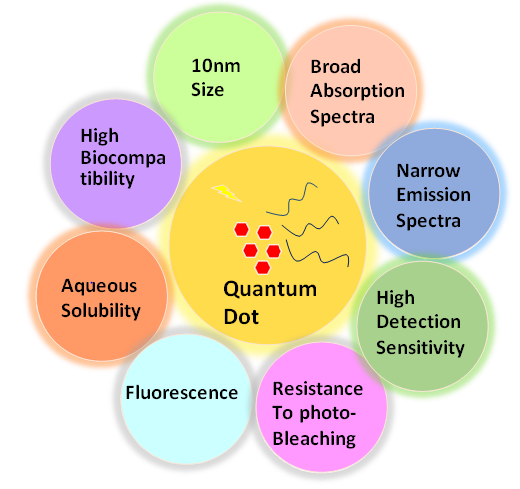
In this review, we focus on the recent inclination towards the quantum dot based techniques for infectious and non-infectious diseases, especially for the point of-care test (POCT). Nano diagnostics that have the most potential to fight against threatening diseases. We briefly introduce the diagnosis of infectious disease caused by Influenza viruses with Fluorescent semiconductor quantum dot (QD) nanocrystals based on localized surface Plasmon resonance (LSPR)- induced immunofluorescence Nano biosensor and other techniques used for the diagnosis of different type of infectious and non-infectious diseases. Moreover, discusses about the recent approaches and the development of novel and new approaches to diagnose and treat infectious diseases in the future (Table 1).
| Detection Method | Limit of Detection | Diagnostic Targets/Diseases | Additional Features | References | |
|---|---|---|---|---|---|
| 1 | Quantum Dot-Based Lateral Flow Immunoassay | 2 ng/mL, 0.016 HAU, lowest dilution of 12.5 pg/μL, 0.001 IU/mL, 1 pg/mL | Syphilis, influenza A virus tuberculosis, tetanus, and COVID-19 | Based on antigen-antibody interaction | [8] |
| 2 | Quantum dot-based immunochromatographic test strip | Concentration of labelled total bacterial protein was 3.9 mg/ml, the coating concentration was 2.0 mg/ml | Brucellosis | Based on antigen-antibody interaction | [9] |
| 3 | Quantum dot barcodes with microfluidics | 10-10-10-12 M (Pico molar) | (hepatitis B virus, HBV; Hepatitis C virus, HCV, and Human immunodeficiency virus, HIV) | Pathogen biomarkers were Hepatitis B surface antigen (HBsAg), HCV non-structural protein 4 (NSP4), and HIV glycoprotein 41 (gp41). | [10] |
| 4 | Quantum dot based Cell phone polarized light microscopy platform | Wide concentration range, from 103 to 107 pfu/mL, ~12 cysts per 10 mL | Virus, Giardia lamblia and other infectious and non-infectious diseases | Based on bio imaging | [11] |
| 5 | Quantum Dot Bio probe | 3ng/mL for dot assay and 0.5 ng/mL for FRET assay | Staphylococcus aureus | TNase based detection of Staphylocoaureus | [12] |
| 6 | Quantum-dots-based fluoroimmunoassay | 1.5 × 10⁻⁴ μg mL-1}$ | Avian influenza virus (AIV) subtype | Based on antigen-antibody interaction | [13] |
| 7 | Quantum dot based Electrochemiluminescence immunoassay “ECLIA” | 0.6 (U/mL) | Cancer | Based on biomarkers | [14] |
| 8 | Detection by QD based biomarkers | 1.68 × 10⁻²² μg mL-1, 0.082 picomolesper liter 1.341 picomolesper liter | Viral infections :-Coronavirus Disease—2019, Hepatitis B virus, Hepatitis C virus, | Based on biomarkers | [15] |
| 9 | Quantum dots based fluorescent biosensor | 0.09 pg. mL-1}$ | Small cell lung cancer | Based on biomarkers | [16] |
| 10 | Quantum dot-based paper strip | By naked eyes was 500 cfu mL-1}$ | E. coli O157:H7 | Visualized by fluorescent quenched band | [17] |
Table 1: Overview of detection methods based on quantum dot for infectious and non- infectious disease.
Infectious Diseases
Infectious diseases are mainly caused by pathogenic microorganisms including viruses such as human immunodeficiency viruses (such as hepatitis B virus, and hepatitis C virus, influenza), fungi, bacteria (such as tuberculosis and cholera), and parasites (such as malaria, leishmaniasis, and trypanosomiasis) that have an intense impact on humankind and animals because of their unique characteristics and specific pathologies [18]. In the 21st
century, there have been successive epidemic outbreaks and pandemics of viruses including severe acute respiratory syndrome coronavirus (SARS-CoV), Middle East respiratory syndrome coronavirus (MERS- CoV), Ebola virus, and severe acute respiratory syndrome coronavirus 2 (SARS-CoV-2) (the most recent) [1–3], all of the outbreaks give rise to a great challenge to global public health and economy worldwide [19].
More importantly, the frequent and widespread infectious diseases have caused progressive increase of morbidity and mortality rates in the developing nations with limited and slow diagnostic approaches towards these communicable diseases. Thus, there is an urgent need to develop new and novel diagnostic approaches to detect infectious diseases to stop the spread, secure public health, and promote rapid and best treatments. Nanotechnology has advanced the development of many fields because of the unique properties those are favourable for microorganism detection [18]. Evidently, the present modern-day biosensor mechanisms have great benefits, which offer extra precision, sensitivity, speed, specificity, and having ability to recognize a very low concentration of target biomolecules. One of the major infectious diseases has been cause globally by influenza virus and now days the diagnosis and treatment of this virus has become a big concern to the biomedical community. So furthermore, we briefly discuss about the Influenza virus and its diagnosis, which has based on quantum dot biosensor.
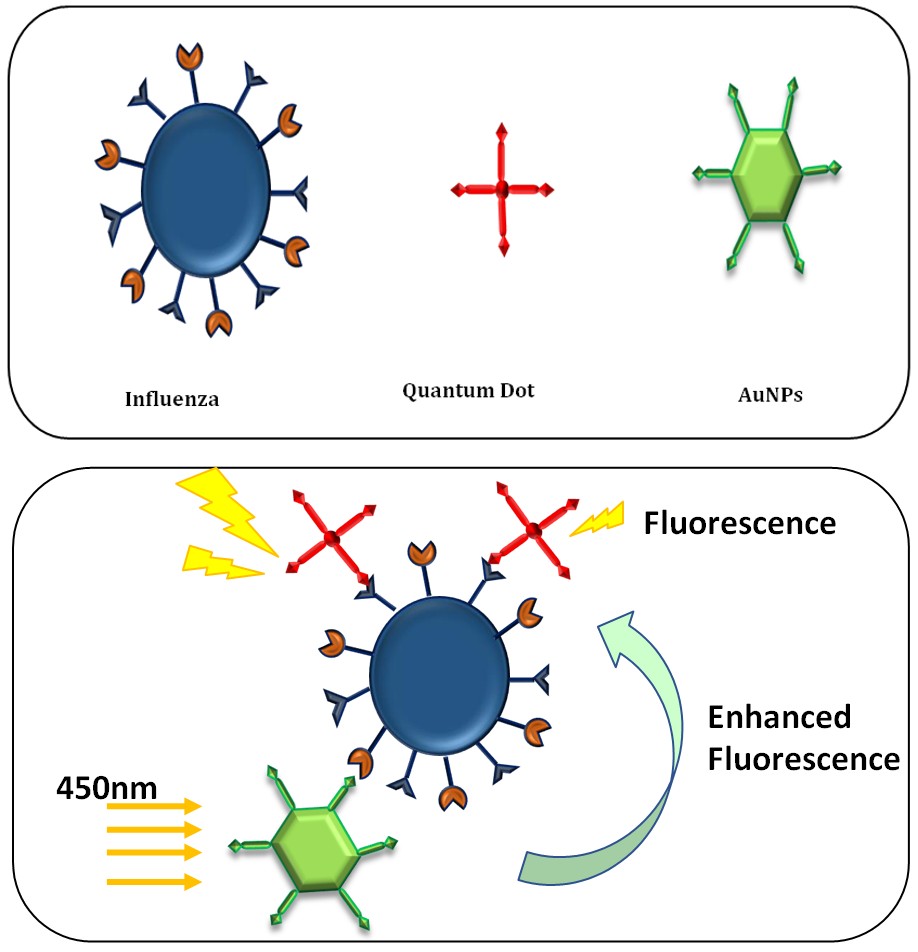
Influenza viruses have classified into three genera types, namely influenza virus A, B and C. Over them, influenza virus A is the most frequently disease-causing virus because it carries the infectious human pathogen and highly diversified and easily mutated within its genetic material [20]. Traditional diagnostic systems used for the influenza virus have certain limitations that have inspired the continuous development of efficient techniques. Fluorescent semiconductor quantum dot (QD) nanocrystals are been extensively used as fluorescence reporters in various biosensor designs. Therefore, by using fluorescent semiconductor, quantum dot (QD) nanocrystals an rapid ultrasensitive, and specific localized surface Plasmon resonance (LSPR)-induced immunofluorescence Nano biosensor has been developed for the influenza virus which basically based on a gold nanoparticle (AuNP)-induced quantum dot (QD) fluorescence signal (Figure 2).
(a)
( b) Figure 2: a) Influenza virus, quantum dot, AuNPs b) Mechanism of fluorescent semiconductor quantum dot (QD) nanocrystals an ultrasensitive, rapid and specific localized surface Plasmon resonance (LSPR)-induced immunofluorescence Nano biosensor.
The concept of the biosensor involves the conjugation of anti-neuraminidase (NA) antibody (anti-NA Ab) to thiolate AuNPs and the conjugation of anti-hemagglutinin (HA) antibody (anti-HA Ab) to alloyed quaternary L-cysteine- capped CdSeTeS QDs. Interaction of the antigens displaying on the surface of the influenza virus target with anti-NA Ab- conjugated AuNPs and anti-HA Ab-conjugated QDs induces an LSPR signal from adjacent AuNPs to trigger fluorescence- enhancement changes in the QDs in proportion to the concentration of the target virus. Detection of the influenza virus (H1N1) has carried out in DI water and in human serum. The detection limit for influenza H1N1 virus was 0.03 pg/mL in deionized water and pg/mL in human serum; while, for the clinically isolated H3N2, the detection limit was 10 PFU/mL [21].
Non-infectious Diseases
A disease that is not transmissible has regarded as non- infectious diseases. Generally includes heart and stroke disorders, chronic respiratory obstruction conditions cancer, diabetes, etc. These diseases influence people of all regions geographically and all nations have linked to older age groups. Recent reports state that around 15 million non-infectious diseases caused deaths has recorded between 30 and 69 years of age and more than 85 percent of such deaths cases has reported in low- and medium economy holding countries. These deaths have been controlled through an effective, instant, inexpensive, and accurate diagnostic process. These requirements can be encounter with the advancement in the field of Nano biosensors, constructed for detection of specific biomarkers for the disease type, which supports further precise treatment of the patients. Therefore in the sections below applications of Nano biosensors has briefly discussed in some of the most depleting non-infectious diseases like cancer, metabolic disorders, and neurological disorders in (Table 2) [1].
| Techniques | Disease Types | Nanoparticles | Biomarkers | Limit of detection | References | |
|---|---|---|---|---|---|---|
| 1 | Electrochemical | Gastric cancer | AuNP and CdSe quantum dots- contained magnetic nanocomposites polythiophene/reduced graphene oxide- modified carbon electrodes | miR-106a and let-7a | 0.02 fM for let-7a and 0.06 fM for miR-106a | [22] |
| 2 | Electrochemical | Diabetes | Carbon quantum dots (CQDs)/AuNPs and glucose oxidase (GOx) enzyme | Glucose | 17 μM | [23] |
| 3 | Fluorescence and electrochemical | Alzheimer’s disease | Curcumin- graphene quantum dot platform coated on the transparent | APOe4 | 0.48pgmL-1 | [24] |
| 4 | Fluorescence | Alzheimer’s disease | Sheet-like structures of GQDs (graphene quantum dots) | Amyloid-β | Dependent on the fluorescence intensity | [25] |
Table 2: Quantum dots based techniques for detection of non-infectious disease.
Current Scenario and Future Prospectus
For several infectious and non-infectious diseases, the current diagnostic technologies are inadequate. Most of them depend on the presence of symptoms or pathogen-specific antibodies for the diagnosis but these had been utilized until the pathogen has replicated to a detectable titer [26]. Quantum dots (QDs) present a versatile tool to enable more accurate diagnostics and fluoroimmunoassays, multiplexed imaging, dual imaging and therapeutic platforms, real-time in vivo and cellular process imaging, and tracking of single cells and biological molecules.
With the widely increased attention towards inorganic particles as if nanoparticle includes quantum dot over the last decade, the design and development of QDs has advanced significantly. Recent advances in synthesis and bio conjugation strategies have rapidly progressed the ability to ensure accurate control over QD size, quantum yield, and surface properties, florescence properties. The developed strategies after modification are versatile and flexible; enabling QDs has been used in more complex hybrid nanomaterials for new and advanced technologies. Additionally, QDs has been readily used as replacement for other toxic material and are significantly more significant than traditional fluorophores, outperforming in nearly every aspect of biomedical fields [4]. Generally, QDs have become a powerful tool for hazardous and transmissible diseases. However, visible-light-emitting QDs are difficult to use for in-vivo imaging due to the strong absorption and scattering of visible light by tissues. Thus, near infrared QDs that can overcome these problems of unmodified quantum dot approaches, as well as auto fluorescence from biological components, become promising in this field [7].
In spite of these advances, several notable limitations and regulatory issues need to be dispatch before the application of QDs. So there is a crucial need to develop a detailed understanding of the relationship between then QD physicochemical properties and their and diagnostics behaviour. The ultimate clinical advances of QDs will depend on the ability of future research overcome these limitations of conventional approaches and quantum dot novel modifications. Ultimately, we believe that researchers will be able to address these challenges and continue to push QDs forward towards their clinical potential [4]. Furthermore, in future the diagnostic devices based on nanotechnology, which can make thousands of measurements very fast and very inexpensively, will become accessible. Future drift in diagnostics will continue in miniaturization of biochip quantum dot based technology to the nanoscale range.
Conclusion
This review presented current limitations of conventional treatments and diagnostic approaches as well as current leading facilitated by quantum dot based techniques address these limitations and solve these problems of traditional approaches for diagnosis. Modern quantum dot -based techniques are more reliable and fast than conventional techniques. The emerging field of nanotechnology accelerates new approaches and developments of quantum dot based and related devices, especially through further miniaturization of different molecules and integration into lab-on-chip systems for to diagnosis of infectious and non-infectious diseases due to presence of their significant properties. Furthermore, nanotechnology based therapeutics, vaccines, and diagnostics may foster easy, inexpensive, safe, and portable use of end products, which will help control the spread of infectious diseases, especially in developing countries, and improve public health. The premier clinical applications of currently available nanotechnology are in the areas of biomarker discovery, cancer diagnosis, and detection of infectious disease causing microorganisms. Quantum dot promises to play an important role in the future development of diagnostic methods with several integration to different approaches in this field.
Acknowledgement
Authors would like to thank Dr. Ramesh Kumar and Mr. Rahul for helpful discussions and suggestions.
Conflict of Interests
Authors declare no conflict of interest.
References
-
Kerry RG, Ukhurebor KE, Kumari S, Maurya GK, Patra S, et al. (2021) A comprehensive review on the applications of nano-biosensor- based approaches for non- communicable and communicable disease detection. Biomaterials Science 9(10): 3576-3602.
-
Bhardwaj T, Ramana LN, Sharma TK (2022) Current Advancements and Future Road Map to Develop ASSURED Microfluidic Biosensors for Infectious and Non-Infectious Diseases. Biosensors (Basel) 12(5): 357.
-
Chaney L, Gasama HM, Layman L, Russell R, Fox J, et al. (2020) Compliance with Transmission-Based Precautions: Does Influenza Season Matter? American Journal of Infection Control 48(8): S30.
-
Wagner AM, Knipe JM, Orive G, Peppas NA (2019) Quantum Dots in Biomedical Applications. Acta Biomater 94: 44-63.
-
Li G, Rong Z, Wang S, Zhao H, Piao D, et al. (2020) Rapid detection of brucellosis using a quantum dot-based immunochromatographic test strip. PLoS Negl Trop Dis 14(9): e0008557.
-
Kaushik S, Soni V, Skotti E (2022) Nanosensors for Futuristic Smart and Intelligent Healthcare Systems. 1st(Edn.), Taylor and Francis Ltd.
-
Zhang LJ, Xia L, Xie HY, Zhang ZL, Pang DW (2019) Quantum dot based biotracking and biodetection. Anal Chem 91(1): 532-547.
-
Najib MA, Selvam K, Khalid MF, Ozsoz M, Aziah I (2022) Quantum Dot-Based Lateral Flow Immunoassay as Point-of-Care Testing for Infectious Diseases: A Narrative Review of Its Principle and Performance. Diagnostics (Basel) 12(9): 2158.
-
Klostranec JM, Xiang Q, Farcas GA, Lee JA, Rhee A, et al. (2007) Convergence of quantum dot barcodes with microfluidics and signal processing for multiplexed high-throughput infectious disease diagnostics. Nano Lett 7(9): 2812-2818.
-
Naranjo JCC, Wei Q, Ozcan A (2015) Mobile Phone-Based Microscopy, Sensing, and Diagnostics. in IEEE Journal of Selected Topics in Quantum Electronics 22(3): 1-15.
-
Chandan HR, Venkataramana M, Kurkuri MD, Geetha BR (2016) Simple quantum dot bioprobe/label for sensitive detection of Staphylococcus aureus TNase. Sensors and Actuators B: Chemical 222: 1201-1208.
-
Chen L, Sheng Z, Zhang A, Guo X, Li J, et al. (2010) Quantum‐ dots‐based fluoroimmunoassay for the rapid and sensitive detection of avian influenza virus subtype H5N1. Luminescence 25(6): 419-423.
-
Hasanzadeh M, Shadjou N (2017) What are the reasons for low use of graphene quantum dots in immunosensing of cancer biomarkers? Mater Sci Eng C Mater Biol Appl 71: 1313-1326.
-
Mousavi SM, Hashemi SA, Kalashgrani MY, Omidifar N, Lai CW, et al. (2022) The Pivotal Role of Quantum Dots-Based Biomarkers Integrated with Ultra-Sensitive Probes for Multiplex Detection of Human Viral Infections. Pharmaceuticals (Basel) 15(7): 880.
-
Kalkal A, Pradhan R, Kadian S, Manik G, Packirisamy G (2020) Biofunctionalized graphene quantum dots based fluorescent biosensor toward efficient detection of small cell lung cancer. ACS Appl Bio Mater 3(8): 4922-4932.
-
Qiao Z, Cai Q, Fu Y, Lei C, Yang W (2021) Visual and quantitative detection of E. coli O157: H7 by coupling immunomagnetic separation and quantum dot-based paper strip. Anal Bioanal Chem 413(17): 4417-4426.
-
Wang Y, Yu L, Kong X, Sun L (2017) Application of nanodiagnostics in point- of-care tests for infectious diseases. Int J Nanomedicine 12: 4789-4803.
-
He Y, Hu C, Li Z, Wu C, Zeng Y, et al. (2022) Multifunctional carbon nanomaterials for diagnostic applications in infectious diseases and tumors. Mater Today Bio 14: 100231.
-
Christman MC, Kedwaii A, Xu J, Donis RO, Lu G (2011) Pandemic (H1N1) 2009 virus revisited: an evolutionary retrospective. Infect Genet Evol 11(5): 803-811.
-
Takemura K, Adegoke O, Takahashi N, Kato T, Li TC, et al. (2017) Versatility of a localized surface plasmon resonance-based gold nanoparticle-alloyed quantum dot nanobiosensor for immunofluorescence detection of viruses. Biosens Bioelectron 89(Pt 2): 998-1005.
-
Daneshpour M, Karimi B, Omidfar K (2018) Simultaneous detection of gastric cancer-involved miR-106a and let-7a through a dual-signal-marked electrochemical nanobiosensor. Biosens Bioelectron 109: 197-205.
-
Buk V, Pemble ME, Twomey K (2019) Fabrication and evaluation of a carbon quantum dot/gold nanoparticle nanohybrid material integrated onto planar micro gold electrodes for potential bioelectrochemical sensing applications. Electrochimica Acta 293: 307-317.
-
Mars A, Hamami M, Bechnak L, Patra D, Raouafi N (2018) Curcumin- graphene quantum dots for dual mode sensing platform: Electrochemical and fluorescence detection of APOe4, responsible of Alzheimer’s disease. Anal Chimica Acta 1036: 141-146.
-
Huang H, Li P, Zhang M, Yu Y, Huang Y, et al. (2017) Graphene quantum dots for detecting monomeric amyloid peptides. Nanoscale 9(16): 5044-5048.
-
Tribolet L, Kerr E, Cowled C, Bean AGD, Stewart CR, et al. (2020) MicroRNA biomarkers for infectious diseases: from basic research to biosensing. Front Microbiol 11: 1197.
-
Jain KK (2007) Applications of nanobiotechnology in clinical diagnostics. Clin Chem 53(11): 2002-2009.
- Antifungal Activity of New Acetophenone Derivatives
- Interconnected Microbiomes Human Health Within an Environmental Framework
- Silkworm-Based Vaccine Production for H5N1: A One Health Approach to Pandemic Preparedness
- Microbial Diversity and Lipolytic Activity of Bacteria and Fungi from Oil-Contaminated Sites in Makurdi Metroplois
- Antibiotic Resistance Profile of Bacteria Isolated at the Central Laboratory of the National Hospital Center of Nouakchott
- Epidemiology and Sensitivity to Antibiotics of Germs Isolated from Blood Cultures in the Laboratory of the National Hospital Center of Nouakchott-Mauritania