
Microbial Community Structure in Anaerobic Digestion for Green Energy Production: A Mini Review
Anaerobic digestion (AD) is a process driven by microbes that supports renewable energy production, together with waste utilization. The role of microorganisms is undisputable as they are involved in the subsequent processes of hydrolysis, acidogenesis, acetogenesis, and methanogenesis. Microbial communities vary in wide ranges, depending on the type of substrates used and the conditions provided. Anaerobic systems are addressed, operating under mesophilic and thermophilic conditions for the biodegradation of agricultural wastes for biogas/biomethane production. AD comprises successive degradation pathways and syntrophic microbial consortia activities. Identifying the microbial content in digesters could help attaining new information on the digester performance. Archaeal and bacterial associations have to be determined as their important role to be elucidated. Molecular-biological methods of metagenomics are applied to identify the residing mixed cultures therein. Methanogens have been attained to the domain Archaea. Bacterial and archaeal populations, specific for each stage are differentiated in thermophilic or mesophilic conditions as temperature plays a crucial role in AD process, especially for hydrolysis and methanogenesis and determines microorganisms’ variety.
Introduction
The microbiome residing in anaerobic digesters drives the anaerobic digestion process and converts a variety of feedstocks to biogas as a renewable source of energy [1]. The AD process is a complex one and comprises four sequential biochemical steps: hydrolysis by hydrolytic bacteria, acidogenesis by acidogenic bacteria, acetogenesis by acetogenic bacteria and methanogenesis by methanogenic archaea. Most significant during the last step of methanogenesis are both acetotrophic and hydrogenotrophic methanogens, but their roles during this phase are not fully elucidated yet.
Studies on microbial varieties start with cultivation methods towards molecular biology techniques such as metagenomics, permitting detailed analyses. Microbiome in anaerobic digesters is complex and heterogeneous with a huge diversity of uncharacterized microbes. Metagenomics is a tool for identification of previously unknown abundant species with significant functional potential in the AD process [2]. Availability of Next-Generation Sequencing technologies and bioinformatic algorithms have raised metagenomic analysis to a significant method for understanding microbial communities within anaerobic digestion. Knowing the functional roles of different microorganisms in the AD process, allows adjusting the right process parameters for enhanced biogas/biomethane yield [3]. The acivity of microbes and their interactions are influenced by various environmental and process parameters [4].
Role of Substrate and Temperature on Microbial Community Structure
In nature, cellulose, lignocellulose and lignin are the major sources of renewable plant biomass and therefore, their recycling is indispensable for the carbon cycle. Most of the feedstocks used for biogas production, such as livestock manure [5], crop residues [6], food waste [7], municipal sludge [8], are complex and rather not susceptible to microbial attack. Biogas production from manure by mono- and co-digestion was reported by Ahlberg-Eliasson, et al. [5] with particular attention to lowering greenhouse gas emissions and promoting the circular economy concept and nutrient re-circulation. In both cases, temperature increase from 37°C to 52°C, caused no major problems and similar shift in the microbial community profile to a typical thermophilic community was proven, with an increase in the relative abundance of the phylum Firmicutes.
A thermophilic process could accelerate the biochemical reactions and lead to higher degradation efficiency, as well as higher methane production rates compared to a mesophilic process [9]. At mesophilic conditions, different pretreatments of the substrate are needed to increace accessibility of hardly digestable substrates. Pre-treatment methods to improve anaerobic digestion efficiency are being examined with regard to their effect on various substrate types. A necessary condition is to match the pretreatment type to the exact substrate and purpose of application. Steam pretreatment, lime pretreatment, liquid hot water pretreatment and ammonia-based pretreatments are concluded to be with high potentials when lignocellulosic substrates are involved [10]. In common, except for lignocellulosic substrates, the hydrolysis step is not the rate limiting in anaertobic digestion, as all hydrolytic bacteria in the bioreactors are able to utilize the hydrolysis products as substrates for growth and development through fermentation and produce short chain fatty acids. Then, the rate limiting step remains methanogenesis [11]. However, the AD process is dependent not only on the physicochemical characteristics of the substrates, but also on the abundance of anaerobic microbial species, forming consortia.
Improvement of biogas production via AD has stepped on understanding the associated microbial processes, taking place. The synergistic action of a variety of microorganisms is necessary for recycling lignocellulosic materials. Li, et al. [12] worked on defining the substrate to inoculum ratio as a critical factor in AD of food waste for process stability and structure of microbial community, with low ratios favorable for methanogenesis. Depending on the substrate, the optimum temperature for highest biogas production may vary. Temperature affects and shapes the microbiota in anaerobic digestion and leads to increased efficiency. Elevated temperature provoked a shift from Bacteroidetes/Proteobacteria to Firmicutes and a transition from hydrogenotrophic to acetoclastic methanogenesis from 10 to 45 °C, for a manure-based fermentation [13]. Temperature influences the methanogens activity and may become a reason for changes in the syntrophic community composition and hence the degradation capacity. Zinder, et al. reported [14], methanogenesis was sharply inhibited in sludge, incubated at 70°C. Temperature also plays its role in the effective pathogen risk elimination when the resultant digestate is being further applied - reuse, recycle, recover, because pathogens are rapidly inactivated by heat [15].
Our own experiments included metagenome library construction and sequencing, conducted by Macrogen Inc. (Seoul, South Korea). For library construction, total DNA was extracted from a sample using a GeneJET Genomic DNA Purification Kit (Thermo Scientific™, Waltham, MA, USA). The microbial diversity was revealed for two temperature regimes (35°C and 55°C) of AD processes in laboratory anaerobic digesters, operating with 5g/L wheat straw (Figure 1 and Figure 2).
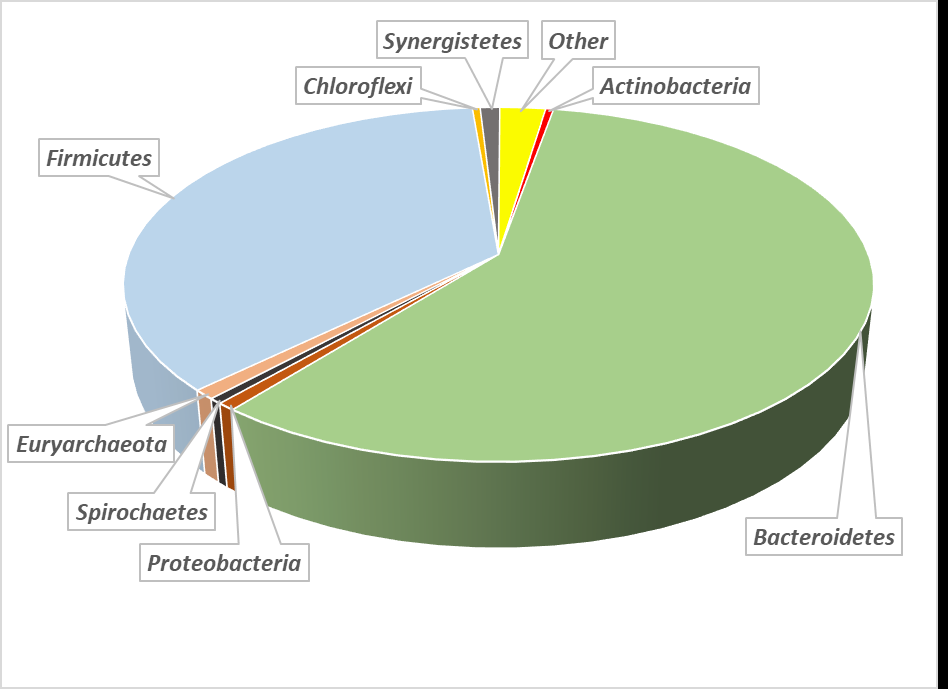
The prevailing phyla defined were Firmicutes 36% to 39%, Bacteroidetes 58% to 22%, Proteobacteria 1% to 25% for mesophilic to thermophilic conditions. The archaeal share (Euryarcheota) of the microbiota under mesophilic and thermophilic conditions is in favor of the thermophilic ones.
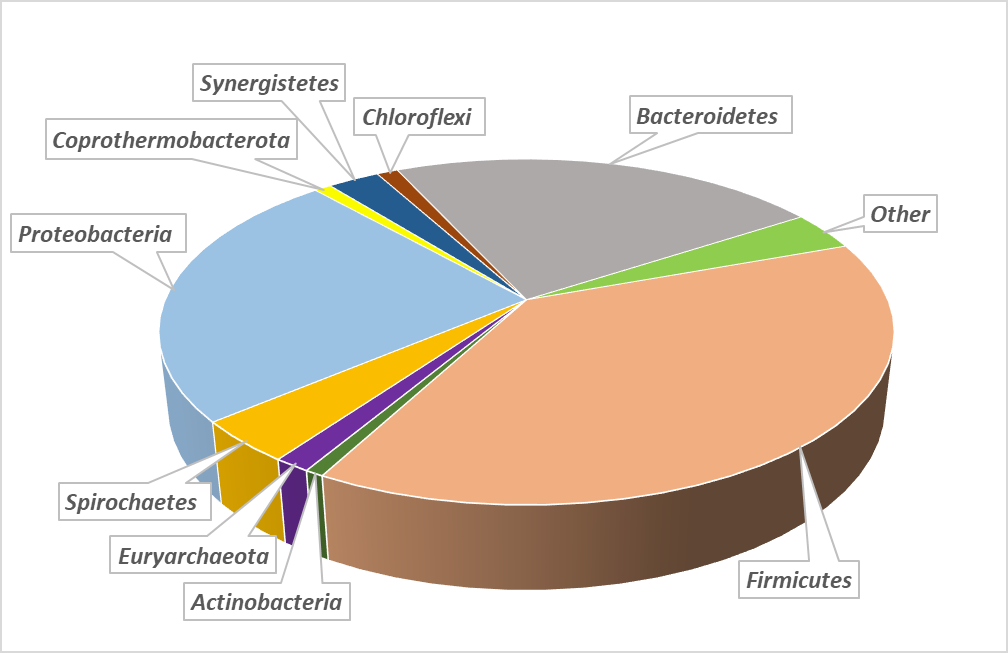
The proper ratio of key microbiota is an essential requirement for the stability and efficiency of the anaerobic digestion process. Methane is produced by methanogenic archaea, which convert simple substrates and the production rates of CH4 increase with increasing temperature. Hyperthermophilic methanogenic species were discussed by Stetter [16]. However psychrophilic methanogenic archaea (4 to 5°C) had also been discussed [17]. By metagenome approaches, we analyzed the composition of microbial communities in anaerobic digesters under two different temperatures. Firmicutes and Bacteroidetes are the main bacteria with impact on CH4 yield. Increase in their share, leads to significant improvement in methane yield in stable mesophilic digesters [18]. Methanothrix and Methanosarcina within the Euryarchaeota are the two genera performing acetoclastic methanogenesis. The other known methanogens use the hydrogenotrophic pathway, responsible for the remaining part of methane production as a result of the reduction of carbon dioxide with hydrogen [19]. Main methanogens have optimum growth rate at mesophilic temperatures (30–40°C), with exemption of the archaeal representatives, which have optimal growth rate at thermophilic conditions (50–55°C) [20]. Deeper studies of methanogens could help elucidating the bioenergetics basis of life [21]. Methanogens are important in microbial conversion of carbon into methane, which is a high-energy fuel.
Conclusion
The microbial consortium metagenomic identification is the main tool for better understanding of its structure and performance in processes like energy production. It reveals its complexity and probable synergetic mechanisms in the AD. Finding the most appropriate microbial communities involved, at the appropriate conditions chosen, can make a successful future application in energy production. Process management could be optimized for enhanced methane yields with the aim of waste utilization for green energy production in the concept of waste-to-energy sustainable methods. Renewable energy alternatives such as the biotechnological energy production are among the most important issues affecting quality of life worldwide.
Acknowledgments
This work was supported by the Bulgarian National Science Fund, Grant: KP-06-IP-CHINA/3.
Declarations of Interest
The authors declare that there are no conflicts of interest.
Funding
This work was supported by the Bulgarian National Science Fund, Grant: KP-06-IP-CHINA/3.
References
-
Lim JW, Park T, Tong YW, Yu Z (2020) The microbiome driving anaerobic digestion and microbial analysis. Adv Bioenergy 5: 1-61.
-
Maus I, Bremges A, Stolze Y, Hahnke S, Cibis KG, et al. (2017) Genomics and prevalence of bacterial and archaeal isolates from biogas-producing microbiomes. Biotechnol Biofuels 10: 264.
-
Campanaro S, Treu L, Rodriguez RLM, Kovalovszki A, Ziels RM, et al. (2020) New insights from the biogas microbiome by comprehensive genome-resolved metagenomics of nearly 1600 species originating from multiple anaerobic digesters. Biotechnol Biofuels 13: 25.
-
Roopnarain A, Adeleke R (2017) Current status, hurdles and future prospects of biogas digestion technology in Africa. Renewable Sustainable Energy Reviews 67: 1162-1179.
-
Ahlberg-Eliasson K, Westerholm M, Isaksson S, Schnürer A (2021) Anaerobic digestion of animal manure and influence of organic loading rate and temperature on process performance, microbiology, and methane emission from digestates. Front Energy Res Sec. Bioenergy Biofuels 9: 740314.
-
Hubenov V, Carcioch RA, Ivanova J, Vasileva I, Dimitrov K, et al. (2020) Biomethane production using ultrasound pre-treated maize stalks with subsequent microalgae cultivation. Biotechnol Biotechnol Eq 34(1): 800-809.
-
Hubenov V, Varbacheva I, Kabaivanova L (2024) Impact of waste cooking oils addition on thermophilic dry co-digestion of wheat straw and horse manure for renewable energy production in two stages. Life (Basel) 14(3): 312.
-
Cheng S, Guo L, Zheng Y, Yu D, Jin C, et al. (2022) Effect of mixed primary and secondary sludge for two-stage anaerobic digestion (AD). Biores Technol 343: 126160.
-
Watts S, Hamilton G, Keller J (2006) Two-stage thermophilic-mesophilic anaerobic digestion of waste activated sludge from a biological nutrient removal plant. Water Sci Technol 53(8): 149-157.
-
Carlsson M, Lagerkvist A, Morgan-Sagastume F (2012) The effects of substrate pre-treatment on anaerobic digestion systems: A review. Waste Manag 32(9): 1634- 1650.
-
Tomei MC, Braguglia CM, Cento G, Mininni G (2009) Modeling of anaerobic digestion of sludge. Critical Rev Environ Sci Technol 39(12): 1003-1051.
-
Li Y, Chen Z, Peng Y, Huang W, Liu J et al. (2022) Deeper insights into the effects of substrate to inoculum ratio selection on the relationship of kinetic parameters, microbial communities, and key metabolic pathways during the anaerobic digestion of food waste. Water Res 217: 118440.
-
Hupfauf S, Plattner P, Wagner AO, Kaufmann R, Insam H et al. (2018) Temperature shapes the microbiota in anaerobic digestion and drives efficiency to a maximum at 45 °C. Biores Technol 269: 309-318.
-
Zinder SH, Anguish T, Cardwell SC (1984) Effects of temperature on methanogenesis in a thermophilic (58 degrees C) anaerobic digestor. Appl Environ Microbiol 47(4): 808-813.
-
Seruga P, Krzywonos M, Paluszak Z, Urbanowska A, Kruczek HP, et al. (2020) Pathogen reduction potential in anaerobic digestion of organic fraction of municipal solid waste and food waste. Molecules 25(2): 275.
-
Stetter KO (2002) Hyperthermophilic microorganisms. Extremophiles 1.
-
Nozhevnikova AN, Zepp K, Vazquez F, Zehnder AJB, Holliger C (2003) Evidence for the existence of psychrophilic methanogenic communities in anoxic sediments of deep lakes. Appl Environ Microbiol 69(3): 1832-1835.
-
Ma G, Chen Y, Ndegwa P (2021) Association between methane yield and microbiota abundance in the anaerobic digestion process: A meta-regression. Renewable Sustainable Energy Reviews 135: 110212.
-
Sikora A, Detman A, Mielecki D, Chojnacka A, Błaszczyk M (2018) Searching for metabolic pathways of anaerobic digestion: A useful list of the key enzymes. In: Banu JR (Ed.), Anaerobic Digestion. IntechOpen, London, UK.
-
Lin R, Cheng J, Ding L, Murphy JD (2018) Improved efficiency of anaerobic digestion through direct interspecies electron transfer at mesophilic and thermophilic temperature ranges. Chem Eng J 350: 681- 691.
-
Buan NR (2018) Methanogens: pushing the boundaries of biology. Emerg Top Life Sci 2(4): 629-646.
- Antifungal Activity of New Acetophenone Derivatives
- Interconnected Microbiomes Human Health Within an Environmental Framework
- Silkworm-Based Vaccine Production for H5N1: A One Health Approach to Pandemic Preparedness
- Microbial Diversity and Lipolytic Activity of Bacteria and Fungi from Oil-Contaminated Sites in Makurdi Metroplois
- Antibiotic Resistance Profile of Bacteria Isolated at the Central Laboratory of the National Hospital Center of Nouakchott
- Epidemiology and Sensitivity to Antibiotics of Germs Isolated from Blood Cultures in the Laboratory of the National Hospital Center of Nouakchott-Mauritania