
Evaluation of Anti-inflammatory Activity of Clerodendrum wallichii (Merr.) Leaves
Clerodendrum wallichii Merr. (Family: Verbenaceae) commonly known as Sampulis is native to Southern Asia from the Himalayas to Southern China, the Nicobar Islands and Northeast into Pakistan. In India, it is mainly found in Sikkim, Tripura, Mizoram, Meghalaya, Assam, Maharashtra and Uttarakhand regions. It is widely used for various ailments in the traditional systems of medicines; most importantly, it is used against diarrhea, skin infection, inflammation and fever. The plant has never been subjected to in vivo anti-inflammatory activity. Therefore, the objective of the present study was to evaluate anti-inflammatory effect of C. wallichii leaves in rats. Hydro-alcohol extract was prepared and fractionated using n-hexane, chloroform and ethyl acetate. Carrageenan induced paw edema and cotton pellet granuloma model were employed for acute and chronic inflammation respectively. Hydro-alcohol extract showed significant (p <0.05) anti-inflammatory activity. Furthermore, amongst various fractions of hydro-alcohol extract, only n-hexane fraction exhibited potent anti-inflammatory activity (p < 0.05) at a dose of 50 & 100 mg/kg., p.o. The findings of present investigation indicate that C. wallichii has a strong anti-inflammatory activity and could constitute a potential source for the development of new drug for the treatment of inflammatory disorders.
Introduction
The genus Clerodendrum comprises of more than 400 species and largely spread in Asia, Africa and America [1, 2]. The plant Clerodendrum wallichii Merr. (Family: Verbenaceae) commonly known as Sampulis is native to southern Asia from the Himalayas to Southern China, the Nicobar Islands and northeast into Pakistan [3, 4]. In India, it is found in Sikkim, Tripura, Mizoram, Meghalaya, Assam, Maharashtra and Uttarakhand [5, 6, 7]. Ethanopharmacological reports on this plant revealed that leaves are used for the treatment of skin infection and inflammation in Mao Naga tribe in India. It is used as vegetable and in folkloric medicine among Khasi and Jentia tribes in Meghalaya in India [6]. The plant possesses phenolic and flavanoid compounds and other chemical groups like steroid, alkaloids etc [8]. Arial parts of the plant are also reported clerodolone, clerosterol, β-sitosterol, stigmasterol and 24(S) ethyl-cholesta-5, 22, 25-trien-3β-ol [9]. Leaf extract of this plant is taken to treat diarrhea and dysentery. Leaves are pounded with slaked lime and used for the treatment of skin infection and inflammation in Mao Naga tribe in India. Ethanol extract of aerial parts is used as diuretic. Root juice is given for the treatment of high fever (Marmatribe) [4, 5, 6].
Many species of the genus Clerodendrum are reported to exhibit significant anti-inflammatory activity [10, 11, 12, 13]. Amongst various species of genus Clerodendrum,
Clerodendrum wallichii has never been subjected to in-vivo anti-inflammatory activity. Moreover, an exhausted literature survey on C. wallichii revealed that sporadic phytochemical and pharmacological reports are available on this plant. Thus, it was considered worthwhile to evaluate C. wallichii for anti-inflammatory activity.
Materials and Methods
Plant Material
The plant C. wallichii was collected from the campus of Forest Research Institute, Dehradun, Uttarakhand, India. The plant was identified and authenticated from Department of Botany, Botanical Survey of India, Dehradun, Uttarakhand, India vide ref. no. 118175. The voucher specimen was maintained in Botanical Survey of India laboratory for the further reference.
Reagents and Chemicals
Petroleum ether (CDH, New Delhi, INDIA), chloroform, ethanol (Himedia), all other chemicals (Lobachemie, Himedia, Mumbai, India), all of LR grade were employed for extraction of the plant material. Carrageenan and diclofenac sodium standard drug (CDH, New Delhi, INDIA) were used in the present study.
Extraction process
The dried leaves of the plant were collected and pulverized through a mechanical grinder. The powder material was dried at room/lab temperature. The plant material was defatted with petroleum ether and then macerated with hydro-alcohol (i.e. distilled water and ethanol) in a ratio of 30:70. After that the extract was concentrated, weighed and subjected to fractionation with each of n-hexane and chloroform.
Animal
Wistar albino rats of either sex 150-250 g were used in the study. Animals were maintained on standard environmental conditions and fed with standard rodent diet and tap water ad libitum. They were housed in the institutional animal house and were exposed to natural photoperiod. The experimental protocol was approved by Sardar Bhagwan Singh Post Graduate Institute of Biomedical Sciences & Research, Animal Ethics Committee and care of the animals (CPSEA/IAEC/SBS/2017-18/013) was carried out as per the guidelines of the Committee for the Purpose of Control and Supervision of Experiments on Animals, Ministry of Environment and Forest, Government of India.
Toxicity study
The acute toxicity was carried out as per Organization for Econonomic Cooperation and Development (OECD) 423 Guidelines [14]. The study was carried out in Wistar albino rat. The acute toxicity explored the nontoxic nature of all the extracts even at highest starting dose of 2000 mg/kg body weight of animal for oral route of administration.
Evaluation of anti-inflammatory activity
Carrageenan induced rat paw edema: Carrageenan releases histamine, 5-HT, bradykinin and prostaglandin and produces inflammation and oedema. 1% carrageenan solution was prepared, and 0.1 ml was injected into the right hind paw of the rats [15, 16]. On the basis of design of the experiment at varying doses the plant extract/standard drug and control vehicle were administered 30 min after the injection of carrageenan. By using volume displacement method before and 1, 2, 3, 4, 5 and 6 h after administration of carrageenan. The paw volume is measured by using plethismometer. To differentiating true anti-inflammatory and counterirritant activity, carrageenan was mixed with drug extract. Mixture first contained 0.1 ml of 1% carrageenan and specific amount of plant extract. Mixture second contained 0.1 ml of 1% carrageenan and second dose of extract and it is injected into the right hind paw of rats.
Experimental Protocol
Group I: Control group - Animal received normal saline 0.9% sodium chloride Group II: Standard group - Animal treated with diclofenac sodium (10 mg/kg) Group III: Positive control group - Animal treated with carrageenan solution Group IV: Hydro-alcohol extract treated group (100 or 200 mg/kg, p.o.) Group V: Chloroform fraction treated group (50 or 100 mg/ kg, p.o.) Group VI: n-hexane fraction treated group (50 or 100 mg/ kg, p.o.)
Cotton Pellet Granuloma Model for Chronic Inflammation
The rats were anaesthetized and sterile cotton pallet (10 mg) is inserted into one in each of axilla of rats. At varying doses, the extract, control vehicle and standard drug were administered for 7 consecutive days starting from the first day of cotton pallet inserted. On the 8th day, the animals are again anaesthetized for the removal of cotton pallet by the help of surgery. The cotton pellets are excised from extraneous tissues which are incubated at 37°C for 24 hrs and dried at 60°C up to constant weight occurred. The increase in the weight of cotton pallet is a measure for the formation of granuloma [17].
The effect produced by the extract on the pouch of granuloma show by the chronic test. The test drug systematically inhibits the formation of granuloma in rats. The features of formation of granuloma are proliferation of fibroblasts and multiplication of blood vessels at the repair phase of the inflammation. These proliferating cells are penetrated and produce the redness mass in the tissue called as granulation tissue [18]. Effective test drug reduces the cotton pellet granuloma and implies its activity in the chronic phase of the inflammation.
Statistical Analysis
Results were analyzed using One-way analysis of variance (ANOVA) followed by Tukey’s multiple range comparison tests. Data expressed as Mean ± SEM, n = 6. P < 0.05 was considered as statistically significant.
Result
Yield of Extract/ Fractions of C. wallichii Leaves
The yields of various fractions of hydro-alcohol extract of C. wallichii are presented in Table 1.
| Extracts | Yield (% w/w) |
|---|---|
| Hydro-alcohol extract | 13.02 |
| n-hexane fraction | 10.26 |
| Chloroform fraction | 5.20 |
Table 1: Yield of different extracts of C. wallichii leaves.
Toxicity Study
The acute toxicity was carried out as per Organization for Economic Cooperation and Development (OECD) 423 Guidelines, 2001. Swiss albino rats were employed in the study. The acute toxicity explored the nontoxic nature of all the extracts even at highest starting dose of 2000 mg/kg body weight of animal for oral route of administration.
Screening of Anti-Inflammatory Activity
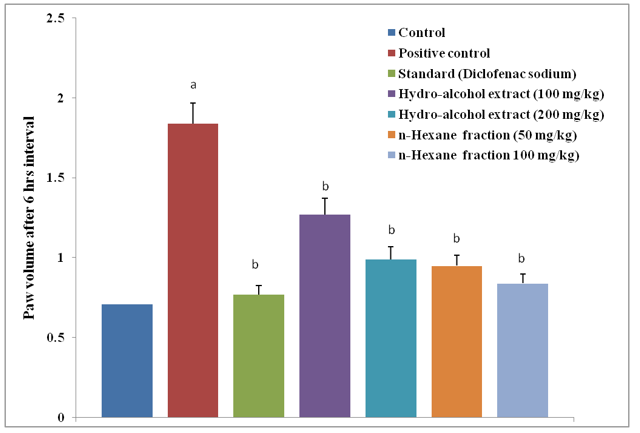
Carrageenan induced paw edema: The anti-inflammatory activity of C. wallichii hydro-alcohol extract and its fractions was measured at the dose of 50, 100 and 200 mg/kg against carrageenan induced paw edema in rats. The results were indicated that the hydro-alcohol extract at a dose of 200 mg/ kg and its n-hexane fraction at a dose of 50 and 100 mg/kg exhibited significant (P < 0.05) anti-inflammatory activity (Table 2, Figure 1).
| Groups | Paw volume in each time interval (hrs.) | ||||||
|---|---|---|---|---|---|---|---|
| 0 hour | 1 hour | 2 hours | 3 hours | 4 hours | 5 hours | 6 hours | |
| Control | 0.68 ±0.21 | 0.71 ± 0.005 | 0.73 ±0.003 | 0.69 ±0.007 | 0.70 ±0.002 | 0.72 ±0.005 | 0.71 ±0.002 |
| Positive Control | 0.72 ±0.037 | 1.21 ±0.054 | 1.37 ±0.07 | 1.52 ±0.058 | 1.62 ±0.05 | 1.67 ±0.048 | 1.84* ±0.045 |
| Standard (Diclofenac sodium) | 0.71 ±0.07 | 0.94 ±0.05 | 1.12 ±0.085 | 1.02 ±0.07 | 0.80 ±0.065 | 0.78 ±0.049 | 0.77 ±0.040** |
| Hydro-alcohol Extract (100 mg/kg) | 0.72 ±0.052 | 1.13 ±0.076 | 1.42 ±0.034 | 1.38 ±0.035 | 1.31 ±0.033 | 1.28 ±0.053 | 1.27 ±0.056 |
| Hydro-alcohol Extract (200/ mg/kg) | 0.73 ±0.039 | 1.178 ±0.052 | 1.312 ±0.05 | 1.13 ±0.063 | 0.81 ±0.039 | 0.80 ±0.073 | 0.99 ±0.064* |
| Chloroform Fraction (50 mg/kg) | 0.75 ±0.07 | 1.42 ±0.072 | 1.32 ±0.081 | 1.14 ±0.068 | 1.12 ±0.085 | 1.10 ±0.048 | 1.05 ±0.07 |
| Chloroform Fraction (100 mg/kg) | 0.73 ±0.04 | 1.03 ±0.048 | 1.27 ±0.07 | 1.12 ±0.061 | 1.11 ±0.058 | 0.95 ±0.049 | 0.82 ±0.045 |
| n-hexane Fraction (50 mg/ kg) | 0.77 ±0.02 | 1.07 ±0.033 | 1.35 ±0.025 | 1.22 ±0.044 | 1.18 ±0.032 | 1.14 ±0.043 | 0.95 ±0.023* |
| n-hexane Fraction (100 mg/kg) | 0.72 ±0.01 | 1.03 ±0.019 | 1.25 ±0.029 | 1.11 ±0.014 | 0.92 ±0.016 | 0.79 ±0.022 | 0.84 ±0.015* |
Table 2: Effect of hydro-alcoholic extract of C. wallichii leaves and its different fractions using carraigeenan- induced hind pa
Cotton pellet granuloma model
Hydro-alcohol extract (200 mg/kg) and its n-haxane fraction (50, 100 mg/kg) exhibited significant (P < 0.05) anti-inflammatory activity in cotton pellet granuloma model of inflammation by inhibiting the moist weight of cotton pellet in rats (Table 3, Figure 2).
| Groups | Dose (mg/kg) | Weight of granuloma (after 7th day) | % Inhibition |
|---|---|---|---|
| Positive Control | 10 | 63.02± 0.63 | 0 |
| Standard (Diclofenac) | 10 | 20.01± 0.64** | 68.2 |
| Hydro-alcohol extract | 100 | 41.40± 0.21 | 34.3 |
| Hydro-alcohol extract | 200 | 32.71± 0.11* | 47.61 |
| n-haxane fraction | 50 | 29.30± 0.10* | 53.5 |
| n-haxane fraction | 100 | 24.40± 0.08* | 61.59 |
| Chloroform fraction | 50 | 49.17± 0.15 | 21.97 |
| Chloroform fraction | 100 | 46.12± 0.17 | 26.97 |
Table 3: Effect of hydro-alcoholic extract of C. wallichii leaves and its different fractions using cotton pellet granuloma model
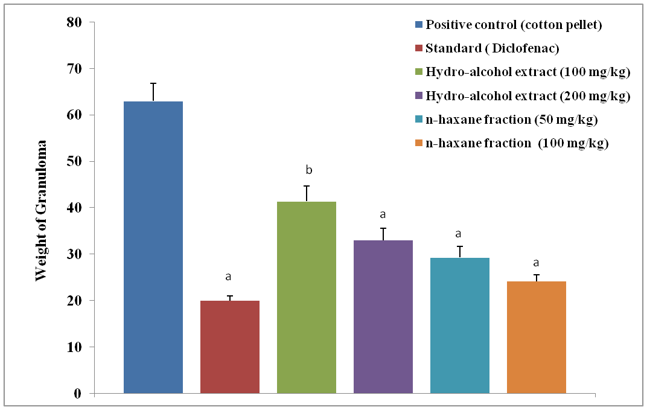
Figure 2: Effect of hydro-alcoholic extract (doses- 100 and 200 mg/kg) and n-hexane fraction (doses- 50 and 100 mg/kg) of C. wallichii leaves using cotton pellet granuloma model in albino rats. Drug administered orally for 7 days regularly. Diclofenac injection (10 mg/kg) was used as a standard drug. Cotton pellets (10 mg) after dipping in carrageenan and air dried was used for granuloma formation. a P<0.05 versus control, b P<0.05 versus standard.
Discussion
In the current scenario, pharmaceutical companies are involved in research on plant material for their potential medicinal value as due to their fewer adverse effect as compare to other system of medicines, the demand of herbal product is growing exponentially. A large majority of worldwide population is getting affected by inflammation related disorders. The current analgesia inducing drugs such as opiates and NSAIDS are not useful in all cases, because of their side effects such as gastrointestinal tract irritation, liver dysfunction and many more. There are number of immune-suppressing agents have been developed based on their COX- 1 inhibition mechanism, but they cause severe side effects on long term administration. To avoid the side effect of COX-1 inhibitors, selective inhibitors of COX-2 were developed. However, one of these inhibitors also has been reported to increase the risk of myocardial infraction and atherothrombotic events. Thus, it is likely that COX-2 inhibitors will not be suitable for the treatment of chronic inflammatory diseases. Large number of herbs has been used traditionally or as folk medicines against inflammation disorders [19].
The plant Clerodendrum wallichii (Family: Verbenaceae) commonly known as Sampul is one of the popular folkloric medicine used in North-East India. The plant has never been subjected to in vivo anti-inflammatory studies. Thus, it was considered worthwhile to evaluate C. wallichii for anti_-_ inflammatory.
In the present study, carrageenan induced rat paw edema and cotton pellet granuloma model of anti- inflammatory activity were employed. Carrageenan is a sulphated polysaccharide. By releasing of histamine, 5-HT, bradykinin and prostaglandin it produces inflammation and edema [20]. Carrageenaninduced rat paw edema model in rats is known to be sensitive to cyclooxygenase inhibitors and has been used to evaluate the effect of non-steroidal anti-inflammatory agents, which primarily inhibit the cyclooxygenase involved in prostaglandin synthesis [21]. In this study, hydro-alcohol extract (200 mg/kg) and its n-haxane fraction (50,100 mg/kg) showed significant anti- inflammatory activity in carrageenan-induced paw edema in albino rats (Table 2, Figure 1). These results are similar to many other activities in which non-polar fraction showed significance anti-inflammatory activity.
The cotton pellet granuloma method is widely used to evaluate the transudative and proliferative components of the chronic inflammation [22]. The moist weight of the cotton pellet correlates with the transuda; the dry weight of the pellet correlates with the amount of the granulomatous tissue. Hydro-alcohol extract and its n-haxane fraction exhibited significant anti-inflammatory activity in cotton pellet granuloma model of inflammation by inhibiting the moist weight of cotton pellet in rats (Table 3, Figure 2).
On the basis of present results, it is suggested that the anti-inflammatory effect could be due to presence of steroidal compounds (s) in hexane fraction, which is similar to a study by Patel and Savjan [23]. Furthermore, these findings of present study support the hypothesis of the greater effect of the C. wallichii on the inflammation mediators in the immediate response of inflammation in rats.
Future prospects of the current investigation include firstly, bioactivity directed further fractionation of bioactive n-hexane fraction with a view to isolate and characterizes valuable bioactive constituent (s), and also reveal mechanism of action involved in anti-inflammatory activity.
Acknowledgement
To carry out this research work financial support from the Gaurav Bharti Shiksha Sansthan, Dehradun, Uttarakhand, India, which runs the School of Pharmaceutical Sciences & Technology, Sardar Bhagwan Singh University, is gratefully acknowledged.
References
-
Armitage AM (2001) Armitage’s manual of annuals, biennials, and half-hardy perennials. Portland, Cambridge, Timber Press, USA, pp: 539.
-
Acevedo-Rodríguez P (2005) Vines and climbing plants of Puerto Rico and the Virgin Islands. Contributions from the United States National Herbarium, pp: 483.
-
Harley RM, Atkins S, Budantsev AL (2004) The Family and Genera of Vascular Plants. Vol. VII. Berlin; Heidelberg, Germany: Springer-Verlag, ISBN: 978-3-540-40593-1. Labiatae pp: 167e275.
-
Mabberley DJ (2008) Mabberley’s Plant-book. 3rd (Edn.), UK, Cambridge University Press, ISBN: 978-0-521- 82071-4.
-
USDA-ARS (2014) Germplasm Resources Information Network (GRIN). Online Database. Beltsville, Maryland, USA: National Germ plasm Resources Laboratory.
-
Deori C, Roy DK, Talukdar SR, Pagag K, Sarma N (2013) Diversity of the genus Clerodendrum Linnaeus (Lamiaceae) in Northeast India with special reference to Barnadi Wildlife Sanctuary, Assam. Pleione 7(2): 473- 488.
-
Pradeep AK, Jayaram KMJ (1992) Bomb Nat Hist Soc 88: 467.
-
Narumol P, Nantana N (2016) European J Integr Med 8:281-285.
-
Toshihiro A, Yuzuru M, Parthasarathi G, Swapnadip T, Toshitake T, et al. (1989) Sterols of some Clerodendrum species (verbenaceae): Occurrence of the 24α- and 24β-epimers of 24-ethylsterols lacking a Δ25-bond. Steroids 53(3-5): 625-638.
-
Solapure P, Pradeep, Mundugaru R, Hegd LP (2016) J Phytopharmacol 5: 38-44.
-
Joseph J, Bindhu AR, Aleykutty NA (2013) In vitro and in vivo Antiinflammatory Activity of Clerodendrum paniculatum Linn. Leaves. Indian J Pharm Sci 75(3): 376- 379.
-
Das S, Haldar PK, Pramanik G, Suresh RB (2010) Evaluation of Anti-Inflammatory Activity of Clerodendron infortunatum Linn. Extract in Rats. Global J Pharmacol 4(1): 48-50.
-
Shakeel AK, Sammia S, Waqar A, Sami U (2017) Int J Pharmaceut Scie Res 2: 22-30.
-
h t t p : / / w w w. o e c d . o r g / o f f i c i a l d o c u m e n t s / p u b l i c d i s p l ayd o c u m e n t p d f / ? c o te = e nv / j m / mono(2001)4&doclanguage=en.
-
Winter CA, Risley EA, Nuss GW (1962) Carrageenin- induced edema in hind paw of the rat as an assay for antiiflammatory drugs. Proc Soc Exp Biol Med 111: 544- 547.
-
Bhatt KR, Mehta RK, Shrivastava PN (1977) A simple method for recording antiinflammatory effects on rat paw oedema. Ind J Physiol Pharmacol 21(4): 399-400.
-
Crunkhorn P, Meacock SC (1971) Mediators of the inflammation induced in the rat paw by carrageenin. Br J Pharmacol 42(3): 392‑402.
-
Winter CA, Porter CC (1957) J Am Pharm Sci 46: 515- 519.
-
Swingle KF (1974) Evaluation for anti-inflammatory activity. In Anti-inflammatory Agents Vol 2, (Eds.), Scherrer RA, Whitehouse MW, London: Academic Press, pp: 34-122.
-
Modi CM, Mody SK, Patel HB, Dudhatra GB, Kumar A, et al. (2012) Toxicopathological overview of analgesic and anti-inflammatory drugs in animals. J Appl Pharm Sci 2(1): 149-157.
-
Necas J, Bartosikova L (2013) Carrageenan: a review. Veterinarni Medicina 58: 187-205.
-
Olajide OA, Awe SO, Makinde JM, Ekhelar AI, Olusola A, et al. (2000) Studies on the anti-inflammatory, antipyretic and analgesic properties of Alstonia boonei stem bark.J Ethnopharmacol 71(1-2): 179-186.
-
Patel SS, Savjani JK (2015) Systematic review of plant steroids as potential antiinflammatory agents: Current status and future Perspectives. J Phytopharmacol 4(2): 121-125.
- Acido Labile or Gastro Irritant Apis and Enteric Release in Galenic Practice: An Overview
- A Study on Knowledge, Attitude and Practice of Hand Hygiene among Healthcare Professionals at a Tertiary Care Hospital, India
- Influence of Inoculum Concentration on In Vivo Incubation Period of Emmia lacerata, Pathogenesis and Management of Wilt in Pepper (Capsicum annuum L.)
- Vanilla’s Chemistry
- Marine Anti-Cancer Compounds and Adverse Effects of Global Warming on Oceans: An Overview
- Serological Investigation of Chikungunya Virus Antibody among Malaria-Suspected Febrile Patients in Some Healthcare Facilities in Rivers State