
Stability and Stabilization of Pabialgin (Cibalgin) Liquid Preparation
Shelf-life time was supposed to be determined for active principles of original Pabialgin® (Cibalgin®) drops (allobarbital, aminophenazone) and for its stabilized liquid formulation using accelerated testing at elevated temperatures. The paper chromatography-spectrophotometric selective method was used for the determination of allobarbital and aminophenazone in presence of themselves as well as solubilisates and antioxidants. The semi-logarithmic Arrhenius equation was used to calculate shelf-life times at ambient temperature, from apparent first-order rate constants, determined at elevated temperatures. Since shelf-life times of allobarbital and aminophenazone in original pabialgin® liquid formulation were not satisfactory certain stabilization attempts were undertaken. First of all, water as a solvent was replaced with glycerol to inhibit a hydrolytic pathway of allobarbital degradation, and some antioxidants were introduced to stabilize photo-oxidation processes involved in the degradation of aminophenazone. It resulted in an unusual increase in shelf-life times of the abovementioned active principles. Aminophenazone is now replaced with propyphenazone in the so-called neo pabialgin P, because it can be transformed into a potentially cancerous nitrosamine. However, propyphenazone is also a derivative of 1-phenyl2,3-dimethylpyrazolone-5 similar to aminophenazone. Therefore, it should be also susceptible to oxidative processes and our findings could be used within the framework of pharmaceutical work to stabilize pabialgin P as well. A new stabilization technology of pabialgin has been successfully patented.
Introduction
Pabialgin consists of aminophenazone (1-phenyl- 2,3-dimethyl-4-dimethylaminopyrazolone-5) (AP) and allobarbital (5,5-diallylbarbituric acid) (AB). AP is a grandfather drug (1896) used for many decades against pain of different locations (head, teeth, neuralgic) and fever [1]. Now, it is not used in medicine, because of a cancerous effect of its metabolite. Therefore, a new pabialgin (pabialgin P) has been introduced, in which AP is replaced by other pyrazolone-5 derivatives (phenazone:1-phenyl-2,3- dimethylpyrazolone-5) or propyphenazone (1-phenyl-2,3- dimethyl-4- isopropylphenazone-5). However, a new version of pabialgin (pabialgin P) is of minor use in medicine (Egypt, Kuwait, Malaysia, Turkey, Sri Lanka, India). The former pabialgin preparations were unstable (drops, injections, tablets, suppositories) and became yellowish in storage because of the formation of AP degradation products, since AB degradation products are colorless [2, 3, 4, 5, 6].
The aim of this work is the kinetic investigation of instability of AP and AB in the preparation of liquid pabialgin® (cibalgin®) and attempts for its stabilization. Despite the fact that AP is not used in human medicine anymore, the results of this work can be of importance for the stability of preparation of new pabialgin P liquid, where AP is replaced by other pyrazolone-5 derivatives.
Materials and Methods
Materials
AP, AB, pabialgin (88 % AP and 12 % AB), ascorbic acid, glycerol (86 %) and urethane fulfilled the requirements of the Polish Pharmacopoeia (F.P. IV). Ethyl-urea was obtained from Loba-Chemie, Austria. All the other chemicals were of reagent grade. Water was house distilled from silica glass equipment. Pabialgin® drops (Polfa Pharmaceutical Works, Pabianice, Poland) were prepared in accordance with their original recipe. Therefore, to a volumetric flask 25 ml were added pabialgin 6.25 g, urethane 7.0 g, ethyl urea 7.0 and then dissolved and made up with water to the mark.
Assays for AP and AB determination in presence of themselves and their degradation products: AP and AB were determined spectrophotometrically in eluates of the paper chromatographic separation procedure published previously [7].
Kinetics of AB and AP degradation in pabialgin® drops:
One ml of original pabialgin® drops previously weighed was sealed in 20 ml glass ampoules by means of a gas burner. The ampoules (approximately 20 each) were immersed in an ultra-thermostat at separate temperatures 90°, 80°, 70°, 60°, and 50°. At suitable time interval an ampoule was withdrawn, cooled to room temperature and transferred to a volumetric flask 25 ml and made up to the mark with water. Required volume (0.1 ml or 0.02 ml) of the solution was spotted on suitable chromatographic paper for AB and AP determination respectively, and developed with the mobile phase mentioned [7]. Each spot of AB was extracted with 10 ml borate buffer pH 10.2, and in the case of AP it was extracted with 20 ml of 0.1 mol/l sulfuric acid. The eluate absorbances were measured at λmax (242 and 260 nm respectively) of the above-mentioned compounds against suitable blank sample eluates by means of a spectrometer (Spectrophotometer Specord U V VIS, Carl Zeiss, Jena, Germany). The results of accelerated testing at elevated temperatures were plotted on a semi-logarithmic paper for AB and AP concentrations as a function of time.
New formulation technology of pabialgin drops [8]: Suitable amounts: 22.0 g AP, 3.0 g AB, 28.0 g urethane and ethyl urea, as well as 0.05 g ascorbic acid, sodium meta- bisulfite, disodium versenate each, previously fine grinded and blended, were weighed into a beaker and 36.0 g glycerol was added in order to dissolve the mixture at 60° in a water bath. The solution cooled to the room temperature is transferred to a 100 ml volumetric flask using fresh portions of required glycerol, and is made up to the mark.
Kinetics of AB and AP stability in new stabilized pabialgin drops: Kinetics of AB stability in stabilized pabialgin drops was followed exactly according to the above procedure described for pabialgin® drops which were not stabilized. However, kinetics od AP was investigated in a diluted pabialgin solution (1.25 % pabialgin solution in an aqueous acetate-ammonia buffer (pH 7.1) as well as in a glycerol acetate-ammonia buffer (pH 8.0) in presence of three antioxidants mentioned above at concentration of 0.05 % each. The buffer was prepared accordingly of 0.3 mol/l ammonia and 0.3 mol/l glacial acid was prepared accordingly.. Methodology for the determination of AB and AP concentrations was previously published [7]. However, the stability of AP in its concentrated solution (22 %) is too good to be kinetically interpreted [2]. Therefore, it was necessary to prepare its diluted solution (1.25 %) in an acetate-ammonia buffer (pH 7.1) in aqueous and glycerol medium. The concentration of AB (c in %) for kinetic investigations was calculated from the following formula:
$$ c [ \% ] = \frac {A _ {2 4 2} \cdot 2 5 0 0}{4 4 0 \cdot b} $$
, Where A242 – absorbance of AB in an eluate from a chromatogram at λ = 242 nm, 440 - (specific absorbance of AB at 242 nm in a silica cell of 1 cm wide, [100 ml·g-1·cm]), b – weighed sample of pabialgin liquid in g, 2500 – dilution index. However, the concentrations of AP were calculated from the other formula:
$$ c [ \% ] = \frac {A _ {2 6 0} \cdot 1 2 5 0 0}{3 7 0 \cdot b} $$
Where A260 – absorbance of AP in an eluate from a chromatogram at 260 nm, 370 - (specific absorbance of AP at 260 nm in a silica cell of 1cm wide, [100 ml·g-1·cm-1]), b – weighed sample of pabialgin liquid examined in g, 12500 – dilution index.
Results and Discussion
Quantitative method for AP and AB (active ingredients) [7] was first of all certified with respect to their determination in original Pabialgin® drops obtained from a drug store lot # 10468 (Polfa Pharmaceutical Works, Pabianice, Poland) after approx. 4 months elapsed from their preparation (Table 1).
| n | AP | AB |
|---|---|---|
| 1 | 20.12 | 2.854 |
| 2 | 20.43 | 2.859 |
| 3 | 20.37 | 2.788 |
| 4 | 20.55 | 2.754 |
| 5 | 20.10 | 2.788 |
| Mean | 20.31 | 2.8086 |
| SDa | 0.1973 | 0.02142 |
| MSDb | 0.0882 | 0.00958 |
| CV(%)c | 0.97 | 0.763 |
| CId | 20.31±0.25 | 2.81±0.03 |
Table 1: Results of determination of aminophenazone (AP) and allobarbital (AB) (%, g/100g) in the original Pabialgin® drops (P
aStandard deviation. bStandard deviation of the mean. cCoefficient of variation. dConfidence interval at p = 0.95 for degree of freedom k = 4 and test t = 2.776. Table 1: Results of determination of aminophenazone (AP) and allobarbital (AB) (%, g/100g) in the original Pabialgin® drops (Polfa Pharmaceutical works, Pabianice, Poland), Lot # 10468, and their statistical estimate.
It can be learnt that the loss of both AP and AB is not significant within 4 months, 1.69 % and 0.19 % respectively. However, that loss is greater after 1 year shelf-life time at ambient temperature: 13 % and 19 % respectively [4]. The solutions became yellowish and later on intensive yellowish.
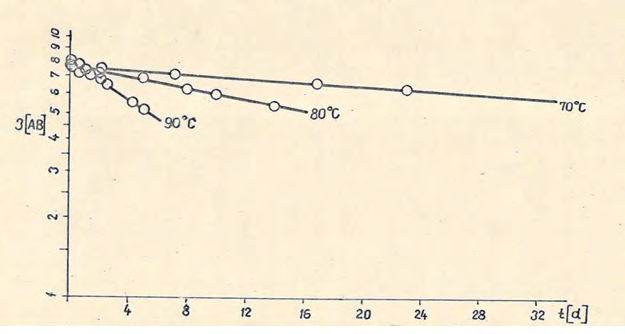
Kinetics of AB degradation was investigated in pabialgin drops formulation prepared according to the producer’s recipe (Polfa Pharmaceutical Works, Pabianice, Polands) at elevated temperatures (50°, 60°, 70°, 80°, and 90°). The degradation process followed the first-order kinetics (Figure 1).
The same studies were done for stabilized pabialgin drops prepared in accordance with a patented technology [8]. However, pH of glycerol formulation is 8.0 (original formulation pH = 7.1) and the rate of the degradation is significantly slower. Therefore, the degradation was feasible to be followed at greater temperatures (70°, 80°, and 90°). The degradation processes follow also first- order kinetics (Figure 2).
![Figure 2: Characteristic first-order plots (semi- logarithmic) for allobarbital (AB) concentrations (increased threefold) as a function of time in pabialgin stabilized drops, degraded at different temperatures [8].](/fulltextimages/7774/fig_2.png)
AP degradation at its high concentration (22 %) is slower than in a diluted solution [2]. Therefore, its initial concentration (21.8 %) decreased to 15.1 % and 17.7 % during 6 and 12 days at 80° and 70°, respectively. Therefore, it was necessary to follow kinetics of AP degradation in its diluted solutions. The initial pabialgin concentration (25 %) was diluted to 1.25 % in both aqueous and glycerol medium, and also the concentrations of other ingredients were similarly diminished. Acetate-ammonia buffer was used to maintain pH 7.1 as in the original Pabialgin® drops. The degradation process of AP also follows the first-order kinetics (Figure 3).
![Figure 3: Characteristic first-order plots (semi- logarithmic) for aminophenazone (AP) concentrations (increased threefold) as a function of time in diluted pabialgin (1.25%) drops in acetate-ammonia buffer (pH 7.1), stabilized and degraded at different temperatures [8].](/fulltextimages/7774/fig_3.png)
The first-order straight lines were calculated by means of the least-square method to receive their slopes (a) and intercepts (b) (Fig. 1-3). The slopes are equal to negative values of apparent first-order rate constants (- k), which are expressed in s-1 and provided in Table 2 and Table 3.
| Temperatures °C | 1a | 2a | 3 b |
|---|---|---|---|
| 50 | 0.837 | - | - |
| 60 | 2,510 | 2.71 | - |
| 70 | 6.59 | 8.695 | 0.988 |
| 80 | 27.7 | - | 2.95 |
| 90 | 47.34 | 42.4 | 7.36 |
Table 3: Apparent first-order rate constants (107∙k, s-1) for allobarbital (AB) hydrolysis in the original Pabialgin® drops (1
apH of the above aqueous solutions was 7.0 ± 0.2 and maintained as such during the course of hydrolysis. bapparent pH of the glycerol solution was 8.0. Table 2: Apparent first-order rate constants (107∙k, s-1) for allobarbital (AB) hydrolysis in the original Pabialgin® drops (1) and their new formulation stabilized [8] in an aqueous (2) and glycerol (3) solutions, at different elevated temperatures.
| Temperatures °C | 1 | 2 |
|---|---|---|
| 70 | 15.5 | 1.81 |
| 80 | 26 | 2.941 |
| 90 | 54.45 | 5.35 |
Table 2: Apparent first-order rate constants (107∙k, s-1) for Aminophenazone (AP) Aqueous Acetate-Ammonia buffer pH 7.1 in pre
apH was not maintained constant during oxidation, because it increased to 7.84. It was not possible to choose a more effective buffer. Furthermore, a phosphate buffer resulted in formation of a deposit. bpH increased from 8.0 to 8.6. A borate buffer solution could not be used, because a new chemical compound was formed as a result of boric acid reaction with glycerol. Table 3: Apparent first-order rate constants (107∙k, s-1) for Aminophenazone (AP) Aqueous Acetate-Ammonia buffer pH 7.1 in presence of Ab and Solubilisatesa (Urethane and Ethyl Urea) (1), and Ap Glycerol Acetate-Ammonia buffer (pH 8.0)b oxidation in presence of the solubilisates and Antioxidants (2), at different elevated temperatures.
The first-order rate constants allowed us to calculate shelf-life times for AB and AP using the Arrhenius equation for ln k as a function of reciprocal of absolute temperatures (1/T) (Figure 4) [9].
![Figure 4: Typical Arrhenius relationships (semi-logarithmic) for apparent frist-order rate constants (108∙k, s-1) as a function of reciprocal of absolute temperatures (in K,103∙1/T) for hydrolysis of allobarbital (AB) in the original Pabialgin® drops (1), and in new stabilized drops [8] (2) as well as for oxidation of aminophenazone (AP) in a diluted 1.25% pabialgin acetate-ammonia aqueous buffer (pH 7.1), in presence of solubilisates (3), and in a glycerol acetate-ammonia buffer pH (8.0), in presence of solubilisates and antioxidants [8] (4).](/fulltextimages/7774/fig_4.png)
Figure 4: Typical Arrhenius relationships (semi-logarithmic) for apparent frist-order rate constants (108∙k, s-1) as a function of reciprocal of absolute temperatures (in K,103∙1/T) for hydrolysis of allobarbital (AB) in the original Pabialgin® drops (1), and in new stabilized drops [8] (2) as well as for oxidation of aminophenazone (AP) in a diluted 1.25% pabialgin acetate-ammonia aqueous buffer (pH 7.1), in presence of solubilisates (3), and in a glycerol acetate-ammonia buffer pH (8.0), in presence of solubilisates and antioxidants [8] (4).
Its slope and intercept were calculated for the logarithmic form of the above-mentioned Arrhenius equation. The slope a = - ΔHa/R and provides apparent energy of activation (ΔHa). The intercept b = ln A, is called frequency coefficient. The apparent first-order rate constant (k20) of AP and AB degradation at ambient temperature is also calculated from the above Arrhenius equation. The other thermodynamic parameters e.g. enthalpy of activation ΔH≠ = ΔHa - R·T, where R denotes the gas constant in J·mol-1·K-1, and entropy of activation ΔS≠:
$$ \Delta \mathrm {S} ^ {\neq} = 2. 3 0 3 \cdot \mathrm {R} \cdot \left[ \log \mathrm {k} - (\log \bar {k} \cdot \mathrm {T} / \mathrm {h}) + \Delta \mathrm {H} ^ {\neq} / (2. 3 0 3 \cdot \mathrm {R} \cdot \mathrm {T}) \right], $$ Where k and h the Boltzmann and Planck constants, respectively can be found in the literature [10, 11].
The shelf-life time for AP and AB was calculated from a typical equation of first-order processes: t0,1 = 0.1054/k20, which provides the time needed to lose 10% of pharmacologically active drug in a formulation stored at ambient temperature. All parameters mentioned are presented in Table 4.
| Parameters | 1 | 2 | 3 | 4 |
|---|---|---|---|---|
| 103·ΔH[J·mol-1·l-1] a | 102.235 | 104.297 | 65.238 | 64.831 |
| log A | 9.4444 | 8.8821 | 4.104 | 3.087 |
| 103·ΔH≠[J·mol-1·l-1]a | 99.466 | 101.5293 | 62.386b | 61.979b |
| ΔS≠[J·K-1·mol-1]a | -73.63 | -84.0286 | - 175.763b | - 186.992b |
| 109·k [s-1] 20 | 1.687 | 0.1959 | 29.89 | 3.4 |
| t [y] 0.1 | 2.01±0,17 | 16.99±3.76 | 1.06±0.06 [mo] | 6.61±1.13 [mo] |
Table 4: Thermodynamic and stability testing parameters for allobarbital (AB) stability in the original Pabialgin® drops [8] (
a60°. b70°. Table 4: Thermodynamic and stability testing parameters for allobarbital (AB) stability in the original Pabialgin® drops [8] (2), and for aminophenazone (AP) stability in 1.25 % Pabialgin in aqueous acetate-ammonia buffer (pH 7.1) in presence of solubilisates (3) and in a glycerol acetate-ammonia buffer (pH 8.0) in presence of solubilisates and antioxidants (4).
The results give us information that AP is less stable if compared to AB in presence of Pabialgin® drops ingredients (t0.1 approx. 1 mo and 2 y, respectively). A difference is also in the mechanism of degradation of those active ingredients. Therefore, heat of activation is lower for AP than for AB (62.39, 99.47 kJ/(mol·l), respectively). The mechanism of AB degradation is hydrolytic as in case of other barbituric acids derivatives, but AP is degraded in accordance with oxidative processes [2, 6, 12, 13]. AP releases on degradation first dimethylamine and next forms dioxypyramidone, especially in an alkaline medium, and other undefined yellow-brownish compounds. Perhaps free radicals take place in that process. Therefore entropy of activation is lower for AP (- 175.763) than for AB (- 73.630 J/(K·mol)).
It is important to mention the significant stabilization of AB in patented glycerol pabialgin drops (Table 4) [8]. The shelf-life time of AB in that formulation is increased almost eight times (t0.1 = 17 y). This excellent effect is obtained by replacing water with glycerol (the dielectric constant is lowered from 78.5 to 42.5) [14]. This situation favours the stability of drugs which are degraded due to solvolytic processes.
The main effect on the stabilization of AP is due to the antioxidants used (ascorbic acid, sodium meta-bisulfite, disodium versenate). The shelf-life time of AP in that solution is increased over six times (from 1 mo to 7mo, Table 4) [8]. It should be emphasized again that the AP shelf-life is significant for a diluted 1.25 % pabialgin solution. It can be learnt that concentrated AP solutions are more stable than the diluted ones [2]. The stability of AP can also be increased if its solution is placed in amber ampoules sealed under nitrogen to shelter them from oxygen and light [15, 16]. AB stabilizes AP approx. twofold and inversely AP increases the degradation of AB 1.5 times [5].
Furthermore, AB is approx. 6 times more stable in original pabialgin liquid preparation (Table 2) if compared to its stability in a phosphate buffer at pH approx. 7, because its first-order rate constants are higher in that medium as it follows (in s-1): 1.74·10-6 , 3.82·10-6 , 1.3·10-5 at 60°, 70° and 80°, respectively [12]. The explanation of AP stabilization in presence of AB (an acid) is that it is more stable in slightly acidic medium (pH 5) than in slightly alkaline medium (pH 8.0) [15]. AP first-order rate constants, in aqueous borate buffer at pH approx. 8.6 at 70° at 80°, are 2.28·10-6 and 3.07·10-6 s-1, respectively being over 10 times greater than for pabialgin glycerol buffer diluted solution (Table 3) [15]. The above conclusion results from greater solubility of oxygen (main AP degradation agent) in water than in glycerol. Furthermore, the solubilisates (urethane and ethyl urea) accelerate the degradation of AP (almost twice) [4].
AP is now replaced in a pabialgin liquid preparation with propyphenazone (5-isopropylantipyrine) and used in some countries (Sri Lanka, Malaysia, Thailand, Turkey and India) for its anti-inflammatory, analgesic and antipyretic activity. Propyphenazone is structurally related to AP, but cannot be transformed into potentially carcinogenic nitrosamines and has therefore been widely used as a replacement drug for AP. Therefore, it is my belief that the data provided in this publication can be used by a pharmaceutical company for a formulation of the liquid pabialgin P, completely if allobarbital is concerned, and partly with respect to propyphenazone, which is also a pyrazolone-5 derivative. Its degradation pathways should be, to some extent, similar to aminophenazone, which is not used in medicine anymore.
Conclusion
In conclusion, the shelf-life times of the original Pabialgin® (Cibalgin®) liquid formulation were unsatisfactory for pharmacologically active principles (allobarbital, 2 y; aminophanazone, 1 mo). Therefore, attempts have been undertaken to slow down the hydrolytic reactions and oxidation processes responsible for AB and AP degradation, respectively [1, 6, 12]. To reach those goals, water was replaced with glycerol to decrease the dipole moments of the solvent used as well as solubility of oxygen. As a result, the shelf-life times were increased over eight and six times for AB and AP, respectively. The method of accelerated testing at elevated temperatures was used for prediction of shelf-life time using the Arrhenius equation [9]. Since AP is not used in medicine anymore, because of a cancerous effect of its metabolite, the findings of this publication can be used for the stabilization of neo pabialgin P where AP (4-dimethylaminoantipyrine) is replaced with propyphenazone which is also a derivative of antipyrine (4-isopropylaminoantipyrine).
Acknowledgments
One of the authors (TWH) wants to appreciate prof. F. Adamanis, Ph.D., his first head of the Department of Pharmaceutical Chemistry at the Poznan School of Pharmacy (now Poznan University of Medical Sciences) who has written an introduction to his first scientific paper and unfortunately is not an author of that publication. We appreciate A. Hermann, MSc in Law, our son and grandson respectively, for his significant role in refining the linguistic layer of this publication. Furthermore, it is appreciated that Figure 4 was drawn by Andrzej Czyrski, Dr. Habil. – a former student of Tadeusz W. Hermann.
This research received no specific grant from any funding agency in the public, commercial, or nonprofit sector.
References
-
Schulek E, Menyhárth P (1932) Neues Verfahren zur titrimetrischen Bestimmung des Pyramidones (Dimethylaminophenyldimethylpyrazolone) auch in Gegenwart von Antipyrin, Acetanilid, Phenacetin, Coffein usw. Z anal Chem 89: 426-439.
-
Pawełczyk E, Hermann TW (1963) Investigation of stability of aminophenazone aqueous solutions (in polish). Biul WAM Supp 1: 85-89.
-
Hermann TW (2017) Mini review on research of T.W. Hermann as an honorable editor. J Pharm Res 1(7): 1-2.
-
Pawełczyk E, Knitter B (1970) Assays of decay products of drugs. 28. Chromatographic-spectrophotometric determination of components of Pabialginum liquidum besides its decay products. Acta Polon Pharm 27(5): 455-462.
-
Pawełczyk E, Knitter B (1971) Studies on decomposition kinetics of drugs. Part 16. Stability of aminophenazone (APh) and allobarbital (AB) in the preparation Pabialginum liquidum (PBG)-(Cibalgin liq.). Acta Polon Pharm 28(3): 297-304.
-
Hermann T (1976) Kinetics and mechanism of degradation of some 5-allylbarbituric acid derivatives. Part 2. Mechanism of 5,5-diallylbarbituric acid degradation as a function of pH. Pharmazie 31(6): 368- 372.
-
Pawełczyk E, Hermann T, Marciniec B, Pluta I (1971) Studies on kinetics of degradation of drugs. Part 19. Thermal degradation of aminophenazone (AP), allobarbital (AB) and cycloadyphenine hydrochloride (CAD) mixture in cetyl phthalate medium. Acta Polon Pharm 28: 593-602.
-
Pawełczyk E, Hermann T (1971) Stabilization procedure for solution containing 1-phenyl-2,3- dimethyl-4- dimethylaminopyrazolone-5 and 5,5-diallylbarbituric acid PL 148514.
-
Attwood D, Florence AT (2012) Physical Pharmacy. 2nd (Edn.), London, Philadelphia: Pharmaceutical Press.
-
Laidler KJ (1965) Chemical Kinetics. 2nd (Edn.), New York (NY): McGraw-Hill.
-
Garrett ER, Metha PJ (1972) Solvolysis of adenine nucleosides. I. Effects of sugars and adenine substituents on acid solvolysis. J Amer Chem Soc 94(24): 8532-8541.
-
Hermann T (1974) Kinetics and mechanism of degradation of some 5,5-diallylbarbituric acid derivatives. Part 1. Log k – pH profile for 5,5-diallylbarbituric acid solvolysis. Pharmazie 29: 453-461.
-
Garrett ER, Bojarski TJ, Yakatan GJ (1971) Kinetics of hydrolysis of barbituric acid derivatives. J Pharm Sci 60(8): 1145-1154.
-
Martin A, Bustamante P, Chun AHC (1993) Physical pharmacy. 4th (Edn.), Philadelphia, London: Lea and Febiger.
-
Pawelczyk E, Hermann T, Zak G (1977) Kinetics of drug decay. Part 43. General acid-base catalysis of aminophenazone decay. Acta Pol Pharm 34(1):69.
-
Pawełczyk E, Hermann T (1977) Drug decomposition kinetics. Part 44. Specific acid-base catalysis of aminophenazone decomposition. Acta Polon Pharm 34: 491-497.
- Acido Labile or Gastro Irritant Apis and Enteric Release in Galenic Practice: An Overview
- A Study on Knowledge, Attitude and Practice of Hand Hygiene among Healthcare Professionals at a Tertiary Care Hospital, India
- Influence of Inoculum Concentration on In Vivo Incubation Period of Emmia lacerata, Pathogenesis and Management of Wilt in Pepper (Capsicum annuum L.)
- Vanilla’s Chemistry
- Marine Anti-Cancer Compounds and Adverse Effects of Global Warming on Oceans: An Overview
- Serological Investigation of Chikungunya Virus Antibody among Malaria-Suspected Febrile Patients in Some Healthcare Facilities in Rivers State