
A Review on Cucurbitaceae
Plants are basic source of food and energy cucurbitaceous family possess antibacterial, antimicrobial, antifungal characteristics and showed activities like antioxidant, phytochemical and hypoglycaemic activity. Cucurbitacins which are structurally diverse triterpenes found in the members of Cucurbitaceae and several other plant families possess immense pharmacological potential. The diverse phytoconstituent may prove to be important lead molecules for future research. This review is aimed to provide an insight into the chemical nature and medicinal potential of these compounds.
Introduction
The Cucurbitaceae family is also known as the cucurbit or gourd family. Cucurbitaceae is a fairly large plant family, consisting of about 125 genera and 965 species, botanically highly specialized family of mainly climbing plants. The various parts (fruit, seeds, stems, leaves) of the plants belonging to the cucurbitaceae family are very popular for their uses in culinary purposes from the ancient time. It is also used in Ayurvedic and folk medicine for their several therapeutic values due to the presence of a large number of metabolites (both primary and secondary). The important genera belonging to the family are Trichosanthes, Lagenaria, Luffa, Benincasa, Momordica, Cucumis, Citrullus, Cucurbita, Bryonopsis and Corallocarpus [1]. Some species that have attracted scientific investigation include Momordica charantia, Cucurbita pepo, Cucumis sativus, Cucumis melo, Citrullus colocynthis, Luffa echinata, Trichosanthes kirilowii, Lagenaria siceraria, Beninca sahispida [2].
The consumption of the fruits of Cucurbitaceae plants is widely popular among Indians due to their various nutritional and medicinal purposes. Cucurbitaceae family plants are mainly distributed in tropical or subtropical region, with a few species extending into temperate climate [3]. Cucurbitaceae is the largest group of summer vegetable crops. These include cucumber, musk melon, water melon, tinda, bottle gourd, luffa, and bitter gourd, pumpkin, squashes, parwal and snake gourd [4].
Many species of this family are the sources of medicine. Some of these plant sources are well reported in Ayurveda due to their potential therapeutic importance. The cucurbits are a good source of glucose, fructose, essential amino acids, vitamins, water-soluble polysaccharides, dietary fibers, phenolic glycosides, flavonoids, terpenoids, and minerals etc. Apart from the diverse chemical constituents, this family is very well characterized by their presence of cucurbitacin. Cucurbitacin consists of tetracyclic cucurbitane nucleus skeleton with a variety of oxygenation functionalities at different positions with diverse chemical categories. The cucurbitacins are present as non-glycosylated or glycosylated triterpenoids and divided into twelve categories, incorporating cucurbitacins A-T. Cucurbitacins are typically found in the roots, stems, cotyledons, leaves and fruits of cucurbits [5]. The concentrations increase with age. Research on cucurbitacins has shown them to be a taste deterrent in plants foraged by some animals and in some edible plants preferred by humans, like cucumbers.
Chemistry of Cucurbitacin
All cucurbitacins contain a basic 19-(10→9β)–abeo-- 10α–lanost–5-ene ring skeleton. A common feature among all compounds in the category of Cucurbitacins is the presence of 5, (6)-double bond. The difference of Cucurbitacins from steroidal nucleus lies in the fact that in basic structure of Cucurbitacins a methyl group is located at C-9 rather than C-10. Most of the Cucurbitacins are tetracyclic, but some representatives have an extra ring due to formal cyclization between C--16 and C--24 as in cucurbitacins S and T [6]. The Cucurbitacins differ from most of the other tetracyclic triterpenes by being highly unsaturated and contains numerous keto--, hydroxyl--, and acetoxy—groups [7]. Certain Cucurbitacins have been discovered in the form of glycosides and some of them lack C--11 carbonyl function [8]. Chemically, Cucurbitacins are ranked according to presence of various functional groups on rings A and C, diversity in side chain and stereochemical considerations [9]. The structural composition of following Cucurbitacins are known and have been designated by the letters: A, B, C, D, E, F, G, H, I, J, K, L, O, P, Q, R and S (Figure 1) [3]. The term “Cucurbitacin” refers to group of Cucurbitacins along with their glycosidic forms mentioned above, including those forms listed before. Cucurbitacin G and H have same structures but differ from each other in the configuration of the hydroxyl group at position 24 which is not yet established [11]. Cucurbitacin R was demonstrated to be 23, 24-dihydrocucurbitacin D (DHCD) hence, its description has been moved to the group of Cucurbitacin D. Similarly Cucurbitacin J and K differ from each other only in the configuration of hydroxyl group at position 24 which is yet to be determined [12]. A special group of Cucurbitacins are called as momordicosides, named after their occurrence in Momordica charantia. Momordicosides have never been identified in any other plant species [13]. The common feature of momordicosides is that C19 has been oxidized to an aldehyde group.
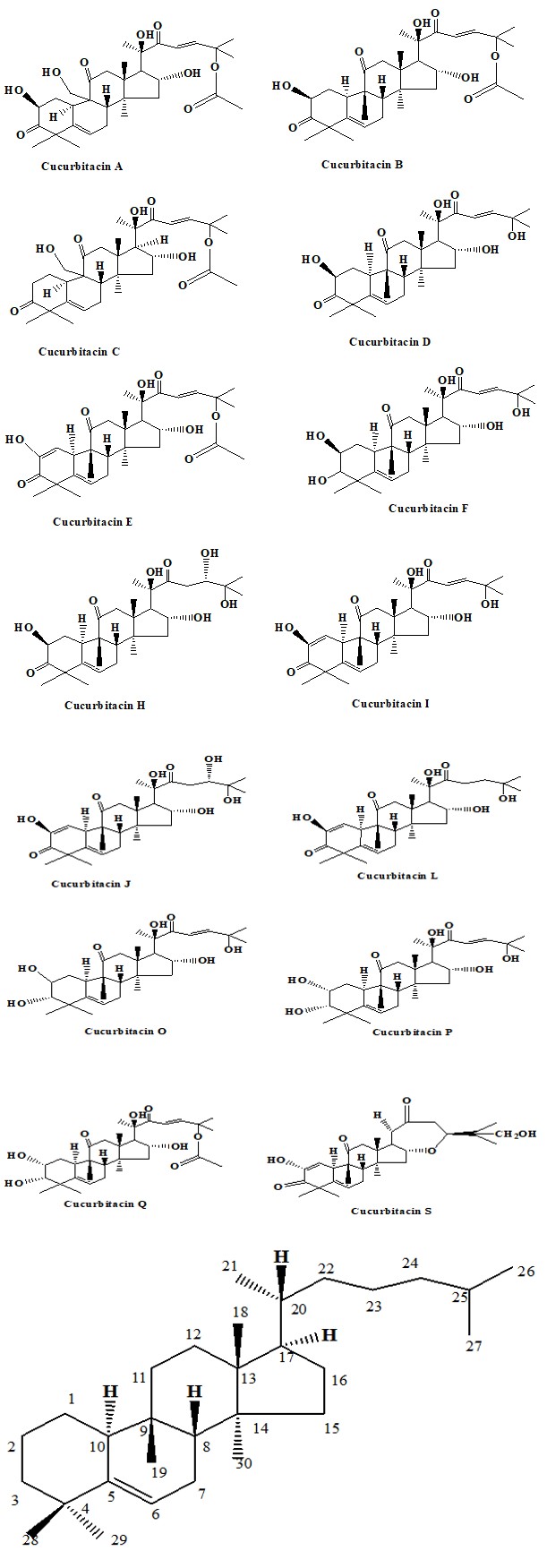
Pharmacological Action of Some Medicinal Plant
A lot of work has been done by the researchers throughout the world on various plants of the family of cucurbitaceae. Some of the important plants that have been studied.
Cucurbito Pepo
It is also known as konda, safed kadu. The fruit is cooling and astringent to the bowels, increase appetite, cures leprosy and purifies the blood and they are good source of important minerals such as copper, zinc, iron and magnesium. The seed extract of cucurbito pepo modulate immnunobiochemical pathways induced by interferons [13]. Pumpkin seeds a moderate to very good source of a variety of nutrients, including minerals, protein and healthy fats [14].
Luffa cylindrica
Luffa cylindrica is a green herbal plant that plays an important role in all around the world. It is very common in Nigeria, was investigated for the properties of its seed oil. It shows antioxidant effect due to Carotenoids present in the leaves of various organic solvent extracts ethanol extract of Luffa cylindrica leaves was found to have the highest number of flavonoids, saponins, and triterpenes as studied by Rotelli, et al., Mahato, et al., Safayhi and Sailer, et al. respectively [15]. The extract was found to have anti-inflammatory effect. antibacterial effects the n-hexane fraction of Luffa cylindrica showed good (64%) and the crude methanolic extract, modest (58%) antibacterial activity against Bacillus subtilis [16]. Butanol fraction gave modest activity (58%) against S. flexenari. Devi S et al. showed that ethanolic extract of Luffa cylindrica fruit has antifungal property against Aspergillus fumigates, Aspergillus Niger and Candida albicans and Chloroform extract was observed to have wound healing activity by reduction of wound area and period of epithelisation [17, 18].
Cucumis Sativus
Cucumis sativus exhibited strong activities against a wide range of diseases. Jony Mallik et al were carried out a study on the cytotoxic activity of the ethanolic extracts of Cucumis sativus. The ethanol extract showed lethality. Swapnil Sharma et al was studied with the aqueous extract fruit pulp of C. sativa significantly neutralized acid and showed resistance against change in pH and also illustrate good carminative potential [19]. The extract of C. sativa, has shown to possess significant carminative and antacid property. The aqueous extract of C. sativus L. selected for screening against experimentally induced boweldisease [20]. The extract of C. sativa, has shown to possess significant property against ulcerative colitis. R Sharmin, et al were investigated Hypoglycemic and Hypolipidemic Effects of Cucumber in Alloxan Induced Diabetic Rats [21]. It also shows pharmacological activity such as Wound Healing Activity, Hepatoprotective Activity, Antioxidant Activity, Copper Effect etc [22, 23].
Cucumis melo (musk melon)
It has been linked to the cure for chronic eczema. It is diaphoteric, diuretic, laxative, good tonic and has anti- inflammatory properties.
Momordica charantia – bitter melon
Momordica charantia is also known as karela. It has been used in various Asian traditional medicine systems for a long time, originally for non-communicable diseases like asthma, burning sensation, constipation, colic, diabetes, fever (malaria), gout, helminthiases, inflammation, and ulcer. It has also been publicized to have hypoglycaemic (antidiabetic) properties in animal as well as human studies. The juice of Momordica charantia were leaves used to treat piles totally, treating and preventing liver damage, menstrual troubles, burning sensations, constipation and blood purification due to its bitter tonic properties damage. Also, the leaves of Momordica charantia are used in treatment of menstrual troubles, burning sensation, constipation, fever (malaria), worms and parasites. Momordica charantia was effective tool in antifungal activity.
Many notorious plant pathogens like Fusarium have been controlled by the Momordica seed extract (MSE) making it a sustainable alternative to synthetic fungicide [24]. Extracts from the leaves of Momordica charantia was also effective against hepatitis [25]. Some ribosome inactivating protein RIPs were once isolated from Momordica charantia opening ways for antiviral therapy [26].
Trichosanthes cucumerina (snake gourd)
It is mainly consumed as a vegetable being rich in protein and vitamin C, carbohydrate, fibre, iron, phosphorus, vitamin B1, vitamin B2 and niacin. It is very common in Srilanka and India. All parts of the plant have their medicinal value. The root of the plant has been used for curing boils, headaches, bronchitis. The fruit and seeds are used for anthelmintic and stomach disorder respectively. The root extract has anti- inflammatory activity while the seed has antidiabetic activity [27, 28].
Lagenaria siceraria (Bottle Gourd)
It is a vegetable which is commonly consumed in India. It is a good tonic especially for the heart. It is effective against diseases such as fever, pectoral cough, bronchia disorders, ulcers and pain [29]. It also has diuretic activity [30, 31].
Benincasa hispida (wax gourd)
It is a known vegetable in most of the tropical countries that has a high medicinal value. Particularly in curing internal bleeding, epilepsy, cough, asthma, diabetes and nervous disorders [32].
Citrullus colocynthis (bitter apple)
Its part used are pulp of peeled fruit, leaves, seeds and the roots. It is grown in arid places and good for hypoglycemia, tumors, ulcers, bronchitis, constipation.
The leaves exhibit anti-inflammatory activity, diuretic and are used in painful menstruation, as well as in the treatment of asthma and jaundice [33, 34, 35, 36, 37, 38, 39, 40, 41, 42, 43, 44, 45].
| Sr. No. | Paper | Phytoconstituent | Plant Name | Column &λ max | Mobile phase & Elution Pattern, Flow Rate | Results |
|---|---|---|---|---|---|---|
| 1 | Determination of cucurbitacin E in some selected herbs of ayurvedic importance through RP-HPLC | cucurbitacin E | Lagenaria siceraria | C18 Spherisorb 5 mm ODS2 column (C18,250” *4.6”, 5 mm particle size). detection at 230 nm | Acetonitrile & water (1% glacial acetic acid) (70:30 v/v) flow rate 1 ml/min | The lowest amount was reported in fruit of Lagenaria siceraria (Bottle gourd) i.e. (0.0356% w/w). |
| Benincasahispida | Cucurbitacin E content in Benincasahispida was 0.0446% w/w). | |||||
| Momordica charantia | Cucurbitacin E content in Momordica charantia was 0.0523% w/w). | |||||
| Cocciniagrandis | Cucurbitacin E content in Coccinia grandis was 0.0511% w/w). | |||||
| Cucurbita pepo | Highest cucurbitacin E content in Cucurbita pepo. (pumpkin) was 0.0663% w/w) | |||||
| Luffa acutangula | Cucurbitacin E content inLuffa acutangulawas 0.0556% w/w). | |||||
| 2 | High performance liquid chromatography determination of cucurbitacins in the roots of Wilbrandia ebracteata Cogn. | cucurbitacin B (CB) | Wilbrandia ebracteata Cogn | C-18 RP (Supelco®, 150 X 4.6 mm, 5 μm) detection at230 nm | ACN:H 0 (40:60), 2 flow-rate 1.2 mL/min., and isocratic elution. | Rt CB;10.05 & |
| Dihydrocucurbitacin B (DHCB). | DHCB 11.58 |
Momordicoside L,
Momordicoside F2,
Momordicoside, K.
Determination and Quantitation of Five Cucurbitane triterpenoids in Momordica charantia by Reversed-Phase High-Performance Liquid Chromatography with Evaporative Light Scattering Detection Momordica charantia
3
3β,7β,25-trihydroxy cucurbita-5, (25E)- dien-19al, preliminary phytochemical analysis and quantitative analysis of quercetin by HPLC of momordica charantia. Quercetin Momordica charantia
4 Cucurbita pepo Identification and quantification of gamma-tocopherol in Cucurbita pepo, Cucumis melo and Cucumis sativus seeds extracts by high performance liquid chromatography. y-Tocopherol Cucumis melo
5 Cucumis sativus methanol (A), acetonitrile (B), and water (C), all containing 0.1% acetic acid, which were applied in the following gradient elution: 0–5 min, 10% A, 25% B, 65% C; 5–36 min, 10% A, 25% B, 65% C to 4% A, 70% B, 26% C; 36–38 min, 4% A, 70% B, 26% C to 100% B, then held for 5 min. Each run was followed by a 5 min washing procedure with 100% acetonitrile. The flow rate was adjusted to 0.5 mL/min, Gemini C-18 column (150 × 4.6 mm; 5 μm particle size) detection at Gradient HPLC (Perkin Elmer) with Merck C-18 select Bondapak (4.0 mm x125 mm) column was used.
Methanol: acetonitrile: water (60: 20: 20 V/V). flow rate of 1ml/min. RT 1.647
n-Hexane & petroleum ether seed extracts of Cucurbita pepo, were determined to contain 0.2900% w/v & 0.6666% w/v γ-tocopherol respectively n-Hexane & petroleum ether seed extracts of Cucumis melo were determined to contain 0.9162%w/v&0.5093%w/v, γ-tocopherol respectively reverse-phase C-18, 5μ, 250x4.6mm; column detection at 292nm; run time, 15minutes.
methanol: acetonitrile 60:40(v/v); flow rate, 1.0ml/min;
n-Hexane & petroleum ether seed extracts of Cucumis sativus were determined to contain0.7781%w/v, 0.5564%w/v γ- Tocopherol respectively
| 6 | An improved HPLC method for determination of colocynthin in colocynth. | Colocynthin | Citrullus colocynthis (L.) | The column was a RP (Luna C18 250 × 4.6 mm, 5μm) column (Phenomenex Inc., Aschaffenburg, Germany) equipped with C18 security guard cartridge (Luna 4 × 3.0 mm). Detection wavelength, 237 nm | Methanol: isopropanol: water: triflouroacetic acid 30:10:60:0.1 (v/v) ; solvent flow rate, 1.0 mL/min sample injection volume, 5 μL run time, 20.0 min | Colocynthin (RT=13.791 min). |
|---|---|---|---|---|---|---|
| 7 | Development of Isocratic RP- HPLC Method for Separation and Quantification of L-Citrulline and L-Arginine in Watermelons. | L-citrulline | Citrullus lanatus | The RP-HPLC columns Gemini C18,250 × 4.6 mm, 110˚A, 3 𝜇m (Phenomenex, Torrance, CA)] UV- Vis detection was performed at 195 nm. | The mobile phase at the concentration of 0.1% H P0 : ACN 3 4 (90: 10) flow rate of 0.5mL/min | L-citrulline is eluted at a short retention time 5.787 min. |
| L-arginine | L-arginine is eluted at a retention time at 4.773 min | |||||
| 8 | Simultaneous-HPLC Quantification of Phenolic Acids in Traditionally used Ayurvedic Herb Diplocyclospalmatus (L.) Jeffry | gallic acid (GA), | Diplocyclospalmatus | phenomenex Luna RP-C 18 column (4.6 × 250 mm, i.d., 5mm pore size) preceded with guard column of same material. UV detector at 254 nm, | Elution was carried out at a flow rate of 0.6 ml/min with water: acetic acid (99.0:1.0 v/v) as solvent A and acetonitrile as solvent B using a gradient elution in 0-14 min with 20-35% of solvent B, 14-40 min with 35- 50% of solvent B. | gallic acid (GA), 6.38 ± 0.030 |
| protocatechuic acid (PCA), | protocatechuic acid (PCA), 8.04 ± 0.032 | |||||
| caffeic acid (CA), | caffeic acid (CA), 11.93 ± 0.113 |
Isolation, characterization and quantitative HPLC-DAD analysis of components of charantin from fruits of Momordica charantia stigmasterol glucoside Momordica charantia
9 used Symmetry® C18 column (75 mm X 4.6 mm, 3.5μm) as stationary phase. UV detected at 204 nm.
Methanol: water (98:02, v/v) as mobile phase. mobile phase flow rate was set at 0.4 mL/min.
Retention times of STG were found to be 10.707 min.
β-sitosterol glucoside Retention times of BSG were found to be 11.870 min.
Charantin Momordica charantia
Charantin: An important lead compound from Momordica charantia for the treatment of diabetes
10 Isolation, Characterization and Quantification of Isoflavone in Momordica dioica_Roxb. Ex Wild (Cucurbitaceae) Fruits. daidzein _Momordica _dioica_Roxb
11 Development and validation of RP-HPLC method for simultaneous determination of glipizide and momordicinin in rat plasma.
Momordicinin Momordica charantia
12 C18 Hypersil column (300 mm X 3.9 mm, 10 μm) Detection was carried out at 204 nm.
methanol: water (100: 2, v/v) flow rateof 1.0 ml/min. Charantin eluted at retention time of 8.1 min.
C-18 Inertsil ODS-3 column (250 mm X 4.6 mm, 5 μm). Detection was carried out at 204 nm mobile phase composed of methanol: water (100:2, v/v). flow rate of 1.0 ml/min Retention time of charantin was approximately 12.0 min by using C-18 column (250 x 4.6, 5-μm) with an isocratic Wavelength at 255 nm.
Mobile phase, methanol and water containing 0.1% ortho- phosphoric acid (60:40 v/v) flow rate of 1.0 ml/min.
The Retention time (Rt) for daidzein was 15.5 min By using hypersil gold C18 column (250 × 4.6, 5µm) and Quantification was done at wavelength 223 nm Mobile phase constituting acetonitrile: phosphate buffer 10 mM with pH 3.5 (40:60, v/v).
The Rt of Momordicinin was 4.60 min.
References
-
Patel S, Rauf A (2017) Edible seeds from Cucurbitaceae family as potential functional foods: immense promises, few concerns. Biomed Pharmacother 91: 330-337.
-
Subrahmanyam NS (2004) Modern Plant Taxonomy. Vikas Publishing House Pvt. Ltd. New Delhi, India, pp: 316-321.
-
Chen JC, Chiu MH, Nie RL, Cordell GA, Qiu SX (2005) Cucurbitacins and cucurbitane glycosides: structures and biological activities. Nat Prod Rep 22(3): 386-399.
-
Choudhury B (1967) Vegetables. National Book Trust, New Delhi, India, pp: 130-162.
-
Dinan L, Harmatha J, Lafont R (2001) Chromatographic procedures for the isolation of plant steroids. J Chromatogr A 935(1-2): 105-123.
-
Gamlath CB, Leslie GA, Alvi KA, Rahman A, Balasubramaniam S (1988) Cucurbitacins of Colocynthis vulgaris_._ Phytochem 27(10): 3225-3229.
-
Jorn G, Inge S, Hans CA (2006) Cucurbitacins in plant food. TemaNord, pp: 556.
-
Stuppner H, Muller EP, Wagner H (1991) Cucurbitacins from Picrorhizakurrooa. Phytochem 30(1): 305-310.
-
Zheng CH, Fu HW, Pei YH (2007) A new cucurbitacin from Bolbostemma paniculatumFranguent. J Asian Nat Prod Res 9(2): 187-190.
-
Roa MM, Meshulam H, Lavie D (1974) Constituents of Ecballium elaterium XXIII: Cucurbitacins and hexanorcucurbitacin. J Chem Soc 22: 2552.
-
Stecher PG (2009) The Merc index-An encyclopedia of Chemicals and drugs. Rahway: Merck and Co., Inc., pp: 296-7.
-
Patel E, Murthy KR (2013) A review on potency of some Cucurbitaceae plants against hepatitis and antimicrobial activities. Ind J Fund Appl Life Sci 3(2): 13-18.
-
Krepsky PB, Cervelin MDO, Porath D, Peters RR, Ribeiro- do-Valle RM, et al. (2009) High performance liquid chromatography determination of cucurbitacins in the roots of Wilbrandia ebracteata Cogn. Revista Brasileira de Farmacognosia 19(3): 715-719.
-
Wang YH, Avula B, Liu Y, Khan IA (2008) Determination and quantitation of five cucurbitane triterpenoids in Momordica charantia by reversed-phase high- performance liquid chromatography with evaporative light scattering detection. Journal of chromatographic science 46(2): 133-136.
-
Supe U, Daniel P (2014) Preliminary phytochemical analysis and quantitative analysis of Quercetin by HPLC of Momordica charantia. World Journal of Pharmaceutical Research 4(01): 848-853.
-
Doshi GM, Kanade PP (2017) Identification and quantification of γ-tocopherol in Cucurbita pepo, Cucumis melo and Cucumis sativus seeds extracts by high performance liquid chromatography. Journal of Pharmacognosy and Phytochemistry 6(2): 192-196.
-
Desai S, Tatke P (2015) Charantin: An important lead compound from Momordica charantia for the treatment of diabetes. J Pharmacogn Phytochem 3(6): 163-166.
-
Shweta SS, Priyanka T, Ganesh TG, Khadabadi SS (2012) Distribution and ancient-recent medicinal uses of Trichosanthe species. Int J Phytopharm 2(4): 91-97.
-
Shekarchi M, Ramezany F, Shams Ardekani MR, Lamshöft M, Rastegar H, et al. (2015) An improved HPLC method for determination of colocynthin in colocynth. Research Journal of Pharmacognosy 2(4): 39-48.
-
Ridwan R, Abdul Razak HR, Adenan MI, Md Saad WM (2018) Development of isocratic RP-HPLC method for separation and quantification of L-citrulline and L-arginine in watermelons. International journal of analytical chemistry.
-
Mallik J, Akhter R (2012) Phytochemical Screening and In-vitro Evaluation of Reducing Power, Cytotoxicity and Anti-Fungal Activities of Ethanol Extracts of Cucumissativus. International Journal of Pharmaceutical & Biological Archives 3(3): 555-560.
-
Sharma S, Dwivedi J, Paliwal S (2012) Evaluation of antacid and carminative properties of Cucumis sativus under simulated conditions. Scholars Research Library Der Pharmacia Lettre 4(1): 234-239.
-
Patil K, Kandhare A, Bhise D (2012) Effect of aqueous extract of Cucumis sativus Linn. fruit in ulcerative colitis in laboratory animals. Asian Pacific Journal of Tropical Biomedicine 2(2): 962-969.
-
Sharmin R, Khan M, Akhter M, Alim A, Islam A, et al. (2013) Hypoglycemic and Hypolipidemic Effects of Cucumber, White Pumpkin and Ridge Gourd in Alloxan Induced Diabetic Rats. J Sci Res 5 (1): 161-170.
-
Saeed H, Waheed A (2017) A Review on Cucumber (Cucumis Sativus). International Journal of Technical Research & Science 2(6): 402-405.
-
Winkler C, Wirleitner B, Schennach H, Schroecksnadel K, Fuchs D (2005) Extracts of pumpkin ((Cucurbita pepo L.) seeds suppress stimulated peripheral blood mononuclear cells in vitro. Am J Immunol 1(1): 6-11.
-
Hernández JEB, León J (1994) Neglected crops 1492 from a different perspective. FAO (FAO Plant Production and Protection Series pp: 26.
-
Bulbul IJ, Zulfiker A, Hamid K, Khatun H, Begum Y (2011) Comparative study of in vitro antioxidant, antibacterial and cytotoxic activity of two Bangladeshi medicinal plants Luffa cylindrica L and Luffa acutangula. Pharmacognosy Journal 3(23): 23 59-66
-
Kanwal W, Syed AW, Salman A, Mohtasheem HM (2013) Anti-emetic and anti- inflammatory activity of fruit peel of Luffa cylindrical (L) Roem. Asian Journal of Natural & Applied Sciences 2(2): 75-80.
-
Devi GS, Muthu AK, Kumar DS, Rekha S, R Nandhini (2009) Studies on the Antibacterial and Antifungal Activities of the Ethanolic Extracts of Luffa Cylindrica (Linn) Fruit. International Journal of Drug Development and Research 1(1): 105-109.
-
Abirami MS, Indhumathy R, Devi GS, Kumar DS, Sudarvoli M, et al. (2011) Evaluation of the Wound Healing and Anti-Inflammatory Activity of Whole Plant of Luffa Cylindrica (Linn) in Rats. Pharmacologyonline 3: 281- 285
-
Santos KKA, Edinardo FF, Matias CE, Sobral-Souza SR, Tintino MFB, et al. (2012) Trypanocide, cytotoxic, and antifungal activities of Momordica charantia. Pharm Biol 50(2): 162-166.
-
Wang S, Zheng Y, Xiang F, Li S, Yang G (2016) Antifungal activity of Momordica charantia seed extracts toward the pathogenic fungus Fusarium solani L. J Food Drug Anal 24(4): 881-887.
-
Puri M, Kaur I, Kanwar RK, Gupta RC, Chauhan A, et al. (2009) Ribosome inactivating proteins (RIPs) from Momordica charantia for anti-viral therapy. Curr Mol Med 9(9): 1080-1086.
-
Kar A, Choudhary BK, Bandyopadhyay NG (2003) Comparative evaluation of hypoglycaemic activity of some Indian medicinal plants in alloxan diabetic rats. J Ethnopharm 84(1): 105-108.
-
Chanda J, Biswas S, Kar A, Mukherjee PK (2020) Determination of cucurbitacin E in some selected herbs of ayurvedic importance through RP-HPLC. Journal of Ayurveda and integrative medicine 11(3): 287-293.
-
Ramalingam B, Patel CN (2010) Studies on anthelmintic and antimicrobial activity of the leaf extracts of Lagenaria siceraria. J Glob Pharm Technol 2: 66-70.
-
Deshpande JR, Choudhari AA, Mishra MR, Meghre VS, Wadodkar SG, et al. (2008) Beneficial effects of Lagenaria siceraria (Mol.) Standley fruit epicarp in animal models. Indian J Exp Biol 46(4): 234-242.
-
Shehata AZI (2010) Studies on the efficacy of some plant extracts against the mosquito vector, Culex pipiens (Diptera: Culicidae). Unpublished M. Sc. Thesis, Fac Sci, Al-Azhar Univ, Egypt.
-
Ghule BV, Ghante MH, Yeole PG, Saoji AN (2007) Diuretic activity of Lagenaria siceraria fruit extracts in rats. Ind J Pharma Sci 69(6): 817-819.
-
Warrier PK, Nambiar VPK, Ramakutty C (1994) Indian medicinal plants. Orient Longman Limited, India, pp: 261.
-
Marzouk BZ, Marzouk E, Haloui N, Fenina A, Bouraoui A, et al. (2010) Screening of analgesic and anti-inflammatory activities of Citrullus colocynthis from Southern Tunisia. J Ethnopharmacol 128(1): 15-19.
-
Gill NS, Kaur S, Arora R, Bali M (2011) Screening of antioxidant and antiulcer potential of Citrullus colocynthis methanolic seed extract. Res J Phytochem 5(2): 98-106.
-
Kumar S, Kumar D, Manjusha, Saroha K, Singh N, et al. (2008) Antioxidant and free radical scavenging potential of Citrullus colocynthis (L.) Schrad. methanolic fruit extract. Acta Pharmaceut 58(2): 215-220.
-
Ingle A, Kulkarni P, Sathiyanarayanan L (2022) Development and validation of RP-HPLC method for simultaneous determination of glipizide and momordicinin in rat plasma. IJPSR 13(1): 1000-1006.
- Acido Labile or Gastro Irritant Apis and Enteric Release in Galenic Practice: An Overview
- A Study on Knowledge, Attitude and Practice of Hand Hygiene among Healthcare Professionals at a Tertiary Care Hospital, India
- Influence of Inoculum Concentration on In Vivo Incubation Period of Emmia lacerata, Pathogenesis and Management of Wilt in Pepper (Capsicum annuum L.)
- Vanilla’s Chemistry
- Marine Anti-Cancer Compounds and Adverse Effects of Global Warming on Oceans: An Overview
- Serological Investigation of Chikungunya Virus Antibody among Malaria-Suspected Febrile Patients in Some Healthcare Facilities in Rivers State