
Determination and Validation of RP-HPLC Method for the Estimation of Fosamprenavir in Tablet Dosage Form
A new simple, accurate, profitable, rapid-fire and precise rear phase high performance liquid chromatographic system has been developed for the validated of Fosamprenavir in bulk form and its pharmaceutical lozenge form. Chromatographic separation was carried out on Zorbax C18(4.6mm X 250mm, 5m, Make X terra) column using a admixture of Acetonitrile Methanol Water (503020 v/v) as the mobile phase at an inflow rate of 1.0ml/min , the discovery was carried out at 265nm. The retention time of the Fosamprenavir was set up to be 5.462±0.02 min. The system was validated according to ICH guidelines for linearity, perceptivity, delicacy, perfection, particularity and robustness. The response was set up to be direct in the medicine attention range of 50−90mcg/ml for Fosamprenavir. The correlation measure was set up to be 0.999. The LOD and LOQ for Fosamprenavir were set up to be 1.6µg/ml and 4.8µg/ml independently. The proposed system was set up to be good chance recovery for Fosamprenavir, which indicates that the proposed system is largely accurate. The system perfection for the determination of assay was below 2.0 RSD. The system is useful in the quality control of bulk and retailed pharmaceutical phrasings
Introduction
Chromatography is a technique for the separation of a mixture. The admixture is dissolved in a fluid called the mobile phase, which carries it through a structure holding another material called the stationary phase. The colorful ingredients of the admixture trip at different pets, causing them to separate. The separation is grounded on discriminational partitioning between the mobile and stationary phases. Subtle differences in a compounds partition measure result in discriminational retention on the stationary phase and therefore affect the separation [1].
Chromatography may be preliminary or logical. The purpose of preliminary chromatography is to separate the factors of a admixture for after use, and is therefore a form of sanctification. Analytical chromatography is done typically with lower quantities of material and is for establishing the presence or measuring the relative proportions of analytes in an admixture. The two aren’t mutually exclusive [2].
Chromatography is grounded on the principle where moites in mixture applied onto the surface or into the solid, and fluid stationary phase is separating from each other while moving with the aid of a mobile phase. factors effective on this separation process molecular characteristics related to adsorption(liquid-solid), partition (liquid-solid) and affinity or differences among their molecular weights [3, 4]. Because of these differences, some factors of the admixture stay longer in the stationary phase, and they move sluggishly in the chromatography system, while others pass fleetly into mobile phase, and leave the system briskly [5, 6].
Grounded on this approach three components form the basis of the chromatography technique.
- Stationary phase: This phase is always composed of a “ solid ” phase or “ a subcaste of a liquid adsorbed on the solid support surface”
- Mobile phase: This phase is always composed of “liquid” or a “gassy element”.
- Separated moites The type of commerce between stationary phase, mobile phase and substances contained in the admixture is the introductory element effective on separation of motes from each other. Chromatography styles grounded on partition are veritably effective on separation, and identification of small moites as amino acids, carbohydrates and adipose acids still, affinity chromatography’s (i.e. ion- exchange chromatography) are more effective in the separation of macromolecules like nucleic acids, and proteins. Paper chromatography is used in the separation of proteins, and in studies related to synthesis of protein; gas- liquid chromatography is employed in the separation of alcohol, Esther, lipid, and amino groups, and observation of enzymatic relations, while molecular- sieve chromatography is employed especially for the determination of molecular weights of proteins. Agarose- gel chromatography is used for the sanctification of RNA, DNA patches, and contagions [7, 8].
Stationary phase in chromatography is a solid phase or a liquid phase carpeted on the face of a solid phase. Mobile phase flowing over the stationary phase is a gassy or liquid phase. However, and if its gas also it’s called gas chromatography (GC), If mobile phase is liquid it’s nominated as liquid chromatography (LC). Gas chromatography is applied for feasts, and fusions of unpredictable liquids, and solid material. Liquid chromatography is used especially for thermal unstable and non-volatile samples [9, 10].
The purpose of applying chromatography which is used as a system of quantitative analysis piecemeal from its separation is to achieve a satisfactory separation within a suitable time interval colorful chromatography styles have been developed to that end. Some of them include column chromatography, thin-layer chromatography(TLC), paper chromatography, gas chromatography, ion exchange chromatography, gel saturation chromatography, high- pressure liquid chromatography, and affinity chromatography [11, 12].
- Column chromatography
- Ion-exchange chromatography
- Gel-permeation (molecular sieve) chromatography
- Affinity chromatography
- Paper chromatography
- Thin-layer chromatography
- Gas chromatography
- Dye-ligand chromatography
- Hydrophobic interaction chromatography
- Pseudo affinity chromatography
- High-pressure liquid chromatography (HPLC)
Instrumentation of HPLC
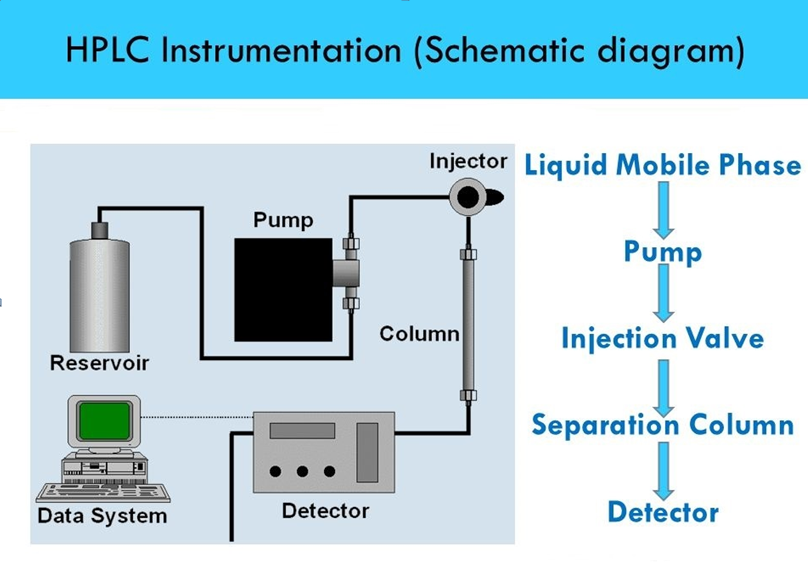
As shown in the schematic illustration in Figure 1 over, HPLC instrumentation [13, 14] includes a pump, injector, column, sensor and integrator or accession and display system. The Main Part of the system is column in this separation occurs
Experimental Methods
Instruments Used:
| Instruments And Glass wares | Model | |
|---|---|---|
| 1 | HPLC | WATERS Alliance 2695 separation module, Software: Empower 2, 996 PDA detectors. |
| 2 | pH meter | Lab India |
| 3 | Weighing machine | Sartorius |
| 4 | Volumetric flasks | Borosil |
| 5 | Pipettes and Burettes | Borosil |
| 6 | Beakers | Borosil |
| 7 | Digital ultra sonicator | Lab man |
Table 1: Instruments Used.
Chemicals Used:
| S. No. | Chemical | Brand names |
|---|---|---|
| 1 | Fosamprenavir (Pure) | Sura labs |
| 2 | Water and Methanol for HPLC | Lichrosolv (Merck) |
| 3 | Acetonitrile for HPLC | Merck |
Table 2: Chemicals Used.
HPLC Method Development (Trails)
Preparation of standard solution: Accurately weigh and transfer 10mg of Fosamprenavir working standard into a 10ml of clean dry volumetric flasks add about 7ml of Methanol and sonicate to dissolve and removal of air completely and make up the volume up to mark with the Methanol [15]. Further pipette 0.7ml of the above Fosamprenavir stock solutions into a 10ml volumetric flask and dilute up to the mark with Methanol.
Procedure: Inject the samples by changing the chromatographic conditions and record the chromatograms, note that the conditions of proper peak elution for performing validation parameters as per ICH guidelines.
Mobile Phase Optimization: Initially the mobile phase tried was methanol: Water and Methanol: Phosphate buffer with varying proportions. Finally, the mobile phase was optimized to Methanol: Phosphate Buffer ( ) 4.0 pH − ( ) 35:65%v v respectively [16].
Optimization of Column: The method was performed with various columns like C18 column, X- bridge column, X terra, and C18 column. Symmetry ODS
18 4.6 X 150 , 5 ( ) , : C mm mm m Make X terra µ w a s found to be ideal as it gave good peak shape and resolution at 1ml/min flow [17].
Optimized Chromatographic Conditions:
| Instrument used | Waters HPLC with auto sampler and PDA detector 996 model. |
|---|---|
| Mobile phase ratio | Acetonitrile: Methanol: Water (50:30:20% v/v) |
| Column | Zorbax C18 (4.6mm x 250mm, 5mm, Make: X terra) |
| Column temperature | 35℃ |
| Wavelength | 265nm |
| Flow rate | 1ml/min |
| Injection volume | 20μl |
| Run time | 10min |
Table 3: Optimized Chromatographic Conditions.
Validation
Preparation of Mobile Phase: Accurately measured 500ml (50%) of Acetonitrile, 300ml (30%) of Methanol and 200ml of HPLC Grade water (20%) were mixed and degassed in digital ultra sonicater for 15 minutes and then filtered through 0.45 µm filter under vacuum filtration [18].
Diluent Preparation: The Mobile phase was used as the diluent.
Validation Parameters
System Suitability: Accurately weigh and transfer 10mg of Fosamprenavir working standard into a 10ml of clean dry volumetric flasks add about 7ml of Diluents and sonicate to dissolve it completely and make the volume up to the mark with the same solvent (Stock solution). Further pipette 0.7ml of the above Fosamprenavir stock solution into a 10ml volumetric flask and dilute up to the mark with diluents. Procedure: The standard result was fitted for five times and measured the area for all five injections in HPLC. The RSD for the area of five replicate injections was set up to be within the specified limits.
%
Specificity Study of Drug
Preparation of Standard Solution: Directly weigh and transfer 10mg of Fosamprenavir working standard into a 10ml of clean dry volumetric flask add about 7ml of Diluents and sonicate to dissolve it fully and make volume up to the mark with the same solvent [19] (Stock solution) Further pipette 0.7ml of the above Fosamprenavir stock solutions into a 10ml volumetric flask and dilute up to the mark with diluents. Further pipette 0.7ml of the below Fosamprenavir stock results into a 10ml volumetric flask and dilute up to the mark with diluents.
Preparation of Sample Solution: Take average weight of Tablet and crush in a mortar by using pestle and weight 10mg original weight of Fosamprenavir sample into a 10ml clean dry volumetric flask and add 7ml of Diluent and sonicate to dissolve it fully and make volume up to the mark with the same solvent [20, 21]. Further pipette 0.7ml of Fosamprenavir above stock solution into a 10ml volumetric flask and dilute up to the mark with diluent.
Procedure: Inject the three replicate injections of standard and sample solutions and calculate the assay by using formula:
100 Sample area Weight of standard Standard area Dilution of standard Dilut ASSAY X X = ion of sample Purity Weight of tablet Weight of sample Label claim X X X
100
Results and Discussion
| Acetonitrile: Methanol: Water(50:30:20% v/v) | |
|---|---|
| Column | ZorbaxC18(4.6mm x 250mm, 5μm, Make: X terra) |
| Column temperature | 35°C |
| Wavelength | 265nm |
| Flow rate | 1ml/min |
| Injection volume | 20μl |
| Run time | 10min |
Table 4: Optimized Chromatogram (Standard).
| S. No. | Name | RT | Area | Height | USP Tailing | USP Plate Count |
|---|---|---|---|---|---|---|
| 1 | Fosamprenavir | 5.462 | 1052689 | 75421 | 1.62 | 9625 |
Table 5: Optimized Chromatogram (Standard) Observation.
Observation: In this trial it shows proper peak, tailing, plate count and baseline in the chromatogram. So it’s optimized chromatogram.
| S. No. | Name | RT | Area | Height | USP Tailing | USP Plate Count |
|---|---|---|---|---|---|---|
| 1 | Fosamprenavir | 5.466 | 1068547 | 76584 | 1.63 | 9658 |
Table 6: Optimized Chromatogram (Standard).
Acceptance Criteria:
- Theoretical plates must be not less than 2000.
- Tailing factor must be not more than 2.
• It was found from above data that all the system suitability parameters for developed method were within the limit.
| Peak Name | RT | Area (µV*sec) | Height (µV) | USP Plate Count | USP Tailing | |
|---|---|---|---|---|---|---|
| 1 | Fosamprenavir | 5.474 | 1052658 | 75842 | 9658 | 1.63 |
| 2 | Fosamprenavir | 5.466 | 1058475 | 75481 | 9758 | 1.62 |
| 3 | Fosamprenavir | 5.474 | 1059854 | 75162 | 9685 | 1.63 |
| 4 | Fosamprenavir | 5.452 | 1054786 | 75241 | 9635 | 1.62 |
| 5 | Fosamprenavir | 5.446 | 1052642 | 75468 | 9649 | 1.63 |
| Mean | - | - | 1055683 | - | - | - |
| Std. Dev. | - | - | 3331.494 | - | - | - |
| % RSD | - | - | 0.315577 | - | - | - |
Table 7: Results of system suitability for Fosamprenavir.
Specificity
| S.No. | Name | RT | Area | Height | USP Tailing | USP Plate Count | Injection |
|---|---|---|---|---|---|---|---|
| 1 | Fosamprenavir | 5.427 | 1052689 | 75421 | 1.63 | 9674 | 1 |
| 2 | Fosamprenavir | 5.43 | 1052854 | 75462 | 1.62 | 9657 | 2 |
| 3 | Fosamprenavir | 5.443 | 1055365 | 75489 | 1.62 | 9625 | 3 |
Table 8: Peak results for assay standard.
| S.No. | Name | RT | Area | Height | USP Tailing | USP Plate Count | Injection |
|---|---|---|---|---|---|---|---|
| 1 | Fosamprenavir | 5.453 | 1065851 | 76854 | 1.63 | 9785 | 1 |
| 2 | Fosamprenavir | 5.462 | 1065482 | 76352 | 1.64 | 9786 | 2 |
| 3 | Fosamprenavir | 5.466 | 1063544 | 76586 | 1.63 | 9795 | 3 |
Table 9: Peak results for Assay sample.
100 Sample area Weight of standard Standard area Dilution of standard Dilut % ASSAY X X = ion of sample Purity Weight of tablet Weight of sample Label claim X X X
100 The % purity of Fosamprenavir in pharmaceutical dosage form was found to be 99.58%.
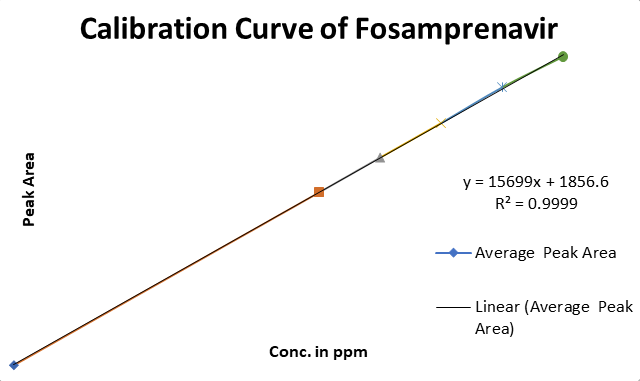
Linearity
Chromatographic Data for Linearity Study:
| Concentration mg/ml | Average Peak Area |
| 50 | 786789 |
| 60 | 945685 |
| 70 | 1102689 |
| 80 | 1265241 |
| 90 | 1405476 |
Table 10: Chromatographic Data for Linearity Study.
Repeatability
Obtained Five (5) replicates of 100% accuracy solution as per experimental conditions. Recorded the peak areas and calculated % RSD.
| Peak name | Retention time | Area (μV*sec) | Height | USP Plate Count | USP Tailing | ||
|---|---|---|---|---|---|---|---|
| Peak name | Retention time | Area (μV*sec) | USP Plate Count | USP Tailing | (μV) | ||
| 1 | Fosamprenavir | 5.419 | 1052658 | 76231 | 9658 | 1.63 | |
| 2 | Fosamprenavir | 5.405 | 1056854 | 75898 | 9667 | 1.62 | |
| 3 | Fosamprenavir | 5.478 | 1052468 | 75452 | 9652 | 1.63 | |
| 4 | Fosamprenavir | 5.466 | 1052774 | 75468 | 9635 | 1.62 | |
| 5 | Fosamprenavir | 5.466 | 1055245 | 76214 | 9658 | 1.63 | |
| Mean | - | - | 1054000 | - | - | - | |
| Std.dev | - | - | 1958.724 | - | - | - | |
| %RSD | - | - | 0.185837 | - | - | - |
Table 11: Results of Repeatability for Fosamprenavir.
Acceptance criteria: %RSD for sample should be NMT 2. The %RSD for the standard solution is below 1, which is within the limits hence method is precise.
Intermediate precision:
| Peak Name | RT | Area (μV*sec) | Height (μV) | USP Plate Count | USPTailing | |
|---|---|---|---|---|---|---|
| 1 | Fosamprenavir | 5.484 | 1075846 | 76985 | 9785 | 1.65 |
| 2 | Fosamprenavir | 5.493 | 1078254 | 76854 | 9748 | 1.64 |
| 3 | Fosamprenavir | 5.406 | 1078598 | 76254 | 9786 | 1.65 |
| 4 | Fosamprenavir | 5.419 | 1075461 | 76859 | 9726 | 1.65 |
| 5 | Fosamprenavir | 5.446 | 1075236 | 75898 | 9742 | 1.64 |
| 6 | Fosamprenavir | 5.452 | 1075842 | 76985 | 9785 | 1.65 |
| Mean | - | - | 1076540 | - | - | - |
| Std. Dev. | - | - | 1483.688 | - | - | - |
| % RSD | - | - | 0.13782 | - | - | - |
Table 12: Results of Intermediate precision for Fosamprenavir.
Acceptance criteria: %RSD of six different sample solutions should not more than 2.
| S. No. | Peak Name | RT | Area (µV*sec) | Height (µV) | USPPlate Count | USPTailing |
|---|---|---|---|---|---|---|
| 1 | Fosamprenavir | 5.493 | 1068545 | 78574 | 9865 | 1.65 |
| 2 | Fosamprenavir | 5.493 | 1068547 | 78546 | 9854 | 1.64 |
| 3 | Fosamprenavir | 5.478 | 1063588 | 78452 | 9826 | 1.65 |
| 4 | Fosamprenavir | 5.466 | 1063542 | 78542 | 9824 | 1.65 |
| 5 | Fosamprenavir | 5.478 | 1065243 | 78563 | 9863 | 1.66 |
| 6 | Fosamprenavir | 5.419 | 1065874 | 78632 | 9875 | 1.66 |
| Mean | - | - | 1065890 | - | - | - |
| Std. Dev. | - | - | 2251.215 | - | - | - |
| % RSD | - | - | 0.211205 | - | - | - |
| %Concentration (at specification Level) | Area | Amount Added (ppm) | Amount Found (ppm) | % Recovery | Mean Recovery | |
| 50% | 553829 | 35 | 35.159 | 100.45% | 100.29% | |
| 100% | 1105114 | 70 | 70.275 | 100.39% | ||
| 150% | 1650868 | 105 | 105.039 | 100.04% |
Table 13: The Accuracy Results for Fosamprenavir. Acceptance Criteria: The percentage recovery was found to be within the limit (9
Acceptance criteria: %RSD of six different sample solutions should not more than 2.
| Parameter used for sample analysis | Peak Area | Retention Time | Theoretical plates | Tailing factor |
|---|---|---|---|---|
| Actual Flow rate of 1.0ml/min | 1052689 | 5.453 | 9625 | 1.62 |
| Less Flow rate of 0.9ml/min | 1015241 | 5.599 | 9155 | 1.54 |
| More Flow rate of 1.1ml/min | 1023654 | 4.576 | 9254 | 1.56 |
| More Organic phase | 1015853 | 3.827 | 9147 | 1.54 |
| Less organic phase | 1002514 | 7.415 | 9256 | 1.53 |
Table 14: Results for Robustness.
Acceptance Criteria: The tailing factor should be less than 2.0 and the number of theoretical plates (N) should be more than 2000.
Summary
- The analytical method was developed by studying different parameters.
- First the maximum absorbance was found to be at 265nm and the peak purity was excellent.
- Injection volume is selected to be 20_µl_ which gave a good peak area.
- The column used for study was Zorbax 18 4.6 250 , 5 ( ) , : C mm x mm m Make X terra µ because it was giving good peak.
- 350C temperatures were found to be suitable for the nature of drug solution. The flow rate was fixed at 1.0ml/ min because of good peak area and satisfactory retention time.
- Mobile phase is Acetonitrile: Methanol: Water ( ) 50:30: 20% / v v was fixed due to good symmetrical peak. So this mobile phase was used for the proposed study.
- Run time was selected to be 10 min because analyze gave peak around 5.462 ±0.02min respectively and also to reduce the total run time.
- The percent recovery was found to be 98.0-102% was linear and precise over the same range. Both system and method precision was found to be accurate and well within range.
- The analytical method was found linearity over the range 50-90µg/ml of Fosamprenavir of the target concentration.
- The analytical passed both robustness and ruggedness tests. On both cases, relative standard deviation was full satisfactory.
Conclusion
The HPLC system developed is accurate, precise, repeatable and specific. The system is direct over a wide range and utilizes a mobile phase which can be fluently prepared. The column used is an extensively available reversed phase Zorbax 18 4.6 250 , 5 ( ) , : C mm x mm m Make X terra µ . This system is suitable for the routine quantification of Fosamprenavirin bulk medicine and in the tablet dosage forms.
The Validation of this system was proved to be simple, fast and reliable. The system was validated for its performance parameters Linearity, Repeatability, Accuracy, Precision, Ruggedness, and Robustness etc.
The developed method offers several advantages in terms of simplicity in mobile phase, isocratic mode of elution and sample preparation steps and comparative short run time makes the system specific, repeatable and reliable for its intended use in determination of Fosamprenavir in bulk form and pharmaceutical dosage form.
References
-
John MM (2011) Organic chemistry: with biological applications 2nd (Edn.), Brooks/Cole Cengage Learning pp: 395.
-
Hostettmann, K, Marston, A, Hostettmann M (1998) Preparative Chromatography Techniques 2nd (Edn.), A.J.Med. pharm sci Applications in Natural Product Isolation Berlin Heidelberg Springer pp: 50.
-
Karnakar N, Ramana H, Parameshwar, Narsimha RR, Vasanthi R (2021) Analytical Method Development and validation for the Simultaneous Estimation of Ephidrine and Theophylline by RP-HPLC Method. A. J. Med. Pharm Sci 9(1): 23-26.
-
Cuatrecasas P, Wilchek M, Anfinsen CB (1968) Selective enzyme purification by affinity chromatography. Proc Natl Acad Sci U S A 61(2): 636-643.
-
Porath J (1997) From gel filtration to adsorptive size exclusion. J Protein Chem 16(5): 463-468.
-
Amani P, Narendar M, Karnakar N, Ramya SS (2022) RP- HPLC Method for Estimation of Zanamivir in API and Pharmaceutical Formulation. Int J Life Sci Pharma Res 12(1): 20-27.
-
Harris DC (2004) Exploring chemical analysis 3rd (Edn.), WH. Freeman & Co
-
Regnier FE (1983) High-performance liquid chromatography of bio polimers. Science 222(4621): 245-252.
-
Sharma BK (2004) Instrumental methods of chemical analysis Introduction to analytical chemistry 23th (Edn.), Goel publishing house meerut pp: 12-23.
-
Willard HH, Merritt LL, Dean JA, Settle FA (1986) Instrumental methods of analysis 7th (Edn.) CBS publishers and distributors New Delhi pp: 518-521
-
John Adamovies (1996) Chromatographic analysis of pharmaceutical 2nd (Edn.), Marcel Dekker Inc. New York pp: 5-15.
-
Chatwal G, Anand SK (1984) Instrumental methods of chemical analysis 5th (Edn.), Himalaya publishing house New Delhi pp: 1.1-1.8.
-
Skoog DA, Donald MW, Holler F, Nieman TA (1997) Principle of instrumental analysis, 5th (Edn.), Saunders college publishing pp: 778-787.
-
Skoog DA, Holler F, Nieman TA (2001) Principals of instrumental analysis 5th (Edn.), Harcourt publishers international company pp: 543-554.
-
William K (2005) Organic spectroscopy 3rd (Edn.), Palgrave New York pp: 7-10 & pp: 328-330.
-
Sethi PD (2001) HPLC: Quantitative analysis pharmaceutical formulations, CBS publishers and distributors, New Delhi pp: 3-137.
-
Michael E, Schartz IS, Krull (1997) Analytical method development and validation pp: 25-46.
-
Snyder LR, Joseph JK, Joseph LG (1997) practical HPLC method development 2nd (Edn.), John Wiley and sons New York pp: 180-182.
-
Gadi RRR, Raju VKV, Prasad GS (2013) Estimation of Frovatriptan Succinate in Tablet Dosage Form by RP- HPLC. Der Pharmacia Lettre 5(5): 151-157
-
Kumara Swamy G (2012) Development and validation of RP - HPLC method for the estimation of frovatriptan succinate in bulk and tablet dosage form. Journal of Pharmacy Research 5(2): 894-895
-
Usha RN, Sreenivasa RR, Saraswathi K, Murthy TEGK, Rp– Hplc and Spectrophotometry Method For The Analysis Of Frovatriptan In Fomulations.
- Acido Labile or Gastro Irritant Apis and Enteric Release in Galenic Practice: An Overview
- A Study on Knowledge, Attitude and Practice of Hand Hygiene among Healthcare Professionals at a Tertiary Care Hospital, India
- Influence of Inoculum Concentration on In Vivo Incubation Period of Emmia lacerata, Pathogenesis and Management of Wilt in Pepper (Capsicum annuum L.)
- Vanilla’s Chemistry
- Marine Anti-Cancer Compounds and Adverse Effects of Global Warming on Oceans: An Overview
- Serological Investigation of Chikungunya Virus Antibody among Malaria-Suspected Febrile Patients in Some Healthcare Facilities in Rivers State