
Assessment of Steel Slag as a Persulfate Activator for Treatment of Landfill Leachate
In this research, the performance of steel slag (SS) as an activator of persulfate (PS) for the removal the chemical oxygen demand (COD) of raw leachate landfill was studied. The experiments were conducted in a batch reactor. The SS was obtained from the Esfahan Steel Company, Iran. X-ray diffraction (XRD) and field emission scanning electron microscope (FE-SEM) and energy dispersive spectroscopy (EDS) analysis were used to investigate the characteristics of the SS. The effects of SS dosage (0-5 g L-1), PS/COD ratio (1-5), and reaction time (0-180 min) on the removal of leachate landfill. The Maximum removal efficiencies at optimize operational conditions (SS dosage 3 g L-1, PS/COD ratio: 3 and reaction time: 45 min) was 83%. The addition of SS (3 g L-1) led to more than six and a halftimes increase in degradation rate constants of COD.
Introduction
Leachate is highly contamination fluid may formed Because of leaking rain water in landfill and/or through some procedural events like Waste compaction as well as the decomposition of waste materials within Waste cells [1, 2]. Leachate contains a large spectrum of organic substances and other toxic matters that which makes safe disposal of it are vital issues [3]. There is no specific method or technique for leachate treatment, because the components of leachate vary and differ permanently depending on different factors and conditions [4, 5].
Generally treatments for leachates, It includes mainly: (a) leachate transfer: recycling and combined treatment with domestic sewage, (b) biodegradation: aerobic and anaerobic processes and (c) chemical and physical methods: chemical oxidation, adsorption, chemical precipitation, coagulation/flocculation, sedimentation/flo tation and air stripping [6]. These methods are no longer effective, because leachate landfill contains high organic loading and refractory compounds [7].
Persulfate (PS, S2O8-2 ) has a standard oxidation potential (Eo= 2.01 V) [8, 9]. This feature has made it widely used for chemical oxidation of various organic pollutants [10, 11]. PS is induced by using activators such as (pH, heat, transition metal ions, UV radiation and ozone, etc.) [12, 13]. The purpose of this is to generate sulfate radical (SR, SO4•−) with redox potential (Eo =2.4 V) [14, 15]. The use of sulfate radical-based advanced oxidation processes (SR-AOPs) has achieved promising results in terms of removing a large spectrum of pollutants [15, 16]. Several studies have indicated the success of their use in treatment of landfill leachate [4, 17, 18].
Steel manufacturing industry causes generation many waste materials [19]. Steel slag is considered a major product of them [1]. Steel slag contains a large proportion of calcium compounds such calcium oxide (CaO) and hydrated lime Ca(OH)2 which makes it a good source of alkaline when dissolved in water, according to Eq. 1 and Eq. 2 [20]. The hydroxide anions activates persulfate to initiate sulfate radical formation, according to Eq. 3 and Eq. 4 [8].
2 ( ) ( 2 ) ( ) S aq H O Ca OH CaO + → (1)
2(aq) (O ) 2 H C C a a OH + − → + (2)
− − − + −+ + + → (3)
2 2 2 8 2 2 4 OH S O H O S H HO O
2 2
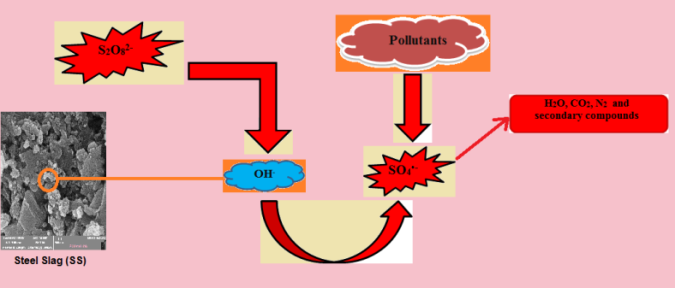
In this search, the steel slag was employed in integrated landfill leachate management. SS used as a solid activator for persulfate activation process. The mechanism of pollutants degradation by sulfate radical produced through activation of PS using CS is shown in Figure1.
Materials and Methods
Materials
The steel slag (SS) was gathered from Esfahan Steel Company, Iran. Then it was ground and sieved through a 60 mesh sieve. All chemicals employed for analysis were of analytical grade and obtained from reliable companies. Deionized water was used during the experiences. Fresh leachate was brought from Aradkouh’s landfill located in Tehran, Iran. This landfill accommodates 8000 tons solid waste per day [21]. The characteristics of raw leachate are shown in Table 1. The transferred fresh leachate to the laboratory is kept a refrigerator at 4°C to diminish changes that can be made on it until the experiments were carried out [2].
| Parameter | Average* | Unit | ||||||
|---|---|---|---|---|---|---|---|---|
| pH | 6.3 | — | ||||||
| COD | 2100 | mg L-1 | ||||||
| NH 3 | 250 | mg L-1 | ||||||
| BOD 5 | 450 | mg L-1 | ||||||
| TDS | 350 | mg L-1 | ||||||
| EC | 5.2 | mS cm-1 |
Table 1: The transferred fresh leachate to the laboratory is kept a refrigerator at 4°C to diminish changes that can be made on i
The surface morphology and elemental composition of SS were investigated by using FE-SEM and EDS analyzes (MIRA3//TESCAN). X-ray diffraction (XRD) patterns of SS were acquired using an X-ray diffractometer (X’Pert PRO MPD, PANalytical Company) with a CuKa radiation source at 40 kV and 40 mA. COD concentration was determined using a spectrophotometer (HACH, DR 5000). The interference of PS in the COD was considered by following Soubh, et al. method [1]. BOD5 was determined by a BOD measurement system (OxDirect), and A Metrohm 691 pH meter used to measure the potential of hydrogen in solutions. Electrical conductivity (EC) and total dissolved solids (TDS) were measured with a multimeter equipped with a conductivity electrode (WTW COND 7110, inoLab).
For investigating the performance of steel slag (SS) as activator of PS for treatment of leachate, All experiments were conducted in batch mode. Briefly, 40 mL of leachate solution was transferred to a 100-mL glass flask to which the given amount of sodium persulfate dissolved in 10 mL of the leachate landfill had been added while stirring on a stirrer at 150 rpm. Afterwards, the certain amount of activator was added to the mixture, and the concentration of COD was determined at specified time intervals. The effects of SS dosage (0-5 g L-1), PS/COD ratio (1-5), and reaction time (0-180 min), respectively on removal of COD of leachate landfill was studied.
Results and Discussion
Characterization of SS
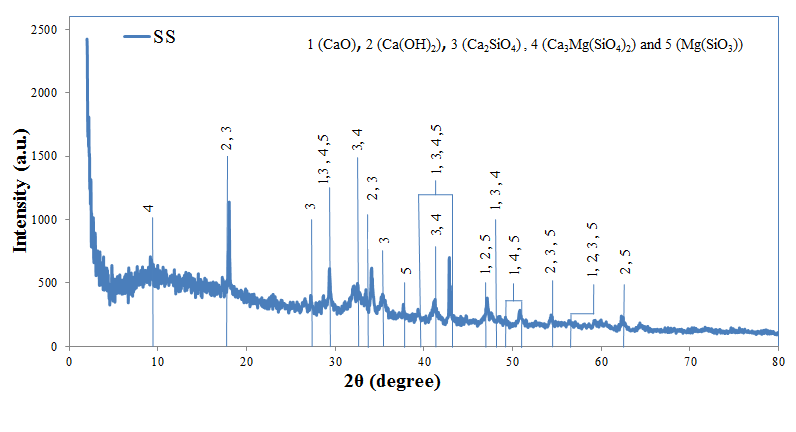
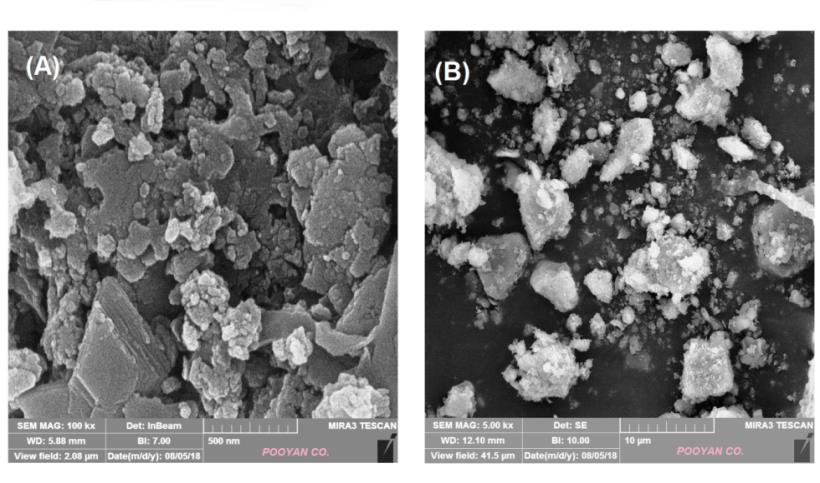
The XRD pattern of SS is shown in Figure 2. As shown in Figure 2, the XRD pattern of SS appeared abundance in the calcium compounds which increases the possibility of using as a source of alkaline. SEM images of SS are shown in Figure 3 (A and B). As shown in Figure 3 (A and B), the most particle size of CS was within range (0.5-5 µm);
these can increase the contact area between SS and PS. Figure 3C shows EDS analysis of the atomic % of O, Mg, Si, S, K Ca, Mn, Fe and Zn present in the SS powder where It proved the presence of calcium about forty-five percent.
Activation Mechanism
Effect of SS and PS/COD dosages: The effect of SS dosage on the removal of COD studied Figure 4. A significant increase in removal efficiencies was achieved as SS dosage increased from 0.0 to 3 g L-1, which can be attributed to an increase in the initial pH concentrations as a result of adding SS and subsequent improvement in persulfate activation according to Eq. 3 and Eq. 4.
However, by a further increase in the SS dose, removal efficiency increased slightly because Alternatively, sulfate radicals can react with each other; as a consequence, they have a quenching effect on the sulfate radical production at high concentration, according to Eq. 5 [22].
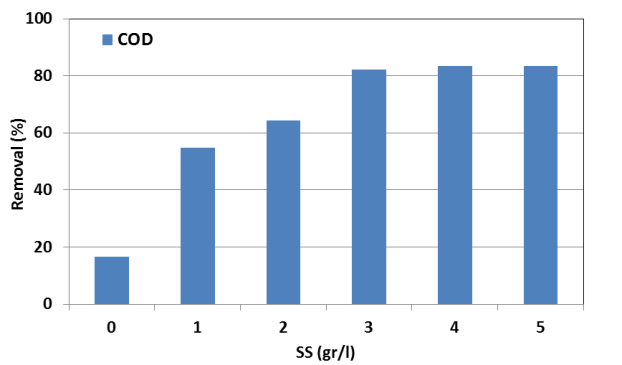
Therefore, the SS dosage of 3 g L-1 was selected as the optimum dose for next experiments. As shown in Figure 4, in the presence of PS alone without SS, the removal efficiency was weak, which indicates the significant role of SS in activation of PS.
• • 2 4 4 2 8 SO SO S O − − − + → (5)
The effect of PS/COD ratio on the performance of the SS system was investigated in the range of 1 to 5. The experiments were carried out at SS dosage of 3 g L-1.
As can be seen in Figure 5, by increasing the PS/COD ratio from 1 to 4, the removal efficiencies of COD and increased significantly from 37 to 93.72 and 84%. This is due to the increase in generating of sulfate radical, then there was stability in removal efficiency, because the sulfate radical can be discouraged at high concentration of PS, according to Eq. 5 [23]. The PS/COD ratio of 3 was selected to perform following experiments.
• 2 2 4 2 8 2 8 4 SO S O S O SO − − − − + → + (5)
![Figure 5: Effect of SS dosage on the COD removal efficiency (reaction time: 45 min; SS dosage of 3 g L-1) Variations in pH upon SS addition: The pH changes in preceding conditions have been studied. The addition of persulfate alone causes a decrease the pH of solution gradually from 6.3 to 5.2, which can due to produce the of positive ions resulting from decomposition of PS, according to Eq. 6 and Eq. 7 [24]. The addition of steel slag alone causes an increase the pH of solution from 6.3 to 12.2. This is due to dissolution calcium oxide (CaO) and hydrated lime Ca(OH)2 in solution, according to Eq. 1 and Eq. 2. While the pH was partially reduced to 11.1 after addition of persulfate (Figure 6).](/fulltextimages/4151/fig_5.png)
Figure 5: Effect of SS dosage on the COD removal efficiency (reaction time: 45 min; SS dosage of 3 g L-1) Variations in pH upon SS addition: The pH changes in preceding conditions have been studied. The addition of persulfate alone causes a decrease the pH of solution gradually from 6.3 to 5.2, which can due to produce the of positive ions resulting from decomposition of PS, according to Eq. 6 and Eq. 7 [24]. The addition of steel slag alone causes an increase the pH of solution from 6.3 to 12.2. This is due to dissolution calcium oxide (CaO) and hydrated lime Ca(OH)2 in solution, according to Eq. 1 and Eq. 2. While the pH was partially reduced to 11.1 after addition of persulfate (Figure 6).
2 2 8 2 4 2 1 2 2 S O H O HSO O − − + → + (6)
2 4 4 HSO SO H − − + → + (7)
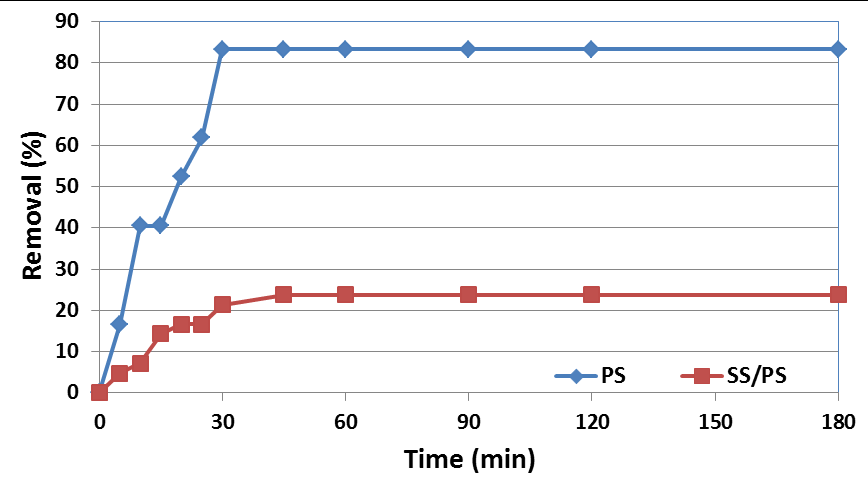
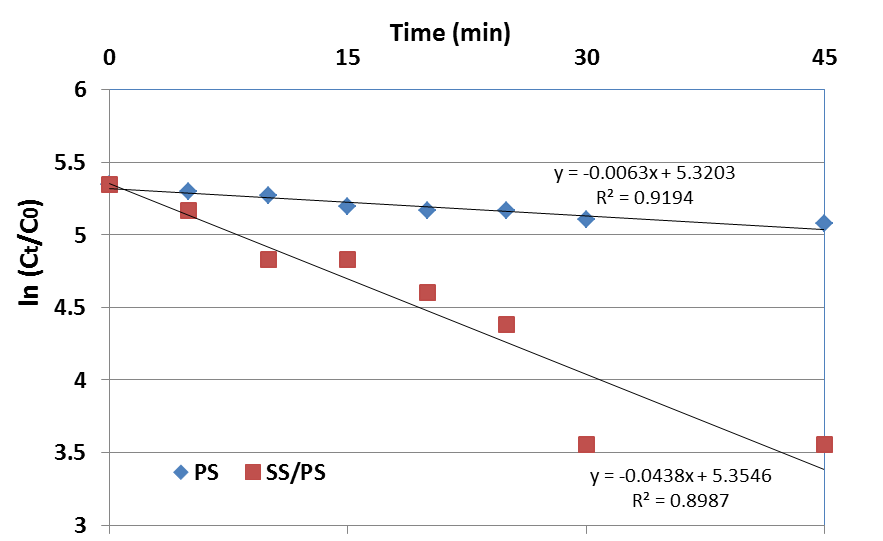
![Figure 6: pH changes during the reaction (reaction time: 45 min; SS dosage of 3 g L-1 and PS/COD ratio: 3). Effect of reaction time: In order to use the full potential of persulfate to remove COD, the effect of time was studied in the range of 0-180 min at the most efficient conditions (SS dosage of 3 g L-1 and PS/COD ratio: 3) [25- 30]. By increasing the reaction time up to 45 min, the removal efficiencies of COD increased. After that, no significant change in removal efficiencies was observed. Thus, the reaction time of 45 min was selected as the optimum reaction time. The removal efficiencies of COD increased significantly from 24% with PS process to 83 with SS/PS process. This confirms the effectiveness of using the SS in upgrading of the removal efficiencies about 60%. The effects of SS and PS/SS processes on the removal rate of COD were also examined using pseudo- first-order kinetic model. The addition of SS (3 g L-1) led to more than six and a halftimes increase in degradation rate constants of COD (Figures 7 & 8) [30-33].](/fulltextimages/4151/fig_6.png)
Figure 6: pH changes during the reaction (reaction time: 45 min; SS dosage of 3 g L-1 and PS/COD ratio: 3). Effect of reaction time: In order to use the full potential of persulfate to remove COD, the effect of time was studied in the range of 0-180 min at the most efficient conditions (SS dosage of 3 g L-1 and PS/COD ratio: 3) [25, 26, 27, 28, 29, 30]. By increasing the reaction time up to 45 min, the removal efficiencies of COD increased. After that, no significant change in removal efficiencies was observed. Thus, the reaction time of 45 min was selected as the optimum reaction time. The removal efficiencies of COD increased significantly from 24% with PS process to 83 with SS/PS process. This confirms the effectiveness of using the SS in upgrading of the removal efficiencies about 60%. The effects of SS and PS/SS processes on the removal rate of COD were also examined using pseudo- first-order kinetic model. The addition of SS (3 g L-1) led to more than six and a halftimes increase in degradation rate constants of COD (Figures 7 & 8) [30, 31, 32, 33].
Conclusion
This study investigated the possibility of using steel slag generated form steel manufacturing industry as a wastage-material for activating PS oxidation for leachate treatment. Experiments were shown that the SS can be considered a good source of alkaline, because it contains of calcium compounds such calcium oxide (CaO) and hydrated lime Ca(OH)2 . The XRD analysis confirmed the presence of calcium compounds and the EDS analysis showed an iron component with a ratio about of 45%. The use of SS as activator of PS caused a rise of the removal efficiencies about 60%.
Acknowledgements
This research has been done in Graduate Faculty of Environment, University of Tehran.
References
-
Soubh AM, Baghdadi M, Abdoli MA, Aminzadeh B (2018a) Activation of Persulfate Using an Industrial Iron-Rich Sludge as an Efficient Nanocatalyst for Landfill. Catalysts 8(5): 218.
-
Soubh A, Mokhtarani N (2016) The post treatment of composting leachate with a combination of ozone and persulfate oxidation processes. Rsc Adv 6(80): 76113-76122.
-
Wu L, Chen S, Zhou J, Zhang C, Liu J, et al. (2015) Simultaneous removal of organic matter and nitrate from bio-treated leachate via iron-carbon internal micro-electrolysis. RSC Adv 5(84): 68356-68360.
-
Abu Amr SS, Aziz HA, Adlan MN, Bashir MJK (2013) Pretreatment of stabilized leachate using ozone/persulfate oxidation process. Chemical Engineering Journal 221: 492-499.
-
Kulikowska D, Klimiuk E (2008) The effect of landfill age on municipal leachate composition. Bioresource Technology 99(13): 5981-5985.
-
Renou S, Givaudan JG, Poulain S, Dirassouyan F, Moulin P (2008) Landfill leachate treatment: Review and opportunity. Journal of Hazardous Materials 150(3): 468-493.
-
Mokhtarani N, Khodabakhshi S, Ayati B (2016) Optimization of photocatalytic post-treatment of composting leachate using UV/TiO2. Desalination and Water Treatment 57(47): 22232-22243.
-
Liang C, Guo YY (2012) Remediation of diesel- contaminated soils using persulfate under alkaline condition. Water, Air, and Soil Pollution 223(7): 4605-4614.
-
Wahba N, El Asmar MF, El Sadr MM (1959) Iodometric Method for Determination of Persulfates. Analytical Chemistry, 31(11): 1870-1871.
-
Do SH, Kwon YJ, Kong SH (2010) Effect of metal oxides on the reactivity of persulfate/Fe (II) in the remediation of diesel-contaminated soil and sand. Journal of Hazardous Materials, 182(1-3): 933-936.
-
Kumar MA, Dikshit A (2012) Treatment of Municipal Landfill Leachate by Oxidants. American Journal of Environmental Engineering 2(2): 1-5.
-
Soubh AM, Baghdadi M, Abdoli MA, Aminzadeh B (2018b) Zero-valent iron nano fi bers ( ZVINFs ) immobilized on the surface of reduced ultra-large graphene oxide ( rULGO ) as a persulfate activator for treatment of land fi ll leachate. Journal of Environmental Chemical Engineering 6(5): 6568- 6579.
-
Soubh AM, Baghdadi M, Abdoli MA, Aminzadeh B (2019) Assessment of Converter Sludge from Esfahan Steel Company as a Persulfate Nano-Activator for Permeable Reactive Barriers (Prbs) in Landfill Leachate Treatment. Pollution 5(2): 395-409.
-
Fang G, Dionysiou DD, Al-abed SR, Zhou D (2013) Superoxide radical driving the activation of persulfate by magnetite nanoparticles: Implications for the degradation of PCBs. Applied Catalysis B, Environmental 129: 325-332.
-
Liu C, Wu B, Chen X (2018) Sulfate radical-based oxidation for sludge treatment: A review. Chemical Engineering Journal 335(October): 865-875.
-
Deng Y, Ezyske CM (2011) Sulfate radical-advanced oxidation process (SR-AOP) for simultaneous removal of refractory organic contaminants and ammonia in landfill leachate. Water Research 45(18): 6189-6194.
-
Chou YC, Lo SL, Kuo J, Yeh CJ (2015) Microwave- enhanced persulfate oxidation to treat mature landfill leachate. Journal of Hazardous Materials 284: 83-91.
-
Hilles AH, Abu Amr SS, Hussein RA, El-Sebaie OD, Arafa AI (2016) Performance of combined sodium persulfate/H2O2 based advanced oxidation process in stabilized landfill leachate treatment. Journal of Environmental Management 166: 493-498.
-
Karchegani SM, Hoodaji M, Kalbasi M (2014) The effect of steel converter slag application along with sewage sludge in iron nutrition and corn plant yield. Bulletin of Environment, Pharmacology and Life Sciences 3(III): 96-104.
-
Xu X, Liu D, Chen W, Zong S, Liu Y (2018) Waste control by waste : efficient removal of bisphenol A with steel slag, a novel activator of peroxydisulfate. Environmental Chemistry Letters 16(4): 1435–1440.
-
Pazoki M, Abdoli MA, Karbassi A, Mehrdadi N, Yaghmaeian K (2014) Attenuation of municipal landfill leachate through land treatment. International Journal of Environmental Health Science & Engineering 1(12:12): 1-8.
-
Yang S, Yang X, Shao X, Niu R, Wang L (2011) Activated carbon catalyzed persulfate oxidation of Azo dye acid orange 7 at ambient temperature. Journal of Hazardous Materials 186(1): 659-666.
-
Deng J, Shao Y, Gao N, Deng Y, Tan C, et al. (2013) Zero-valent iron/persulfate(Fe0/PS) oxidation acetaminophen in water. International Journal of Environmental Science and Technology 11(4): 881- 890.
-
Kusic H, Peternel I, Koprivanac N, Bozic AL (2011) Iron-Activated Persulfate Oxidation of an Azo Dye in Model Wastewater: Influence of Iron Activator Type on Process Optimization. Journal of Environmental Engineering-Asce 137(6): 454-463.
-
Devi LG, Kumar SG, Raju KSA, Rajashekhar KE (2010) Photo-Fenton and photo-Fenton-like processes for the degradation of methyl orange in aqueous medium: Influence of oxidation states of iron. Chemical Papers 64(3): 378-385.
-
Hou L, Zhang H, Xue X (2012) Ultrasound enhanced heterogeneous activation of peroxydisulfate by bimetallic Fe-Co/GAC catalyst for the degradation of Acid Orange 7 in water. Journal of Environmental Sciences (China) 26(6): 1267-1273.
-
Liang C, Bruell CJ, Marley MC, Sperry KL (2004) Persulfate oxidation for in situ remediation of TCE. I. Activated by ferrous ion with and without a persulfate-thiosulfate redox couple. Chemosphere 55(9): 1213-1223.
-
Liang C, Wang ZS, Bruell CJ (2007) Influence of pH on persulfate oxidation of TCE at ambient temperatures. Chemosphere 66(1): 106-113.
-
Liu D, Xiu Z, Liu F, Wu G, Adamson D (2013) Perfluorooctanoic acid degradation in the presence of Fe(III) under natural sunlight. Journal of Hazardous Materials 262: 456-463.
-
Nachiappan S, Gopinath KP (2015) Treatment of pharmaceutical effluent using novel heterogeneous fly ash activated persulfate system. Journal of Environmental Chemical Engineering 3(3): 2229- 2235.
-
Shiying Y, Wang P, Yang X, Wei G, Zhang W, et al. (2009) A novel advanced oxidation process to degrade organic pollutants in wastewater: Microwave-activated persulfate oxidation. Journal of Environmental Sciences 21(9): 1175-1180.
-
Virtanen S, Schmuki P, Davenport AJ, Vitus CM (1997) Dissolution of Thin Iron Oxide Films Used as Models for Iron Passive Films Studied by In Situ X-Ray Absorption Near-Edge Spectroscopy. Journal of the Electrochemical Society 144(1): 198.
-
Yan J, Lei M, Zhu L, Anjum MN, Zou J, et al. (2011) Degradation of sulfamonomethoxine with Fe3O4 magnetic nanoparticles as heterogeneous activator of persulfate. Journal of Hazardous Materials 186(2-3): 1398-1404.
- Electronic Waste Management in the Top Ten Economies in the World: A Critical Review on Waste Generation, Regulations, Collection, Recycling and Environmental Challenges
- Some Challenging Transdisciplinary Aspects of the Sustainable Waste Management in the Permacrisis Context
- Use of Mobile Autonomous Systems for Pollution Control of Inland Water Bodies
- Environmental Impact Perspective Sustainable Online Textile Retailing: Harnessing Augmented Reality-Based Digital Twins in Bangladesh
- Composite Treatment Module for Removing Acidity and Metal (Loid)S from Acid Rock Drainage
- Household E-Waste Management Systems [E-Wms] in Malaysia