
Determination of the Level of Heavy Metals and Physico-Chemical Parameters of Bamo River in Goba Administrative Town, Southeastern, Ethiopia
The accumulation of heavy metals in water bodies can pose serious environmental problems to the surrounding areas as well as serious health problems in people that use it for drinking purposes and domestic activities. The main aim of this study is to determine the levels of selected heavy metals and physiochemical parameters in Bamo river water of Goba district of Oromia Region, Ethiopia. Three samples collected from Bamo River were analyzed using FAAS and Palin test photometer. Generally, the physicochemical parameters such as temperature, TDS, EC, and TH were measured on site. While pH, Dissolved Oxygen (DO), Biochemical Oxygen Demand (BOD), Chemical Oxygen Demand (COD), total hardness, nitrate, sulfate, phosphate, K, Mg, Ca, Fe, Mn, K, and Cu were analyzed in the laboratory. All the samples were analyzed for seven heavy metals (Zn, Fe Cu, Pb Ni, Cr and Mn). The mean concentrations (in mg/L) of studied heavy metals were found to be in the range: Zn (0.330- 0.274), Cu (0.56-0.44), Pb (0.009-0.057), Ni (2,93- 3.58), Cr (0.179-0.294) and Mn (0.012-1.011). Comparison of the results for the studied heavy metals with international standard revealed that the concentrations of (Pb, Cr, and Ni) in water samples were slightly higher than the maximum permissible limits recommended by WHO, USEPA and EU. Therefore, the river water consumed by the rural and urban population of the district and their neighbors could potentially be exposed to the health risks of levels of these heavy metals. Therefore, the researcher recommends that the river of target area should be treated before using for drinking and domestic purpose.
Introduction
Water is essential for life on the earth. Because of its importance, the pattern of human settlement through history has often been determined [1]. Next to oxygen; water is the most important substance for human existence. It is an essential nutrient, which also sustains agriculture, allows aquatic life, supports industry, produces hydroelectric power, permits aquatic transport, ensures personal hygiene, and maintains a clean environment, besides its uses in sport as well as recreation [2]. The contamination of water is directly related to the degree of contamination of environment.
The water body is significantly contaminated by human activities including mining, the evacuation of treated and untreated waste, the discharge of contaminated metals and their complexes [3], as well as by numerous industries like nuclear power plants, steel industries, battery plants, tannery sites, etc. safe drinking water is not easily available. In fact, it is difficult to find safe drinking water in the majority of African and Asian nations, even in those that are relatively advanced countries, like India. Of the six billion people on the earth, more than one billion lack access to safe drinking water, and about 2.5 billion do not have access to adequate sanitation services. In addition to shortcomings, various types of water- borne diseases kill on an average more than 6 million children each year i.e., about 20,000 children a day [4]. Developing countries, like Ethiopia, have suffered from lack of access to safe water from improved sources and adequate services [5]. In the recent years, the availability and access to fresh water has the most critical issue in the world. Fresh water is essential to human health, agriculture, industry and natural ecosystems, but it now running scarce in many regions of the world [6]. The desirable of water quality characteristics should include adequate amount of dissolved oxygen, relatively low organic content, pH value near neutrality moderate temperature and free from excessive number of infectious agents, toxic substance and mineral matter [7]. Water should be free from disease producing microorganisms and chemical substances that are dangerous to health [8]. Majority of rural people do not have access to potable water and depend on well, stream and river waters for domestic use, excessive use of limited water resources, and disposal of various industrial effluents, human wastes water may release heavy metals, which harm both human and animal health [9]. The inorganic chemicals hold a greater portion as contaminants in water in comparison to organic chemicals [10]. As they build up, heavy metals can interfere with the proper functioning of human organs and the neurological system. Heavy metals like lead (Pb), nickel (Ni), copper (Cu), and zinc (Zn) have drawn a lot of attention recently since they are linked to health issues [11]. The accumulation of the heavy metals in water and sediments will eventually reach human and other living organisms through the aquatic ecosystem, since heavy metals can be transferred through the food chain. The accumulation heavy metals in human’s body will cause adverse health problems. For instance, they inhibit the biological function of essential nutritional minerals by replacing their position [12]. Therefore, it is crucial to determine the amount of heavy metals in water that is frequently consumed.
In this study, efforts have been made to ascertain the water's physicochemical characteristics and heavy metal concentrations.
Materials and Methods
Description of the Study Area
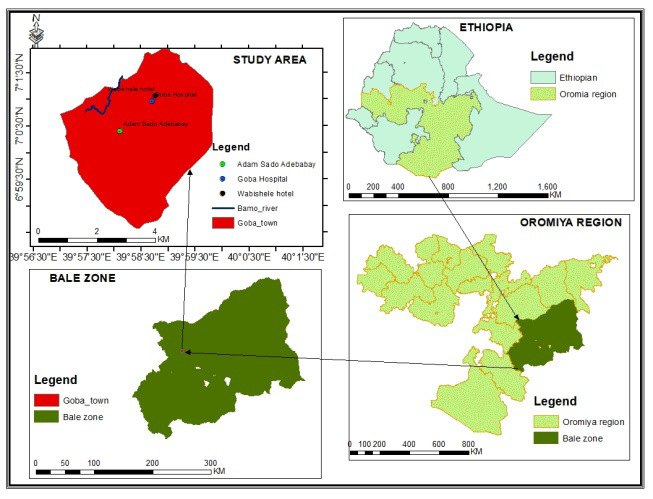
The study was conducted in Goba administrative town, southeastern Ethiopia. Goba town is located in Bale zone, Oromia region approximately 446 km southeast of Addis Ababa, the capital city of Ethiopia. The town has latitude and longitude of 70 N and 390 59 E and an elevation of 2,743 meters above sea level. The town has two kebeles with a population of approximately 32,025 [13]. It is gifted with two major rivers, one of which separates the town into two major parts called Bamo River. The people living the area have used river water sources for drinking, bathing, washing and for another house hold purpose [14] Figure 1.
Sample Collection and Preparation
The samples collection, handling, preservation and analysis were carried out according to standard methods described [15]. The river water samples were collected from three sampling sites in the study area, namely, the source sample point at upper, middle and lower Bamo river (surrounding Goba town) at different depths (40, 50, and 60 cm) and intervals (1km). Before collection of water samples, polyethylene bottles were rinsed with 0.02 M HNO3 and distilled water for 100 mL of each sample to maintain constant pH, minimize loss of sample and to avoid contamination. The sample containers were rinsed with respective water samples before filling each with the sample [16]. The sampling was carried out across the study area on July 2021. The water samples were acidified to pH value two with HNO3 immediately on arrival to the laboratory and kept at four until analysis.
Chemicals and Reagents
The reagents used in the study were all analytical grades. Nitric acid (69-72%), H2O2 (30%), and HClO4 (37%) were used for the digestion of the water samples. The stock standard solutions containing 1000 mg/L in 2% HNO3 of the metals (Ni, Zn, Pb, and Cr) and tablets to test metals like Fe, Cu and Mn for experiments. Distilled-deionized water was used throughout the experiment for sample preparation and dilution and rinsing of apparatus prior to analysis.
Instruments
Atomic Absorption Spectrometer, AAS (Buck, scientific model – AVG- 210) and Palin test automatic wavelength selection photometer, (Wagtech, Scientific model-7100), were used to determine the concentration of the selected heavy metals.
Measured Physicochemical Parameters of Bamo River Water
Assessment of various physicochemical parameters, namely TSS, pH, turbidity, BOD, COD, DO, TOC, total alkalinity, sulfate, nitrate, phosphate and heavy metal concentrations (iron, copper, lead, nickel, and zinc) were carried out as per the method described in APHA,2000. And the electrical conductivity (EC), Total dissolved solid (TDS), salinity and Temperature reading method was described in [17, 18, 19]. Total hardness was measured by EDTA titration using Ferrochrome Black T as an indicator and to determine the total hardness of water samples were described and analytical calculation of the total hardness of water was reported [20]. The Palin test Photometer was described the measurement of the pH value and the turbidity of the water. The Chemical Oxygen Demand (COD) test (Palin test COD/1000 predicts the oxygen requirement of the effluent and is used for monitoring and control of discharges. The impact of an effluent or wastewater discharge on the receiving water is predicted by its oxygen demand. The COD test is therefore performed as routine in laboratories of water utilities and industrial companies [21, 22, 23, 24].
Sample Digestion for Heavy Metal Analysis
The digestion procedure for water samples were carried out using concentrated HNO3 (69-72%). First, 5 mL of conc. HNO3, and a few boiling chips were added to a flask containing 100 mL of water.
The mixture was boiled and evaporated on a hot plate to the lowest volume possible (approximately 20 mL). This process continued until digestion is complete as it is indicated by a formation of light color or clear solution. Then, the content of the flask was cooled, filtered with Whatman No 42 in to a 100 mL volumetric flask, and the flask was filled with distilled water up to the mark.
Method of Validation Study
Method validation is the process used to confirm that the analytical method employed for a specific test is suitable for its intended use. There are diverse documents for method validation including information about different performance parameters. In this study, the parameter used to check the method validation was through spiking experiment and calculating percent recovery.
Data Analysis
Simple descriptive statistics were used to summarize the values of the selected physic-chemical parameters, nutrients, and heavy metals in tap water samples. The results were also compared with WHO and EEPA.
Results and Discussions
Method Validation
The % recovery of the method validation experiment was performed by adding known amount of a standard solution of the selected metals (5 ppm) in water sample taken from upper, middle and lower sampling sites, which was initially analyzed for the spiked metals. Then, the difference between the analytical results for samples with and without the added metals was calculated, and then the percentage recovery was calculated as.
F-I %recovery= ×100 A
Where F = Spiked sample concentration; I = Unpicked sample concentration; A = concentration of Analyze added to the spiked portion.
The % recovery obtained were ranged 96.44–100.24 % as shown in Table 1, which indicates the procedure had good accuracy to state that the method was valid.
| Unspiked Conc.(ppm) | Amount added(ppm) | Spiked Conc.(ppm) | %Recovery | |
|---|---|---|---|---|
| Zn | 0.004 | 5 | 5.003 | 99.98 |
| Ni | 0.189 | 5 | 5.011 | 96.44 |
| Pb | 0.005 | 5 | 5.0158 | 100.24 |
| Cr | 0.021 | 5 | 5.0158 | 99.89 |
Table 1: Recovery test for the optimized procedure in water sample.
Physicochemical Characteristics of River Water
The results (mean ±SD) of the analysis of some physicochemical properties in water samples at different sampling sites are presented in Table 2.
| Parameters | Upper sample site (S1) | Middle sample site (S2) | Lower sample site (S3) |
|---|---|---|---|
| EC(µS/cm) | 153.33±2.49 | 104.66 ± 0.94 | 131.33 ± 3.39 |
| TDS(mg/L) | 76.66±1.24 | 52 ± 0.81 | 65.66 ± 169 |
| pH | 7.91 ± 0.01 | 8.16 ± 0.04 | 7.88 ± 0.08 |
| Tur(NTU) | 73.33± 1.24 | 65 ± 2.16 | 78.33 ± 1.69 |
| DO(mg/L) | 4.43 ± 0.09 | 3 ± 0.08 | 4.13 ± 0.04 |
| BOD(mg/L) | 81.66 ± 6.12 | 91.33 ± 3.77 | 78 ±2.16 |
| COD(mg/L) | 249.33 ± 1.24 | 488 ± 2.94 | 254.33 ± 4.78 |
| TH(mg/L) | 75.33 ± 1.24 | 60 ± 0.81 | 81 ± 1.63 |
| NO --N(mg/L) 3 | 2.15 ± 0.03 | 2.12 ± 0.01 | 2.22 ±0.07 |
| PO 2-(mg/L) 4 | 0.65 ± 0.01 | 0.49 ± 0.01 | 0.70 ± 0.01 |
| SO 2-(mg/L) 4 | 25 ± 0.81 | 18.66 ± 0.47 | 20.66 ± 1.24 |
Table 2: Physicochemical properties of water samples taken from Bamo river.
pH Status: According to WHO (2008), the recommended pH value of drinking water is 6.5-8.5. In this study, the pH varied from 7.88 to 8.16 water sample sites (Table 2). This indicates that water samples were slightly basic water. Basicity affect conduit fixtures, transport channels and infiltrate deadly trace metals into water. Thus, triggering visual difficulties, like acid taste, fabric discoloration and water system. The result of analysis of variance showed that the mean pH values were significant (p < 0.05) different among three sites. Electrical conductivity status: In this study, the highest EC (153.33 ± 2.49 μS/cm) was observed in upper site water while the lowest EC (104.66 ±0.94 μS/cm) was recorded in middle site water sample (Table 2). The all EC values recorded, in this study, were below the maximum permissible limit (1000 μS/cm) given by WHO (2008). The EC result of upper site water was significantly greater than the others sites. The difference of EC value of Bamo river water samples may due to factors such as agricultural activities land use and mineral contents the nearby soil. Total dissolved solids (TDS) status: The observed mean TDS (mg/L) was varied from (52.00) in middle site to (76.66) in upper water sample (Table 4). These results were below the maximum permissible limit (1000 mg/L), there is no health-based limit for TDS in sample water, but drinking water becomes unpalatable if TDS level greater than 1000 mg/L. There was significant variation of TDS values among the sampling sources at p< 0.05. Total Hardness: The highest total hardness value (81 ± 1.63 mg/L) was observed in lower site water sample, while the lowest total hardness value (60 ± 0.81 mg/L) was recorded at middle site (Table 2). The results were less than maximum limit (500 mg/L). This indicates upper, middle and lower sites were moderately hard, water. Analysis of the variance showed that total hardness of middle site water source was significantly less than that of at lower and upper sampling sites at p<0.05.
The dissolved Oxygen (DO): The lowest DO value of 3 mg/L was recorded at middle water sample site; 4.13 mg/L was recorded in lower site. While, the highest DO value of 4.43 mg/L was recorded in upper river site. There was significant differed (P0.05) between sites.
Biochemical Oxygen Demand (BOD): In this study, the observed the biochemical oxygen demand (mg/L) values were varied (78 ± 2.16) (91.33 ± 3.77) in lower source and middle water sample site respectively. The recommended biochemical oxygen demand set by WHO is 25 mg/L, Thus, the biochemical oxygen demand value in all sample sites was greater than [11]. According to analysis of variance, the mean BOD value was significant (p < 0.05) different among three sampling sites. The save limit of EEPA and WHO for determining drinking water quality.
Concentration of Metals in Water Sample
In this study, all analyzed heavy metals (Zn, Cr, Ni, Cu, Pb, Mn and Fe) were detected in the water samples, and their concentrations (mean ± SD) are presented in Table 3. The concentration of Ni was highest when compared to the all other heavy metals followed by Fe, while Mn level was lowest among the heavy metals.
| Metals | Upper sample site (S1) | Middle sample site (S2) | Lower sample site (S3) | USEPA | WHO |
|---|---|---|---|---|---|
| Ca | 20.3 ± 1.25 | 27.7 ± 1.25 | 25 3 ±1.25 | ||
| Mg | 5 ± 0.82 | 9 ± 0.82 | 7 ± 0.82 | ||
| K | 25.7 ±1.25 | 14.3 ± 1.25 | 21 ± 0.82 | ||
| Fe | 1.23 ± 0.017 | 0.9 ± 0.012 | 1.11 ± 0.016 | 0.3 | 0.3 |
| Cu | 0.56 ± 0.017 | 0.64 ± 0.008 | 0.44 ± 0.016 | 1.3 | 2 |
| Mn | 0.012 ± 0.0004 | 0.011 ± 0.0005 | 0.011 ± 0.0005 | 0.05 | 0.05 |
| Zn | 0.283 ±0.003 | 0.274 0.0045 | 0.33 ± 0.007 | 3 | 5 |
| Ni | 2.93 ± 0.012 | 3.19 ± 0.095 | 3,58 ± 0.026 | 0.1 | 0.1 |
| Pb | 0.057 ±0.014 | 0.041 ± 0.0015 | 0.009 ± 0.0058 | 0.015 | 0.01 |
| Cr | 0.279 ± 0.003 | 0.294 ± 0.0035 | 0.179 ± 0.0045 | 0.05 | 0.05 |
Table 3: Concentration of metals (Mean± SD, n=3) mg/L in water sample sites.
Nickel status: The concentration of nickel in this study was obtained as 2.93 ± 0.012 mg/L at Upper Site, 3.19 ± 0.095 mg/l at middle site and 3.58 ± 0.026 mg/L at lower sample site. The result obtained from these water sample taken site areas were higher than the permissible limit recommended by international water quality standards like WHO (0.2 mg/L) and guide lines. So Nickel is cause of health problem if water is used for domestic and irrigational use. Zinc status: The dissolved concentration of zinc in the water samples from Upper site recorded 0.283± 0.003 mg/l, 0.274 ± 0.0045 mg/L at middle site and 0.33 ± 0.068 mg/L recorded at lower water sample. The mean concentrations of zinc metal in the three sample sites were recorded below the permissible limit recommended by WHO and USEPA guideline range (3 mg/L) and (5 mg/L) respectively. Chromium status: Analysis of the depth integrated water samples of the river for dissolved Chromium gave the values: 0.279 ± 0.003 mg/L at Upper Site, 0.2294 ± 0.0035 mg/L at middle site and 0.179 ± 0.0045 mg/L in lower river water samples. Both the WHO and the USEPA guidelines require the maximum concentration of Chromium in drinking water to be 0.05 mg/L. The finding revealed that the concentration of Chromium was recorded above the maximum permissible limit. This result indicates that, Chromium could be a cause of health problem if the water is used for irrigation and household purposes Hexavalent chromium exposure can occur through people breathing it, ingesting it in food or water, or through direct contact with the skin. Research performed by the National Toxicology Program (NTP) has shown that the hexavalent chromium containing chemical sodium dichromate dehydrate causes cancer in laboratory animals following oral ingestion at high doses. Thus, chromium enters in to river from municipal wastes and pesticides. The standard (MCL) for total chromium is based on allergic dermatitis (skin reactions). Copper status: Copper was determined in every site with the following values 0.56 ± 0.017 mg/L from upper site, 0.64 ± 0.008 mg/L at middle site and 0.44 0.0053 mg/L at lower site. According to the WHO maximum permissible limit of drinking water is (2 mg/L). The finding revealed that the concentration of Copper was recorded below the maximum limit. This result indicates that, Copper has no a cause of health problem if the water is used for irrigation and domestic purposes.
Manganese: The concentration of manganese was recorded 0.012 ± 0.0004 mg/L at Upper Site, 0.011 ± 0.0005 mg/L at middle site and 0.011 ± 0.0005 mg/L in lower sample site. The result obtained from sites were below the permissible limit recommended by international water quality standards like WHO (0.1 mg/L) and USEPA (0.5 mg/L) guide lines. So these sites were safe for domestic and irrigational use. Lead Status: The Pb concentration (0.057 ± 0.014 mg/L) was recorded in upper water sample site, 0.041 0.0015 mg/L at middle site and 0.009 0.0058 mg/L in lower Pb concentration. In the study area, the result obtained were above the maximum permissible level given by WHO (2004) and US-EPA (2011). This indicates there is health problem related with lead in the study area. Iron Status: As shown in Table 8, the concentration of Fe in the study area ranged from 1.23 ± 0.017 mg/L in upper sample water to 0.9-0.012 mg/L (in middle site) and 1.11 0.016 mg/L at lower site. The results were found above the prescribed maximum permissible limit (0.3 mg/L) set by WHO (2004). This indicates there is health problem related with iron in the study area.
Conclusion and Recommendation
Based on the results of this research, it was observed that the physicochemical levels of the parameters including the concentrations of certain heavy metals in the water samples collected from three sites of Bamo River. The results were demonstrating that, most of the parameters were not found averagely to deviate from the standard or found to be present in high concentrations except for conductivity, sulfate, DO, K, Mg, Ca, pH. In addition, most of the water samples were found to be at least at minimal satisfactory level that has ninety percent (90%) of the parameters tested to be at unsatisfactory level. Ni, Cr and Fe all sites, Pb at upper and middle sites was recorded above the maximum permissible limit of WHO standards. Especially, the concentration of Chromium in Bamo River was recorded higher than WHO permissible limit, which might cause skin allergic, abdominal pain, weak bones on human body. Therefore, it is advised that water from Bamo should not be used for drinking and sanitation purpose, unless and otherwise treated with suitable chemicals or boiling, because it is dangerous to use these river water for domestic purpose. In addition, the concentration of lead was higher than that of WHO permissible limit, which may affect nervous system and kidney failure. Analysis of variance showed at the 95% confident level, the mean concentration of all water was found to be statistically significant different (p<0.05). The value of Pearson correlation coefficient revealed very strong positive correlation was seen between Ni with Cr. Moreover, strong positive correlation was seen between Pb with Zn. The rest have moderate or weak positive or negative correlation to each other.
The increment of some parameters may be controlled by treatment process; especially water treatment of Goba administrative town still has a problem. The concerned body should take immediate mechanism in order to control increments of contaminants process. Agro-chemicals that contain high levels of heavy metals from being used and entering into the rivers that would see the concern of pollution of water bodies highly eliminate. The final recommendation the administrative town will be, please take into consideration this research value and check your water treatment process or mechanism. In additional to encourage the further study conducted on the other physico-chemicals, biological parameters including heavy metals.
Data Availability
All the data used to support the findings of this study are available from the corresponding author upon request.
Conflicts of Interest
The authors declare that there is no conflict of interest regarding the publication of this paper.
Funding Statement
This research was funded by the Ethiopian Ministry of Education.
Acknowledgment
We would like to acknowledge the Ethiopian Ministry of Education for funding the research and the Department of Chemistry, Hawassa University for accomplishing my work.
References
-
Mohamoud AS Emanuel E, Joseph J, Wilson BL (2001) Chemical evaluation of commercial bottled drinking water from Egypt. Journal of Food Composition and Analysis 14: 127-152.
-
Wold FG, Ayenew B, Ahmad T (2016) Assessment of heavy metals concentration in Togona River of Goba Town, Oromia region, Ethiopia.
-
Ammann AA (2002) Speciation of heavy metals in environmental water by ion chromatography coupled to ICP-MS. Anal Bioanal Chem 372(3): 448-452.
-
TWAS (2002) Safe drinking water-the need the problem, solutions and an action plan, Third world academy of sciences, Trieste, Italy.
-
WHO (2006) Disinfectants and disinfectant by products. Environmental health criteria 216. World Health Organization.
-
WWF (1998) Living planet report: over consumption in driving the rapid decline of the world’s environments.
-
Oluyemi EA, Adekunlel AS, Avenge AA, Makinde WO (2010) Physico-chemical properties and heavy metal content of water sources in Ife North Government Area, pp: 691-697.
-
Lamikanra A (1999) Essential Microbiology for students and practitioner of pharmacy, medicine and microbiology. 2nd(Edn.), Amkra.
-
Singh S, Mosley LM (2003) Trace metal levels in drinking water on Viti Levu, FijiIslands. The South Pacific Journal of Natural and Applied Sciences 21(1): 31-34.
-
Azrina A, Khoo HE, Idris MA, Amin I, Razman MR (2011) Major inorganic elements in water.samples in pen insulator Malaysia. Malaysian journal of Nutrition 17(2): 271-276.
-
WHO (2011) Guide lines for drinking water quality. 4th(Edn.), WHO press, Geneva, Switzerland, pp: 396.
-
Singh KB, Tajena SK (2010) Effect of long term excessive Zn supplementation on blood lipid profile and tissue mineral status in wistar. Rat J Exp Sci 1(3): 4-9.
-
Davidson T, Kluz T, Burns F, Rossman T, Zhang Q, et al. (2004) Exposure to chromium (VI) in the drinking water increases susceptibility to UV-induced skin tumors in hairless mice. Toxicol Appl Pharmacol 196(3): 431-437.
-
Breugnot E, Durartre A, Laplace Treyture C, Haury J (2008) Local Distribution of Macrophytes and Consequences for Sampling Methods in Large Rivers. Journal of Hydrobiogia 610: 13-23.
-
Wakuma B, Fita T (2017) Physico-Chemical Analysis of Drinking water (in case of Mattu town, Southwest Ethiopia). International Journal of Scientific and Research Publications 7(4): 364-370.
-
Adepoju Bello AA, Oguntibeju OO, Onuegbu MT, Ayoola GAA, Coker HAB (2012) Analysis of selected metallic impurities in soft drinks marketed in Lagos, Nigeria. African J Biotechnol 11(20): 4676-4680.
-
Said MD, Jimoh WLO (2012) Trace metals concentration in untreated water supplies from some selected areas of Kano metropolis and its environs, Kano state, Nigeria. Biological and Environmental Science Journal for the Tropics 9(3): 212-214.
-
Sun L, Peng W, Cheng C (2016) Source estimation of heavy metal in shallow water based on UNMIX model a case study, Indian Journal of geo- marine science 45(6): 756-762.
-
AWWA (2002) American Water Works Association Standard Methods for the Determination of Water and wastewater.
-
WHO (2003) Guideline for drinking water quality. 4th (Edn.), Geneva, Switzerland.
-
APHA (2005) Standard Methods for the Examination of Water and Wastewater. 21st(Edn.), American Public Health Association, American Water Works Association and Water Environment Federation. Section, Washington DC.
-
APHA (2000) Standard Methods for the Examination of Water AND Wastewater. 10th(Edn.), DC, American Public Health Association, Washington.
-
UNEP (2009) A practical Guide to the Design and implementation of Fresh water quality Studies and Monitoring Programs.
-
USEPA (2017) Method of detection limit.
- Electronic Waste Management in the Top Ten Economies in the World: A Critical Review on Waste Generation, Regulations, Collection, Recycling and Environmental Challenges
- Some Challenging Transdisciplinary Aspects of the Sustainable Waste Management in the Permacrisis Context
- Use of Mobile Autonomous Systems for Pollution Control of Inland Water Bodies
- Environmental Impact Perspective Sustainable Online Textile Retailing: Harnessing Augmented Reality-Based Digital Twins in Bangladesh
- Composite Treatment Module for Removing Acidity and Metal (Loid)S from Acid Rock Drainage
- Household E-Waste Management Systems [E-Wms] in Malaysia