
Municipal Solid Waste Disposal in the City of Aba: Challenges and Solutions
This paper focused on the challenges of municipal solid waste disposal in Aba urban, Nigeria, and proposed practical solutions to tackle this menace. The study used mixed-methods approach, combining qualitative and quantitative research methods. The qualitative research involved interviews with key stakeholders, including waste management officials and residents. The quantitative research involved surveys to collect data on waste generation disposal and waste management practices. The findings of this study will contribute to a better understanding of the complex issues surrounding municipal solid waste disposal in Aba. The study identified key challenges, such as inadequate waste collection and disposal infrastructure, lack of public awareness and participation in waste management, and insufficient funding for waste management services. The study also suggested possible solutions, such as improving waste collection and disposal infrastructure, increasing public awareness and participation in waste management, and exploring innovative funding mechanisms for waste management services.
Background
Municipal solid waste management has become a significant environmental challenge for both developed and developing nations. According to Mutezo [1, 2] and the rapid population growth and industrialization in Sub-Saharan African nations have resulted in a significant increase in the generation of wastes, with projections indicating that the region will produce approximately 244 million tons of waste per year by 2025. This is a significant increase compared to the current production level, which is estimated at 174 million tons of waste per year.
The lack of adequate waste management practices in developing nations of the world is a significant health concern and poses a serious risk for pathogen spread. The indiscriminate disposal of municipal solid waste in developing nations is often linked to poverty, bad governance, urbanization, population increase, low living standards, lack of environmental consciousness, and insufficient environmental knowledge management [3, 4, 5]. This menace has led to diseases such as cholera, malaria, and hepatitis B virus (HBV), as well as significant health risks, such as gastrointestinal issues, eczema, asthma, cancer, and bronchitis.
Effective municipal solid waste management practices should include source reduction, recycling, composting, waste-to-energy, and landfilling. Source reduction involves reducing the amount of waste generated at the source, while recycling involves the separation of waste materials and their conversion into new products. Composting involves the natural decomposition of organic waste materials into a soil-like substance, while waste-to-energy involves the conversion of waste into energy. Landfilling is the disposal of waste in a designated area, with appropriate management practices to minimize the risk of pollution.
To effectively manage municipal solid waste, there is a need for appropriate policies, regulations, and funding. Governments should prioritize the provision of waste management infrastructure, which includes collection and transportation systems, recycling and composting facilities, as well as waste-to-energy plants. In addition, the private sector can play a significant role in waste management through investment in waste management technology, infrastructure, and services.
The lack of proper municipal solid waste management in developing countries, especially Sub-Saharan Africa has a significant impact on the environment and human health. Moodley, et al. [6], Ahmed, et al. [7] and Peng, et al. [8] notes that improper management of MSW contributes to greenhouse gas emissions, including methane from organic waste. In addition, the growing interconnectedness between urban lifestyles, recycling, and goods, efficient municipal waste collection, transportation, and disposal remain a complex environmental service. The implementation of effective municipal solid waste management practices can reduce the negative impact of waste on the environment, human health, and the economy, while promoting sustainable development.
Overall, the challenges of managing municipal solid waste in Sub-Saharan African countries, especially Nigeria, which is the most populous black nation on earth require urgent attention and action from governments, the private sector, and individuals. By prioritizing waste management practices, the Nigerian state can reduce the negative impact of waste on the environment, human health, and the economy, while promoting sustainable development.
Aba urban, Abia State, in South-East Nigeria, provides a striking example of the challenges faced in managing municipal solid waste in developing nations. Despite tremendous urbanization, creating a large market for industrial companies and organizations and a surge in population resulting in fast city expansion, there is an urgent need for waste evaluation in Aba. While the Abia State Government has established the Abia State Environmental Protection Agency (ASEPA) to manage MSW, the waste management challenges in the city continue to increase, highlighting the need for practical solutions [9, 10].
This paper therefore, seeks to synthesize the problems associated with municipal solid waste management in Aba city and propose practical solutions to tackle this menace. The paper explores the existing management of municipal solid wastes, the challenges affecting municipal waste management, as well as practical solutions relating to municipal solid waste issues in the city.
Materials and Methods
Study Area
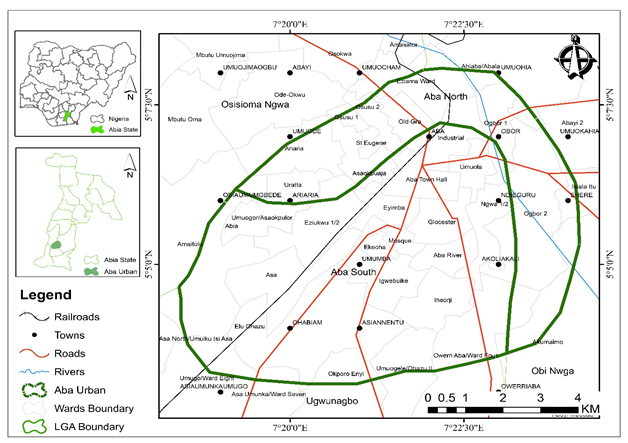
Aba, which was established by the Ngwa clan as a market town is the commercial nerve of Abia state, Nigeria. Aba is divided into two; Aba North and Aba South. Aba South is the city center, and sits at the western bank of the Aba River. Godswill, et al. [11] and Ijioma [12], argues that owing to its cosmopolitan nature, Aba city has expanded to Ugwunabo, Osisioma Ngwa, and Obi Ngwa local government areas. The city of Aba, remains the most populous in Abia State, and ranks amongst the most populous cities in the Southeast region of Nigeria. Geographically, Aba city is located between latitudes 050 2’ 30” N and 50 08’ 00” N of the equator and longitudes 070 20’ 00” E and 070 26’ 00” E of the Greenwich meridian. The city lies within the tropical rain forest zone of West Africa (Figure 1).
Aba has a well-developed infrastructure that includes several major roads and highways. The city has road connections leading to states such as Akwa Ibom, Imo, Ebonyi, Enugu and River States, respectively. Culturally, Aba has a rich cultural heritage; the city is home to several traditional festivals which includes the popular Ojionu festival and the Ahiajoku festival, celebrating the city's cultural traditions and history. Aba is also home to several museums and cultural centers, including the National Museum of Colonial History and the Abia State Cultural Center [13].
Economically, Aba is known for its thriving markets and manufacturing industries. The city is famous for its production of leather goods, textiles, and plastics. It is also home to several large-scale manufacturing companies, including breweries, oil mills, and soap factories. The city's vibrant commercial sector is supported by a network of markets and trading centers, including the Ariaria International Market, which is one of the largest markets in West Africa.
The city experiences two climatic conditions annually which are the dry and rainy season. The dry season (October-March) and the rainy season (April-September) vary due to seasonal changes. Harmattan period usually characterized by dusty wind and dry conditions starts from December to February, though it can vary. Aba has an average mean temperature of 24-34°C.
Data Sources
Data for this study was derived from both primary and secondary sources. Secondary data sources for this study include; Journals, books, grey literature and other online sources. The primary sources include a handheld camera, which was used to capture images of interest; a Global Positioning System (GPS), used for ground-truthing and also, to acquire coordinates of existing waste bins, landfills and indiscriminate waste disposal points. Similarly, in-depth interview and structured questionnaire survey, aided by Kobo tool-box collector, was employed to elicit responses from respondents. Respondents for this study were heads of households and are strictly residents of Aba urban. These respondents were randomly drawn from market places, residential areas and other public spaces. According to Olukanni, et al. [14] markets, residential areas, schools and other public space are the places where a researcher could readily assess and interact with diverse people for interview schedules and questionnaire survey.
Sampling Method
The confidentiality of all respondents was duly observed and respondents were randomly sampled to obtain a broader spectrum of the waste management situation in Aba urban area. The 1991 population census figure for Aba stood at 413,852. The 1991 population census figure was chosen because of the controversies that marred the 2006 census exercise in the Southeast region of Nigeria. Further, using the Abia State growth rate of 2.74%, the 1991 population census figure for Aba was projected to 2021 using the formula:
$$Pn = Pi (1+r)^n$$
Where;
$Pn =$ projected population
$Pi =$ population of the base year
$1=$ constant
$r =$ growth rate divided by 100
$n=30$ years (1991-2021).
After substitution of figures, the 2021 projected population figure for Aba stood at 931,176. The sum of the projected population for Aba (931,176) was substituted in Taro Yamane 1967 formular;
$$n = \frac{N}{1+N(e)^2}$$
Which gave $n = 399.8$. This therefore gives a sample size of 400 respondents.
Data Analysis
Coordinates of existing waste bins, landfills and indiscriminate waste disposal points, were retrieved from the Global Position System (GPS) and saved in XLS format. The data was imported into the ArcGIS environment, digitized and overlaid to form a thematic map of points, lines and polygons. The output map was exported into the Microsoft word environment, where it was interpreted based on visual analysis. In examining the current state of municipal solid waste in Aba urban, responses from the Kobo toolbox collector was retrieved via the online profile. The data was downloaded in XLS format and exported into Microsoft Excel, where results were presented in pie-chart, bar chart and histogram. To determine the density of existing MSW disposal points in the study area, a density surface, showing the number of solid waste-bins per unit area was computed using Kernel Density Estimation (KDE) within ArcGIS. KDE calculates the magnitude per unit area from point features using a kernel function to fit a smoothly tapered surface to each point. A radius of at least 0.5 km was used. The mean and standard deviation of the KDE was used to determine the density of the MSW and also a raster map was generated, where the concentration of dumpsites is represented by continuous surfaces.
Data Analysis and Discussion of Results
Distribution of Waste Bins in Aba
The environment of a city describes the quality of life of its inhabitants. The process through which solid waste is collected and transferred is the core of the waste management system. According to Wekisa and Majale [15], the placement of waste containers is recommended for industrial areas, which experiences huge volumes of waste, while stationary waste containers should be placed in the surrounding areas of the neighborhood for commercial and residential areas. Figure 2 shows the distribution of waste-bins, indiscriminate waste disposal and landfill in the city of Aba.
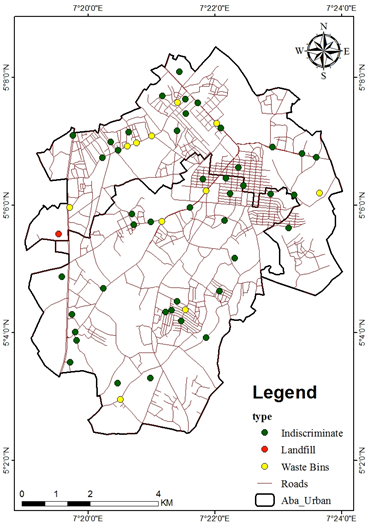
Visual analysis in Figure 2, indicates that majority of the existing waste-bins, are placed along tarred roads in the study area. Similarly, majority of indiscriminate waste dumps in the study area, could be seen to be formed within residential buildings and also along tarred roads. It is not new that cities in Nigeria and the study area inclusive generate solid waste at an alarming rate, such that in most cases, the volume of wastes generated is often more than what the city system could absorb, leading to indiscriminate dumpsites at sensitive areas.
Availability of Waste Bins in Aba
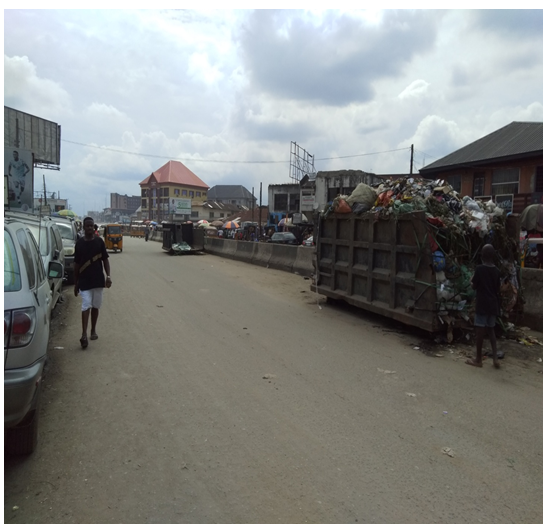
Dumpsters in Aba are all of equal sizes. They are large and made of thick metal, designed to be hoisted by an evacuation truck and emptied. Despite the presence of one of Africa’s biggest markets (Ariaria international market) as well as the presence of several other markets all within the urban area, waste bins in Aba are few and the available ones are haphazardly located. Despite Ariria being the largest, most populous and the busiest market in the city, no single dumpster was sighted by the researcher both in and around the market. Same observation was also made around Ahia- ohuru market, which is also located in the heart of the city. This study further observed that Ekeoha market (Shopping center), which is another large market in the city center, is the only market with a waste bin around its vicinity. Even at that, the waste bin was placed in the middle of the road, obstructing traffic flow see Figure 3.
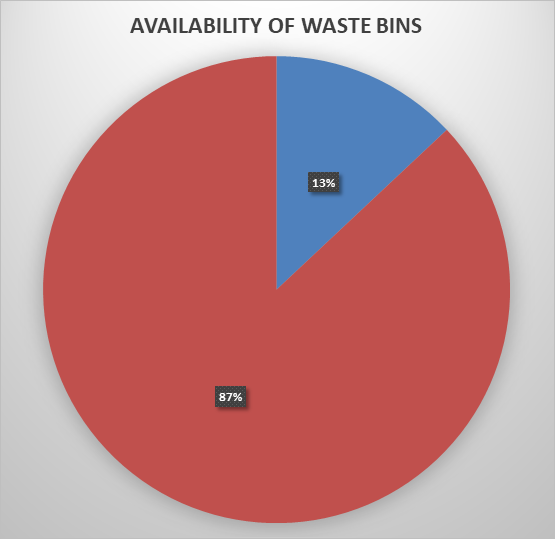
From the analysis of responses, 87% of the study population, which translates to 348 respondents, indicated absence of dumpsters in their neighborhoods, while 13% of respondents, translating to 52 residents, acknowledged presence of dumpsters in their neighborhoods (Figure 3).
Density of Existing MSW Disposal Sites in Aba
Earlier findings in this study indicated that MSW disposal points are located on road networks, built-up areas as well as other public spaces. Waste disposal points in this study include waste-bins, indiscriminate waste disposal as well as landfills. In this section, the Kernel Density Estimation (KDE) computed in Figure 4 which was the bivariate probability density function of the x- and y-coordinates, multiplied by the number of points, shows how the density of MSW disposal points varies across the study area.
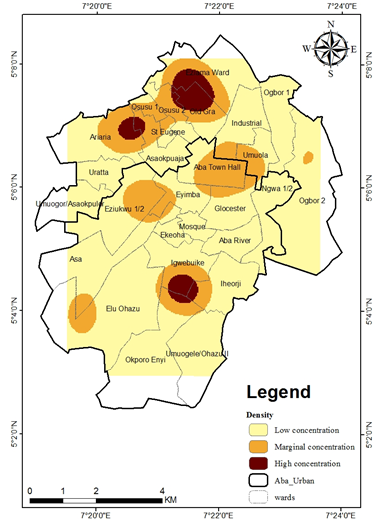
From Figure 5 darker colored cells have more MSW disposal sites around them than lighter ones. Since the search radius was put at 0.5 km, the density can be seen to fall between the range of 1 - 2 and 6 - 7 disposal sites per every 0.5 km2. This means that within the highest density regions, there are at least 6 – 7 existing MSW disposal sites, while within the least density regions, there exist between 1 or 2 MSW disposal sites per every 0.5 km2. According to even when it makes sense to interpret the cell values, it is often much more meaningful to also report the expected count within cells of high densities. So, assuming that the underlying factors that contribute to irregular MSW disposal sites will not change for at least a year, and then each of the highest density regions such as areas around Ariaria, Old GRA, Eziama, and Osusu in Aba urban, may have atleast additional two (2) disposal sites in the following year.
Municipal Solid Waste Evaluation in Aba
Respondents were given the opportunity of evaluating the effectiveness of waste managers in the study area. Although from the researcher’s observation and field exercise, wastes were seen dumped indiscriminately within the urban area. Heaps of refuse on motor ways, as seen in Figure 6, open plots, drainage channels, etc, were common sights.
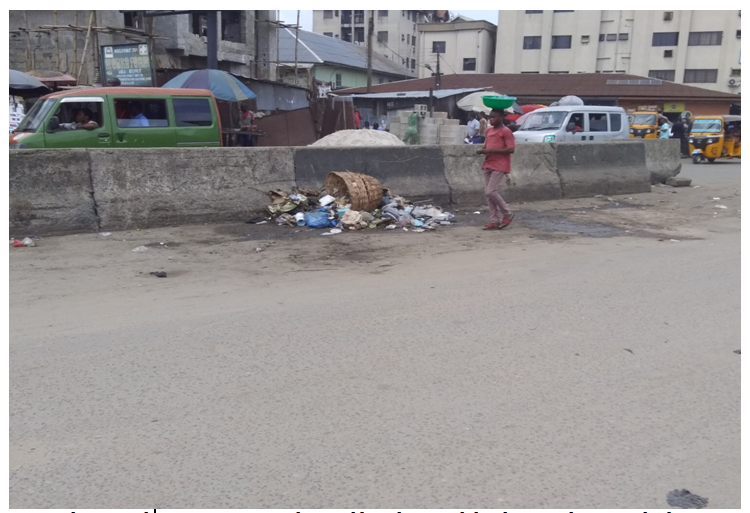
Similarly, waste bins were placed haphazardly without considering several factors such as centrality, adequacy of space and walking distance to residential buildings. Researcher’s field observation also revealed that majority of dumpsters in Aba are old and weak, with the basements broken, leading to the leakage of leachates. Figure 7 shows the evaluation of waste managers by residents of Aba urban.
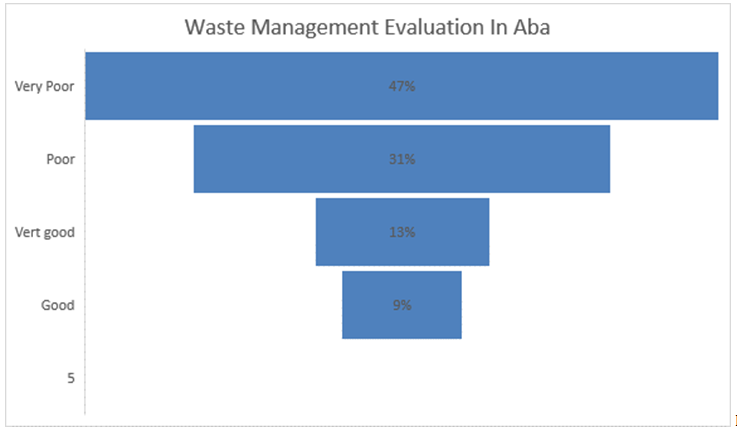
The evaluation of the effectiveness of waste management authorities followed a set of criteria. Respondents were given a set of criteria to guide their options which included: standard waste disposal trucks and equipment’s, prompt evacuation of filled waste-bins, manpower and dedication to work. The residents selected from a four-class options of Very good, good, poor and very poor. Analysis of results from Fig. 7 indicated that 47% of residents of Aba, who form the majority indicated a “very poor” performance by ASEPA, who are their waste managers. Similarly, 31% of the respondents indicated a “poor” performance by ASEPA, 13% and 9% of the respondents rated ASEPA’s performances as “good” and “very good” respectively [16].
Recommendations and Conclusion
This study hereby recommends as follows;
- Increase awareness and education: Education and awareness campaigns can be initiated to help educate the public on the importance of proper waste disposal and the negative impacts of indiscriminate waste disposal. This can include campaigns on radio, TV, billboards, and social media.
- Implement effective waste management policies: Abia State Government should implement effective waste management policies, regulations, and ensure adequate funding to support the provision of waste management infrastructure, including collection and transportation systems, recycling and composting facilities, and waste- to-energy plants.
- Encourage waste reduction and recycling: Source reduction, recycling, and composting should be encouraged in order to reduce the amount of waste generated and promote the reuse of waste materials. This can be achieved through the provision of recycling bins and the promotion of environmentally friendly products and packaging.
- Increase public and private sector investment: Both the public and private sector can play a significant role in waste management through investment in waste management technology, infrastructure, and services. This can help to create jobs and promote economic growth while also addressing the waste management challenges.
- Engage local communities: Engaging local communities in waste management initiatives can help to build trust and foster a sense of ownership and responsibility among residents. This can be achieved through the formation of community waste management groups, regular community clean-up campaigns, and other community-led initiatives.
- Develop a comprehensive waste management plan: A comprehensive waste management plan should be developed to guide the management of municipal solid waste in Aba city.
This should include clear goals and objectives, as well as specific strategies for waste reduction, recycling, and disposal.
In conclusion, municipal solid waste management has become a significant environmental challenge in both developed and developing nations, including Sub-Saharan Africa. The lack of adequate waste management practices in this region poses a serious risk for pathogen spread and significant health risks. Effective municipal solid waste management practices should include source reduction, recycling, composting, waste-to-energy, and landfilling, with appropriate policies, regulations, and funding from governments and the private sector. The challenges of managing municipal solid waste in an urban setting such as Aba require urgent attention and action from all stakeholders to promote sustainable development.
References
-
Mutezo G, Mulopo J, Chirambo D (2020) Climate change adaptation Opportunities for increased material recycling facilities in African cities. In: Filho, et al. (Eds.), African Handbook of Climate Change Adaptation. Springer, Cham, pp: 849-874.
-
Chen KC, Leach M, Black MJ, Tesfamichael M, Kemausuor F, et al. (2021) BioLPG for clean cooking in sub Saharan Africa present and future feasibility of technologies feedstocks enabling conditions and financing. Energies 14(13): 3916.
-
Fattah MA, Rimi RA, Morshed SR (2022) Knowledge behaviour and drivers of residents willingness to pay for a sustainable solid waste collection and management system in Mymensingh City Bangladesh. Journal of Material Cycles and Waste Management 24: 1551-1564.
-
Roy H, Alam SR, Bin Masud R, Prantika TR, Pervez MN, et al. (2022) A Review on Characteristics Techniques and Waste to Energy Aspects of Municipal Solid Waste Management Bangladesh Perspective. Sustainability 14(16): 10265.
-
Ajinawo EJ, Aribasoye MR (2023) Assessment of solid waste management practices in Ikere local government Ekiti State. Electronic Journal of Education Social Economics and Technology 4(2): 82-86.
-
Moodley P, Trois C (2022) Circular closed loop waste biorefineries Organic waste as an innovative feedstock for the production of bioplastic in South Africa. South African Journal of Science 118: 1-6.
-
Ahmed F, Hasan S, Rana MS, Sharmin N (2023). A conceptual framework for zero waste management in Bangladesh. International Journal of Environmental Science and Technology 20: 1887-1904.
-
Peng X, Jiang Y, Chen Z, Osman AI, Farghali M, et al. (2023) Recycling municipal, agricultural and industrial waste into energy fertilizers, food and construction materials and economic feasibility a review. Environmental Chemistry Letter 21: 765-801.
-
Nwankpa S, Scandrett E (2020) History and contexts of municipal solid waste management in AbaRecounting the stories of residents. Journal of Environment and Earth Science 10(9): 61-74.
-
Samuel O, Okofor O, Ignatius U (2020) Solid Waste Management and Sustained Urban Development Problems in Aba, Nigeria. Akpauche International Journal of Arts and Social Sciences 1(2).
-
Godswill OC, Chinweoke N, Ugonma OV, Ijeoma EE (2016) The Resilience of Street Vendors and Urban Public Space Management in Aba Nigeria. Developing Country Studies 6(11): 83-93.
-
Ijioma UD (2021) Evaluation of water situation and development of drinking water management plan for Aba City Southeast Nigeria. Doctoral dissertation, BTU Cottbus-Senftenberg.
-
Chudi Duru CC (2019) Textile and Fashion Museums. Politics and Identity Formation in Southeastern Nigeria, The Igbo in Perspective, 61.
-
Olukanni DO, Pius Imue FB, Joseph SO (2020) Public Perception of Solid Waste Management Practices in Nigeria Ogun State Experience. Recycling 5(2).
-
Wekisa E, Majale C (2020) Spatial distribution of waste collection points and their implications on quality of life in Mombasa County Kenya. Journal of Urban Management _9_(2): 250-260.
-
Fakere AA, Ayeni DA (2013) Communal Facilities and Residential Neighbourhoods in Akure Nigeria. Civil and Environmental Research 3(1): 48-56.
- Electronic Waste Management in the Top Ten Economies in the World: A Critical Review on Waste Generation, Regulations, Collection, Recycling and Environmental Challenges
- Some Challenging Transdisciplinary Aspects of the Sustainable Waste Management in the Permacrisis Context
- Use of Mobile Autonomous Systems for Pollution Control of Inland Water Bodies
- Environmental Impact Perspective Sustainable Online Textile Retailing: Harnessing Augmented Reality-Based Digital Twins in Bangladesh
- Composite Treatment Module for Removing Acidity and Metal (Loid)S from Acid Rock Drainage
- Household E-Waste Management Systems [E-Wms] in Malaysia