
Treatment of Slaughter Sub products: High Health Risk Classification
Brazil is one of the largest producers and exporters of food in the world, but faces significant challenges in agricultural production, especially in relation to dependence on imported fertilizers. By-products of animal slaughter, condemned by the Health Inspection System (SIF) during the slaughter process, are classified as Animal By-products (ABPs) with a high health risk (Cat1). Cat1 ABPs cannot be used for human food or animal feed, even after being treated by rendering. This biomass is rich in nutrients but presents an imminent risk of pathogenicity. Heat treatments at high temperatures (>2500 C), in the absence of oxygen, are more efficient at controlling pathogens. This study aims to discuss the opportunity to recover nutrients from ABPs Cat1 from the Brazilian meat production chain as potential biomass for the production of biofertilizers. Pyrolysis shows signs of denaturing pathogens, as it converts the biomass in a controlled environment above 5000 C. The results indicate that every year Brazil misses out on the opportunity to recover tons of phosphorus pentoxide (P2O5) from the biomass of Cat1 ABPs in landfills. This is in addition to the health risk and environmental impact associated with the main source gas of organic biomass decomposition, methane (CH4), which is 80 times more polluting than carbon dioxide (CO2). Waste management is the main challenge to achieving nutrient recovery in the Brazilian meat chain.
Abbreviations
ABPs: Animal by Products; SIF: Federal Inspection System; PNRS: National Solid Waste Policy; BSE: Bovine Spongiform Encephalopathy.
Introduction
Brazil occupies a prominent position in global food production. The country is among the world’s largest exporters of soybeans (56%), corn (31%), coffee (27%), orange juice (76%), beef (24%) and chicken meat (33%), for which 63.5 million hectares are used for agricultural production [1]. To maintain all this food production, Brazil is the world’s fourth largest importer of fertilizers, 85% of the phosphate fertilizer used in national production is imported. The low concentration of Brazilian phosphate reserves makes local production unfeasible. The Russia- Ukraine conflict highlighted the vulnerability of the Brazilian production chain, which reduced the amount of fertilizer needed to meet food production by 40%. This restriction has had the effect of reducing crop yields and impacting on meat production. In 2022, the Brazilian government drew up the National Fertilizer Plan 2022-2050 (PNF) [2] with the aim of reducing Brazil’s dependence on imported fertilizers. Among the solutions identified in the PNF was the need to recover nutrients from organic biomass.
The amount of organic biomass from by-products of food production makes it possible to circularize nutrients [3, 4, 5] and can help minimize Brazil’s dependence on imported fertilizers. When destined for landfills, the main product of organic biomass decomposition is methane gas (CH4) [6] which, if left untreated, contributes to global warming, since CH4 is 80 times more polluting than carbon dioxide (CO2) [7].
To give you an idea of this opportunity, in 2023 alone, Brazil produced 29.6 million tons of animal protein [8]. Only 55% of the weight of live animals is used for human consumption (Alao et al. 2017). The rest is classified as animal by-products (ABPs). ABPs are biomass of animal origin not intended for human consumption [9, 10, 11] either because it is of low commercial interest or because it is unsanitary [10].
The use of ABPs is related to their health risk classification. ABPs classified as low health risk (Cat3) or edible, can be used in industrial formulations, such as sausages. ABPs with a medium health risk (Cat2) are often destined for animal feed after being recycled, if the health and environmental safety parameters are met. Rendering is commonly applied in Brazilian animal recycling [12]. However, ABPs with a high health risk (Cat1) dDue to the imminent danger of pathogenicity, it is expressly forbidden to dispose of condemned animal waste (Cat1) as animal feed [13]. This biomass usually comes from condemnation by the rigorous Brazilian Federal Inspection System (SIF).
Inconsistent as it may seem, in Brazil, Cat1 ABPs are still disposed of in landfills, which is an uninteresting alternative in terms of food safety, health and the scarcity of natural resources. This study aims to discuss the destination and treatment of ABPs with a high health risk (Cat1) from the Brazilian meat production chain as potential nutrient recovery.
Health Risk Classification for Animal By- Products
The classification of ABPs into “edible” and “inedible” is essential for food safety regulations [14]. Edible ABPs are intended for human consumption in industrial formulations but can also be used in animal feed. Edibles are generally known in Brazil as “offal” and their consumption are more associated with local culture. Examples are brain, tongue, heart, liver, kidneys, rumen, reticulum, tail and mocotó. However, other edibles can also be used for human consumption, such as lungs, spleen, spinal cord, mammary gland, testicles, lips, cheeks and cartilage [15].
Inedible are non-edible products that have other destinations, for example, bovine skin or leather is destined for the tanning industry, hooves and horns can be sent to the tailoring industry. In addition, animals or parts of animals “rejected by the Federal Inspection System (SIF)”, regardless of whether they are edible or not, are necessarily classified as Inedible for both Feed and Human Food [15].
According to the Brazilian National Solid Waste Policy (PNRS), Law 12.305/2010, animal by-products (ABPs) are classified as hazardous waste, i.e. the possibility of pathogenicity poses a risk to public health and the quality of the environment [16]. Although it is not clear whether the PNRS applies to Edible or Inedible, it can be interpreted that the guidelines are aimed at waste with high pathogenicity, more prone to inedible ABPs, or in an advanced state of decomposition, whatever the initial classification.
In addition, according to the PNRS, solid waste is material whose characteristics make it unfeasible to dispose of it in sewage systems, making it necessary to use technologies that modify it and make it less aggressive to the environment, so that it can be recycled or reused [16]. And the final destination for ABPs necessarily observes the health and environmental risk classification [11] according to the health risk categories:
- Category 3 (Cat3): Low health and environmental risk. These are ABPs that are fit for human consumption, but “not” intended for human consumption for commercial interest, such as bones, blood, mechanically separated meat waste, some offal, etc., which can be used for animal feed, provided that their industrialization meets quality and safety parameters.
- Category 2 (Cat2): Medium health and environmental risk. Post-mortem failures, solids with drug residues, etc. Cannot be used for human consumption. Can be destined for animal consumption, as long as it is associated with a reliance on heat treatment, at high temperatures, to possibly control pathogens.
- Category 1 (Cat1): Waste classified as high health and environmental risk. Not recommended for human consumption or feed. These are animals killed at the production site or during transportation from the property to the slaughterhouse. Also, material from condemnation by the SIF, including carcasses, viscera, intestinal contents, material with pathogenicity or imminent suspicion of pathogenicity.
The health risk classification can vary during the production process. A carcass classified as Edible (Cat3), when condemned by the SIF, becomes part of health risk category 1 (Cat1), and is therefore classified as inedible with a high health risk.
According to the PNRS, the disposal of solid waste, which includes recycling, energy recovery or landfill disposal, is the responsibility of the producing company, in accordance with specific regulations and to minimize environmental impacts [16]. But responsibility for treatment does not mean free choice on the part of companies.
The strict sanitary control for the production of animal protein and its by-products is justified by history, such as the bovine spongiform encephalopathy (BSE) crisis in 1999, which resulted in a ban on the use of meat and bone meal for animal feed [17]. Obviously, the health risk classification has a direct impact on the hierarchical choice of methods for disposing of, treating or recycling the biomass from ABPs and the associated added value (Figure 1).
![Figure 1: Hierarchy of the main methods of treatment, recycling and destination and adding value to animal by-products. Source: Adapted from the Brazilian Animal Recycling Association [12].](/fulltextimages/13452/fig_1.png)
Edible ABPs such as giblets, when classified as fit for human consumption by the SIF, present a greater possibility of financial return (Figure 1), especially when making up formulations for industrialized food products, such as nuggets and sausages.
Inedible ABPs (Figure 1) can be recycled by thermo- conversion, usually in rendering processes. They are destined for the pharmaceutical and nutraceutical sector, such as the manufacture of collagens and anesthetics [18] products for the hygiene and cleaning sector [19] biofertilizers [20, 21], biofuels [22], or even for energy recovery through incineration [23] or composting [24].
Obviously, taking into account the limitations of health and environmental risks, the preferred destination of ABPs is based on the potential for adding value to this biomass (Figure 1). The greatest potential for added value per ton is related to industrialized edibles, followed by recycling possibilities that have already been consolidated in the Brazilian market [12], followed by the possibility of recovering energy, where the potential for added value is reduced. The last alternative is landfill disposal, where the cost of transportation and disposal does not add value, in which case ABPs are classified as a negative financial return for the generating company, plus environmental liabilities and health risks.
Kinergic Parameters for Pathogen Inactivation
Variations in the physicochemical characteristics and treatment methods for ABPs interfere with the inactivation kinetic parameters for the main pathogens [25]. Table 1 shows examples of inactivation kinetic parameters of microorganisms exposed to heat treatment for the main ABP pathogens.
| Main Pathogens | Thermal Resistance | Heat Exposure (min) | Process | Reference |
|---|---|---|---|---|
| (0C) | ||||
| Salmonella | 43,7 | 5 | Rendering | [26] |
| Escherichia coli | 70 | 5 | Ultra-high temperature | [27] |
| Yersinia enterocolitica | 50 | 4 | Rendering | [26] |
| Staphylococcus aureus | 46 | 7 | Rendering | [27] |
| Clostridium perfringens | 46 | 5 | Rendering | [27] |
| Listeria monocytogenes | 45 | 3 | Rendering | [25] |
| Prions | 134 | 18 | Rendering | [28] |
Table 1: Inactivation kinetic parameters for the main pathogens contaminating meat and poultry products.
Escherichia coli O157:H7, Listeria monocytogenes and Salmonella spp. Table 1 are the main foodborne pathogens that can contaminate raw and processed meat and poultry products [25]. The fat and moisture present in animal biomass favors the proliferation of Salmonella. Salmonella do not multiply at refrigeration temperatures but are extremely resistant to freezing [27]. Listeria monocytogenes, on the other hand, can multiply at refrigeration temperatures [25]. For all bacteria, melted saturated fats probably exerted a protective effect [25]. The pathogen Prions, which is related to prion diseases or transmissible spongiform encephalopathies [28] requires a longer exposure time at higher temperatures for inactivation Table 1.
For ABPs intended for animal feed (Cat 2 and 3), health regulations stipulate that heat treatments must be carried out at temperatures above 133°C, for a minimum of 20 minutes, at a pressure of no less than 3 bar [10, 29, 30]. It is worth noting that it is forbidden to use animal waste as cattle feed (CFSPH, 2016), which means that the recycling of Cat 2 and 3 ABPs into meat meal, offal meal, blood meal and fats is complementary to poultry and pig feed.
If Cat 1 ABPs are destined for the incineration process, no prior treatment is required; for incineration, the minimum temperature is 850°C for at least 2 seconds [31]. In incineration, there is no recovery of nutrients due to the complete denaturation of the molecules [23].
If destined for landfill, and ABPs cat1 is condemned for “confirmed” pathogenicity, the European Commission, Regulation N0 1069/2009, article 12, recommends pressure sterilization heat treatment prior to landfill disposal [10].
The Pyrolysis Process for Treating Abps Cat 1
One alternative for treating Cat1 ABPs to be considered is the pyrolysis process. This consists of a thermochemical conversion reactor that promotes the breakdown of molecules in a controlled temperature and vacuum environment. In fast pyrolysis, exposing ABPs Cat1 for 10-15 minutes to temperatures above 2500 C favors the denaturation of pathogens in a uniform manner [31].
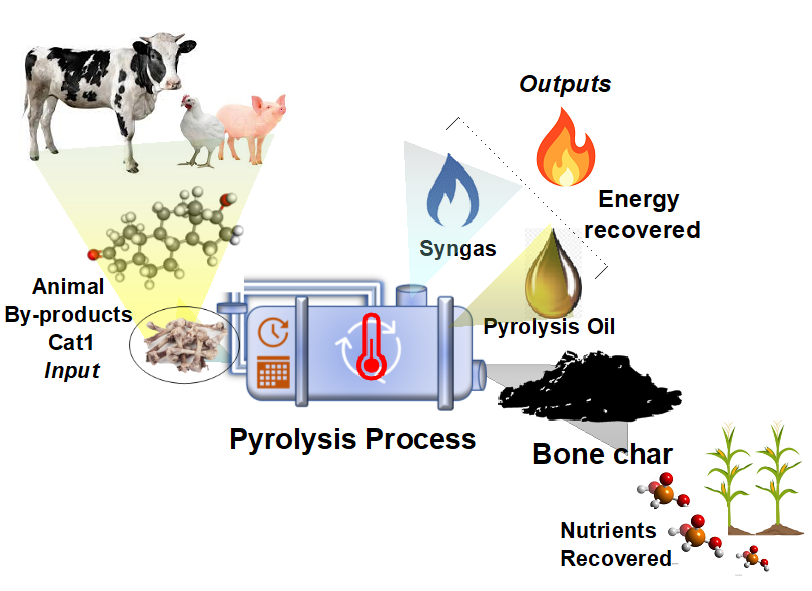
Bone char is the main output of the pyrolysis process (Figure 2). In this research, the term Biochar was used generically to represent the char output from the pyrolysis process, originating from various biomasses, such as vegetable, animal, plastic, etc. The term Bone char was used for the biochar output of the pyrolysis process originating exclusively from biomass of animal origin. The parameters of the pyrolysis process such as temperature, time and additives can be managed to increase the concentration and bioavailability of the nutrients contained in the Bone char Biofertilizer [32, 33, 34] which favors absorption by plants [31]. This can increase crop yields and reduce the possibility of eutrophication.
The main nutrient available in bone char is phosphorus (P). Bone char contains on average 13-20% of the nutrient P [35, 36, 37] in addition to Calcium, Magnesium, Nitrogen, Potassium and Zinc and low Cadmium (Cd) levels [38] can contribute to the goal of reducing soil contamination by Cd [39].
If used as a biofertilizer, biochar can generate decarbonization credits. The carbon retained in bone char is classified as stable, i.e. it has the capacity to remain in the soil for a long time (≅ 100 years) [40]. This is an indication of the quality of the carbon credit [35]. The method for quantifying and qualifying retained carbon is still under development. Compared to the low costs of rock fertilizers, Bone char biofertilizer is not competitive. The generation of decarbonization credits associated with the reduction of natural reserves could make the recovery of nutrients by pyrolysis viable [41].
Bone char can be used in ways that differ from soil fertilization Figure 2. In intensive livestock farming, Biochar has been tested as a feed additive for cattle [42], horses [43], pigs [44], poultry [45] and fish [46]. Biochar added to cattle feed increased milk production by 3.43% and protein and fat content by 2.63-6.32%, respectively, and reduced enteric methane gases in cattle by 30% [42], the porous property of biochar can maintain the intestinal microbiota, thus reducing the emission of greenhouse gases from ruminants [47].
It is worth noting that if biochar is used as a heat source, burning it releases part of the retained carbon, so the capture and storage of carbon is related to the application of biochar as a biofertilizer [48].
In short, the only justification found for Cat1 ABPs not being destined for pyrolysis treatment is the lack of health regulations for this treatment process in Brazil. However, other authorized and safe processes, such as incineration, should precede the alternative of landfill disposal, as provided for in the PNRS (Figure 1).
Future studies could contribute to the management of waste from the meat chain, aimed at both health safety and nutrient management, including the definition of pyrolysis process parameters, quantification and quality of the carbon and nutrients contained in Bone char, calorific value of Bone char, and financial viability analysis. These and other studies could contribute to the development of relevant regulations and investments by the meat chain in processes that are better for ABPs than landfill disposal.
Conclusion
Every year, Brazil misses out on the opportunity to recover tons of the nutrient phosphorus by disposing of the biomass from Cat1 ABPs in landfills. Waste management is the main challenge to achieving nutrient recovery in the Brazilian meat chain.
Acknowledgements
Funding This work was supported by the National Council for Scientific and Technological Development (CNPq) under Grant Number 302517/2022-7.
References
-
FAO (2018) The future of food and agriculture: Alternative pathways to 2050. Food and Agriculture Organization of the United Nations, Rome, Italy, pp: 64.
-
FAO (2022) National Fertilizer Plan 2022-2050 and the National Fertilizer and Plant Nutrition Council, Brazil.
-
Mary ED, Kahigwa TT, Dietrich P, Akoraebirungi B, Kagorora JP (2022) Biomass Contribution and Nutrient Recycling of Organic Matter Management Practices in Tropical Smallholder Annual Farming Systems. Acta Agriculturae Scandinavica 72(1): 945-956.
-
Emily E, Ben-Uri L, Grozovski J, Bar-On YM, Milo R (2020) Global Human-Made Mass Exceeds All Living Biomass. Nature 588(7838): 442-444.
-
Shweta, Capareda SC, Kamboj BR, Malik K, Singh K, et al. (2024) Biomass Resources and Biofuel Technologies: A Focus on Indian Development. Energies 17(2): 382.
-
Ester HC, Amaral KGCD, Lange MV, Higarashi MM, Steinmetz RLR, et al. (2022) Life Cycle Assessment of Waste Management from the Brazilian Pig Chain Residues in Two Perspectives: Electricity and Biomethane Production. Journal of Cleaner Production 354: 131654.
-
IPCC (2023) Technical Summary: Climate Change 2022 - Mitigation of Climate Change. Cambridge University Press, UK, pp: 51-148.
-
ABPA (2023) Brazilian Animal Protein Association. Gulf Food, Brazil.
-
FAO (2017) Animal Feed. Codex Alimentarius.
-
EC (2009) Regulation (EC) no 1069/2009 of the European Parliament and of the council of 21 October 2009 laying down health rules as regards animal by- products and derived products not intended for human consumption and repealing regulation (EC) no 1774/ 2002 (animal by-products regulation). EUR-Lex.
-
EC (2014) Guidance: Animal by-product categories, site approval, hygiene and disposal. Food & Rural Affairs and Animal and Plant Health Agency, Department for Environment, UK.
-
ABRA (2021) ABRA Yearbook: Animal recycling sector 2021. Brazilian Association of Animal Recycling, São Paulo, Brazil.
-
MAPA (2017) Waste of animal origin, from the Ministry of Agriculture. Livestock and Supply.
-
Herbert WO, Basu L, Toldrá F (2017) Lawrie’s Meat Science. In: Awan ZA, et al. (Eds.), Edible By-Products, 8th (Edn.), Elsevier, pp: 679-696.
-
RIISPOA (2020) Decree no. 10,468/2020 Inspection of products of animal origin.
-
PNRS (2010) National Solid Waste Policy. Brazil
-
Katharine H, Garske B, Ekardt F (2023) Using Bone Char as Phosphate Recycling Fertiliser: An Analysis of the New EU Fertilising Products Regulation. Environmental Sciences Europe 35(1): 109.
-
Silva AIBD, Bezerra TKA, Nascimento ESD, Gadelha CADA, Gadelha TS, et al. (2018) Optimal conditions for obtaining collagen from chicken feet and its characterization. Food Science and Technology 38(Supply 1): 167-173.
-
Babatunde A, Falowo A, Chulayo A, Muchenje V (2017) The Potential of Animal By-Products in Food Systems: Production, Prospects and Challenges. Sustainability 9(7): 1089.
-
Ferreira MK, Hall KE, Takeshita V, Rossi ML, Tornisielo VL (2018) Animal Bonechar Increases Sorption and Decreases Leaching Potential of Aminocyclopyrachlor and Mesotrione in a Tropical Soil. Geoderma 316: 11-18.
-
Meththika V, Mayakaduwage SS, Gunarathne V, Rajapaksha AU, Ahmad M, et al. (2021) Animal Carcass Burial Management: Implications for Sustainable Biochar Use. Applied Biological Chemistry 64(1): 91.
-
Ahmed MD, Saeed LI, Altamer MH, Fadhil AB, Badawy T (2022) The Production of Bio-Based Fuels and Carbon Catalysts from Chicken Waste. Renewable Energy 201: 21-34.
-
Zygmunt K, Makara A (2021) The Circular Economy Model Used in the Polish Agro-Food Consortium: A Case Study. Journal of Cleaner Production 284: 124751.
-
Yilie LD, Tesfaye T, Ayele M, Husien NM, Ferede E, et al. (2022) A Comprehensive Review on Utilization of Slaughterhouse By-Product: Current Status and Prospect. Sustainability 14(11): 6469.
-
Huang L, Cheng-An H, Ting F (2019) Improved Estimation of Thermal Resistance of Escherichia Coli O157:H7, Salmonella Spp., and Listeria Monocytogenes in Meat and Poultry – The Effect of Temperature and Fat and A Global Analysis. Food Control 96: 29-38.
-
Hernandez AR, Inestroza B, Parks A, Brashears MM, Sanchez-Plata MX, et al. (2018) Thermal Inactivation of Salmonella in High-Fat Rendering Meat Products. Journal of Food Protection 81(1): 54-58.
-
Anvisa (2019) Normative Instruction. National Health Surveillance Agency.
-
(2016) Transmissible Spongiform Encephalopathies of Animals. The Center for Food Security & Public Health, USA, pp: 1-18.
-
MAP (2008) Normative Instruction no. 34, of May 28, 2008, from the Ministry of Agriculture, Livestock and Supply (MAPA), which establishes procedures for the treatment of waste of animal origin in accordance with biosafety standards.
-
UE (2011) Commission Regulation. Implementing Regulation.
-
Edward S, Pugliese M (2018) Concentrated Phosphorus Recovery from Food Grade Animal Bones. Sustainability 10(7): 2349.
-
Shakeel A, Zhang M, Li Y, Yang X, Gao F, et al. (2023) Pyrolyzed Bone Char for Nitrobenzene Adsorption: Insight into the Physicochemical Characterizations and Adsorption Mechanisms. Journal of Environmental Chemical Engineering 11(6): 111597.
-
Alkurdi SSA, Al-Juboori RA, Bundschuh J, Bowtell L, McKnight S (2020) Effect of Pyrolysis Conditions on Bone Char Characterization and Its Ability for Arsenic and Fluoride Removal. Environmental Pollution 262: 114221.
-
Cristiano DP, Hesterberg D, Muraoka T, Novotny EH (2021) Optimizing Pyrolysis Conditions for Recycling Pig Bones into Phosphate Fertilizer. Waste Management 131: 249-257.
-
Wolfram B, Wurzer C, Manning DAC, Rohling EJ, Borevitz J, et al. (2022) Mineral-Enriched Biochar Delivers Enhanced Nutrient Recovery and Carbon Dioxide Removal. Communications Earth & Environment 3(1): 67.
-
Felipe MP, Nair VD (2021) Characterization of bonechar as a soil amendment in tropical soils. Horticulture International Journal 5(2): 74-76.
-
Pranshu S, Kumar A, Tekasakul P, Lam SS, Palamanit A (2021) Comparative Investigation of Yield and Quality of Bio-Oil and Biochar from Pyrolysis of Woody and Non- Woody Biomasses. Energies 14(4): 1092.
-
Martin NP, Russelle MP, Powell JM, Sniffen CJ, Smith SI, et al. (2017) Invited Review: Sustainable Forage and Grain Crop Production for the US Dairy Industry. Journal of Dairy Science 100(12): 9479-9494.
-
European Commission (2018) Fertilisers/cadmium: Parliament and Council negotiators reach provisional deal. Europe.
-
Samer F, Osman AI, Yang H, Doran J, Rooney DW (2021) Industrial Biochar Systems for Atmospheric Carbon Removal: A Review. Environmental Chemistry Letters 19(4): 3023-3055.
-
Hashim AA, Aktas CB (2017) Life Cycle Environmental and Economic Performance of Biochar Compared with Activated Carbon: A Meta-Analysis. Resources, Conservation and Recycling 118: 13-26.
-
Mohammed AA, Bowtell L, Hancock K, Preston S (2021) Addition of Activated Carbon into a Cattle Diet to Mitigate GHG Emissions and Improve Production. Sustainability 13(15): 8254.
-
Miroslav J, Výborná A, Tyrolová Y, Kudrna V, Trakal L, et al. (2022) Feeding Biochar to Horses: Effects on Nutrient Digestibility, Fecal Characteristics, and Blood Parameters. Animal Feed Science and Technology 285: 115242.
-
Carina SD, Chuppava B, Witte F, Terjung N, Visscher C (2021) Effect of Two Different Biochars as a Component of Compound Feed on Nutrient Digestibility and Performance Parameters in Growing Pigs. Frontiers in Animal Science 2: 633958.
-
Idoia G, Ruiz R, Atxaerandio R, Lavin JL, De Otálora XD, et al. (2021) Assessing the Potential Use of a Feed Additive Based on Biochar on Broilers Feeding upon Productive Performance, pH of Digestive Organs, Cecum Fermentation and Bacterial Community. Animal Feed Science and Technology 279: 115039.
-
Godwin A, Luo G, Meng H, Yang Z, Afriyie GO, et al. (2020) The Use of Biochar in the Production of Tilapia (Oreochromis Niloticus) in a Biofloc Technology System - BFT. Aquacultural Engineering 91: 102123.
-
Aazam M, Torbatinejad NM, Shakeri P, Mokhtarpour A (2020) Effects of Biochar Produced from Different Biomass Sources on Digestibility, Ruminal Fermentation, Microbial Protein Synthesis and Growth Performance of Male Lambs. Small Ruminant Research 183: 106042.
-
Peter SH, Couce AA, Hagemann N, Werner C, Gerten D, et al. (2019) Pyrogenic Carbon Capture and Storage. GCB Bioenergy 11(4): 573-591.
- Electronic Waste Management in the Top Ten Economies in the World: A Critical Review on Waste Generation, Regulations, Collection, Recycling and Environmental Challenges
- Some Challenging Transdisciplinary Aspects of the Sustainable Waste Management in the Permacrisis Context
- Use of Mobile Autonomous Systems for Pollution Control of Inland Water Bodies
- Environmental Impact Perspective Sustainable Online Textile Retailing: Harnessing Augmented Reality-Based Digital Twins in Bangladesh
- Composite Treatment Module for Removing Acidity and Metal (Loid)S from Acid Rock Drainage
- Household E-Waste Management Systems [E-Wms] in Malaysia