
Impact Of COVID-19 Pandemic Era 2020 on Rashtriya Bal Swasthya Karyakram (RBSK) - National Child Health Program in India-A Cross-Sectional Comparative Research Study
In India because of the elevated birth rate and Brobdingnagian population (globally next to china) Rashtriya Bal Swasthya Karyakram (RBSK) (National Child Health program) is a significant measure by the Government of India, quite vital for public health care provision systems for reducing mortality in children (to achieve SDG goal), particularly within the current COVID-19 pandemic era throughout which most of the essential maternal- kid RCH (Reproductive and Child Health) health services were disrupted globally as well as in India. One of the researchers is a medical doctor who felt that the performance of RBSK during COVID-19 must be investigated to know the status of implementation of services during the pandemic crisis to alert policymakers if there is a disruption of these vital health services due to ongoing pandemic so that proper and timely action should be taken to rectify disruption if any during as well as after pandemic. This analysis study was done to supply significant information to the scientific community and decision-makers with concrete information analysis from authorized HMIS (Health Management data system) of Government - MoHFW (Ministry of Health and Family Welfare)) to provide the COVID-19 impact on RBSK services by public health care facilities across thirty-six states and UTs of India. This novel cross sectional research study revealed that COVID-19 period 2020 had a less number of Male/Female children identified with Disease (6 month to 18 years) screened by RBSK services mobile health teams at Govt and Govt aided schools and Anganwadi centre under RBSK services in India on an all India cumulative basis. This is clearly due to less number of screenings done during the COVID-19 era. The prevalence of Male/Female children identified with Disease (6 month to 18 years) / 1000 screened were 23.49, 31.18 and 29.72 for males and 22.37, 30.27 and 29.31 for females during 2018-2019-2020 respectively, is reduced during COVID-19 era is a good sign.
Introduction
Background/Rationale
In India because of the elevated birth rate and Brobdingnagian population (globally next to china) Rashtriya Bal Swasthya Karyakram (RBSK) (National Child Health program) is a significant measure by the Government of India, quite vital for public health care provision systems for reducing mortality in children (to achieve SDG goal), particularly within the current COVID-19 pandemic era throughout which most of the essential maternal- kid RCH (Reproductive and Child Health) health services were disrupted globally as well as in India [1]. There was also an increasing trend in other diseases for example the number of PW (pregnant women) found seropositive for Syphilis, and the number of babies with Congenital Syphilis, during pandemic years as compared to pre-pandemic years [2, 3]. Women and children are considered a special vulnerable group in situations like the COVID-19 pandemic, and apart from health issues they are also prone to violence as well as mental trauma in situations of distress [4]. Due to different geographical locations, even the COVID-19 incidence, as well as prevalence, varies across 36 states and union territories of India but on a cumulative, all India basis several significant routine health care services utilization were disrupted as well as mortality at emergency department were increased in India due to disastrous impact of COVID-19 [5, 6, 7, 8, 9]. ANC (antenatal care) services for PWs (pregnant women) in India in addition as well as immunization services for youngsters were found to be negatively affected throughout the continued pandemic era which can cause issues to PWs in addition kids may suffer from VPD (vaccine-preventable diseases) [10]. The Ministry of Health & Family Welfare (MoHFW), Government of India, under the National Health Mission launched the Rashtriya Bal Swasthya Karyakram (RBSK) (National Child Health program) in February 2013, associate innovative and bold initiative, that envisages kid health screening and early intervention services, a general approach of early identification and link to support and treatment [11]. Rashtriya Bal Swasthya Karyakram (RBSK) is a unique program to enhance the quality of life of youngsters to reach their full potential; additionally offers comprehensive care to all kids within the community [12]. This program involves screening of kids from birth to eighteen years older for four Ds- Defects at birth, Diseases, Deficiencies, and Development delays, spanning thirty-two common health conditions for early detection and free treatment and management, together with surgeries at the tertiary level [13]. Youngsters diagnosed with defects are provided early intervention services and follow-up care at the district level District Early Intervention Centre (DEIC) and above as per requirements without any treatment cost, so serving their families scale back out-of-pocket expenditure incurred on the treatment [14]. To facilitate the screening of kids, there’s a robust convergence with the Ministry of women and child Development for screening youngsters listed at Anganwadi centers and with the Ministry of Human Resource Development for screening the kids listed in Government and Government-assisted colleges [15]. The newborn is screened for birth defects in health facilities by the doctors and through the house visit by ASHA (Accredited Social Health Activist) (peripheral health worker) [16]. The task is mammoth however quite attainable, through the systematic approach that RBSK envisages. It’d yield wealthy dividends in protecting and promoting the health of youngsters, once enforced in right earnest. Under this initiative, around twenty-seven crores of youngsters would be lined during a phased manner, all newborns delivered at public health facilities and houses are screened for birth defects by dedicated Mobile Block Health groups consisting of 2 AYUSH doctors (one male and one female), one ANM and one health care provider [17]. The program is monitored through the Health Management data system of NHM and periodic visits to the states by central and state-level groups [18]. Through the RBSK Republic of India has taken a large step for screening and early intervention for defects at birth, childhood diseases, deficiencies, and disabilities but the shortage of specialists hands like a special professional person is of major concern and youngsters ought to be impelled to require up rehabilitation sciences as a career possibility [19]. One of the researchers is a medical doctor who felt that the performance of RBSK during COVID-19 must be investigated to know the status of implementation of services during the pandemic crisis to alert policymakers if there is a disruption of these vital health services due to ongoing pandemic so that proper and timely action should be taken to rectify disruption if any during as well as after pandemic.
Objectives
This analysis study was done to supply significant information to the scientific community and decision- makers with concrete information analysis from authorized HMIS (Health Management data system) of Government - MoHFW (Ministry of Health and Family Welfare)) to provide the COVID-19 impact on RBSK services by public health care facilities across thirty-six states and UTs of India [18]. The scientist hopes that the findings of this cross-sectional data- based analysis study can facilitate vital stakeholders and policymakers in framing ways for the prioritization of RBSK health care services throughout the continuing COVID-19 and even once the pandemic amount.
Materials and Methods
Study Design and Period
India is that the second-most populous country within the world with a natality (births per woman) of 2.20 (2020) [20]. This cross-sectional empiric analysis study was conducted across all 36 states and union territories from solar calendar month 2018 to solar calendar month 2020. A public health facility-based retrospective mixed cross- sectional study was conducted for newborns and kids up to eighteen years for 12 health services provided under RBSK by the public health facilities across thirty-six states and UTs of India from the first Gregorian calendar month 2018 to the thirty-first Gregorian calendar month 2020. The primary COVID-19 case in India was known on the twenty-seventh of the Gregorian calendar month 2020[5]; therefore for this analysis study, the year before 2020 i.e. 2018, and 2019 were taken as the pre-pandemic period and the year 2020 as pandemic period. The RBSK health services were compared throughout the COVID-19 pandemic period i.e.2020 with 2018 and 2019 the pre-pandemic period. The foremost vital confounders (Live Births) were taken under consideration as per information accessibility and results were calculated for RBSK health services within the pandemic period, that was compared with the pre-pandemic period to assess the impact of COVID-19 on RBSK free health services.
Setting
This cross-sectional data-based analysis study was dispensed by continuous assortment, observation, and analysis of public health facilities information from the HMIS of MoHFW. The populations coated were newborn and children-adolescent up to 18 years of age from thirty six states and union territories that accessed or received any public health facilities and received/benefitted from RBSK free entitlements. As per the info obtained from HMIS, the overall newborn and children-adolescent up to 18 years of age from thirty six states and union territories received/ benefitted from RBSK free entitlements were presented in Table 1. The monetary burden of RBSK free health services by the public/government hospital is cost-free, coated partially by state / UTs and central government.
| Year | Total 2018 | Total 2019 | Total 2020 | Grand Total |
|---|---|---|---|---|
| Live Birth-Male at public health facility | 7779435 | 7748563 | 7236228 | 22764226 |
| Live Birth-Female at public health facility | 7236614 | 7243702 | 6770683 | 21250999 |
| Total Live Birth at public health facility | 15016049 | 14992265 | 14006911 | 44015225 |
| Number of newborn screened for defects at birth (as per RBSK) | 6422283 | 8474973 | 6719027 | 21616283 |
| Number of newborn screened for defects at birth (as per RBSK) per 1000 live birth | 427.6945953 | 565.2897011 | 479.6937026 | 491.1092241 |
| Number of children (6 month to 6 years) screened by RBSK mobile health teams at Anganwadi center | 66795744 | 89282721 | 25994893 | 182073358 |
| Number of children (6 years to 18 years) screened by RBSK mobile health teams at Govt and Govt aided schools | 76514223 | 94504570 | 25022186 | 196040979 |
| Number of Male children identified with Disease | 3366832 | 5729653 | 1516205 | 10612690 |
| Number of Female children identified with Disease | 3206560 | 5563668 | 1495311 | 10265539 |
| Number of Male children identified with Deficiency | 1134845 | 3057340 | 639507 | 4831692 |
| Number of Female children identified with Deficiency | 2795549 | 2517427 | 696971 | 6009947 |
| Number of Male children identified with Developmental delay | 804820 | 974983 | 260000 | 2039803 |
| Number of Female children identified with Developmental delay | 822175 | 1009928 | 258361 | 2090464 |
| Number of Children Managed by Intervention - Medical | 4494646 | 9364330 | 2598929 | 16457905 |
| Number of Children Managed by Intervention - Surgical | 157633 | 136125 | 44271 | 338029 |
| Early intervention at DEIC (District Early Intervention Centre) | 622949 | 685948 | 302841 | 1611738 |
Table 1: Overall newborn and children-adolescent up to 18 years of age from thirty six states and union territories received/ ben
The RBSK entitles the table-1 mentioned free service to all newborn and children-adolescent up to 18 years of age at public health establishments solely. Thus this analysis study was done solely over the general public health facilities. Also, we all know that the confounder may be a variable associated with the variable of interest/study and also the outcome of interest. The foremost vital confounders (which will interfere with the outcome) enclosed during this study were
- Live Birth - Male at public health facilities
- Live Birth - Female at public health facilities
- Total live birth at public health facilities secret data. The aim of this analysis study is well explained on top of, and moral approval isn’t applicable for such studies in India supported knowledge accessible within the property right.
Sample Size and Sampling Technique
The numbers of newborn and children-adolescent up to 18 years of age are shown in table-1 registered at HMIS only in India across different states and UTs were included in this research study with a purposive sampling technique. The knowledge needed for this study purpose was collected from HMIS of the MoHFW that is the solely accessible most licensed data supply. The entire range of variables/indicators as well as confounders derived from accessible knowledge for the study were 16. The information were collected and analyzed with the assistance of Microsoft workplace and stata15.1 software.
- Participants
- The actual participants were newborn and childrenadolescent up to 18 years of age from thirty six states and union territories in India that accessed or received any public health facilities and received/benefitted from RBSK free entitlements as shown in Table 1.
- Variables
- Ethical Consideration
- Ethical approval wasn’t applicable for this analysis study as we’ve not done any human or animal trials etc. or concerned them in such act that needs moral approvals.
- Additional to this the information used is out there to the general public and that we had not disclosed any hidden or
- Number of Newborn Screened for Defects at Birth (as per RBSK)-Process
- Number of newborn screened for defects at birth (as per RBSK) per 1000 live birth - Process
- Number of children (6 month to 6 years) screened by RBSK mobile health teams at Anganwadi center - Process
- Number of children (6 years to 18 years) screened by RBSK mobile health teams at Govt and Govt aided schools - Process
- Number of Male children identified with Disease – output
- Number of Female children identified with Disease – output
- Number of Male children identified with Deficiency – output
- Number of Female children identified with Deficiency – output
- Number of Male children identified with Developmental delay – output
- Number of Female children identified with Developmental delay – output
- Number of Children Managed by Intervention – Medical – outcome
- Number of Children Managed by Intervention – Surgical – outcome
- Early intervention at DEIC ( District Early Intervention Centre) – outcome
Table 2: Process / output /outcome variables for RBSK research study.
Data Sources/Measurement
Data Collection and Quality Assurance: 16 variable/ indicator knowledge from HMIS registered health services utilization below the umbrella of RBSK of were hand- picked purposively (sampling) to seek out the impact of COVID nineteen pandemic on RBSK free health services across public health facilities in thirty six states and UTs of India and were unendingly collected, observed-analyzed by Microsoft workplace and stata15.1 software package from electronic records of HMIS-MoHFW. The info was checked for specificity, quality, accuracy, responsibleness, completeness, and consistency.
Data Management and Analysis: The data obtained were checked for any inconsistencies, missing values, wholeness, etc then collected into Microsoft workplace code and more exported to STATA15.1 for more analysis. Knowledge assortment was through with Microsoft workplace from HMIS-Government of India and moral approval isn’t needed for such analysis studies supported government knowledge within the property right. Knowledge associated with RBSK tending services and for attainable confounders was obtained from HMIS for the pandemic amount 2020 and compared with pre-pandemic knowledge for a similar amount years 2019 and 2018. The info entered into a Microsoft surpass computer program were conjointly analyzed by Stata code version fifteen.1.
Data Availability
The data is available on HMIS MoHFW, Government of India. The link to the source is: - https://hmis.nhp.gov.in/#!/ standardReports
Bias and Confounders
During the analysis study amount, the scientist found that comparison solely the RBSK free services utilization could also be a biased study. Therefore the scientist enclosed some variables and 2 pre-pandemic year information to scale back the bias in addition on beware of potential confounders. These variables were as follows:
- Total Live Birth
- Number of newborn screened for defects at birth (as per RBSK) per 1000 live birth Study Size Through purposive sampling technique variables were included in this study and size of study is listed in Table 1.
Quantitative Variables
See Table 1 which shows all the purposively selected variables.
Statistical Methods
The annual prevalence for RBSK care services utilization at public health facilities in India provided beneath the RBSK theme was calculated from the info of all the thirty six states and UTs for the study amount. For the confounders annual prevalence for number of newborn screened for defects at birth (as per RBSK) per 1000 live birth was calculated for comparison. Growth or declines in numbers/percentage were compared from the previous year and it absolutely was additionally calculated to assess the trends of RBSK free services utilization throughout the study amount.
Participants
The total number of eligible participants at each stage of this research study is illustrated in Table 1.
Descriptive Data
A public health facility-based utilization of free services of RBSK of the Govt. of India; retrospective mixed cross- sectional study was applied from first Gregorian calendar month 2018 to thirty first December 2020, for newborn and children-adolescent up to 18 years of age registered at HMIS with a purposive sampling technique to assess the impact of COVID-19 on the use of RBSK free services.
Outcome data
The Microsoft office and stata15.1 were utilized for data collection analysis and graphical presentations etc. The outcome data are presented in Tables 3- 5 and Figures 1-5.
| Year | Increase (+)decrease (-) to previous year 2018 in 2019 | Increase decrease to previous year 2019 in 2020 | Increase decrease % to previous year 2018 in 2019 | Increase decrease % to previous year 2019 in 2020 |
|---|---|---|---|---|
| Live Birth - Male at public health facility | -30872 | -512335 | -0.4 | -6.61 |
| Live Birth - Female at public health facility | 7088 | -473019 | 0.1 | -6.53 |
| Total Live Birth at public health facility | -23784 | -985354 | -0.16 | -6.57 |
| Number of newborn screened for defects at birth (as per RBSK) | 2052690 | -1755946 | 31.96 | -20.72 |
| Number of newborn screened for defects at birth (as per RBSK) per 1000 live birth | 137.6 | -85.6 | +32.17 | -15.14 |
| Number of children (6 month to 6 years) screened by RBSK mobile health teams at Anganwadi center | 22486977 | -63287828 | 33.67 | -70.88 |
| Number of children (6 years to 18 years) screened by RBSK mobile health teams at Govt and Govt aided schools | 17990347 | -69482384 | 23.51 | -73.52 |
| Number of Male children identified with Disease | 2362821 | -4213448 | 70.18 | -73.54 |
| Number of Female children identified with Disease | 2357108 | -4068357 | 73.51 | -73.12 |
| Number of Male children identified with Deficiency | 1922495 | -2417833 | 169.41 | -79.08 |
| Number of Female children identified with Deficiency | -278122 | -1820456 | -9.95 | -72.31 |
| Number of Male children identified with Developmental delay | 170163 | -714983 | 21.14 | -73.33 |
| Number of Female children identified with Developmental delay | 187753 | -751567 | 22.84 | -74.42 |
| Number of Children Managed by Intervention - Medical | 4869684 | -6765401 | 108.34 | -72.25 |
| Number of Children Managed by Intervention - Surgical | -21508 | -91854 | -13.64 | -67.48 |
| Early intervention at DEIC (District Early Intervention Centre) | 62999 | -383107 | 10.11 | -55.85 |
Table-3- Comparisons of RBSK healthcare services during 2018-2019-2020. Note - Increase (+); decrease (-)
Main Results
Impact of Covid-19 On
a) Live Birth/Live male birth/Live female birth The total number of Live Birth registered at public health facilities were 15016049, 14992265 and 14006911 during 2018-2019-2020 respectively which shows a continuous decreasing trend during the study period. During 2019 there were -0.16% decrease in live births compared to 2018 and -6.57% decreases in 2020 compared to 2019.
The total number of live male Birth registered at public health facilities were 7779435, 7748563 and 7236228 during
2018-2019-2020 respectively which shows a continuous decreasing trend during the study period. During 2019 there were -0.40% decrease in live male births compared to 2018 and -6.61% decreases in 2020 compared to 2019.The total number of live female Birth registered at public health facilities were 7236614, 7243702 and 6770683 during 2018-2019-2020 respectively which shows that during 2019 there were +0.10% increase in live female births compared to 2018 and -6.53% decreases in 2020 compared to 2019 see table 1,3 and Figures 1A-C. This novel cross sectional research study revealed that COVID-19 period 2020 had a negative impact on total numbers of live birth as well as total live male and female births at public health facilities in India on an all India cumulative basis.
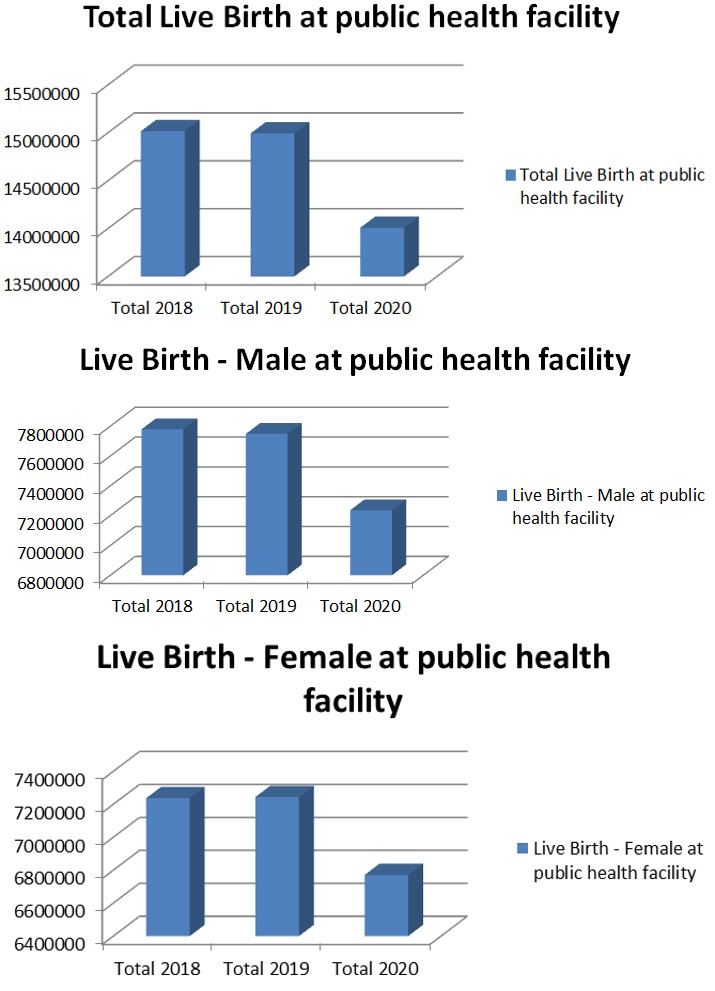
Figure 1A: Total Live Birth at Public Health Facility.
Figure 1B: Live Birth- Male at Public Health Facility.
Figure 1C: Live Birth-Female at Public Health Facility. Figure 1: Number of A-Live Birth/B-Live male birth/C-Live female birth during 2018-2019-2020 b) Number of Newborn Screened for Defects at Birth (As Per RBSK) The total number of newborn screened for defects at birth (as per RBSK) under RBSK services were 6422283, 8474973 and 6719027during 2018-2019-2020 respectively which shows an increase during 2019 followed by sharp decline during 2020 the COVID-19 era of study period. During 2019 number of newborn screened for defects at birth (as per RBSK) under RBSK services increase in 2019 by 31.96% compared to 2018 and decreased by (-) 20.72% in 2020, compared to 2019. The Utilization of this service under RBSK per 1000 live birth registered at Public health facilities were 427.69, 565.29 and 479.69 during 2018- 2019-2020 respectively which shows an increasing during 2019 followed by sharp decline during 2020 the COVID-19 era of study period, see table-1, 3, and Figures 2A & B. This novel cross sectional research study revealed that COVID-19 period 2020 had a negative impact on number of newborn screened for defects at birth (as per RBSK) under RBSK services at public health facilities in India on an all India cumulative basis.
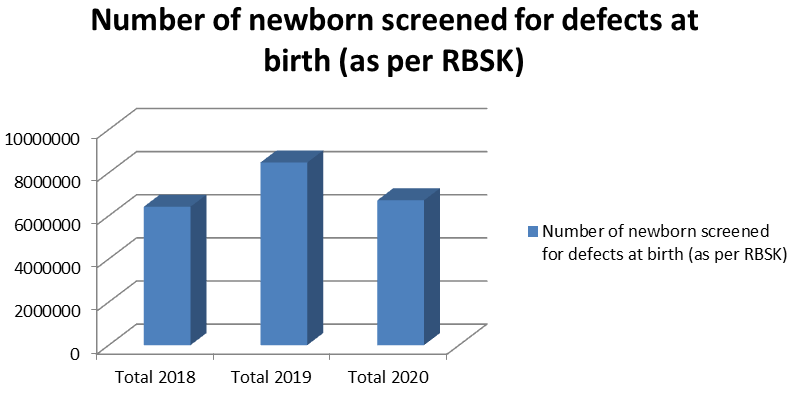
Figure 2A
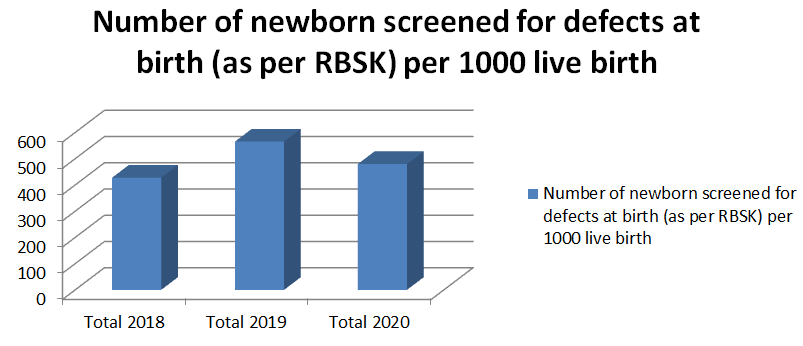
Figure 2B Figure 2: Comparison of Number of newborn screened for defects at birth (as per RBSK) during 2018-2019-2020.
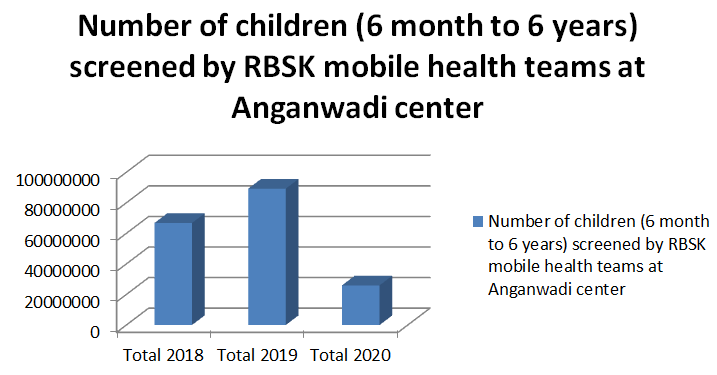
c) Number of Children (6 Month To 6 Years) Screened by RBSK Mobile Health Teams at Anganwadi Center The total number of children (6 month to 6 years) screened by RBSK mobile health teams at Anganwadi center under RBSK services were 66795744, 89282721 and 25994893 during 2018-2019-2020 respectively which shows an increase during 2019 followed by sharp decline during 2020 the COVID-19 era of study period. During 2019 the study found 33.67% increase in number of children (6 month to 6 years) screened by RBSK mobile health teams at Anganwadi center under RBSK services compared to 2018 and (-) 70.88% decrease in 2020 COVID-19 era of study period compared to 2019 see table-1, 3, and Figure 3. This novel cross sectional research study revealed that COVID-19 period 2020 had a negative impact on number of children (6 month to 6 years) screened by RBSK mobile health teams at Anganwadi center under RBSK services in India on an all India cumulative basis.
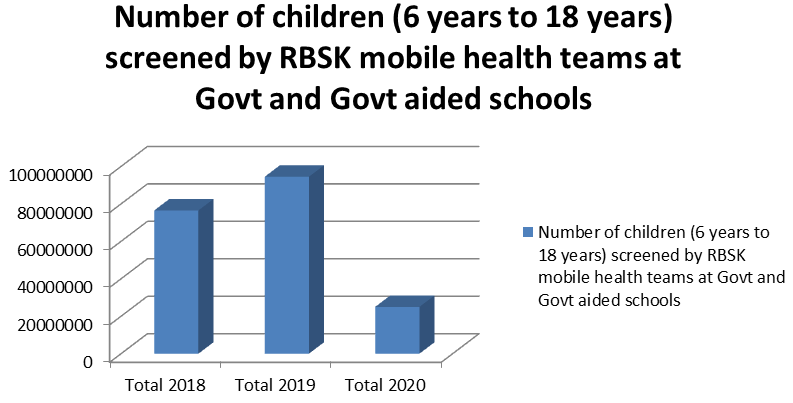
d) Number of children (6 years to 18 years) screened by RBSK mobile health teams at Govt and Govt aided schools The total number of children (6 years to 18 years) screened by RBSK mobile health teams at Govt and Govt aided schools under RBSK services were 76514223, 94504570 and 25022186 during 2018-2019-2020 respectively which shows an increase during 2019 followed by sharp decline during 2020 the COVID-19 era of study period. During 2019 the study found 23.51% increase in number of children (6 years to 18 years) screened by RBSK mobile health teams at Govt and Govt aided schools under RBSK services compared to 2018 and (-) 73.52% decrease in 2020 COVID-19 era of study period compared to 2019 see tables 1,3 and Figure 4. This novel cross sectional research study revealed that COVID-19 period 2020 had a negative impact on number of children (6 years to 18 years) screened by RBSK mobile health teams at Govt and Govt aided schools under RBSK services in India on an all India cumulative basis.
| Year | Total 2018 | Total 2019 | Total 2020 | Grand Total |
|---|---|---|---|---|
| Total number of children screened at school and Anganwadi (7+8) | 143309967 | 183787291 | 51017079 | 378114337 |
| Number of Male children identified with Disease / 1000 screened | 23.49 | 31.18 | 29.72 | 28.07 |
| Number of Female children identified with Disease/ 1000 screened | 22.37 | 30.27 | 29.31 | 27.15 |
| Number of Male children identified with Deficiency/1000 screened | 7.92 | 16.64 | 12.54 | 12.78 |
| Number of Female children identified with Deficiency/1000 screened | 19.51 | 13.7 | 13.66 | 15.89 |
| Number of Male children identified with Developmental delay/ 1000 screened | 5.62 | 5.3 | 5.1 | 5.39 |
| Number of Female children identified with Developmental delay/ 1000 screened | 5.74 | 5.5 | 5.06 | 5.53 |
| Number of Children Managed by Intervention - Medical/ 1000 screened | 31.36 | 50.95 | 50.94 | 43.53 |
| Number of Children Managed by Intervention - Surgical | 1.1 | 0.74 | 0.87 | 0.89 |
| Early intervention at DEIC (District Early Intervention Centre)/ 1000 screened | 4.35 | 3.73 | 5.94 | 4.26 |
Table 4: Comparison of total screening and output / outcome per 1000 screened during 2018-2019-2020.
| Year | Increase decrease to previous year 2018 in 2019 | Increase decrease to previous year 2019 in 2020 | Increase decrease % to previous year 2018 in 2019 | Increase decrease % to previous year 2019 in 2020 |
|---|---|---|---|---|
| Total number of children screened at school and Anganwadi (7+8) | 40477324 | -132770212 | 28.24 | -72.24 |
| Number of Male children identified with Disease / 1000 screened | 7.68 | -1.46 | 32.7 | -4.67 |
| Number of Female children identified with Disease/ 1000 screened | 7.9 | -0.96 | 35.3 | -3.18 |
| Number of Male children identified with Deficiency/ 1000 screened | 8.72 | -4.1 | 110.07 | -24.65 |
| Number of Female children identified with Deficiency/ 1000 screened | -5.81 | -0.04 | -29.78 | -0.26 |
| Number of Male children identified with Developmental delay/ 1000 screened | -0.31 | -0.21 | -5.54 | -3.93 |
| Number of Female children identified with Developmental delay/ 1000 screened | -0.24 | -0.43 | -4.22 | -7.84 |
| Number of Children Managed by Intervention - Medical/ 1000 screened | 19.59 | -0.01 | 62.46 | -0.02 |
| Number of Children Managed by Intervention - Surgical/ 1000 screened | -0.36 | 0.13 | -32.66 | 17.16 |
| Early intervention at DEIC ( District Early Intervention Centre)/ 1000 screened | -0.61 | 2.2 | -14.14 | 59.05 |
Table 5: Increase / decrease (-) and percent comparison of total screening and output / outcome per 1000 screened during 2018-201
e) Number of Male/Female children identified with Disease / 1000 screened Here it is important to note that B, C, and D section of Results are the sections which talks about the process and now we will discuss the output of this process in this section E, as well as in next sections F and G see table - 2. Additionally we know that in such studies the output is totally dependent on input (RBSK) and process. Hence getting reduced number of output during COVID-19 period 2020 is quite natural as the process results discussed in above section were reduced compared to pre-pandemic period of 2018 and 2019 see tables 1-5. The total number of Male/Female children identified with Disease (6 month to 18 years) screened by RBSK services mobile health teams at Govt and Govt aided schools and Anganwadi centre under RBSK services were 3366832, 5729653 and 1516205 male as well as 3206560, 5563668 and 1495311 females during 2018-2019-2020 respectively which shows an increase during 2019 followed by sharp decline during 2020 the COVID-19 era of study period. During 2019 the study found 70.18% and 73.51% increase in male and female number of children (6 months to
18 years) respectively identified with Disease, screened by RBSK mobile health teams at Govt and Govt aided schools and Anganwadi centers under RBSK services compared to 2018 and (-) 73.54% and (-) 73.12% decrease in male and female number of children (6 months to 18 years) respectively identified with Disease, screened by RBSK services in 2020 COVID-19 era of study period compared to 2019 see tables 1-5 and figure 5, A-B. This novel cross sectional research study revealed that COVID-19 period 2020 had a less number of Male/Female children identified with Disease (6 month to 18 years) screened by RBSK services mobile health teams at Govt and Govt aided schools and Anganwadi centre under RBSK services in India on an all India cumulative basis. This is clearly due to less number of screenings done during the COVID-19 era. The prevalence of Male/Female children identified with Disease (6 month to 18 years) / 1000 screened were 23.49, 31.18 and 29.72 for males and 22.37, 30.27 and 29.31 for females during 2018-2019-2020 respectively, is reduced during COVID-19 era is a good sign, see table 5 and Figures 5A & B.
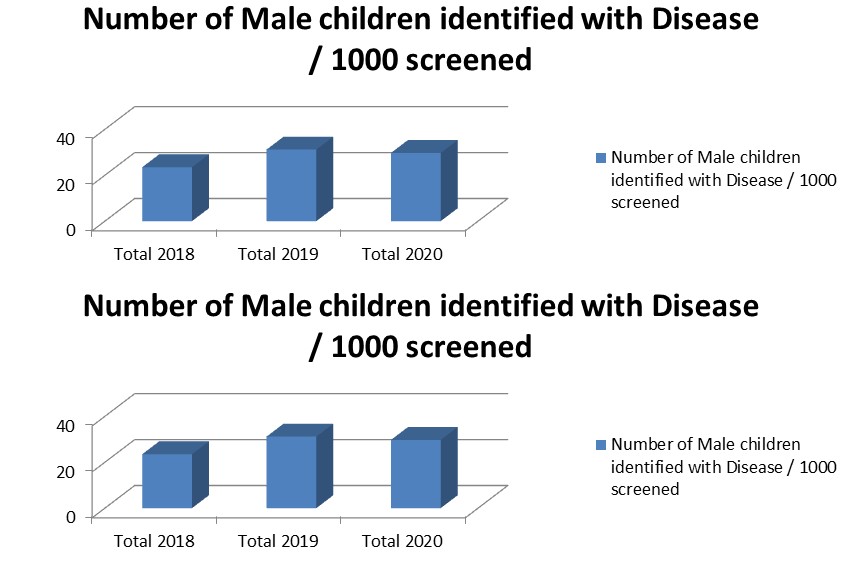
Figure 5A
Figure 5B Figure 5: Number of Male/Female children identified with Disease / 1000 screened.
f) Number of Male/Female children identified with Deficiency/ 1000 screened The total number of Male/Female children identified with Deficiency (6 month to 18 years) screened by RBSK services mobile health teams at Govt and Govt aided schools and Anganwadi centre under RBSK services were 1134845,
3057340and 639507male as well as 2795549, 2517427and 696971 females during 2018-2019-2020 respectively which shows an increase during 2019 (male) followed by sharp decline during 2020 the COVID-19 era of study period. During 2019 the study found 169.41% increase and -9.95% decrease in male and female number of children (6 months to 18 years) respectively identified with Deficiency, screened by RBSK mobile health teams at Govt and Govt aided schools and Anganwadi centers under RBSK services compared to 2018 and (-) 79.08% and (-) 72.31% decrease in male and female number of children (6 months to 18 years) respectively identified with Deficiency, screened by RBSK services in 2020 COVID-19 era of study period compared to
2019 see table-1, 3, 4, 5 and figure 6-A-B. This novel cross sectional research study revealed that COVID-19 period 2020 had a less number of Male/Female children identified with Deficiency (6 month to 18 years) screened by RBSK services mobile health teams at Govt and Govt aided schools and Anganwadi centre under RBSK services in India on an all India cumulative basis. This is clearly due to less number of screenings done during the COVID-19 era. The prevalence of Male/Female children identified with Deficiency (6 month to 18 years) / 1000 screened were 7.92, 16.64 and 12.54 for males and 19.51, 13.70 and 13.66 for females during 2018- 2019-2020 respectively, is reduced during COVID-19 era is a good sign, see table 5 and Figures 6A & B.
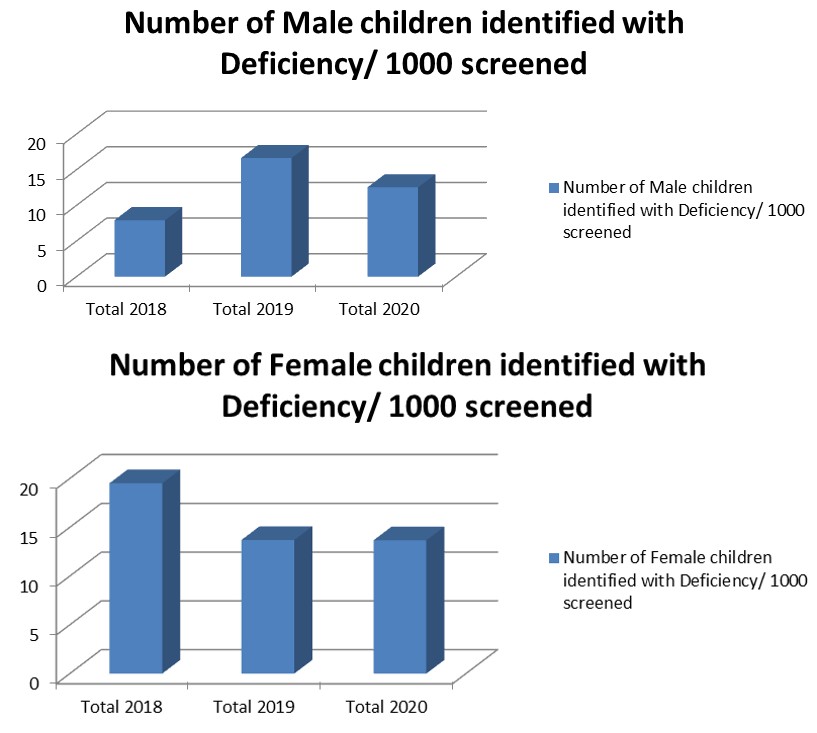
Figure 6A
Figure 6B Figure 6: Number of Male/Female children identified with Deficiency/ 1000 screened.
g) Number of Male/Female children identified with Developmental delay/ 1000 screened The total number of Male/Female children identified with Developmental delay (6 month to 18 years) screened by RBSK services mobile health teams at Govt and Govt aided schools and Anganwadi centre under RBSK services were 804820,974983 and 260000male as well as 822175, 1009928 and 258361females during 2018-2019-2020 respectively which shows an increase during 2019 (male) followed by sharp decline during 2020 the COVID-19 era of study period. During 2019 the study found 21.14% increase and 22.84% increase in male and female number of children (6 months to 18 years) respectively identified with Developmental delay, screened by RBSK mobile health teams at Govt and Govt aided schools and Anganwadi centers under RBSK services compared to 2018 and (-) 73.33% and (-) 74.42% decrease in male and female number of children (6 months to 18 years) respectively identified with Developmental delay, screened by RBSK services in 2020 COVID-19 era of study period compared to 2019 see table-1, 3, 4, 5 and figure 7-A- B. This novel cross sectional research study revealed that COVID-19 period 2020 had a less number of Male/Female children identified with Developmental delay (6 month to 18 years) screened by RBSK services mobile health teams at Govt and Govt aided schools and Anganwadi centre under RBSK services in India on an all India cumulative basis. This is clearly due to less number of screenings done during the COVID-19 era. The prevalence of Male/Female children identified with Developmental delay (6 month to 18 years) / 1000 screened were 5.62, 5.30 and 5.10 for males and 5.74, 5.50 and 5.06 for females during 2018-2019-2020 respectively, is reduced during COVID-19 era is a good sign, see table 5 and Figures 7A & B.
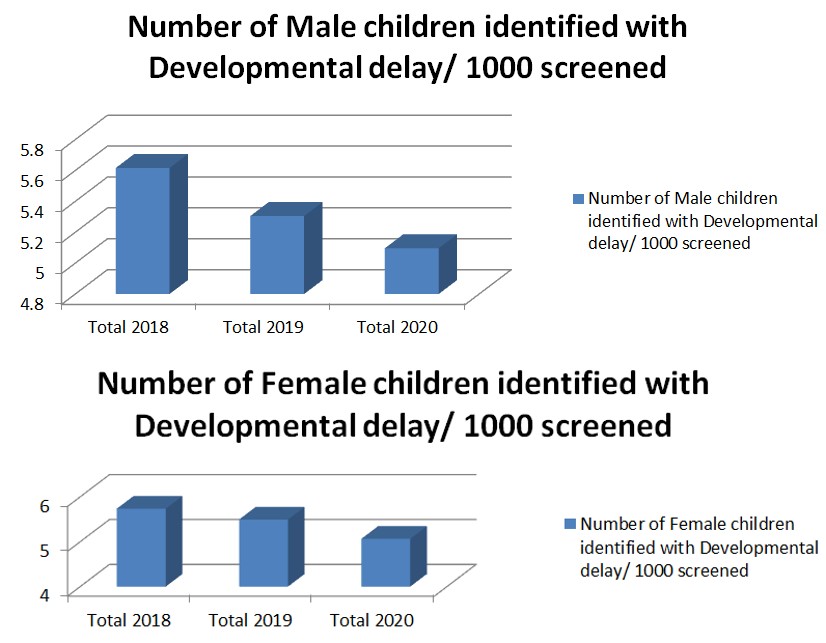
Figure 7A
Figure 7B Figure 7: Number of Male/Female children identified with Developmental delay/ 1000 screened.
h) Number of Children Managed by Intervention – Medical and Surgical/1000 screened The total number of Children Managed by Intervention – Medical and Surgical intervention (6 month to 18 years) screened by RBSK services mobile health teams at Govt and Govt aided schools and Anganwadi centre under RBSK services were 4494646, 9364330 and 2598929 medical intervention as well as 157633, 136125, and 44271surgical
intervention during 2018-2019-2020 respectively which shows an increase during 2019 (medical) followed by sharp decline during 2020 the COVID-19 era of study period. During 2019 the study found 108.34% increase and -34.4% decrease in children’s Managed by Intervention – Medical and Surgical intervention (6 months to 18 years) respectively identified with any Ds, screened by RBSK mobile health teams at Govt and Govt aided schools and Anganwadi centers under RBSK services compared to 2018 and (-) 72.25% and (-) 67.48% decrease in children’s Managed by Intervention – Medical and Surgical intervention (6 months to 18 years) respectively identified with any Ds requiring intervention (medical or surgical), screened by RBSK services in 2020, the COVID-19 era of study period compared to 2019 see tables 1, 3-5 and Figures 8 A-B. This novel cross sectional research study revealed that COVID-19 period 2020 had a less number of children’s Managed by Intervention – Medical and Surgical intervention (6 month to 18 years) for any Ds screened by RBSK services mobile health teams at Govt and Govt aided schools and Anganwadi centre under RBSK services in India on an all India cumulative basis. This is clearly due to less number of screenings done during the COVID-19 era. The prevalence of children’s Managed by Intervention – Medical and Surgical intervention (6 month to 18 years) / 1000 screened were 31.36, 50.95 and 50.94 for medical and 1.10, 0.74 and 0.87 for surgical intervention during 2018-2019- 2020 respectively, see table 5 and Figures 8A & B. Here the researcher would like to emphasize that due to lack of data on Ds requiring medical and or surgical intervention the prevalence were calculated by taking into account the number of screenings to reduce the bias.
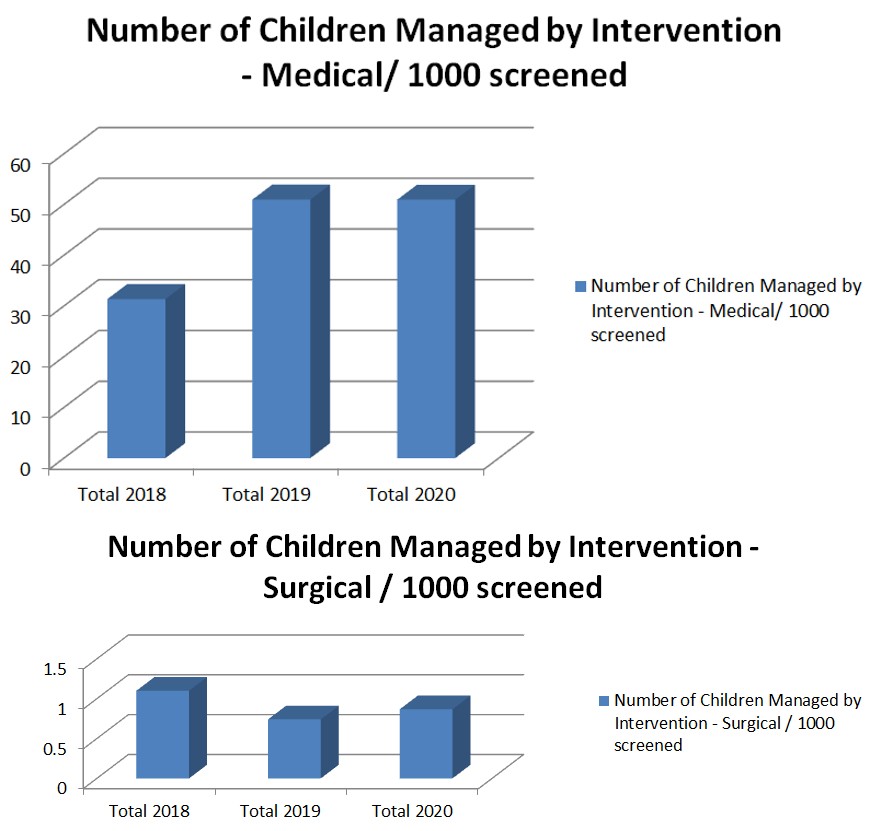
Figure 8A
Figure 8B Figure 8: Number of Male/Female children identified with Developmental delay/ 1000 screened.
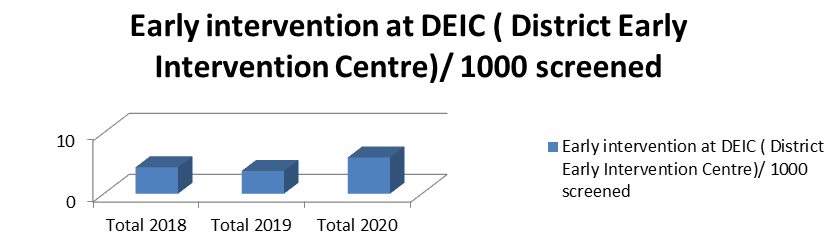
i) Early intervention at DEIC (District Early Intervention Centre)/ 1000 screened The total number of Children Managed by Early intervention at DEIC (District Early Intervention Centre) (6 month to 18 years) out of screened by RBSK services mobile health teams at Govt and Govt aided schools and Anganwadi centre under RBSK services were 622949, 685948 and 302841during 2018-2019-2020 respectively which shows an increase during 2019 (medical) followed by sharp decline during 2020 the COVID-19 era of study period. During 2019 the study found 10.11% increase and -55.85% decrease in 2020 in children’s Managed by Early intervention at DEIC respectively identified with any Ds, screened by RBSK mobile health teams at Govt and Govt aided schools and Anganwadi centers under RBSK services see table-1, 3, 4, 5 and Figure 9. This novel cross sectional research study revealed that COVID-19 period 2020 had a less number of children’s Managed by Early intervention at DEIC (6 month to 18 years) for any Ds screened by RBSK services mobile health teams at Govt and Govt aided schools and Anganwadi centre under RBSK services in India on an all India cumulative basis. This is clearly due to less number of screenings done during the COVID-19 era. The prevalence of Early intervention at DEIC (District Early Intervention Centre)/ 1000 screened children’s were 4.35, 3.73 and 5.94 during 2018-2019-2020 respectively, is increased during COVID-19 era is a good sign; Table 5 and Figure 9. Here the researcher would like to emphasize that due to lack of data on Ds requiring Early intervention at DEIC the prevalence were calculated by taking into account the number of screenings to reduce the bias.
Other Analyses
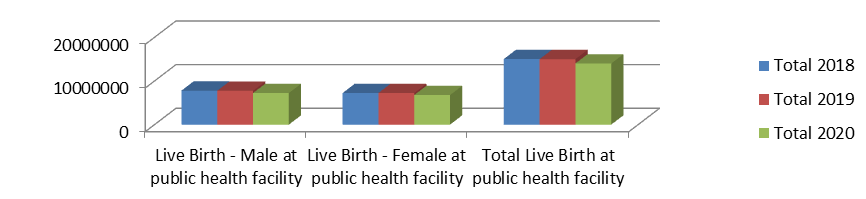
An important observation during this research study is that total live birth, as well as lives of male and female birth at public health facilities, declined during the 2020 Covid-19 era as compared to the pre-pandemic era under study; Table 6 and Figure 10.
| Total 2018 | Total 2019 | Total 2020 | |
|---|---|---|---|
| Live Birth - Male at public health facility | 7779435 | 7748563 | 7236228 |
| Live Birth - Female at public health facility | 7236614 | 7243702 | 6770683 |
| Total Live Birth at public health facility | 15016049 | 14992265 | 14006911 |
Table 6: Comparison of total live birth and live birth male / female at public health facility during study period.
Key Results
- This novel cross sectional research study revealed that COVID-19 period 2020 had a negative impact on total numbers of live birth as well as total live male and female births at public health facilities in India on an all India cumulative basis.
- This novel cross sectional research study revealed that COVID-19 period 2020 had a negative impact on number of newborn screened for defects at birth (as per RBSK) under RBSK services at public health facilities in India on an all India cumulative basis.
- This novel cross sectional research study revealed that COVID-19 period 2020 had a negative impact on number of children (6 month to 6 years) screened by RBSK mobile health teams at Anganwadi center under RBSK services in India on an all India cumulative basis.
- This novel cross sectional research study revealed that COVID-19 period 2020 had a negative impact on number of children (6 years to 18 years) screened by RBSK mobile health teams at Govt and Govt aided schools under RBSK services in India on an all India cumulative basis.
- This novel cross sectional research study revealed that COVID-19 period 2020 had a less number of Male/ Female children identified with Disease (6 month to 18 years) screened by RBSK services mobile health teams at Govt and Govt aided schools and Anganwadi centre under RBSK services in India on an all India cumulative basis. This is clearly due to less number of screenings done during the COVID-19 era. The prevalence of Male/ Female children identified with Disease (6 month to 18 years) / 1000 screened were 23.49, 31.18 and 29.72 for males and 22.37, 30.27 and 29.31 for females during 2018-2019-2020 respectively, is reduced during COVID-19 era is a good sign, see table 5 and figure – 5 A-B.
- This novel cross sectional research study revealed that COVID-19 period 2020 had a less number of Male/ Female children identified with Deficiency (6 month to 18 years) screened by RBSK services mobile health teams at Govt and Govt aided schools and Anganwadi centre under RBSK services in India on an all India cumulative basis. This is clearly due to less number of screenings done during the COVID-19 era. The prevalence of Male/ Female children identified with Deficiency (6 month to 18 years) / 1000 screened were 7.92, 16.64 and 12.54 for males and 19.51, 13.70 and 13.66 for females during 2018-2019-2020 respectively, is reduced during COVID-19 era is a good sign, see table 5 and figure – 6- A-B.
- This novel cross sectional research study revealed that COVID-19 period 2020 had a less number of Male/ Female children identified with Developmental delay (6 month to 18 years) screened by RBSK services mobile health teams at Govt and Govt aided schools and Anganwadi centre under RBSK services in India on an all India cumulative basis. This is clearly due to less number of screenings done during the COVID-19 era. The prevalence of Male/Female children identified with Developmental delay (6 month to 18 years) / 1000 screened were 5.62, 5.30 and 5.10 for males and 5.74, 5.50 and 5.06 for females during 2018-2019-2020 respectively, is reduced during COVID-19 era is a good sign, Table 5 and Figures 7A & B.
- This novel cross sectional research study revealed that COVID-19 period 2020 had a less number of children’s Managed by Intervention – Medical and Surgical intervention (6 month to 18 years) for any Ds screened by RBSK services mobile health teams at Govt and Govt aided schools and Anganwadi centre under RBSK services in India on an all India cumulative basis. This is clearly due to less number of screenings done during the COVID-19 era. The prevalence of children’s Managed by Intervention – Medical and Surgical intervention (6 month to 18 years) / 1000 screened were 31.36, 50.95 and 50.94 for medical and 1.10, 0.74 and 0.87 for surgical intervention during 2018-2019-2020 respectively, see table 5 and figure-8: A-B. Here the researcher would like to emphasize that due to lack of data on Ds requiring medical and or surgical intervention the prevalence were calculated by taking into account the number of screenings to reduce the bias.
- This novel cross sectional research study revealed that COVID-19 period 2020 had a less number of children’s Managed by Early intervention at DEIC (6 month to 18 years) for any Ds screened by RBSK services mobile health teams at Govt and Govt aided schools and Anganwadi centre under RBSK services in India on an all India cumulative basis. This is clearly due to less number of screenings done during the COVID-19 era. The prevalence of Early intervention at DEIC (District Early Intervention Centre)/ 1000 screened children’s were 4.35, 3.73 and 5.94 during 2018-2019-2020 respectively, is increased during COVID-19 era is a good sign; see table 5 and figure 9. Here the researcher would like to emphasize that due to lack of data on Ds requiring Early intervention at DEIC the prevalence were calculated by taking into account the number of screenings to reduce the bias.
Discussion
Rashtriya Bal Swasthya Karyakram (RBSK) might cut back owed expenses for families of each newborn and children and such programs measures are needed a lot in LMICs like Asian country India wherever an outsized proportion of the population forced to travel underneath the proper income required for adequate and timely management of Ds discussed above. Government ought to expand this theme to private hospital establishment underneath this theme because the public health facilities aren’t enough alone to cater to the requirements of the huge population further as poor infrastructure, malpractice, and corruption within the government health sector also are necessary hurdles in achieving the goal of safe maternity and healthy kid. The RBSK theme of the Govt is found to be significantly negatively affected throughout the COVID-19 pandemic era 2020 evident from the great reduction of RBSK services underneath this theme. The analysis of this study is also useful to world governments further as well as policy and decision-makers to investigate and perceive the loopholes in RBSK theme for the betterment of kid health by continuous provision of such essential aid services within the in progress COVID-19 era or the other disasters. Throughout 2020 different world nation’s had disruption of many routine aid services utilization which may arise necessity to create a sturdy framework and implementation of essential services like RBSK theme.
Strength and Limitations
Till today 27-06-2022 to the best of the author knowledge, there are no research study done exclusively to find out impact of COVID-19 on the RBSK scheme; exploring the impacts through HMIS registered data across 36 states and UTs of by analyzing accredited, time-bound indicators for newborn and children in the country. This new research study is not available as per researcher knowledge anywhere on a global basis, which calculated and analyzed the impact of covid-19 on RBSK health services through several processes or output indicators.
Conclusion and Recommendations
This cross-sectional analysis study found that the covid-19 pandemic decreased the employment of assorted RBSK free health care services among newborn and children’s which may increase Ds (Defects at Birth, Deficiencies, Diseases and Developmental Delays including disabilities) among them in India compared to the pre-pandemic amount. Thus the scientist recommends a lot of efforts is needed significantly to ensure the continuum of such vital services during any disasters like COVID-19. The framework associated implementation mode of RBSK may be thought- about for enhancing RBSK health services utilization that seems to be intermittent or discontinuous during COVID-19 period.
References
-
Kumar P, Habib HF (2022) What is the Impact of Covid-19 Pandemic on the RCH (Reproductive and Child Health) Programme in Rajasthan, because of Nationwide Lockdown (April 2020 to June 2020)? J Cli Ped Chi Res 3(1): 26-41.
-
Kumar P (2022) Impact of Covid-19 Pandemic Era on Prevalence of Pregnant Women Sero-Positivity for Syphilis, Among Women Attending Antenatal Care in India and Babies Diagnosed with Congenital Syphilis-A Cross-Sectional Research Study. J Cli Ped Chi Res 3(1): 67-77.
-
Kumar P (2022) What is the Impact of Covid-19 Pandemic Era on Pregnant Women Sero-Positivity for Syphilis Among Women Attending Antenatal Care in India and Number of Babies Diagnosed with Congenital Syphilis? J Cli Ped Chi Res 3(1): 61-66.
-
Kumar P (2022) What Impact Have SARS-CoV-2/Covid-19 Pandemic on Domestic Violence Against Women in India Across Different States and Union Territories from the Beginning of Lockdown due to Covid-19 Pandemic in March 2020 Till 20th September 2020? J Cli Ped Chi Res 3(1): 78-83.
-
Kumar P (2022) What Impacts Have Geographical Locations on the Cases and Deaths from Covid-19/SARS- CoV-2 Pandemic in 36 States and Union Territories of India:-Observational Analysis in India. J Mari Scie Res Ocean 5(1): 01-07.
-
Kumar P (2022) What Impacts Have Variation in Geographical Locations on the Cases and Deaths from COVID-19/SARS-CoV-2 Pandemic in 36 States and Union Territories Of India: Observational Analysis in India between December 2019 and 05 January 2022-V2. Insig Cardio Vasc Phar Res 2(1); 07-16.
-
Kumar P (2022) What Impact Have SARS-CoV-2/ Covid-19 Pandemic Induced Lockdown on the Number of OPD Patients of Diabetes, Hypertension, Stroke (CVA), Acute Heart Disease, Mental Illness, Epilepsy, Ophthalmic, Dental and oncology in India during the Lockdown Months (April-May-2020)-Observational Research Analysis? Int J Cancer Res Ther 7(2): 51-62.
-
Kumar P (2022) What is the Impact of COVID-19 Pandemic Years on Deliveries and Home-Based New- Born Care in India? A Cross-sectional Comparative Research Study, January 2018-December 2021. Journal of Clinical Cases & Reports 2022(S12): 66-81.
-
Kumar P (2022) Impact of COVID-19 pandemic on mortality count at the Emergency Ward of Hospitals in India: A Cross-sectional study from January 2019 to May 2021. Adn Envi Was Mana Rec 5 (1): 62-73.
-
Kumar P (2022) What is the impact of Covid-19 on the Antenatal Care Services Utilization in Public-Private- Rural-Urban Hospitals of India during the COVID-19 Pandemic Period of 2020-2021 Compared to Pre- Pandemic Era 2018-2019? Modern Applied Medical Research (MAMR) 2(2): 1-10.
-
Gupta A, Kumar R, Khera A, Sankar S, Khurmi M, et al. (2012) Operational Guidelines Rashtriya Bal Swasthya Karyakram.
-
Rashtriya Bal Swasthya Karyakram (RBSK) Ministry of Health & Family Welfare, Government of India.
-
Rashtriya Bal Swasthya Karyakram (RBSK) (2013) Child Health Screening and Early Intervention Services under NRHM.
-
Rashtriya Bal Swasthya Karyakram (RBSK) Child Health Screening and Early Intervention Services under NHM Ministry of Health & Family Welfare Government of India April 2014 - Setting up District Early Intervention Centres Operational Guidelines.
-
(2021) Handbook on Early Intervention Centers for Children with Disabilities. Department of Empowerment of Persons with Disabilities (Divyangjan) Ministry of Social Justice and Empowerment Government of India.
-
Helping ASHA identify birth defects. Rashtriya Bal Swasthya Karyakram (RBSK) National Health Mission.
-
(2015-2016) Interventions to Address Birth Defects, Disabilities, Delays and Deficiencies. In: Child Health Programme. Annual Report pp: 37-50.
-
Health Management data system of NHM.
-
Rameshbabu B, Kumaravel K, Balaji J, Sathya P, Shobia N (2019) Health Conditions Screened by the 4D`s Approach in a District Early Intervention Centre (DEIC) under Rashtriya Bal Swasthya Karyakram (RBSK) Program. Pediatr Oncall J 16: 73-78.
-
(2020) Fertility Rate, Total (Births per Woman). The World Bank India.
- Intersecting Epidemics and Climate Vulnerabilities in Conflict- Driven Displacement: Epidemiology, Systemic Challenges, and One Health Gaps in South Sudan
- Advancing Domestic Health Financing for Community Health System Sustainability in South Sudan: The Boma Health Initiative Model (2025–2035)
- Prevalence and Correlates of Post-Exposure Prophylaxis Uptake among Men Who Have Sex with Men in Kisumu County, Kenya
- Medical, Ethical, and Legal Conflicts Surrounding Euthanasia in Argentina. Its Global Implications
- Knowledge and Attitude on Menstrual Hygiene among Adolescent Girls Studying in Secondary Level in Public Schools of Chitwan District, Nepal
- Biological Efficacy of an Adulticide Mixture (clothianidin + deltamethrin) as an Indoor Residual Spray against Adult Anopheles flavirostris in Palawan, the Philippines