
What is the impact of COVID-19 pandemic era 2020 on Jssk-Janani-Shishu Suraksha Karyakram (mother-child protection program) services utilization in India – A cross-sectional comparative research study?
In India due to the elevated fertility rate and vast population (globally next to china) mother (Janani) and child (Shishu) protection programs (Suraksha Karyakaram) are quite significant for public healthcare provision systems, especially in the ongoing COVID-19 pandemic era during which most of the necessary pregnancy and infant care protective health services utilization are disrupted. The Government of India started JSSK (Janani Shishu Suraksha Karyakaram) on 1st June 2011 for the benefit of millions of pregnant women (PW) and infants utilizing Government (public) health facilities across all the States and UTs (union territories) of India. The Government JSSK scheme provides various free entitlements and services to PW and infants. This may improve maternal and child health services utilization at public health facilities which can reduce MMR (maternal mortality rate) and IMR (infant mortality rate) in the country. The ongoing COVID 19 pandemic era has disrupted several routine health services utilization in India due to lockdowns etc particularly RCH (reproductive and child health) healthcare services which made a situation of rethinking necessary to take necessary steps in the healthcare system's current scenario to prioritize the services according to need and urgency as well as to construct a robust plan to ensure public health services utilization amidst pandemic or any disasters. This research study was done to provide reference to the scientific community and decision-makers with concrete data analysis from accredited HMIS (Health Management Information system) source (Government of India- MoHFW (Ministry of Health and Family Welfare)) to find out the COVID-19 impact on JSSK services utilization by the PW and sick infants of India attending public healthcare facilities across 36 states and UTs of India. This research study was public health facility-based, retrospective, mixed, cross-sectional study that was conducted for infants and pregnant women who utilized the available free services under JSSK in the public health facilities across 36 states and UTs of India from 1st January 2018 to 31st December 2020. The first COVID-19 patient in India was confirmed on the 27th of January 2020. Hence for this research study, the year before 2020 i.e. 2018, and 2019 were considered as the pre-pandemic period and the year 2020 was considered as the pandemic period. This research study revealed that there is an increase in almost all JSSK service utilization at public health facilities in India compared to the pre-pandemic era on a cumulative all India bases.
Introduction
Background/Rationale
In India due to the elevated fertility rate and vast population (globally next to china) mother (Janani) and child (Shishu) protection programs (Suraksha Karyakaram) are quite significant for public healthcare provision systems, especially in the ongoing COVID-19 pandemic era during which most of the essential pregnancy and infant health services are disrupted [ 1]. ANC (antenatal care) services for women in India as well as immunization services for children were found to be negatively affected during the ongoing pandemic era which may cause problems to PWs as well as kids who may suffer from VPD (vaccine-preventable diseases) [2 ]. The Government of India initiated JSSK (Janani Shishu Suraksha Karyakaram) on 1st June, 2011for the benefit of millions of pregnant women (PW) and infants utilizing Government (public) health facilities across all the States and UTs (union territories) of India [3]. Under JSSK pregnant women and sick infants (from 30 days to infants coverage increased in 2014) accessing public government health facilities are entitled to [4]:
- Free and cashless delivery
- Free C-Section
- Free drugs and consumables
- Free diagnostics
- Free diet during the stay in the health institutions (3 days during normal delivery and 7 days for C-section)
- Free provision of blood
- Exemption from user charges
- Free transport from home to health institutions
- Free transport between facilities in case of a referral
- Free drop back from Institutions to home after 48hrs stay
- Free treatment In 2014 these entitlements extended to all antenatal &post-natal complications of pregnancy The Government JSSK scheme providing various free entitlements and services to PW and infants may improve maternal and child health services utilization at public health facilities and reduce MMR (maternal mortality rate) and IMR (infant mortality rate) in the country. The ongoing COVID 19 pandemic has disrupted several routine health services utilization in India due to lockdowns etc, particularly the RCH (reproductive and child health) continuum of care, and a situation of rethinking persist today in the healthcare system’s current scenario to prioritize the services according to need and urgency to constitute a robust framework to ensure public health services utilization amidst pandemic or any disasters [5]. Owing to the wide variations among 36 states and UTs of India in the healthcare workforce, state / UTs rankings in the NITI Aayog report, management, equipment, facilities, and geographical locations among various states and UTs; a complex and robust healthcare management framework is much needed to cope with the increasing population during disasters like ongoing COVID 19 [6, 7, 8].
Other Public health services utilization was also reduced in scale due to the impact of COVID-19 as well as the women and children are particularly considered a vulnerable group during disasters and calamities such as COVID-19 and apart from health issues these groups also suffer from violence and mental agony in situations like COVID-19 leading to the family as well as social/national distress [9, 10, 11, 12, 13]. The pandemic had increased mortality rates in the emergency department of public health facilities during COVID 19 but COVID-19 mortality is low among children and women of reproductive age [14, 15]. Public health management should be customized to state/ UTs specific scenarios, according to the needs assessment on maternal and child health, and ensuring regular essential health services provisions during the pandemic or any other distress is the real challenge emanating from this situation. This observational study is an attempt to quantify the impact of the corona-pandemic on JSSK in India. This analytical study may help policymakers / decision-makers in making informed decisions. This observational study may provide a reference to the decision- makers and researchers to derive or think about strategies of response to a pandemic or other distress.
Objectives
This research study was done to provide reference to the scientific community and decision-makers with concrete data analysis from accredited HMIS (Health Management Information system) source (Government of India- MoHFW (Ministry of Health and Family Welfare)) to find out the COVID-19 impact on JSSK services utilization by the PW of India attending public healthcare facilities across 36 states and UTs of India [16]. The researcher hopes that the findings of this cross-sectional observational research study will help important stakeholders and policymakers in framing strategies for the prioritization of pregnancy healthcare services during the ongoing COVID-19 and even after the pandemic period.
Materials and Methods
Study Design and Period
India is the second-most populous country in the world with a Fertility rate (births per woman) of 2.2 in 2020 which were 5.9 in 1960 [17]. This cross-sectional observational research study was conducted in India across all public health facilities of all the 36 states and union territories of India from January 2018 to December 2020. A public health facility-based retrospective mixed cross-sectional study was conducted for infants and pregnant women who utilized the available free services under JSSK in the public health facilities across 36 states and UTs of India from 1st January 2018 to 31st December 2020. The first COVID-19 case in India was identified on the 27th of January 2020 [18]. Hence for this research study, the year before 2020 i.e. 2018, and 2019 were considered as the pre-pandemic period and the year 2020 was considered as the pandemic period. The JSSK health services utilized were compared during the covid-19 pandemic period i.e.2020 with 2018 and 2019 the pre-pandemic era. The most important confounders were taken into account as per data availability and results were calculated for JSSK health services utilization in the pandemic era which was compared with the pre-pandemic era to assess the impact of COVID-19 on JSSK free health services utilization.
Setting
This cross-sectional observational research study was carried out by continuous collection, observation, and analysis of public health facilities data from the HMIS of MoHFW. The populations covered were PW and infants from 36 states and union territories of India who accessed any public health facilities and received/benefitted from JSSK free entitlements. As per the data obtained from HMIS, the total number of pregnant women registered for ANC at public health facilities during the study period were 81756387 numbers of PWs. The financial burden of JSSK free health services in the public/government hospital of India is cost- free, covered partly by state / UTs and central governments. The JSSK entitles above mentioned free service utilization to all pregnant women delivering in public health institutions only and sick babies and infants up to one year of age accessing public health institutions only for treatment. Hence this research study was done only over the public health facilities of India. Also, we know that the confounder is a variable associated or related to both the variable of interest/study (here it was free health services utilization at public health facilities provided under JSSK) and the outcome of interest. The most important confounders (which can interfere with the outcome) included in this study were
- Total number of pregnant women registered for ANC at public health facilities
- Live Birth - Male at public health facilities
- Live Birth - Female at public health facilities
- Number of Institutional Deliveries conducted (Including C-Sections) at public health facilities
- Total C -Section deliveries performed at public health facilities Here it is also important to state that number 1 above is an independent variable whereas others 2,3,4,5 and services utilized under JSSK are dependent variables in this research study.
Participants
The actual participants were all the PWs registered for ANC at public health facilities and PWs as well as infants who utilized JSSK free health services at any public health facilities of choice in India across 36 states and UTs, during the study period of this research study, were considered as the study population. A total of 60547407 numbers of pregnant women and 30706393 institutional deliveries who fulfilled the inclusion criteria were included in this research study.
Ethical Consideration
Ethical approval was not applicable for this research study as we have not done any human or animal trials etc. or involved them in such a way that requires ethical approvals. Added to this, the data utilized is available to the public and we had not disclosed any hidden or secret data. The purpose of this research study is well explained above, and ethical approval is not applicable for such studies in India based on data available in the public domain. The researcher is a medical doctor working for the government of Bihar, India and this research study is a part of the author’s independent self-financed research works.
Sample Size and Sampling Technique A total of 81756387 numbers of PWs and 40405616 institutional deliveries registered at public health facilities only in India across different states and UTs were included in this research study with a purposive sampling technique. The data required for this study purpose were collected from HMIS of the MoHFW which is the only available most accredited data source in India. The total number of variables/indicators including confounders and those derived from available data for the study were fifteen (15). The data were collected and analyzed with the help of Microsoft office and stata15.1 software. Live male and female birth variables were kept under section other analyses.
Variables
Study Variables and Operational Definition: The outcome variables for this research study were JSSK health care free services utilization by any PWs and infants across 36 states and UTs of India during the study period. JSSK health care free services utilization for this study was defined as follows:
- Total number of pregnant women registered for ANC at public health facilities ( registration of ANC is a free service and included in the research study to reduce bias as well as potential confounders recognized during the research study)
- Number of Pregnant Women provided - Free Medicines under JSSK
- Number of Pregnant Women provided - Free Diet under JSSK
- Number of Pregnant Women provided - Free Diagnostics under JSSK
- Number of Pregnant Women provided - Free Home to facility transport under JSSK
- Number of Pregnant Women provided - Interfacility transfers when needed under JSSK
- Number of Pregnant Women provided - Free Drop Back home under JSSK
- Number of sick infants provided - Free Medicines under JSSK
- Number of sick infants provided - Free Diagnostics under JSSK
- Number of sick infants provided - Free Home to facility transport under JSSK
- Number of sick infants provided - Interfacility transfers when needed under JSSK
- Number of sick infants provided - Free Drop Back home under JSSK
- Number of Institutional Deliveries conducted (Including C-Sections) at public health facilities ( institutional deliveries conducted at public health facilities is a free service and included in the research study to reduce bias as well as potential confounder recognized during the research study)
- Total C -Section deliveries performed at public health facilities
- Total C -Section deliveries performed per 1000 institutional deliveries at public health facilities (C -Section deliveries / 1000 performed at public health facilities is a free service and included in the research study to reduce bias as well as potential confounders recognized during the research study)
Data Sources/Measurement
Data Collection and Quality Assurance: Fifteen (15) variable/indicator data from HMIS registered health services utilization under the umbrella of JSSK of the Government of India providing free maternal and child healthcare services were selected purposively (sampling) to find out the impact of COVID 19 pandemic on JSSK free health services utilization across public health facilities in 36 states and UTs of India and were continuously collected, observed-analyzed using Microsoft office and stata15.1 software from electronic records of HMIS-MoHFW. The data were checked for specificity, measurability, accuracy, reliability, completeness, and consistency.
Data Management and Analysis: The data obtained were checked for any inconsistencies, missing values, incompleteness, etc then collected into Microsoft office software and further exported to STATA15.1 for further analysis. Data collection was done with Microsoft office from HMIS-Government of India and ethical approval is not required for such research studies based on government data in the public domain. Data related to JSSK healthcare services and for possible confounders were obtained from HMIS for the pandemic period 2020 and compared with pre- pandemic data for the same period years 2019 and 2018. The data entered into a Microsoft Excel spreadsheet were also analyzed using Stata software version 15.1.
Data Availability: The data source for this research study is available on HMIS MoHFW, Government of India. The link to the source is: - https://hmis.nhp.gov.in/#!/standardReports.
Bias and Confounders: During the research study period, the researcher found that comparing exclusively the JSSK free services utilization may be a biased study. Hence the researcher included some variables and two pre-pandemic year data to reduce the bias as well as to take care of potential confounders. These variables were as follows:
- Total number of pregnant women registered for ANC at public health facilities ( registration of ANC is a free service and included in the research study to reduce bias as well as potential confounders recognized during the research study)
- Number of sick infants provided - Free Drop Back home under JSSK
- Number of Institutional Deliveries conducted (Including C-Sections) at public health facilities ( institutional deliveries conducted at public health facilities is a free service and included in the research study to reduce bias as well as potential confounder recognized during the research study)
- Total C -Section deliveries performed at public health facilities
- Total C -Section deliveries performed per 1000 institutional deliveries at public health facilities (C -Section deliveries / 1000 performed at public health facilities is a free service and included in the research study to reduce bias as well as potential confounders recognized during the research study) Study Size
The purposive sampling technique was utilized to get the answer for this research study title mentioned research question. A total of 60547407 numbers of PWs and 30706393 institutional deliveries registered at public health facilities only during the study period were included in this study as explained above.
Quantitative Variables
The quantitative variables were purposively chosen to get the answer to the research question. See Table 1 which lists all the purposively selected variables.
Total number of pregnant women registered for ANC at public health facilities Number of Pregnant Women provided - Free Medicines under JSSK Number of Pregnant Women provided - Free Diet under JSSK Number of Pregnant Women provided - Free Diagnostics under JSSK Number of Pregnant Women provided - Free Home to facility transport under JSSK Number of Pregnant Women provided - Interfacility transfers when needed under JSSK Number of Pregnant Women provided - Free Drop Back home under JSSK Number of sick infants provided - Free Medicines under JSSK Number of sick infants provided - Free Diagnostics under JSSK Number of sick infants provided - Free Home to facility transport under JSSK Number of sick infants provided - Interfacility transfers when needed under JSSK Number of sick infants provided - Free Drop Back home under JSSK Number of Institutional Deliveries conducted (Including C-Sections) at public health facilities Total C -Section deliveries performed at public health facilities Total C -Section deliveries performed per 1000 institutional deliveries at public health facilities Other analyses variables Total Live Birth at public health facilities Live Birth - Male at public health facilities Live Birth - Female at public health facilities
- Total C -Section deliveries performed per 1000 institutional deliveries at public health facilities
- Other analyses variables
- Total Live Birth at public health facilities
- Live Birth - Male at public health facilities
- Live Birth - Female at public health facilities
Table 1: List of variables for this research study.
Statistical Methods
The annual prevalence for all the free healthcare services utilization at public health facilities in India provided under the JSSK scheme was calculated from the data of all the 36 states and UTs for the study period. For controlling the confounders annual prevalence per 1000 JSSK free healthcare services utilization was calculated for comparison. Growth or declines in numbers/percentage were compared from the previous year and it was also calculated to assess the trends of JSSK free services utilization during the study period.
Participants
A total number of 27586683, 27957956 and 26211748 PWs registered at public health facilities of India across 36 states and UTs and listed on HMIS of MoHFW (Government of India) were included in this research study during the years 2018, 2019, and 2020 respectively. Similarly, other participants were selected keeping intact the key eligibility of free healthcare services utilization under JSSK at public health facilities located in any state / UTs of India during the study period. Table 2 shows the number of eligible participants at each stage of this research study.
| Indicator | Total 2018 | Total 2019 | Total 2020 |
|---|---|---|---|
| Total number of pregnant women registered for ANC at public health facilities | 27586683 | 27957956 | 26211748 |
| Number of Pregnant Women provided - Free Medicines under JSSK | 9892026 | 12477364 | 13923237 |
| Number of Pregnant Women provided - Free Diet under JSSK | 6724038 | 7897742 | 8143716 |
| Number of Pregnant Women provided - Free Diagnostics under JSSK | 10883867 | 13047226 | 13570356 |
| Number of Pregnant Women provided - Free Home to facility transport under JSSK | 5068731 | 4755161 | 5137408 |
| Number of Pregnant Women provided - Interfacility transfers when needed under JSSK | 826016 | 941306 | 1104539 |
| Number of Pregnant Women provided - Free Drop Back home under JSSK | 4039457 | 4840247 | 5044712 |
| Number of sick infants provided - Free Medicines under JSSK | 1970113 | 2284127 | 2266045 |
| Number of sick infants provided - Free Diagnostics under JSSK | 1445638 | 1906050 | 1875769 |
| Number of sick infants provided - Free Home to facility transport under JSSK | 327287 | 472707 | 559696 |
| Number of sick infants provided - Interfacility transfers when needed under JSSK | 154258 | 218437 | 259447 |
| Number of sick infants provided - Free Drop Back home under JSSK | 488498 | 648149 | 752506 |
| Number of Institutional Deliveries conducted (Including C-Sections) at public health facilities | 13581181 | 13819578 | 13004857 |
| Total C -Section deliveries performed at public health facilities | 1859455 | 1941098 | 1822538 |
| Total C -Section deliveries performed per 1000 institutional deliveries at public health facilities (outcome data) | 136.91 | 140.46 | 140.14 |
Table 2: Number of eligible participants during 2018-2019-2020.
Descriptive Data
A public health facility-based utilization of free services under JSSK of the Government of India; retrospective mixed cross-sectional study was carried out from 1st January 2018 to 31st December 2020, for pregnant women attending all public healthcare services in 36 states and UTs of India. In this study, a total of 60547407 numbers of PWs and 30706393 institutional deliveries registered at public health facilities were included in the study with a purposive sampling technique to assess the impact of COVID-19 on the utilization of JSSK free services. See Tables 1& 2.
Outcome Data
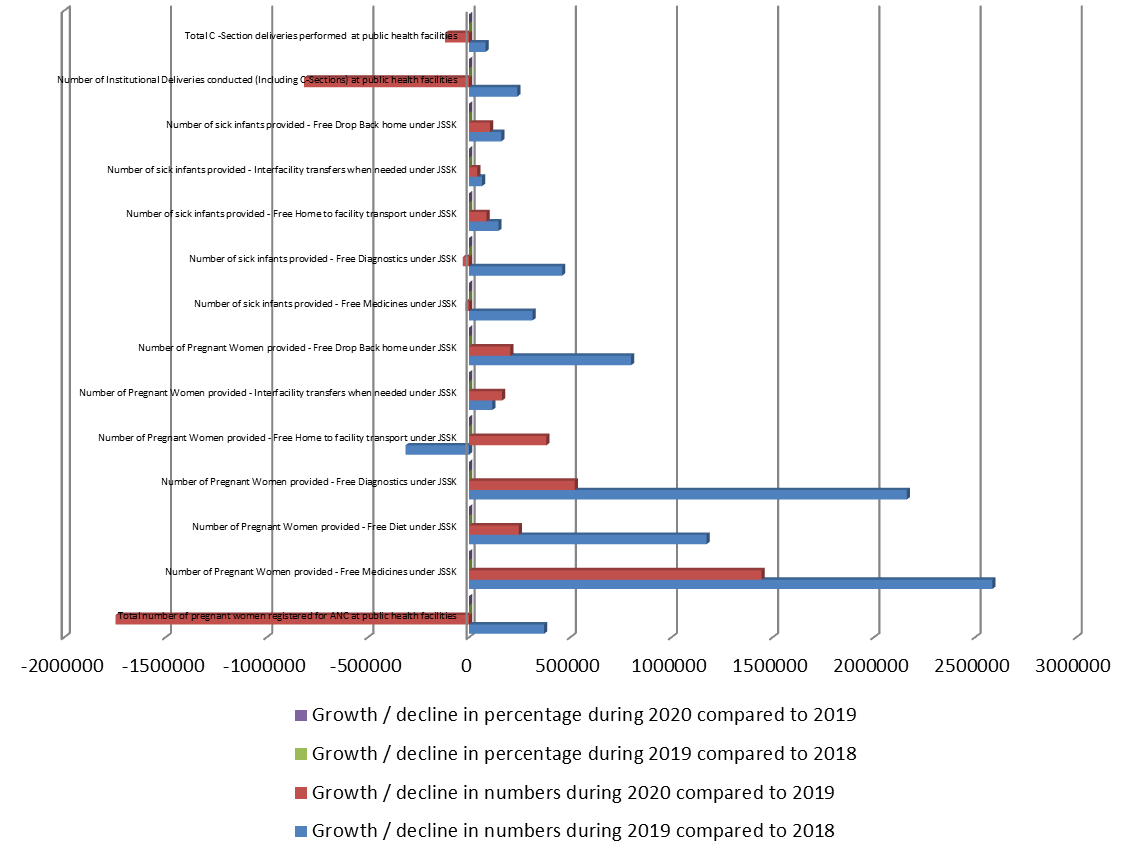
As stated earlier the Microsoft office and stata15.1 software were used for data collection analysis and graphical presentations etc. Before going to the results the outcome data are presented in Table 3-5 and Figures 1-5.
| Indicator | Percentage of previous year 2018 numbers during 2019 | Percentage of previous year 2019 numbers during 2020 | Growth / decline in numbers during 2019 compared to 2018 | Growth / decline in numbers during 2020 compared to 2019 | Growth / decline in percentage during 2019 compared to 2018 | Growth / decline in percentage during 2020 compared to 2019 |
|---|---|---|---|---|---|---|
| Total number of pregnant women registered for ANC at public health facilities | 101.35 | 93.75 | 371273 | -1746208 | 1.35 | -6.25 |
| Number of Pregnant Women provided - Free Medicines under JSSK | 126.14 | 111.59 | 2585338 | 1445873 | 26.14 | 11.59 |
| Number of Pregnant Women provided - Free Diet under JSSK | 117.46 | 103.11 | 1173704 | 245974 | 17.46 | 3.11 |
| Number of Pregnant Women provided - Free Diagnostics under JSSK | 119.88 | 104.01 | 2163359 | 523130 | 19.88 | 4.01 |
| Number of Pregnant Women provided - Free Home to facility transport under JSSK | 93.81 | 108.04 | -313570 | 382247 | -6.19 | 8.04 |
| Number of Pregnant Women provided - Interfacility transfers when needed under JSSK | 113.96 | 117.34 | 115290 | 163233 | 13.96 | 17.34 |
| Number of Pregnant Women provided - Free Drop Back home under JSSK | 119.82 | 104.22 | 800790 | 204465 | 19.82 | 4.22 |
| Number of sick infants provided - Free Medicines under JSSK | 115.94 | 99.21 | 314014 | -18082 | 15.94 | -0.79 |
| Number of sick infants provided - Free Diagnostics under JSSK | 131.85 | 98.41 | 460412 | -30281 | 31.85 | -1.59 |
| Number of sick infants provided - Free Home to facility transport under JSSK | 144.43 | 118.4 | 145420 | 86989 | 44.43 | 18.4 |
| Number of sick infants provided - Interfacility transfers when needed under JSSK | 141.6 | 118.77 | 64179 | 41010 | 41.6 | 18.77 |
| Number of sick infants provided - Free Drop Back home under JSSK | 132.68 | 116.1 | 159651 | 104357 | 32.68 | 16.1 |
| Number of Institutional Deliveries conducted (Including C-Sections) at public health facilities | 101.76 | 94.1 | 238397 | -814721 | 1.76 | -5.9 |
| Total C -Section deliveries performed at public health facilities | 104.39 | 93.89 | 81643 | -118560 | 4.39 | -6.11 |
Table 3: Comparisons of JSSK healthcare services utilization during 2018-2019-2020.
| Indicator | Utilization of Services per 1000 PW registered for ANC at Public health facilities 2018 | Utilization of Services per 1000 PW registered for ANC at Public health facilities 2019 | Utilization of Services per 1000 PW registered for ANC at Public health facilities 2020 |
|---|---|---|---|
| Number of Pregnant Women provided - Free Medicines under JSSK | 358.58 | 446.29 | 531.18 |
| Number of Pregnant Women provided - Free Diet under JSSK | 243.74 | 282.49 | 310.69 |
| Number of Pregnant Women provided - Free Diagnostics under JSSK | 394.53 | 466.67 | 517.72 |
| Number of Pregnant Women provided - Free Home to facility transport under JSSK | 183.74 | 170.08 | 196 |
| Number of Pregnant Women provided - Interfacility transfers when needed under JSSK | 29.94 | 33.67 | 42.14 |
| Number of Pregnant Women provided - Free Drop Back home under JSSK | 146.43 | 173.13 | 192.46 |
| Indicator | Utilization of Services per 1000 institutional deliv- eries registered at Public health facili- ties2018 | Utilization of Ser- vices per 1000 institutional deliveries regis- tered at Public health facili- ties2019 | Utilization of Services per 1000 institutional deliv- eries registered at Public health facili- ties2020 |
| Number of sick infants provided - Free Medicines under JSSK | 145.06 | 165.28 | 174.25 |
| Number of sick infants provided - Free Diagnostics under JSSK | 106.44 | 137.92 | 144.24 |
| Number of sick infants provided - Free Home to facility transport under JSSK | 24.1 | 34.21 | 43.04 |
| Number of sick infants provided - Interfacility transfers when needed under JSSK | 11.36 | 15.81 | 19.95 |
| Number of sick infants provided - Free Drop Back home under JSSK | 35.97 | 46.9 | 57.86 |
Table 4: Comparisons of JSSK healthcare services utilization per 1000 PWs during 2018-2019-2020
Main Results
Impact of Covid-19 on
a) Total Number of Pregnant Women Registered for ANC at Public Health Facilities - See Figure- 1, 2, and Table-2, 3 The total number of PWs registered for ANC at public health facilities were 27586683, 27957956 and 26211748 during 2018-2019-2020 respectively which shows a continuous decreasing trend for this indicator during the study period. During 2019 101.35 % of 2018 and during 2020 only 93.75% of 2019 numbers were registered which shows that there is an increase of 371273 numbers of PWs ANC registration in 2019 compared to 2018 followed by a decrease of -1746208 during the COVID-19 era 2020 compared to 2019 expressed as1.35% increase in 2019 compared to 2018 and -6.25% decrease in 2020 compared to 2019.
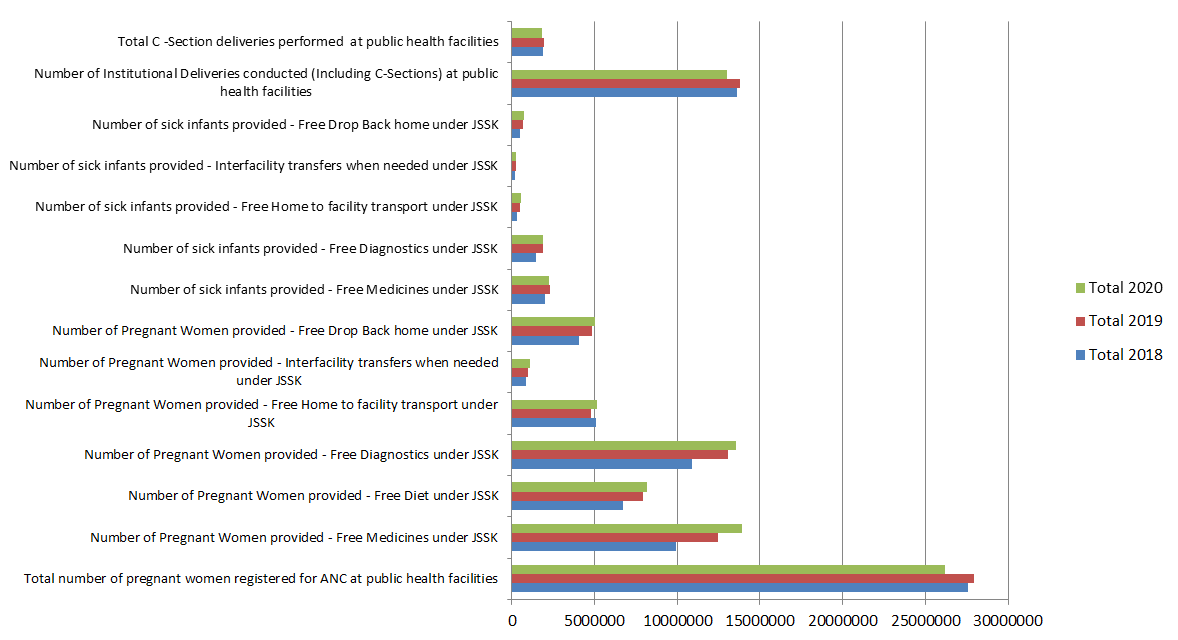
b) Number of Pregnant Women Provided - Free Medicines under JSSK The total number of PWs provided - Free Medicines under JSSK were 9892026, 12477364, and 13923237during 2018-2019-2020 respectively which shows a continuously increasing trend for this indicator during the study period. During 2019 126.14 % of 2018 and 2020, 111.59% of 2019 numbers were provided - Free Medicines under JSSK which shows that there is an increase of 2585338 numbers of PWs provided - Free Medicines under JSSK in 2019 compared to
2018 followed by an increase of 1445873 during COVID-19 era 2020 compared to 2019 expressed as 26.14% increase in 2019 compared to 2018 and 11.59% increase in 2020 compared to 2019. The Utilization of this service of free medicines provision under JSSK per 1000 PW registered for ANC at Public health facilities were 358.58, 446.29 and 531.18 during 2018-2019-2020 respectively which shows a continuously increasing trend for this JSSK free healthcare services utilization during the study period. See tables 2-4 and figures 1-3.
c) Number of Pregnant Women Provided - Free Diet under JSSK The total number of PWs provided - Free Diet under JSSK were 6724038, 7897742, and 8143716 during 2018-2019- 2020 respectively which shows a continuously increasing trend for this indicator during the study period. During 2019 117.46 % of 2018 and 2020, only 103.11% of 2019 numbers were provided - Free Diet under JSSK which shows that there is an increase of 1173704 numbers of PWs provided - Free Diet under JSSK in 2019 compared to 2018 followed by an increase of 245974 during COVID-19 era 2020 compared to 2019 expressed as 17.46% increase in 2019 compared to 2018 and 3.11% increase in 2020 compared to 2019. The Utilization of this service of free diet provision under JSSK
per 1000 PW registered for ANC at Public health facilities were 243.74, 282.49 and 310.69 during 2018-2019-2020 respectively which shows a continuously increasing trend for this JSSK free healthcare services utilization during the study period See tables 2-4 and figures 1-3.
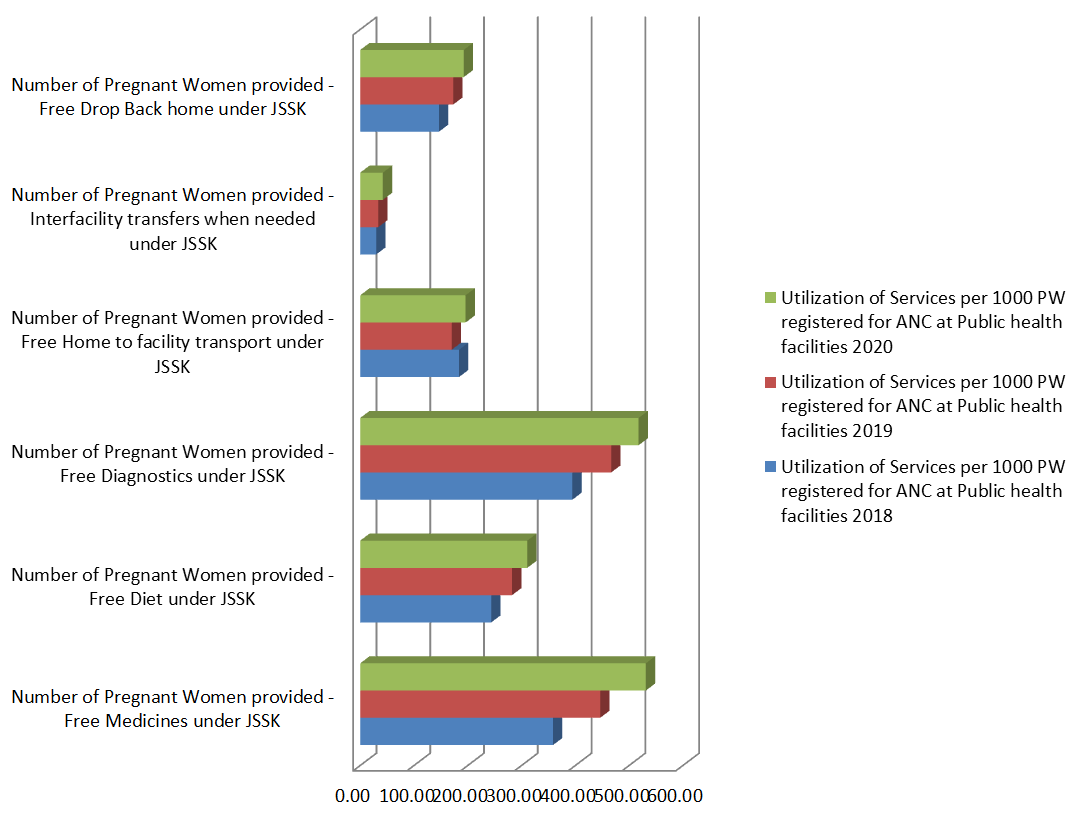
d) Number of Pregnant Women provided - Free Diagnostics under JSSK The total number of PWs provided - Free Diagnostics under JSSK were 10883867, 13047226, and 13570356 during 2018-2019-2020 respectively which shows a continuously increasing trend for this indicator during the study period. In 2019 119.88 % of 2018 and 2020, 104.01% of 2019 numbers were provided - Free Diagnostics under JSSK which shows that there is an increase of 2163359 numbers of PWs provided - Free Diagnostics under JSSK in 2019 compared to 2018 followed by an increase of 523130 during COVID-19 era 2020 compared to 2019 expressed as 19.88% increase in 2019 compared to 2018 and 4.01% increase in 2020 compared to 2019. The Utilization of this service of free diagnostics provision under JSSK per 1000 PW registered for ANC at Public health facilities were 394.53, 466.67 and 517.72 during 2018-2019-2020 respectively which shows a continuously increasing trend for this JSSK free healthcare services utilization during the study period See tables 2-4 and figures 1-3.
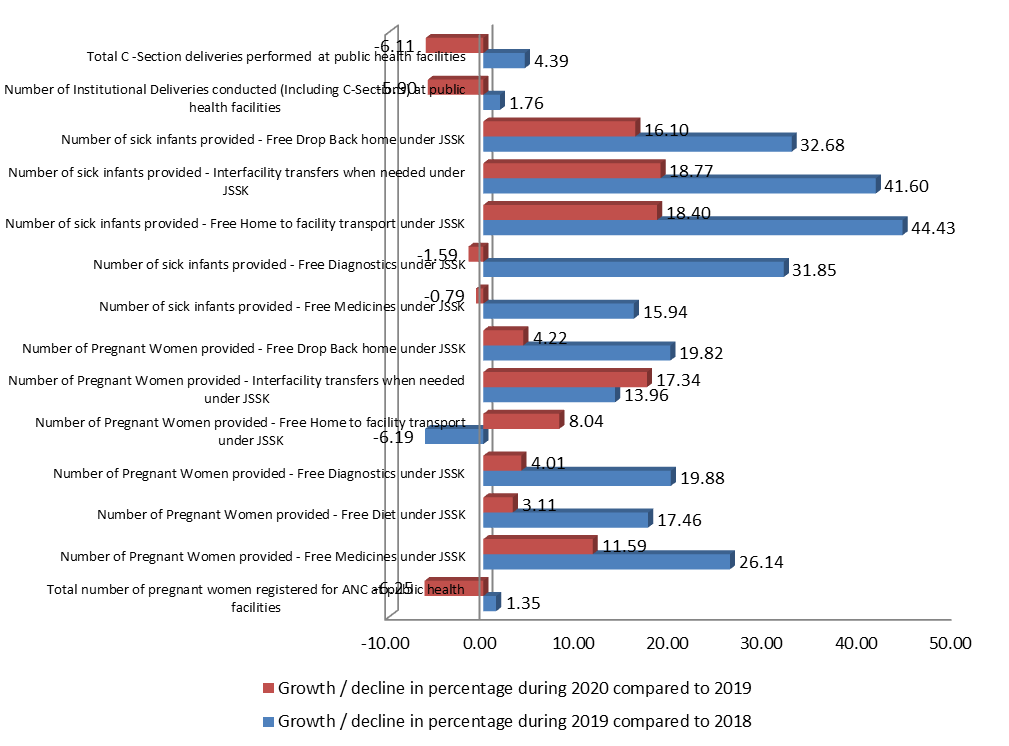
Figure 4: Comparison of Growth / decline in percentage of JSSK free health services utilization. e) Number of Pregnant Women Provided - Free Home to Facility Transport under JSSK The total number of PWs provided - Free Home to facility transport under JSSK were 5068731, 4755161, and 5137408 during 2018-2019-2020 respectively which shows that after a decrease in 2019 it increased in the 2020 COVID era. In 2019 93.81 % of 2018 and during 2020, 108.04% of 2019 numbers were provided - Free Home to facility transport under JSSK which shows that there is a decrease of -313570 numbers of PWs provided - Free Home to facility transport under JSSK in 2019 compared to 2018 followed by an increase of 382247 during COVID-19 era 2020 compared to 2019 expressed as -6.19% decrease in 2019 compared to 2018 and 8.04% increase in 2020 compared to 2019. The Utilization of this service of Free Home to facility transport under JSSK per 1000 PW registered for ANC at Public health facilities were 183.74, 170.08 and 196.00 during 2018-2019-2020 respectively for this JSSK free healthcare services utilization during the study period. The Utilization of this service of Free Home to facility transport under JSSK increased in the COVID-19 era of 2020 compared to the pre-pandemic era of 2018 and 2019 See tables 2-4 and figures 1-4.
f) Number of Pregnant Women Provided - Interfacility Transfers When Needed under JSSK The total numbers of PWs provided - Interfacility transfers when needed under JSSK were 826016, 941306, and 1104539 during 2018-2019-2020 respectively which shows an increasing trend even in the 2020 COVID era. In 2019 113.96 % of 2018 and during 2020, 117.34% of 2019 numbers were provided - Interfacility transfers when needed under JSSK which shows that there is an increase of 115290 numbers of PWs provided - Free Home to facility transport under JSSK in 2019 compared to 2018 followed by an increase of 163233 during COVID-19 era 2020 compared to 2019 expressed as 13.96% increase in 2019 compared to 2018 and 17.34% increase in 2020 compared to 2019. The Utilization of this service of Interfacility transfers, when needed under JSSK per 1000 PW, registered for ANC at Public health facilities were 29.94, 33.67 and 42.14 during 2018-
2019-2020 respectively for this JSSK free healthcare services utilization during the study period See tables 2-4 and figures 1-4.
g) Number of Pregnant Women Provided - Free Drop Back Home under JSSK The total numbers of PWs provided - Free Drop Back home under JSSK were 4039457, 4840247, and 5044712 during 2018-2019-2020 respectively which shows an increasing trend even in the 2020 COVID era. In 2019 119.82 % of 2018 and during 2020, 104.22% of 2019 numbers were provided - Free Drop Back home under JSSK which shows that there is an increase of 800790 numbers of PWs provided - Free Drop Back home under JSSK in 2019 compared to 2018 followed by an increase of 204465 during COVID-19 era 2020 compared to 2019 expressed as 19.82% increase in 2019 compared to 2018 and 04.22% increase in 2020 compared to 2019. The Utilization of this service of Free Drop Back home under JSSK per 1000 PW registered for ANC at Public health facilities were 146.43, 173.13 and 192.46 during 2018-2019-2020 respectively for this JSSK free healthcare services utilization during the study period See tables 2-4 and figures 1-4.
h) Number of Sick Infants Provided - Free Medicines under JSSK The total numbers of sick infants provided - Free Medicines under JSSK were 1970113, 2284127, and 2266045 during 2018-2019-2020 respectively which shows an increase in 2019 followed by a little decrease in the 2020 COVID era. In 2019 115.94 % of 2018 and 2020, 99.21% of 2019 numbers sick infants provided - Free Medicines under JSSK which shows that there is an increase of 314014 numbers of sick infants provided - Free Medicines under JSSK in 2019 compared to 2018 followed by a decrease of -18082 during COVID-19 era 2020 compared to 2019 expressed as 15.94% increase in 2019 compared to 2018 and -0.79% decrease in 2020 compared to 2019. The Utilization of this service of Free Medicines under JSSK per 1000 institutional deliveries at Public health facilities was 145.06, 165.28 and 174.25 during 2018-2019-2020 respectively for this JSSK free healthcare services utilization during the study period See tables 2-5 and figure 5.
i) Number of Sick Infants Provided - Free Diagnostics under JSSK The total numbers of sick infants provided - with Free Diagnostics under JSSK were 1445638, 1906050, and 1875769 during 2018-2019-2020 respectively which shows an increase in 2019 followed by a little decrease in the 2020 COVID era. In 2019 131.85 % of 2018 and 2020, 98.41% of 2019 numbers sick infants provided - Free Diagnostics under JSSK which shows that there is an increase of 460412 numbers of sick infants provided - Free Diagnostics under JSSK in 2019 compared to 2018 followed by a decrease of -30281 during COVID-19 era 2020 compared to 2019 expressed as 31.85% increase in 2019 compared to 2018 and -1.59% decrease in 2020 compared to 2019. The Utilization of this service of Free Diagnostics under JSSK per 1000 institutional deliveries at Public health facilities was 106.44, 137.92 and 144.24 during 2018-2019-2020 respectively for this JSSK free healthcare services utilization during the study period See tables 2-5 and figure 5.
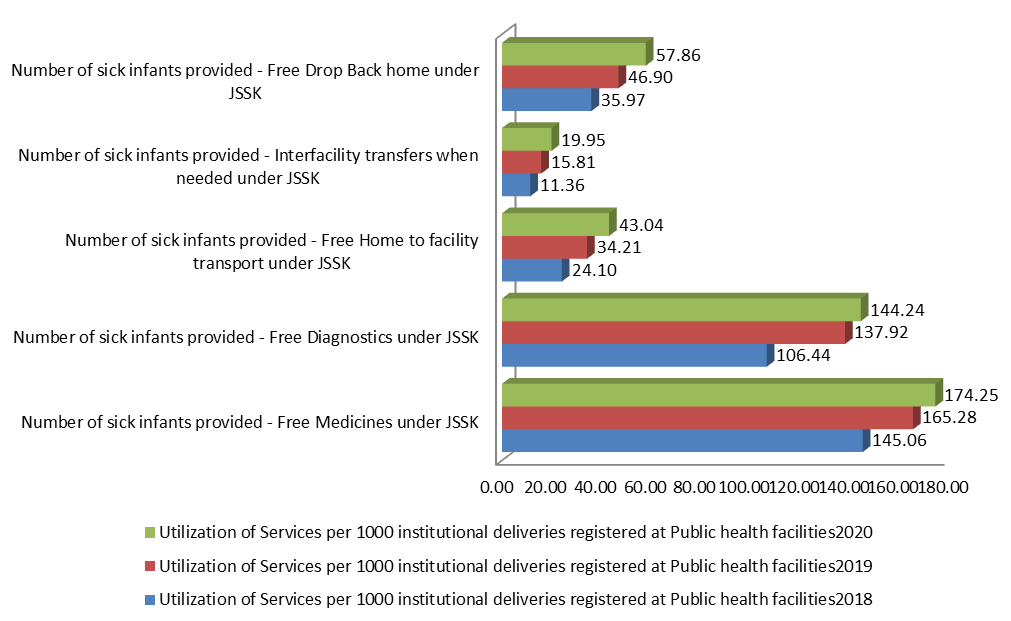
j) Number of Sick Infants Provided - Free Home to Facility Transport under JSSK The total numbers of sick infants provided - Free Home to facility transport under JSSK were 327287, 472707, and 559696 during 2018-2019-2020 respectively which shows an increasing trend in this free service utilization. In 2019 144.43 % of 2018 and 2020, 118.40% of 2019 numbers sick infants provided - Free Home to facility transport under JSSK which shows that there is an increase of 145420 numbers of sick infants provided - Free Home to facility transport under JSSK in 2019 compared to 2018 followed by an increase of 86989 during COVID-19 era 2020 compared to 2019 expressed as 44.43% increase in 2019 compared to 2018 and 18.40% increase in 2020 compared to 2019. The Utilization of this service of Free Home to facility transport under JSSK per 1000 institutional deliveries at Public health facilities were 24.10, 34.21 and 43.04 during 2018-2019-2020 respectively for this JSSK free healthcare services utilization during the study period See tables 2-5 and figure 5.
k) Number of Sick Infants Provided - Interfacility Transfers When Needed under JSSK The total numbers of sick infants provided - Free Interfacility transfers when needed under JSSK were 327287, 472707, and 559696 during 2018-2019-2020 respectively which shows an increasing trend in this free service utilization. In 2019 144.43 % of 2018 and 2020, 118.40% of 2019 numbers sick infants provided - Free Interfacility transfers when needed under JSSK which shows that there is an increase of 145420 numbers of sick infants provided - Interfacility transfers when needed under JSSK in 2019 compared to 2018 followed by an increase of 86989 during COVID-19 era 2020 compared to 2019 expressed as 44.43% increase in 2019 compared to 2018 and 18.40% increase in 2020 compared to 2019. The Utilization of this service of Free Interfacility transfers when needed under JSSK per 1000 institutional deliveries at Public health facilities were 11.36, 15.81 and 19.95 during 2018-2019-2020 respectively for this JSSK free healthcare services utilization during the study period See tables 2-5 and figure 5.
l) Number of Sick Infants Provided - Free Drop Back Home under JSSK The total numbers of sick infants provided - Free Drop Back home under JSSK were 488498, 648149, and 752506 during 2018-2019-2020 respectively which shows an increasing trend in this free service utilization. In 2019
132.68 % of 2018 and 2020, 116.10% of 2019 numbers sick infants provided - Free Drop Back home under JSSK which shows that there is an increase of 159651 numbers of sick infants provided - Free Drop Back home under JSSK in 2019 compared to 2018 followed by an increase of 104357 during COVID-19 era 2020 compared to 2019 expressed as 32.68% increase in 2019 compared to 2018 and 16.10% increase in 2020 compared to 2019. The Utilization of this service of Free Drop Back home under JSSK per 1000 institutional deliveries at Public health facilities were 35.97, 46.90 and 57.86 during 2018-2019-2020 respectively for this JSSK free healthcare services utilization during the study period See tables 2-5 and figure 5.
m) Number of Institutional Deliveries Conducted (Including C-Sections) At Public Health Facilities The total Number of Institutional Deliveries conducted (Including C-Sections) at public health facilities were 13581181, 13819578 and 13004857 during 2018-2019- 2020 respectively which shows an increase followed by a decrease during COVID-19 ERA 2020. During 2019 101.76 % of 2018 and during 2020 only 94.10% of 2019 numbers were registered which shows that there is an increase of 238397 numbers of Institutional Deliveries conducted (Including C-Sections) at public health facilities in 2019 compared to 2018 followed by a decrease of -814721 during COVID-19 era 2020 compared to 2019 expressed as1.76% increase in 2019 compared to 2018 and -5.90% decrease in 2020 compared to 2019.
n) Total C -Section Deliveries Performed at Public Health Facilities The Total C -Section deliveries performed at public health facilities were 1859455, 1941098 and 1822538 during 2018-2019-2020 respectively which shows an increase followed by a decrease during COVID-19 ERA 2020. In 2019 104.39 % of 2018 and 2020, only 93.89% of 2019 numbers were registered which shows that there is an increase of 81643 numbers of C -Section deliveries performed at public health facilities in 2019 compared to 2018 followed by a decrease of -118560 during COVID-19 era 2020 compared to 2019 expressed as 4.39% increase in 2019 compared to 2018 and -6.11% decrease in 2020 compared to 2019. The Total C -Section deliveries performed per 1000 institutional deliveries at public health facilities were 136.91, 140.46 and 140.14 during 2018-2019-2020 respectively for this JSSK free healthcare services utilization during the study period.
Other Analyses
| Indicator | Total Live Birth | Live Birth - Male at public health facilities | Live Birth - Female at public health facilities |
|---|---|---|---|
| Total 2018 | 15016049 | 7779435 | 7236614 |
| Total 2019 | 14992265 | 7748563 | 7243702 |
| Total 2020 | 14006911 | 7236228 | 6770683 |
| percentage comparison from previous year 2018 numbers during 2019 | 99.84806 | 99.6 | 100.1 |
| Growth in percentage during 2020 compared to 2019 | 92.58213 | 93.39 | 93.47 |
| Growth in numbers during 2019 compared to 2018 | -17319 | -30872 | 7088 |
| Growth in numbers during 2020 compared to 2019 | -844231 | -512335 | -473019 |
| Growth in percentage during 2019 compared to 2018 | -0.15194 | -0.4 | 0.1 |
| Growth in percentage during 2020 compared to 2019 | -7.41787 | -6.61 | -6.53 |
Table 5: Comparison of total live birth and live birth male / female during study period.
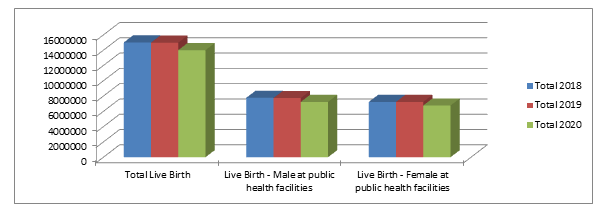
An important observation during this research study is that total live birth, as well as lives of male and female birth at public health facilities, declined during the 2020 Covid-19 era as compared to the pre-pandemic era under study; see table 6 and figure 6. The total live birth reduced by -17319 in 2019 compared to 2018 and -844231in 2020 compared to 2019 i.e. -0.15% in 2019 and -7.4% in 2020 compared to immediate previous years. The total live birth male reduced by -30872 in 2019 compared to 2018 and -512335 in 2020 compared to 2019 i.e. -0.40% in 2019 and -6.61% in 2020 compared to immediate previous years. The total live birth female increased by 7088 in 2019 compared to 2018 and reduced by -473019 in 2020 compared to 2019 i.e. 0.10% increase in 2019 and -6.53% in 2020 compared to immediate previous years.
Key Results
This research study revealed that there is an increase in almost all JSSK service utilization at public health facilities in India compared to the pre-pandemic era on a cumulative all-India basis. The total number of PWs registered for ANC at public health facilities were 27586683, 27957956 and 26211748 during 2018-2019-2020 respectively which shows a continuous decreasing trend in the study period, particularly during the COVID-19 era 2020. The Utilization of service of free medicines provision by PWs under JSSK per 1000 PW registered for ANC at Public health facilities were 358.58, 446.29 and 531.18 during 2018-2019-2020 respectively which shows a continuously increasing trend for this JSSK free healthcare services utilization during the study period, particularly during COVID-19 era 2020. The Utilization of service of free diet provision by PWs under JSSK per 1000 PW registered for ANC at Public health facilities were 243.74, 282.49 and 310.69 during 2018-2019-2020 respectively which shows a continuously increasing trend for this JSSK free healthcare services utilization during the study period, particularly during COVID-19 era 2020.
The Utilization of service of free diagnostics provision by PWs under JSSK per 1000 PW registered for ANC at Public health facilities were 394.53, 466.67 and 517.72 during 2018-2019-2020 respectively which shows a continuously increasing trend for this JSSK free healthcare services utilization during the study period, particularly during COVID-19 era 2020. The Utilization of service of Free Home to facility transport by PWs under JSSK per 1000 PW registered for ANC at Public health facilities were 183.74, 170.08 and 196.00 during 2018-2019-2020 respectively for this JSSK free healthcare services utilization during the study period. The Utilization of this service of Free Home to facility transport under JSSK increased in the COVID-19 era of 2020 compared to the pre-pandemic era of 2018 and 2019. The Utilization of service of Interfacility transfers, when needed by PWs under JSSK per 1000 PW, registered for ANC at Public health facilities were 29.94, 33.67 and 42.14 during 2018- 2019-2020 respectively for this JSSK free healthcare services utilization during the study period. The Utilization of this service of Free Interfacility transfers, when needed under JSSK, increased in the COVID-19 era of 2020 compared to the pre-pandemic era of 2018 and 2019. The Utilization of service of Free Drop Back home by PWs under JSSK per 1000 PW registered for ANC at Public health facilities were 146.43, 173.13 and 192.46 during 2018-2019-2020 respectively for this JSSK free healthcare services utilization during the study period. The Utilization of this service of Free Drop Back home under JSSK increased in the COVID-19 era of 2020 compared to the pre-pandemic era of 2018 and 2019. The Utilization of Free Medicines by sick infants under JSSK per 1000 institutional deliveries at Public health facilities were 145.06, 165.28 and 174.25 during 2018-2019-2020 respectively for this JSSK free healthcare services utilization during the study period. The Utilization of this service of free medicines under JSSK increased in the COVID-19 era of 2020 compared to the pre-pandemic era of 2018 and 2019. The Utilization of service of Free Diagnostics by sick infants under JSSK per 1000 institutional deliveries at Public health facilities were 106.44, 137.92 and 144.24 during 2018-2019-2020 respectively for this JSSK free healthcare services utilization during the study period. The Utilization of this service of free diagnostics under JSSK increased in the COVID-19 era of 2020 compared to the pre-pandemic era of 2018 and 2019. The Utilization of service of Free Home to facility transport by sick infants under JSSK per 1000 institutional deliveries at Public health facilities were 24.10, 34.21 and 43.04 during 2018-2019-2020 respectively for this JSSK free healthcare services utilization during the study period which shows the utilization of this service increased in COVID-19 era of 2020 compared to pre-pandemic era 2018 and 2019.
The Utilization of service of Free Interfacility transfers when needed under JSSK by sick infants per 1000 institutional deliveries at Public health facilities were 11.36,
15.81 and 19.95 during 2018-2019-2020 respectively for this JSSK free healthcare services utilization during the study period which shows the utilization of this service increased in COVID-19 era of 2020 compared to pre-pandemic era 2018 and 2019. The Utilization of service of Free Drop Back home under JSSK by infants per 1000 institutional deliveries at Public health facilities were 35.97, 46.90 and 57.86 during 2018-2019-2020 respectively for this JSSK free healthcare services utilization during the study period which shows the utilization of this service increased in COVID-19 era of 2020 compared to pre-pandemic era 2018 and 2019. The total Number of Institutional Deliveries conducted (Including C-Sections) at public health facilities were 13581181, 13819578 and 13004857 during 2018-2019-2020 respectively which shows an increase followed by a decrease during COVID-19 ERA 2020. The Total C -Section deliveries performed at public health facilities were 1859455, 1941098 and 1822538 during 2018-2019-2020 respectively which shows an increase followed by a decrease during COVID-19 ERA 2020.
Discussion
Janani Shishu Suraksha Karyakaram (JSSK) may reduce out-of-pocket expenses for families of both pregnant women and sick infants and such programs are much needed in LMICs like India where a large proportion of the population are forced to go under the poverty line due to heavy expenses on health issues every year as well as such schemes may also increase institutional deliveries by reducing fear of heavy expense at delivery institutions. Government should expand this scheme to cover private institution deliveries also under this scheme as the public health facilities are not enough alone to cater to the needs of the vast population as well as poor infrastructure, malpractice, and corruption in the government health sector are also important hurdles in achieving the goal of safe motherhood and healthy child [19]. The JSSK scheme of the government is found to be beneficial and quite helpful as well as significant for PWs and sick infants during the COVID-19 pandemic era 2020 evident from the good utilization of various free protective services under this scheme. The research analysis of this study may be helpful to global governments as well as policy and decision-makers to analyze and understand the JSSK scheme for the betterment of maternal and child health by continuous provision of such essential healthcare services in the ongoing COVID-19 era or any other disasters. During 2020 the Government of India had imposed lockdown like other global nation’s leading to disruption of several routine healthcare services utilization but the healthcare service utilization provided under JSSK scheme increased significantly despite low PWs registration for ANC and lockdown etc [20]. This may be due to the robust framework and implementation of JSSK scheme services as well as due to reduced choice to visit private health facilities due to lockdown and COVID-19 impacts leading to closure and denial by private health facilities which is a matter of further research.
Strength and Limitations
Till today 13-06-2022 to the best of the researcher’s knowledge, there is no research study done exclusively on the JSSK scheme; exploring the impacts of the COVID-19 era on JSSK health care services utilization at all HMIS registered public health facilities across 36 states and UTs of India by analyzing 15 accredited HMIS time-bound indicators for PWs and sick infants in the country. This novel research study is not available anywhere on a global basis, which assessed the impact of covid-19 on JSSK health services utilization through several processes or output indicators.
Conclusion and Recommendations
This cross-sectional research study found that the covid-19 pandemic increased the utilization of various JSSK free health care services among PWs and sick infants in India compared to the pre-pandemic period. Hence the researcher recommends more efforts in other healthcare services utilization, particularly the non-communicable diseases which constitute a major burden of disease in India as well as globally. The framework and implementation mode of JSSK can be considered as an example of the improvement in public health services for enhancing other health services utilization which was disrupted due to COVID-19 [21].
Funding
Financial support and sponsorship – Nil, The researchers declares that no funds are taken from any individual or agency-institution for this study.
Conflicts of Interest: There are no conflicts of interest.
Other Information
This is the first version of this work and more versions will evolve in future with more information and analysis.
Declarations
This version of paper has not been previously published in any peer reviewed journal and is not currently under consideration by any journal. The document is Microsoft word with English (United States) language & 5001 words excluding reference and declaration etc. (9513 words Total including all). Ethics approval and consent to participate: Not applicable. This study has not involved any human or animals in real or for experiments. The submitted work does not contain any identifiable patient/participant information. Consent for publication: The author provides consent for publication. Availability of data and materials: Electronic records from HMIS (health management information system) of MoHFW (ministry of health and family welfare), Government of India, NITI Aayog, NHSRC.
Conflicts of Interest/ Competing Interest: There are no conflicts / competing of interest Funding-Self Sponsored: No aid taken from individual or agency etc. Authors’ Contributions: The whole work is done by the Author - Dr Piyush Kumar, M.B.B.S., E.M.O.C., P.G.D.P.H.M., -Senior General Medical Officer- Bihar Health Services- Health Department- Government of Bihar, India and Advocate Anupama-Senior Lawyer, Bar Council, Patna. Acknowledgements: I am thankful to Advocate Anupama my wife and daughters Aathmika-Atheeva for cooperation. Author Information: The author is currently working as Senior General Medical Officer for the government of Bihar and Advocate Anupama-Senior Lawyer, Bar Council, Patna.
References
-
Kumar P (2022) What is the Impact of COVID-19 Pandemic Years on Deliveries and Home-Based New- Born Care in India? A Cross-sectional Comparative Research Study, January 2018 - December 2021. Journal of Clinical Cases & Reports 2022(S12): 16.
-
Piyush K (2022) What is the impact of Covid-19 on the Antenatal Care Services Utilization in Public-Private- Rural-Urban Hospitals of India during the COVID-19 Pandemic Period of 2020-2021 compared to pre- pandemic era 2018-2019?. Modern Applied Medical Research 2(2): 1-10.
-
NHM, A brief note on Janani Shishu Suraksha Karyakram, the new initiative of Ministry of Health and Family Welfare. National Health Mission.
-
NHM, Janani-Shishu Suraksha Karyakaram. National Health Mission.
-
Kumar P, Farooqui HH (2020) what is the Impact of COVID-19 Pandemic on the RCH (Reproductive and Child Health) Programme in Rajasthan, Because of Nationwide Lockdown (April 2020 to June 2020)?. SSRN.
-
Piyush K (2022) What Impacts have Variation in Geographical Locations on the Cases and Deaths from COVID-19/SARS-Cov-2 Pandemic in 36 States and Union Territories of India: Observational Analysis in India Between December 2019 and 05 January 2022 - V2. Journal of Clinical Cases & Reports 2022(S12): 20.
-
Kumar P, Anupama A (2022) Analysis of NITI AAYOG (National Institution for Transforming India) Health Index Report on the Ranking of States and Union Territories: Round 2 (2015-2016/ 2017-2018)-V2. SSRN.
-
Kumar P, Anupama A (2022) Analysis of NITI AAYOG (National Institution for Transforming India) Health Index Report on the Ranking of States and Union Territories: A Cross Sectional Observational Research Study Round 1 (2014-2016)- V. SSRN.
-
Kumar P (2022) Impact of Covid-19 Pandemic era on Prevalence of Pregnant Women Sero-Positivity for Syphilis, Among Women Attending Antenatal Care in India and Babies Diagnosed with Congenital Syphilis-A Cross-Sectional Research Study. J Cli Ped Chi Res 3(1): 67-77.
-
Kumar P, Farooqui HH (2022) what is the Impact of Covid-19 Pandemic on the RCH (Reproductive and Child Health) Programme in Rajasthan, because of nationwide lockdown (April 2020 to June 2020)? J Cli Ped Chi Res 3(1): 26-41.
-
Kumar P (2022) What is the impact of covid-19 pandemic era on Pregnant Women sero-positivity for Syphilis among women attending antenatal care in India and number of babies diagnosed with Congenital Syphilis? J Cli Ped Chi Res 3(1): 61-66.
-
Kumar P (2022) What Impact Have SARS-CoV-2/Covid-19 Pandemic on Domestic Violence against Women in India across Different States and Union Territories from the Beginning of Lockdown Due To covid-19 pandemic in March 2020 till 20th September 2020? J Cli Ped Chi Res 3(1): 78-83.
-
Kumar P (2022) What Impact Have SARS-CoV-2/ Covid-19 Pandemic induced lockdown on the number of OPD patients of Diabetes, Hypertension, Stroke (CVA), Acute Heart Disease, Mental Illness, Epilepsy, Ophthalmic, Dental and oncology in India during the lockdown months (April-May-2020)-Observational Research Analysis?. Int J Cancer Res Ther 7(2): 51-62.
-
Kumar P (2022) Impact of COVID-19 pandemic on mortality count at the Emergency Ward of Hospitals in India: A Cross-sectional study from January 2019 to May 2021. Adn Envi Was Mana Rec, 5 (1): 62-73.
-
Kumar P, Anupama A (2022) What percentage of mortality were medically certified among total registered mortality in 36 States & UTs of India during 2018- 2020 and COVID-19 mortality age-sex distribution pattern in India: A cross sectional observational research study. Research Scope.
-
HMIS, Health Management Information system.
-
The World Bank. Fertility rate, total (births per woman) India.
-
Kumar P (2022) What Impacts Have Geographical Locations On The Cases And Deaths From Covid-19/ SarsCov-2 Pandemic In 36 States And Union Territories Of India:-Observational Analysis In India. J Mari Scie Res Ocean 5(1): 1-7.
-
Kumar P, Anupama A (2022) Establishment of Public Health Management Cadre in India and guidelines for implementation – 2022.
-
Piyush K (2022) What Impact Have SARS-CoV-2/ COVID-19 Pandemic Induced Lockdown on the Number of OPD Patients of Diabetes, Hypertension, Stroke (CVA), Acute Heart Disease, Mental Illness, Epilepsy, Ophthalmic, Dental and Oncology in India During the Lockdown Months (April-May-2020)–Observational Research Analysis?. PAST 7(2): 51-62.
-
Piyush K (2022) Impact of COVID-19 Induced Lockdown on the OPD Patients of Diabetes, Hypertension, Stroke (CVA), Acute Heart Disease, Mental Illness, Epilepsy, Ophthalmic, Dental and Oncology in India- A Cross- Sectional Research Study. SSRN, pp: 15.
- Intersecting Epidemics and Climate Vulnerabilities in Conflict- Driven Displacement: Epidemiology, Systemic Challenges, and One Health Gaps in South Sudan
- Advancing Domestic Health Financing for Community Health System Sustainability in South Sudan: The Boma Health Initiative Model (2025–2035)
- Prevalence and Correlates of Post-Exposure Prophylaxis Uptake among Men Who Have Sex with Men in Kisumu County, Kenya
- Medical, Ethical, and Legal Conflicts Surrounding Euthanasia in Argentina. Its Global Implications
- Knowledge and Attitude on Menstrual Hygiene among Adolescent Girls Studying in Secondary Level in Public Schools of Chitwan District, Nepal
- Biological Efficacy of an Adulticide Mixture (clothianidin + deltamethrin) as an Indoor Residual Spray against Adult Anopheles flavirostris in Palawan, the Philippines