
Biological Efficacy of an Adulticide Mixture (clothianidin + deltamethrin) as an Indoor Residual Spray against Adult Anopheles flavirostris in Palawan, the Philippines
To reach the goal of malaria-free Philippines status by 2030, there is a need to address the issue of insecticide resistance. An option to address such goal would need an alternative product for vector control – one of which is the use of an insecticide mixture. The study was conducted to evaluate the killing efficacy and persistence of a new adulticide mixture of clothianidin and deltamethrin (Fludora Fusion) against adult Anopheles flavirostris mosquitoes on different surfaces under field conditions in the village of Bacungan, Puerto Princesa City, Palawan from 2017-2018. Houses made up of wood and cemented walls were selected and sprayed with Fludora Fusion (Clothianidin + deltamethrin 10g/L), in comparison to Ficam 80 WP (bendiocarb 12.5g/L) and Victor 20 WP using two concentrations (etofenprox 20WP 25g/L and etofenprox 12.5/L). Wild-caught Anopheles flavirostris was subjecte to the WHO cone bioassay test for the observation of knockdown (after 1 hour), immediate (24 hours), and delayed mortality effects (72 hours) from the baseline up to 6 months after indoor residual treatment. Biological efficacy tests showed that all products met the 80% mortality at the initial test, but their killing effect decreased across months. Generally, insecticides sprayed on wooden surfaces performed better than on cemented walls. Among them, the Fludora Fusion has consistently met the WHO cutoff values of 80% mortality. Its killing effects are found to be significantly (p < 0.0001) greater than those of the other products tested, with higher mortality rates observed after 72 hours. Only Fludora Fusion (clothianidin + deltamethrin) adulticide mixture formulation has ≥80% mortality after 6 months. The susceptibility of the specimens used in the bio-assays was tested using the WHO procedure. Results revealed Anopheles flavirostris incipient resistance to alpha-cypermethrin (96.5%), and full susceptibility to 11 insecticides (permethrin (99%), cyfluthrin (98.9%), lambda-cyhalothrin (99%), malathion (100%), fenitrothion (100%), pirimiphos-methyl (100%), propoxur (100%), and DDT (100%)) including the active ingredients (deltamethrin (100%), etofenprox (100%) and bendiocarb (100%)) component of the insecticide products evaluated.
Abbreviations
M: Mortality; DOH: Department of Health; LLINs: Long-Lasting Insecticide-Treated Nets; IRS: Indoor Residual Spraying; NMCEP: National Malaria Control and Elimination Program; RITM: Research Institute for Tropical Medicine; WHO: World Health Organisation; KD: Knockdown; AI:Active Ingredient
Introduction
Vector control tools such as long-lasting insecticide- treated nets (LLINs) and indoor residual spraying (IRS) are considered vital components of malaria prevention, control, and elimination strategies [1]. These strategies largely contributed to the battle against malaria in the country [2]. The latest statistics show a highly significant reduction in the number of malaria cases (by 87% from 48,569 in 2003 to 6,120 cases in 2020) and in mortality (by 98% reduction from 162 deaths in 2003 to 3 deaths in 2020). A total of 60 out of 81 provinces were declared malaria-free. The remaining 19 provinces currently have no local transmission, pending assessment for subnational malaria-free declaration [3]. The Philippines is now traversing the path toward the final stage of malaria elimination, focusing on the remaining malaria- endemic provinces, particularly Palawan and Sultan Kudarat. The province of Palawan contributed to 97.67% (5944 out of 6068 cases) of the country’s malaria cases in 2020, concentrating particularly in the southern municipalities.
The WHO-approved insecticides for public health are limited to four classes (carbamates, organochlorines, organophosphates, and pyrethroids) [4], which are also widely used in agriculture [5]. Excessive usage in the same geographical location increases pressure that may result in the development of resistance among mosquito vectors [6]. From 2016-2018, the Philippine National Malaria Control and Elimination Program (NMCEP)-DOH widely distributed over 2 million nets in transmission areas. A 100% IRS coverage has been accomplished for 2 to 3 routine cycles per year. The active ingredients (AI) of the recently distributed LLIN (e.g. Olyset (AI: permethrin), Dawa Plus (AI: deltamethrin, and Permanet 2.0 (AI: deltamethrin) and those compounds used for IRS operations (Bifenthrin, etofenprox, deltamethrin) all belong to the pyrethroids group.
To manage resistance in areas with high coverage of LLIN, a yearly rotation strategy for IRS operations using a non-pyrethroid product should be implemented [4]. In the latest world malaria report, insecticide resistance among Anopheles vectors has been reported in 72 malarious countries [7]; with some experiencing high levels of resistance to all four classes of insecticides used for public health. Since 2010, vector resistance to pyrethroids has been reported for the Philippines [8, 9]. Currently, the local strategy includes the use of both pyrethroid insecticides in LLINs and IRS operations [10]. The results of the periodic monitoring conducted by the Research Institute for Tropical Medicine (RITM) from 2001 to 2019 have shown incipient levels of resistance in three vector species: Anopheles flavirostris, Anopheles maculatus, and Anopheles litoralis [10]. Hence, resistance is a significant threat to the vector control program in achieving malaria elimination. The Philippine NMCEP stressed the need for an alternative insecticide to retard the development of resistance [11].
Other options for delaying insecticide resistance include the use of the two promising vector control tools: pyrethroid-PBO (piperonyl butoxide) nets and insecticide mixture products for IRS [1]. The pyrethroid-PBO net is a mosquito net that includes both a pyrethroid insecticide and the synergist, piperonyl butoxide. The nets with PBO have an increased killing effect on malaria vectors because it is a synergist that acts by inhibiting certain metabolic enzymes (e.g. mixed-function oxidases) that detoxify or sequester insecticides before they can have a toxic effect on the mosquito [4]. This PBO-treated tool has been prequalified by the WHO (as opposed to pyrethroid-only active ingredients in LLINs) and is recommended for use when pyrethroid resistance is detected in the principal malaria vector [1].
On the other hand, insecticide mixture products for use in IRS come with two insecticides of different classes (different modes of action) that are co-formulated [4]. Since this is a new tool, there are limited product and biological evaluation studies available. Only the Fludora Fusion product is available, and studies on its biological efficacy have shown good performance against both susceptible and resistant malaria vectors. Results of Fludora Fusion evaluations demonstrated an increase in delayed mortality after 72 hours and prolonged biological efficacy for up to 10 months across various surfaces [12, 13, 14]. In 2018, Fludora Fusion was the only product that received prequalification intended solely for use in malaria indoor residual spraying by the WHO Prequalification Team – Vector Control [15]. In the prequalification certification, the mixture product is described as a wettable powder formulation containing a combination of clothianidin (500g/kg; 50%) and deltamethrin (6.25g/ kg; 6.25%). Clothianidin is a neonicotinoid insecticide that has already been commercialized for use in crop protection and professional pest control in various formulations. Deltamethrin, on the other hand, is a broad-spectrum pyrethroid insecticide available commercially in a variety of formulations and uses. According to the latest report from the WHO, the neonicotinoid insecticide is now recommended for IRS operations [1].
Since the major vector control interventions remain insecticide-based, the threat of resistance development should be a primary consideration in selecting active ingredients. The national malaria program considers IRS as one of the control measures in communities where nets are not culturally accepted. The program also considers IRS in displaced population communities and in the management of epidemics [2]. The evaluation of the residual effectiveness of Fludora Fusion will probably address the NMCEP’s current needs.
Methods
Evaluation Site
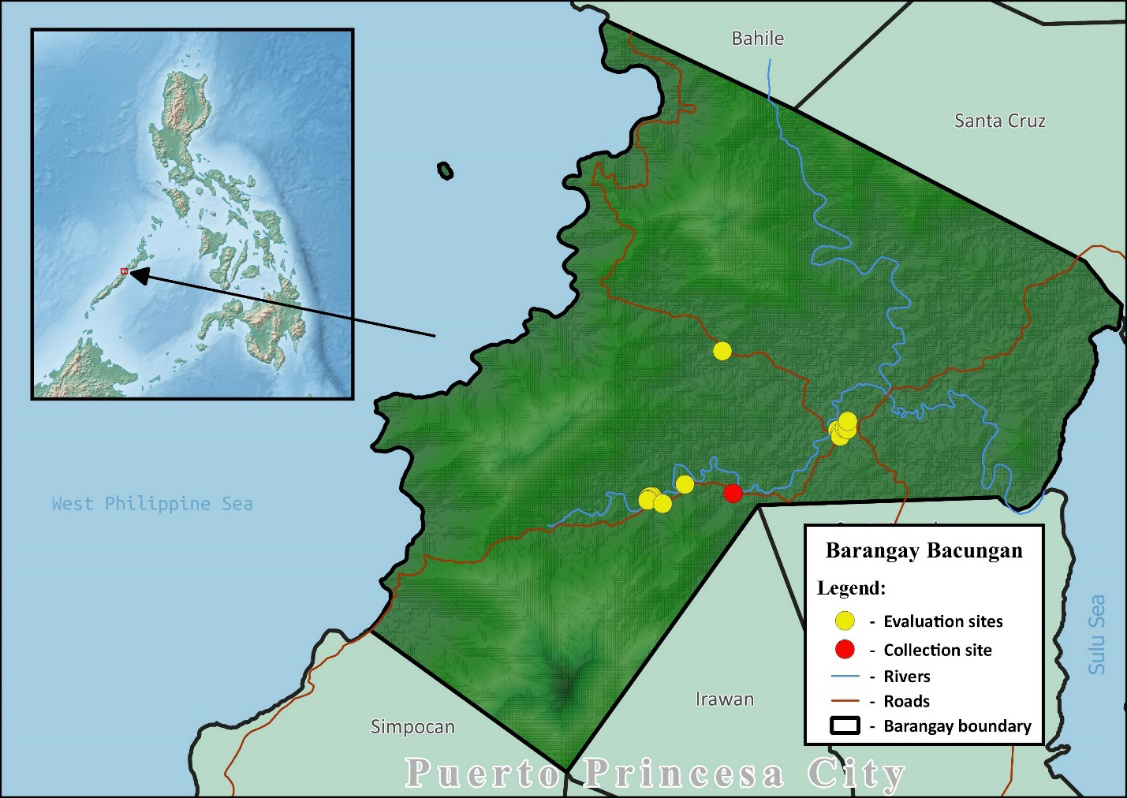
The study was conducted at a village in Barangay (Brgy.) Bacungan, Puerto Princesa City (Figure 1) located 20km north of the city proper, July 2017 to June 2018. Houses made of wood and cemented surfaces were sprayed upon obtaining the written consent of the household heads.
Spraying of the Wall Surfaces
Insecticide application was done using a Hudson Sprayer (2009-2010 model, H.D. Hudson Manufacturing Company), following the safety precautions and guidelines of the WHO for IRS [16].
Different insecticide products and active ingredients (AI) with specific concentrations were sprayed on cemented and wooden surfaces: Fludora Fusion (AI: clothianidin + deltamethrin 10g/L); Victor WP 20 (AI: Etofenprox, 12.5g/L), Victor WP 20 (AI: Etofenprox 25g/L); and Ficam 80WP (AI: Bendiocarb, 12.5g/L).
Wall Biological Test
The procedure for assessing the biological efficacy and persistence (Figures 2) of the different insecticides sprayed on surfaces followed the WHO cone wall bioassay guidelines [17]. Initial or baseline testing was performed 24 to 48 hours after the spraying activity to ensure complete dryness of the insecticides on the surfaces. The sprayed surfaces were continuously monitored monthly for 6 months. A total of 64 sets of wall structures (8 replicates × 4 dilution rates × 2 surfaces) were tested each evaluation month, together with the control, per structure exposed in clean, insecticide-free wood/cardboard.
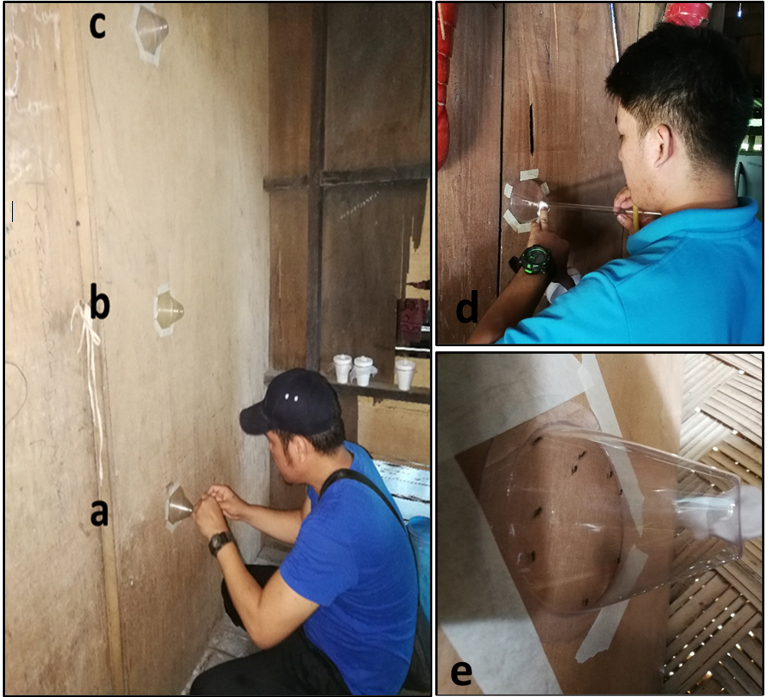
The Anopheles flavirostris, the primary malaria vector in the Philippines, was used in the evaluation. Prior to this study, the susceptibility level was determined against 12 insecticides using the WHO standard susceptibility test procedure [18]. The study used carabao (water buffalo) baited trapping to collect test Anopheles [19]. Specimens were morphologically identified using the illustrated keys for Anophelines in the Philippines [20]. The WHO cones (8.5cm in diameter at the base and 5.5cm in height) were installed on the wall surfaces at three fixed positions at 2, 4, and 6ft from the ground (Figure 2). Using a manual aspirator, a total of 10 female mosquitoes were exposed to a WHO cone for 30 minutes. Afterwards, specimens were removed and released to their respective holding cups labeled with the house number, name of the wall structure, and the corresponding position on the wall. Specimens were given access to 10% sugar solution as their food. A damp towel was placed on top of the holding cups to maintain ambient temperature. Knockdown (KD) mosquitoes were counted 1-hour post- exposure, while dead mosquitoes were observed after 24 hours and further extended up to 72 hours for the delayed mortality/ies (M). Temperatures and relative humidities were recorded at the start of the test, as well as after 24 hours and 72 hours, to determine the variation of environmental parameters that might affect the test.
Statistical Analysis
Susceptibility Determination: Following the WHO guidelines [18], the susceptibility levels of An. flavirostris to different insecticides were determined. The number of dead mosquitoes is divided by the total number of mosquitoes tested, multiplied by 100. According to the guidelines, mortalities between 98-100% indicate full susceptibility, while 90-97% mortality indicates incipient resistance and requires additional tests for confirmation. Mortalities below 90% confirm resistance in the population. A similar calculation was made to compute the average M rates as well as for the control specimen. Tests showing control mortality between 5 and 20% were corrected using Abbott’s formula for the final percentage M. Test with control mortalities above or equal to 20% were discarded.
( ) % observed mortality %controlmortality Corrected Mortality = ×100 100 %controlmortality − − Biological Efficacy Tests: The samples were tested for biological efficacy using both KD and M counts. Percent KD was computed by the number of KD mosquitoes per cone (or position), divided by the total number of exposed mosquitoes per cone (or position) multiplied by 100. The KD effect for each structure was then computed by taking the averages of the three positions (2ft, 4ft, and 6ft). The same formula was used to compute both percentage M and control per wall structure. If the control M of the test batch lay between 5% and 20%, it was corrected using Abbott’s formula to determine the final percentage M.
The monthly KD and M averages for each formulation were computed to check if they satisfy the WHO cutoff values (≥95% KD rates, & ≥80% M rates). The full factorial analysis was used to compare the effect of insecticides (4) at different wall types (2) across all months, looking at both KD and M. Further analyses were done to estimate the effect of the insecticides against control, separately with all observations under wooden walls and another dealing with cement walls. In all the analyses, repeated measures design was applied. Bonferroni comparison was used to show the significant difference between the KD and M of the insecticides.
Results
Susceptibility Testing against Anopheles flavirostris
The susceptibility level of Anopheles flavirostris was tested not only on the active ingredients of the insecticide products evaluated but also on 12 insecticides recommended by WHO for public health. As for Fludora Fusion, only deltamethrin was tested, as clothianidin paper was not yet available. Results showed that Anopheles flavirostris was still susceptible (all 100% mortality) to deltamethrin (Fludora Source Sum of Squares df Mean Squares F-value p-value Decision Main effects Insecticide (I) 213245.69 4 53311.424 515.91 <0.0001 significant Month (M) 7291.13 6 1215.19 12.27 <0.0001 significant Two-Way Interaction Effect I x M 6973.53 24 290.56 2.93 0.0024 significant Fusion), etofenprox (Victor20WP), and bendiocarb (Ficam 80WP). To other insecticides that are non-active ingredients of Fludora FusionTM, the malaria vector had incipient resistance to alpha-cypermethrin (96.5%), but remains susceptible to other 8 insecticides permethrin (99%), cyfluthrin (98.9%), lambda-cyhalothrin (99%), malathion (100%), fenitrothion (100%), pirimiphos-methyl (100%), propoxur (100%), and DDT (100%).
Factorial Analysis
An overall analysis was performed to determine the interactions between compounds (insecticide formulations), wall structure (cement, wood), month of evaluation, hour, and control mortalities, in order to assess their effects on the KD and mean mortalities (M) after 24 and 72 hours in An. flavirostris. For the KD (Tables 1-3), all factors (insecticide and month of evaluation) are significant (p < 0.0001) for both surfaces. Results showed that the two- way interaction effects between insecticides and months observed in cemented walls (p < 0.0001) differed from those in wooden walls (p < 0.0024). Insecticides differed in terms of mean KD rates and the effect of insecticide interacted significantly with months of observation. Among them, Clothianidin + deltamethrin (Fludora Fusion) has consistently shown good KD performance on both surfaces. Using the Bonferroni comparison, it was revealed that the mean KD of Clothianidin + deltamethrin 10g/L against An. flavirostris on wooden surfaces was significantly higher than the other three formulations (Etofenprox 25g/L, Etofenprox 12.5g/L, Bendiocarb 12.5g/L). However, the KD effect of Clothianidin + deltamethrin 10g/L was not different from the effect of Bendiocarb 12.5g/L and Etofenprox 25g/L, but was significantly different from the KD effect of Etofenprox 12.5g/L (Table 3). Consistently, the KD effect between Clothianidin + deltamethrin 10g/L and Etofenprox 25g/L showed no significant effects in cemented walls, but both showed a significant difference from the other two formulations (Etofenprox 12.5g/L and Bendiocarb 12.5g/L.
- R-squared = 92.68%
- Sphericity requirement was not satisfied. p-value corrected with HF epsilon.
Table 1: Summary of the factorial Analysis in wood wall type only with control using the mean knockdown effects.
Source Sum of Squares df Mean Squares F-value p-value Decision
Main effects
Insecticide (I) 209844.8 4 52461.2 141.97 <0.0001 significant
Month (M) 19203.12 6 3200.52 13.41 <0.0001 significant
Two-Way Interaction Effects
I x M 39628.06 24 1651.17 6.92 <0.0001 significant
- R-squared = 86.59%
- Sphericity requirement was not satisfied. p-value corrected with HF epsilon.
Table 2: Summary of the factorial Analysis in cemented wall type only with control using the mean mortality effects.
| Insecticides | Bonferroni Pairwise Comparison * | |||
|---|---|---|---|---|
| Wood | Cement | |||
| Victor 20 WP (Etofenprox) 12.5g/L | 91.53 | A, B | 59.29 | A |
| Victor 20 WP (Etofenprox) 25g/L | 87.92 | B | 94.94 | B |
| Fludora Fusion (Clothianidin + deltamethrin) 10g/L | 93.45 | A | 93.27 | B |
| Ficam 80WP (Bendiocarb) 12.5g/L | 93.45 | A | 65.48 | A |
| Control | 0.01 | C | 0.01 | C |
Table 3: Bonferroni Pairwise Comparison of the different insecticide products using their mean knockdown and mortality means with
* treatment pairs with different letters have significantly different mean mortality Table 3: Bonferroni Pairwise Comparison of the different insecticide products using their mean knockdown and mortality means with control.
With respect to the mean M (Tables 4-6), all three factors (wall structure, month of evaluation, hour) showed significance (p=<0.0001) for both wall surfaces. Two-way interactions were also found to be significant, except for the interaction between insecticide and hours of observation in wooden walls (p = 0.1654). The Bonferroni comparison showed that Clothianidin + deltamethrin 10 g/L had significantly higher efficacy than the three formulations (Etofenprox 25 g/L, Etofenprox 12.5 g/L, Bendiocarb 12.5 g/L) on the wood surface. Its M effect was consistent in the cemented wall, which is significantly higher than the two insecticides (Etofenprox 12.5 g/L, Bendiocarb 12.5 g/L), but similar to the observed effect of Etofenprox 25 g/L. Finally, the mean KD and M of the Control showed significantly lower values, and thus, its effect was significantly different from all the formulations evaluated.
- Source
- Sum of Squares df
- Mean Squares
- F-value p-value
- Decision
- Main effects
- Insecticide (I)
- 671814.6
- 4
- 167953.65
- 1654.5
- <0.0001 significant
- Month (M)
- 7402.76
- 6
- 1233.79
- 28.67
- <0.0001 significant
- Hour (H)
- 1869.84
- 2
- 934.92
- 21.72
- <0.0001 significant
- Two-Way Interaction Effects
- I x M
- 16937.04
- 24
- 705.71
- 16.4
- <0.0001 significant
- I x H
- 525.51
- 8
- 65.69
- 1.53
- 0.1654 not significant
Table 4: Summary of the factorial Analysis 2 in wood wall type only with control using the mean mortality.
Source Sum of Squares df Mean Squares F-value p-value Decision
Main effects
Insecticide (I) 624527.03 4 156131.76 337.36 <0.0001 significant
Month (M) 28945.88 6 4824.31 37.26 <0.0001 significant
Hour (H) 8596.75 2 4298.37 33.2 <0.0001 significant
Two-Way Interaction Effects
I x M 61640.73 24 2568.36 19.84 <0.0001 significant
I x H 8460.81 8 1057.5 8.17 <0.0001 not significant
- R-squared = 89.61%
- Sphericity requirement was not satisfied. p-value corrected with HF epsilon.
Table 5: Summary of the factorial Analysis 2 in cemented wall type only with control using the mean mortality.
| Insecticides | Bonferroni Pairwise Comparison * | |||
|---|---|---|---|---|
| Wood | Cement | |||
| Victor 20 WP (Etofenprox) 12.5g/L | 92.72 | C | 76.67 | B |
| Victor 20 WP (Etofenprox) 25g/L | 92.9 | C | 95.73 | A |
| Fludora Fusion (Clothianidin + deltamethrin) 10g/L | 98.08 | A | 97.22 | A |
| Ficam 80WP (Bendiocarb) 12.5g/L | 95.28 | B | 75.67 | B |
| Control | 0.11 | D | 0.11 | C |
Table 6: Bonferroni Pairwise Comparison of the different insecticide products using their mean knockdown and mortality means with
* treatment pairs with different letters have significantly different mean mortality. Table 6: Bonferroni Pairwise Comparison of the different insecticide products using their mean knockdown and mortality means with control.
The KD activity of the 4 Formulations against Anopheles flavirostris
The results of the initial tests for cement and wooden walls showed that all formulations were above the WHO threshold value of ≥95% KD (Figure 3). However, all formulations generally decreased the KD activity during the succeeding months of monitoring. The mean KD of the Clothianidin + deltamethrin 10g/L and bendiocarb 12.5g/L showed high KD effects on wood. Both formulations maintained a≥95% kill rate until 5 months on wooden surfaces. Their performances were far better than etofenprox 20WP 12.g/L and 25g/L, which lasted both only within 1 month. On the other hand, the performance of the following insecticides on cemented walls showed that Clothianidin + deltamethrin 10g/L and Etofenprox 20WP 25g/L, applied in the 4th and 5th months, worked better than Etofenprox 12.5g/L and Bendiocarb 12.5g/L, which were effective within the first month.
The Killing Effects of the 4 Formulations against Anopheles flavirostris
The mean mortalities of all formulations met and passed the WHO cut-off of ≥80% M at the initial tests but their killing effects uniformly decreased across months (Figure 4,5,6). Mean M rates showed that clothianidin + deltamethrin 10g/L and bendiocarb 12.5g/L had the highest mortality rates in both wall structures after 24-hour observation (Figure 4). However, only clothianidin + deltamethrin 10g/L maintained its killing effect of ≥80% after 6 months for both cemented and wooden surfaces. Both etofenprox 20WP formulations (12.5g/L and 25g/L) sustained the required killing effect after 3 months on wood surfaces. The two etofenprox 20WP formulations yielded disparate results in cemented walls, with the higher dilution of 25g/L (5 months) performing better than the lower dilution of 12.5g/L (1 month). Bendiocarb 12.5g/L worked better in woods (5 months) compared to cemented walls (< 1 month). Extended mean M observations up to 48-hour (Figure 5) and 72-hour (Figure 6) showed that all formulations generally increased their killing effect for both structures (cement and wood walls): Clothianidin + deltamethrin 10g/L (92% & 100%); Etofenprox 12.5g/L (63% & 91.50%); Etofenprox 25g/L (88.75% &100%); and Bendiocarb 12.5g/L (87.5% & 80.42%). Generally, the four compounds (Clothianidin + deltamethrin 10g/L, etofenprox 20WP 25g/L, etofenprox 12.5/L, and bendiocarb 12.5g/L) performed better in woods than in cemented surfaces.
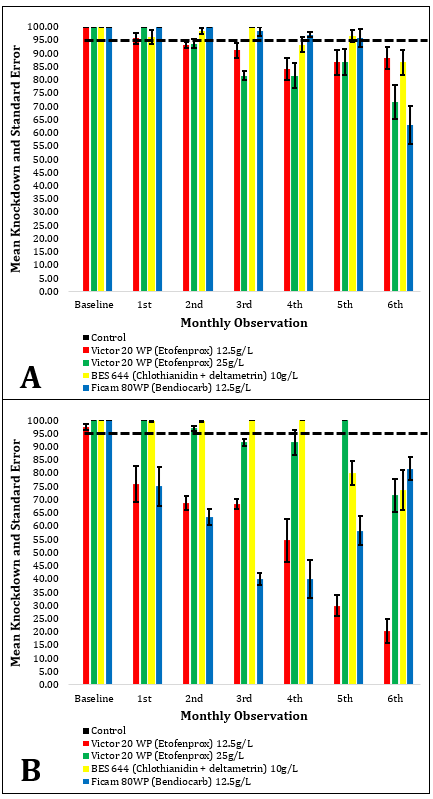
Figure 3: Showing the KD rates of the control (BLACK); Fludora Fusion (AI: clothianidin + deltamethrin 10g/L) (BLUE); Victor WP 20 (AI: Etofenprox, 12.5g/L) (RED), Victor WP 20 (AI: Etofenprox 25g/L) (GREEN); and Ficam 80WP (AI: Bendiocarb, 12.5g/L) (YELLOW) in wood (A) and (B) cemented wall surfaces from baseline to 6 months. The error bars show the standard deviation while straight dotted line (BLACK) shows the WHO cut-off values of 95% KD.
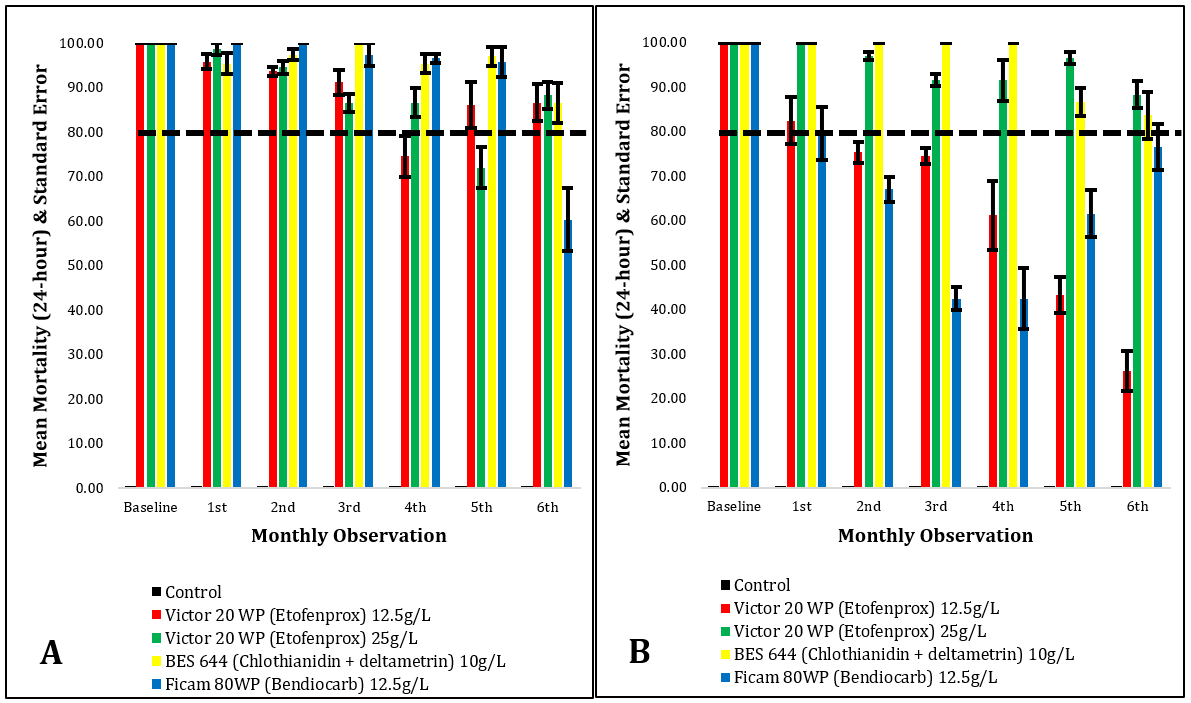
Figure 4: Showing the 24-hour mortality rates of the control (BLACK); Fludora Fusion (AI: clothianidin + deltamethrin 10g/L) (BLUE); Victor WP 20 (AI: Etofenprox, 12.5g/L) (RED), Victor WP 20 (AI: Etofenprox 25g/L) (GREEN); and Ficam 80WP (AI: Bendiocarb, 12.5g/L) (YELLOW) in wood (Figure 4A) and (Figure 4B) cemented wall surfaces from baseline to 6 months. The error bars show the standard deviation, while the straight dotted line (BLACK) shows the WHO cut-off values of 80% KD.
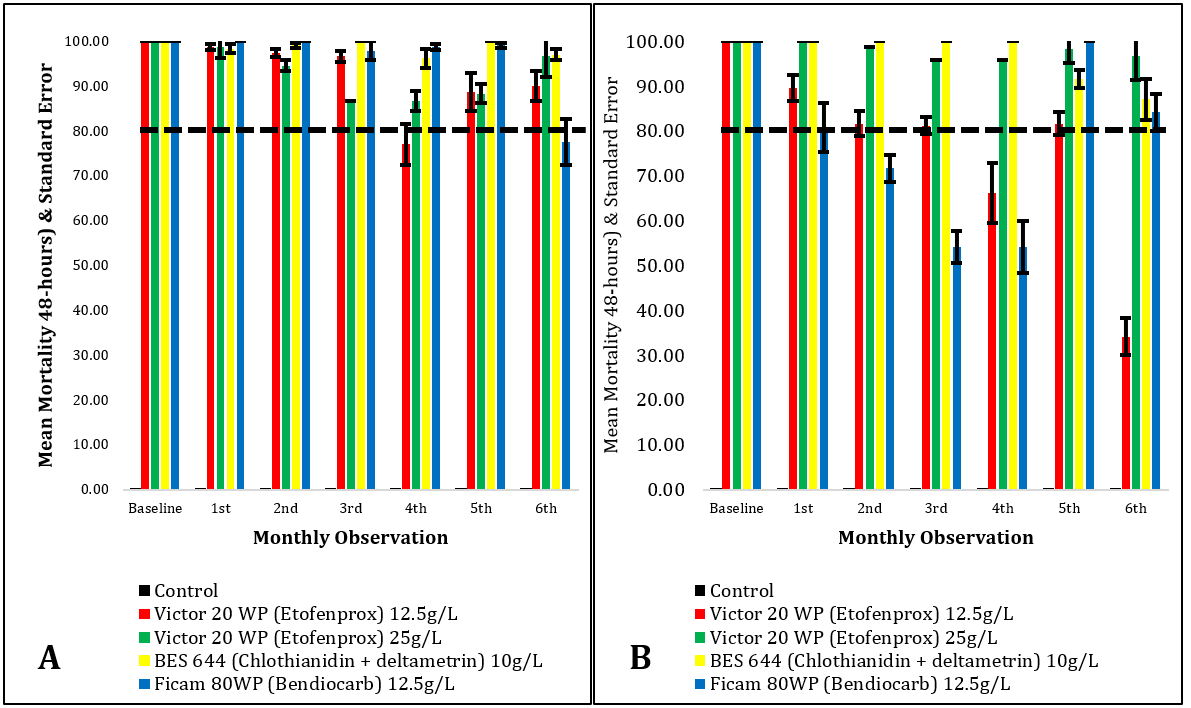
Figure 5: Showing the delayed mortality after 48-hour of the control (BLACK); Fludora Fusion (AI: clothianidin + deltamethrin 10g/L) (BLUE); Victor WP 20 (AI: Etofenprox, 12.5g/L) (RED), Victor WP 20 (AI: Etofenprox 25g/L) (GREEN); and Ficam 80WP (AI: Bendiocarb, 12.5g/L) (YELLOW) in wood (Figure 5A) and cemented wall surfaces (Figure 5B) from baseline to 6 months. The error bars show the standard deviation, while the straight dotted line (BLACK) shows the WHO cut-off values of 80% KD.
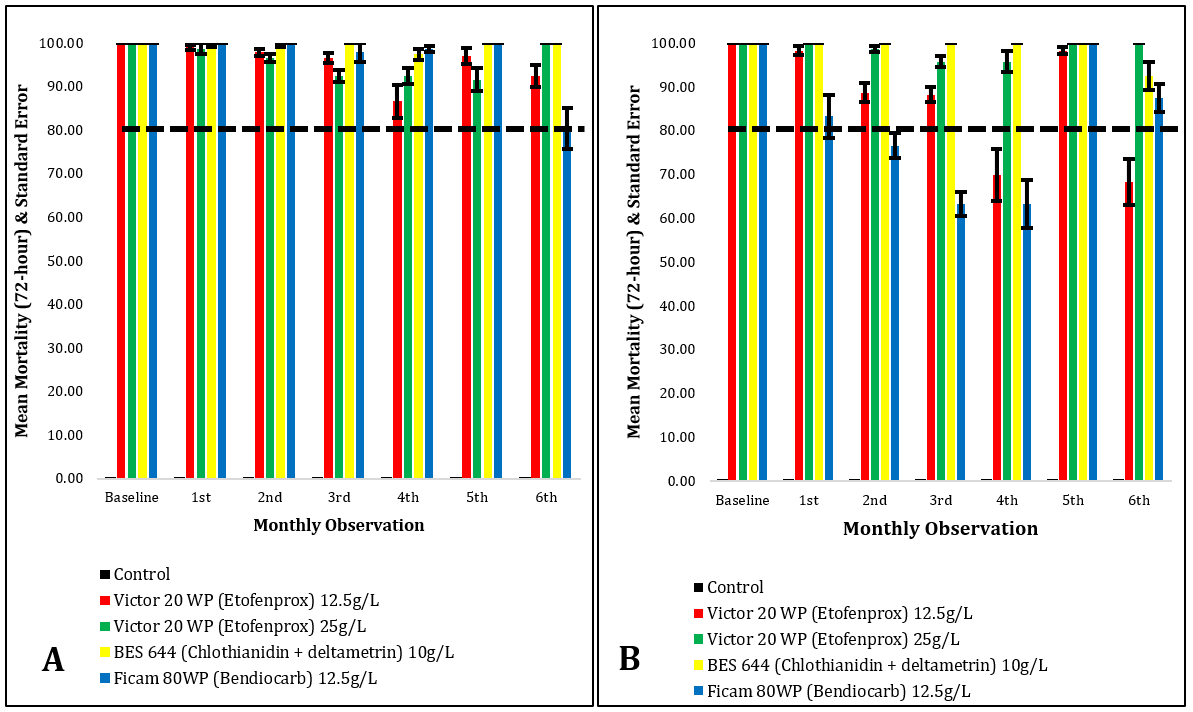
Figure 6: Showing the delayed mortality after 72-hour of the control (BLACK); Fludora Fusion (AI: clothianidin + deltamethrin 10g/L) (BLUE); Victor WP 20 (AI: Etofenprox, 12.5g/L) (RED), Victor WP 20 (AI: Etofenprox 25g/L) (GREEN); and Ficam 80WP (AI: Bendiocarb, 12.5g/L) (YELLOW) in wood (Figure 6A) and cemented wall surfaces (Figure 6B) from baseline to 6 months. The error bars show the standard deviation, while the straight dotted line (BLACK) shows the WHO cut-off values of 80% KD.
Discussion
The current study evaluated the biological efficacy of Clothianidin + deltamethrin (Fludora Fusion) and its persistence through time in wood and cement walls against An. flavirostris. The wall efficacy of this insecticide mixture (10g/L) was tested along with other compounds Etofenprox 20 WP 12.5 g/L & 25 g/L, and Bendiocarb 80 WP 12.5g/L) that are being used for vector control operations in the Philippines. General observations revealed that the biological efficacy of all insecticides against An. flavirostris performed better in woods than cemented walls. This has shown similar results in recent studies in Palawan [3] using the currently used insecticides (Victor (etofenprox) 20WP and K-Othrine (deltamethrin) 25 WGD). Studies in Benin, West Africa, state that lower residual activity is consistently observed in cemented walls that have greater porosity [14, 21]. One limitation of the study was that bamboo walls were not included in the evaluation. However, bamboo walls can be found in the study area. In Palawan, where most affected populations are indigenous people living in the foothills and remote areas along mountain ranges [3], houses are typically made from local products available in the forest, such as plant leaves, wood, and bamboo. The 2017-2018 DOH evaluation revealed that bamboo walls performed better than cemented walls, but wood had the highest killing effect among all [3].
The 6-month long study revealed that the new mixture has shown promising results compared to other insecticides tested against the primary vector in the Philippines. Mortality results consistently showed that it is significantly higher than the other insecticides (except for Etofenprox 25 g/L in cemented walls). Although it has shown a decreasing KD% across months, with a drop in KD within the threshold from the fifth to sixth month, its killing effect has consistently been above 80% over the 6-month evaluation period. Greater mortality of Clothianidin + deltamethrin was observed after the delayed mortalities of 72 hours in both walls; immediate (>80% after 24 hours) and delayed mortalities (92-100% after 72 hours) over 6 months of evaluation. This has shown similar results conducted in Equatorial Guinea, wherein mean mortalities are recorded to be higher after delayed observation at 72 hours [13]. The study showed that intermediate and delayed mortalities were maintained above the 80% cut-off across 6 months in wood (86.67%-100%) and cement (83.75%-92.50%). In Equatorial Guinea, biological efficacy evaluation was performed for up to 9 months and Clothianidin + deltamethrin had maintained over 80%
mortality in 7 months after 24 hours, and in 8 months for delayed (72 hours) mortality observations. Another study in Benin, West Africa revealed that the susceptible and resistant An. gambiae s.s. exhibited mortality rates of more than 80% over a period of 10 and 9 months, respectively [21]. In Dakar, Senegal the susceptible An. coluzzii reached the threshold mortality after 8 months of delayed observation (24 hours), while increased mortality was observed for up to 11 months post-applications after 96 hours of prolonged observations [22]. The residual efficacy of Clothianidin + deltamethrin had also been concluded in the prequalification by the WHO [15].
As one of the measures to mitigate insecticide resistance, the overall performance of Clothianidin + deltamethrin has been shown to be effective in killing the primary vector of malaria in the Philippines. Sustaining the killing effect over a required evaluation period is one of the good characteristics of a candidate product for IRS [4]. In 2018, clothianidin + deltamethrin was prequalified by the WHO, as it demonstrated longer residual efficacy on various surfaces and is now listed as one of the vector control products. It is non-toxic and safe for public health use as it does not present any unacceptable risk both for the IRS operators and the communities [15]. As the Philippine NMCEP-DOH gears toward elimination by 2030, the use of IRS remains one of the essential vector control interventions. The use of an insecticide mixture in conjunction with the recommendation and guidelines of the WHO is a measure to mitigate and address the emerging and existing problem of insecticide resistance [1]. In this country where malaria vectors are recorded to have been determined with resistance and possible resistance in some insecticides, this study provides a reference to the NMCEP in the selection of an alternative insecticide product that is proven effective for both susceptible and resistant malaria vectors [14, 15, 21]. Current interventions in the country show that IRS program operations are conducted twice a year in malaria-affected areas, but IRS operations in priority areas (classified as active malaria foci) in Palawan since 2016 have been increased to 3-cycles annually due to early reduction of residual efficacy (≈4 months) of the current insecticide products [10]. The current IRS strategy requires additional funds, manpower, and ground expenses, as well as a higher volume of products to be procured. With the new information on the longer residual efficacy of Clothianidin + deltamethrin, the local and national malaria programs may benefit by reducing the spraying cycle back to 2 cycles per year. The fact that it is the very first data in the Philippines, there are further evaluation works that must be done including the determination of maximum residual efficacy in different surfaces that are common in the affected communities. In the case of Palawan, the only reporting province in the country since 2022, the integration of a new insecticide mixture like the Fludora is a good approach in the vector control options for IRS operations to mitigate the development of resistance.
Rotational strategy in the vector control operations could potentially lead to the disruption of resistance development [1, 23]. Despite that no resistance has been detected in some insecticide resistance sentinel sites in Palawan, the mere fact that some sites started showing the possibility of resistance to some pyrethroids (cyfluthrin and lambdacyhalothrin) [11] and the continuous use of the same pyrethroid insecticides both in LLIN and IRS operation could continue put pressure on the development of resistance.
Moreover, IRS has already been adopted by the Philippine dengue program. The IRS, currently referred to as “targeted indoor and outdoor residual spraying (TIRS/TORS)” has started since the implementation of the national guidelines to control vectors of dengue, specifically Aedes aegypti and Aedes albopictus. For several years, no evaluation has been conducted. However, recent studies have shown that there is evidence of pyrethroid resistance in the National Capital Region [24]. The widespread use of the same insecticide products for vector control against dengue in all affected regions of the Philippines may create similar pressure on the mosquito vectors responsible for the disease. Thus, it is vital to conduct similar evaluation studies on the residual efficacy of dengue vectors, Aedes aegypti and Aedes albopictus, through TIRS and TORS approach in common substrates in affected communities in the region.
Conclusion
Anopheles flavirostris is found to be fully susceptible to almost all insecticides except alpha-cypermethrin (96.5%), which exhibited incipient resistance. Biological efficacy tests showed that all products met the 80% mortality at the initial test, but their killing effect decreased across months. Generally, insecticides sprayed on wooden surfaces performed better than on cemented walls. Among them, the Fludora Fusion has consistently met the WHO cut-off values of ≥80% mortality after 6 months. The killing effect exhibited by the Clothianidin + deltamethrin mixture qualifies this formulation to the WHO criteria as a potential product for malaria vector control.
References
-
World Health Organization (2019) Guidelines for Malaria Vector Control.
-
Department of Health (2017) National Malaria Control and Elimination Program. Manual of Operations.
-
Department of Health (2017) National Malaria Control and Elimination Program. Manual of Operations.
-
World Health Organization (2017) Framework for a national plan for monitoring and management of insecticide resistance in malaria vectors.
-
Aktar W, Sengupta D, Chowdhury A (2009) Impact of pesticides use in agriculture: Their benefits and hazards. Interdiscip Toxicol 2(1): 1-12.
-
Sternberg ED and Thomas MB (2018) Insights from agriculture for the management of insecticide resistance in disease vectors. Evol Appl 11(4): 404-414.
-
World Health Organization (2020) World malaria report 2020: 20 years of global progress and challenges.
-
World Health Organization (2016) World Malaria Report 2015.
-
World Health Organization (2018) World Malaria Report 2019.
-
Department of Health - National Program for the Control and Elimination of Malaria, National Strategic Plan for the Control and Elimination of Malaria in the Philippines 2020-2022. 2020.
-
Salazar FV, Malijan RPB, Braganza JB, Angeles JR, Ammugauan MA, et al (2021) Operationalization of Insecticide Resistance Monitoring Amongst Malaria Vectors in the Philippines. Public Health Open Access 5(2): 1-16.
-
Fongnikin A, Houeto N, Agbevo A, Odjo A, Syme T, et al. (2020) Efficacy of Fludora® Fusion (a mixture of deltamethrin and clothianidin) for indoor residual spraying against pyrethroid-resistant malaria vectors: Laboratory and experimental hut evaluation. Parasit Vectors 13(1): 466.
-
Fuseini G, Phiri WP, von Fricken ME, Smith J, Garcia GA (2019) Evaluation of the residual effectiveness of FludoraTM fusion WP-SB, a combination of clothianidin and deltamethrin, for the control of pyrethroid-resistant malaria vectors on Bioko Island, Equatorial Guinea. Acta Trop 196: 42-47.
-
Agossa FR, Padonou GG, Fassinou AJYH, Odjo EM, Akuoko OK, et al. (2018) Small-scale field evaluation of the efficacy and residual effect of Fludora ® Fusion (mixture of clothianidin and deltamethrin) against susceptible and resistant Anopheles gambiae populations from Benin, West Africa. Malar J 17(1): 484.
-
World Health Organization (2018) Prequalification Team Vector Control Decision Document Fludora Fusion.
-
World Health Organization (2015) Indoor Residual Spraying; An Operational Manual for Indoor Residual Spraying (IRS) For Malaria Transmission Control and Elimination.
-
World Health Organization (2006) Guidelines for Testing Mosquito Adulticides for Indoor Residual Spraying and Treatment of Mosquito Nets.
-
World Health Organization (2016) Test procedures for insecticide resistance monitoring in malaria vector mosquitoes.
-
Salazar FV, Torno MM, Galang C, Baquilod M, Bangs MJ (2015) Bionomics and Ecology of Anopheles Litoralis King, 1932 on Bongao Island, Tawi-Tawi Province, Philippines: Implications for Vector Control. pp: 1-16.
-
Cagampang-Ramos A, Darsie RF, USAF Fifth Epidemiological Flight, and Malaria Eradication Training Center (1970) Illustrated Keys to the Anopheles Mosquitoes of the Philippine Islands.
-
Djènontin A, Aïmihouè O, Sèzonlin M, Damien GB, Ossè R, et al. (2013) The residual life of bendiocarb on different substrates under laboratory and field conditions in Benin, Western Africa.
-
Gueye M, Dia I, Diedhiou S, Samb B, Dia AK, et al. (2022) Evaluation of the Efficacy of Fludora® Fusion WP-SB 56.25 (Mixture of Clothianidin and Deltamethrin) against Anopheles coluzzii Laboratory and An. arabiensis Wild Colonies. Trop Med Infect Dis 7(10): 316.
-
Insecticide Resistance Action Committee (2019) IRAC Mode of Action Classification Scheme Prepared by: IRAC International MoA Working Group Approved by: IRAC Executive IRAC MoA Classification Contents.
-
Angeles JR, Paul Malijan RB, Minelle Apilado AA, Ann MT, and Salazar FV (2023) Insecticide resistance in Aedes aegypti from the National Capital Region, Philippines. Filinvest Corporate City, pp: 1781.
- Measuring What Matters: Data Gaps, Certificate of Need Reform, and Pediatric Psychiatric Inpatient Capacity in North Carolina
- Intersecting Epidemics and Climate Vulnerabilities in Conflict- Driven Displacement: Epidemiology, Systemic Challenges, and One Health Gaps in South Sudan
- Advancing Domestic Health Financing for Community Health System Sustainability in South Sudan: The Boma Health Initiative Model (2025–2035)
- Prevalence and Correlates of Post-Exposure Prophylaxis Uptake among Men Who Have Sex with Men in Kisumu County, Kenya
- Medical, Ethical, and Legal Conflicts Surrounding Euthanasia in Argentina. Its Global Implications
- Knowledge and Attitude on Menstrual Hygiene among Adolescent Girls Studying in Secondary Level in Public Schools of Chitwan District, Nepal