
Macroconcepts in Edgar Morin’s Thought: Need and Function
This paper analyzes the necessity and operation of conceptual macromolecule inside Edgar Morin’s school of thought due to the significant connection of his epistemological proposal and the language transformation with which the knowledge of reality is expressed in complex thought. This paper is organized as follows. First, we pointed the essential link between conceptualizer/observer subject and the macro-conceptualization. Second, we interpret the system or complex basic unity expounded in Method I based on complexity principles. Finally, it may be concluded that the linguistic resources used by this paradigm are in accordance with the new ways to understand complexity.
Macroconceptualization
Systems theory and quantum mechanics had an important impact on Morin’s complex epistemology2 [3, 4]. The concepts of system and complementarity provoked the revision of the traditional conception of the subject-object relationship when new scientific discoveries had to be confronted with the epistemological theory of the Newtonian- Cartesian paradigm [5]. If the main premise is that reality is a network of interconnected systems in which there are no precise limits between objects, but that these constitute a relational network made up of atoms, molecules, organelles, cells, tissues, organs, communities, society and the biosphere, a division between subject-system and object-system would be arbitrary. The subject is a physical and mental system of great complexity and is part of other systems, such as the social one, in which ideas that communicate, traditions that are learned, languages that are used, thoughts that are cultivated, culture that is received are woven; for its part, the object of study is not separated from its environment as if it could exist without internal and external links. Consequently,
2 The use of the concept “complexity” in the paradigm proposed by Morin differs from that used in the complexity sciences. For Morin, the semantic field of the term is epistemologically delimited. (Maldonado and Gómez Cruz)However, the complementarity between complex thinking and the complexity sciences is already emerging instead of epistemological and methodological disputes. (Leonardo G. Rodriguez Zoya et al.).
between the subject and the object there is no abysmal split, on the contrary, there are countless links that bring them closer3 [6].
From certain conditions of observation, the individual influences the behavior of atomic reality; according to the principle of complementarity, the deep analysis of epistemic activity confirms that the subject does not know both forms (particle and corpuscle) of atomic reality at the same time. Morin took up this principle to consider that there is a systemic continuity and not an unbridgeable ontological abyss between subject and object. Systemic theory postulates similar considerations in that, once the intrinsic relations between the observer and the observed have been corroborated, it is accepted that there is a sort of influence of the observer on the observed and vice versa4: When [one] observes a system, to some extent [the subject] is also observing himself, given that the observing system and the observed system are inscribed in the same [polysystemic] universe... the observer contributes his conceptualizing capacity, his theories, culture, his context, which are part of the polysystem from which the system will be drawn (Garciandía Ímaz 142).
It is interesting here to emphasize the conceptualizing capacity of the observer who understands himself and reality through a complex vision; we speak then of the subject-system relationship, in which he understands the systemic reality of which he is a part, reformulating how to name it insofar as objects and simple concepts have been rethought in function of a broader and more dynamic conception: “objects are no longer only objects, things are no longer things; every object of observation or study must henceforth be conceived in function of its organization, of its environment, of its observer” (p. 427) [2].
Thus, there is a need for macroconceptualization, which
3 Fritj of Capra’s research Capra is especially revealing with respect to change. His work the web of life sets out the conditions that made possible the emergence of systems thinking from various branches of knowledge such as biology, ecology and complexity sciences.
4 Niels Bohr, one of the precursors of quantum physics, “points out that light behaves as a particle in certain conditions of observation (for example, in interference effects), and as a wave in others (for example, in photoelectric effects), which leads to conclusions that are conceptually incompatible, but which, with a more rigorous epistemological basis, are complementary. Different observational situations are often complementary to each other, which means that, although they seem to be mutually exclusive, ... by analyzing more deeply the epistemic activity of the subject, they are perceived as compatible, reconcilable and complementary.” (Martínez Miguélez 82). In these approaches, some postulates of complex thinking are recognizable with respect to the behavior of the system as an organizational phenomenon that must deal with constraints, emergencies, complementarities and antagonisms between the elements that compose it.
allows the use of not only one explanatory master concept, but several integrated concepts that broaden the understanding of reality as a process. In a simplistic paradigm5 [7], which is based on the separation between the subject of knowledge and the object of study, the ability to name the changing reality by means of language is reduced. In contrast, the activity of the subject of knowledge, re-signified in the complexity paradigm, enables him/her to appropriate a new language to tell the world. The simplistic paradigm deepened “the ontological and self-sufficient status of the object, and the resulting abyss between subject and object. To such an extent that the subject is dispossessed of language and the latter becomes a mere instrument, the pincers with which to catch and show the object”, an issue that, thus posed, does not prevent the subject from being a mere instrument (p. 46) [8]. This question, thus posed, does not avoid sustaining that man makes and says the world. The new paradigm vindicates the activity of the cognizing subject and language involved in a complex understanding of reality, beyond mere adequacy, correspondence or simple description.
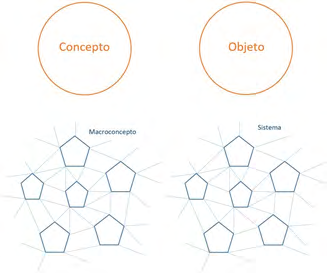
If the object is no longer immutable or closed, neither is the language that names it, through which the new complex structure must be able to be said. The change is gestated, then, from two angles: from the object to the complex system or complex unit of base6 and from the concept to the
5 In this article the expression simplistic paradigm alludes to the currents of thought that make the name an atomic unit of language, the simple particular-object an atomic unit of reality, and the empirical concepts the basis of a unified science. (Stroll).
6 The system is then the base complex unit, no longer the object; it is the simplest complex concept, not simplistic: “The system is the base complex concept because it is not reducible to elementary units, simple concepts, general laws. It is the base concept because it can be developed in systems macroconcept. This is defined as a significant molecule that tries to emulate the behavior of the system it names, therefore, its concepts cannot be separated from each other and lose explanatory capacity. A complex reality can be named by a language of the same character, not only associative, but also organizational, since a macroconcept works from the generating movement of macro and micro meanings.
The Macro Concept of the Basic Complex System or Unit
In order to explain the functioning and necessity of macroconceptualization in complex thinking, we will take as an example the macroconcepts defined by Morin in the first part of his work Method I for the basic complex system or unit; in this way, we will see how the linguistic resources used by the author respond to the complex organizational nature according to which systems function. Interactions - Interrelationships (Δ) - ORGANIZATION (Δ) - System (Δ)7 A system is formed by elements (phenomena, bodies, atoms, parts, among others) that are constantly related through interactions or interrelations. Interactions do not yet produce a state of organization as a system, however, disorder is present as agitation, turbulence, imbalance, randomness that allows the generation of links between the elements: “interactions are reciprocal actions that modify the behavior or nature of the elements, bodies, objects and phenomena that are present or are influenced”. (Morin, The Method I. The nature of nature 69) The characteristic of disorder is that the elements of the system do not remain identical and change as they associate with others. Therefore, there are four important conditions for an interaction: (1) it supposes the existence of the elements in relation; (2) it implies the conditions of encounter caused by disorder; (3) it considers the particular characteristics of the elements, objects or phenomena -for example: the conditions of encounter between two atoms will not be the same as between two ecosystems, or between two molecules will not be the same as between two persons: The number and richness of interactions increases as the level of interactions increases not only between particles, but also between organized systems, atoms, stars, molecules and, above all, living beings, of systems of systems of systems ... Our aim is not to make reductionist systemism. We are going to use universally our conception of system, not as the master-word of totality, but at the root of complexity.” (Morin, The Method I. The nature of nature 177).
7 The macro concepts discussed in this article are not reproduced in their entirety due to the copyrights that cover the work. Therefore, some are transcribed in a linear fashion and others, due to their graphic complexity, are quoted for the reader’s review.
societies; the more the diversity and complexity of phenomena and interactions increases, the more the diversity and complexity of the effects and transformations arising from these interactions increases (Morin, The Method I. The nature of nature 70).
Thus, speaking of interactions between elements that do not yet form a system is not the same as speaking of interactions between established systems, since they involve a greater degree of complexity, both because they occur between organized systems and because the number of elements increases and, therefore, the size of the systems. Finally, it is essential that interactions have the possibility of becoming interrelationships. The links of these are more stable and give rise to a phenomenon of organization by decreasing the level of disorder and building more durable links between its elements, without being unbreakable (the permanence of the links would be a disadvantage for a system in constant exchange with others). The interrelationship is presented in the form of associations, unions, combinations, communication, among other types of connections: unions are common among atoms, but communication is characteristic of communities of living beings, for example. Parts → All ← In the system there is a constant tension between the parts that compose it and the whole that they form by linking themselves in enduring relationships. The system, understood as a totality, inaugurates new characteristics absent in the parts, while at the same time it does not suppress their individual existence, since complexity supposes the belonging of both to the same systemic phenomenon, in which the whole predominates at one moment and the parts at another. In this sense, according to Morin: “The idea of interrelation refers to the types and forms of union between elements or individuals, between these elements/ individuals and the Whole” (The Method I. The nature of nature 127). This concept would be a hinge between the concepts of interaction (which implies the encounters between the parts) and organization (which alludes to the arrangement of the parts within, in and by a whole). In organization, therefore, not only the particular movements of the elements are contemplated, but also the properties that they inaugurate. In the system, organization predominates as a process that, in spite of being formed from order and disorder, tends to generate stable, but not unalterable, links. This whole process can be described in a macro-concept that does not privilege any of the definitions in particular, but connects them all, giving account of a greater understanding without losing their singularity.
The organization of the basic complex unit can be understood on the basis of two types of properties: as they pertain to a set of parts and a whole and, at the same time, to the diversity and unity of the system. Both characteristics highlight different levels of the system; while the parts- whole relationship privileges the quantitative, i.e. the link between the one and the whole, the diversity-unity nexus considers the qualitatively distinctive between the elements of the system: The idea of complex unity will take on density if we realize that we can neither reduce the whole to the parts, nor the parts to the whole, nor the one to the multiple, nor the multiple to the one, but that we must try to conceive together, in a way that is both complementary and antagonistic, the notions of whole and parts, of one and different (Morin, The Method I. The nature of nature 28).
Thus, the quantitative and the qualitative consist of tools for understanding the system which, added to contradiction, make it possible to deal with complexity in all its magnitude. The links between parts and whole are modified according to the predominance of one or the other: when the whole is more than the sum of its parts, emergences arise, i.e. properties of the system that are absent in its component elements, but present in the whole thanks to their interactions.
Emergences - complementarities - ORGANIZATION - constraints – antagonisms8 Emergencies, as one of the most relevant properties of unity, inaugurate a novel organizational capacity. Morin describes two types of emergencies: the global and the micro-emergency. In order not to neglect the movements of the system, the author accepts that the whole is more than the part (emergency), but also that the part is more than the part (micro-emergency). The emergence, whose existence is impossible without the interrelation of the parts, depends on these and vanishes without them; if the elements are separated, the emergence disappears together with the system. Nor is it logically deducible because it consists of an aggregate of the system, a property that comes from the elements, but of a different nature as it is based on the totality; hence we speak of globality, since it cannot be detached from the complete character of the system.
It also happens in the system that the part surpasses itself when it belongs to a union that transforms it. A solitary element, such as an atom or an individual, has certain characteristics, but when it unites with another to form a molecule or an interpersonal relationship, it is modified by
8 The macro concepts discussed in this article are not reproduced in their entirety due to the copyrights that cover the work. Therefore, some are transcribed in a linear fashion and others, due to their graphic complexity, are quoted for the reader’s review.
uniting its characteristics with those of another, whether or not it is similar. Thus, unpublished qualities (micro- emergences) emerge thanks to the interrelationships that made them possible. It is concluded that the part is transformed when it is united to a whole because its properties are enhanced to the extent that others appear without precedent. However, Morin is not unaware, as is characteristic of complexity that the opposite aspect of emergence also occurs in the system, without this meaning its destruction. This implies a necessary dynamism to understand the contradictory way in which reality behaves. In addition to emergencies, constraints arise in the complex unity. The belonging of a part to the totality both empowers and inhibits it, because not all its qualities are coupled with those of the other parts and it can be inhibited in function of the totality.
Not only does the whole constrain the parts, but also the parts constrain it. Clearly, emergent properties appear in the whole, but they are determined by what happens in the parts: the water molecule, understood as a system, cannot be the same as the air molecule because its specific components determine it to be in one way and not in another. The parts constrain each other for the benefit of the whole: in a social group, for example, certain qualities of individuals are highlighted while others are discarded when they do not contribute to an established end. Thus, from emergencies and constraints, it is possible to understand the relationship between the parts and the whole in the complex unit.
Diverse → one → ORGANIZATION ←
Now, the parts of a system are not all the same; on the contrary, diversity seeks organization. The system, formed by multiple elements, transforms diversity into unity without eliminating it completely. That is to say, the system, in order to be a complex unity, needs both complementarities and equalities; correspondence and similarity alone would annul the dynamism of the system, but if only diversity and multiplicity prevail, the organization would disintegrate to make the system disappear; hence both diversity and unity are indispensable. Complementarities are of various types; interactions and interrelationships have already been mentioned, but there are also unions, combinations and communications. What is common to all of them is that complementarities produce antagonisms and both co- produce each other. The confluences between the parts of the complex unity sustain its organization because, as we saw with the constraints of the parts to the whole and vice versa, rejections between the elements are inevitable. But these contrary movements must be restrained, so that their action does not destroy the system, that is to say, they must remain virtual, possible, but active, because without antagonism there is no complementarity: “every system presents, then, an emerged day side, which is associative, organizational, functional, and a shadow side, immersed, virtual, which is the negative of that side” (Morin, The Method I. The nature of nature 144). The emerged face is the apparent organization of the system, but it is assumed that in the submerged face the antagonisms between the parts are debated, which, although they sometimes do not reach the surface of the system, because that would destroy it, they remain active as an anti-organizational component. Thus, the system both creates and represses antagonism. For example, in the relationships that are woven between individuals in a society, there are family or cultural complementarities, i.e., links that increase organization, but also civil wars, arguments, ideological struggles, and even contradictions within the subject itself. The confluences also provoke differences and this anti-organizational component transforms the parts into a function of the whole.
As can be seen, the basic complex unity cannot be understood on the basis of a single explanatory concept or univocal principle, precisely because its organization, instead of being essentialist, is processual, contemplating aspects that favor or do not favor order and organization. The day side of the system, emergencies and complementarities, would not be possible without its hidden side, constraints and antagonisms. The principles of its transformation, its creation and its destruction are found within the system.
The Macro Concept
Although Morin makes abundant use of macroconcepts in his works to explain the processual and non-static character of reality, their theoretical basis is not clearly defined; only some sporadic references allow a brief understanding of their function for complexity thinking; but what they are, how they behave, whether or not they are necessary for the new paradigm, remain as questions. For Morin, as evidenced, it was fundamental to make clear the shift from object to system in order to modify a basic aspect of the simplistic paradigm: Objects leave their place to systems, instead of essences and substances, organization; instead of simple and elementary units, complex units; instead of aggregates forming body, systems of systems of systems of systems ... the Aristotelian model (form/ substance) and the Cartesian model (simplifiable and decomposable objects), underlying one and the other in our conception of objects, do not constitute principles of intelligibility of the system. It can be taken neither as a pure unity or absolute identity, nor as a decomposable compound. We need a systemic concept that expresses unity, multiplicity, totality, diversity, organization and complexity at the same time (Science with consciousness 149) [9].
There is a reciprocal relationship of transformation between the paradigm and the language that names it, but transporting new ideas with a language loaded with old meanings is one of the challenges that the emerging paradigm must face: “the concepts, when expressing new realities, face a serious obstacle: either they are already existing terms and in this case they are linked to “old” realities or they are new terms expressly coined; but, if so, they must be explained by resorting to the equally “old” current language.” (Martínez Miguélez 103) [10]. As a prerequisite for profound change, in the complexity paradigm old realities and old concepts must be transformed into new ones. Indeed, if the object was named from meaningful atoms, or as Morin calls them, master and univocal words, which claimed their correspondence with reality, the system could not be named with concepts that cannot express its processual character. These new forms of expression are characterized by having already known words and other new ones, expressly coined by the new paradigm, which derive their meaning from the relationship with others that define them. Macroconcepts are part of the newly coined terms that re-signify the old ones and seek the creation of new meaningful structures, even with the difficulty of introducing new ideas “within the framework of an old system of concepts” (Martínez Miguélez 104) [10].
Indeed, it is necessary to make explicit the change in the system of concepts of a paradigm in order to perceive the original links woven between language and reality. In his work Seven Necessary Knowledges for the Education of the Future, Morin recognizes that paradigms are characterized by their status of rationality; however, when this becomes rationalization, theories become blind and untouched by changes in the phenomena they study, avoiding considering the changes that force a re-examination of the principles on which the paradigm is based: Rationality must remain open to discussion in order to prevent it from being enclosed in a doctrine and becoming rationalization [because] true rationality, open by nature, dialogues with a reality that resists it. It operates an incessant to-and-fro between the logical instance and the empirical instance; it is the fruit of the argued debate of ideas and not the property of a system of ideas (Morin, The Seven Necessary Knowledge for the Education of the Future, 7) [11].
That is to say, a rational paradigm, as Morin intends his to be, attends to the changes of phenomena in order to prevent theories from becoming stagnant and rather transform themselves with reality. The complexity paradigm considers the profound metamorphoses of physics (quantum mechanics, thermodynamics, complexity sciences) and biology (evolutionary theory, self-organization, systemics) to understand, elaborate and unify non-rationalized rational concepts, i.e. macro- concepts that name, for example, the basic complex unit.
The notion of macromolecule comes from the field of biology and refers to a giant molecule composed of a large number of atoms, each with their respective bonds. Jacob [12] refers to a giant molecule composed of a large number of atoms, each with its respective bonds. This origin of the term from biology allows us to consider that, if complexity instead of eliminating simplicity includes it, conceptual macromolecules will be made up of significant atoms. Thus, since the macromolecule is formed by links between atoms that give it new properties, the conceptual macromolecule will be formed by concepts that modify their meaning when related to others, and if they were separated from it, they would return to being atomic concepts.
Principles of Complexity
Now, in order to point out the forcefulness of complex thought in expressing itself through macroconcepts, its function will be interpreted in the light of the same principles of complexity, to show how they are used coherently with complex epistemology. The first principle to which we shall refer is the dialogical principle that It helps to think in the same mental space logics that complement and exclude each other. The dialogical principle can be defined as the complex association (complementary / concurrent / antagonistic) of necessary instances, jointly necessary, for the existence, functioning and development of an organized phenomenon (Edgar Morin Emilio Roger Ciurana Raúl Domingo Motta 31) [13].
The dialogic indicates the capacity of interlocution between opposing parts, which are not related to each other or, simply, are part of two different orders. The complementary and antagonistic character, mentioned above, refer to the interrelations, unions and recognition of the differences between the parties. The concurrent or confluent character consists in the fact that the parts “are subject to go in the same direction and sense, in an interaction that surpasses the facilities that complementarities offer and the difficulties that antagonisms oppose” (Garciandía Ímaz 160). Take as an example the macro-concept Disorder (Δ) - Organization (Δ) - Order (Δ) - Interactions, which represents a tetralogical loop; the concepts of order and disorder are contrary, antagonistic, however, their complementarity under the concept of organization is necessary. Thus, antagonism survives, but becomes complementarity when the state of disorder gives way to that of organization (order) through interrelationships. However, order can turn back into disorder, thus representing the movement of an organizational phenomenon. Concurrence is also present when order, disorder and interrelationships combine to fulfill a single purpose, giving rise to organization.
The second is the recursive principle or recursivity, which takes up the circular causality developed by cybernetics. The former consists of a feedback connection between causes and effects, i.e., the latter strengthen the causes so that the process renews itself. Recursivity brings with it an element of greater complexity, which implies the conversion of effects into causes in a new process; recursivity “is a process in which the effects or products are at the same time causers and producers of the process itself, and in which the final states are necessary for the generation of the initial states” (Edgar Morin Emilio Roger Ciurana Raúl Domingo Motta 31). This principle assumes a very intrinsic relationship between the concepts of the macroconcept that does not admit the adoption of a univocal meaning isolated from the others. With respect to the macroconcept Disorder (Δ) - Organization (Δ) - Order (Δ) - Interactions, Morin comments, “The old solitary keyword is replaced by a macroconcept, not only of a molecular character, but in which the relations between its terms are circular, that is, a macroconcept of a recursive character” (Science with consciousness 208). The recursive principle, then, is key to understanding the functioning of macroconcepts, since these, besides being schemes in which the terms are linked to each other, are figures in which significant links are created according to the direction of their movement, their number of components, the antagonistic, complementary or non-complementary character of these or whether they converge in another concept, etc. Since we are talking about several terms that are connected, it is necessary to think of them in a mobile way, not static, as is the system. The macro- concept Emergencies - complementarities - ORGANIZATION - constraints - antagonisms shows arrows that connect in different directions each of its terms and shows that organization, as a central concept, produces the action of all the others.
The third is the hologrammatic principle, according to which “in every complex organization not only the part is in the whole, but also the whole is in the part” (Edgar Morin Emilio Roger Ciurana Raúl Domingo Motta 29) and it is fulfilled without exception in all macroconcepts, since each part of the whole, that is to say, each concept of the macromolecule, is defined by its relations. The macroconcept is indissoluble in its constituent elements because in the definition of one of its components all the others are present. It is impossible to understand organization without referring to order, disorder, interactions or system. In his work Science with Consciousness, Morin notices such a requirement in the complex use of language and, referring to the macroconcept Interrelation → System → Organization ←, notes:
These three terms are indissoluble; they refer to each other; the absence of one seriously mutilates the concept: the system without the concept of organization is as mutilated as the organization without the concept of system. It is a macro-concept. Now, we realize that the simplifying understanding that has formed us has only placed at our disposal atomic concepts, and not molecular ones; isolated and static chemical concepts, and not organismic concepts that co-produce among themselves in the recursive relation of their interdependence (205).
Morin calls this relationship of interdependence in which concepts are co-produced organismic. We speak here, then, of the production of macro and micro meanings. Each component of the macro-concept is nourished by the rest, configuring a micro meaning. The conceptual macromolecule as a whole acquires a meaning enriched by each of its parts, the macro-meaning.
For the few authors who have commented on macroconceptualization as a tool used in complex thinking, there is also the principle of fuzziness. This is not raised by Morin, but it is relevant because its formulation is explicit with respect to the treatment of concepts and raises the different uses of language made by the paradigm. Although such a principle is not directly proposed, we believe that it is an active principle of complex thinking and, in one way or another, is present in it. The fuzzy principle opposes the idea that all statements and concepts characteristic of complex organizations can be put in black or white, without ambiguity. The fuzziness principle allows thought to reason (MORIN: 1988) with uncertain or undecidable statements and concepts. The principle of fuzziness is a principle that opposes the principle of bivalence and the tendency not to recognize median entities. It is thus a principle that helps us to conceive of mixed entities or mixtures, produced within a complex organization. Thus, the principle of blurriness enables us to overcome some of the classical dichotomies: man/woman, being/ not being ... In short, to go beyond clear and distinct ideas (Gómez Marín and Jiménez 67) [14].
A fuzzy concept does not have precise limits with another and, more specifically, with its opposite, therefore, it becomes an uncertain term, in the words of these authors. However, this principle may not be the most accurate because the clear and distinct Cartesian ideas, the simple names of logical atomism or the empirical concepts of logical positivism are not overcome when they become fuzzy terms that can hardly be used due to lack of intelligibility. The strategy of complex thought consists in keeping its concepts defined, but never isolated or absolute, but deeply related to others that give them meaning and turn them into organismic concepts. But blurriness can be understood as the capacity of complex concepts to change, since order certainly mutates into disorder and vice versa, and both into organization or interactions into interrelationships, but not for this reason as uncertain concepts. In his work Introduction to Complex Thought, Morin addresses precisely his argument against clear and distinct Cartesian ideas: First of all, I believe that we need macro-concepts. Just as an atom is a constellation of particles, just as the solar system is a constellation around a star, so we need to think by means of constellation and solidarity of concepts. Moreover, we must know that, with respect to the most important things, concepts are never defined by their boundaries, but from their nucleus. This is an anti-Cartesian idea, in the sense that Descartes thought that distinction and clarity were intrinsic characteristics of the truth of an idea (105).
Morin emphasizes that macroconceptualization makes it possible to elaborate complex thinking from constellations of concepts that are in solidarity with each other. To conceive a complex concept in isolation is almost impossible in definition when other concepts of the network of which it is a part are present. If we continue with the metaphor of the constellation, the conceptual macromolecule is never defined by its borders, but by its nucleus. In other words, constellations, like macromolecules, are made up of nodes and connections; in the case of macroconcepts, each concept corresponds to a node and the lines are the connections. The fact that a concept is worth by its nucleus and not by its borders means that it is not a semantic atom separated from the others, but that it has the capacity to include in its meaning other concepts that accompany it. The concept can be in solidarity with others when it creates explanatory connections and contemplates the creation of macro meanings that are nourished by micro meanings in a recursive or embedded movement. The paradigm of complexity, therefore, brings with it a new complex intelligibility or capacity that deals with ambiguity and uncertainty, which seeks to understand with openness the novelties and changes of the phenomena of reality (González 61) [15].
Conclusion
Garciandía describes complex reality as ambiguous, which macroconcepts attempt to name and explain. Ambiguity is proscribed from the simplistic paradigm, however, when observing reality it is impossible not to see it as one and multiple, even from scientific observation. In this paradigm the method “separates what is united and linked, that is to say, it splits and disjoins it in such a way that the multiple appears. Or, it unites what is diverse, it reduces it to unity”. (152) In contrast, in the complex paradigm the one and the multiple are presented “at the same time, without fissures, integrated and condensed in a complex whole” (Garciandía, 152) [16] overcoming the inability of the simplistic paradigm to show the one and the multiple in synchrony. Hence the need for macroconceptualization, the interrelated terms of order, disorder, emergence, constraint, complementarity and antagonism illustrate complex intelligibility because “such a union of notions, hitherto disjoint, brings us closer to the very core of complexity which is not only in the union of the separate/isolated, but in the association of what was considered as antagonistic” (Garciandía, 152), (Morin, The Method I. The nature of nature 427).
For some authors such as Motta and Ciurana, complex thinking must employ macroconceptualization because of the nature of its explanations of reality, which requires weaving the meanings of the concepts it uses into macromolecules that condense those extensive disquisitions on the phenomena, beings and events of the real world. Thus, “complex thought thinks by means of macro-concepts; that is to say, by means of the association of atomic concepts separated by general rule, antagonistic at times, but which in their interrelation generate complex figures that, without this interactive dynamic, volatilize and cease to exist” (52). It could be argued that macroconceptualization exercises a certain violence on language, but in favor of a critical association of concepts that reveals a more comprehensive reality, thus “the practice of macroconceptualization only [intends] to gain in understanding, critically recognizing, that which is lost in the one-dimensional worldview of a simplifying and reductionist thought” (Edgar Morin Emilio Roger Ciurana Raúl Domingo Motta 52).
It is not certain whether macroconcepts are points of arrival or departure, since in Morin’s work they are used to reinforce approaches or to initiate them. They can be seen as mental schemes, small conceptual maps, or simple figures that accompany the text, but to say that they constitute a violence against language must be precise, since he does it on a static and essentialist language with the purpose of affirming a complex language that names and recognizes the dynamic character of the real. Hence, macroconcepts, unlike other conceptual structures, are figures in movement that attempt to emulate the generative movement of reality. If it is accepted that the foundation of reality is complex (basic complexity) and that this is not immutable but organizational, the linguistic resources employed must respond to this need to enunciate the complex and complexified. Such creative violence seeks to provoke understanding by preventing atomic concepts from isolating, volatilizing or disappearing, since they are not lost in the totality of the macro-concept, since from the holistic perspective of macro- conceptualization, unity and simplifying totality can be embraced. To avoid the stagnation of thought in one or the other, Morin activates the notion of process, as a concept that defines itself and as a movement that lies at the root of everything that occurs in reality and in thought: The idea of loop carries in itself the principle of a knowledge neither atomistic nor holistic (simplifying totality). It means that one can only think from a cognitive praxis (active loop) that makes sterile notions interact productively when they are disjunct or completely antagonistic. It means that any explanation, instead of being reductionist/ simplifying, must go through a retroactive/recursive game that becomes a generator of knowledge (The Method I. The nature of nature 429) This cognitive process is directly related to the circular causality of cybernetics: thinking is the result of a movement of feedback and recursivity in which knowledge enriches each other. The simple is included in the complex and words become as dynamic as what they are trying to name. When a concept is part of a conceptual macromolecule, it is transformed to link its meaning with the rest of the components, since being an open structure “they draw lines of force, they do not isolate the essences; they bring into play the relationships; they interact with each other” (The Method I. The nature of nature 426).
This article has considered many relevant aspects of macroconceptualization in order to show that new ideas need new conceptual constellations that fit together. To conclude, it is necessary to take up again that the macroconcept that underlies the complex understanding of reality has a tripartite basis -physical, psychological and spiritual-, since the existence of the system, besides being an effective physical phenomenon, is intimately linked to the conceptions of the observer/conceptual subject who recognizes the behavior of the system, elaborates the macroconcepts and acts as the executor of complex thinking and macroconceptualization. Therefore, for the complexity paradigm, the language/reality link is mediated by the action of the thinking subject who recognizes himself as part of the polysystemic network he explores. Thus, macroconcepts, as a tool for the pretensions of this paradigm, respond to the need to express the complex reality [17, 18].9
9 As a prospective of analysis, it is also necessary to analyze the place acquired by the new forms of naming within the proposal of complexity with the reception that Morinian thought has had in the Latin American context. (Gallegos) In order to continue opening paths of inquiry for future research linking complexity with education, research and philosophical and humanistic thought in our field.
References
-
Laguna-Sánchez GA (2016) Sobre lo complejo y su sus sus sustrato multidimensional. Complexity and complex systems: a multidimensional approach. Gerardo A Laguna-Sánchez (Ed.), EditoraC3 CopIt- arXives, pp: 11- 15.
-
Edgar M (1993) Method I. The nature of nature. Ediciones Cátedra.
-
Maldonado CE, Nelson Alfonso GC (2011) El mundo de las ciencias de la complejidad. Editorial Universidad del Rosario.
-
Leonardo G Rodríguez Zoya (2015) Pensamiento complejo y ciencias de la complejidad. Proposal for their epistemological and methodological articulation. Argumentos 28(78): 187-208.
-
Lozano López C (2020) The emergence of a new paradigm: from classical to complexity thinking. UARICHA 17: 39-48.
-
Capra F (2010) La trama de la vida. Anagrama.
-
Stroll A (2002) La filosofía analítica del siglo XX. Siglo veintiuno de España editores, S.A.
-
Aguado T, Juan M (2003) Communication and cognition. Epistemological bases of complexity. Comunicación Social Ediciones y Publicaciones.
-
Edgar M (1984) Science with consciousness. Anthropos Editorial.
-
Martínez Miguélez M (1993) The emerging paradigm. Towards a new theory of rationality. Gedisa.
-
Edgar M (1999) The seven skills needed for the education of the future. UNESCO.
-
Jacob F (1999) The logic of the living. A history of inheritance. Tusquets Editores.
-
Edgar M, Emilio RC, Raúl DM (2002) Educating in the planetary era. Complex thinking as a method of learning in human error and uncertainty. Secretariat of publications and editorial exchange. University of Valladolid.
-
Gómez M Raúl, Javier A Jiménez (2003) De los principios del pensamiento complejo”. Manual de iniciación pedagógica al pensamiento complejo. Instituto Colombiano de Fomento de la Educación Superior UNESCO, pp: 189-195.
-
González S (1999) Notes for an epistemology of complexity. Visiones sobre la complejidad. 1st (Edn.), El Bosque.
-
Garciandía Í, José A (2011) Pensar sistémico. Una introdicción al pensamiento sistémico. Editorial Pontificia Universidad Javeriana.
-
Gallegos M (2016) A cartography of the ideas of complexity in Latin America: the diffusion of Edgar Morin. Latin America. Journal of Latin American Studies 63: 93-127.
-
Edgar M (1996) Introduction to complex thinking. Gedisa.
- The Place of Wittgenstein’s Tractatus in the History of Philosophy
- Digital Hermeneutics Embodied in Brian Kim Stefans’ “The Dreamlife of Letters,” and Memory: Analog to Flash Interface in the Light of Ecofeminism
- Using C-Tables to Teach Class Logic
- The Ideology of Education’s Postponed Fantasies: Deepenings on a Pressing Problematic
- Phantasia and Perceptual Realism in Aristotle
- The Pleasures of Solitude