
The Givenness of the World The Problem of Directionality in Modern Epistemology
As widely acknowledged, the epistemological turn of early modernity was based on the Cartesian method of doubt and negation, which primarily relates to the world of objects. The methodological negation and separation of sensible qualities and subjective attributes of objects left behind residual entities, which, from the Cartesian res extensa to the Kantian thing-initself, explicates an important basic feature of a historically unfolding transcendentalism: the reduction of objects to a mere givenness and the directional conditionality of epistemology that presupposes it. The following paper examines how and to what extent modern epistemology tacitly assumes an epistemic directionality, and accordingly reduces the world of objects to its mere givenness by subordinating the objects to a hierarchical structure of cognition. The investigation is carried out both in a theoretical-philosophical as well as in a historical framework.
The Hierarchisation of Cognition
Modern epistemology began undoubtedly with Rene Descartes’ system of philosophy. As is well known, Cartesian modernism was based on an epistemological turn which, in clear contrast with the philosophy of medieval scholasticism, paradigmatically established the primacy of epistemology, or the priority of cognizability over existence. The methodological tool that Descartes developed for this purpose and effectively deployed in his main works, Discours de la méthode, Méditations sur la philosophie première, Les Principes de la philosophie, was the method of epistemological negation. If all modes of existence of the sensory qualities and subjective attributes that are held to be objective can be doubted in the object, the existence of the thinking or We rise in thought to the heavenly throne But our own nature still remains unknown Voltaire (Poème sur le désastre de Lisbonne) doubting subject eludes any possible doubt. Since, according to Descartes, all mental acts such as sensation, perception, cognition, judging, imagination, remembering, etc., can be observed as various modes of thinking and, therefore, subsumed under a uniform overarching term ‘thought’,1 a final and irreducible dictum ego cogito, ergo sum, “I think, therefore I am”, will surface, which for Descartes is the very first principle of thought and existence, i.e. the existence of a thinking subject.
1 Descartes, René: Key Philosophical Writings, trans. Elizabeth S. Haldane und G. R. T. Ross, Wordsworth Classics of World Literature, Hertfordshire 1997. “Thought is a word that covers everything that exists in us in such a way that we are immediately conscious of it. Thus all the operations of will, intellect, imagination, and the senses are thoughts.” Precisely in this subordination, as with every radical reduction in philosophy, many necessary differentiations, presuppositions, conditions, nuances, etc., of various acts of the subject are lost. The more receptive sensations can be distinguished from productive thinking, cognition and judgment. Imagination or memory can also be differentiated from direct experience – on the basis of sensory perceptions – and within sensory perceptions the real from the virtual. Accordingly, both the sensory perceptions and the bodily acts or volition presupposes the nexus between the body and the mind, which, therefore, should have a certain form of extension and materiality. Immediately after the publication of Meditations in 1641, the first criticism or polemic against Descartes’ extremely reductionist basic notion of the immaterial and non-extended res cogitans came from his favorite and most popular disciple, Princess Elisabeth of Bohemia, who was in exile in Holland with her family: In October 1642 Descartes had learnt that Princess Elizabeth of Bohemia, in exile at the Hague, had read his Meditations with enthusiasm. He offered to visit her to explain any difficulties she encountered; but she put her questions in writing in a letter of 6 May 1643. “How can the soul of a man determine the spirits of his body so as to produce voluntary actions (given that the soul is only a thinking substance)? For it seems that all determination of movement is made by the pushing of a thing moved, either that it is pushed by the thing which moves it or it is affected by the quality or shape of the surface of that thing. For the first two conditions, touching is necessary, for the third extension. For touching, you exclude entirely the notion that you have of a soul; extension seems to be incompatible with an immaterial thing.” Descartes’ reply began a correspondence which lasted until his death.2 In his answer to Princess Elisabeth’s first letter, Descartes admits that he strategically suppressed or ignored the physical nexus between body and sensory perceptions and volitional acts in favor of thinking – that is, in favor of the primacy of thinking: There are two facts about the human soul on which depend all the things we can know of its nature. The first is that it thinks, the second is that it is united to the body and can act and be acted upon along with it. About the second I have said hardly anything; I have tried only to make the first well understood. For my principal aim was to prove the distinction between soul and body, and to this end only the first was useful, and the second might have been harmful.
2 Nye, Andrea: The Princess and the Philosopher. Letters of Elisabeth of the Palatine to René Descartes, Rowman & Littlefield Publishers, Lanham 1999, p. 9-10.
But because your Highness’ vision is so clear that nothing can be concealed from her, I will try now to explain how I conceive the union of the soul and the body and how the soul has the power to move the body.3 This strategic subsuming of sensory perceptions and volition under an abstract ‘thinking’ which, according to Descartes, turns out to be res cogitans, which is neither extended nor material, was actually a grave matter at that time, i.e. in 17th century, and later. For such a confession on the part of Descartes could completely undermine or fundamentally reverse the overall system of philosophy – especially epistemology – built up by Descartes. Despite the repeated and uncompromising polemics by Princess Elisabeth and criticism from other Cartesians such as Pierre Gassendi, such clear anomalies in Cartesian epistemology have hardly been adequately considered and studied till date. For the modern subject, almost paradigmatically established by Descartes, unfolded ever stronger and invincible in the history and, as is well known, culminated in Kantian transcendentalism, as represented in the transcendental subject, under whose shadow we still live.
What led to the hierarchisation of the cognitive process in the Kantian system, in which all mental acts or operations were merely subsumed under abstract-logical thinking, and subsequently to all the anomalies caused by such subordination in the Cartesian epistemology, was obviously the strategic negation of the given world which is extended and material (to which the human body also belongs) and its separation from the domain of the subject, the merely thinking “I”. The method of negation used by Descartes was clearly directed towards a given world with all its extended material bodies, in which the merely thinking or cognizing subject negates, separates and consequently appropriates all mental sensible qualities. The negation of the given world and its reduction to a res extensa is in principle the negation of all forms of individuation that make up the given world.
Cognition is directed towards an object that is cognized. In what way is the cognizing subject free and autonomous in the process of cognition, which happens almost entirely in its sphere? The object cognized participates in the cognitive process both in the case of sensory perceptions and in conceptual cognition. As is well known, this participation of the object is reduced to a givenness in modern epistemology. The object is merely given and subjectively cognized. In the Cartesian system of philosophy such a givenness of the object is more or less taken for granted and, as such, rather implicitly
3 Descartes, René: Philosophical Letters, ed. Anthony Kenny, Oxford 1970, p. 137-138.
represented, although the givenness of object is reduced to a res extensa, a residual outcome of his epistemological method of negation. In contrast, Kant explains the givenness of objects in the propaedeutic part of his transcendental philosophy, Critique of Pure Reason. A renowned Kantian, Arthur Schopenhauer, regarded the Kantian conception of the givenness of objects as a strategic measure in the context of his transcendentalism, to ignore or not to mention the world of objects, which according to Kant is merely given to the subject, so that the entire transcendental philosophy could be built on the knowing subject alone, i.e. on a transcendental epistemology. According to Schopenhauer, the neglect and marginalization of the givenness of the world on the part of Kant is a clearly transcendental philosophical strategy, as he polemicizes against it in his Kant-Kritik, which appeared as an appendix to his major work World as Will and Idea.
It is astonishing how Kant, without further reflection, pursues his way, following his symmetry, arranging everything according to it, without ever considering by itself one of the subjects thus dealt with. I will explain myself it in more detail. After taking intuitive knowledge into consideration merely in mathematics, he entirely neglects the rest of knowledge of perception in which the world lies before us, and sticks solely to abstract thinking. Such thinking, however, receives the whole of its meaning and value only from the world of perception, which is infinitely more significant, more universal, and more substantial than is the abstract part of our knowledge. In fact, and this is a main point, he has nowhere clearly distinguished knowledge of perception from abstract knowledge, and in this way, as we shall see later, he becomes implicated in inextricable contradictions with himself. After disposing of the whole world of the senses with the meaningless “it is given”, he now, as we have said, makes the logical table of judgements the foundation-stone of his structure.4
4 Schopenhauer, Arthur: The World as Will and Representation, trans. E. F. J. Payne, Vol. I, Dover Publications, New York 1969, p. 431. See also Schopenhauer, Arthur: Kritik der Kantischen Philosophie, in: Die Welt als Wille und Vorstellung, Sämtliche Werke, Band I, Suhrkamp Verlag, Frankfurt am Main 1986, p. 582. „Es ist zum Erstaunen, wie Kant, ohne sich weiter zu besinnen, seinen Weg verfolgt, seiner Symmetrie nachgehend, nach ihr alles ordnend, ohne jemals einen der so behandelten Gegenstände für sich in Betracht zu nehmen. Ich will mich näher erklären. Nachdem er die intuitive Erkenntnis bloß in der Mathematik in Betracht nimmt, vernachlässigt er die übrige anschauliche Erkenntnis, in der die Welt vor uns liegt, gänzlich und hält sich allein an das abstrakte Denken, welches doch alle Bedeutung und Wert erst von der anschaulichen Welt empfängt, die unendlich bedeutsamer, allgemeiner, gehaltreicher ist als der abstrakte Teil unserer Erkenntnis. Ja er hat, und dies ist mein Hauptpunkt, nirgends die anschauliche und die abstrakte Erkenntnis deutlich unterschieden und ebendadurch, wie wir hernach sehn werden, sich in unauflösliche Widersprüche mit sich selbst verwickelt. – Nachdem er die ganze Sinnenwelt abgefertigt hat mit dem Nichtssagenden >sie ist gegeben< macht er nun, wie gesagt, die logische Tafel der Urteile zum Grundstein seines Gebäudes.“ Schopenhauer’s criticism is not unfounded, but it is based on Schopenhauer’s intention and undertaking to develop his philosophy of will from the givenness of the world, which makes up half of the work World as Will and Idea. According to Schopenhauer, the world that is given forms the objectification of the will (Wille). In contrast to this, the world perceived and cognized by the subject is a purely subjective idea. To this extent, Schopenhauer philosophically rehabilitates and legitimizes the givenness of the world, which Kant only mentions but hardly explains. Such a rehabilitation of the givenness of the world in Schopenhauer’s system of philosophy clearly has historical foundations or roots. In his philosophy, Schopenhauer revived a long- forgotten discourse from the medieval scholastic philosophy, namely the discourse on individuation, or more precisely, on the principium individuationis, which for Schopenhauer is a historical evidence for the legitimation of his doctrine of the will, whose objectification is the World that is given. Schopenhauer equates the diverse individuations with the objectifications of the will.
The principium individuationis was clearly the best- known enduring discourse in scholastic philosophy. Numerous scholastic philosophers took part in this aporetic discourse. Why this discourse dominated scholastic philosophy, and why it repeatedly proved to be aporetic and thus never completed, also refers to the fact that the givenness of the world as an ontological matter was the focus in various philosophies of scholasticism. As generally known, the particular prevailed over the universal in medieval philosophy, although this predominance was discussed to some extent in the context of the dispute over universals. The discourse on individuation, especially on principium individuationis, was evidently a more ontological discourse – i.e. a discourse that proceeded from the existence of the individual or particular. When philosophical modernity was founded and established – on the basis of modern epistemology – this discourse was strategically suppressed by Descartes and later by Cartesians. For Descartes wanted to overcome the predominance of ontology in the traditional scholastic philosophy once and for all and replace it with a strict epistemology. The given existence of the manifold objects no longer became the measure of their cognizability; conversely, in Cartesian epistemology, only cognizability can secure and guarantee the existence of objects – including God – and their givenness.
Some philosophical problems, by virtue of their importance relative to a philosophical system, are widely discussed by those safely within the parameters of a system – solutions are contested, distinctions are generated, and the promise of eventual resolution is entertained by all. Once the system comes under attack, however, leading either to its piecemeal or even wholesale rejection, those problems formerly of consummate importance may reduce to minor irritants mainly of antiquarian interest. (…) One issue constituting the theme of this volume apparently shares the same fate, namely, the problem of individuation (or, more accurately, the cluster of related problems discussed under that heading) whose contending solutions were debated with much vigor during the medieval era, but to which only passing reference is made by philosophers in the early modern period. Thus, while Francisco Suárez in 1597 devotes 150 pages to the problem of individuation in his Disputationes metaphysicae, the seminal work in early modern philosophy appearing a mere forty-four years later, Descartes´s Meditations, not only fails to advance Suárez´s discussion but refuses to acknowledge the existence of the problem. Although this neglect is rectified to an extent elsewhere in Descartes and in the later Cartesians, the problem of individuation is never restored by the Cartesians to the place of prominence it formerly held in medieval philosophy.5
The Directionality of Epistemology
At this juncture it is important to mention how the primacy of epistemology over ontology evolved in the early modern period. The Cartesian method of strictly epistemological negation was the most important tool with which Descartes tried conclusively to overcome the ontologically aporetic discourses that dominated scholasticism – both in the philosophy of mind and in natural philosophy. Apparently there were additional strategies and standards – as can be seen from the above-cited correspondence between Descartes and Princess Elisabeth – which created such a privileged position for epistemology in early modernity. In his response to the princess’s polemics, Descartes admits that he ignored the inevitable nexus of the body with sensory perceptions and volitional acts in order to prioritize the abstract thinking. From these considerations of Descartes certain “strategies and measures” for the preferential position of epistemology in the early modern period can be inferred. They are specifically: the strategic neglect of some important premises or even their complete omission as well as the subordination of basic or elementary faculties of cognition such as sensory perceptions to the finality of the conceptual mode of thinking and thought (which Descartes clearly targets in his method of epistemological negation). This could also include the characteristic aversion to the senses – being the lower faculty of cognition – that has prevailed throughout the history of philosophy since Plato and, following it, the preference for the logical-conceptual
5 Barber, Kenneth, Individuation and Identity in Early Modern Philosophy, Kenneth Barber and Jorge J. E. Gracia, eds., State University of New York Press, New York 1994, p.1.
thinking, which only appears to be certain to us or can prove to be a priori and apodictic. In addition, we could also take note of the traces left behind by the Platonism, which, in its historical persistence, is clothed alternately in philosophy and theology, and in which the philosopher is inclined from the outset to detach himself from the shadows of fake objects and the equally deceptive objects of sense perceptions only to raise, i.e., direct his eyes to the eternal ideas in heaven.
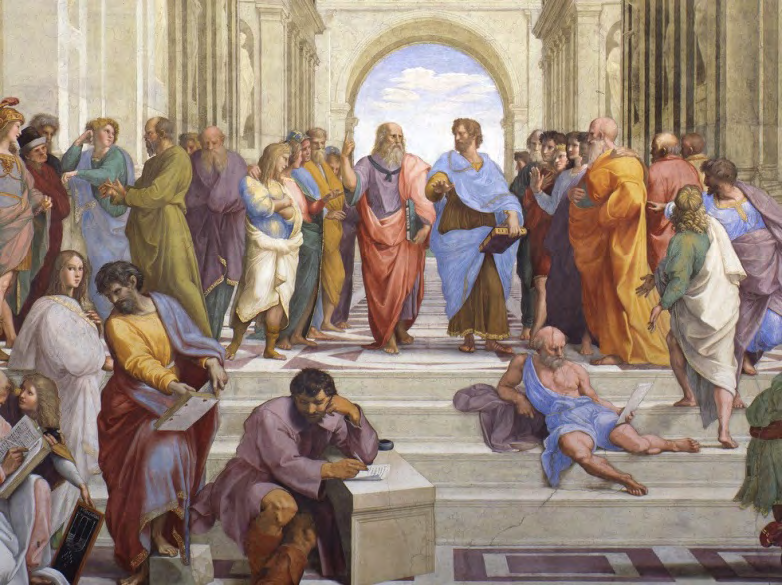
Raphael, School of Athens, 1509-1511, fresco (Stanza della Segnatura, Palazzi Pontifici, Vatican) This leitmotif in epistemology established by Plato – as the doctrine of the episteme that is opposed to the Sophist’s “opinion”, doxa – surfaces clearly in the famous portrayal of the Greek philosophers in the painting The School of Athens by Raphael. A common interpretation of the apparently antipodal hand gestures of Plato and Aristotle is the opposing directions or directionality of knowledge, which can also be seen as the dissimilarity in epistemic referentiality. If, according to Plato, knowledge – as the epistemic act of the human mind – is ultimately to be directed towards eternal ideas or eternal beings, Aristotle insists on the earthly unfolding of eidos or form, which does not require a heavenly accommodation.
In addition to the strategies and measures mentioned above, another and even more important factum has to be emphasized, that significantly influenced the structure of the systems of epistemology in the modern age, specifically the directional nature of the subject in cognition. In the cognitive process, the subject focuses on an object that is cognized, as discussed earlier. The directional nature of the cognition is therefore obviously determined by the nature of the object and also by some subjective strategies and preferences in cognition. That the philosophical rationalism of modernity, which was initiated by Descartes and blossomed in the Kantian transcendental philosophy, is based on the a priori existence of knowledge and its apodicticity, would indicate that besides its origin the directional nature of knowledge refers to certain orientations in cognition. If we consider the development of modern epistemology from Descartes to Kant in the context of a historically unfolding transcendentalism, we recognize the references to a certain orientation of the subject to the directional nature of its cognition. Now the subjective orientation in the cognitive process is implicit in the Cartesian “ego cogito, ergo sum”, but it is clearly explicated in the Kantian definition of the transcendental philosophy. In the introduction to the Critique of Pure Reason, Kant defines his transcendental philosophy, which is fundamentally based on the ‘transcendental’ in knowing, using a reference to the directional nature and orientation of the knowing subject in relation to the object of knowledge:
I entitle transcendental all knowledge which is occupied not so much with objects as with the mode of our knowledge of objects in so far as this mode of knowledge is to be possible a priori. A system of such concepts might be entitled transcendental philosophy.6 The emphasis on the a priori of knowledge indicates that the subject is directed towards the forms of intuition and concepts of understanding that exist a priori in the subject itself. However, since Kant’s transcendental philosophy is basically a philosophy of synthesis – with binding knowledge – the a priori forms of space and time as well as the concepts in the cognitive process are applied to or synthesized with the objects given in sensibility (Sinnlichkeit) – indeed in the context of a synthetic unity of apperception. All of this proves that cognition is clearly dependent on the directionality of the cognition from the subject to the object, as, according to Kant, the given object should be oriented towards the a priori cognizing subject (and not vice versa). Strictly speaking, Kant’s transcendentalism is based on such a directional nature of subjective cognition and, simultaneously, on the orientation of the given object to the subject. These preconditions for transcendentalism are introduced and explained in the foreword to the Critique of Pure Reason using the Copernican revolution as an analogy.
In this most frequently cited example of the Copernican Revolution, Kant refers to the historical reversal of the epistemological relationship between the subject and the
6 Kant, Immanuel: Critique of Pure Reason, trans. Norman Kemp Smith, The Macmillan Press Ltd, London 1982, p. 59 (B25-26). See also Kant, Immanuel: Kritik der reinen Vernunft, ed. Raymund Schmidt, Felix Meiner Verlag, Hamburg 1990, p. 55 (B 30). “Ich nenne alle Erkenntnis transzendental, die sich nicht sowohl mit Gegenständen, sondern mit unserer Erkenntnisart von Gegenständen, insofern diese a priori möglich sein soll, überhaupt beschäftigt. Ein System solcher Begriffe würde Transzendental-Philosophie heißen.“ object, i.e., the object to be cognized. Like the Copernican turn or reversal, in which Ptolemy’s geocentric cosmos, which had prevailed for almost fifteen centuries, was replaced by a heliocentric cosmos, in the transcendental turn of modern epistemology objects should be oriented towards the subject that is now placed at the center:
Hitherto it has been assumed that all our knowledge must conform to objects. But all attempts to extend our knowledge of objects by establishing something in regard to them a priori, by means of concepts, have, on this assumption, ended in failure. We must therefore make trial whether we may not have more success in the tasks of metaphysics, if we suppose that objects must conform to our knowledge. This would agree better with what is desired, namely, that it should be possible to have knowledge of objects a priori, determining something in regard to them prior to their being given. We should then be proceeding precisely on the lines of Copernicus’ primary hypothesis. Failing of satisfactory progress in explaining the movements of the heavenly bodies on the supposition that they all revolved round the spectator, he tried whether he might not have better success if he made the spectator to revolve and the stars to remain at rest. A similar experiment can be tried in metaphysics, as regards the intuition of objects. If intuition must conform to the constitution of the objects, I do not see how we could know anything of the latter a priori; but if the object (as object of the senses) must conform to the constitution of our faculty of intuition, I have no difficulty in conceiving such a possibility. (…) … experience is itself a species of knowledge which involves understanding; and understanding has rules which I must presuppose as being in me prior to objects being given to me, and therefore as being a priori. They find expression in a priori concepts to which all objects of experience necessarily conform, and with which they must agree.7
7 See Kant, Immanuel, Critique of Pure Reason, trans. Norman Kemp Smith, p. 22-23 (B xvii-xviii). See also Kant, Immanuel, Kritik der reinen Vernunft, p. 19-20. „Bisher nahm man an, alle unsere Erkenntnis müsse sich nach den Gegenständen richten; aber alle Versuche über sie a priori etwas durch Begriffe auszumachen, wodurch unsere Erkenntnis erweitert würde, gingen unter dieser Voraussetzung zunichte. Man versuche es daher einmal, ob wir nicht in den Aufgaben der Metaphysik damit besser fortkommen, dass wir annehmen, die Gegenstände müssen sich nach unserem Erkenntnis richten, welches so schon besser mit der verlangten Möglichkeit einer Erkenntnis derselben a priori zusammenstimmt, die über Gegenstände, ehe sie uns gegeben werden, etwas festsetzen soll. Es ist hiermit ebenso, als mit den ersten Gedanken des Kopernikus bewandt, der, nachdem er mit der Erklärung der Himmelsbewegungen nicht gut fort wollte, wenn er annahm, das ganze Sternenheer drehe sich um den Zuschauer, versuchte, ob es nicht besser gelingen möchte, wenn er den Zuschauer sich drehen, und dagegen die Sterne in Ruhe ließ. In der Metaphysik kann man nun, was die Anschauung der Gegenstände betrifft, es auf ähnliche Weise versuchen. Wenn die Anschauung sich nach der Beschaffenheit der Gegenstände richten müßte, so sehe ich nicht ein, wie man a priori von ihr etwas wissen könne; richtet sich aber der Gegenstand (als Objekt der Sinne) nach der Beschaffenheit unseres Anschauungsvermögens, so kann ich mir diese Möglichkeit ganz voll vorstellen. (...) ...weil Erfahrung selbst The expression ‘hitherto’ here, with which Kant begins this seminal consideration, apparently points to the prevailing school of empiricism, as represented in the philosophy of Locke, Hobbes, Hume and others. However, it basically refers to the medieval scholastic philosophy in which the existence of given objects took precedence over their cognizability. Within the framework of scholastic philosophy, the knowing subject should focus on the given individuations that are not to be negated. Kant’s Copernican Revolution is therefore clearly a revision of the Cartesian reversal of the traditional primacy of existence over its cognizability, of ontology over epistemology. Now the preferential position of epistemology takes place differently with the two philosophers. The Cartesian dictum, “I think, therefore I am”, points to the centeredness of thinking and knowing on the modern subject, whereas Kant, in addition to centering the transcendental subject, pleads for the necessary orientation of the given objects towards the subject. Apart from such structural differences, the complete autonomization of the transcendental subject in the Kantian system of philosophy – as explicitly stated in his analogy of the Copernican Revolution – is a clear continuation and reinforcement of the prevalent Cartesian epistemology. The Cartesian epistemological turn culminates in the Kantian Copernican turn, in which the historically unfolding transcendentalism triumphs.
The paradigmatic establishment of the transcendental philosophy by Kant on the basis of a Copernican turn again explicates the directional nature of modern epistemology and its potentials as well as problems. The Copernican turning point in Kantian epistemology is based on two radical or radicalized facts: first, the sun-like centering of the transcendental subject, and second, the directional orientation of the objects that are considered to be merely given to the a priori knowing subject. Both facts together make the power and sovereignty of the transcendental subject in relation to the world, which, according to Kant, is merely given to the subject. For the subject, which is in the center, and to which the surrounding given objects should orientate in the cognitive process, attains the power and sovereignty of the center – or of being in the center – in relation to the orientation of the decentered and as such merely given objects. It is this seizure of power by the transcendental subject through which knowing in the Kantian system of transcendental philosophy takes place exclusively transcendentally and indeed a priori, and the known world is reduced to its mere givenness for the subject (against which Schopenhauer polemicizes in his Kant- Kritik). The fact that the world is regarded as merely given eine Erkenntnisart ist, die Verstand erfordert, dessen Regel ich in mir, noch ehe mir Gegenstände gegeben werden, mithin a priori voraussetzen muß, welche in Begriffen a priori ausgedrückt wird, nach denen sich also alle Gegenstände der Erfahrung notwendig richten und mit ihnen übereinstimmen müssen.“ to a powerful, sovereign subject and not further explicated as such, would presuppose that, within the framework of Kantian transcendentalism, the given world is taken for granted. The transcendental seems to hardly care about the given world, or problematize the given world. It does not ask what, how and why the world is, but takes the givenness of the world for granted.
It is true that the epistemological directionality (as indicated in the analogy to the Copernican Revolution) empowers the transcendental subject to be located in the center of knowledge and to subordinate the given world, which is now to be oriented towards the subject. But at the same time such a transcendental empowerment of the subject signals the emergence of many anomalies and their potential danger, which is inherent in the epistemological- directional nature of cognition itself. The reduction of the world to a mere givenness within the framework of a transcendental epistemology obscures or veils the existence of the world and its necessary participation in every cognitive process. Even in the transcendental doctrine of elements in the Critique of Pure Reason, Kant takes strategic methodological measures that ultimately lead to the assumption of a mere givenness of the world. It is the very last stage of the method of epistemological negation, namely the negation of the spatiality and temporality of given objects and their appropriation by a transcendental subject as pure a priori notions (Vorstellungen a priori), which in the Kantian system of philosophy requires the reduction of the world to a givenness. If space and time are pure a priori notions and, as such, should necessarily be present in the transcendental subject as pure forms or forming potentials of sensibility, only an appearance (Erscheinung) accessible to the subject can remain objective in the sphere of the subject (to borrow an expression from Nietzsche), as the thing-in- itself (Ding an sich) is inaccessible to the subject and, as such, a leftover or residual entity, as implied in the Kantian system. The diremption of the givenness of the object into binary residues – almost in dichotomies – namely the appearance and thing-in- itself, was clearly the inevitable outcome of the apriorization of space and time, through which Kant empowers and autonomises the transcendental subject in his theoretical philosophy.
The ‘Return’ of Objects
The reversal of the epistemological directionality, as a result of which the givenness of objects, of the world in general, begins to rule over the hitherto dominant transcendental subject, turns out not only to be a theoretical-philosophical, but also – and indeed primarily – a historical matter. For the reversibility of the epistemological directionality within the framework of theoretical philosophy is not a coincidence or something that develops out of theoretical philosophy itself, but, as is well known, it requires a historical cause. This seems to violate the ideal notion of the ahistoricity of philosophy to some extent; however it explicates the indispensable historic origins of philosophy in the time where it arises.
The reversal of epistemological directionality does not occur gradually or in a gradual historical process, but radically – almost like a paradigm shift. For such reversals in the theoretical-philosophical framework are normally caused by natural disasters such as earthquakes, floods as well as natural phenomena such as pandemics, which occur in a relatively short period of time. But we can also count socio-political events such as civil wars, revolutions or mass uprisings and rebellions, because those who participate in these resistances have long been suppressed in history by powerful transcendental – i.e., religious, social and political – systems and consequently treated as merely given entities like natural objects. In this respect, the radical eruption of resistance, as represented in the above-mentioned forms, can be seen as necessary consequences of the religious, social and political reification of human beings, in which they – both as individuals and as masses – tend to be taken for granted, i.e. given almost like natural objects, and are therefore viewed as consumable goods. Such oppression of people, represented in the very explicit forms like slavery that existed in feudal societies and the current human trafficking, as well as in the subjugation of people in social and political systems such as feudalism, fascism or dictatorship, is based in principle on an imposed status of being merely given.
It is the factum of object that, in the radical reversal of the epistemological directionality, begins to prevail over the dominant subjectivism of modernity. The well-known natural catastrophes and pandemics that prompted such reversals are particularly noteworthy, for they demonstrate the radical emergence and transformation of the factum of object – from a state of being merely given into power. The most well-known example of a natural catastrophe that had a radical effect on the prevailing rationalism and the associated scientific optimism of modernity was the earthquake in Lisbon in the 18th century. Other natural phenomena – before and after the Lisbon earthquake –, which are relevant in this regard would be the pandemics such as the bubonic plague in the Middle Ages, which broke out in 1347, and the Spanish flu in the early 20th century as well as the current covid-19 pandemic. How did the plague start affecting the general mindset of people in the Middle Ages? Coupled with the failure of Crusades, the radical and fatal spread of the fourteenth-century bubonic plague, popularly known as Black Death, seemed to give rise to a certain genesis of doubt, which began to undermine the dominant and all-overpowering medieval Christian religious belief or belief system, as brilliantly portrayed in Ingmar Bergman’s masterpiece, film The Seventh Seal (1957). At this juncture we have to ask afresh whether the historically recognized Cartesian origin of modernity, which was philosophically based on the epistemological method of doubt, had a prehistory or a prehistoric genesis in the Middle Ages. In all likelihood, the age of doubt began much earlier in the Middle Ages, even though it culminated in Descartes and emerged quite explicitly in the Cartesian modernity.
The earthquake in Lisbon on 1st November 1755, which completely destroyed the capital of Portugal, was known to be the moment of one of the greatest failures of modern scientific-rational optimism – a rupture in modernity built primarily on Cartesian rationalism. This natural catastrophe had a significant impact on modern thought, especially on the perspectives of philosophers. Rationalists like Leibniz tried in vain to maintain the long-established rationalism and consequently not to break away from his idea that our earthly world is the best of all worlds that God ever created. As before, Leibniz believed in a pre-established harmony of the world. In contrast, Voltaire polemicized in his well- known poem Poème sur le désastre de Lisbonne (1759) that the rational optimism of man is hardly confirmed by nature.
In the current pandemic, which in many of its fatal effects resembles the previous natural disasters such as the Lisbon earthquake or Black Death, we can identify a recurring factum of object that – in its independence and autonomy – opposes the historical progress of the modern subject. At first glance, this setback in modernity seems prima facie to produce some morphoses in the long-established and prevailing theoretical-philosophical foundations. As before, we are in the age of Kantian transcendentalism, which – as a historically significant revision and continuation of the Cartesian revolution in thought – ensures and guarantees the hegemony and sovereignty of the transcendental subject, as previously discussed.
The transcendental turn of modernity primarily aimed at the enlightenment of the human mind (as explicated by Kant in his pre-critical essay Was ist Aufklärung) and, consequently, at securing and guaranteeing the dignity and sovereignty of an individual human being. However, Kantian transcendentalism again presupposed the strengthening and uninterrupted continuation of many of the fundamental principles and traits of early modernity. The most important of these would be the dictum implicitly represented by Francis Bacon – with a clear biblical connotation – dominium terrae, “subdue the earth”. The characteristic disappearance of the ‘object’ in Kant’s theoretical philosophy – between a merely transcendental phenomenon of appearance (Erscheinung) and a thing-in-itself inaccessible to the transcendental subject – implies the strategic reification of nature, tacitly legitimized in the post-Kantian modernity. The factum of object was almost completely subsumed under the factum of an overpowering transcendental subject, as reflected both in the basic Kantian notion of the thing-in-itself and in Husserl’s revisionist-transcendental idea of the bracketing of objects – “Einklammerung” – as transcendental reduction in relation to the transcendental “ego.” While the Lisbon earthquake signaled a clear rift in the progressive Cartesian rationalism of early modernity, the prevailing transcendentalism undergoes an analogous setback in the current pandemic. In both cases the rational- transcendental subject seems to fail in its supremacy and hegemony and in its unceasing conviction that man rules over the world and nature. The necessary consequence of such historical setbacks would be a reversal of the dominant transcendentalism itself, represented in theoretical framework as the reversal of the epistemological directionality discussed earlier. All over the world people now have to orient towards an object, i.e. Corona virus and its various mutations, so as to survive at all. The dictum that has been handed down since antiquity, “Man as the measure of all things” (Protagoras), seems no longer to apply. The virus, which spreads quickly and proves invincible in many mutations, determines our life and its prerequisites – in everyday life, in politics, economy, education, etc. A tiny invisible object can now bring all our transcendental institutions – industries, private and public institutions and infrastructure, trade, business, social life – to a standstill! Military forces of powerful nations are completely powerless against the virus!
Thus, in the current pandemic the factum neglected by Kant, i.e., the givenness of objects, seems to emerge powerfully against a transcendental subject. Like a revelation, the pandemic awakens us into the awareness that the world is no longer transcendentally predetermined, but objectively given, and we must first experience the world a posteriori. The much speculated multiplicity or plurality of subjective perspectives also has little validity here, because the powerful surfacing of the factum of object and its givenness – as clearly opposed to its transcendental-subjective apriorization – invalidates the subjective perspectives, which now, both as individual and collective perspectives, should focus on the givenness of objects, of the world in general.
Conclusion
The givenness of objects and the world that consists of objects – both in the theoretical-philosophical as well as in the historical framework – refers to a unique dilemma in our earthly existence, which we usually discard in everyday life. For our mental world rules over the environment, i.e., the surrounding world of objects, whose indispensable participation in our cognitive processes and everyday life we tacitly ignore. Our world is built on particular objects, although we gain abstract and universal knowledge from them. Cognitive abstraction and generalization might lead us to merely overlook the participatory function of objects in their particularity.8 The participation of given objects in the process of cognition – in sensory perceptions, mathematical- and mechanical-formal intuitions, conceptual cognitions, etc. – occurs primarily within the framework of natural sciences. However, it constitutes an essential factor of philosophical thought, even though it was strategically repressed in the modern age. Such a repression of the given within the framework of epistemology can be traced back to the unfortunate divergence between the natural sciences and philosophy – correspondingly to the divergence and mutual alienation between philosophical and scientific epistemology in the early modern period. As the participation of the given objects, the world in general, proves to be an indispensable prerequisite of philosophy and, therefore, of our mental world, our cognition of the given world should involve an equal, mutual and harmonious participation of the philosophical and scientific epistemologies. The reduction of the world of objects to a mere givenness, which was thus marginalized within the framework of modern philosophical epistemology, apparently led to a paradigmatic apriorism in modernity, represented in particular in the theories of perception and cognition. The need for the external physical world to participate in the internal mental world has been strategically ignored. The paradigmatic establishment of apriorism in modernity – such as the insistence on the intromission theory of vision or the apriority of knowledge within the framework of transcendental philosophy and their designation as closed theories – applies not only to philosophy and philosophical sciences, but also to natural sciences; it can be identified, for example, in the mathematical formalism that prevails till date, and on which the axiomatics of many modern sciences are based. The participation of the external and given world of objects in our mental processes and states, represented in various forms of sensory perception, mental cognition, judgment, etc., cannot plainly be subordinated to a prevailing or almost paradigmatically established transcendentalism. Knowing and the objects of the world subject to it form hardly an epistemological- hierarchical order; instead, they complement each other in a participatory manner.
8 For Jorge Gracia particular comes from partaking, which also refers to the basic Platonic idea of the participation of particular objects – as natural objects, sensory qualities, human virtues, etc. – in universal ideas. See Gracia, Jorge J. E.: Introduction to the Problem of Individuation in the Early Middle Ages, Philosophia Verlag, München/Wien 1984, p. 25. “For particularity has to do with an individual’s “participation in” or “partaking of” a universal. In this sense the individual is considered as being a part of something else, or as partaking of it. Thus, a man, for example, is particular (particularis) in that it participates in man, which itself is not particular.”
References
-
Barber K (1994) Individuation and Identity in Early Modern Philosophy. Kenneth B, Jorge JE. Gracia (Eds.), State University of New York Press, New York.
-
Descartes R (1997) Key Philosophical Writings. Elizabeth S Haldane, G. R. T. Ross (Trans.), Wordsworth Classics of World Literature, Hertfordshire.
-
Descartes R, Kenny A (1970) Philosophical Letters. Oxford.
-
Gracia Jorge JE (1984) Introduction to the Problem of Individuation in the Early Middle Ages, Philosophia Verlag, München/Wien.
-
Kant I (1982) Critique of Pure Reason. Norman KS (Trans.), The Macmillan Press Ltd, London.
-
Kant I, Schmidt R (1990) Kritik der reinen Vernunft. Felix Meiner Verlag, Hamburg.
-
Nye A (1999) The Princess and the Philosopher. Letters of Elisabeth of the Palatine to René Descartes, Rowman & Littlefield Publishers, Lanham.
-
Schopenhauer A (1969) The World as Will and Representation. Payne EFJ (Trans.), 1st (Vol.), Dover Publications, New York.
-
Schopenhauer A (1986) Kritik der Kantischen Philosophie. In: Die Welt als Wille und Vorstellung, Sämtliche Werke, Band I, Suhrkamp Verlag, Frankfurt am Main.
- The Place of Wittgenstein’s Tractatus in the History of Philosophy
- Digital Hermeneutics Embodied in Brian Kim Stefans’ “The Dreamlife of Letters,” and Memory: Analog to Flash Interface in the Light of Ecofeminism
- Using C-Tables to Teach Class Logic
- The Ideology of Education’s Postponed Fantasies: Deepenings on a Pressing Problematic
- Phantasia and Perceptual Realism in Aristotle
- The Pleasures of Solitude