
On Music and Tradition
In this paper we elaborate on the question how to bridge the gap between contemporary (New) music and the tradition of the past, often called ‘classical’ music. First we analyze the notion of tradition (in classical music) as being distinct from traditional music, nationalism and traditionalism. A central role in this paper is dedicated to the role of counterpoint education following J.J. Fux’s Gradus ad Parnassum in the development of Central-European classical music between the late Renaissance and late Romantic periods. The developments in the 20th century New Music reveal several important trend breaks. The controversies raised during the early Renaissance, regarding the practice of polyphonic singing, are discussed with respect to their impact on music development in later ages. From these controversies and the re-discovery of Nicholas de Cusa’s view on mysticism, the experience of the non-experience in polyphonic music is elucidated. Herewith, an illuminative heuristic is found in the enfolding-unfolding paradigm both in music and pictural arts, from the Renaissance till the present.
Outline
- Introduction: Tradition versus Traditionalism
- Sergei Prokofiev’s neo-classical revolution (
Introduction: Tradition versus Traditionalism
The original idea for this paper resulted from an introduction given by Gabriel Prokofiev (°1975), at the performance of his Piano Trio nr 1 by the Van Baerle Trio (Maria Milstein, violin, Gideon den Herder, cello, and Hannes Minnaar, piano) in Amsterdam [1]. The question “how to bridge the gap between contemporary music and the (neo- classical) music of Sergei Prokofiev (1891-1953)” was also an intriguing question, and, because it wasn’t at all self-evident, it became a luring quest. Of course, the official records had filed some space on the shelves of musicology regarding to Prokofiev’s life and career. Sergei Prokofiev wouldn’t have been happy at all with the name ‘neo-classicism’, which would remind him of “the music of Mozart, but with the wrong notes”. We were lucky to find an abridged edition of Sergei Prokofiev’s diaries [2], in order to shed some light on the early period of Prokofiev’s career as a composer. Both his First Violin Concerto (opus 19) and First Symphony, the so- called ‘Classical’ Symphony (op. 25) as well as his Third Piano Concerto (op. 26) [3] were all composed around 1917, the year of the two Russian Revolutions (see ¶ 2. Sergei Prokofiev’s neo-classical revolution and contemporary music).
But, the quest didn’t end with reading his famous diaries. The question how music is related to tradition, and the importance of that question going beyond traditions and the historical impressions it has left today, was rather a matter of carving out the unwanted connotations like ‘traditionalism’, that have spoiled its core. Keeping aloof from traditionalism means, for instance, avoiding the heinous conflicts around the question whether the 18th century patriotic poems Rule, Britania (music by Thomas Arne, 1740) and Land of Hope and Glory (music by Edward Elgar, 1902), make or make not an essential part of the tradition of the Last Night of the Proms [4]. This paper also isn’t about the traditional yearly performances of Johann Sebastian Bach’s (1685-1750) Matthäus Passion (1727) or Johannes Passion (1724) around the Easter celebration (in Christian tradition), neither we will dwell on all kind of popular tunes used in commercials, radio and TV-broadcasting, and so on. We will come back to the notion of music as ‘fertile soil for resentment’, as Friedrich Nietzsche puts it in 1988 [5] regarding the late operas of Richard Wagner (1813-1883) (see ¶ 3. The end of Romanticism, universal beauty and fertile soil for resentment).
Another example: a concert festival with contemporary classical music, the quite sophisticated genre of the string quartet!1. Some people have their young child with them. The child, an 8 to 11 year boy is clearly bored, he doesn’t understand the complex music. Some people in the audience get angry, and for me as a listener, the concert is really spoiled. I am not only bothered by the child that is not behaving as expected (for an adult), but also by the adults who can’t stand the little brat. What does the child miss, or, what prevents him from connecting with the music? It is probably an experience that we, or many of us, remember from our youngest years. What has changed in our minds, between these very first musical experiences, till the moment that we fully appreciate, enjoy and sometimes even comprehend this sophisticated music?
So, we might find out that tradition goes along with education, and, without education of some kind, tradition is lost in oblivion. But then, what is the impact of music writing (as opposed to the tradition of performing) and of longstanding severe counterpoint training, as for instance manifested in the Italian-German tradition of composition? We will elaborate on the remarkably successful role of the Gradus ad Parnassum of the Austrian baroque composer Johann Joseph Fux (1660-1741) [6] and his great influence on the First Viennese School (Joseph Haydn [1732, 1733, 1734, 1735, 1736, 1737, 1738, 1739, 1740, 1741, 1742, 1743, 1744, 1745, 1746, 1747, 1748, 1749, 1750, 1751, 1752, 1753, 1754, 1755, 1756, 1757, 1758, 1759, 1760, 1761, 1762, 1763, 1764, 1765, 1766, 1767, 1768, 1769, 1770, 1771, 1772, 1773, 1774, 1775, 1776, 1777, 1778, 1779, 1780, 1781, 1782, 1783, 1784, 1785, 1786, 1787, 1788, 1789, 1790, 1791, 1792, 1793, 1794, 1795, 1796, 1797, 1798, 1799, 1800, 1801, 1802, 1803, 1804, 1805, 1806, 1807, 1808, 1809], W.A. Mozart [1756, 1757, 1758, 1759, 1760, 1761, 1762, 1763, 1764, 1765, 1766, 1767, 1768, 1769, 1770, 1771, 1772, 1773, 1774, 1775, 1776, 1777, 1778, 1779, 1780, 1781, 1782, 1783, 1784, 1785, 1786, 1787, 1788, 1789, 1790, 1791], L. van Beethoven [1770, 1771, 1772, 1773, 1774, 1775, 1776, 1777, 1778, 1779, 1780, 1781, 1782, 1783, 1784, 1785, 1786, 1787, 1788, 1789, 1790, 1791, 1792, 1793, 1794, 1795, 1796, 1797, 1798, 1799, 1800, 1801, 1802, 1803, 1804, 1805, 1806, 1807, 1808, 1809, 1810, 1811, 1812, 1813, 1814, 1815, 1816, 1817, 1818, 1819, 1820, 1821, 1822, 1823, 1824, 1825, 1826, 1827],..) and numerous composers after them (see ¶ 4. An eternal
1 Kronos Quartet (and other performers) (2023). Kronos’ Fifty for the Future Weekend, 6-7 May 2023, Amsterdam.
Gradus ad Parnassum). The inscription of J.J. Fux’ Gradus ad Parnassum in the tradition of Central-European music, obviously furthers questions about the pioneering roles of the renaissance composers before him, especially Giovanni Pierluigi de Palestrina (1525-1594) and Claudio Monteverdi (1567-1643). But also it raises questions about the revolutionary movement that opposed this Central- European tradition, such as entailed by Claude Debussy’s (1862-1918) composition ‘Doctor Gradus ad Parnassum’ (part 1 of the bundle ‘Children’s Corner’, 1908). Debussy composed this bundle for his little daughter, shortly before Arnold Schoenberg (1874-1951) started experimenting with atonal compositions and founded the so-called Second Viennese School (with Alban Berg and Anton Webern).
Another opinion is that only in recent times – in contrast to previous era - so much attention is given to classical music. However, there is not much proof for that opinion, especially when old documents are consulted. In this paper, we will follow a five-layered archaeologic-musicological excavation of what may appear or unveil both the origins and their tradition of ‘classical’ music. Etymologically, tradition is derived from the Latin verb tradere, literally to hand over. But it is not money that is traded or transferred, nor a financial value that constitutes the essence of the transaction (through the generations). The diagrams or music scores may be stored in archives for ages, but the unfolding of the music in sounding voices, instruments, … used to be immediate and also immediately lost, at least during the many centuries when recording technology still had to be discovered. But ‘tradition’, in our perspective after all, also isn’t about the question how our contemporary, postmodern performance and recording tools have or have not mimicked the past experience.
It is heard, at many occasions, that it is a bewilderment, following an excessive, mystical experience of the unheard beauty of some music, that is overflowing our senses, and, that eventually may give us comfort when we are grieving. But such an ‘oceanic’, submerging approach to mysticism in music, is not uncontested. And, even if I may remember a ‘holistic’, comforting experience from listening e.g. to some simple melody line in a movie-picture, it is not what the mysticism of the old medieval masters was about. It will appear, that a most bewildering narrative of enfolding and unfolding reality in listening to music was lost for ages, but re-discovered, as we may learn from a philosophical excavation of the so-called ‘dark ages’ (see ¶ 5. Mysticism and the Coincidentia oppositorum of Nicholas of Cusa).
Sergei Prokofiev’s Neo-Classical Revolution (1917) and Contemporary Music
But first, let’s return to the revolutionary impetus worked out by Sergei Prokofiev, being inspired by his argument with critic and ballet producer Sergei Diaghilev (1872-1929), the latter arguing about Prokofiev’s modernism that was too ‘Russian’ to be cosmopolitan or futuristic (according to Diaghilev’s standards)2 . Here, we may recall the delicate balances between nationalism and tradition in music and, in hindsight, also the unpredictable paths of new music [7, 8]. Sergei Prokofiev was born in 1891 in the town Sontsovka, Ukraine, which then belonged to the Russian Empire. Today, it is only a day’s walk from his native place to Avdiivka and the frontline of the Russian-occupied Donbass region. In the dispute with Diaghilev, the latter reproaches Prokofiev of being inclined towards his home-base fans, in Charkov (Ukraine), “where there is not much difference between Charkov and Petrograd (St Petersburg)” (and, between the lines, it is understood: “although there is a huge discrepancy with Paris and the Western world”). Prokofiev witnessed the two revolutions of 1917, the first in February, when the reign of the Tsar Nicholas II was overthrown, the turmoil that made Prokofiev excitedly run through the streets of Petrograd [2] and the second revolution or Bolshevist take-over in October... In 1918, Prokofiev started ‘five wandering years’, composing and giving concerts all through Europe, America and Japan. He settled in 1923 in Paris, but regularly revisited the Soviet Republic in the following decade. Initially, he was welcomed there as a world-renowned Russian musician- revolutionary. In 1933, he definitively returned to the U.S.S.R. and remained, till he died from a cerebral hemorrhage on March 5, 1953. That was also the very day of the death of Stalin (1878-1953). Prokofiev was posthumously honored with the Lenin Prize in 1957 and became one of the most popular Ukrainian-Russian composers of the 20th century. But unlike his somewhat younger fellow composer, Dmitri Shostakovich (1906-1975), he was far less hailed as a victim of soviet repression. This may have toned down his popularity in Western Europe.
Of course, many more influential composers could be listed in this review, which however is not intended to be exhaustive. The beginning of the 20th century is very illustrative though, because of the many avant-garde composers, futurists and innovators and the so-called synesthetic mingling of music with visual arts (see also ¶ 5. Mysticism and the Coincidentia oppositorum of Nicholas of Cusa). For instance, the works of the Lithuanian painter-composer Mikolajus K. Čiurlionis (1875-1911), of the Russians Alexander Scriabin (1872-1915), the poetic ‘futurist’ Vladimir V. Majakovski (1893-1930) and of course, the well-known Igor Stravinsky (1882-1971), all played an important role, and, with the exception of Čiurlionis, were also recognized by Prokofiev [2].
2 See Prokofiev’s reflections upon his disputes with Diaghilev in Prokofiev’s diary notes of 18 February 1915, 25 Febr.-5 March 1915 (written in Rome/Naples) and the friendly words (of admiration) by Igor Stravinsky (20-22 March 1915, Milano)(see ref. 2) Listening to the first and third movement of Prokofiev’s First Violin Concerto (in D-major, op. 19), a curious cadenza appears at the end of the first (Andantino) and the third (Moderato-Andante) movement. It sounds like a veiled hint to the famous Dresdener Amen, a well-known musical phrase from the Lutheran church3, and used by Wagner in his famous Parsifal (1882) opera. Wagner’s last opera, however, was fiercely criticized, not only by Nietzsche [5] (see ¶ 3. The end of Romanticism, universal beauty and fertile soil for resentment ), but also by Debussy [3], and many others that loathed the overt Christian symbolism in his work. Prokofiev’s reference, although not documented as such, suggests a playful, maybe sardonic hint to this old-German tradition. In his version, the subsequent chords are adorned as a sequence of triols of the solo violin, rising up like a butterfly drunk of the angel’s nectar, doubled by a softly dubbing flute tune. According to a review in The Strad, this feature of Prokofiev’s concerto are unique and ingenious: “no other concerto in the general violin repertoire operates like that. They are like a bracing splash of iced water in the face (…)” [9].
If such a link, between a phrase from Lutheran service in Saxony, passed over through the iconic composer’s hands in Parsifal and sardonically transformed by the Russian dandy-par-excellence Sergei Prokofiev, is perceived by the listener’s ear, but not established as a ‘real’ causal inference, - because it was not officially recognized by the composer, as far as we know - what then may significate such a link for the tradition of music? Is it just playfulness, or, is it an example of playfulness at some occasion inscribed within the indulgent contours of musical tradition? Here, we may borrow a quote from Schoenberg, about borrowing from one discipline into another: “Drama and poetry are greatly inspiring to a composer. But much of what they evoke on the one hand, they revoke on the other. A melody, if it followed the dictates of its musical structure alone, might develop in a direction different from that in which a text forces it.”4[10]. The borrowing from one aspect of culture into another will become a prominent feature of cultural tradition in the 20th and 21th centuries (see below). And once again, we arrived at the iconoclastic drivers of 20th century Western music reforms [11].
The End of Romanticism, Universal Beauty and Fertile Soil for Resentment (Nietzsche, 1888)
In the second half of the 19th century, when Romanticism flourished in European music, also strong opposing movements appeared, at first in Germany and followed by
3 The Dresdener Amen is a sequence of 6 chords in rising order, sung during the church services in Saxony since the beginning of the 19th century.
4 A. Schoenberg (1954)(op. cited), p. 76.
more igniting reactive trends in France and elsewhere. The contrast between the so-called conservative (romantic) music of e.g. Johannes Brahms (1833-1897) or Anton Bruckner (1824-1896), versus the reformers Franz Liszt (1811-1886) and Richard Wagner, not only is notorious in music history, but it is also often misunderstood. According to Schoenberg, Brahms too could be considered ‘progressive’, a view shared by many 20th century listeners, writers and composers [10, 12, 13, 14]. Even today, the musical modernisms of Brahms (as well as of Schoenberg) seem to ‘haunt’ contemporary composers, such as Thomas Adès (in his own words) [15].
The opposition to Wagner’s ‘modernisms’ is well-known, although presumably also misunderstood according to Schoenberg (13), following the cynical publications of the late Nietzsche5[5, 16]. The Overture of Wagner’s Oper Lohengrin, first conducted by Liszt in Weimar (1850), was much appreciated at the epoch, the young Nietzsche being one of his fiercest admirers. Schoenberg [13] focused on the novelty of Wagner’s tonal transformations in Lohengrin, in particular in the Prelude to Act III and in Elsa’s Traum6. The ‘universal beauty’ of Wagner’s Tristan und Isolde (1865) theme will inspire philosophers like Slavoj Žižek (°1949, Ljubljana, Slovenia) for his notion of the ‘Sublime’ in music [8]. For the late Nietzsche, however, the perception of Wagner’s music and the over-excitability of his nerves are transformed into an unheard resentment [5]. The ‘fertile soil’ for resentment, a typically Nietzschean notion associated with the notions of nihilism and decadence in Western culture7[17], then became applied to Nietzsche’s ‘favorite’ music composer, in his own words, to the ‘incarnated, practical Schopenhauer’ [18]. His spectacular conversion became published as Der Fall Wagner [5]. It was published 5 years after Wagner’s demise, and 6 years after his much criticized ‘Christian’ opera Parsifal (1882). In Nietzsche’s words: “In the beginning of Wagner there is the hallucination: not of sounds but of gestures(…)”8. The word ‘hallucination’ suggests that Nietzsche (after some time) became aware of the intoxicating, addictive properties of Wagner’s music. According to the philosopher, Wagner
5 Assailed by doubts whether or not to publish the ‘serious’ sequel Nietzsche contra Wagner (December 1888), Nietzsche finally decides not to publish it (January 2nd, 1889), just one day before his catastrophic nervous breakdown (see also ref. 16).
6 A. Schoenberg, 1954, (op. cited), p. 103, resp. 104.
7 See e.g. Nietzsche’s Nachgelassene Fragmente (NF), in: Kritische Gesammtausgabe Werke (KGW), Abteiling VIII, 14-15 (re-edited by G. Colli and M. Montinari, Berlin, New York: W. de Gruyter).
8 “Bei Wagner steht im Anfang die Halluzination: nicht von Tönen, sondern von Gebärden. Zu ihnen sucht er erst die Ton-Semiotik. Will man ihn bewundern, so sehe man ihn hier an der Arbeit: wie er hier trennt, wie er kleine Einheiten gewinnt, wie er diese belebt, heraustreibt, sichtbar macht. Aber daran erschöpft sich seine Kraft: der Rest taugt Nichts. Wie armselig, wie verlegen, wie laienhaft ist seine Art zu ‘entwickeln‘, sein Versuch, Das was nicht auseinander gewachsen ist, wenigstens durcheinander zu stecken!“ (F. Nietzsche, 1888, op. cited, eKGW, ¶ 7).
uses the ‘semiotics’ of sound sequences (Leitmotivs), that Nietzsche however doesn’t fully comprehend, as we may read in the same work of Schoenberg9. The single most important hallmark (since Beethoven) of music development in the romantic era, the Leitmotiv, is scornfully dismissed by Nietzsche as nothing more than a ‘tooth-pick’, when it comes to Wagner’s elaboration of it10.
However, the accurate analysis of Wagner’s modernization of romantic composition, as shown by Schoenberg [5], was also recognized by others. Among them we found one of the most ardent defenders of the Second Viennese School, Theodor W. Adorno (1903-1969), in his Kranichsteiner Lectures [19]. Notwithstanding this, instead of Wagner’s operas, in the 20th century musicological tradition it is rather the revolutionary transformation(s) of Schoenberg’s atonal and 12-tone music, as worked out in his Harmonielehre [20], that marked the New Music era [21]. Through the publication of extensive textbooks, conference lectures and philosophical publications, both Schoenberg and Adorno strived for a fundamental re-education of the new generations of musicians. Nevertheless, despite the strong anti-Wagner sentiments, as echoed in the French tradition starting with Debussy [3], Wagner’s legacy will strongly influence the postwar culture in the West through the Hollywood film industry [22]. According to Alex Ross [22], this habit started already with the musical accompaniment of D.W. Griffith’s (1875-1948) silent film The Birth of a Nation (1915), orchestrated by staged music pioneer Joseph Carl Breil (1870-1926). Breil was an American tenor who started experimenting with movie-music. Unfortunately, the racist propaganda in this sadly influential movie picture has strongly exacerbated the negative aura of Wagner’s music and cultural legacy [22].
The coupling of the Leitmotiv element to visual themes and personages, which became a notorious feature in film- music, has marked another land slide transformation of Western culture. Namely it became a harbinger for the take-over of auditive by visual communication (way before video did). Beside that, the reproductive revolution of mass culture by film technology, in the sense of Walter Benjamin (1892-1940) [23], provided a completely new audience for this music. Moreover, it was no longer necessary to follow the long, laborious road to composing music by learning counterpoint and reading and writing multiple scores, such
9 A. Schoenberg, 1954, (op. cited), p. 105.
10 “Was gar das Wagnersche ‘Leitmotiv’ betrifft, so fehlt mir dafür alles kulinarische Verständnis. Ich würde es, wenn man mich drängt, vielleicht als idealen Zahnstocher gelten lassen, als Gelegenheit, Reste von Speisen los zu werden. Bleiben die ‘Arien’ Wagners – Und nun sage ich kein Wort mehr.“ (F. Nietzsche, 1888, op. cited, eKGW, ¶ 8).
as the education of harmony and counterpoint had shown in previous centuries (see below: ¶ 4. An eternal Gradus ad Parnassum).
One example of 20th century’s sturdy endeavor to preserve the tradition of counterpoint education, however is found in the work of Paul Hindemith (1895-1963) [24]. However, his composition work was scornfully defamed by Adorno [21], allegedly for its ‘reactionary composition tendency’. Today, Hindemith may not be listed among the most progressive composers of his time (e.g. compared to Edgar Varèse [1883, 1884, 1885, 1886, 1887, 1888, 1889, 1890, 1891, 1892, 1893, 1894, 1895, 1896, 1897, 1898, 1899, 1900, 1901, 1902, 1903, 1904, 1905, 1906, 1907, 1908, 1909, 1910, 1911, 1912, 1913, 1914, 1915, 1916, 1917, 1918, 1919, 1920, 1921, 1922, 1923, 1924, 1925, 1926, 1927, 1928, 1929, 1930, 1931, 1932, 1933, 1934, 1935, 1936, 1937, 1938, 1939, 1940, 1941, 1942, 1943, 1944, 1945, 1946, 1947, 1948, 1949, 1950, 1951, 1952, 1953, 1954, 1955, 1956, 1957, 1958, 1959, 1960, 1961, 1962, 1963, 1964, 1965], Karlheinz Stockhausen [1928, 1929, 1930, 1931, 1932, 1933, 1934, 1935, 1936, 1937, 1938, 1939, 1940, 1941, 1942, 1943, 1944, 1945, 1946, 1947, 1948, 1949, 1950, 1951, 1952, 1953, 1954, 1955, 1956, 1957, 1958, 1959, 1960, 1961, 1962, 1963, 1964, 1965, 1966, 1967, 1968, 1969, 1970, 1971, 1972, 1973, 1974, 1975, 1976, 1977, 1978, 1979, 1980, 1981, 1982, 1983, 1984, 1985, 1986, 1987, 1988, 1989, 1990, 1991, 1992, 1993, 1994, 1995, 1996, 1997, 1998, 1999, 2000, 2001, 2002, 2003, 2004, 2005, 2006, 2007] and others), but his oeuvre certainly did point to the important role of education in music tradition.
An Eternal Gradus Ad Parnassum (Johann Joseph Fux, 1725)
Unlike the modernizations initiated by the Second Viennese School [20, 21] the work of the author of Gradus ad Parnassum, according to Alfred Mann (1917-2008) [6], not only founded a two centuries flourishing tradition with some of the greatest European composers (Haydn, Mozart, Beethoven, Brahms…), it also unified instead of separated the Italian and German composing traditions. Vienna thus not only became the center of the First Viennese School, it also became the melting pot of European culture of the era. But, unlike Robert Musil in his famous novel [25], we’d rather move on from the nostalgic admiration of the cultural role of Vienna in the subsequent era (referring to Musil’s sarcastic renaming into ‘Kakania’, i.e. the lost land of the double monarchy).
What was the success formula of J.J. Fux (1725) that inspired so many contemporary composers and followers? But first, we have to stress that Fux’s counterpoint textbook not at all was meant to curtail the creative achievements and ambitions of those innovative composers that were popping up in the first half of the 18th century, like Antonio Vivaldi (1675-1741) – who seemed to have experienced the fame of a ‘rock star’ according to his contemporaries - and Jean Philippe Rameau (1683-1764), two composers that still today are recognized for their trend-breaking work. It is well-known that some of Vivaldi’s compositions were used and transformed by J.S. Bach, which wasn’t unusual at the time [26]. In the words of Fux, - memorized and repeated by A. Mann, in his introduction to this work [6]: “It is to the diseased that one gives medication, not to those that are in good health. (…) I wouldn’t try to resist to the torrent precipitating through and overflowing the high river banks (précipitamment les berges)”11. Herewith, Fux referred to the ‘healthy’ composers that created such innovative music that would stand the times.
Another misconception regards the strictly determined, arithmetic construction of the 18th century counterpoint (see e.g. references in [11]). This tradition would have consolidated the European music of the following ages, by enforcing strict counterpoint rules, as if they were carved out in stone! This misconception is easily brushed away by reading the patient step-by-step education of the putative pupil throughout the work. Of course, rules exist in counterpoint, but these also follow human practices, derived from the human ear, the capacity of human singing and usage of harmonious chords. It is not that exceptions or divergences are not allowed, but they are always associated with the effect on human auditive experience (see examples below). It appeared, that this method of instruction and education would lead to an unmatched, flourishing tree of new musical ‘discoveries’ in the forthcoming era.
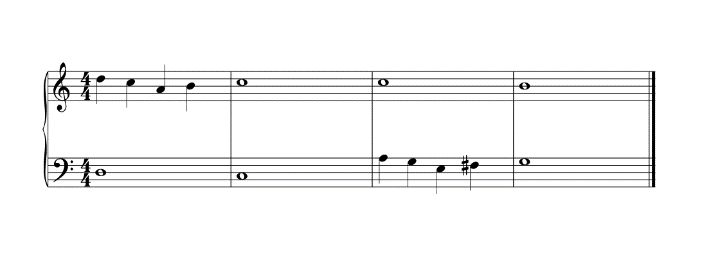
![Figure 1: Example of a note-against-note-counterpoint education exercise borrowed from J.J. Fux (1725) Gradus ad Parnassum [6]. The cantus firmus (melody line) is in the lower stave. The double sharps in the counterpoint stave (above) here indicate suggestions for improvement, made by the fictitious master ‘Aloysius’ (referring to Da Palestrina). The suggested correction is to avoid an interval consisting of an augmented (major) sixth for the singers (J.J. Fux, op. cited, p. 28).](/fulltextimages/12471/fig_1.png)
Figure 1: Example of a note-against-note-counterpoint education exercise borrowed from J.J. Fux (1725) Gradus ad Parnassum [6]. The cantus firmus (melody line) is in the lower stave. The double sharps in the counterpoint stave (above) here indicate suggestions for improvement, made by the fictitious master ‘Aloysius’ (referring to Da Palestrina). The suggested correction is to avoid an interval consisting of an augmented (major) sixth for the singers (J.J. Fux, op. cited, p. 28).
11 J.J. Fux (1725, 2012ed), p. 16.
The following examples from the Gradus ad Parnassum [6] illustrate some of what was called ‘forbidden’ intervals, such as the (chromatic and diatonic) second, the augmented fourth and augmented sixth, the octava battuta (= opening with an octave on a first measure )12. The master accompanies his pupil in a step-by-step course through the counterpoint of the first kind (note against note), 2nd, 3rd, 4th kind (species). Some forbidden intervals can be easily solved (e.g. by the nota cambiata to correct a dissonant in a 3rd kind counterpoint)13 and difficult progressions made easier (for the singing voice), e.g. by diminution of the fifth, etc.14 (Figures 1,2). The Italian terms (diabolica, battuta, cambiata,…) and Fux’s frequent references to the possibilities of the singing voice, make no secret of the fact that his main inspiration was derived from the Italian, late Renaissance, vocal polyphonic tradition, especially from the oeuvre of Da Palestrina.
In his foreword, Alfred Mann explains how also the controversial modernisms of Monteverdi’s polyphony, and that of some of his contemporaries, eventually have added to the didactic assets of Fux’s method [6]. Not the criticisms of an ‘obsolete’ pedagogy (Hugo Riemann, 1849-1919) [27] nor a stronghold for the tradition of ‘reactionary’ compositions against the relatively new ‘baroque’ style of the epoch (e.g. the strong opposition associated with the name of Giovanni Artusi [1540, 1541, 1542, 1543, 1544, 1545, 1546, 1547, 1548, 1549, 1550, 1551, 1552, 1553, 1554, 1555, 1556, 1557, 1558, 1559, 1560, 1561, 1562, 1563, 1564, 1565, 1566, 1567, 1568, 1569, 1570, 1571, 1572, 1573, 1574, 1575, 1576, 1577, 1578, 1579, 1580, 1581, 1582, 1583, 1584, 1585, 1586, 1587, 1588, 1589, 1590, 1591, 1592, 1593, 1594, 1595, 1596, 1597, 1598, 1599, 1600, 1601, 1602, 1603, 1604, 1605, 1606, 1607, 1608, 1609, 1610, 1611, 1612, 1613]), determined the historical relevance of Fux’s masterpiece. Via an eminent disciple of Monteverdi, the German composer Heinrich Schütz (1585-1672) and, in turn, via his disciple Christoph Bernhard (1628-1692), as well as via the Italians Giacomo Carissimi (1605-1674) and especially the polemic writing of Marco Scacchi (1600- 1662), the Italian tradition of counterpoint found its way to the German and Austrian music of the 18th century, and also to J.J. Fux.
An interesting remark of Mann, regarding the reception of Fux’s counterpoint by W.A. Mozart, is that historical sources had proven that the young Wolfgang did not use the Gradus ad Parnassum as a student, but as an adult composition teacher he did!15. Mozart was also the best example to demonstrate that counterpoint could equally well serve the composition of a music piece full of dissonances (the ‘Dissonance’ Quartet, KV. 465). For Mozart’s contemporaries the latter quartet was not much appreciated though, because it was found ‘too spicy’ [3]. Despite the controversies and transitional ripples, the habit of using Italian terms, in addition to the ones mentioned above (e.g. piano, forte, allegro, andante, presto, …), remained customary in music practice until
12 J.J. Fux (op. cited), p. 28.
13 J.J. Fux (op. cited), p. 38.
14 J.J. Fux (op. cited), p. 26.
15 J.J. Fux (op. cited), Foreword by A. Mann, p. 13.
today. However, the impact of Roman Catholic and Protestant vocal polyphonic singing traditions16[28] fundamentally altered, when also the relation of progressively independent composers (like Mozart, Beethoven,…) became detached from their religious or aristocratic employers. Through the religious and laic works of the Lutheran tradition (see e.g. the unsurmountable impact of the Bach dynasty) and the reception at the Viennese School, also the counterpoint tradition was handed over from Italian Renaissance, through the Baroque period, to a new German-Austrian metamorphosis, and establishing the Romantic music in the bourgeois salon society of the 19th century. But, at the end of this 19th century another important change in society had taken place. It was not a mere coincidence, that also in sociology, the theory of ‘Functionalism’ (in social relations and in all matters of public life) came to the forefront [29, 30].
It is interesting to note that Schoenberg, in his Structural Functions of Harmony [10] doesn’t write about ‘counterpoint’, but about ‘progressions’ of chords: “a succession (of chords) is aimless; a progression aims for a definite goal”17. A composition, in Schoenberg’s opinion, should be functional, aiming at a certain ‘goal’. Progressions of chords point to a structural ‘function’ of harmony Figures 3,4. Sometimes, progressions can even be considered “too strong for continuous use”; for Schoenberg, such progressions appear as ‘deceptive’ or false18 (Figure 4).
![Figure 3: From R. Wagner’s Prelude to Lohengrin (1850), example of a so-called succession of chords that is called functionless, according to A. Schoenberg (1954) [10]. Schoenberg argues that here a succession is used that “neither is expressing an unmistakable tonality nor requiring a definite continuation. Such successions are frequently used in descriptive music” (In addition, several examples of Wagner’s operas are shown) (A. Schoenberg, 1954, p. 1).](/fulltextimages/12471/fig_3.png)
Figure 3: From R. Wagner’s Prelude to Lohengrin (1850), example of a so-called succession of chords that is called functionless, according to A. Schoenberg (1954) [10]. Schoenberg argues that here a succession is used that “neither is expressing an unmistakable tonality nor requiring a definite continuation. Such successions are frequently used in descriptive music” (In addition, several examples of Wagner’s operas are shown) (A. Schoenberg, 1954, p. 1).
16 Different approaches of polyphonic singing found way in the Calvinistic versus Lutheran Churches. Unlike John Calvin’s (1509-1564) and Huldrych Zwingli’s (1484-1531) suspicious attitude to music, Martin Luther (1483- 1547) was nót opposed to polyphony in church music, even loved it (see e.g. S. Heighes [2023]).
17 A. Schoenberg (1954), op. cit., p. 1.
18 A. Schoenberg (1954), op. cit., p. 9.
![Figure 4: Example of a so-called deceptive progression, adopted from Schoenberg (1954) [10]. Schoenberg explains how the progression is “too strong for continuous use” and therefore is called deceptive or false: “it avoids a cadence” (p. 8-9). Or, in plain language: it goes nowhere!.](/fulltextimages/12471/fig_4.png)
In the latter work of Schoenberg (1954), that appeared 3 decades later than his Harmonielehre [20], he proves himself a “preserver of traditional values, rather than a revolutionary”19. However, this tradition would eventually lead into the consideration of their relevance to Schoenberg’s 12-tone compositions, as Leonard Stein remarked. In the composer’s own words: “One day there will be a theory which abstracts rules from these [twelve-tone] compositions. Certainly, the structural evaluation of these sounds will again be based on their functional potentialities” [31]. Indeed, the reception of Schoenberg’s 12-tone music, and especially the dominant role of the Second Viennese School in Theodor W. Adorno’s evaluation of the New Music (of the 20th century), was most impressive, but it also fueled a lot of controversy [7, 8].
Of course, also in the French and British classical music traditions, counterpoint and harmony played a prominent role, for instance in the works of Thomas Tallis (1505-1585) and William Byrd (1543-1623), recognized as the founders of the Anglican polyphony20[32].
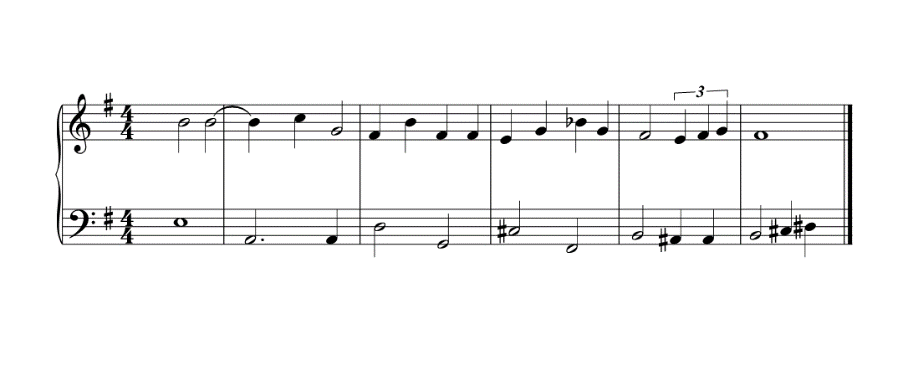
Even in contemporary pop music, some serious elements of counterpoint composing have marked the difference between two rival pop groups of the British popular music scene: the Beatles, sometimes designated as ‘serious pop’, versus the Rolling Stones (coined as ‘plastic soul’ by black musicians)21[33]. For instance, Paul Mc Carthy’s (°1942, Walton, Liverpool) beautiful ballad ‘Michelle’ (1965), showed a renewed interest in the composing of an unheard
19 Foreword by Leonard Stein to the revised edition (1969) of Schoenberg’s Structural Functions of Harmony (see ref. 10).
20 The Anglican Church was founded in 1534 by King Henry VIII’s (1509- 1547) Act of Supremacy. English composers were relatively isolated in the late 15th and 16th centuries and only gradually adopted the newer style of ‘imitative’ counterpoint (See e.g. B.R. Hanning [2023]).
21 M. Lewisohn (1988). Friday 3 December 1965. In: The Complete Beatles recording sessions. London: Octopus Publishing Group plc,, p. 69.
bassline, reminiscent of some kind of counterpoint (Figure 5). In the famous interview, Mc Cartney refers to the work of Georges Bizet (1838-1875) as an inspiration for this particular ballad22. Meanwhile, the potential for ‘classical’ arrangements of this and other Beatles ballads, has been well recognized [34].
The potential use of music tradition(s) for arousing new controversies, as well as for appeasing the minds of newly raised, rebellious generations, remains one of its mysteries. In the words of the Dutch conductor and notorious violinist Jaap van Zweden (° 1960, Amsterdam), “tradition (in music) is not a law carved out in stone; in order to grow it has to be flexible…”23.
Mysticism and the Coincidentia Oppositorum of Nicholas of Cusa (1401-1464)
When J.J. Fux in his Gradus ad Parnassum (1725) made reference – although somewhat veiled - to the oeuvre of the late 16th century composer G.P. da Palestrina, that work was almost one and a half century passed! Why following the example of Da Palestrina, the alleged composer of the Contra-Reformation and hailed savior of church polyphony music24[35], and not following the examples of polyphony
22 M. Lewisohn (1988). The Paul McCartney Interview. In: The Complete Beatles recording sessions. London: Octopus Publishing Group plc, p. 13.
23 H. Haffmans (2024). Interview with Jaap van Zweden. Podium, NPO- Klassiek, 28 February 2024 (at the occasion of J. van Zweden’s appointment as conductor of the Orchestre Philharmonique de Radio France, starting from September 2026 [fide: https://nos.nl ).
24 The Contra-Reformation is considered to be installed by Pope Paul III (1534-1549), who initiated the Council of Trent (1545-1563) as a reaction to the rise of Protestantism in Europe. The association with the composing work of Da Palestrina (ca 1525/1526-1594), church musician and choirmaster in Rome, who would have composed a mass (the Missa Papae Marcelli, or Pope Marcellus Mass) for the council delegates, in order to demonstrate that the text in a polyphonic composition could be set in such a way that the words were clearly understood, appears to be a legend: the at its summit, for instance as demonstrated by the earlier Franco-Flemish masters of Burgundy, Guillaume Dufay (ca. 1397-1474) and Johannes Ockeghem (ca. 1410-1497)? Also this period of history was marked by fierce criticism and opposition to the bright innovators of their epoch. It may seem a curious twist of fate, that it was the tradition in the Lutheran Church music, rather than the Calvinistic and Catholic traditions, that saved the ‘savior’ of the Contra- Reformation, as later on was called Da Palestrina. The controversies and antagonisms in the use of polyphony in the churches indeed point to a much longer history, that eventually became neutralized in the work of Da Palestrina. But what was lost in the process?
Based on recent philosophical writings and several discoveries in the scores and performance practice of early renaissance music, Björn Schmelzer (°1975, Antwerp), performing artist, musicologist and director of Graindelavoix vocal ensemble, points to the putative role of the philosopher Nicolaus of Cusa (1401-1464)(hereafter named Cusanus) [36]. Although Cusanus didn’t write much about actual music, in contrast to painting, “music is so primordially an essential feature of the structure of Being (…), that music is everywhere and nowhere”. According to Schmelzer, Cusanus’ thoughts about music and art can be read between or along the lines of his analysis (with some rather strange, even embarrassing exceptions (see below). His thoughts therefore are supported by his exceptional philosophical position in the late scholastic era, as for instance recognized by the French Jesuit philosopher Michel de Certeau (1925-1986) [37, 38].
What seems obscured now, due to the distance in time, is not only the difference between medieval and modern conceptions of polyphony, related to the different perception of the aspects of difference and unity in the two music- historical periods, as was also recognized by Dahlhaus [39]. It is also not a ‘positivistic’ appreciation of the “experience of polyphony as the (Pythagorean) harmony of the spheres”. Such a positivism is associated with the fetishization of the ‘divine’ music and its performers by the secular rulers and lords of the epoch. Apparently, Schmelzer knows his classics [40]. At the contrary, according to Schmelzer, Cusanus reacts to a positivizing of music performance as making audible the divine (see below), comparable to the revival of a synesthetic mysticism in a much later period, e.g. in the work of some early 20th century composers (see ¶ 2. Sergei Prokofiev’s neo-classical revolution and contemporary music) (Figure 6). A similar antagonism is found in Sigmund Freud’s (1856-1939) dismissing of the ‘oceanic’ experience, “a feeling of an indissoluble bond, of being one with the external world”, as suggested by his friend, musicologist and Nobel “savior of church polyphony” legend (see: G. Predota [2013]).
Prize-winning author (1915) Romain Rolland (1866-1944) [41]. In Freud’s words: “Mysticism is as impenetrable to me as music” (quoted in Michel de Certeau) [38].
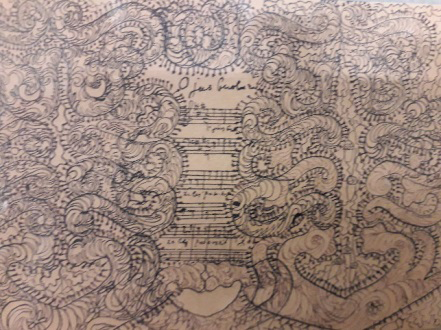
Figure 6: Detail of graphics on a post card by M.K. Čiurlionis. Čiurlionis’ music and painting are associated with a so- called synesthetic form of mysticism, not uncommon in the Russian avant-garde of the early 20th century (see also text for the opposing views regarding this mysticism by S. Freud and contemporaries).(Čiurlionis: Beyond heaven and Earth, Museum Belvédère, Oranjewoud, Fryslân, Spring 2024).
Schmelzer demonstrates how the exploration of Cusanus’ thoughts on the polyphonic practice are the result of some kind of parallel critical thinking and writing, being opposed to his friend Denis the Carthusian (1402-1471) and also different from that of Matthaeus Herbenus (1451- 1538), another early humanist thinker of the Low Countries (Maastricht). Cusanus adopts a different stand than the moralistic position of Denis the Carthusian, regarding the often heard ‘excess’ character of polyphony, and especially regarding the practice of “the physical and vocal presence of the singers”. According to Herbenus, “the fragile, fleeting character of polyphony not only makes it impossible to get a grip on the art and its context, leaving us with a feeling of lack and dissatisfaction”, but, on top of that, would confront us with the narcissism of singers, “depriving us of judgement, exerting themselves only in order to please their own feelings” [36, 42]. However, the position of Cusanus, according to Schmelzer, is anti-moralistic: “Cusanus takes the point of view of God, which could not be more than a boutade for him, an impossible, nonsensical perspective, because it is absolutely unknown (for humans)” [36]. Here, it is important to point out to the fact that Cusanus acknowledges the tradition of apophatic theology, simply stated the doctrine of the impossibility of any human knowledge of God, or the so-called negative theology [43]. This ‘negative’ viewpoint is unmistakenly corroborated in Cusanus’ main work De docta ignorantia (abbreviated as DI)
[44], where he takes an apophatic position on the ‘naming of God’, in analogy with and with particular reference to the work of Meister Eckhart (1260-1328)25. Similarly, his provocative, almost dialectical articulation of contrasting ideas, often put in a contradictory juxtaposition, and designated as the Coincidentia oppositorum, the coincidence of opposites, have added to the relevance of Cusanus’ thinking until present [36].
Regarding the disturbingly shocking naming of music as faeces adhaerentes pavimento, translated literally as ‘shit stuck to the floor’, Schmelzer explains that this passage is not a slip of the pen26[45]. The juxtaposition of the most wonderful music (as experienced by ordinary humans and kings), the nightingale song - that in medieval texts represented the incommensurable, the excess of the ordinary and a symbol of human longing [46] and the more hideous ‘sirens’ (associated with misleading and danger), it is all found ‘crap’ or at least ‘dissimilar’ in the court of the King of kings (a well known reference to the divine). Schmelzer links this apophatic viewpoint to Cusanus’ knowledge of Dionysios the Areopagite [36, 43].
The core of Cusanus’ relation to polyphony and mysticism, according to Schmelzer [36], can be inferred from his treatise De Visione Dei [47], sent in 1453 to the monks of Tegernsee in Bavaria and accompanied by a painting of a so-called ‘all-seeing face’. Such paintings were known from the Byzantine iconic tradition and also eternalized in the work of the Flemish Primitives Jan van Eyck (1390-1441) and Rogier van der Weyden (1399/1400-1464). The monks were requested to regard and interact with the painting and “use the treatise as a sort of manual to experiment with the question of mystic experience” [36]. An important discovery (for the monks then and for us now) is the moment where “a sort of symbiotic reciprocity is fantasized of me looking at the portrait and the portrait looking back wherever I go, and that fantasy is shattered and divided through the voice of the other who proclaims to have the same imaginary experience as me“[36]. The discovery of the meaning of the perception and reflection of the other, not only causes some anxiety, due to the loss of meaning of the self, but this meaninglessness also becomes meaningful, “capable of engaging one’s desire”. As a result, “polyphony is thus the creation of a strange field of desire, a field of the other and of subjectivity, not dissimilar to
25 Cusanus (op. cited). DI, Chapter 24 -26, in particular footnote 298 of DI.
26 “In the kingdom of hearing, the concordant resonance-of-all-voices and the pleasant harmony there, as well as the indescribable variety of all [the musical] instruments, together with those melodies from golden organs, as well as the songs of sirens and of nightingales, and all other exquisite riches of the king of the kingdom of hearing; in the court of the greatest and best King of kings [all these] are [as if] dung/shit stuck to the floor (faeces adhaerentes pavimento).” (B. Schmelzer, p. 8, citing from Cusanus’ De Quaerendo Deum [1445]).
the mystical experience (of absence) as explored by Cusanus” [36]. Moreover, in Cusanus’ view on the emergence of the other (in the experience of hearing together), he seems to shift from the trompe l’oeil experience to the ‘wall of paradise’, referring to the painting of Parrhasius of Ephesus27. Not only painting evokes the viewer’s desire, through the realist trompe l’oeil, but by simulating that something is hidden through an obstacle. In the words of Schmelzer: “the experience of this wall of contradiction, the limit of the coincidence of opposites, is the core of mystic experience” [36].
Schmelzer’s analysis thus indicates not only how Cusanus’ thinking surpasses the views of contemporaries on the excess character of polyphonic singing, it also indicates how far the individualistic philosophies of the modern world became separated from this late-medieval, mystic experiencing of the (non-) relation between us and the other, let alone the relation between us and the divine. With respect to the later emphasis on the textual messaging of music, the melodic part of the music that was only subserving the message, Cusanus offers an interesting perspective too. Not only the medieval listeners knew the Latin texts by heart, because they belonged to the official liturgical prayers and hymns. But also there was a very different perspective on the music performance. “Since the 14th century, music was called musica mensurata or cantus mensurabilis. Similar to the ideas developed in Cusa’s De Conjecturis, the reading of a score could be imagined as a sort of continuous measuring. Singers had to interpret the quantified musical signs on the levels of height and duration but had also to deal with the complexity of changing proportion signs, which could alter the meaning of quantity of certain musical material” [36]. Schmelzer here refers to the so-called proportion canon, “Le Ray au Soleil”, by Johannes Ciconia (early 15th century), a canon with a dazzling 4:3 proportion between the two upper voices. Evidence suggested that Cusanus could have heard a performance in Padua around 1420 (where he obtained his PhD in Canon Law).
Typical for the polyphony of this early Renaissance period is that there is no real center of the music, as Schmelzer explains and also demonstrates in the performances of Graindelavoix [36]. It may be surprising that Cusanus already in 1440 noted, in De docta Ignorantia [44], that ”the Earth, that could not be the center (of everything, the Universe), therefore would not be without movement”28, more than
27 Schmelzer here refers to the story from Ancient Greece, painted by Parrhasius of Ephesus (before 399 BC) and recorded by Pliny the Elder in his book Naturalis Historia (77-79 AD). In a contest with his rival Zeuxis, attempting to paint a perfect trompe l’oeil, Parrhasius outwitted his rival by painting a curtain, that Zeuxis tried to move aside to see the painting, but the curtain was actually a painting of a curtain.
28 Cusanus (op. cited), DI, p. 126 (¶ 157).
a century before Nicolaus Copernicus (1543) and almost two centuries before Galilio Galilei (1564-1642) defended a heliocentric model (!) [48]. Obviously, Cusanus has to be understood as an exponent of the medieval, scholastic thinking. The rise and successes of natural sciences following the introduction of experimental methods, came centuries later. But it illustrates that critical thinking wasn’t absent from the (late) medieval scholars. The theologian Cusanus obtained the rank of cardinal in the Roman Catholic Church. From 1446, he even traveled as a legate of the pope of Rome. But his practical experience as an official representative of the Church was not without controversies and grave failures. His attempts for peace talks with the challengers of the Byzantine Empire are formulated in his De pace fidei (1453) [49]. However, they didn’t prevent the Conquest of Constantinople in 1453 by the Ottoman army of Sultan Mehmed II. Also in his own diocese Brixen (Bressanone in Tirol), a vehement conflict ended in bloodshed and his flight to Rome [49]. In the words of religion-philosopher Inigo Bocken (° 1968), translator of several of Cusanus’ works: ”probably, his theory resulted from his practical insights, showing that reality still bears possibilities that haven’t yet been realized” [49]. Brocken mentions Cusanus’ direct influence upon the early humanist thinkers, such as Marsilio Ficino (1433-1499), Giovanni Pico della Mirandola (1463- 1494), Leonardo da Vinci (1452-1519) and Giordano Bruno (1548-1600).
The correspondence and contrast between music and pictural art, the enfolding-unfolding relation, was also recognized by Da Vinci in the Paragone [50] treatise. The Paragone, literally a ‘comparison’, refers to a debate during the Italian Renaissance, about the comparison of painting with sculpture, music, and poetry, and about the question which art form was superior and how they were distinct one to another. “Painting is pure enfolded simultaneity, and, in this sense, virtually eternal. (…) While painting potentially remains forever, music ‘dies by birth’ as Leonardo aptly remarked. Music’s unfolding is at the same time a disappearing or dissolving”, Schmelzer noted [36]. The resulting anxiety, according to Schmelzer is reflected in the experiencing of the musical work. “What produces the artistic experience is at the same time what it blurs.” We may ask whether Schmelzer is right in suggesting that Cusanus’ view on the mystical experience - in contrast to the view of William James (1842- 1910) - is found in “the appearance of the other in the field of experience, the one who makes that position (of unity with the experienced) impossible. Or, mystical experience is rather the experience of a non-experience, mediated through the other (in listening to music). What Michel de Certeau (see above) called the ‘madness’ of the mystical experience…” [36].
In analyzing the past, we may indeed risk to project a contemporary mind set. It seems that the 15th century critical voices regarding the polyphonic music, found a strange ally in certain contemporary philosophies (see also ¶ 6. Epilogue: Enfolding and Unfolding). Or the present times indeed mirror a distant era, as Barbara Tuchman declared [51].
Epilogue: Enfolding and Unfolding
The notion of reciprocity in the experiencing of music is not only of interest to the philosophers. It may bring us back to the question of the tradition of music, and what tradition means in music. We could have added to the discrimination between tradition and traditionalism (see ¶ 1. Introduction: Tradition versus Traditionalism), the discarding of the habit of preferring one figurehead above the other: whether J.S. Bach, Mozart, Haydn or Beethoven was ‘the greatest’ of them all – and, therefore, could have their preferred tunes sent on an interplanetary spacecraft, like the Voyager Golden Records sent in 1977 - , but should we? Or, prefer Guillaume Dufay above Da Palestrina? It is not difficult to develop one type of traditionalism or another, from choosing these figureheads and sticking to the genre, whether or not some rational criteria are found to defend such a choice. And equally so, we confined ourselves to the traditions found in western or European music, often designated as ‘classical’, but why not follow the African-American roots of jazz [8], or hip-hop, rap, or any new music genre? Others do it [52].
But isn’t that a very essential part of the reciprocity question? The possible alternative is that the choosing of figureheads or examples to follow, is equally at the core of ‘tradition’ as my personal choice (or ours) to abstain from such a blinded perspective, and questioning its essential characteristics. Such a perspective may indeed look as the blinders used for keeping the horse in a straight line before the carriage. With due respect, one may call it the right education (for the horse), but the analogy obviously is flawed. The horse wouldn’t learn to ‘behave’ independently and wishfully in our postmodern, crowded traffic. It is beyond doubt, that education cannot be missed in our highly sophisticated and specialized societies, and music education cannot and shouldn’t be missed, according to many. It is also obvious that the counterpoint tradition as instigated by the late Renaissance composers and worked out in Fux’s Gradus ad Parnassum (see ¶ 4. An eternal Gradus ad Parnassum) has proven itself a success formula, without (many) matching examples in other eras or cultures.
Therefore, taking the latter critical notes together, the discovery of the important role of a sheer reciprocity during listening as well as when performing music, not only may act as a clue to express meaning to our sense of correspondence or reminiscence of such a correspondence [48]. As an antagonizing effect, the reciprocity also works as the (mystical) experience of the non-experience, in the words of Schmelzer (see ¶ 5. Mysticism and the Coincidentia oppositorum). The importance of the medieval theologian-philosopher Nicholas of Cusa in uncovering this aspect of reciprocity was recognized in the 20th century, most importantly by Ernst Cassirer (1874-1945) [53]. This medieval reading, as also found out by de Certeau and Schmelzer (see above), offers an surprisingly different viewpoint on measuring correspondence and commensurability, and therefore also re-defining reciprocity, not as an equalization of opinions but as an abyssal non-equality with the other, which moreover, may spark the bridging of the existential abyss. Needless to say that measuring the quality of music by defining the solidity of its mathematical construction [11], counting its financial proceeds, or by counting its likes or its followers (of the performers or influencers) on social media, is beyond a solar system away from this confrontation with our non- self and the existential question(s) as pioneered by these philosophers.
![Figure 7: Photograph of an exhibition poster of the graphics work by L. Hoenraet (1985, no title). The symbol on the forefront has a dual, discomforting effect: is the ‘crossing-out’ referring to the religious connotation of the symbol, or does it belong to the enfolding act of finalizing the work of art, literally a crossing out of the work of art? The enfolding-unfolding paradigm here appears as a heuristic tool, similar to the Coincidentia oppositorium of Cusa (see text) or the mystical ‘experience of the non- experience’ in polyphonic singing (B. Schmelzer, 2024) [36].](/fulltextimages/12471/fig_7.png)
Figure 7: Photograph of an exhibition poster of the graphics work by L. Hoenraet (1985, no title). The symbol on the forefront has a dual, discomforting effect: is the ‘crossing-out’ referring to the religious connotation of the symbol, or does it belong to the enfolding act of finalizing the work of art, literally a crossing out of the work of art? The enfolding-unfolding paradigm here appears as a heuristic tool, similar to the Coincidentia oppositorium of Cusa (see text) or the mystical ‘experience of the non- experience’ in polyphonic singing (B. Schmelzer, 2024) [36].
Hoenraet referred to the habit of Japanese calligraphers to roll up the art work (as an enfolding), symbolizing Da Vinci’s eternal enfolding of the painting (see above) as an act of practice. Moreover, the act of crossing out the art work could be regarded as a final, enfolding moment of the unfolding of its creation [16, 54]. Recently, when walking through a nature reserve, I saw the beautiful colors on the wings of several, different duck species, unfolded while in their flight, and I tried to correlate them to the enfolded color Nevertheless, an important caveat has to be added to the habit of promoting or defending traditions in music and elsewhere. The longing for the purity of certain music forms as well as for the philosophies re-discovered from an ancient past, has proven not to be without risk for the zealous followers of any genre or kind. Crossing out the religious connotation(s) may be wise, in accordance with the apophatic tradition, as Cusanus had acknowledged. Otherwise, it may equally lead to the fetishization of music, as formulated by the critics of the polyphony in Cusanus’ epoch (see above) and today [40]. An important lesson to take-away, is found in the enfolding-unfolding paradigm.
Quite some years ago, I happened to encounter the Flemish painter and graphics artist Luc Hoenraet (1941- 2023), who gave me another reading of this enfolding- unfolding paradigm and of the symbol associated with a similar ‘crossing out’ of a work of art [54] (Figure 7).
patterns of the sitting or swimming ducks, with their wings folded to their trunks. I realized that James Whitcomb Riley’s (1849-1916) phrase “when I see a bird that walks (flies) like a duck (…), I call that bird a duck”, certainly had missed the enfolding-unfolding paradigm. And it made me smile towards all those followers of Riley and his epistemological rules of duck-typing, digital programming, AI and all the other fundamentals of commensurability.
References
-
Van Baerle Trio, Prokofiev G (2023) The Contemporary Prokofiev. Series International Chamber Music. Muziekgebouw aan ’t IJ, Amsterdam, Netherlands.
-
Sergei Prokofiev Estate (2002) Dnevnik 1907-1933. (Dutch Translation A. Vander Ent, 2007), Amsterdam, Antwerpen: Uitgeverij de Arbeiderspers).
-
Höweler C (1975) X-Y-Z of Music. [20thEd.], De Haan, Bussum, Netherlands.
-
Golby J (2020) This phoney war over Last Night of the Proms is everything we deserve. The Guardian.
-
Nietzsche F (1888) Der Fall Wagner. In: Paolo D (Ed.), Friedrich Nietzsche, Werke, Kritische Gesamtausgabe (KGW) and Digitale Kritische Gesamtausgabe (eKGW) de Gruyter, Berlin, New York.
-
Fux JJ (1725) Gradus ad Parnassum. Traité de contrepoint. Foreword [Préface] by Alfred Mann; French trans (2012); based on the Latin fac-simile by Bärenreiter. Éditions Lemoine, Paris.
-
Allaerts W (2022) On Music and Soul: Coltrane’s My Favorite Things, LeRoi Jones’ Black Music and Adorno’s papers on Jazz. International Journal of Arts and Humanities 2(1): 56-69.
-
Allaerts W (2022) On Music and Perfection: Adorno’s Dialectics, the notion of the Sublime in Slavoj Žižek and in the Cinematography of Werner Herzog. Philosophy International Journal 5(2): 1-8.
-
The Strad (2016). Prokofiev’s First Violin Concerto is rarely performed – but the work is unique. The Strad.
-
Schoenberg A (1954) Structural Functions of Harmony. Faber and Faber, Boston, London.
-
Allaerts W (2021) On Music and computability: Contrasts between Harry Partch’s Bitter Music and Guerino Mazzola’s Topos of Music. International Journal of Arts and Humanities 2(1): 44-55.
-
Schoenberg A (1975) ‘Brahms the Progressive’. In: L. Stein (Ed.), Style and Idea: Selected Writings of Arnold Schoenberg St. Martin’s Press, New York, pp: 398-441.
-
Gay P (1978) ‘Aimez-vous Brahms? On Polarities in Modernism’. In: P Gay, et al. (Ed.), Masters and Victims in Modernist Culture. Oxford University Press, Oxford, New York, pp: 231-256.
-
Burkholder JP (1984) Brahms and Twentieth-Century Classical Music. 19th-Century Music, University of California) 8(1): 75-83.
-
Venn E (2015) Thomas Adès and the Spectres of Brahms. Journal of the Royal Musical Association Cambridge University Press, 140 (1): 163-212.
-
Allaerts W (2014) The Case Friedrich Nietzsche (contra [Wagner crossed out] World). bi-logical 5(1): 38-48.
-
Tongeren P Van (2022) Het Europese nihilisme. Friedrich Nietzsche over een dreiging die niemand schijnt te deren. Boom uitgevers, Amsterdam.
-
Driessen H (1993) Nawoord. Sterrenvriendschap. In: Driessen H (Ed.), Het Geval Wagner (Dutch transl. of Nietzsche’s Der Fall Wagner and Nietzsche contra Wagner. De Arbeiderspers, Amsterdam, Antwerpen, pp: 106.
-
Adorno TW (1955) ‘The Young Schoenberg. In: The New Music: Kranichstein Lectures. (Herausgabe K. Reichert and M. Schwarz, Kranichsteiner Vorlesungen, Nachgelassene Schriften, Abteilung IV, B and 17, Berlin: Suhrkamp Verlag, 2014), Polity Press, Cambridge, UK, Medford, MA.
-
Schoenberg A (1922). Harmonielehre. 3rd(Ed.), Universal Edition, Vienne.
-
Adorno TW (1949) Philosophie der neuen Musik. Frankfurt a. Main: Suhrkamp Verlag (Original publ. Berlin, 1949; Herausgabe Rolf Tiedemann, 1976) (Suhrkamp Taschenbuch Wissenschaft 239).
-
Ross A (2020) How Wagner Shaped Hollywood. The New Yorker.
-
Benjamin W (1936) Das Kunstwerk im Zeitalter seiner technischen Reproduzierbarkeit. Zeitschrift für Socialforschung. (Herausgabe In: Walter Benjamin [posthum. ed. with co-operation Theodor Adorno and Gershom Scholem, re-edited Rolf Tiedemann & Hermann Schweppenhauser]. Gesammelte Schriften, Band 1,2. Frankfurt a. Main: Suhrkamp Verlag, 1972 (Suhrkamp Taschenbuch Ausgabe, 2010).
-
Hindemith P (1939) The Craft of musical composition. Book 1: Theory, 2: Exercises in two-part writing (English transl. Otto Hartmann, 1941). Mainz, Londen, New York.
-
Musil R (1978) Der Mann ohne Eigenschaften. Rowohlt Verlag, Reinbek bei Hamburg.
-
T Hart M (2000) Johann Sebastian Bach. De Arbeiderspers, Amsterdam, Netherlands, pp: 181.
-
Dahlhaus C, Eggebrecht HH, Gurlitt W (1882) Riemann Musiklexikon. 13th(Edn.), Schott Music, Germany, pp: 964.
-
Heighes S (2023) The Reformation: how did Martin Luther revolutionize church music. BBC Music Magazine.
-
Durkheim E (1895) Les règles de la méthode sociologique. F Alcan 1: 186.
-
Goddijn HPM (1963) Het functionalisme in de sociologie [in Dutch}. Van Gorcum, Assen, Netherland.
-
Schoenberg A (1954) Apollonian Evaluation of a Dionysian Epoch. In: Stein L (Ed.), Introduction to Structural Functions of Harmony. Faber and Faber, Boston, London.
-
Hanning BR (2023) Reformation Church Music outside Germany. Concise History of Western Music. W W Norton & Company, New York.
-
Lewisohn M (1988) The Complete Beatles recording sessions. Octopus Publishing Group plc, London, pp: 202.
-
O’ Grady TJ (1979) The Ballad Style in the Early Music of the Beatles. In: L Urkevich (Ed.), The College Music Symposium: Journal of the College Music Society.
-
Predota G [2013] Music and Religion: The Catholic Retaliation. Interlude.
-
Schmelzer B (2024) The Philosophy of Cusanus and Polyphonic Practice: a rudimentary attempt to explore their (non-)relation (1st draft). Workshop presented at Conference in the Footsteps of Cusanus, Bergkerk, Deventer.
-
De Certeau M (2015) The Mystic Fable, Vol 2. University of Chicago Press, Chicago.
-
De Certeau M, Brammer M (1992) Mysticism. Diacritics 22(2): 11.
-
Dahlhaus C (1962) Die Natur der Musik und die Konsonanz. In: Wiora W [Ed.], Die Natur der Musik als Problem der Wissenschaft. Musikalische Zeitfragen, Bärenreiter Verlag, Kassel, Basel, 10: 19-26.
-
Adorno TW (1938) On the Fetish-Character in Music and the Regression of Listening. In: Gesammelte Schrifte, 14: pp. 14-50 (Frankfurt) and In: Theodor WA (Ed.), Essays on Music. , selected, with introduction, commentary and notes by R. Leppert (Ed.), new Engl. transl. by S.H. Gillespie (2002), pp. 288-317, Berkeley, Los Angeles, University of California Press, London.
-
Freud S (1929) Civilization and Its Discontents. Internationaler Psychoanalytischer Verlag, Wien.
-
Wegman R (2005) The Crisis of Music in Early Modern Europe, 1470-1530. Routledge, London, New York.
-
Allaerts W (2020) How to Avoid Speaking: The Experience of the Chora in Derrida’s Denials and in Other Paradigms of Negativity. Philosophy International Journal 3(1): 16000133.
-
Nicholas of Cusa (Cusanus) (1440) De docta ignorantia. 2023rd(Ed.), Uitgeverij Damon, Eindhoven.
-
Cusanus (1445) De Quaerendo Deum. In: Jasper Hopkins, Harvard University, Boston.
-
Dickson M (2019) Nightingales in Medieval Text and Sound: Liminality and Evasion. Polysèmes, Revue d’études intertextuelles et intermédiales 22(2019).
-
Cusanus (1453) De Visione Dei (Dutch transl. Inigo Bocken [1993}, De blik van God. Nijmegen: Titus Brandsma Instituut, Uitg. Sjibbolet), 2019th(Ed.), Nijmegen.
-
Allaerts W (2022) The quadrature of the governance triangle: on the heritage of Idealism and Prometheus’ myth. Communication & Cognition 53: 21-48.
-
Bocken I, Xan CN (2001) Inleiding tot De leek over de geest. (Dutch transl) Uitgeverij Damon, Eindhoven, pp: 144.
-
Da Vinci L (1949) Paragone. A Comparison of the Arts. Geoffrey Cumberlege at the Oxford University Press, London.
-
Tuchman B (1978) A distant mirror. AA Knopf Inc, New York, pp: 720.
-
Ebert G (2022) Diagrams of Turntables and Amps Chart the History of Jazz, Hip-Hop, and Rock and Roll. Colossal.
-
Cassirer E (1927) Individuum and Kosmos in der Philosophie des Renaissance. The Individual and the Cosmos in Renaissance Philosophy. The University of Chicago Press, Chicago.
-
Allaerts W (2007) Hoenraet: een filosofische duografie. In: Pentalogie (Ed.), 2022nd(Ed.), Biological Publishing A&O pp: 8-24.
- The Place of Wittgenstein’s Tractatus in the History of Philosophy
- Digital Hermeneutics Embodied in Brian Kim Stefans’ “The Dreamlife of Letters,” and Memory: Analog to Flash Interface in the Light of Ecofeminism
- Using C-Tables to Teach Class Logic
- The Ideology of Education’s Postponed Fantasies: Deepenings on a Pressing Problematic
- Phantasia and Perceptual Realism in Aristotle
- The Pleasures of Solitude