
Public Perception and Compliance to Immunization
Immunization is the process whereby a person is made immune or resistant to an infectious disease, typically by the administration of a vaccine. A vaccine stimulates the body’s own immune system to protect the person from subsequent infection or disease. Significance of immunizationis that it prevents childhood diseases such as whopping cough, measles, diphtheria, chicken pox, small pox, poliomyelitis and yellow fever by giving chemical substance which has the causative organism of the infection to reduce virulent state. It can either be given by injection or through mouth.Expended program of immunization was started in May 1974 by WHO with the objectives to vaccinate children throughout the world.
Saleha Sadeeqa*, Aleena Zahra and Fatima Amin
Women University, Lahore, Pakistan, E-mail: salehasadeeq@gmail.com Keywords: Immunization; Infectious diseases; EPI; Hemophilus
Introduction
Health for All is a programming goal of the World Health Organization (WHO), which promotes envisions securing the health and wellbeing of people around the world that has been since the 1970s. It is the basis for the World Health Organization's primary health care strategy to popularize health, human dignity, and enhanced quality of life_._ Health for All demands, ultimately, literacy for all. Until this becomes reality it demands at least the beginning of an understanding of what health means for every individual. The health services must be accessible to all through primary health care, in which basic medical help is available in every village, backed up by referral services to more specialized care. Immunization must similarly achieve universal coverage.
Immunization is the process whereby a person is made immune or resistant to an infectious disease, typically by the administration of a vaccine [1]. A vaccine stimulates the body’s own immune system to protect the person from subsequent infection or disease. Significance of immunization is that it prevents childhood diseases such as whopping cough, measles, diphtheria, chicken pox, small pox, poliomyelitis and yellow fever by giving chemical substance which has the causative organize of the infection to reduce virulent state [2]. It can either be given by injection or through mouth. Expended program of immunization (EPI) was started in May 1974 by WHO with the objectives to vaccinate children throughout the world. EPI is a disease prevention activity aiming at reducing illness, disability and mortality from childhood diseases preventable by immunization. EPI target diseases are; Tuberculosis, Diphtheria, Poliomyelitis, Measles, Pertussis, Tetanus and also mothers against Tetanus.EPI has recently added Hepatitis B and Haemophillus influenza Type B to the list of target diseases.
In 1999, the Global Alliance for Vaccines and Immunization (GAVI) was created with the sole purpose of improving child health in the poorest countries by extending the reach of the EPI [3].
EPI in Pakistan
Pakistan is a developing country with a population of 150 million. Currently 15% deaths of children under 5 years of age contribute to 50% overall mortality in Pakistan as compared to 8-10% in the developed world [4]. Even though the under-five mortality rate has shown some reduction in the last 15 years it is still alarmingly high for Pakistan and currently stands at 94/1000 live births. Expanded program on immunization was started in Pakistan in 1978 with the ultimate goal of reduction in morbidity and mortality caused by eight vaccine preventable diseases: Childhood tuberculosis, Diphtheria, Poliomyleitis, Pertussis, Measles, Tetanus, Hepatitis B, and Haemophilus influenza type B. The target groups are children of 0-11 months and women of child bearing age [4].
Objectives of EPI
a) Attaining and sustaining over 80% routine EPI
coverage in each district by the year 2005 and achieving 90 % and above coverage nationally from 2008 onwards. b) Elimination of NNT by the year 2005. c) Reduction of measles morbidity by 90% and mortality by 95 % by year 2010. d) Interruption of poliovirus by the year 2005. e) Reduction of Diphtheria, Pertussis, Neonatal Tetanus, Hepatitis B and Childhood Tuberculosis to a minimum level. f) Assure steady supply of vaccine/needles/syringes g) Ensure safety of injections h) Control of other diseases such as Haemophilus Influenza type B by introduction of new vaccines in EPI schedule as and when they are available. i) Using EPI as a spearhead for promoting other PHC activities and finally integration of EPI in PHC.
Aims of Study
In the light of objectives mentioned above, a report was prepared with the aims a) To observe the awareness about EPI among the people in rural and urban areas of Lahore District and Mandi Bahau Din district b) To observe the EPI compliance. c) To identify the reasons of non-compliance. d) To observe either EPI is a failure or success in Pakistan. e) To observe the role of pharmacist in preventive EPI in Pakistan.
Materials and Methods
An observational and questionnaire survey based study was conducted in urban and rural areas of Lahore district and Mandi Bahau Din division. From general population of urban and rural areas, 20 Urban families and 20 Rural families were included using convenient and random sampling technique, during August -2014 to September- 2014. A data collection form was designed covering the People’s demography and Immunization status.Data collection forms were filled during face to face interviews with families and tabulated.
Results and Discussion
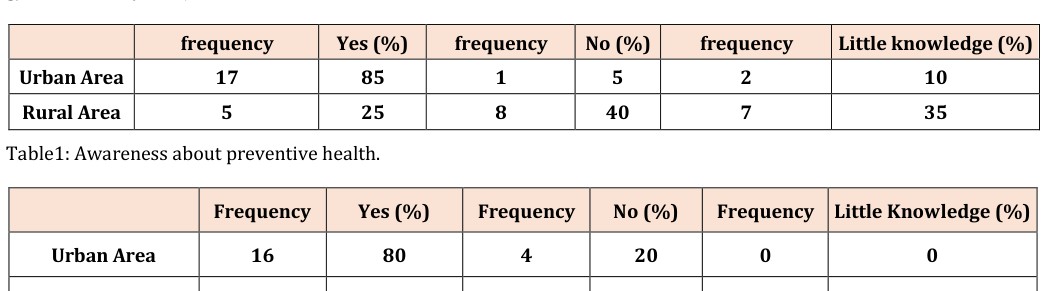
| Frequency | Yes (%) | Frequency | No (%) | Frequency | Little Knowledge (%) | |
| Urban Area | 16 | 80 | 4 | 20 | 0 | 0 |
| Rural Area | 0 | 0 | 6 | 30 | 14 | 70 |
Table 1: Do you know anything about vaccines and vaccinations?
| Frequency | Yes (%) | Frequency | No (%) | Frequency | Little Knowledge (%) | |
| Urban Area | 11 | 55 | 3 | 15 | 6 | 30 |
| Rural Area | 0 | 0 | 20 | 100 | 0 | 0 |
Table 2: Awareness about EPI.
| f | Doctor (%) | f | Nurse (%) | f | Pharmacist (%) | f | Vaccinators (%) | f | LHW (%) | f | LHV (%) | |
| Urban Area | 15 | 75 | 0 | 0 | 1 | 5 | 1 | 5 | 4 | 20 | 0 | 0 |
| Rural Area | 0 | 0 | 0 | 0 | 0 | 0 | 0 | 0 | 14 | 70 | 6 | 30 |
Table 3: Awareness of vaccination obtained from.
| f | E | lectronic M | edia | f | Newspapers (%) | f | Radio | f | Posters | f | Banners | f | NGO (%) | ||||||||
|---|---|---|---|---|---|---|---|---|---|---|---|---|---|---|---|---|---|---|---|---|---|
| (%) | (%) | (%) | (%) | ||||||||||||||||||
| Urban Area | 10 | 50 | 4 | 20 | 2 | 10 | 2 | 10 | 0 | 0 | 2 | 10 | |||||||||
| Rural Area | 18 | 90 | 0 | 0 | 0 | 0 | 0 | 0 | 2 | 10 | 0 | 0 |
Table 4: Awareness of vaccination obtained from other source.
| f | Yes (%) | f | No (%) | f | Little knowledge (%) | |
| Urban Area | 9 | 45 | 7 | 35 | 4 | 20 |
| Rural Area | 1 | 5 | 17 | 85 | 2 | 10 |
Table 5: Awareness about EPI schedule of vaccinations.
| f | Yes (%) | f | No (%) | |
| Urban Area | 20 | 100 | 0 | 0 |
| Rural Area | 20 | 100 | 0 | 0 |
Table 6: Maintenance of record of vaccination.
| f | Yes (%) | No (%) | ||
|---|---|---|---|---|
| Urban Area | 17 | 85 | 3 | 15 |
| Rural Area | 19 | 95 | 1 | 5 |
Table 7: EPI is successful in protecting children by immunization.
| f | 1 month | f | 3 months | 6 months | f | 1 Year | ||
| Urban Area | 2 | 10% | 14 | 70% | 4 | 20% | 0 | 0% |
| Rural Area | 7 | 35% | 11 | 55% | 0 | 0% | 2 | 10% |
Table 8: Health care professionals visit in your area.
| Yes | f | No | f | Little knowledge | f | |
| Urban Area | 65% | 13 | 15% | 3 | 20% | 4 |
| Rural Area | 30% | 6 | 40% | 8 | 30% | 65 |
Table 9: Do you know anything about vaccinations during pregnancy Table 10: Do you know anything about vaccinations during pregna
| f | Excellent (%) | f | Very good (%) | f | Good (%) | f | Satisfactory (%) | f | Unsatisfactory (%) | |
| Urban Area | 0 | 0 | 0 | 0 | 16 | 80 | 4 | 20 | 0 | 0 |
| Rural Area | 0 | 0 | 0 | 0 | 15 | 75 | 5 | 25 | 0 | 0 |
Table 10: Do you agree that the EPI is successful in protecting children by immunizing?
Table 12: Government’s role in education and promotion of EPI. Results showed that the EPI profile was better in urban families than the rural families. Higher the academic education, better the awareness about vaccination [5]. Higher the financial status, better the EPI profile. Most of the people were unaware of the types of vaccination, their names and sera. People preferred to choose the "private" sector for both the delivery and the vaccination due to better quality of services. Almost all of those referring to the Government sector adopted it due to financial constrains. 90% of the rural citizens take physical and mental fitness as health and 10% perceive freedom from disease as health. Best quality of life is not the criterion of health perception. Whereas in urban society 95% people think health is physical and mental fitness and for 5% people best quality of life is health. Almost all of the families had their children educated on vaccination by their school management. The visit history of health authorities in different localities is unsatisfactory. Most of the people have no idea of vaccine storage except the coolers and the ice boxes. No one mentioned the temperature of storage. About 60% of the population was totally unaware of what the word "PHARMACIST" means. No one observed any pharmacist participating in educating about EPI. Families have shown a positive response regarding the role of government and the media. Most awareness was obtained through electronic media and lady health workers or lady health visitors in both sectors [6]. EPI teams must work hard and educate the people about their program. Studies have shown that EPI administration can be improved through mass campaigns but it requires strengthening of health systems, enhanced political commitment and raising awareness among the masses [7, 8]. Distribution system for vaccines and supplies needs to be redesigned with storage facilities at the district level.
Media is noted to be a very strong source for providing awareness among the respondents about immunization. Television can be a good source to promote immunization. Among the hurdles about immunization by the respondents include those such as lack of funds and lack of awareness and education about immunization. Such barriers have also been reported earlier. The role of physician is also very important in promotion of immunization among the population. It is recommended that appropriate and focused training programs be initiated for different categories of EPI staff and skill building through hands-on training. Civil society may be involved in program advocacy, planning and implementation through CBO’s, NGO’s and community leaders. LHWs have formed Health committees, which can play an important role in program propagation for community involvement. Proper monitoring of the EPI programmers by keeping records of children and mothers being vaccinated. Vaccinators should be offered a healthy salary package so that they visit their assigned. Maintenance of proper surveillance data.
Conclusion
Pakistan’s EPI performance has a significant impact on global and regional immunization indicators such as Poliomyelitis Eradication, Maternal and Neonatal Tetanus and Measles Elimination. Government role in improving EPI programmers is not satisfactory. During the survey it was concluded that factors such as knowledge, attitude and practices of parents and patients also contribute to success or failure of EPI. Though international agencies, WHO and UNICEF promote global immunization drives and policies, the success of immunization programmers depends more on local realities and national policies. The issues of vaccine procurement i.e. storage, transport and administration are already known to contribute to inefficiency of immunization program.
References
-
WHO Health topics.
-
Importance of immunization.
-
Lu C, Michaud CM, Gakidou E, Khan K, Murray CJ (2006) Effect of the Global Alliance for Vaccines and Immunisation on diphtheria, tetanus, and pertussis vaccine coverage: an independent assessment. Lancet 368(9541): 1088-1095.
-
Pildat briefing paper: Immunization in Pakistan, 2010.
-
Bosede Ehelami Adebayo, Regina Eziuka Oladokun, Felix Olukayode Akinbami (2012) Immunization Coverage in A Rural Community in Southwestern Nigeria. J Vaccines Vaccin 3: 143.
-
Saira Afzal, Azka Naeem, Unaiza Shahid, Wajiha Noor Syed, Urva Khan et al. (2016) Effective role of lady health workers in immunization of children in Pakistan. Pak J Med Sci 32(6): 1500-1505.
-
Ajibola Abioye, Kaveh Hajifathalian, Goodarz Danaei (2013) Do mass media campaigns improve physical activity? a systematic review and meta-analysis. Arch Public Health 71(1): 20.
-
Nawab Khan Mangrio, Muhammad MazharAlam, Babar Tasneem Shaikh (2008) Is Expanded Programme on Immunization doing enough? Viewpoint of Health workers and Managers in Sindh, Pakistan. J Pak Med Assoc 58(2): 64-67.
- Update on Malariology and Malaria Vaccines
- Addressing Vaccine Hesitancy in the Age of Measles Resurgence: A Mini-Review
- Exploring Barriers and Facilitators of Group Antenatal Care Implementation in Kaduna State, Nigeria: A Qualitative Evaluation
- The Role of IL-11 in Regenerative Medicine and Tissue Engineering
- New Prediction of Mortality rate of Covid -19 According to WHO Estimation
- Measles Vaccine in Kano, Northern Nigeria: Past, Present and Future