
Recent Challenges and Opportunities on Middle East Respiratory Syndrome Corona Virus (MERS Cov)
Middle East Respiratory Syndrome Corona Virus (MERS CoV) is an extremely contagious viral illness caused by severe acute respiratory syndrome corona virus (SARS – CoV). Whats more disease is transmitted via respiratory droplets of infected patients during coughing or sneezing and affects primarily the lung parenchyma. Present work were focused on an update of recent challenges and opportunities on Middle East Respiratory Syndrome corona virus the discovery of this MERS-CoV in Saudi Arabia and Jordan in 2012, the health threat increased all over the world. Most of the respiratory diseases in this danger came to the fore, the reason behind the occurrence of MERS CoV is an animal i.e. dromedari camel, due to which the virus spread to humans again and again. This viral domestication is a factor associated with zoonotic transmission, a transmission system within camels. This disease is rare in community joint family and group living together. The virus is also transmitted through direct contact with a health care worker, during the diagnosis of patients in hospitals, and care of patients. Its outbreak increased rapidly. There are many such viral infections and they affect the health facilities. Similarly, people affected by MERS CoV viral and pose a serious threat and methods of transmission of health related treatment used in prevention patients from this infection have been explained. Furthermore the global impact of this new epidemic is yet uncertain there is a need of some effective technologies and vaccines to protect from further attack.
Background & Introduction
Middle East Respiratory Syndrome (MERS) is a viral respiratory disease that causes Middle East Syndrome, first recorded in 2012 in Saudi Arabia Corona virus disease in an infection disease caused by the SARS CoV virus [1]. Middle East respiratory syndrome virus is the type of forest in corona virus identification in 2019 cause the pandemic of the respiratory illness that also known as covid19 the first case of the 2019 was reported by the December 1st 2019 it is very contagious and has quickly spread around the world other countries, including the United States [2]. This case has been found in Saudi Arabia Corona virus can cause serious disease including severe acute middle East respiratory syndrome middle East respiratory syndrome related coronavirus MERS CoV is caused by a virus in the coronavirus family and the syndrome is also known as MERS Cov [3]. Though it has similar symptoms to COVID-19, MERS is not a contagious 2600 cases have been reported. About 35% of people diagnosed with MERS have died [4]. MERS CoV is spread from the infected camels to people [5]. An infected person may suffer from severe respiratory illness which includes fever, cough, shortness of breath and difficulty in breathing [6]. MERS CoV can cause serious illness such as pneumonia in the patient [7]. There is a lack of oxygen in the respiratory illness. The oxygen level decreases and there is a problem in breathing [8]. Weakness comes in the body. Transmission any one can get the MERS virus and the symptoms of this virus appear from one to less than 99 years of age. People can get this virus through contact with animals like camels, environment, or other patients [9]. This virus is spread from person to person by close contact. Treatment for MERS CoV supplement oxygen, Mechanical Ventilation [8].
Methodology
Literature survey was revealed that the overall challenges in MERS CoV along with its outbreak, mode of transmission, pathophysiology and management.
Outbreak of MERS-Cov
The disease was detected in Saudi Arabia in September 2012. Through the first investigation, they said that the first case of MERS had appeared in Jordan in April 2012. It appeared on people coming from outside or living in and around the Arabian Peninsula, MERS situation in the U.S. and two cases committed on 2014 high public impatience in the affected countries [10]. MERS case reported very high case death rates 9.5 and 34.4 % then in 2015 its symptoms were seen the state of Korea. Between 29 December 2021 and 31 October 2022, this M E R S virus infection was observed in Wasim and Makkah regions [11]. Due to which people saw symptoms like fever, shortness of breath, in which the age was between 23 and 74. The last cases of MERS corona virus came in Saudi Arabia on 7 April 2022.
Mode of Transmission
MERS CoV is also spread from person to person through contact with people who are sick. Like taking care of a sick person, this virus spread rapidly among people in the Arabian Peninsula and its surrounding countries and people started suffering from this MEMERS is also spread from person to person through contact with people who are sick. Like taking care of a sick person, this virus spread rapidly among people in the Arabian Peninsula and its surrounding countries and people started suffering from this MERS CoV is an animal i.e., dromedari camel, due to which the virus spread to humans again and again. This viral domestication is a factor associated with zoonotic transmission, a transmission system within camels [12]. This disease is rare in community joint family and group living together. The virus is also transmitted through direct contact with a health care worker, during the diagnosis of patients in hospitals, and care of patients Most of the respiratory diseases in this danger came to the fore, the reason behind the occurrence of MERS [11].
Sometimes Spread Human to Human
This virus spreads from an infected person to a healthy person and by touching any item of an infected person and through cough, cold and air, a healthy person also gets infected with this virus. Hospital patient to other healthy patient and health care personal due to nosocomial [13].
Infected Animals
Sometimes such viruses also spread through animals. MERS virus was spread in Saudi Arabia through a camel [14]. Transmission of MERS CoV from camel to other animals. MERS CoV infected bats transmit the virus through their excreta and saliva, transmission of the virus from camels to human through consumption of its meet and milk [13].
Pathophysiology
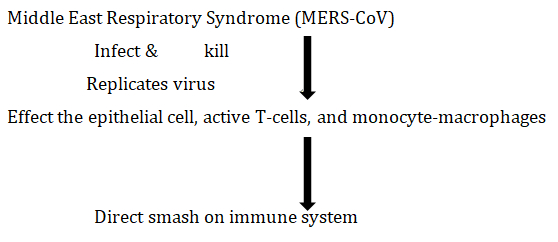
The MERS virus interacts with the host dpp4 receptor through its spike S after entering the respiratory tract. DP4 receptors are present on epithelial surfaces, such as in the lungs, kidneys, liver, bone, marrow, thymus, and intestines [15]. Systematic delivery of Dpp4 facilitates virus delivery into the human body. Post exit pollination stage dpp4 expression is mainly on sites endothelial cells epithelial cells and some types of nonciliated epithelial cells in type one and type two neo. In the upper airways and on the epithelial surface of the nose suggested that individuals with pre- existing respiratory diseases such as MRRs are said to avoid viruses such as MRRS because chronic respiratory diseases result in an increase in dpp-4 expression Developed [15]. The pathophysiology is explained by flowchart.
Symptoms
MERS CoV causes a flu-like symptom. MERS CoV causes mild to very severe symptoms. The most common symptoms of MERS are Fever Cough Pain areas: - fatigue fever, chills loss of appetite or body pain GIT:- Diarrhea or sneezing Common:- coughing , shortness of breathing, headache or sore throat [16]. The symptoms usually appear 5 to 6 days after disclosure to the virus but they many take 2 -14 days to arises. People with the severe symptom may need to spend a long time in the hospital receiving mechanical ventilation and exhaustive case. People who already have some other diseases, such as diabetes and cancer, also have a weakened immune system before MERS [17]. That is, it spreads rapidly in patients with Munia. It can cause serious respiratory diseases. It also requires ventilation for its care. This increases the risk of MERS CoV in people with weakened immune systems and those with cancer, high blood pressure, heart, and chronic diseases [18]. They may also be prone to kidney related diseases, difficulty in breathing and death.
Diagnosis
The MERS virus, it shows the same symptoms as other respiratory diseases. To get rid of this, investigation can be done based on syndromic diagnosis. This virus has been identified for the first time in the lab, allowing serological testing to detect MERS antibodies in camels, so that an antidote can be made to get rid of the disease. The antibody score and TMERs from serum samples can also be tested using the immunofluorescence test [19]. Some such enzyme linked immunosorbent assays, protein micro array and micro neutralization can also be used to detect antibodies [20].
Molecular test=Molecular tests are used to diagnose and prevent severe infections. The MERS CoV is known to be contagious. RRV PCR test is also a molecular test. It is used to detect viral RNA. The rRT PCR developed by the CDC has been applied to test for MERS coronavirus. We also perform molecular testing using Polymer Chain Reaction which is used for easy detection of RNA of viruses. Laboratory diagnosis of MERS CoV infection requires testing of two genomic targets, either rRT-PCR in the case of the CDC.
Serology test= Serological test: This is used to detect antibodies to the infection MERS coronavirus. Antibodies After infection, proteins are made by our body’s immune system to kill external microorganisms, viruses, bacteria, which can kill them. Serological tests use two screening tests and a confirmatory test and can detect antibodies to M E R S CoV. ELISA is also a screening test using which the antibody and its function can be detected. Microneutralization test by using this test we can detect antibodies which can neutralize the virus. Antibodies found in samples such as serum can also be detected by this test [21].
Antigen test Antigen test: A lateral floor test by using this we can know the presence or absence of antigen. The test is a side effect test that detects antibodies and can also be performed to detect nucleic acids. By using it we can get rid of infection. It works on the principle of RAT antigen antibody. It sets a threshold by antibody chromatography substrate against the proteins inside the virus [22].
Management
Monoclonal and Polyclonal Antibodies: Monochrome and polyclonal antibodies are also known as immunoglobinsare secreted by B. coccioa to neutralize antigens such as bacteria and viruses. The classical representation of an antibody is a Y-shaped molecule composed of four polypeptides, two heavy chains and two light chains. Each tip of y has 1 Para tope that is also specific for a particular epitope on the antigen, allowing these two chains to bind together precisely [23]. The ability to bind to a single molecule has led to their ubiquitous use in a variety of life sciences and medical sciences. These antibodies can be classified into two primary types. The means by which they are made from lymphocytes each have an important role in immune system diagnostic examination and treatment [24].
Convalescent Plasma
Convalescent plasma therapy may be the best therapy for MERS coronavirus infection. The investigators from this study studied the pharmacokinetics of immunoglobins in response to convalescent plasma administration so that they could be detected from the study and the use of that plasma [25]. Plasma is collected from those who have recovered from that disease and this therapy can also be cured. Furthermore, saveral drugs were also used to manage the symptoms of MERS CoV i.e. Ribvarin, Hexachloropene , Ayoclovir ,Dasatinib , Lopinavir, chloroquine [26, 27].
Conclusion
All this information suggests that the increasing treatment of MERS coronavirus infection, has a significant impact on mental health of patients and death due to infection [28]. Apart from this, the identification of patients suffering from diseases and the care of patients during medical quarantine and the prevention and attention of that disease are required. COVID-19 SARS and MERS there is a subtle difference between these viruses [29]. A person infected with all these shows symptoms like continuous fever and cough. Identified and investigated a growing disease in camels and published MERS and confirmed infection in camels. It can cause serious respiratory diseases [30]. It also requires ventilation for its care. This increases the risk of MERS CoV in people with weakened immune systems and those with cancer, high blood pressure, heart, and chronic diseases religious places [31].
Conflict of Interest
All authors certify that they have no affiliations with or involvement in any organization or entity with any financial interest or non-financial interest in the subject matter or materials discussed in this manuscript. The authors have no financial or proprietary interests in any material discussed in this article.
References
-
Al-Rabiaah A, Temsah MH, Al-Eyadhy AA, Hasan GM, Al- Zamil F, et al. (2020) Middle East Respiratory Syndrome- Corona Virus (MERS-CoV) associated stress among medical students at a university teaching hospital in Saudi Arabia. J Infect Public Health 13(5): 687-691.
-
Khalid M, Khan B, Al Rabiah F, Alismaili R, Saleemi S, et al. (2014) Middle Eastern respiratory syndrome corona virus (MERS CoV): case reports from a tertiary care hospital in Saudi Arabia. Ann Saudi Med 34(5): 396-400.
-
Al-Osail AM, Al-Wazzah MJ (2017) The history and epidemiology of Middle East respiratory syndrome corona virus. Multidiscip Respir Med 12(1): 1-6.
-
Arabi YM, Harthi A, Hussein J, Bouchama A, Johani S, et al. (2015) Severe neurologic syndrome associated with Middle East respiratory syndrome corona virus (MERS- CoV). Infection 43(4): 495-501.
-
Folegatti PM, Bittaye M, Flaxman A, Lopez FR, Bellamy D, et al. (2020) Safety and immunogenicity of a candidate Middle East respiratory syndrome coronavirus viral- vectored vaccine: a dose-escalation, open-label, non- randomised, uncontrolled, phase 1 trial. Lancet Infect Dis 20(7): 816-826.
-
Al-Hameed FM (2017) Spontaneous intracranial hemorrhage in a patient with Middle East respiratory syndrome corona virus. Saudi Med J 38(2): 196-200.
-
Hamimi A (2016) MERS-CoV: Middle East respiratory syndrome corona virus: Can radiology be of help? Initial single center experience. The Egyptian Journal of Radiology and Nuclear Medicine 47(1): 95-106.
-
Layqah LA, Eissa S (2019) An electrochemical immunosensor for the corona virus associated with the Middle East respiratory syndrome using an array of gold nanoparticle-modified carbon electrodes. Microchimica Acta 186(4): 224.
-
Mahallawi WH (2018) Case report: Detection of the Middle East respiratory syndrome corona virus (MERS- CoV) in nasal secretions of a dead human. J Taibah Univ Med Sci 13(3): 302-304.
-
Al-Qahtani AA, Lyroni K, Aznaourova M, Tseliou M, Al- Anazi MR, et al. (2017) Middle east respiratory syndrome corona virus spike glycoprotein suppresses macrophage responses via DPP4-mediated induction of IRAK-M and PPARγ. Oncotarget 8(6): 9053-9066.
-
Algahtani H, Subahi A, Shirah, B (2016) Neurological complications of Middle East respiratory syndrome coronavirus: a report of two cases and review of the literature. Case Rep Neurol Med 2016: 3502683.
-
Almutairi MA (2016) Awareness about middle east respiratory syndrome-corona virus (mers-cov) among dental students in riyadh, saudi arabia. Pakistan Oral & Dental Journal 36(3): 426.
-
Al-Mohrej A, Agha S (2017) Are Saudi medical students aware of middle east respiratory syndrome coronavirus during an outbreak? J Infect Public Health 10(4): 388- 395.
-
Das KM, Lee EY, Langer RD, Larsson SG (2016) Middle East respiratory syndrome coronavirus: what does a radiologist need to know? American Journal of Roentgenology 206(6): 1193-1201.
-
Al-Tawfiq JA, Perl TM (2015) Middle East respiratory syndrome coronavirus in healthcare settings. Curr Opin Infect Dis 28(4): 392-396.
-
Yusof MF, Eltahir YM, Serhan WS, Hashem FM, Elsayed EA, et al. (2015) Prevalence of Middle East respiratory syndrome coronavirus (MERS-CoV) in dromedary camels in Abu Dhabi emirate, United Arab Emirates. Virus Genes 50(3): 509-513.
-
Van Den Brand JM, Smits SL, Haagmans BL (2015) Pathogenesis of Middle East respiratory syndrome coronavirus. J Pathol 235(2): 175-184.
-
Alqahtani FY, Aleanizy FS, Alanazi MS, Mohamed N, Alrasheed MM, et al. (2019) Prevalence of comorbidities in cases of Middle East respiratory syndrome coronavirus: a retrospective study. Epidemiol Infect 147: 35.
-
Altamimi A, Ahmed AE (2020) Climate factors and incidence of Middle East respiratory syndrome coronavirus. J Infect Public Health 13(5): 704-708.
-
Coleman CM, Sisk JM, Mingo RM, Nelson EA, White JM, et al. (2016) Abelson kinase inhibitors are potent inhibitors of severe acute respiratory syndrome coronavirus and Middle East respiratory syndrome coronavirus fusion. J Virol 90(19): 8924-8933.
-
Thabet F, Chehab M, Bafaqih H, AlMohaimeed S (2015) Middle East respiratory syndrome coronavirus in children. Saudi Med J 36(4): 484-486.
-
Yong CY, Ong HK, Yeap SK, Ho KL, Tan WS, et al. (2019) Recent advances in the vaccine development against Middle East respiratory syndrome-coronavirus. Frontiers in microbiology 10: 1781.
-
Alhogbani T (2016) Acute myocarditis associated with novel Middle East respiratory syndrome coronavirus. Ann Saudi Med 36(1): 78-80.
-
Azhar EI, Lanini S, Ippolito G, Zumla A (2016) The Middle East respiratory syndrome coronavirus–a continuing risk to global health security. Adv Exp Med Biol 972: 49- 60.
-
Das KM, Lee EY, Jawder SEA, Enani MA, Singh R, et al. (2015) Acute Middle East respiratory syndrome coronavirus: temporal lung changes observed on the chest radiographs of 55 patients. AJR Am J Roentgenol 205(3): 267-274.
-
Payne DC, Iblan I, Rha B, Alqasrawi S, Haddadin A, et al. (2016) Persistence of antibodies against Middle East respiratory syndrome coronavirus. Emerg Infect Dis 22(10): 1824-1826.
-
Ramadan N, Shaib H (2019) Middle East respiratory syndrome coronavirus (MERS-CoV): A review. Germs 9(1): 35-42.
-
Hui DS, Azhar EI, Kim YJ, Memish ZA, Zumla, A, et al. (2018) Middle East respiratory syndrome coronavirus: risk factors and determinants of primary, household, and nosocomial transmission. Lancet Infect Dis 18(8): 217-227.
-
Kim ES, Choe PG, Park WB, Oh HS, Kim EJ, et al. (2016) Clinical progression and cytokine profiles of Middle East respiratory syndrome coronavirus infection. J Korean Med Sci 31(11): 1717-1725.
-
Elrggal ME, Karami NA, Rafea B, Alahmadi L, Alamoudi R, et al. (2018) Evaluation of preparedness of healthcare student volunteers against Middle East respiratory syndrome coronavirus (MERS-CoV) in Makkah, Saudi Arabia: a cross-sectional study. Z Gesundh Wiss 26(6): 607-612.
-
Zhang L, Li L, Yan L, Ming Z, Jia Z, et al. (2018) Structural and biochemical characterization of endoribonuclease Nsp15 encoded by Middle East respiratory syndrome coronavirus. J Virol 92(22): e00893-e00918.
- Update on Malariology and Malaria Vaccines
- Addressing Vaccine Hesitancy in the Age of Measles Resurgence: A Mini-Review
- Exploring Barriers and Facilitators of Group Antenatal Care Implementation in Kaduna State, Nigeria: A Qualitative Evaluation
- The Role of IL-11 in Regenerative Medicine and Tissue Engineering
- New Prediction of Mortality rate of Covid -19 According to WHO Estimation
- Measles Vaccine in Kano, Northern Nigeria: Past, Present and Future