Citation: Amegovu KA, et al.Variation in Time and Sensitivityof Anthropometric Measures of MUAC and WFH/WFL Z-Score for Screening, Admission to Follow Up and Discharge of Moderately Malnourished Children 6-59 months on Supplementary Feeding Program. Food Sci Nutr Technol 2016, 1(2): 000109
*Corresponding author: Amegovu kiri Andrew, Department of Food Technology, College of Applied and Industrial Sciences, University of Juba, South Sudan, Email: [email protected]
Under nutrition is a direct causal factor of more than half of child mortality globally, reduces human productivity and cripples national economy by an estimated 10%. It is therefore imperative that malnourished children are identified and enrolled on to rehabilitation programmes. WHO recommends the use of Weight-for-Length (WLZ)/Weight-for-Height (WHZ) and Mid Upper Arm Circumference (MUAC) for the assessment of nutritional status in children? However, results from these two anthropometric measures often differ; only a proportion, 40% of malnourished children identified by one of the indicators is also identified by the other. There is also a discrepancy in the prediction of recovery, thus the followup time between the two indicators. Therefore, this study investigated the variation in time and error margin in the use of MUAC and WHZ for the admission, follow up and discharge of moderately malnourished (MAM) preschool children on supplementary feeding program. This was a prospective cohort study and was conducted from September 2015 to November 2015 in Moroto district, Karamoja region, North Eastern Uganda. A total of 181 MAM preschool children were recruited and followed up. MAM cases were screened in the villages using MUAC (11.5 to 12.5 cm) by VHTs who referred them to 14 different sites. At these sites, trained nutritionist rescreened the children based on MUAC and W/H criteria. Participants were provided with super cereal plus ration on a biweekly basis obtained from WFP. They were followed up weekly using MUAC and WHZ until discharge for maximum of 90days.During follow-up, both MUAC and W/H measurements were done on each participant at each visit to determine which criterion participants responded to first.Kaplan Meir Survival analysis was done to ascertain the differences in recovery time.On admission, all the 181participant qualified as MAM cases with MUAC >11.5cm and<12.5cm as per WHO guideline. However, on using WLZ/WHZ in z-score, 56.4% did not qualify as MAM cases as their WHZ-score is >-2SD. Only 33.7% qualified as MAM and9.9%as Severe Acute Malnutrition (SAM) implying high sensitivity but low specificity of MUAC in identifying MAM cases during screening. The error margin or difference of56.4%between MUAC and WHZ measure for admission could be a result of confounding by other factors such as age, sex, and stunting which this study did not investigate. There was no significant difference (p>0.05) in time taken on using MUAC and WHZ-score for the follow up of MAM cases admitted into SFP until discharge. Based on MUAC criteria, 59% (71/120) of the followed up participants, reached the recovery cutoff point while based on W/H criterion, only 41% (49/120) reached the recovery discharge cutoff. This equally shows MUAC as a good measure for discharge as it is for admission. There was a similarity between the average length of stay (LOS), 43days from admission to recovery using either MUAC or WHZ. The use of MUAC as a stand-alone anthropometric measure could be recommended for admission, follow up and discharge into nutritional rehabilitation programmes for MAM.
Keywords: Admissions; Time variation; Follow-up; Discharge; MUAC; WHZ
Acute malnutrition, particularly during the first 1000days of life, a crucial period of growth and development, has remained a serious concern worldwide despite numerous efforts towards its elimination [1,2]. Globally, an estimated 52 million preschool children are wasted. Wasting confers detrimental effects, for example, 11.5% of total child deaths are directly linked to wasting [1]. Beyond its short-term impaction survival and health (inferior psychomotor, mortality and morbidity related expenditures) [3], this wasting burden has long-lasting consequences for both individuals and societies i.e. higher incidences of adulthood obesity, non-communicable diseases (NCD’s) and mental development incapacities presenting a considerable economic burden [4,5]. For example, it is estimated that in Uganda, child under nutrition confers an economic loss of US $ 899 million, an equivalent of 5.6% of her Gross Domestic Product per year [6].
A number of interventions are therefore being implemented to treat acute malnutrition among preschool children; one of them being community based feeding Programs [7]. Putting in consideration the detrimental effects of under nutrition (morbidity and mortality) and the fact that operation resources are always limited, it’s imperative that affected children are correctly identified and enrolled in to these programmes. Two anthropometric indicators; mid-upper arm circumference (MUAC) and weight-for-height z score (WHZ) with cutoffs of <11.5cm for severe acute, 11.5 to 12.5cm for moderate acute malnutrition and less than 3 and 2, respectively are recommended by WHO/UNICEF/WFP. Accordingly, these two criteria are increasingly being used as independent diagnostic tools. However, using MUAC or WH independently not only raises logistical issues but it may also raise scientific issues. For example, some studies report a poor agreement between these 2 indicators; often identify different children as severely or moderately wasted [8]. Subsequently, a child may be referred for care on the basis of MUAC but consequently refused treatment because he/she does not meet the WH admission criterion. Another discrepancy is on the follow up time; a child may take shorter time on program when followed up by WFH/WFL z-score(normal Z-score achieved faster) and a relatively longer time when followed up by MUAC (normal MUAC not easily achieved). Given time has a great bearing on program outcomes, there still exists lack of knowledge on the difference in time taken using MUAC and WHZ criteria to follow-up and discharge of MAM cases on SFP. To date, this error difference in admission and time of follow-up to recovery when using both measures (MUAC and WFH/WFL z-score) has not been well documented. Therefore, this study sought to further understand these gaps. It was embedded in the ongoing community based supplementary feeding Program targeted towards treating MAM children in Karamoja Region, North Eastern Uganda. This Project is implemented by Andre Food Consult with funding from UNWFP.
ObjectiveTo determine the variation in time and error margin in the use of MUAC and WHZ for the admission, follow up and discharge of moderately malnourished children (6-59 months) on supplementary feeding program.
MethodologyThis study was conducted in Moroto district, central Karamoja region, north eastern Uganda from September 2015 to November 2015.Moroto is among the districts most affected by malnutrition in Uganda; preschool children global acute malnutrition levels are at 18.3% while stunting is at 49% [9]. With support from UNWFP, Andre Food Consult implements a community based supplementary feeding programme to help in the treatment of this malnutrition burden. This programme is delivered through community based outposts (supplementary feeding sites) who are linked to health centers. A total of 14 supplementary feeding sites (7 in Nadunget sub-county,4 in Rupa sub-county and 3 in Lotome sub-county) are currently in place and were all utilized in the study.
Study design and populationThis was a prospective cohort study. The study population comprised of children aged 6-59 months with conditions of moderate acute malnutrition. Eligible children were those with MAM with no edema or any other medical complications.
Sample size determinationSample size was determined using procedure outlined by Lwanga et al. [10]
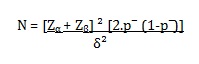 Where;
N= the number of beneficiaries enrolled for treatment of
moderate acute malnutrition
δ² ═ difference to be detected, (P2 – P1)
P‾ ═ mean proportion of success (p1+p2)/2
P1 = success of early recovery amongst beneficiaries using
WHZ score was found to be 70 %.
P2 = success of early recovery amongst beneficiaries using
MUAC was estimated to be 90% i.e. Increase in δ=20%.
Zα=value for alpha error
Zβ=value for beta error
To detect such increment of 80% with study power β=0.20 and 5% level of significance was used and therefore substituting values in the formula, sample size of 148 children was obtained. The calculated sample size was inflated by 22% to cater for attrition and the final sample size was 181.
Admission and discharge criteriaModerate acute malnutrition was defined by weightfor-height z-score of > -3 and ≤ -2 SD or Mid-Upper Arm Circumference of ≥ 11.5cm and < 12.5cm [11]. Children with MAM were randomly admitted on the study basing on either MUAC (≥ 11.5cm < 12.5cm) or WHZ (≥-3 and < - 2 SD) criterion. Children were followed up and their progress monitored during supplementation period. A child was discharged if cured when he/she had achieved the normal MUAC (> 12.5cm) or WFH/WFL z-score (>-2 SD) and considered a non-response if he/she did not respond to treatment after 90 days.
Selection of the study participants14 sites where implementation of supplementary feeding programme (SFP) is conducted were selected. Trained VHTs screened children aged 6-59 months within catchment areas of these sites for MAM. MUAC using a cut off of 11.5 to 12.5cm was used and 360 preschool children were found to be moderately malnourished and referred by VHTs to the SFP sites. At the site, trained nutritionists rescreened the referred children based on both the MUAC and WH Z-score criteria and the confirmed MAM cases were enrolled on to SFP. From these, 181 children were randomly selected to participate in the study. The caregivers of children who met enrolment criteria gave a verbal and written consent before recruitment of their children into the study. Prior to obtaining consent, caretakers were informed of the purpose of the study, potential benefits and the fact that the study posed no direct or indirect harm to them.In SFP, children received 200gdaily rations of super cereal plus(CSB++)on biweekly basis for a maximum period of 90 days.
Data collectionStandard methods for anthropometric measurements were used [12]. Weight was measured with an electronic scale (SECA 725 scale) to the nearest 10g, length/height with a rigid height board to the nearest 0.2 cm, and MUAC to the nearest 1mm using a SECA Girth Measuring Tape. An average of 2 readings was taken to ensure accuracy. Edematous malnutrition (kwashiorkor) was also assessed using bilateral pitting edema criterion. All weighing scales were calibrated daily. Children wore only light clothing with no shoes during measurements.
Data analysisSTATA software version 12 was used to analyze data. To analyze anthropometric data, Emergency Nutrition Assessment software (ENA) for SMART 2012 version was used. World Health Organization (WHO) 2006 growth standards were used to generate the Z- scores. Outliers; WHZ scores above +6/below -4, and HAZ scores above +6/below -6. The data was initially explored using descriptive statistics. The Kaplan-Meier survival curve was used to summarize the survival experience of the study subjects. Confidence intervals (95%) were used as appropriate to evaluate equality. The time the study subjects spent on treatment was captured as discrete time, the Cox PH or AFT survival models could not be used at multivariate level. Instead, the data was arranged into long format and a logistic regression for repeated measures was fitted. This was achieved by having dummy variables for all time periods where patients exited due to cure or censoring. The logistic regression was then used to estimate a proportional odds discrete-time survival model.
Ethical considerationsPermission to conduct the study was sought from the ministry of health officials of Moroto district. The participants’ parents and care takers were informed of the objectives of the study. An oral and written informed consent to participate in the study was obtained from parents/caregivers.
ResultsDemographic characteristics of the study group are summarized in Table 1. Majority of the study participants, 51.9% were males. On average, participants had a MUAC of 120.7mm, age of 19.9 months and weight of 7.8 kg. In terms of age distribution, a substantial proportion of participants, 46% were within the age range of 12-23 months.
Comparison of MUAC defined cases to WH cases at admissionMajority, 56.4% of children found to be malnourished based on MUAC presented a WHZ-score >-2, that is they were not malnourished according to the WH criterion Table 2 and Figure 1. Therefore, 79 children were admitted on the basis of both MUAC and W/H, while the remaining 102 were admitted on the programme only on the basis of MUAC.
Follow upCured and none Responses: An estimated 120 (67%) children responded to treatment. Method of admission had no effect on treatment outcomes, Table 3. Although majority of children admitted on only MUAC basis (71 of 120) as compared to a combination of both MUAC &WHZ criterion (49 of 120) responded to treatment, this difference was not significantly different. About 59 (33%) children did not respond to treatment over the 90 days and were discharged as non-respondents.
Determinants of recovery: Follow up results showed that sex, age and method of admission had no effect on recovery (Table 4). On the other hand, time (length of stay) was a strong determinant of recovery. After a two weeks stay on programme till the 6th week, there was a 99% likelihood of recovery except for the 5th week where the chances of recovery were at 0%.
Time Experience using MUAC and WHZ on supplementary Feeding programThe survival graphs of the two group’s shows an overlap of time taken on the program over a period i.e. graphs of those admitted on only MUAC basis and those who were meeting both MUAC & W/H at admission crisscross showing that both groups had a similarity in length of stay on the program (Figure 2).
DiscussionsThis study assessed the discrepancy between WH and MUAC in diagnosing malnutrition. Additionally, it sought to understand the difference in follow-up time of malnourished cases using the two measures. Results show that more than half of cases identified as MAM based on the MUAC, could not qualify based on WLZ/ WHZ-scores criterion. Similar findings have been reported by Lapidus, [13] Myatt [7] and Dasgupta et al. [14]. The specificity of MUAC decreases with a decrease in age and an increase in prevalence of stunting. In this study, over 70% of participants were below 23 months of age, explaining the high proportion of MUAC defined cases not presenting WH Z-score <-2. Additionally, levels of stunting in the study area, Moroto district are as high as 49% [8]. Mainly, MUAC is a measure of muscle mass; it reflects both body mass and linear growth. This muscle mass does not only decrease during wasting but also in the event of stunting [15]. Hence a low MUAC is indicative of wasting, stunting or both in contrast to WHZ which is standardised for height. Therefore, in situations where the prevalence of stunting is high like in this study setting, MUAC specificity decreases resulting in an increase in MUAC detected wasting.
Study findings highlight that during follow-up, majority of children were discharged on MUAC criteria compared to WHZ-score. Research shows that MUAC increases rapidly, the moment one’s nutritional status starts to improve, for example during nutrition rehabilitation [16,17]. An MSF report on 19318 rehabilitated children in Burkina Faso in 2008/2009 reported a daily 0.4mm increase in MUAC [18].
The study also found out that there is no significant difference (p>0.05) in time taken to recover on receiving treatment of food supplement if only MUAC or both MUAC and WHZ-score criteria are used for admission, follow up and discharge. The length of stay/recovery was similar for both groups (those admitted on criterion of MUAC only or both MUAC & W/H).
The study had some limitations, the main one being that it did not investigate the confounding factors; sex, age and stunting which influence MUAC’s sensitivity and specificity in diagnosing malnutrition cases. In conclusion, this study found MUAC to have a high sensitivity in detection of malnourished cases as well to be a good follow-up tool due to high response to treatment. However, there was no difference in time taken to recover when using either of the measurements; only MUAC or a combination of MUAC &WHZ. Therefore, these findings could point at the use of MUAC as a standalone anthropometric measure for admission; follow up and discharge of MAM and or SAM at nutritional rehabilitation centers.
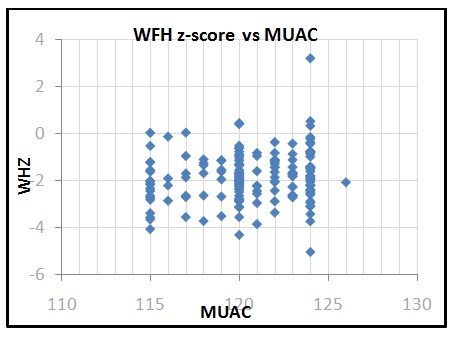
Figure 1: Comparison of MUAC and WHZ at admission.
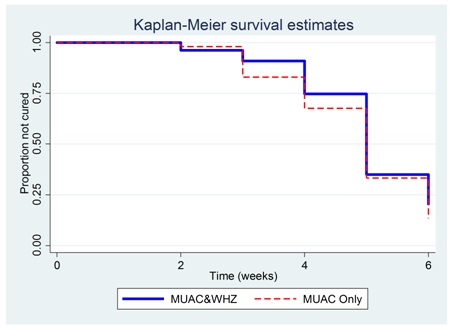
Figure 2: Comparison of cure experience.
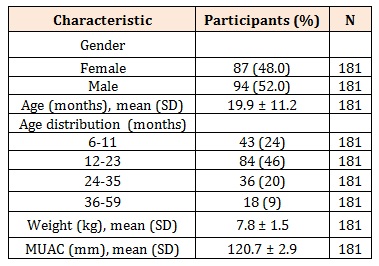
Table 1: Characteristics of study participants on admission.
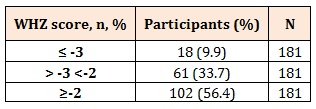
Table 2: Comparison of MUAC defined cases to WH criterion .
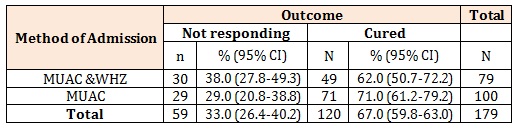
Table 3: Treatment Outcome.
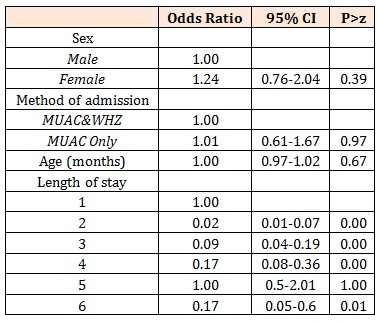
Table 4: Determinants of recovery.