
Impact of Consciousness Energy Healing Treatment on the Isotopic Abundance Ratio of Sulfamethoxazole Using LC-MS and GC-MS Spectrometry
Sulfamethoxazole is a sulfonamide bacteriostatic antibiotic which is commonly used for the treatment of infections caused by bacteria. In this study, the impact of the Trivedi Effect®-Biofield Energy Healing Treatment on the structural properties and the isotopic abundance ratio of sulfamethoxazole was studied using LC-MS and GC-MS spectroscopy. Sulfamethoxazole sample was divided into two parts, one part of sulfamethoxazole was considered as control (no Biofield Energy Treatment was provided), while the second part was received the Consciousness Energy Healing Treatment remotely by a famous Biofield Energy Healer, Dahryn Trivedi and termed as a treated sample. The LC-MS spectra of both the samples at retention time (Rt) 2.5 minutes exhibited the mass of the deprotonated molecular ion peak at m/z 252 [M-H]-. The peak area of the treated sulfamethoxazole was significantly increased by 42.96% compared to the control sample. The LC-MS based isotopic abundance ratio of PM+1/ PM in the treated sulfamethoxazole was significantly decreased by 49.56% compared with the control sample. Thus, 13C, 2H, 15N, 17O, and 33S contributions from (C10H10N3O3S)- to m/z 253 in the treated sample were significantly decreased compared with the control sample. The GC-MS peak area% of the treated sample was significantly increased by 80.3% compared to the control sample. The GC-MS based isotopic abundance ratio of PM+1/PM and PM+2/PM in the treated sulfamethoxazole was significantly altered by 119.53% and -25.48%, respectively compared with the control sample. Hence, 13C, 2H, 15N, 17O, 18O, 33S, and 34S contributions from (C10H11N3O3S)+ to m/z 254 and 255 in the treated sample were significantly altered compared with the control sample. The isotopic abundance ratios of PM+1/PM (2H/1H or 13C/12C or 15N/14N or 17O/16O or 33S/32S) and PM+2/ PM (18O/16O or 34S/32S) in the treated sulfamethoxazole were significantly altered compared to the control sample. It can be assumed that the changes in peak area%, isotopic abundance, and mass peak intensities could be due to changes in nuclei possibly through the interference of neutrino particles via the Trivedi Effect®. The new form of sulfamethoxazole would be more efficacious pharmaceutical formulations that might offer better solubility, dissolution, absorption, bioavailability and therapeutic response against urinary tract infections, tuberculosis, traveler’s diarrhoea, ear infections, shigellosis, bronchitis, and pneumocystis jiroveci pneumonia, etc.
Introduction
Sulfamethoxazole is a sulfonamide bacteriostatic antibiotic which is commonly used in combination with trimethoprim for the treatment of infections caused by bacteria. It competitively inhibits bacterial nucleotides and DNA by inhibiting the bacterial synthesis of dihydrofolic acid thereby competing with para-aminobenzoic acid (PABA) for binding to dihydropteroate synthetase [1, 2]. Sulfamethoxazole in combination with the trimethoprim is used to treat urinary tract infections, bronchitis, tuberculosis, ear infections, traveler’s diarrhea, shigellosis, and Pneumocystis jiroveci pneumonia [3, 4]. The common adverse effects associated with the sulfamethoxazole therapy are nausea, vomiting, loss of appetite, and skin rashes. It is rapidly absorbed orally as well as absorbed topically. ~70% of sulfamethoxazole is bound to plasma proteins. Bioavailability and stability profile of any pharmaceutical compound depends upon its physicochemical profile [5]. The physicochemical properties have an important role in its dissolution, absorption, and bioavailability to achieve the therapeutic efficacy [6, 7].
The Biofield Energy Healing Treatment (the Trivedi Effect®) has a significant impact on the particle size, surface area, and other chemical and thermal behaviour of pharmaceutical/nutraceutical compounds [8, 9, 10]. The Trivedi Effect® is a natural and only scientifically established phenomenon in which an individual can harness this inherently intelligent energy and transfer it anywhere on the planet via the possible mediation of neutrinos [11]. “Biofield Energy” the electromagnetic energy field which exists surrounding the living beings, generated by the continuous movement of the electrically charged particles like ions, cells, etc. inside the body [12, 13]. Biofield based Energy Therapies have significant outcomes against various disease [14]. National Center of Complementary and Integrative Health (NCCIH) has recognized and accepted Biofield Energy Healing as a Complementary and Alternative Medicine (CAM) health care approach along with the other therapies, medicines, and practices such as Tai Chi, yoga, Qi Gong, Reiki, hypnotherapy, etc [15]. These CAM therapies have been accepted by most of the U.S.A. population with advantages [16]. The Trivedi Effect®-Consciousness Energy Healing Treatment has the astounding capability to alter the characteristic properties of the several non-living materials and living object(s), i.e., organic compounds [17, 18], metals and ceramic [19, 20], microbes [21, 22], crops [23, 24], etc. The Consciousness Energy Healing Treatment has also enhanced the bioavailability [25, 26] and isotopic abundance ratio [27, 28] of the pharmaceutical compounds.
Stable isotope ratio analysis has various applications in different scientific fields for understanding the isotope effects resulting from the variation of the isotopic composition of the molecule [29, 30]. Isotope ratio analysis can be performed by using the conventional mass spectrometry (MS) techniques such as gas chromatography - mass spectrometry (GC- MS) and liquid chromatography - mass spectrometry (LC-MS) in low micromolar concentration with sufficient precision [30, 31]. The Trivedi Effect®-Biofield Energy Healing Treatment could be an economical approach for designing better pharmaceuticals formulations. Therefore, in this study, special attention was taken to improve the physicochemical parameters of the pharmaceutical product, e.g., sulfamethoxazole. Therefore, LC-MS and GC-MS were used in this study to characterize the structural properties and evaluate the isotopic abundance ratio analysis of PM+1/PM (2H/1H or 13C/12C or 15N/14N or 17O/16O or 33S/32S) and PM+2/ PM (18O/16O or 34S/32S) in the Trivedi Effect® - Consciousness Energy Healing Treated sulfamethoxazole compared to the control sample.
Materials and Methods
Chemicals and Reagents
The test sample sulfamethoxazole was purchased from Sigma Aldrich, USA and other chemicals used during the experiments were purchased in India.
Consciousness Energy Healing Treatment Strategies
The sulfamethoxazole powder sample was the test sample divided into two parts and termed as control and treated sample based on the Energy Treatment. The control sample did not receive the Biofield Energy Treatment. Further, the control sample was treated with a “sham” healer who did not have any awareness about the Biofield Energy Treatment. However, the treated sample of sulfamethoxazole was received the Trivedi Effect®-Consciousness Energy Healing Treatment remotely for 3 minutes by the renowned Biofield Energy Healer, Dahryn Trivedi, USA. After that, both the samples were kept in sealed conditions and characterized using LC-MS and GC-MS, analytical techniques.
Characterization
Liquid Chromatography-Mass Spectrometry (LC-MS) Analysis and Calculation of Isotopic Abundance Ratio: The LC-MS analysis of the sulfamethoxazole samples was carried out with the help of LC-MS ThermoFisher Scientific (USA), equipped with an ion trap detector connected with a triple-stage quadrupole mass spectrometer. The column used here was a reversed phase Thermo Scientific Synchronis C18 (Length-250 mm X ID 4.6 mm X 5 micron), maintained at 25˚C. Methanol was the diluent used for the sample preparation. 5 µL of sulfamethoxazole solution was injected, and the analyte was eluted using acetonitrile + 0.1% formic acid (75:25) pumped at a constant flow rate of 0.5 mL/min. Chromatographic separation was achieved using gradient condition and the total run time was 10 min. Peaks were monitored at 254 nm using the PDA detector. The mass spectrometric analysis was performed in -ve ESI mode.
The natural abundance of each isotope (C, H, N, O, and S) can be predicted from the comparison of the height of the isotope peak with respect to the base peak. The values of the natural isotopic abundance of the common elements are obtained from the literature [30, 32, 33, 34]. The LC-MS based isotopic abundance ratios (PM+1/PM) for the control and Biofield Energy Treated sulfamethoxazole was calculated using equation 1.
% Change in isotopic abundance ratio = [(IARTreated – IARControl)/ IARControl) x 100] (1) Where IARTreated = isotopic abundance ratio in the treated sulfamethoxazole and IARControl = isotopic abundance ratio in the control sulfamethoxazole.
Gas Chromatography-Mass Spectrometry (GC-MS) Analysis: GC-MS of the sulfamethoxazole samples were analyzed with the help of Perkin Elmer Gas chromatograph equipped with a PE-5MS (30M x 250 micros x 0.250 microns) capillary column and coupled to a single quadrupole mass detector was operated with electron impact (EI) ionization in positive mode. The oven temperature was programmed from 75°C (5 min hold) to 280°C (14.5 min hold) @ 10°C / min (total run time 40 min). The sample was prepared taking 60 mg of the sulfamethoxazole in 4 ml acetonitrile and water (1:1) as a diluent. The GC-MS based isotopic abundance ratios (PM+1/PM and PM+2/PM) for the control and Biofield Energy Treated sulfamethoxazole was calculated using equation 1.
Results and Discussion
Liquid Chromatography-Mass Spectrometry (LC-MS)
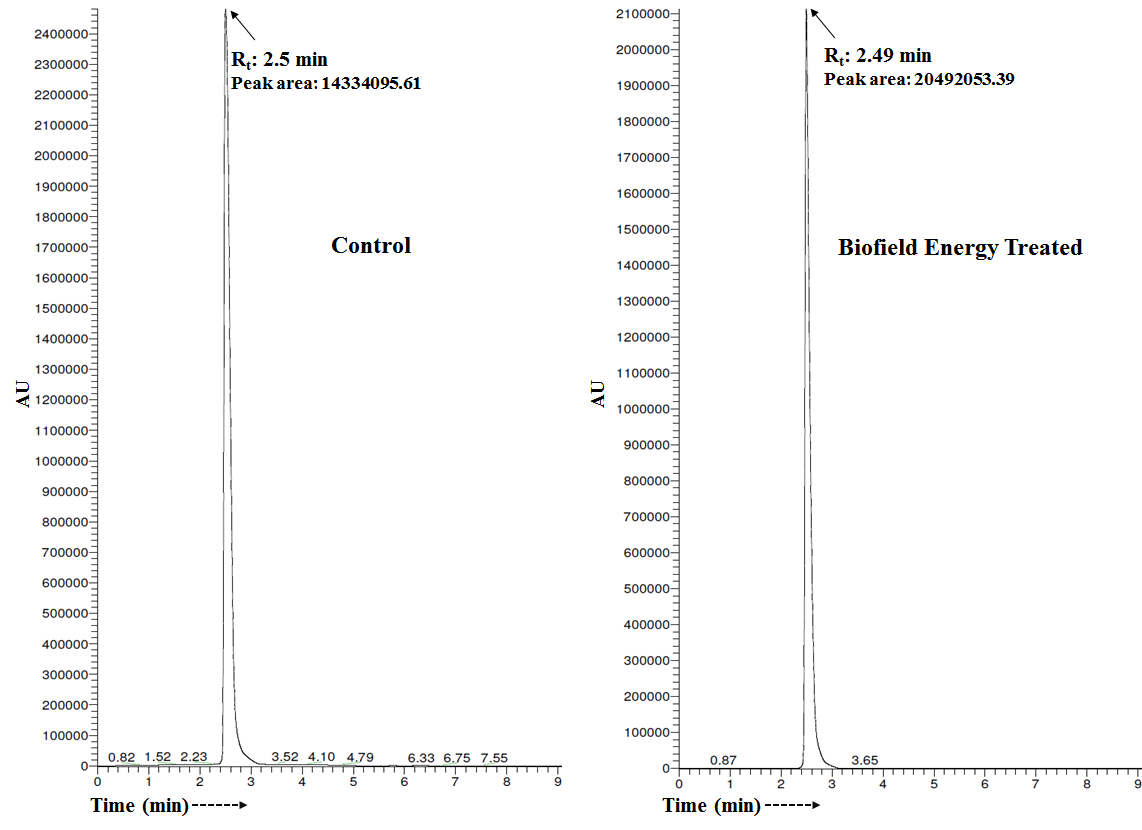
The chromatogram of both the samples of sulfamethoxazole is shown in Figures 1. Both the chromatograms showed the single major chromatographic peak of sulfamethoxazole at the retention time (Rt) of 2.5 minutes (Figure 1). The peak area of the Biofield Energy Treated sulfamethoxazole was significantly increased by 42.96% compared to the control sample, which indicated that the solubility profile of the Biofield Energy Treated sulfamethoxazole was significantly increased after the Biofield Energy Treatment compared to the control sample.
The sulfamethoxazole was detected with the molecular mass peak [M-H]- at m/z 252 in the MS spectrum in negative ion mode [35]. The mass spectra of both the samples of sulfamethoxazole (Figure 2) exhibited the mass of the deprotonated molecular ion peak at m/z 252 [M-H]- (calculated for C10H10N3O3S-, 252.04).
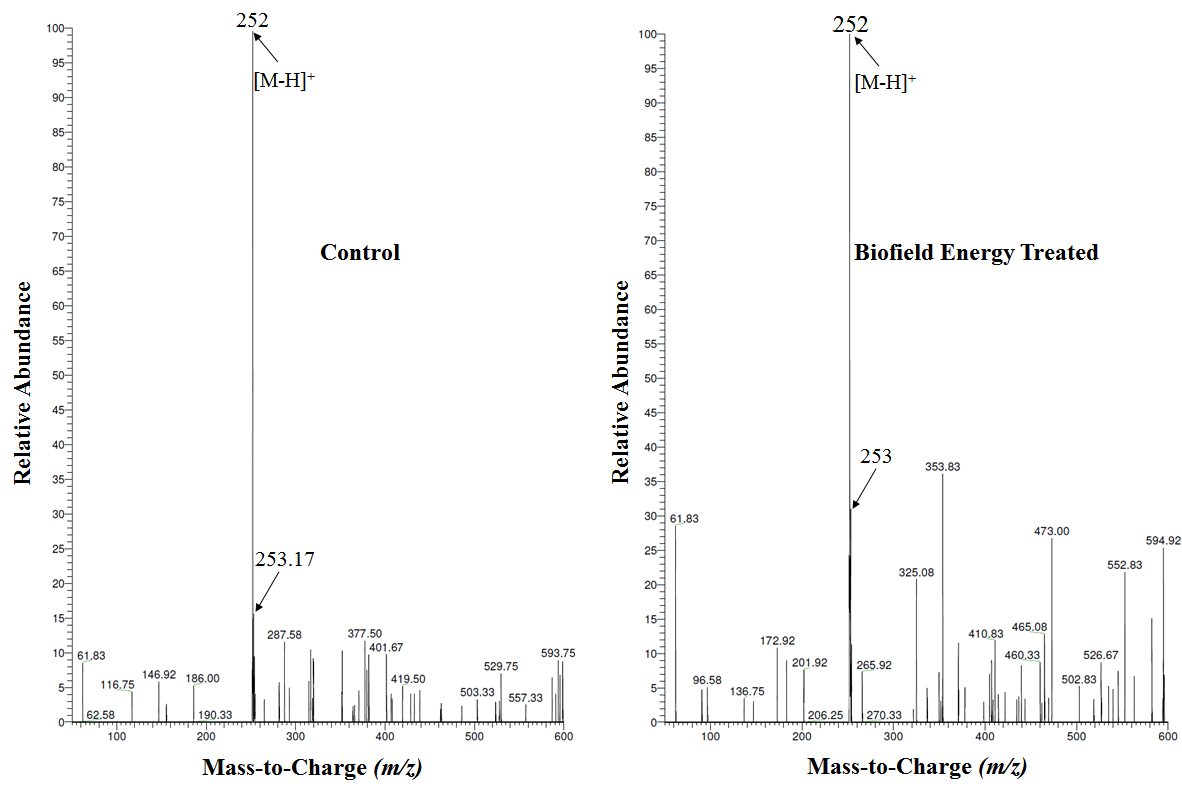
The LC-MS spectra of both the samples showed the mass of the molecular ion peak at m/z 252 [M-H]- (calculated for C10H10N3O3S-, 252.04) with relative intensity of 100%. The theoretical calculation of PM+1 for sulfamethoxazole was presented as below: P (13C) = [(10 x 1.1%) x 100% (the actual size of the M- peak)] / 100% = 11% P (2H) = [(10 x 0.015%) x 100%] / 100%= 0.15% P (15N) = [(3 x 0.4%) x 100%] / 100% = 1.2% P (17O) = [(3 x 0.04%) x 100%] / 100% = 0.12% P (33S) = [(1 x 0.75%) x 100%] / 100% = 0.75% PM+1, i.e. 13C, 2H, 15N, 17O and 33S contributions from (C10H10N3O3S)- to m/z 253 = 13.22% From the above calculation, it has been found that 13C, 15N, and 33S have major contribution to m/z 253.
The LC-MS based isotopic abundance ratio analysis PM and PM+1 for sulfamethoxazole near m/z 252 [M+] and 253 [(M+1)+], respectively of the control and Biofield Energy Treated samples in the ESI-MS spectra (Table 1). The change in the isotopic abundance ratio (PM+1/PM) in the treated sulfamethoxazole was significantly decreased by 49.56% compared with the control sample (Table 1). Thus, it was concluded that the 13C, 2H, 15N, 17O, and 33S contributions from (C10H10N3O3S)- to m/z 253 in the treated sample were significantly decreased compared to the control sample.
| Parameter | Control sample | Biofield Energy Treated sample |
|---|---|---|
| PM at m/z 252 (%) | 100 | 100 |
| PM+1 at m/z 253 (%) | 30.95 | 15.61 |
| PM+1/PM | 0.31 | 0.16 |
| % Change of isotopic abundance ratio (PM+1/PM) with respect to the control sample | -49.56 |
Table 1: LC-MS based isotopic abundance analysis results in Biofield Energy Treated sulfamethoxazole compared to the control samp
Gas Chromatography-mass Spectrometry (GC- MS) Analysis
The control and treated sulfamethoxazole showed the presence of a sharp chromatographic peak at the retention time of 18.7 and 17.35 minutes, respectively in the GC- MS chromatograms (Figures 3 and 4). The peak area% of the treated sample was significantly increased by 15.66%
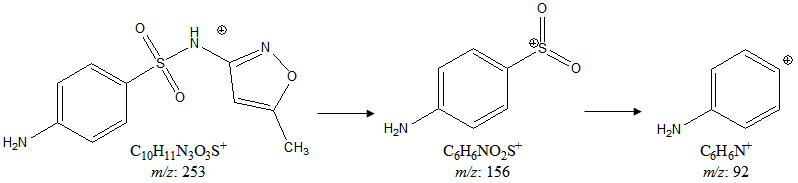
compared to the control sample. This indicated that the solubility of the Biofield Energy Treated sulfamethoxazole was significantly increased compared to the control sample. The peak near the Rt of 18 min in both the chromatograms was due to the sulphanilamide present in the sample. The parent molecular ion peak of sulfamethoxazole at m/z 253 [M]+ (calculated for C10H11N3O3S+, 253.05) in both the samples, along with the lower mass fragment ion peaks near m/z 156 and 92 (Figures 3 and 4) which were proposed corresponded to the molecular formula C6H6NO2S+ and C6H6N+, respectively (Figure 5). The GC-MS spectra of both the control and treated sulfamethoxazole showed the mass of the molecular ion peak [M]+ at m/z 253 [M]+ (calculated for C10H11N3O3S+, 253.05). The theoretical calculation of PM+1 and PM+2 for sulfamethoxazole was presented as below:
P (13C) = [(10 x 1.1%) x 3.31% (the actual size of the M+ peak)] / 100% = 0.36% P (2H) = [(11 x 0.015%) x 3.31%] / 100%= 0.005% P (15N) = [(3 x 0.4%) x 3.31%] / 100% = 0.04% P (17O) = [(3 x 0.04%) x 3.31%] / 100% = 0.004% P (33S) = [(1 x 0.75%) x 3.31%] / 100% = 0.024% PM+1, i.e. 13C, 2H, 15N, 17O, and 33S contributions from (C10H11N3O3S)+ to m/z 254 = 0.43% Similarly, P (18O) = [(3 x 0.2%) x 3.31%] / 100% = 0.019% P (34S) = [(1 x 4.21%) x 3.31%] / 100% = 0.14% PM+2, i.e. 34S and 18O contributions from (C10H11N3O3S)+ to m/z 255 = 0.16% From the above calculation, it has been found that 13C, 15N, 33S, and 34S have major contribution to m/z 254 and 255.
| Parameter | Control sample | Biofield Energy Treated sample | |
| PM at m/z 253 (%) | 3.31 | 3.59 | |
| PM+1 at m/z 254 (%) | 0.21 | 0.5 | |
| PM+1/PM | 0.06 | 0.14 | |
| % Change of isotopic abundance ratio (PM+1/PM) compared with the control sample | 119.53 | ||
| PM+2 at m/z 255 (%) | 1.93 | 1.56 | |
| PM+2/PM | 0.58 | 0.43 | |
| % Change of isotopic abundance ratio (PM+1/PM) compared with the control sample | -25.48 |
Table 2: GC-MS based isotopic abundance analysis results of Biofield Energy Treated sulfamethoxazole compared to the control samp
Table 2: GC-MS based isotopic abundance analysis results of Biofield Energy Treated sulfamethoxazole compared to the control samples. PM: the relative peak intensity of the parent molecular ion [M+]; PM+1: the relative peak intensity of the isotopic molecular ion [(M+1)+]; PM+2: the relative peak intensity of the isotopic molecular ion [(M+2)+]; M: mass of the parent molecule.
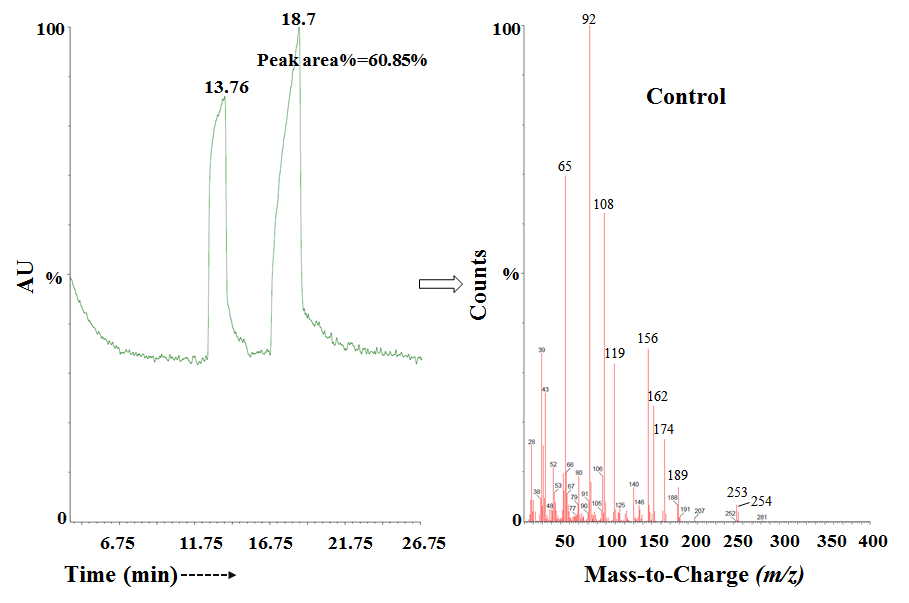
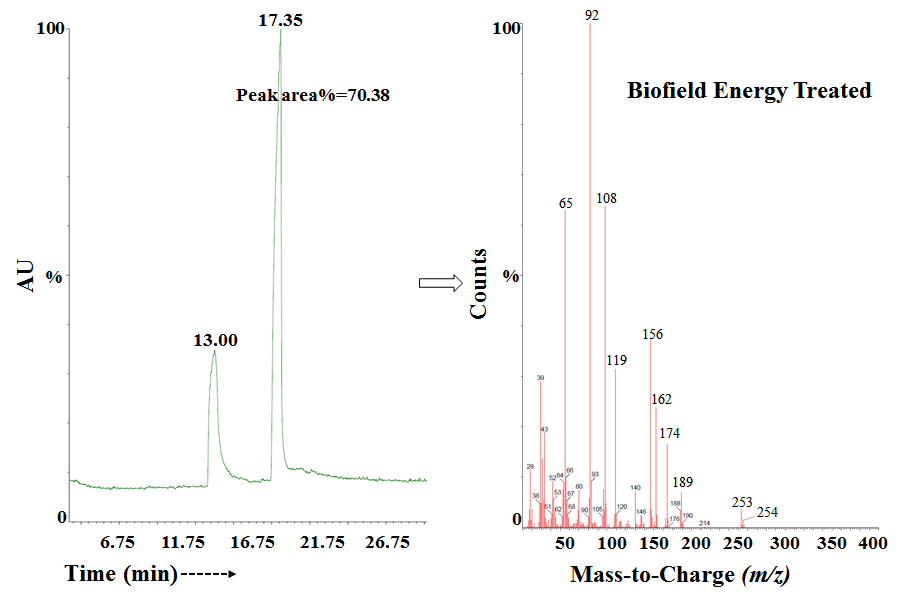
The GC-MS based isotopic abundance ratio analysis of the treated sulfamethoxazole samples was calculated compared to the control sample. PM, PM+1, and PM+2 for sulfamethoxazole near m/z 253 [M+], 254 [(M+1)+], and 255 [(M+2)+] were obtained from the observed relative peak intensities from the mass spectra (Table 2). The isotopic abundance ratio of PM+1/PM in the treated sulfamethoxazole was significantly increased by 119.53% compared with the control sample (Table 2). But, the isotopic abundance ratio of PM+2/PM in the Biofield Energy Treated sulfamethoxazole was significantly decreased by 25.48% compared with the control sample (Table 2). Hence, 13C, 2H, 15N, 17O, 18O, 33S, and 34S contributions from (C10H11N3O3S)+ to m/z 254 and 255 in the Biofield Energy Treated sample were significantly altered compared to the control sample.
LC-MS and GC-MS study confirmed the structure of the sample as sulfamethoxazole. The isotopic abundance ratios of PM+1/PM (2H/1H or 13C/12C or 15N/14N or 17O/16O or 33S/32S) and PM+2/PM (18O/16O or 34S/32S) in the Biofield Energy Treated sulfamethoxazole were significantly altered compared to the control sample. According to science, the neutrinos change identities which are only possible if the neutrinos possess mass and have the ability to interchange their phase from one phase to another internally. Therefore, the neutrinos have the ability to interact with protons and neutrons in the nucleus, which indicated a close relation between neutrino and the isotope formation [11, 30, 31]. The altered isotopic composition in the molecular level of the Trivedi Effect®-Consciousness Energy Healing Treated sulfamethoxazole might have altered the neutron to proton ratio in the nucleus. It can be hypothesized that the changes in isotopic abundance could be due to changes in nuclei possibly through the interference of neutrino particles via the Trivedi Effect®. The overall results concluded that the Consciousness Energy Healing Treatment might create a new form of sulfamethoxazole which would show better solubility, dissolution, absorption, and bioavailability compared with the untreated sample. The Consciousness Energy Healing Treated sulfamethoxazole would be more suitable for the prevention and treatment of various diseases such as urinary tract infections, ear infections, shigellosis, traveler’s diarrhea, bronchitis, and Pneumocystis jiroveci pneumonia, etc.
Conclusion
The Trivedi Effect®-Consciousness Energy Healing Treatment showed a significant impact on the peak area%, isotopic abundance ratios and mass peak intensities of sulfamethoxazole. The LC-MS spectra of both the samples at retention time (Rt) 2.5 minutes exhibited the mass of the deprotonated molecular ion peak at m/z 252 [M-H]-. The peak area of the Biofield Energy Treated sulfamethoxazole was significantly increased by 42.96% compared to the control sample. The LC-MS based isotopic abundance ratio of PM+1/PM in the Biofield Energy Treated sulfamethoxazole was significantly decreased by 49.56% compared with the control sample. Thus, 13C, 2H, 15N, 17O, and 33S contributions from (C10H10N3O3S)- to m/z 253 in the Biofield Energy Treated sample were significantly decreased compared with the control sample. The GC-MS peak area% of the Biofield Energy Treated sample was significantly increased by 80.3% compared to the control sample. The GC-MS based isotopic abundance ratio of PM+1/PM and PM+2/PM in the Biofield Energy Treated sulfamethoxazole was significantly altered by 119.53% and -25.48%, respectively compared with the control sample. Hence, 13C, 2H, 15N, 17O, 18O, 33S, and 34S contributions from (C10H11N3O3S)+ to m/z 254 and 255 in the Biofield Energy Treated sample were significantly altered compared with the control sample. The isotopic abundance ratios of PM+1/PM (2H/1H or 13C/12C or 15N/14N or 17O/16O or 33S/32S) and PM+2/PM (18O/16O or 34S/32S) in the Biofield Energy Treated sulfamethoxazole were significantly altered compared to the control sample. It can be assumed that the changes in isotopic abundance, and mass peak intensities could be due to changes in nuclei possibly through the interference of neutrino particles via the Trivedi Effect® - Consciousness Energy Healing Treatment. The new form of sulfamethoxazole would be better designing novel pharmaceutical formulations that might offer better solubility, dissolution, absorption, bioavailability and therapeutic response against urinary tract infections, ear infections, tuberculosis, traveler’s diarrhea, shigellosis, bronchitis, and Pneumocystis jiroveci pneumonia, etc.
Acknowledgement
The authors are grateful to Sophisticated Instrumentation Centre for Applied Research & Testing (SICART) India, Trivedi Science, Trivedi Global, Inc., Trivedi Testimonials, and Trivedi Master Wellness for their assistance and support during this work.
References
-
Zander J, Besier S, Ackermann H, Wichelhaus TA (2010) Synergistic antimicrobial activities of folic acid antagonists and nucleoside analogs. Antimicrob Agents Chemother 54(3): 1226-1231.
-
Neu HC, Gootz TD (1996) Antimicrobial Chemotherapy. In: Baron S, (Ed.), Medical Microbiology, 4th (Edn.), University of Texas Medical Branch, Galveston TX.
-
Brunton L, Chabner BA, Knollman B (2011) Goodman and Gilman’s The pharmacological Basis of Therapeautics, 12th (Edn.), The McGraw-Hill Companies, Inc.
-
Close SJ, McBurney CR, Garvin CG, Chen DC, Martin SJ (2002) Trimethoprim-sulfamethoxazole activity and pharmacodynamics against glycopeptide-intermediate Staphylococcus aureus. Pharmacotherapy 22(8): 983- 989.
-
Mulla SI, Hu A, Sun Q, Li J, Suanon F, et al. (2018) Biodegradation of sulfamethoxazole in bacteria from three different origins. J Environ Manage 206: 93-102.
-
Savjani KT, Gajjar AK, Savjani JK (2012) Drug Solubility: Importance and Enhancement Techniques. ISRN Pharmaceutics.
-
Khadka P, Ro J, Kim H, Kim I, Kim JT, et al. (2014) Pharmaceutical particle technologies: An approach to improve drug solubility, dissolution and bioavailability. Asian J Pharm 9(6): 304-316.
-
Branton A, Trivedi MK, Trivedi D, Nayak G (2018) Evaluation of the physicochemical and thermal properties of the biofield energy healing treated ofloxacin. J Pharm Pharmaceutics 5: 80-87.
-
Nayak G, Trivedi MK, Branton A, Trivedi D, Jana S (2018) Consciousness energy healing treatment: Impact on physicochemical and thermal properties of silver sulfadiazine. Journal of advanced pharmaceutical science and technology 2(1): 1-13.
-
Trivedi MK, Branton A, Trivedi D, Nayak G, Sethi KK, et al. (2016) Determination of isotopic abundance ratio of biofield energy treated 1,4-dichlorobenzene using gas chromatography-mass spectrometry (GC-MS). Modern Chemistry 4: 30-37.
-
Trivedi MK, Mohan TRR (2016) Biofield energy signals, energy transmission and neutrinos. American Journal of Modern Physics 5(6): 172-176.
-
Rubik B (2002) The biofield hypothesis: Its biophysical basis and role in medicine. J Altern Complement Med 8(6): 703-717.
-
Nemeth L (2008) Energy and biofield therapies in practice. Beginnings 28(3): 4-5.
-
Rubik B, Muehsam D, Hammerschlag R, Jain S (2015) Biofield science and healing: history, terminology, and concepts. Glob Adv Health Med 4: 8-14.
-
Koithan M (2009) Introducing complementary and alternative therapies. J Nurse Pract 5(1): 18-20.
-
Barnes PM, Bloom B, Nahin RL (2008) Complementary and alternative medicine use among adults and children: United States, 2007. Natl Health Stat Report 12: 1-23.
-
Trivedi MK, Branton A, Trivedi D, Nayak G, Sethi KK, et al. (2016) Isotopic abundance ratio analysis of biofield energy treated indole using gas chromatography-mass spectrometry. Science Journal of Chemistry 4(4): 41-48.
-
Trivedi MK, Branton A, Trivedi D, Nayak G, Panda P, et al. (2016) Evaluation of the isotopic abundance ratio in biofield energy treated resorcinol using gas chromatography-mass spectrometry technique. Pharm Anal Acta 7: 481.
-
Nayak G, Trivedi MK, Branton A, Trivedi D, Jana S (2018) The physicochemical and thermal properties of consciousness energy healing treated silver oxide (Ag2O). Aspects in Mining & Mineral Science 2(3): 1-6.
-
Nayak G, Trivedi MK, Branton A, Trivedi D, Jana S (2018) Evaluation of the effect of consciousness energy healing treatment on the physicochemical and thermal properties of selenium. Journal of New Developments in Chemistry 2(1): 13-23.
-
Trivedi MK, Branton A, Trivedi D, Nayak G, Mondal SC, et al. (2015) Antimicrobial sensitivity, biochemical characteristics and biotyping of Staphylococcus saprophyticus: An impact of biofield energy treatment. J Women’s Health Care 4: 271.
-
Trivedi MK, Branton A, Trivedi D, Nayak G, Shettigar H, et al. (2015) Antibiogram of multidrug-resistant isolates of Pseudomonas aeruginosa after biofield treatment. J Infect Dis Ther 3: 244.
-
Trivedi MK, Branton A, Trivedi D, Nayak G, Gangwar M, et al. (2015) Agronomic characteristics, growth analysis, and yield response of biofield treated mustard, cowpea, horse gram, and groundnuts. International Journal of Genetics and Genomics 3(6): 74-80.
-
Trivedi MK, Branton A, Trivedi D, Nayak G, Mondal SC, et al. (2015) Evaluation of plant growth, yield and yield attributes of biofield energy treated mustard (Brassica juncea) and chick pea (Cicer arietinum) seeds. Agriculture, Forestry and Fisheries 4(6): 291-295.
-
Branton A, Jana S (2017) The influence of energy of consciousness healing treatment on low bioavailable resveratrol in male Sprague Dawley rats. International Journal of Clinical and Developmental Anatomy 3(3): 9-15.
-
Branton A, Jana S (2017) The use of novel and unique biofield energy healing treatment for the improvement of poorly bioavailable compound, berberine in male Sprague Dawley rats. American Journal of Clinical and Experimental Medicine 5(4): 138-144.
-
Trivedi MK, Branton A, Trivedi D, Nayak G, Panda P, et al. (2016) Isotopic abundance ratio analysis of 1,2,3-trimethoxybenzene (TMB) after biofield energy treatment (The Trivedi Effect®) using gas chromatography-mass spectrometry, American Journal of Applied Chemistry 4(4): 132-140.
-
Trivedi MK, Branton A, Trivedi D, Nayak G, Sethi KK, et al. (2016) Evaluation of isotopic abundance ratio in biofield energy treated nitrophenol derivatives using gas chromatography-mass spectrometry. American Journal of Chemical Engineering 4(3): 68-77.
-
Schellekens RC, Stellaard F, Woerdenbag HJ, Frijlink HW, Kosterink JG (2011) Applications of stable isotopes in clinical pharmacology. Br J Clin Pharmacol 72(6): 879- 897.
-
Weisel CP, Park S, Pyo H, Mohan K, Witz G (2003) Use of stable isotopically labeled benzene to evaluate environmental exposures. J Expo Anal Environ Epidemiol 13(5): 393-402.
-
Muccio Z, Jackson GP (2009) Isotope ratio mass spectrometry. Analyst 134(2): 213-222.
-
Rosman KJR, Taylor PDP (1998) Isotopic compositions of the elements 1997 (Technical Report). Pure Appl Chem 70(1): 217-235.
-
Smith RM (2004) Understanding Mass Spectra: A Basic Approach, 2nd (Edn.), John Wiley & Sons, Inc.
-
Jürgen H (2004) Gross Mass Spectrometry: A Textbook, 2nd (Edn.), Springer, Berlin.
-
Sanderson JP, Hollis FJ, Maggs JL, Clarke SE, Naisbitt DJ, et al. (2008) Nonenzymatic formation of a novel hydroxylated sulfamethoxazole derivative in human liver microsomes: implications for bioanalysis of sulfamethoxazole metabolites. Drug Metab Dispos 36(12): 2424-2428.
- Origin, Evolution, and Functional Impact of Short Insertion- Deletion Variants in Human Genomes: A Review
- Harnessing Molecular Glues for Next-Generation Vaccine, Cancer and Cardiovascular Disease Drug Development: A Comprehensive Review
- Lateral Cervical Epidermal Inclusion Cyst in a Paediatric Patient: A Rare Case Report
- Malarial Plasmodium Falciparum with Hepatitis B and C Virus Infections among Blood Donors in Ife Central Local Government Area, Ile Ife, Osun State, Nigeria
- Withanolides and Withaferin A- What’s next in Ashwagandha Research
- Designing of Dual Pulse Photoacoustic Tomography for Imaging of Drug-Response and Tumor Growth