
Growth of Gestational Syphilis in a Municipality in Brazil: Analysis of the Profile of Pregnant Women that can help in the Planning of Primary Health Care
Objectives: Gestational syphilis is a significant public health concern that receives free care under the Brazilian public health system. In recent years, there has been a reported increase in cases of gestational syphilis in several regions. The current study aimed to investigate all reported cases of gestational syphilis in the municipality of Caucaia to identify potential causes for this rise. Methods: The study employed a retrospective (2016-2020), quantitative, and documentary research design. Data were collected from the Information System of Diseases and Notification, as well as Excel spreadsheets, and analyzed using Oneway ANOVA. Results: The study demonstrated that the municipality had 361 reported cases, with continuous growth in the last five years. The profile of pregnant women was prevalent among young people, with emphasis on the age group of 18-25 years, of the predominant brown color, followed by the yellow race. Low levels of education (less than 8 years of study) were highlighted, with the occupation profile being housewives (n=174). The study also found that the poorest districts reported more cases of gestational syphilis, showing that it is a disease linked to social vulnerability. Surprisingly, the Municipal Hospital reported the highest number of cases, demonstrating the fragility of primary care without public policies that combat social inequality. Conclusion: The present work reinforces the need to improve public family planning policies and access to prenatal care to prevent congenital syphilis.
Introduction
Syphilis is a systemic bacterial infection caused by Treponema pallidum, in which many people are unaware that they are infected and when untreated, progress to severe stages, which can affect several organs and the patient’s nervous and cardiovascular systems. It is important to emphasize that even when they have signs and symptoms, they can go unnoticed, leading to the sexual contamination of other people [1]. Its transmission occurs mainly through sexual contact, but it can be transmitted vertically to the fetus during pregnancy when the pregnant woman with syphilis is not treated or is treated inappropriately [2]. Gestational syphilis can lead to miscarriage, premature birth, and congenital manifestations that can be early or late and even lead to the death of the newborn [2].
The disease can be differentiated into recent syphilis- with up to one year of evolution, late syphilis - with more than one year of evolution, latent with unknown time, and tertiary. While the phases of recent syphilis correspond to the highest chances of transmission, because it has a large number of treponemas and the intense multiplication of the pathogen [3]. Late syphilis is a major concern in prenatal care, with a risk of affecting the fetus between 30% and 100%, depending on the evolution of the infection and the trimester in which the pregnant woman is [4].
In recent years, an increase in the number of gestational and congenital syphilis has been observed [5]. This increase may be in part due to the expansion of testing coverage, many rapid tests being performed, the decrease in condom use and the resistance of health professionals to administer penicillin in Primary Care, the worldwide lack of medication, and the actions of the surveillance system that contributed to the increase in the number of reported cases [2].
In 2018, 62,599 cases of syphilis in pregnant women were reported in Brazil with a detection rate of 21.4 per 1000 births and 26,219 cases of congenital syphilis with an incidence rate of 9.0 per 1000 live births and 241 deaths from congenital syphilis with mortality rate of 8.2 per 1000 live births [6]. In Ceará, the detection rate of syphilis in pregnant women -and congenital- per thousand live births increased three times in the period from 2010 to 2018, from 3.9 to 16.6 for gestational syphilis and for congenital syphilis from 6. 1 to 12.9 per thousand live births. In the period from 2010 to 2018, 8161 cases of syphilis in pregnant women were reported in the Information and Diseases Notification System (SINAN) [7].
Syphilis, a disease that is both preventable and treatable, continues to plague public health, even with free and effective treatment options available. To tackle this persistent issue, it is crucial to understand the epidemiological profile of pregnant women with syphilis in the city of Caucaia from 2016 to 2020. Armed with this knowledge, we can take necessary measures to curb the number of cases and effectively reduce the incidence of congenital syphilis.
Material and Methods
Design
The Brazilian health care system, Sistema Único de Saúde (SUS), has organized health care in the country. The Rede Cegonha is a program implemented in 2011 with the aim of improving maternal and child health outcomes by providing access to high-quality prenatal, childbirth, and postpartum care. The program focuses on vulnerable populations and aims to prevent and treat gestational syphilis, which is a key component of the program [8].
To prevent gestational syphilis, the Rede Cegonha employs various strategies, such as universal screening for syphilis during pregnancy, prompt treatment of infected women and their partners, and health education for pregnant women and their families. The program also offers training for healthcare professionals to improve their ability to diagnose and treat syphilis. Studies indicate that the implementation of the Rede Cegonha has led to a significant increase in the number of pregnant women who receive screening for syphilis and appropriate treatment, as reported through a National System of Health Problems, known as SINAN, for all cases of gestational syphilis identified by SUS/Rede Cegonha.
Population and Sample
This study is a quantitative retrospective documentary research conducted in the epidemiological surveillance service of the Municipal Health Department in Caucaia, located in the state of Ceará, Brazil. The research analyzed SINAN notification forms of syphilis cases in pregnant women reported between January 2016 and December 2020 in Caucaia. The city has an estimated population of 361,400 inhabitants, as per official data available on the City Hall’s website.
The study was fully approved by the Institutional Research Ethics Committee by number CAAE 457.40821.7.0000.5037.
Data Collection and Statistic Analysis
The study collected data between 01/05/2021 and 08/15/2021 and included all reports of gestational syphilis in the municipality from 2016 to 2020 notified by SINAN. The data collection instrument was a questionnaire that included variables related to the pregnant woman’s demographic profile, with priority given to age, race/color, schooling, district of notification, and occupation. The epidemiological profile variables included the health unit where the pregnant woman received care.
Data were recorded in spreadsheets using Excel and analyzed statistically using one-way ANOVA with GraphPad Prism 8 software.
Results and Discussion
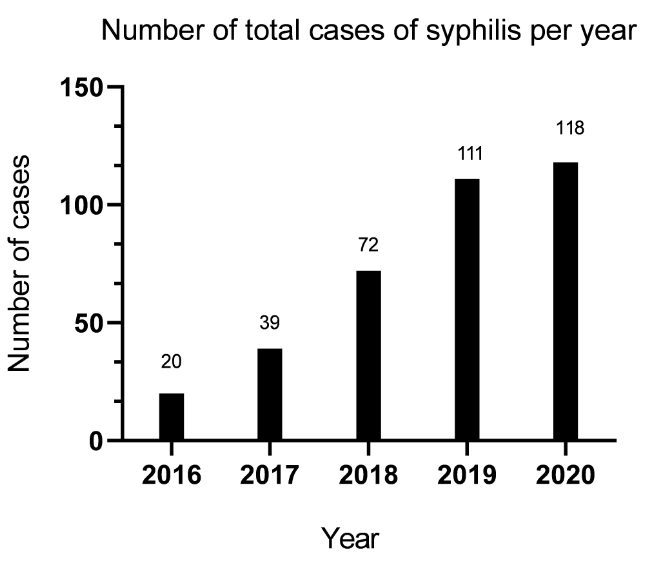
This study, reflective of the current situation throughout Brazil 9-11, reveals a concerning trend in the increasing cases of syphilis in pregnant women diagnosed in the municipality of Caucaia over the last five years, despite a decrease in prenatal care and calls in general in 2020 due to the COVID-19 pandemic. As illustrated in Figure 1, the number of cases has risen steadily, with 20 in 2016, 39 in 2017, and a sharp increase to 73, 111, and 118 cases in 2018, 2019, and 2020, respectively. This trend can be attributed to the rise of rapid tests for syphilis during pregnancy in various health units, as well as heightened epidemiological surveillance and intervention measures [11].
Analysis of the reported cases revealed that the age group with the highest incidence of syphilis among pregnant women was between 18 and 25 years, accounting for 56.4% of cases (p<0.001). The age groups of 26-30 years and 13- 17 years were the second and third highest, with 18.3% and 13.8% of cases, respectively.
Statistical analysis shows that the age group from 18 to 25 years old is the most vulnerable in all the years analyzed in the period with p<0.001 (One-way ANOVA). This is corroborated by other authors who associate the high rate of this STI due to the early and unprotected onset of sexual practice, in addition to multiple partners in these patients [1, 5, 11]. Therefore, health education with an approach to family planning and prevention of sexually transmitted diseases with specific material for this age group should be prioritized within the development of Rede Cegonha campaigns [12].
The race with the highest number of notifications was brown with 190 cases (52.63%), followed by yellow with n=92 (25.48%) and black with 22 cases (6.09%), evidencing the predominance of the self-declared brown race in more than half of the notifications [13, 14, 15]. It should be noted that in other studies carried out in Brazil, the race characteristic does not have a defined profile, and this may vary according to each region. Regarding brown race, most of the Brazilian population declares itself brown due to the miscegenation of the population [16]. According to the study, brown and black women face disadvantages in socioeconomic conditions. They are victims of inequalities in access to prenatal care and have less assistance at the time of delivery, suggesting that these problems of access to prenatal care, and to a planned pregnancy, may be related to socioeconomic differences, where worse indicators of pregnancy are observed access to health services among African American descendants.
Regarding education, no statistical differences was showed at the table, but most pregnant women with syphilis have 8 years less of education with N=160 (44.32%), followed by pregnant women with more than 8 years of education, corresponding to N=122 cases (33.79%) and adding the ignored ones and the blank forms we have N= 76 cases (21.06%). As other studies also show, the high rate of pregnant women with syphilis may be related to access to information about the disease and that low schooling may lead to fewer appointments for medical and nursing appointments [11, 14, 15]. Indirectly, low education may be related to the risk to health and transmission of sexually transmitted infections (STIs), where little access to medical information interferes with knowledge about care for the prevention of various infections and, therefore, the interruption of the transmission chain of the disease syphilis is compromised [16].
Regarding the occupation of pregnant women with syphilis, it is noted that many do not have a formal paid occupation, identifying themselves as housewives, as can be seen in Table 1. Almost half of the women N=174 (48.20%) are identified in this way, followed by students with N=26 cases (7.20%). Interestingly, many blank notifications were found, corresponding to 110 cases (30.47%). Regarding occupation, it was observed that pregnant women with syphilis were housewives, corroborating other studies [12, 13]. This shows that socioeconomic conditions directly interfere with people’s health, especially in vulnerable pregnant women [17]. The high rate of unoccupied pregnant women with syphilis may be related to schooling, as the lower the level of schooling, the lower the chances of getting a job [16].
| VARIABLES (n= 361) | n | % |
|---|---|---|
| Age group (in years) | ||
| 13 to 17 | 48 | 13.8 |
| 18 to 25 | 197* | 56.4 |
| 26 to 30 | 64 | 18.3 |
| 31 to 39 | 34 | 9.7 |
| ≥ 40 | 6 | 1.7 |
| Race/Color | ||
| White | 44 | 12.19 |
| Black | 22 | 6.09 |
| Yellow | 92 | 25.48 |
| Brown | 190 | 52.63 |
| Indigenous | 5 | 1.39 |
| Ignored | 5 | 1.39 |
| Blank | 3 | 0.83 |
| Education | ||
| Illiterate | 3 | 0.83 |
| ≤ 8 years | 160 | 44.32 |
| > 8 years | 122 | 33.79 |
| Ignored | 68 | 18.84 |
| Blank | 8 | 2.22 |
| Notification | ||
| District I | 41 | 11.36 |
| District II | 41 | 11.36 |
| District III | 55 | 15.24 |
| District IV | 34 | 9.42 |
| District V | 86 | 23.82 |
| District VI | 104 | 28.81 |
| Notifying unit or another source | ||
| Santa Terezinha Municipal | 90 | 24.93 |
| Abelardo Gadelha Municipal Hospital | 31 | 8.59 |
| UAPS Antonio Jander Pereira Machado | 18 | 4 .99 |
| UAPS Dr. Francisco Djalma Soares | 15 | 4.15 |
| UAPS Novo São Miguel | 12 | 3.32 |
| Other health units | 195 | 54.02 |
| Occupation | ||
| Housewife | 174 | 48.2 |
| Student | 26 | 7.2 |
| Cashier | 7 | 1.94 |
| Unemployed | 10 | 2.77 |
| Other occupations | 34 | 9.42 |
| Blank | 110 | 30.47 |
Table 1: Sociodemographic characteristics of pregnant women seropositive for syphilis in Caucaia (CE).
Vulnerability is a complex construct that includes physical, biological, economic, social, and political factors that increase the susceptibility to adverse health outcomes. This study aimed to conduct a demographic analysis of syphilis cases in Caucaia, Brazil, to identify the most affected districts and investigate the factors associated with the disease’s transmission.
The results showed that districts V and VI had the highest number of pregnant women with syphilis, representing over half of the notifications in the municipality. District V had the highest number of cases, mainly due to the Santa Terezinha Municipal Hospital, which is the place that receives all pregnant women in the municipality. In contrast, District VI has more neighborhoods with medium-high and high vulnerability due to its rural area’s lack of access to basic needs and low per capita income.
The study also revealed that basic health units and the Emergency Care Unit played a crucial role in diagnosing syphilis. District V had a Reference Hospital for pregnant women, while District VI had UAPS Dr. Francisco Djalma Soares, which had the most notifications. The data suggest that a single health system that has implemented an exclusive program for pregnant women can guarantee broad access to the diagnosis and treatment of curable diseases such as syphilis. However, the transmission of syphilis is still related to the social vulnerability of the places where women live, more than to race or schooling rate. Therefore, public policies that combat social inequality should be considered as a mechanism for preventing sexually transmitted infections.
Conclusion
The findings of this study align with the increasing trend of syphilis cases in pregnant women across several Brazilian states, a concerning factor that contributes to the rise in cases of vertical transmission, including congenital syphilis. The present study highlights that pregnant women who are young, brown, with low education, and no paid activity are at higher risk for syphilis infection. Moreover, the districts V and VI, which have more vulnerable neighborhoods in the socioeconomic and political context, reported the highest number of cases.
Given the public health implications of syphilis, it is imperative to educate young women about the disease and prevention as they are initiating sexual activity earlier. Additionally, ensuring access to prenatal care and actively searching for pregnant women who miss appointments are critical measures to reduce the burden of syphilis. Moreover, it is recommended that periodic training for health professionals in primary health care units is carried out to address the issue of incomplete or inaccurate notification, which hampers the analysis of the actual data.
References
-
Ayala ALM, Jasko BGD, Biliski MJB (2021) Analysis of Syphilis in Pregnant Women from 2010 to 2019 in Joinville/SC. Espaço para a Saúde 22.
-
Brasil, Ministério da Saúde, Secretaria de Vigilância em Saúde (2020) Protocolo Clínico e Diretrizes Terapêuticas para Atenção Integral às Pessoas com Infecções Sexualmente Transmissíveis (IST)/Ministério da Saúde, Secretaria de Vigilância em Saúde, Departamento de Doenças de Condições Crônicas e Infecções Sexualmente Transmissíveis.
-
(2020) Ministério da Saúde, Secretaria de Vigilância em Saúde. Boletim Epidemiológico Especial.
-
Moroskoski M, Rozin L, Batista MC, Queiroz RO, Silva SP (2018) Profile of pregnant teenagers diagnosed with syphilis in Curitiba-PR. Revista de Saúde Pública do Paraná 1(1): 47-58.
-
Barbosa DFR, Albuquerque ACC, Verçosa RCM, et al. (2020) Epidemiological profile of congenital syphilis in pregnant women in the city of Maceió. Revista Eletrônica Acervo Saúde 12(11): e4881.
-
(2019) Ministério da Saúde, Secretaria de Vigilância em Saúde. Epidemiological Bulletins.
-
Boletim Epidemiológico Sifilis.
-
(2015) Universidade Federal do Maranhão. Una-Sus/ Ufma. Redes de Atenção À Saúde: A Rede Cegonha. Consuelo Penha Castro Marques.
-
Maschio Lima T, Machado IL de L, Siqueira JPZ, Almeida MTG (2020) Epidemiological profile of patients with congenital and gestational syphilis in a municipality in the State of São Paulo, Brazil. Rev Bras Saude Mater Infant 19(4): 865-872.
-
Cruz N, Duarte F, Pinto W, et al. (2020) Sífilis em gestantes: uma análise comparativa da região Norte do Brasil no período de 2016 a 2018. Research, Society and Development 9: e1189119547.
-
Bottura BR, Matuda L, Rodrigues PSS, do Amaral CMCA, Barbosa LG (2019) Epidemiological profile of gestational and congenital syphilis in Brazil – from 2007 to 2016. Arquivos Médicos dos Hospitais e da Faculdade de Ciências Médicas da Santa Casa de São Paulo 64(2): 69-75.
-
Cavalcante KM, Brêda BF, Pol Fachin L (2021) Epidemiological profile of gestational Syphilis in Northeastern Brazil between 2015 and 2020. Brazilian Journal of Health Review 4(3): 14055-14063.
-
Lima VC, Mororó RM, Martins MA, Ribeiro SM, Linhares MSC (2017) Epidemiological profile of cases of congenital syphilis in a medium-sized city in northeastern Brazil. Journal of Health & Biological Sciences 5(1): 56-61.
-
Conceição HN da, Câmara JT, Pereira BM (2019) Análise epidemiológica e espacial dos casos de sífilis gestacional e congênita. Saúde debate pp: 1145-1158.
-
Moreira KFA, de Oliveira DM, de Alencar LN, Cavalcante DFB, Pinheiro AS, et al. (2017) Profile of Notified Cases of Congenital Syphilis. Cogit Enferm (Online) pp: 01-10.
-
Marques JVS, Alves BM, Marques MVS, Archangel FPN, Parente CC, et al. (2018) Epidemiological Profile of Gestational Syphilis: Clinical and Evolution from 2012 to 2017. SANARE - Revista de Políticas Públicas 17(2).
-
Sales MCV, Gomes AV, Amorim FCM, Magalhães JM, Gonçalves MER, et al. (2022) Epidemiological profile of cases of congenital and gestational syphilis in the State of Piauí, Brazil. O Mundo da Saúde 46: 357-368.
- Origin, Evolution, and Functional Impact of Short Insertion- Deletion Variants in Human Genomes: A Review
- Harnessing Molecular Glues for Next-Generation Vaccine, Cancer and Cardiovascular Disease Drug Development: A Comprehensive Review
- Lateral Cervical Epidermal Inclusion Cyst in a Paediatric Patient: A Rare Case Report
- Malarial Plasmodium Falciparum with Hepatitis B and C Virus Infections among Blood Donors in Ife Central Local Government Area, Ile Ife, Osun State, Nigeria
- Withanolides and Withaferin A- What’s next in Ashwagandha Research
- Designing of Dual Pulse Photoacoustic Tomography for Imaging of Drug-Response and Tumor Growth