
Toxicological Implications of Hexavalent Chromium in Humans
Heavy metals are quite important as far as industrial production is concerned. This may be attributed to several characteristic properties of the metals which include high strength, durability, high melting and/or boiling point, resistance to environmental temperatures and corrosion. Chromium (Cr) is an important heavy metal that finds wide uses in industries and manufacturing processes. Hexavalent chromium or Cr (VI) is one of the stable states of Cr with demonstrably high toxicity. The Cr (VI) is mostly released from anthropogenic sources like industrial and mining activities and is responsible for disturbing the environmental homeostasis. Cr (VI) mostly affects the environmental matrices including soil, water, and air thus leading to severe toxicity. The high mobility and solubility of Cr (VI) makes it permeable through almost all membranes including human skin. Reports indicate Cr (VI) to be a potent human carcinogen thus leading to several health issues including cancer. The present editorial discusses about the various sources of Cr (VI) toxicity in the environment along with its mode of exposure in humans. It further discusses the mechanism of Cr (VI) toxicity in humans and the effects therein. The paper concludes by highlighting the urgent need to address the situation by means of implementing strict governmental regulations along with sustainable remediation practices to control the menace.
Introduction
Chromium (Cr) is an important element that finds wide uses in the industrial sector. A metal known for its strength, high melting and boiling point, and anti-corrosion properties is mostly preferred by several large scale and small scale industries as an additive to improve the quality of the produce. The industries that rely on this metal and its compounds include leather tanning, textile dyeing, wood polishing, and chemical manufacturing, paint manufacturing, steel manufacturing and iron plants [1, 2]. Cr as a heavy metal is considered to be toxic to the human environment as well as the humans itself [3]. The toxicity of Cr is dependent on its oxidation state which is quite unique when compared with other heavy metals whose toxicities are regulated solely based on their concentrations in the environment. Table 1 provides an account of the different states of Cr. Among all the oxidation states, Cr is most commonly found in the trivalent [Cr (III)] and the hexavalent, Cr (VI) form [4]. The Cr (III) is a stable entity which lacks mobility and remains insoluble in the environment thus pertaining to very low toxicity as compared to that of Cr (VI). On the other hand Cr
(VI) is highly soluble and mobile, thus possessing the ability to permeate through almost all biological membranes [5] thus making it highly toxic and being categorized as a group I carcinogen by the IARC.
| Oxidation State | Compound Example | |
|---|---|---|
| Elemental | 0 | Chromium carbonyl |
| Stable | 3 | Chromium oxide |
| Stable | 6 | Potassium dichromate |
| Unstable | 1 | - |
| 2 | Chromium oxide | |
| 4 | Chromium(VI) oxide | |
| 5 | Chromium pentafluoride |
Table 1: Oxidation States and Forms of Chromium.
Environmental Sources of Cr(Vi) and Exposure in Humans
Cr (VI) is released into the environment mostly from various industrial sources. Exposure of the heavy metal beyond the threshold limit affects the environmental matrices. Being a potential carcinogen, it poses sever threat on public health. The subsequent sub-sections define the various sources of Cr (VI) release, the modes of exposure in humans, and its potential negative impact on human health.
Sources of Cr (VI)
Cr exists in various environmental components (air, soil, and water), that enters from a wide variety of occupational and non-occupational sources with the largest release turning out from industrial sectors. Leather tanning, metal processing, chromite ore refining, stainless steel production, ferrochrome, and chrome pigment production are the industries with the largest contribution to the release of Cr [6]. The high Cr influx to the biosphere is due to the leather industry, accounting for 40% of the total industry. In India, tonnes of elemental Cr from tanneries annually escape into the environment. Generally, hexavalent chromium is released from occupational sources into the environment. Sources of Cr emission can be divided into two categories - direct and indirect. Direct source of emission involves occupational sources and anthropogenic sources. The direct sources of Cr emission are the source that either deals with chromium production or consume Cr to manufacture a product. The occupational sources comprise chromite ore refining, ferrochromium production, refractory production, chromium electroplating, chromium chemical production, steel and alloy welding, leather tanning, antifreeze, anti- algae agents, glass making, photoengraving, porcelain and ceramics manufacturing, production of high-fidelity magnetic audio tapes, textile manufacturing, and production of chromic acid [7].
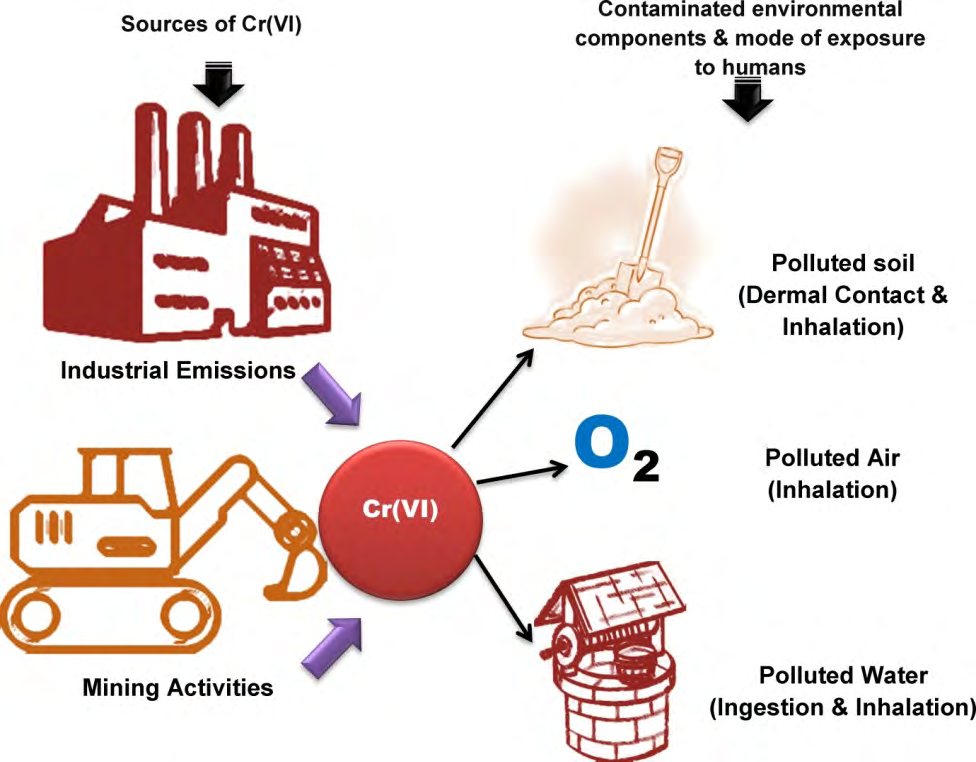
An indirect source of emission involves natural and non- occupational sources. The indirect sources of Cr emission are the source that does not produce Cr compounds and only accidentally emit Cr. For example, the combustion of fossil fuels emits Cr to the atmosphere as it is a component of burned fuel. Non-occupational sources of Cr emission include contaminated soil, water, air, smoking, and diet. The indirect sources comprise airborne emissions from chemical plants and incineration facilities, catalytic manufacture, cooling tower water treatment, cement dust, coal, and fuel combustion, asbestos lining erosion, municipal refuge and sewage, sludge incineration, tobacco smoke, and coke ovens. Routes of Exposure of Cr (VI) in Humans Cr(VI) can be exposed to humans primarily either through inhalation, ingestion, or dermal contact [8] (Figure 1). People exposed to high doses of Cr (VI) in the environment for a longer duration are most likely at the risk of developing carcinogenic symptoms. Industrial combustion of fuels releases Cr (VI) particulates into the air which further is inhaled by humans thereby leading to severe respiratory related ailments. In a similar fashion humans can get affected by Cr (VI) through oral ingestion either by consuming contaminated water or food. Cr (VI) can also easily penetrate through the human skin during activities involving dermal contact with polluted soil and/or water.
Carcinogenecity of Cr (Vi) In Humans
Cr (VI) has been listed as a Group-A carcinogen by the USEPA [9]. Cr (VI) does not have the ability to result in direct DNA damage, however facilitates the same by undergoing reduction in the presence of certain cellular components [10]. Cr (VI) being highly mobile can easily pass through the epidermal layer and into the cell via the sulphate channel. Once inside the cell, Cr (VI) is reduced in the presence of several cellular reductants like GSH (Glutathione), and ascorbate to Cr (III) [11]. During the reduction process, several reactive intermediates in the form of Cr (V) and Cr (IV) are formed. The molecular oxygen is activated during the process and is reduced to super-oxide anion, which is further converted to hydrogen peroxide. The intermediates react with hydrogen peroxide to release reactive oxygen species (ROS). Excessive production and interaction of ROS with the reactive intermediates leads to DNA damage. The DNA damage is mostly characterized by formation of DNA adducts, breaks in DNA strands, DNA-protein cross linking, thereby leading to mutations (Figure 2).
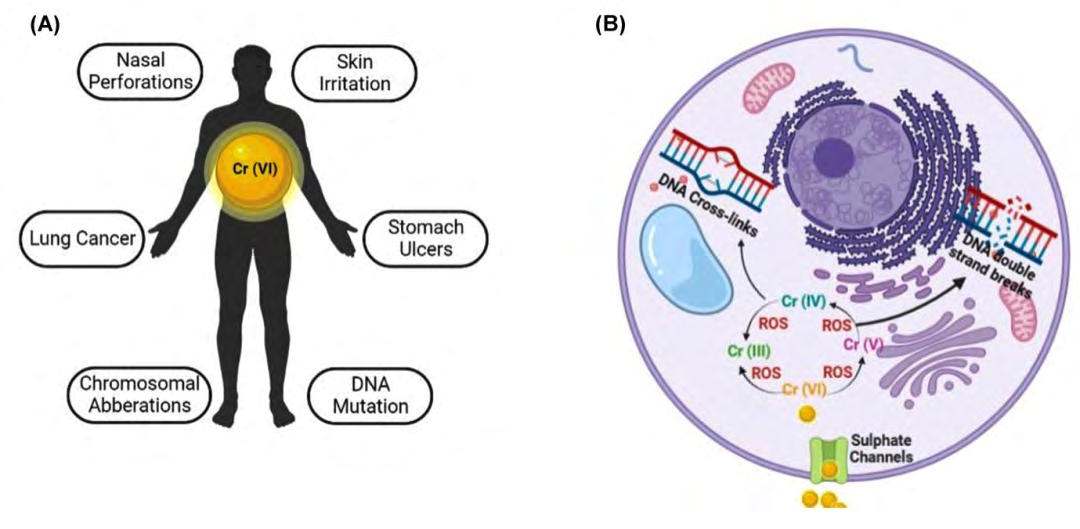
Cr (VI) has been found to pose deleterious effect on human brain thus leading to several setbacks [12]. Although, not much of work has been carried out to evaluate the toxic impact of the heavy metal on humans, but some researchers have pointed out the toxic impact of the heavy metal on humans (Table 2). Inhalation of Cr contaminated air leads to respiratory illness, lung vascular damage, chronic bronchitis, and pulmonary tuberculosis [13]. Men workers exposed to Cr at a mining site at Democratic Republic of the Congo were reported to have offspring’s suffering with congenital defects [14]. Human lung cell lines (BE) when exposed to Cr (VI) have been found to exhibit an increase in the methylation of CpG [15]. Lung tissues of workers exposed to Cr led to methylation of hMLH1 gene. Methylation led decreased expression of p16 gene was also observed [16].
| Effect | References | |
|---|---|---|
| Brain | Impaired learning during childhood, impaired olfactory function, chances of motor neuron diseases. | Wise, et al. [12] |
| Lungs | Respiratory illness, Pulmonary tuberculosis | Abubakar, et al. [13] |
| Foetus | Congenital malformations | Van Brusselen, et al. [14] |
| BE Human (Lung) Cells | Increased CpG methylation in RAD51 gene | Rager, et al. [15] |
| Lung tissue | Methylation in hMLH1 gene, Methylation led reduced expression of p16 gene | Holmes, et al. [16] |
Table 2: Recent Research Carried out Indicating the Toxic Impact of Cr (VI) in Humans.
Conclusion
Cr (VI) is a potent carcinogen that leverages toxic impact on the human health. Mostly released from anthropogenic sources, it contaminates the environment to a greater extent. Exposure to Cr (VI) through inhalation, ingestion, and/or dermal contact leads to severe toxicity in humans, including cancer of the lungs and sino-nasal cavity. Occupational exposure to Cr (VI) is a major issue of public health and should be addressed at the earliest. It is highly necessary for the government to implement strict guidelines so as to regulate the emission of Cr (VI) from various industries. Remediation of Cr (VI) from contaminated environmental matrices especially soil and water bodies should be carried out using sustainable technologies.
References
-
Das PK, Das BP, Dash P (2017) Hexavalent chromium induced toxicity and its remediation using macrophytes. Pollut Res 36(1): 92-98.
-
Das PK, Das BP, Dash P (2022) Evaluation of remediation ability of Pongamia pinnata (L.) Pierre under hexavalent chromium stress soil conditions. Pollut Res 41(3): 989- 996.
-
Das PK, Mohanty C (2022) Silica Assisted Charcoal Bio-Filter Designed for the Remediation of Cr(VI) Contaminated Water Bodies. Adv Clin Toxicol 7(2): 1-8.
-
Das PK, Das BP, Dash P (2022) Analytical study on hexavalent chromium accumulation in plant parts of Pongamia pinnata (L.) Pierre and remediation of contaminated soil. J Appl Biol Biotechnol 10(1): 22-30.
-
World Health Survey (2003) Geneva: World Health Organization.
-
Das PK, Das BP, Dash P (2018) Role of plant species as hyper-accumulators in the decontamination of hexavalent chromium contaminated soil. Indian J Environ Prot 38(12): 1016-1024.
-
Singh M, Kushwaha BK, Singh S, Kumar V, Singh VP, et al. (2017) Sulphur alters chromium (VI) toxicity in Solanum melongena seedlings: role of sulphur assimilation and sulphur-containing antioxidants. Plant Physiol Biochem 112: 183-192.
-
Das PK, Das BP, Dash P (2021) Chromite mining pollution, environmental impact, toxicity and phytoremediation: a review. Environ Chem Lett 19(2): 1369-1381.
-
Das BK, Das PK, Das BP, Dash P (2021) Green technology to limit the effects of hexavalent chromium contaminated water bodies on public health and vegetation at industrial sites. J Appl Biol Biotechnol 9(2): 22-30.
-
OBrien TJ, Ceryak S, Patierno SR (2003) Complexities of chromium carcinogenesis: role of cellular response, repair and recovery mechanisms. Mutat Res 533(1-2): 3-36.
-
Manning FC, Blankenship LJ, Wise JP, Xu J, Bridgewater LC, et al. (1994) Induction of internucleosomal DNA fragmentation by carcinogenic chromate: relationship to DNA damage, genotoxicity, and inhibition of macromolecular synthesis. Environ Health Perspect 102(S3): 159-167.
-
Wise Jr JP, Young JL, Cai J, Cai L (2022) Current understanding of hexavalent chromium [Cr (VI)] neurotoxicity and new perspectives. Environ Int 158: 106877.
-
Abubakar I, Aldridge RW, Devakumar D, Orcutt M, Burns R, et al. (2018) The UCL–Lancet Commission on Migration and Health: the health of a world on the move. The Lancet 392(10164): 2606-2654.
-
Van Brusselen D, Kayembe-Kitenge T, Mbuyi-Musanzayi S, Kasole TL, Ngombe LK, et al. (2020) Metal mining and birth defects: A case-control study in Lubumbashi, Democratic Republic of the Congo. The Lancet Planet Health 4(4): e158-e167.
-
Rager JE, Suh M, Chappell GA, Thompson CM, Proctor DM (2019) Review of transcriptomic responses to hexavalent chromium exposure in lung cells supports a role of epigenetic mediators in carcinogenesis. Toxicol Lett 305: 40-50.
-
Holmes AL, Wise SS, Wise Sr JP (2008) Carcinogenicity of hexavalent chromium. Indian J Med Res 128(4): 353- 372.
- Pattern of Gonadal Hormones in Oral Testosterone-Supplimented Male Wistar Rats with Diabetes-Induced Hypogonadism
- Re-Evaluation of the Genotoxicity of Currently Used Food Dyes in Mouse Multiple Organs Via Continuous Administration by Drinking Using the Comet Assay
- Pharmacogenetics of Type 2 Diabetes Mellitus: Linking Genetic Variability to Drug Efficacy and its Cardiovascular Outcomes
- Exploratory Proteomic Profiling of SARS-CoV-2 Infected THP-1 Macrophages Reveals Alterations in Inflammatory Response and Cellular Metabolism
- Study of Genotoxicity of Hepatocarcinogens in Multiple Organs in Mice by Feeding and Drinking Using the Comet Assay
- Spirulina Polypeptides Inhibit the Growth of Human Lung Tumor (H460) Cells