
QSAR Studies on Some C-21 Mercapto Derivatives as Anti- Pulmonary Inflammatory Agents
Glucocorticoids have been widely used for the treatment of inflammatory conditions but are associated with various side effects. C-21 mercapto derivatives, a class of dissociated steroids, have shown potential as anti-inflammatory agents with reduced side effects. In this study, QSAR (Quantitative Structure-Activity Relationship) analysis was performed on a series of 19 C-21 mercapto hydrocortisone derivatives with IL-6 cytokine inhibition activities. Molecular descriptors were calculated using Alva descriptor software, and significant descriptors governing the activity were identified. Multiple linear regression analysis revealed statistically significant models, and the best two-variable model included spectral mean absolute deviation from reciprocal squared geometrical matrix (SpMAD_RG) and H autocorrelation of lag 3 weighted by i state (H3s). Internal and external validation confirmed the reliability of the models. The study suggests that these structural descriptors, particularly SpMAD_RG and H3s, play a crucial role in the activity prediction of C-21 mercapto derivatives. The findings contribute to the design of novel molecules in this class with improved therapeutic potential.
Introduction
Glucocorticoids (anti-inflammatory steroids) have been the gold standard treatment for both acute and chronic inflammatory diseases since their introduction to the market more than 60 years ago. Asthma, chronic obstructive pulmonary disease, rheumatoid arthritis, and countless more are among the many disorders that fall under this category. Since cortisone and hydrocortisone were discovered in 1948 and 1951, respectively, the number of synthetic glucocorticoids has increased at a staggering rate. The success of using hydrocortisone to treat rheumatoid arthritis sparked a renewed interest in the potential of glucocorticoids for the treatment of other inflammatory illnesses. Weight gain, osteoporosis, and an increased risk of infection are just some of the negative side effects linked to glucocorticoids. Consider the potential benefits and drawbacks of utilising glucocorticoids as a therapeutic option [1, 2, 3].
Rheumatoid arthritis, psoriasis, and diabetes are only some of the inflammatory and metabolic illnesses that may benefit from treatment with C-21 mercapto derivatives. In animal models of disease, these chemicals have been proven to have strong anti-inflammatory properties, and early clinical trials have revealed that they are effective and safe for human use as well. The discovery of Compound A (CpdA) in the early 2000s established the concept of dissociated steroids. We showed that CpdA selectively activates the transrepression pathway of the glucocorticoid receptor (GR), which is responsible for the anti-inflammatory effects of glucocorticoids, while sparing the transactivation pathway, which is responsible for the metabolic effects of glucocorticoids. The word “dissociation” was coined to describe this selective activation of the GR trans repression pathway, which has been advocated as a therapeutic method to lessen the negative effects of traditional glucocorticoids. The structure of CpdA has inspired the development of a new class of dissociated steroids called mercapto derivatives. The metabolic consequences of traditional glucocorticoids are avoided while these compounds exhibit strong anti- inflammatory actions in vitro and in vivo. The steroid’s thiol group interacting with a specific cysteine residue in the GR ligand-binding region is assumed to be responsible for the receptor’s selectivity [4, 5].
More research has led to molecules with stronger affinity for glucocorticoid receptors and more selectivity for progestrone and mineralocorticoids. However, they cause severe adverse effects, which eliminates the possibility of using them repeatedly. By altering their pharmacokinetic profile and route of administration, topical steroids like mometasone furoate have increased the therapeutic index of conventional glucocorticoids [6, 7, 8, 9, 10, 11, 12, 13, 14, 15, 16].
Materials and Methods
A series of 19 C-21 Mercapto hydrocortisone Derivatives with their IL-6 cytokine inhibition activities are selected from literature [17]. The molecular strutres of these 19 hydrocortisone derivative are drawn using chemsketch software (ACD Labs) [18]. These molecular structures were further minimized using and these molecular structures were minimized using the MM994X force field. The molecular structures along with their inhibitory activity values are recorded in Table 1. Using the Alva descriptor software [19] total 5666 molecular descriptors, including 0D, 1D, 2D and 3D descriptors, were calculated. Among all the 5666 descriptors only those descriptors are reported in Table 1 which are governing the activity values. The remaining descriptors which having constant, near constant, and descriptors with pair absolute correlation bigger than 0.95 were excluded by the Alva descriptor software [19] from hundreds of calculated descriptors. The most significant structural descriptors that are found to govern the activity of the compounds were as follows:
H3s = H autocorrelation of lag 3/ weighted by I-State SpMAD_RG = spectral mean absolute deviation from reciprocal squared geometrical matrix The QSAR analysis was further developed using these above descriptors.
Results and Discussion
The current dataset consisting 19 hydrocortisone derivatives are taken from literature Biju P, et al. [17] which inhibit IL-6 cytokine synthesis. All the 19 compounds are divided into two sets comprising of A training set and a test set. 14 compounds, or 75% of the total of 19 compounds, were selected as the training set by random selection and these compounds were used to develop the QSAR models. the remaining 25% of compounds, or 5 compounds are used as test set for evaluating the reliability of the developed QSAR model. The test set compounds are indicated with a “*” mark in Table 1.
A substantial correlation between IL-6 pIC50 and the computed descriptors of the molecules was established using MLR technique (multiple linear regression) on the training set compounds with the help of NCSS software [20]. The strongest correlation using two-variable model is given below.
pIC50 = –45.9313(±34.4047) SpMAD_RG +0.3499(±0.1328) H3s+43.0452 (1) N = 14, r2 = 0.8185, r2 adj = 0.7855, S = 0.2656, F = 24.8039, r2 cv = 0.7630, r2 pred = 0.9473, average _r_2 𝑚 = 0.91, Δ𝑟2 𝑚 = 0.05.
In the above Eq. (1), the description and calculation procedure of these statistical parameters are same as reported in the previous studies [21, 22, 23, 24, 25]. The most significant one variable model is as below.
pIC50 = 0.3805(±0.1657) H3s+3.9034 (2) N = 14, r2 = 0.6760, r2 adj = 0.6491 S = 0.3397, F = 25.0425, r2 cv = 0.5842, r2 pred = 0.8214, average r2 m = 0.74, Δr2 m = 0.16.
Thus, from the above results, Eq. 1, and Eq. 2 both one and two variable models have a significant correlation between the inhibitory activity values and the structural descriptors of the compounds. We have also performed the internal and external validation of these models and calculated the validation parameters like r2 CV, r2 pred, average r2 m,, Δr2 m. It is well established that for an acceptable QSAR model, the value of “average 𝑟2 𝑚” should be >0.5, and “Δ𝑟2 𝑚” should be< 0.2. A close observation of these suggested two models suggested, eq. 1 and eq. 2, fulfilling the criteria of external validation.
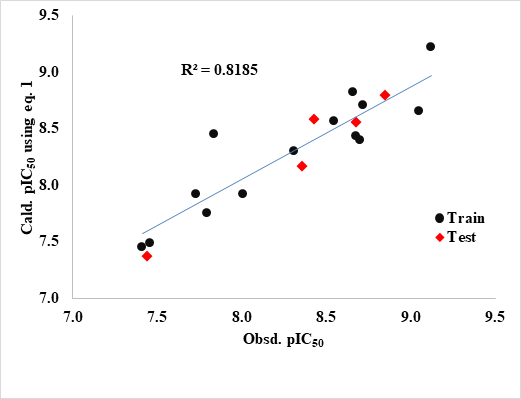
We predicted the IL-6 pIC50 values, which are listed in Tables 2 using the acquired eq. 1 and given in Table 2. A graph between the predicted and observed activities for the training and test sets is drawn which are represented in Figures 1, for the above-mentioned models in eq. 1. This figure shows that the best two-variable model, shown in Figure 1, demonstrates that practically all the points, except for a few, lie close to the straight line. The statistical results above using Eq. 1 show that the two-variable model is the best model for estimating the activity of the current collection of molecules.
Conclusion
19 C-21 Mercapto hydrocortisone Derivatives with their IL-6 cytokine inhibition activities were used to create a QSAR model in this study. The models obtained through MLR analysis validated by internal and external validation, demonstrating that it is substantial, devoid of chance correlation, and capable of making accurate predictions. The model is sufficiently reliable to forecast the inhibition of novel, 17-HSD3 inhibitors of the target enzyme. The eq. 1, also suggests that 3D matrix based descriptors especially spectral mean absolute deviation from reciprocal squared geometrical matrix (SpMAD_RG ) and H autocorrelation of lag 3 weighted by i state will play a major role while designing the novel molecules of C-21 Mercapto Derivatives. Furthermore, the H3s descriptor value must be as high as possible for better activity prediction.
| Compd. No. | Molecular Structure | Il-6 pIC 50 | SpMAD_RG | H3s |
|---|---|---|---|---|
| 1. * | N S S O HO OH O | 7.44 | 0.85 | 9.62 |
| 2. | N S S O HO OH F O | 7.73 | 0.84 | 10.41 |
| 3. | N S S O HO OH O | 7.46 | 0.85 | 9.68 |
| 4. * | N S S O HO OH F O | 8.36 | 0.84 | 10.96 |
| 5. | N S S O HO OH F O F | 8.72 | 0.84 | 11.84 |
| 6. | N S S O HO OH Cl O H | 8.31 | 0.84 | 10.56 |
| 7. | N S S O HO OH H O | 7.41 | 0.85 | 9.72 |
| 8. | N S O O O HO O O | 7.8 | 0.85 | 10.71 |
| 9. | S O N O O HO O O | 8.55 | 0.85 | 13.03 |
| 10. * | N S O N O O HO O O | 8.85 | 0.85 | 13.56 |
| 11. * | N N S O O O HO O O | 8.43 | 0.85 | 12.94 |
| 12. | O N S O O O HO O O | 8.66 | 0.85 | 13.38 |
| 13. | S N S O O O HO O O | 8.7 | 0.84 | 11.49 |
| 14. | S N N S O O O HO O O | 7.84 | 0.84 | 11.65 |
| 15. | N N S O O O HO O O | 8.01 | 0.85 | 11.19 |
| 16. | S N S O O O HO O O | 9.05 | 0.84 | 11.96 |
| 17. | S N S O O O HO O O | 9.12 | 0.84 | 13.47 |
| 18. | N S O O O HO O O | 8.68 | 0.85 | 12.25 |
| 19. * | N N S O O O HO O O | 8.68 | 0.85 | 12.47 |
Table1: A Series of C-21 Mercapto Derivatives and Their Activity Values Used in the Present Study.
| S. No. | Status | pIC 50 | ΔpIC 50 | Pred. LOO | |
|---|---|---|---|---|---|
| Obsd. | Cald. by | Model | Model | ||
| eq. 1 | |||||
| Prediction | 7.44 | 7.37 | -0.07 | - | |
| 2. | Training | 7.73 | 7.92 | 0.19 | 7.95 |
| 3. | Training | 7.46 | 7.48 | 0.02 | 7.49 |
| 4. | Prediction | 8.36 | 8.16 | -0.2 | - |
| 5. | Training | 8.72 | 8.7 | -0.02 | 8.69 |
| 6. | Training | 8.31 | 8.3 | -0.01 | 8.29 |
| 7. | Training | 7.41 | 7.45 | 0.04 | 7.47 |
| 8. | Training | 7.8 | 7.75 | -0.05 | 7.74 |
| 9. | Training | 8.55 | 8.56 | 0.01 | 8.57 |
| 10. | Prediction | 8.85 | 8.79 | -0.06 | - |
| 11. | Prediction | 8.43 | 8.58 | 0.15 | - |
| 12. | Training | 8.66 | 8.82 | 0.16 | 8.89 |
| 13. | Training | 8.7 | 8.39 | -0.31 | 8.36 |
| 14. | Training | 7.84 | 8.45 | 0.61 | 8.51 |
| 15. | Training | 8.01 | 7.92 | -0.09 | 7.9 |
| 16. | Training | 9.05 | 8.65 | -0.4 | 8.58 |
| 17. | Training | 9.12 | 9.22 | 0.1 | 9.27 |
| 18. | Training | 8.68 | 8.43 | -0.25 | 8.39 |
| 19. | Prediction | 8.68 | 8.55 | -0.13 | - |
Table2: Observed and Calculated pIC50 Values of One Variable Model.
References
-
Barnes PJ (1995) Inhaled Glucocorticoids for Asthma. N Engl J Med 332(13): 868-875.
-
Townsend HB, Saag KG (2004) Glucocorticoid Use in Rheumatoid Arthritis: Benefits, Mechanisms, and Risks. Clin Exp Rheumatol 22(5 Suppl 35): S77-82.
-
Greaves M, Gatti S (1999) The Use of Glucocorticoids in Dermatology. J Dermatolog Treat 10(2): 83-91.
-
Lin H, Hou CC, Cheng CF, Chiu TH, Hsu YH, et al. (2007) Peroxisomal Proliferator-Activated Receptor-α Protects Renal Tubular Cells from Doxorubicin-Induced Apoptosis. Mol Pharmacol 72(5): 1238-1245.
-
Li P, Bandyopadhyaya AK, Covey DF, Steinbach JH, Akk G (2009) Hydrogen Bonding between the 17β-Substituent of a Neurosteroid and the GABAA Receptor Is Not Obligatory for Channel Potentiation. Br J Pharmacol 158(5): 1322-1329.
-
SCHACKE H, Döcke DW, Asadullah K (2002) Mechanisms Involved in the Side Effects of Glucocorticoids. Pharmacol Ther 96(1): 23-43.
-
Brattsand RAB (1992) New Inhaled Glucocorticoids. In s. In: Barnes PJ, editor. New drugs for asthma IBC Technical Series 2: pp: 193-208.
-
Rehwinkel H, Schäcke H (2006) GR Ligands: Can We Improve the Established Drugs? ChemMedChem 1(8): 803-805.
-
Axelsson B, Brattsand R (2001) Soft Steroids. In New Drugs for Asthma, Allergy and COPD; KARGER: Basel pp: 94-97.
-
Shapiro EL, Gentles MJ, Tiberi RL, Popper TL, Berkenkopf J, et al. (1987) 17-Heteroaroyl Esters of Corticosteroids. 2. 11.Beta.-Hydroxy Series. J Med Chem 30(9): 1581- 1588.
-
Popper TL, Gentles MJ, Kung TT, Berkenkopf J, Lutsky BN, et al. (1987) Structure-Activity Relationships of a Series of Novel Topical Corticosteroids. J Steroid Biochem 27(4- 6): 837-843.
-
Barnes PJ (1998) Anti-Inflammatory Actions of Glucocorticoids: Molecular Mechanisms. Clin Sci 94(6): 557-572.
-
Rhen T, Cidlowski JA (2005) Antiinflammatory Action of Glucocorticoids — New Mechanisms for Old Drugs. N Engl J Med 353(16): 1711-1723.
-
Ito K, Getting S, Charron C (2006) Mode of Glucocorticoid Actions in Airway Disease. Sci World J 26(6): 1750-1769.
-
Schäcke H, Berger M, Hansson TG, Mc Kerrecher D, Rehwinkel H, et al. (2008) Dissociated Non-Steroidal Glucocorticoid Receptor Modulators: An Update on New Compounds. Expert Opin. Ther Pat 18(3): 339-352.
-
Miner N, Hong MH, Negro-Vilar A (2005) New and Improved Glucocorticoid Receptor Ligands. Expert Opin Investig Drugs 14(12): 1527-1545.
-
Biju P, McCormick K, Aslanian R, Berlin M, Solomon D, et al. (2011) Steroidal C-21 Mercapto Derivatives as Dissociated Steroids: Discovery of an Inhaled Dissociated Steroid. Bioorg Med Chem Lett 21(21): 6343-6347.
-
(2019) Advanced Chemistry Development Inc. Chemsketch. Toronto, Canada.
-
(2022) Alvascience, AlvaDesc (Software for Molecular Descriptors Calculation) Version 2.0.12.
-
Hintze J NCSS 8. NCSS, LLC. Kaysville, Utah, USA.
-
Chouhan A, Shaik B, Ahmad I, Agrawal VK (2023) QSAR studies on a series of biphenyl carboxamide analogues for analgesic activity. J Anal Pharm Res 12(1): 51-58.
-
Shaik B, Zafar T, Agrawal VK, Gupta SP (2022) QSAR and molecular docking studies on a series of spirocyclic BACE-1 inhibitors. J Anal Pharm Res 11(1): 21-25.
-
Roy K, Mitra I (2012) On the Use of the Metric rm 2 as an Effective Tool for Validation of QSAR Models in Computational Drug Design and Predictive Toxicology. Mini-Reviews in Medicinal Chemistry 12(6): 491-504.
-
Shaik B, Zafar T, Agrawal VK (2013) Estimation of Anti- HIV Activity of HEPT Analogues Using MLR, ANN, and SVM Techniques. Int J of Med Chem pp: 795621.
-
Shaik B, Deeb O, Agrawal VK, Gupta SP (2017) QSAR and Molecular Docking Studies on a Series of Cinnamic Acid Analogues as Epidermal Growth Factor Receptor (EGFR) Inhibitors. Letters in Drug Design & Discovery 14(1): 83- 95.
- Pattern of Gonadal Hormones in Oral Testosterone-Supplimented Male Wistar Rats with Diabetes-Induced Hypogonadism
- Re-Evaluation of the Genotoxicity of Currently Used Food Dyes in Mouse Multiple Organs Via Continuous Administration by Drinking Using the Comet Assay
- Pharmacogenetics of Type 2 Diabetes Mellitus: Linking Genetic Variability to Drug Efficacy and its Cardiovascular Outcomes
- Exploratory Proteomic Profiling of SARS-CoV-2 Infected THP-1 Macrophages Reveals Alterations in Inflammatory Response and Cellular Metabolism
- Study of Genotoxicity of Hepatocarcinogens in Multiple Organs in Mice by Feeding and Drinking Using the Comet Assay
- Spirulina Polypeptides Inhibit the Growth of Human Lung Tumor (H460) Cells