
Investigation of Formaldehyde Concentration in Indoor and Outdoor Air, A Systematic Review
Formaldehyde, commonly recognized as formalin, stands as the archetypal aldehyde, distinguished by its colorless gaseous form and acrid scent. Widespread usage and dissemination of this compound pose potential risks of dermatological and ocular irritation, respiratory ailments, genetic alterations, and carcinogenesis. This study aims to explore the concentrations of formaldehyde in both indoor and outdoor environments. The search strategy involved querying English-language articles in Google Scholar and Science Direct databases, specifically selecting those detailing formaldehyde concentrations. Ultimately, 16 articles meeting the criteria were included in the study. Results reveal that outdoor formaldehyde mean concentration reached up to 17.02 ± 11.46 ppm, while indoor level was 0.528 ± 0.527 ppm. Industrial settings exhibited the highest concentrations, with a mean of 10.73 ± 4.5 ppm. The study exposes higher formaldehyde levels in Asian countries (0.0522 ± 0.075 ppm) compared to European and North American counterparts. Additionally, concentrations displayed a tendency to rise during the summer (3.57 ± 5.03 ppm) in contrast to the winter season (3.08 ± 5.03 ppm). These findings underscore the need for heightened awareness and regulatory measures to mitigate formaldehyde exposure, especially in industrial contexts and regions with elevated concentrations.
Introduction
Formaldehyde, represented chemically as O=C2H or commonly referred to as formalin (Formal), belongs to the aldehyde family and stands as the simplest organic molecule. It manifests as a colorless, flammable gas with a pungent odor, existing in a polymerized form that poses dangers and can generate secondary pollutants due to its high reactivity. Typically derived from methanol, it can be in liquid form (formalin) or solid form (Para formalin). When entering the body, formaldehyde can undergo conversion into formic acid, elevating blood acidity. Exposure through skin contact, ingestion, or inhalation yields immediate physiological effects, including skin, eye, and respiratory irritation.
Numerous studies confirm both acute and chronic effects, highlighting formaldehyde’s carcinogenicity in laboratory animals and its impact on human respiratory capacity [1, 2].
Formaldehyde poisoning symptoms encompass weakness, headache, abdominal pain, dizziness, confusion, anxiety, reduced central nervous system activity, and shock [3]. Importantly, it is classified as the 25th carcinogenic compound by the EPA and designated a human carcinogen by the International Agency for Research on Cancer [4].
In medical settings, formaldehyde finds use in disinfecting and sterilizing surgical tools. A 10% solution serves as a preservative and tissue stabilizer in pathology applications. However, inhalation of formaldehyde in these contexts has been linked to adverse respiratory effects [3]. The chemical industry extensively employs formaldehyde in the production of various goods, such as home cleaners, paints, textiles, and pesticides. Its potent preservation effects, attributed to antioxidant characteristics, involve protein denaturation and inhibition of microbial proliferation [4]. Its disinfection mechanism, interacting with amine groups, deactivates proteins and alters nucleic acid structure [5]. Recognized as a prevalent air contaminant due to its hazardous properties and atmospheric dispersion, regulatory standards, including OSHA guidelines, are in place for occupational exposure. The permissible threshold for an 8-hour exposure is set at 0.75 ppm (time-weighted average), with a short-term exposure limit of 2 ppm [2]. A study by Vosoqi et al. identified 36 businesses, as designated by the World Health Organization (WHO), where workers face formaldehyde exposure [2]. Given its substantial health hazards and widespread industrial use, diligent regulation and monitoring of formaldehyde levels are imperative to protect both occupational workers and the general population from its adverse effects.
Study Method
The current systematic review is grounded in funded articles sourced from the “Google Scholar” and “Science Direct” databases, covering the period from October 7 to 22, 2022. No time filtering was applied to the articles during the search process. The search strategy employed the keywords “air” AND “formaldehyde” in both databases. The primary inclusion criterion was the reporting of formaldehyde concentrations in indoor or outdoor air. Articles that did not provide information on formaldehyde in the air were excluded. A total of 22,917 articles were initially identified using the specified keywords. In the first step, articles with titles, abstracts, and keywords containing both “air” and “formaldehyde” were selected. Duplicate entries were subsequently removed, resulting in a refined selection of 50 articles. In the next phase, a comprehensive examination of these 50 articles was undertaken, leading to the identification of 16 articles that reported formaldehyde concentrations. These 16 articles met the criteria and were ultimately included in the study for further analysis.
Results and Discussion
Concentration of Formaldehyde in Indoor and Outdoor Air
In the analysis of the 16 reviewed articles, formaldehyde concentrations in both indoor and outdoor air were investigated. Out of the total, 11 articles reported indoor concentrations, revealing an average of 0.527 ± 0.528 ppm (SE = 0.46 ppm, Median = 0.5 ppm). There was no significant difference for the concentrations between the groups (Mann- Whitney U, p-v>0.5). The highest recorded concentration was observed in industrial settings, reaching 1.053 ppm, while the lowest average formaldehyde quantity was reported in residential environments at 0.04 ppm.
Concurrently, six of the reviewed articles provided insights into outdoor formaldehyde levels, showing an average concentration of 11.46 ± 17.02 ppm (SE = 13.897 ppm, Median = 3.25 ppm). Industrial outdoor locations exhibited the highest concentration at 31.03 ppm, while the lowest average concentration across various countries was 0.106 ppm. The data suggests that outdoor settings generally have higher formaldehyde levels compared to indoor, as depicted in Figure 1. The elevated presence of formaldehyde in industrial settings poses a significant health risk to exposed individuals [6]. Various sources contribute to indoor emissions, including wood, flooring, paint, cooking activities, smoking, electronic equipment, paper, fabric dye, ink, cosmetics, cleaning products, and air fresheners [6, 7]. However, outdoor settings, predominantly influenced by the biosphere, atmospheric interactions, and biomass/ fuel combustion, are identified as the primary source of formaldehyde emissions. Industrial operations such as oil refining, copper plating, and waste incineration, as well as fuel combustion in urban and industrial settings, contribute substantially to outdoor formaldehyde levels.
The majority of examined work settings indicate an insufficient level of both carcinogenic and non-carcinogenic risks associated with occupational exposures to formaldehyde [8]. Notably, studies reveal DNA and chromosomal damage in the peripheral lymphocytes of those occupationally exposed to formaldehyde, suggesting a potential genotoxic risk. This supports the notion that inhalation of formaldehyde can lead to genotoxic damage in circulating blood cells, consistent with previous research [9, 10].
Individuals exposed to formaldehyde are more likely to experience symptoms such as eye and throat irritation, increased headache and weariness, nasal irritation, chest tightness, and shortness of breath [11]. These findings underscore the importance of assessing and managing formaldehyde exposure in various environments to mitigate associated health risks.
![Figure 1: The elevated presence of formaldehyde in industrial settings poses a significant health risk to exposed individuals [6]. Various sources contribute to indoor emissions, including wood, flooring, paint, cooking activities, smoking, electronic equipment, paper, fabric dye, ink, cosmetics, cleaning products, and air fresheners [6,7]. However, outdoor settings, predominantly influenced by the biosphere, atmospheric interactions, and biomass/ fuel combustion, are identified as the primary source of formaldehyde emissions. Industrial operations such as oil refining, copper plating, and waste incineration, as well as fuel combustion in urban and industrial settings, contribute substantially to outdoor formaldehyde levels.](/fulltextimages/12108/fig_1.png)
Concentration of Formaldehyde in Hospitals and Industries
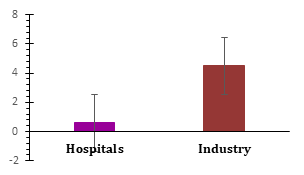
In the examination of the 16 analyzed publications, formaldehyde concentrations within hospitals were reported in 6 articles. There was no significant difference for the concentrations between the groups (Mann-Whitney U, p-v>0.5). The average concentration in hospital settings was found to be 0.62 ± 0.52 ppm (SE = 0.52 ppm, Median = 0.24 ppm), with the highest recorded value observed in a public hospital at 1.33 ppm and the lowest in a military hospital at 0.228 ppm. Additionally, five articles presented data on formaldehyde concentrations in various industrial settings. The average industrial concentration was determined to be 10.73 ± 4.5 ppm (SE = 10.04 ppm, Median = 0.548 ppm). The chemical sector exhibited the highest concentration at 31.03 ppm, while the lowest concentration of 0.2 ppm was recorded in office environments within industrial centers. Notably, the concentration of formaldehyde in industries surpassed that in hospitals, as depicted in Figure 2. The average concentrations in both healthcare and industrial settings exceeded the recommended 8-hour weighted mean threshold value (TWA-TLV) established by the American Conference of Governmental Industrial Hygienists (ACGIH).
The potential health risks associated with formaldehyde exposure, encompassing both carcinogenic and non- cancerous consequences affecting the nervous system, skin, and respiratory system, are significant in both industrial and hospital settings [12]. Industries, particularly those investigated outdoors, demonstrated a high prevalence of formaldehyde exposure, identified by a study conducted by Shahram Vosoqi, et al. revealing 36 distinct industries where workers are exposed to formaldehyde [6].
Formaldehyde finds extensive use in various industries, including fabric, leather, rubber, cement, plastic, adhesives, glues for wood products, paper pulp, and manufacturing processes in furniture and textile industries [13]. Health risk assessments are essential for determining preventive measures against workplace air pollutant exposure, considering the well-established human carcinogenicity of formaldehyde, categorized by the International Agency for Research on Cancer (IARC). The compound has been linked to DNA damage, mutations in mammalian cells, and the development of nasopharyngeal carcinoma (NPC) and leukemia in humans.
In hospital settings, formaldehyde is commonly employed for sterilization and tissue fixation before pathology analysis. However, research indicates a lack of formal training among operating room staff regarding precautions when handling formaldehyde, leading to potential adverse effects. The study by Sultanpour et al. revealed that the average concentration of formaldehyde in the air within healthcare and industrial facilities in Iran exceeds the recommended 8-hour Time-Weighted Average Threshold Limit Value (TWA-TLV). Implementing preventive measures is crucial in both healthcare and industrial settings to mitigate or eliminate elevated air concentrations [12].
Concentration of Formaldehyde in European, Asian and North American Countries
Formaldehyde concentrations in European, Asian, and North American countries were examined in three of the sixteen reviewed studies. The results for them were not significantly difference (Kruskal-Wallis, p-v>0.5). The average concentration in European countries was determined to be 0.0014 ± 0.019 ppm (SE = 0.001 ppm, Median = 0.019 ppm). Germany exhibited the highest concentration at 0.02 ppm, while European countries collectively displayed the lowest concentration at 0.018 ppm.
In Asian countries, the average formaldehyde concentration was 0.075 ± 0.0522 ppm (SE = 0.06 ppm, Median = 0.01 ppm). China showed the highest concentration at 0.139 ppm, with Japan presenting the lowest value at 0.007 ppm. The average concentration in North American countries was 0.0078 ± 0.0295 ppm (SE = 0.0055 ppm, Median = 0.0295 ppm). The United States recorded the highest value at 0.035 ppm, while Canada demonstrated the lowest concentration at 0.024 ppm. The findings underscore that formaldehyde concentrations in Asian countries are comparatively higher than those in European and North American countries, as illustrated in Figure 3.
Elevated formaldehyde levels in Asian countries, particularly China, are linked to their substantial share in global formaldehyde production and consumption, constituting approximately 34% of the global total. The growth of formaldehyde-related industries in China over the last two decades has positioned the country as a leading global producer and consumer of formaldehyde. Despite the implementation of formaldehyde regulations by the Chinese government, enforcement challenges have resulted in only partial effectiveness, contributing to consistent formaldehyde exposure for a significant portion of the Chinese population. This exposure has been associated with various health issues, emphasizing the importance of more stringent enforcement measures and continued monitoring [14].
![Figure 3: Elevated formaldehyde levels in Asian countries, particularly China, are linked to their substantial share in global formaldehyde production and consumption, constituting approximately 34% of the global total. The growth of formaldehyde-related industries in China over the last two decades has positioned the country as a leading global producer and consumer of formaldehyde. Despite the implementation of formaldehyde regulations by the Chinese government, enforcement challenges have resulted in only partial effectiveness, contributing to consistent formaldehyde exposure for a significant portion of the Chinese population. This exposure has been associated with various health issues, emphasizing the importance of more stringent enforcement measures and continued monitoring [14].](/fulltextimages/12108/fig_3.png)
Concentration of Formaldehyde in different Seasons
Analysis of two out of the sixteen reviewed articles provided insights into the concentration of formaldehyde across different seasons of the year. The mean concentration during the hot seasons was found to be 6.13 ± 3.08 ppm (Max = 12.27 ppm, Min = 0.0095 ppm, SE = 5.3 ppm, Median = 0.024 ppm), while the mean concentration during the cold seasons was 3.57 ± 5.25 ppm (Max = 7.125 ppm, Min = 0.018 ppm, SE = 3.55 ppm, Median = 3.57 ppm). These results suggest that the mean concentration of formaldehyde is higher during the hot seasons compared to the cold seasons [15].
Supporting this observation, the study conducted by Salari et al. aligns with the finding that formaldehyde concentrations tend to be higher during hot seasons. This observation implies that photochemical reactions play a substantial role in the generation of formaldehyde, particularly during the warmer months of the year [16]. Understanding the seasonal variations in formaldehyde concentrations is crucial for comprehensive air quality assessments and the implementation of targeted strategies to manage and mitigate formaldehyde exposure.
Conclusion
The concentration of formaldehyde in external environments is typically higher than in internal environments, primarily attributed to the prevalence of various industries. Industries, known for their diverse operations, tend to contribute to elevated formaldehyde levels compared to hospitals. Despite the wide array of industries and prolonged exposure to formaldehyde, absorption can occur through the skin, digestion, and inhalation. Immediate physiological effects manifest as initial stimulation of the skin, eyes, and respiratory mucosa. Prolonged exposure to formaldehyde can result in both acute and chronic effects, including DNA damage, cell mutations, carcinogenesis, and impairment of various bodily systems, particularly the respiratory system.
Furthermore, the concentration of formaldehyde exhibits a seasonal variation, with higher levels observed during warm seasons in contrast to winter. This phenomenon is likely influenced by photochemical reactions that play a significant role in formaldehyde generation throughout the warmer months.
In the context of international comparisons, Asian countries stand out with higher concentrations of formaldehyde when compared to European and North American countries. Notably, China emerges with the highest concentration of formaldehyde among the countries investigated. This discrepancy may be linked to China’s substantial share in global formaldehyde production and consumption, indicating the importance of monitoring and regulating formaldehyde levels, particularly in regions with pronounced industrial activities.
Acknowledgments
The authors are grateful to Semnan University of medical sciences to support the availability of scientific resources to preformats of this research, and Mr. Ali Shojaee for his help on edition of the manuscript.
References
-
Stalikas CD, YC Fiamegos (2008) Microextraction combined with derivatization. TrAC Trends in Analytical Chemistry 27(6): 533-542.
-
Vosoughi S (2013) Toxic Effects Of Formaldehyde Vapors On Testicular Tissue And Sperm Parameters In Adult Mice.
-
Pouladkhay F, Abjar R, Bagheri F, Azarmehr T, Siamian H, et al. (2020) Evaluation of Awareness, Performance and Side Effects of Formaldehyde Exposure. Journal of Mazandaran University of Medical Sciences 30(190): 158-163.
-
Teimour F, Amin MM (2016) Investigation of ZnOsonophotocatalytic Process Efficiency in Formaldehyde Degradation from Aqueous Solution. J Health Syst Res 12(3): 358-364.
-
Nowrozi H, Kazemi A, Adimi P, Afshar S (2013) Antifungal activity of commercial disinfectants: formaldehyde, glutaraldehyde, microten, alcohol 70 and savlon– alcohol on isolated saprophytic fungi from hospital environments. Journal of Gorgan University of Medical Sciences 14(4): 107-112.
-
Liu C, Miao X, Li J (2019) Outdoor formaldehyde matters and substantially impacts indoor formaldehyde concentrations. Building and Environment 158: 145- 150.
-
Saleh IA, Ezzo AA, Abdel-Latif MMN, Mohammed AMF, et al. (2022) Formaldehyde Risk Assessment in Indoor/ Outdoor Environment in Cairo, Egypt. Egyptian Journal of Chemistry 65(7): 175-188.
-
Khoshakhlagh AH, Mohammadzadeh M, Manafi SS, Yousefian F, Gruszecka-Kosowska A (2023) Inhalational exposure to formaldehyde, carcinogenic, and non- carcinogenic risk assessment: A systematic review. Environmental Pollution 331(pt 1): 121854.
-
Costa S, Coelho P, Costa C, Santos LS, Teixeira JP, et al. (2008) Genotoxic damage in pathology anatomy laboratory workers exposed to formaldehyde. Toxicology 252(1-3): 40-48.
-
Costa S, Costa C, Laffon B, Teixeira-Gomes A, Teixeira JP, et al. (2019) Occupational exposure to formaldehyde and early biomarkers of cancer risk, immunotoxicity and susceptibility. Environmental research 179(pt A): 108740.
-
Main DM, Hogan TJ (1983) Health effects of low-level exposure to formaldehyde. Journal of occupational medicine 25(12): 896-900.
-
Soltanpour ZY, Mohammadian Y, Fakhri Y (2022) Mohammadian, and Y. Fakhri, The exposure to formaldehyde in industries and health care centers: A systematic review and probabilistic health risk assessment. Environmental Research 204(pt B): 112094.
-
Fenech M, Nersesyan A, Knasmueller S (2016) A systematic review of the association between occupational exposure to formaldehyde and effects on chromosomal DNA damage measured using the cytokinesis-block micronucleus assay in lymphocytes. Mutation Research/Reviews in Mutation Research 770(Pt A): 46-57.
-
Tang X, Bai Y, Duong A, Smith MT, Li L, et al. (2009) Formaldehyde in China: production, consumption, exposure levels, and health effects. Environment international 35(8): 1210-1224.
-
Nogueira T, Dominutti PA, Fornaro A, Andrade MDF (2017) Seasonal trends of formaldehyde and acetaldehyde in the megacity of São Paulo. Atmosphere 8(8): 144.
-
Salari M (2016) Evaluation of diurnal and seasonal formaldehyde’s concentration variations in ambient air of Enghelab Square region in Tehran, 2014-2015. Journal of Research in Environmental Health 2(1): 20-28.
- Evaluation of Skin Aging Preventive Effects of Cherry Blossom Petal Extracts Through Antioxidant and Anti-Glycation Activities
- Is Cell Death Responsible for False Positive Results of In Vivo Comet Assay?
- Pattern of Gonadal Hormones in Oral Testosterone-Supplimented Male Wistar Rats with Diabetes-Induced Hypogonadism
- Re-Evaluation of the Genotoxicity of Currently Used Food Dyes in Mouse Multiple Organs Via Continuous Administration by Drinking Using the Comet Assay
- Pharmacogenetics of Type 2 Diabetes Mellitus: Linking Genetic Variability to Drug Efficacy and its Cardiovascular Outcomes
- Exploratory Proteomic Profiling of SARS-CoV-2 Infected THP-1 Macrophages Reveals Alterations in Inflammatory Response and Cellular Metabolism