
Brazilian Transvestites for the World A Brief Ethnographic Report in the Bois De Bologne in Paris
Brazil is a hostile environment for Trans and transvestite women, lacking effective public policies and government data, while being characterized by physical and symbolic violence against this group. The research highlights that the numbers of reports do not truly reflect the extent of violence against transvestites in the country due to unreported cases, as well as murders not registered by government public security systems for transphobic reasons. In 2022, the National Association of Transvestites and Transsexuals - ANTRA recorded an increase in the number of murders of transvestites in Brazil, which reduced life expectancy to 35 years. Some transvestites seek a better life by migrating to Europe, here more specifically France. For the transvestites studied, in their imagination, it is a territory for the production of financial and symbolic capital, as well as a life with more possibilities for other relationships. In conclusion, the study emphasizes the marginalization and challenges faced by trans and transvestite women in Brazil and France, highlighting prostitution as a survival strategy due to the lack of effective policies, with the possibility of finding and building other landscapes that keep them linked to life.
Introduction
Brazil is decidedly a territory inhospitable to the existence of trans women and transvestite. Government data and public policies are lacking at the same time that physical and symbolic violence remains on the bodies and existences of these people. Data from a report made by Jornal Hoje, aired on December 26, 2022, points out how – even staggering – the numbers of denunciations do not reveal the reality of homophobia in Brazil, since the prejudice of the employees of the police stations prevents crimes from being reported.
In addition, in 2022, according to data from the National Association of Transvestites and Transsexuals, 131 trans people were murdered, 8% above the average number of murders in absolute numbers [1]. These staggering numbers are reflected in the life expectancy of the population – which is only 35 years (IDEM). The scenario of violence also materializes in the absence of educational and professional opportunities – which relegate this population to work with prostitution; the absence of basic health services; the social pressure for these people to adjust to the gender that was assigned to them at birth (VALE, 2018). Only in 2022
did the Superior Court of Justice (STJ) establish that the Maria da Penha Law (Law 11,340/2006) “must be applied in cases of domestic or family violence against transgender women.” Danielle Coelho Silva points out that “femicide is conceptualized in law 13.104/2015. The Bill that gave rise to law 13.104/2015, was PL 8.305/2014, which consisted of qualifying homicide ‘against women for reasons of gender’”, however, due to political pressures, “the elementary gender was removed and in its place began to include female sex, thus occurring an exclusion of transsexual women” [2]. In Brazil, “crossing the limits of the ‘normal’ of the constructions of gender and sexuality entails the expulsion of subjective and family spheres; in addition, as their life does not correspond to social expectations, then they are also taken from the social sphere” [3] hence migration as a possibility of resistance and as “one of the modalities of response found to escape misery and violence” (VALE, 2008, p. 57). One of the migration destinations, according to Alexandre Fleming Câmara Vale [4] is France, since, from the perspective of those interviewed by one of the authors of this study, it is a country that is more tolerant of transgender people and offers more opportunities for employment and education. He also discusses the fact that France is a more cosmopolitan country, and that it offers more possibilities for self-expression for transgender people.
In 2016, one of the authors of the work carried out ethnography in Paris, as part of his doctoral thesis, with the aim of studying Brazilian transvestites who had migrated to France. This article presents an excerpt from this research as a possibility to highlight discussions regarding transvestites in a migration situation. Through the ethnographic report, we intend to reflect on the existence of these women in foreign territory, as well as the construction of their gender and sexuality identities crossed by work in the field of prostitution. In Bois de Bologne Just as Zeus seduces Europe, by transforming himself into a beautiful Bull and kidnapping her [5] transvestites are seduced by what they understand to be the European continent. Social networks help Brazilian transvestites to show the beauty of Europe, and their posts on YouTube, for the most part, are optimistic: I have to “pump up” and go to Madrid. There, yes, we make money! I know transvestites here or in the center who are doing well, there are one or two who are deported. I think I was unlucky or didn’t know how to do it right. (Verbal information). For the transvestites researched, Europe, or more specifically Barcelona, Madrid, Milan, Lisbon, Paris, in their imagination, are the territories of production of financial and symbolic capital, as well as a place of glamour, and a life with more possibilities of other relationships.
It was December 16, lights, deer and all these common elements at Christmas, in the shop windows. After researching the world of transvestite prostitution, some facts caught my attention: the denunciation about the slave labor of transvestites, the great repercussion of the fact involving an air transport company of women and transvestites to France. The criminalization of the user of prostitution services, as already presented, made me understand that the approaches, as well as the local ones, such as the Bois de Boulogne Park, would not be easy.
After walking down a long avenue lined with neon lights, some drawing female bodies, past the sex museum, which happened to be under renovation near the Moulin Rouge, the Folies Pigalle was my first foray. This choice was due to the representation of a female body in neon, used as a mark and information that would find transvestites, including Brazilians. There was great diversity of people and ethnicities (nothing new for a multicultural city); I try to talk to a transvestite. Nothing! To no avail, she didn’t speak English, Spanish, or Portuguese, or she just didn’t want to. Again, I’ll never know. I return to the table, and after observing the bodies, the clothes, and their gestures, I see that prostitution would not be there explicitly; One or another transvestite would talk to a man and leave. I sit down, frustrated and tired, in addition to all the financial investment made. So, I decide that I am not on a good day and return to the Hostel named Peace and Love, something very decadent, with precarious facilities, but close to what I demanded: subway line and the regions I had researched, as well as the information obtained by the informants. I return to Pigalle and, like a cartographer, I enter the streets, I get to the square, bars, corners and really the prostitution of the transvestites there does not occur on the street. At this point, I am questioned by a man speaking in French, who hands me a bunch of cards, like a deck. They are pictures of women naked and in sexual positions, there were many. However, there were no transvestites. Then I gesture, trying to explain that I wanted breasts and cock. Annoyed, he takes the cards from my hands and leaves. From the tension of the scene, it was evident that he was aware of the illegality of what he was doing.
The previous night’s bar/nightclub was barely moving; I waited at the door, but to no avail. So I decided to go in. I remembered the McDonald’s on Gran Vía in Madrid, so I stayed close to the place where there were some transvestites. Finally, I meet a Brazilian transvestite. After observing, I thought I was Brazilian or from South America, I’m not sure if by clothing, by gesture or by intuition. Even being a Brazilian meeting another Brazilian, we did not have much time together, because she soon realized that she would not have the 100 Euros of the program. So I asked: Me: I’m trying to find the Brazilian transvestites, where do I find them? Transvestite: Here, like me, in Pigalle, in the Bois de Boulogne Park, in the vicinity of the Marais with Chatelet, is more rich and what works well here are the sites.
Me: Have you been here for a long time? Transvestite: It’s been a long time. Me: Do you live here? Transvestite: I’m spending a season; Me: I ordered a beer, do you accept? Transvestite: Can I order a drink? Me: Sure! How are things here? Transvestite: Great. Now, Paris is not like Milan. (Verbal information) The drink arrived and she just picked it up, gave me a goodbye kiss and left. I decided to stay longer, an electronic sound made the conversations short by the difficulty of hearing the interlocutor. However, it had already advanced. Did you know of other locations, maybe these places are less targeted! I could establish other conversations. I did not feel safe walking through Pigalle, Paris, at dawn, I do not know the codes, as well as in Madrid, I know that prostitution is not a crime. However, I could be mistaken for a client, unlike Madrid. Another relevant fact: I did not carry documentation that could confirm that I was conducting a survey, which I must correct in the following incursions. I started walking around with a document from the University of Porto, which stated that, during my doctorate, I had made trips to carry out the research.
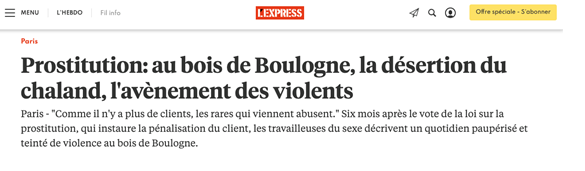
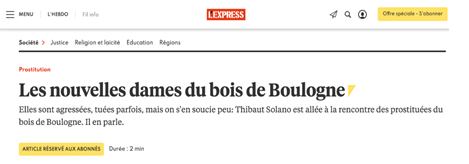
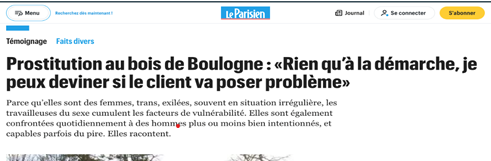
I decided in the morning to go earlier, this time to the Bois de Boulogne Park. In fact, it is a landscape project with a variety of activities, uncommon, which I do not know in Brazilian parks. There are two gardens, Serres d’Auteuil, and to the north, Jardin d’Acclimatatio, two lakes, with plenty of water, which runs through a part of the park and the two gardens mentioned. There is a restaurant with outdoor and indoor tables on the island in the lake. An affectionate atmosphere between couples and expressive by Paris standards. That beautiful park is a symbol of a contemplative and bucolic Paris, with green fields, taking on another configuration. At night, it is no longer the safe territory and on the horizon you can no longer see the cedars, athletic men paddling in the lake and families playing with their children. It changes the relationship with the senses of those who go after sunset. Safety is replaced by a tension, vision is limited to the light of the headlight or artificial lighting, and people are no longer there with so much affection, but for sex, for the most part. There are records of robberies and rapes. The night is known for danger, as I was warned by Yoran at the Peace and Love Hostel. The news found in the newspapers attribute this picture, for the most part, to thieves and prostitutes (cis, trans and transvestite), immigrants, such as the articles in the newspaper L’Express, of October 4, 2016 (Figure 1), of November 30, 2018 (Figure 2) and in Le Parisien of March 18, 2022 (Figure 3).
After a few attempts, after getting off at the Porte Maillot station and waiting for a taxi driver who would agree to enter the Route de Suresnesn, access to the Bois de Boulogne, and go to the regions of prostitution, finally, a young boy, with the appearance of a 30-year-old emigrant, apprehensive, accepted this adventure. For this, I showed him documentation, the student card of the university, and said that it was a research. I asked the taxi driver, who spoke English, to walk slowly, but he tried to convince me that this time was dangerous. Then I looked at my phone and realized it was already past 11 p.m. A few minutes later, a large universe of prostitutes, from cis, transvestite, Trans and other genders, such as crossdress, was gradually evident by the headlight of the car. It was cold, even at Christmas. Passing a few transvestites, one opened a long coat and well lit by the high beam of the taxi, made a seductive game with her body, while showing her breasts and cock. So, kind of quickly, I asked him to stop, but he refused, passed other people who I no longer know if they were men looking for sex or thieves. After all, we were in the middle of a large park. The taxi driver reinforced how dangerous it was to go down to talk there. On the way back, through other avenues, we arrive at the starting point. With satisfaction, he said, “We have arrived, Brazilian”. I can describe this place as a segregated space, where everyone is exposed to violence, inclement weather, police, thieves and abusers. However, I liked the resistance to staying in the Bois de Boulogne, even though I knew that there is little possibility for a transvestite to adjust to the capital, even in France, and that that was the only possibility, perhaps.
The issue of transvestite migration, not just from Aracaju, presents a certain complexity. Therefore, when dealing with this subject, we will start from the concept of Sayad [6] for emigrant and immigrant: [...] what we call immigration, and which we treat as such in one place and in one society, is called, in another society or for another society, emigrant; as two sides of the same reality, emigration as the other aspect of immigration, in which it continues and survives, and which will continue to accompany as long as the immigrant, as the emigrant’s double, does not disappear or has not been definitively forgotten as such. The condition of transvestites is this duplicity, which encounters countless barriers to break with this place of non-belonging, such as those who leave a reality and land in other cultures, most of them, devoid of information and money as an emigrant. This social issue makes them vulnerable, placing them subject to financial agreements, such as that reported in the ethnography of Maria Cecilia Patricio [4].
Final Consideration
The excerpt of the reality of transvestites in Paris presented in the ethnographic account demonstrates that, although France seems a safer and more welcoming destination for these people, marginalization, at different levels, is also something quite present. This fact is intensified when aspects that combine different identity aspects such as sex, gender, sexuality, nationality and the stereotypes that often relegate to transgender people jobs that are discriminated against and not socially valued. Prostitution is still widely stigmatized in our societies, causing transvestites such as those cited in the research to be placed in a position of additional and, why not say, intersectional marginalization [7] considering the various aspects of their identities. The brief report points out how transvestites are subject to their own fate and that – in the absence of effective policies of inclusion by the State – in prostitution they create their own rules of survival, even avoiding researchers, perhaps perceived as an expression of the same State that violates them. The geography of cities also is organized in practical and symbolic terms to marginalize them, even in “more cosmopolitan cities”. Thus, the dwelling and place of experience of transvestites is always surrounded by violence and reported in tones of fanfare, it is as if the city “lost” the region to prostitution and then to violence. We hope that the report presented here will serve as a way to think about these realities and understand that transvestites are marked and the result of violence, not vectors of it.
References
-
Benevides BG (2023) Dossiê murders and violence against Brazilian travesties and transsexuals in 2022. Brasília DF Distrito Drag ANTRA.
-
Silva dc (2022) judicial treatment of transsexual mulher as vitima of the crime of feminicídio. Direito e Sexualidade Magazine 41–58, 29 dez.
-
Suarez (2017) Lucy Victoria Ojeda. The migratory path of Brazilian trans sex professionals to Europe.
-
Patrício MC (2008) doesn’t trade Tran’s nationality and distinction between Brazilian transvestites. Tese (Doutorado) Universidade Federal de Pernambuco Recife.
-
Brunel PP (1988) Dictionaries of literary myths. Translated Carlos Süssekind São Paulo Edusp
-
Sayad AA (1988) migration or the paradoxes of alterity. São Paulo Editora da Universidade de São Paulo
-
Crenshaw, Kimberle (2002) Intersectionality in racial and gender discrimination. Feminist Studies Magazine No. 1.
-
Crimes of homophobia in Brazil and victims report difficulty in registering incidents in offices. (n.d.). G1. Retrieved April 15 2023.
- The Indispensable Role of Informal Caregivers in Supporting the Aging Population
- Socio-Religious Significance of Kamakhya Temple in Guwahati, Assam
- Is Anthropology Possible?
- A Contribution to the History and Paleobiology of Harput/Elazığ Türkiye and Its Surroundings
- A Study on the Cowrie Shells of the Dimasas in Assam
- The Significance of International Organizations Cooperation in the Efficient Resolution of Global Conflict