
Mahala: A Cultural Institution of the Dongria Kandha Community of Odisha
The Particularly Vulnerable Tribal Groups (PVTGs) in the Indian state of Odisha, the Dongria Kandha, have complex marriage customs, which is the subject matter of this study. The Dongria Kandha is an indigenous community inhabited in the Niyamgiri hills of Odisha. The study was conducted among the Dongria Kandha community of Rayagada district, Odisha. The paper is entitled “Mahala: A Cultural Institution of the Dongria Kandha Community of Odisha”, which focuses on marriage practices and ethno-cultural relationships that prevailed within the community for centuries. The study explores cultural continuity and the forces of change, highlighting the socio-cultural dynamics that shape and influence marriage norms within this unique indigenous community. The objectives of the study are too highlights the concept and procedures of Mahala (Negotiation Marriage) of Dongria Kandha community and determine the major variables influencing the preservation or changes in marriage customs in the community. The study also explained the historical view points and modern influences and providing insights into the larger dynamics of tribal societies in Odisha’s modern socio cultural milieu. The findings of this study are projected to encourage stakeholders and policymakers engaged in the preservation of tribal cultural heritage. The paper concluded with an optimistic note that the customary practices of tribal communities lost its significance slowly in the era of digital society.
Abbreviations
PVTGs: Particularly Vulnerable Tribal Groups.
Introduction
Marriage is one of the essential social institutions as well as a means of formulating a family, based upon which society perpetuates. This social institution by means of rituals and symbols connected with certain practices. Marriage is a legal tie between a man and woman or more than two men with woman or more than two women with a man who are living together.
According to Notes and Querries, “marriage is a union between man and woman such that children born to the woman are the recognized legitimate offspring of both parents”. In the Indian context, marriage is a socially sanctioned relationship between man and woman governed by certain rules and rituals. Marriage fulfills the duties of mutual obligation, sexual gratification, procreation, and the upbringing of offspring. Marriage is one of the fundamental ways of transforming strangers into friends, unknowns into knowns, and establishing personal and political alliances [1]. Marriage is a universal phenomenon as it offers how to care for infants, proper division of labour, minimize sexual competition, and look after elderly dependents. It is a customary practice for every known society [2]. Marriage is an occasion that indicates a transformation in both the status and role of a person. The most common features found among societies around the world about marriage are: it includes exclusive sexual rights between the partners, it involves some sort of dependence in terms of economic life, offspring are considered legitimate children, etc. [3]. Marriage is a basic social institution in which alliances are established between groups and social solidarity is maintained in society.
Each tribe has its own style and procedures for selecting a mate. A number of methods have been followed by tribals in India to acquire mates. The assortive mating means the conscious and unconscious inclination of a human being to choose a mate with similar characteristics such as stature, hair colour, psychic intelligence, temperament, etc. It is the general inclination of an individual [4]. The tribal marriage customs in Odisha are varied and a reflection of the rich cultural diversity of the indigenous communities. There are many different tribal groups living in Odisha, and each group has its own marriage-related customs and traditions. In Odisha, endogamy marriage within one’s own tribe or sub- tribal group is a common practice among tribes. For example, the Ho tribe practices clan exogamy, which involves rigorous adherence to a costly affair for both the bride and groom’s families [5].
Arranged marriage, marriage by elopement, marriage by service, and exchange marriage, in which two families consent to marry their children to one another, are customary practices of certain tribal groups in Odisha. Marriage ceremonies among tribals are symbolized by certain conditions, such as the consumption of liquor, feast, dance, song, and bride price. The tradition of bride price is common among the tribals of India. The payment of the bride price varies from tribe to tribe, and in some tribes it is paid in terms of money and in some cases in kind, and payments are made in both. The competence to emphatically connect to a human being is the kernel of marriage as well as the essence of human experience. When two persons are attached with each other emotionally, love, joy, feelings, conflicts, sorrows, experience of one has the direct impact on the emotion of other [6]. The British anthropologist Edmund Leach, (1957) observed that various rights have been allocated to the couple through marriage based on the kind of society; establishing legal parentage, giving monopolies on sexual rights to each other, having the right over labor of each other, having the right over property of each other, developing joint property for children, and establishing a relationship of affinity with spouse relatives [7].
McLenan explained that early humans practiced female infanticide, which led to polyandry. Hence, the present stage of monogamous marriage evolved from sexual promiscuity through the stages of polyandry and polygamy [8]. Monogamy was found to happen in foraging and industrial agricultural societies, whereas polygyny was likely to be found among horticulturists, pastoralists, and non-industrial agricultural societies [9]. In contemporary tribal society, due to modernization and globalization, certain changes have been seen in terms of marriage practices. For example, in the Gadaba community of Odisha, a complete transformation may not have been seen, but a balanced blend of change and continuity has existed in recent times [10].
Significance of the Study
It is essential to give a thorough understanding of the socio-cultural dynamics pertaining to marriage customs prevalent among the Dongria Kandha community. Here, the researchers have taken on the research question; How do the Dongria Kandha community perceive marriage, and what factors contribute to inter-generational shifts in attitudes and practices?. The study contributes to anthropological understanding by providing a form of marriage (Mahala) among the Dongria Kandha. It is essential to document the marriage ritual and procedure for the future generation to know more about this practice.
Objectives of the Study
The main objectives of the study are to highlight the concept and procedures of the Mahala system prevalent in Dongria Kandha society and determine the major variables influencing the preservation or alteration of marriage customs in the community.
Geo-Ethnic Profile of Study Population
The Dongria Kandha community is mainly inhabited in the hilly and forest areas of Odisha, i.e., in the Niyamgiri Hill ranges. The study was conducted among Dongria Kandha’s of Bissamcuttack Block, Rayagada District. One of the most important aspects of the Dongria Kandha community’s cultural identity is their unique Kuvi language and colorful attire with ornaments. Both joint family and nuclear family are common among them. They strictly follow clan exogamy and endogamy. The post of village head is hereditary. A combination of heritage, experience, and community recognition is used to select leaders. Dongria Kandha believed that they were the descendants of Niyam Raja. Dharani Penu is the supreme deity of Dongria Kandha. Meriah is the main festival of Dongria Kandha. The Dongria Kandha emphasizes locally available foods such as Kanda, Kutka, and Kucha produced in different seasons; they intake both vegetable and non-vegetarian food. The staple food of Dongria Kandha is millet. Dry fish is the most preferred food for them, besides fish, chicken, and meat; it is also consumed during special occasions. Salap and mahua liquor are the most preferred drinks among them. Among the narcotics, tobacco is the most preferred which is chewed in the form of powder and smoked. They are skilled horticulturists and practice shifting hill cultivation. The age-old traditions and customs of Dongria Kandha have been handed down through the generations.
Methodology of the Study
Due to the richness of the research subject, a qualitative approach is used in the study to give a detailed account of Dongria Kandha marriage customs. The study involves different research methods, such as observation, case study, household schedule, and focus group discussion, through which qualitative data are collected. The study intends to provide a comprehensive and contextually rich analysis of the socio-cultural dynamics prevalent among Dongria Kandha marriage practices in Odisha.
Results & Discussion
Marriage is an important institution in Dongria Kandha society. Dongria Kandha practiced endogamy and maintained clan exogamy in a strict manner earlier. Due to the impact of modernization and formal education, some sort of acceptance from outside the same group has been found now, but the village political system imposes a penalty of Rs. 50,000 to Rs. 1,00,000/-. The different types of marriage found in society are arranged marriage (Mahala), marriage by elopement, marriage by capture, etc.
Cultural Perspectives on Dongria Kandha Marriage (Mahala)
The most popular kind of marriage system among Dongria Kandha is arranged marriage, locally known as Mahala. In this process, not only two people are connected with each other and new relationships build up, but also two villages are linked up through the bond of marriage. The Mahala process is an elaborate one. It is otherwise known as a negotiation marriage, in which two parties initially negotiate with each other. Then finalize the bride price with the elder members of the two parties. The negotiation process initially starts with an informal discussion among the family members about selecting a girl for their boy. They discuss among themselves and with the villagers the selection of a suitable girl for their boy and locate the appropriate match in different villages. After finding a suitable girl in a particular village, a suitable date is fixed for initiating the process.
On the scheduled date, the elder members, especially women folk such as aunts, sisters, and relatives, make a visit to the girl’s house. The girl’s father asks and inquires about the purpose of coming to his house. The female folk answer allegorically: We are coming to hunt a fowl. The female folk bring with them salap, liquor, rice, salt, etc. Barik, the messenger, also accompanied them, who act as mediators and convey the intentions of the boy’s family. It is the usual practice in the Mahala that the girl parents deny the proposal, scold the members, and send them back to their village. But it is often considered that the girl is promised to the boy. After a few days, a group of villagers consisting of 4–5 people come to the girl’s house and approach the parents again and request that they accept the proposal. The girl’s father does the same thing again and sends them back to their village. But this time his approach towards them is different from the previous one. Then, after the girl reached puberty, the boy’s father, along with Jani, Disari, Bismajhi, Pujari, and other villagers, visited the girl’s house. They bring buffalo, mandiajau (cooked millet), liquor, rice, chilly, salt, and tobacco with them. This is known as the Mahalathem visit. This is the usual practice that the parents accepting the gift.
Then the Barik asks the girl whether she is interested in the proposal or not; usually, the girl denies it. Then the boy party returns to their village. This is called Wadepcha. It is also a part of the custom in marriage proposals. Again, after 3–4 days, the party comes with the same sort of gifts and offers to the girl’s parents. The girl’s parents repeatedly refuse the proposal, and at last, the messenger asks the girl’s parents whether the girl and her family are ready to accept the proposal or not. After this, from among the girls’s sides, one elder member agrees to accept the gifts from the boy party. Immediately, the boy party returns to their village with pleasure. The girl throws a party for the whole village. The boy father also offers a feast or drinks to the boy party. The villagers know about the negotiation. The negotiation is finalized; the first part of marriage is completed. In some cases, it also happens that the girl’s parents or the girl or both of them refuse to accept the proposal. In this situation, the boy party kills the buffalo immediately in the village, considering it unlucky for them, and they come back to their village immediately. If the proposal is accepted, girl villagers demand a certain amount ranging from Rs. 2000 to Rs. 5000 for the boy party. After bargaining from the boy’s side, an amount is fixed, which is paid to the villagers at a time or sometimes in installments. It is like an agreement between two villages that the girl villagers extend all types of cooperation to the boy’s side. After some days, elder members of the family will visit the girl’s house to finalize the bride price and fix the marriage date. The elder sister, mother, and maternal uncle are paid a certain amount that ranges from Rs. 1000 to Rs. 5000. Sometimes the amount may be higher if the girl has a larger number of sisters and uncles. Among Dongria Kandha, the maternal uncle is given a very high status. The father is also given a lion share of the bride price, which ranges from Rs. 5,000 to Rs. 50,000.
7–15 days before the marriage day, the bride goes to the groom’s village to invite them for the marriage, which she welcomes with a feast. Then, after, she used to go to her friends’s houses to make public announcements about her marriage date. There she was welcomed by the villagers and, as a part of the ritual, given a bath, offered cooked rice, and also had the elders give her gifts and money as a token of love. On the wedding day or before, relatives start visiting the bride’s house with gifts such as a saree, household utensils, rice, fowl, and goat. It is quite fascinating to see the procession of relatives gathering with gifts at the bride’s house. The groom and his relatives also reach the bride’s house on marriage day or before marriage, usually on Friday. Among Dongria Kandha, Friday, Saturday, and Sunday are considered very auspicious for organizing any ritual.
The groom is welcomed at the village entrance. Beju (shaman) and Bejuni (shamanin) perform a ritual there, chant a mantra, and sacrifice a foul by beating it on the groom’s feet. At the bride’s house, the groom is welcomed by washing his feet in turmeric water. At night, the groom and all his relatives are given a lavish dinner. On Saturday morning, a ritual is performed near the stream called ‘Bada’ in which both the bride and groom are invited. The ritual is done by Beju and Bejuni in the presence of Jani and other family members. The materials required for the puja are an earthen pot, saree, winnowing fan, fowl, mahula, liquor, rice, and vermilion.
Beju and Bejuni chant the mantra and sacrifice a fowl in the name of the ancestors and deities. After that, holy water is sprinkled upon them with the help of mango leaves, broom stick leaves, and wade leaves. After Bada, the groom and bride go to the neighbour’s house and never turn back, as it is considered un-auspicious for them. The young boys and girls sing and dance together to the tune of a drum. The feast is organized in an open space; everybody enjoys the feast and is busy gossiping with each other. The young boys and girls are also free to choose their life partner among the gathering. On Saturday evenings, she used to go to each and every house in the village where she was offered rice to eat. This is the time when all the villagers are crying along with the bride as their daughter leaves the village. On Sunday morning, the bride and groom are taken in a procession to the groom’s village. The relatives and friends of the bride accompanied her to the in-laws village. During the procession, the bride covers her head, and 3 to 4 girls raise a cloth above her head to protect her from evil eyes. The bride’s parents present her ornaments, such as Andu, Murma, Kagudika, Kakodika, Keja Tadua, Tadwa, Kendukali, Siren Sapar, etc. Besides, the household utensils, other equipment, and some money are also given to the bride.
On the way near the groom’s village, a ritual is performed by Beju and Bejuni named “Angusika Puja,” where goats, sheep, hens, and pigeons are scarified. Rice and liquor are also offered during this puja. At the entrance of the village, a hen is beaten at the feet of the bride. After that, the brother- in-law tramps the feet of the bride, and Bejuni chants a mantra and sprinkles water on them. It is like a symbol of marriage, and then she allows her to enter the village. First of all, the newly married couple bows their heads in front of Dharani Penu, the all-powerful deity of Dongria Kandha. In the house, all the relatives of the groom welcome the couple and wash their feet with turmeric water. In the sacred place of the house, i.e., at Handana Kudu, both of them bow their heads, and Bejuni sacrifices a fowl and seeks blessing for the newly married couple. Rice and curry are prepared, and as a part of the ritual, the bride is given to eat.
After that, all the relatives of the groom and bride, along with the couple, rush towards a mango tree near a stream. The mango tree is considered to be the most auspicious tree in the life of Dongria Kandha. They tease each other through songs and convey their happiness as a new relationship is established between the two villages. Beju and Bejuni chant the mantra and invite ancestors and deities by offering pigs, fowl, pigeons, and liquor. The couple takes three rounds of the mango tree. This is called ‘Bada’. This ritual is performed to avoid curses and in auspicious words against the groom and the good luck of the newly married couple. Then everybody enjoys the feast, and the girl party returns back to their village. After three days, the couple, along with friends (two from each side), visited the bride village, mostly on Tuesday. The bride’s parents, along with the villagers, welcome them. On Wednesday, a ritual is conducted by Bejuni named ‘Giri Tapali Puja’ where a fowl is sacrificed for the deities. After completion of this puja, the couple returns to their in-laws house. All the villagers convey their best wishes to the couple and bless them for a new healthy and happy life.
Causes of the Changing Pattern in Marriage (Mahala) Among Dongria Kandha
Due to the following reasons, the traditional form of Mahala slowly lost its significance in the Dongria Kandha
society:
- instances where, due to Mahala, a number of women were deprived of getting married; as a customary rule, if a proposal has been given by a boy’s parents and a girl’s parents agreed on it by means of accepting buffalo (podha), liquor, and rice. Then it is considered that she is committed to that particular boy. For certain reasons, if marriage cannot take place, another boy can marry that girl if he will pay twice the bride price or any expenditure incurred by the first party. It can only happen in cases where the second party is economically sound. Hence, it is seen that to avoid a heavy return on the bride price, no one is showing interest in marrying the committed girl, and as a result, she became unmarried throughout her life.
- Sometimes conflict arises out of Mahala; both parties fight with each other.
- Instances are also there; instead of marrying a committed girl, the boy is marrying another girl of his choice.
- Due to modernization, Dongria Kandha people are also reluctant to prefer Mahala.
- It is found that the boys and girls, after getting education, are interested in love marriage; either they elope from the village or a proposal is given to the girl’s parents by the boy’s parents at marriageable age.
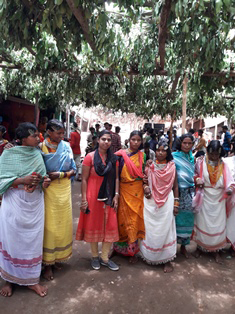
Even today, among Dongria Kandha’s, some of the cases found are of people who are still unmarried due to mahala. The villages of Khajuri, Radanga, Gartali, Mundabali, and Khambesi were covered in this study. It is found that there are seven, four, two, and eight women who are unmarried in the above-mentioned villages, respectively. Here I have given one case to justify the research, i.e., Sima Wadaka (named is changed on ethical grounds), a 55-year-old woman who lived in the Khajuri village. She is a well-known figure among the Dongria Kandha fraternity. She lived in her brother’s house along with nephews, nieces, two brothers, and their spouses. She was promised to a boy from Radanga village at the age of two years. Later, at the age of twenty, she had gone to Tenda village and stayed for two months in the house of Rama (whose name was changed on ethical grounds). Then she came to her village and lived in her father’s house. She also denies marrying the promised one, as the economic status of that boy is low in comparison to hers. Any boy from other villages is also not interested in repaying a high bride price to the previous one. As a result, she becomes unmarried for life Figure 1.
| I: House of the Bride | II: Performing Bada Ritual Near Stream |
| III: Relatives Going to Attend Marriage | III: Presenting Gifts to Bride Parents |
| IV: Women Performing Traditional Dance | V: Preparation of the Feast |
| VI: Researcher with Respondents |
Conclusion
The conclusions drawn from the research contribute to a comprehensive understanding of how the Dongria Kandha navigates the complex interplay of cultural continuity and change within the context of marriage practices. This study enriched our knowledge of the sociocultural dynamics underlying marriage customs among the Dongria Kandha people. In the Dongria Kandha community, the significance of Mahala is slowly decreasing day by day. The Dongria Kandha also practices negotiation marriage, but in a different way. After reaching marriageable age, the boy party searches for a suitable girl for their boy, and accordingly, a marriage proposal has been given to the girl’s parents. Besides love, marriage is the most common form of marriage among them. But in the interior villages, where the influence of modernization and education is less, they practice the Mahala system.
Acknowledgements
We would like to express our heartfelt appreciation to everyone who helped us complete this study. We are deeply indebted to our research participants, who are showing their willingness to engage in the different aspects of this study.
References
-
Baber RE (1953) Marriage and the Family. McGraw-Hill Book Company, India.
-
Klimek D (1979) Beneath Mate Selection and Marriage. Van Nostrand Reinhold Company, New York.
-
Kottak CP (2016) Marriage of Humanity. Cultural Anthropology. McGraw-Hill Book Company, New Delhi.
-
Kottak CP (1941) Cultural Anthropology. McGraw-Hill Book Company, New Delhi.
-
Lenkeit RB (2012) Introducing Cultural Anthropology. McGraw-Hill Book Company, India.
-
Munda S, Nayak K (2023) Change and Continuity in Ho Tribe, a Special Reference “OpertipiAndi” or “Marriage by Capture” in Keonjhar District of Odisha. International Journal of Novel Research and Development (IJNRD), 8(1).
-
Needham R (1967) The Development of Marriage and Kinship. The University of Chicago Press, Chicago.
-
Padhi SR (2015) Institution of Marriage among Gadaba Tribe: Continuity and Change. Odisha Review.
-
Park MA (2014) Introducing Anthropology: An Integrated Approach. McGraw-Hill Book Company, New Delhi.
-
Upadhyay VS, Panday G (2002) History of Anthropological Thought. Concept Publishing Company, New Delhi.
- The Indispensable Role of Informal Caregivers in Supporting the Aging Population
- Socio-Religious Significance of Kamakhya Temple in Guwahati, Assam
- Is Anthropology Possible?
- A Contribution to the History and Paleobiology of Harput/Elazığ Türkiye and Its Surroundings
- A Study on the Cowrie Shells of the Dimasas in Assam
- The Significance of International Organizations Cooperation in the Efficient Resolution of Global Conflict