
Kukama Kukamiria The Violence of Interpretation
The purpose of this article is to offer an interpretation of Amazonian Kukama Kukamiria folk art, in the course of the Amazon River, Province of Maynas, Department of Loreto, and Peru, reflecting on where its possibility of analysis and the violence in its interpretation through Western concepts lie.
Introduction
There is a popular art in Iquitos - Peruvian Amazon - that can be found in the large Belén market, in the central market, in the craft fair on the Itaya River boardwalk or in some of the central streets. It comes from the population centers of Padre Cocha and Santo Tomás (Maynas Province, Loreto Department). It is made by Kukama Kukamiria families (Tupi – Guaraní linguistic group). Their ancestors lived in the Brazilian tropics, but they migrated to Ucayali, probably towards the beginning of the era where they established their way of life. They were the object of Jesuit missionary action but tended to spread throughout the basin between Santa Rita, Nauta and the district of Punchana. Men and women have been great fishermen, cassava growers and potters. Their fame lies in the search for the Tierra sin Mal (Land without harm) which has led them to carry out large- scale migrations [1, 2, 3]. They are people strongly identified with water, the jungle and fish. The first is evoked in the linear decoration of the containers, the second gives them the opportunity for fantastic imagination and the last are exceptionally placed in the decoration or in the shapes. They are ayahuasca drinkers and, therefore, affected by the hallucination that this sacred plant produces [4, 5, 6, 7, 8, 9, 10].
His ceramic art has gone through different technical- formal evolutionary stages (masato containers, cassava deposit shelter for the dead, modeling and mold sculptures) but it was forgotten and recovered and, in this case, it was not a restorative desire but rather a specific action aimed at training and linguistic recovery developed by the local University.
I will have to present some ideas about this popular art. It is dominated by containers intended for vases or pots used in homes and in the cemetery and, above all, piggy banks in the shape of animals and small sculptures that represent fantastic beings. The works are small; Exceptionally, they produce some large specimens and that constitutes a conceptual rupture when compared to those that exist in the Mother Church of Iquitos that come from a large collection that illustrates how the pieces were manufactured in the sixties of the last century. In that collection there are no models either in bulk or in a mold, which is why I consider that the current works result from learning in remedial training.
The works are part of a plastic of bright colors and very expressive results, especially the one dedicated to modeling animals and fantastic beings [1, 2, 3, 4, 5, 6, 7, 8, 9, 10, 11, 12, 13].
I will not focus on aesthetic judgments (some works are really beautiful but there is no shortage of grotesqueries) but on the aesthetic unconscious [14], conceptualism and surrealism that I assign to Kukama ceramics, warning that these dimensions can be contradictory and even contrary, but that are congruent with the aesthetic formation of the Kukama culture.
Objectives and Methodology
My goal is to develop a perspective on contemporary Kukama Kukamiria ceramics. My work is based on interviews with ceramists (men and women) from Padre Cocha and Santo Tomás, on the study of their production in workshops and potteries and the works from the collection of the Mother Church in Iquitos, which I consider as “classical” and preceding the current ones, there being a conceptual and partially technical break between them. I call it “cultural forgetting.” In order to give shape to the afore mentioned perspective, I have proceeded as follows: first, I took into account the works by themselves (my own collection, the collection of the University in the UNAP Workers’ Union and the collection that It is located in the Mother Church of Iquitos, San Juan Bautista, gathered by the parish priests since 1970 and possibly closed around 2010.) It can be said that all of them are contemporary in a historical sense between the two centuries: XX and XXI. All of them were and are functional because the Church’s collection – which can be considered “classic” – is made up of containers to store fresh water in the very hot tropical environment and the rest are mainly dedicated to piggy banks and flower pots. The total number reaches three hundred.
Then I applied the concept of “aesthetic unconscious” because I presume that a drive phenomenology is manifested in the works – not necessarily sexualized – that is linked to the Kukama and Amazonian mentality founded on the surreal multiplication of beings.
Discussion: The Aesthetic Unconscious
Jacques Ranciére [14] maintains that in the post-Kantian reflection on art, it belongs to a regime of thought of art and also to the thought of the effects of art, that is, to a thought that is outside itself. A kind of “thought and non-thought”. The Freudian approach is based on that difference: non- thought or aesthetic unconscious. Both can be contradictory and contrary.
This approach may be useful for the interpretation of Kukama ceramic art, particularly because it contains symptoms of a psychically deep and surreal imagination in a social context that contains shamanic, hallucinatory, and animistic practices. This permeates in a unique way the “possible” history of this popular art, which as such is usually anonymous although the artists can be located in the towns from where the pieces leave for the market. In principle, the total set of works can be divided into a ceramic aesthetic of shape, color and linear decoration carried out in the containers in which the binding quality and color of the clay with the apacharama ashes play a fundamental role in the final result and a ceramic sculptural aesthetic with a surplus of surreal significance because it is based on the representation of animals (one could say magically powerful) and extraordinary beings such as mermaids, bufeos and the chullaychaqui – or shapshico – a being from the jungle that disappears at night. People. The bufeo is the dolphin of the Amazon and has the virtue of transforming into human and seducing women, being, therefore, magical. This sculpture is made manually or with molds. The formal similarity between pieces from different potteries is explained because the producers are related to each other and teach artistic techniques to young apprentices (Figures 1-5).
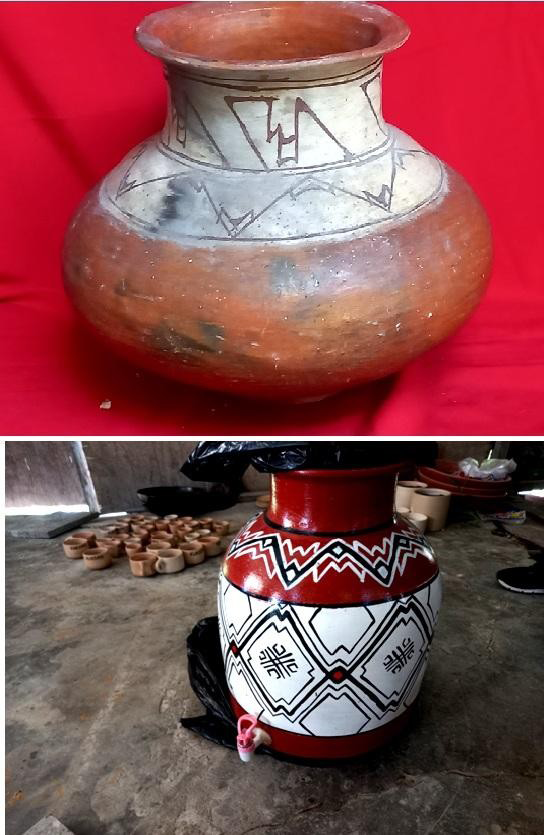
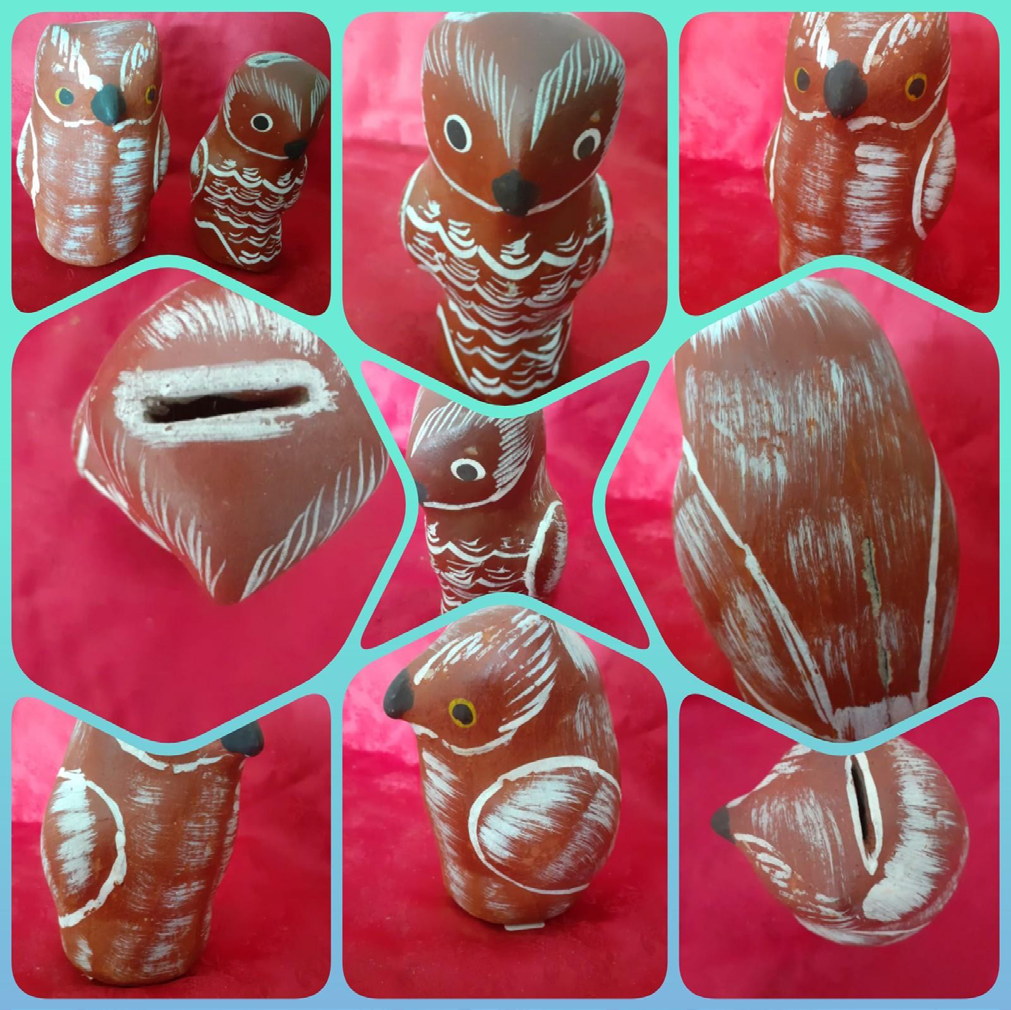
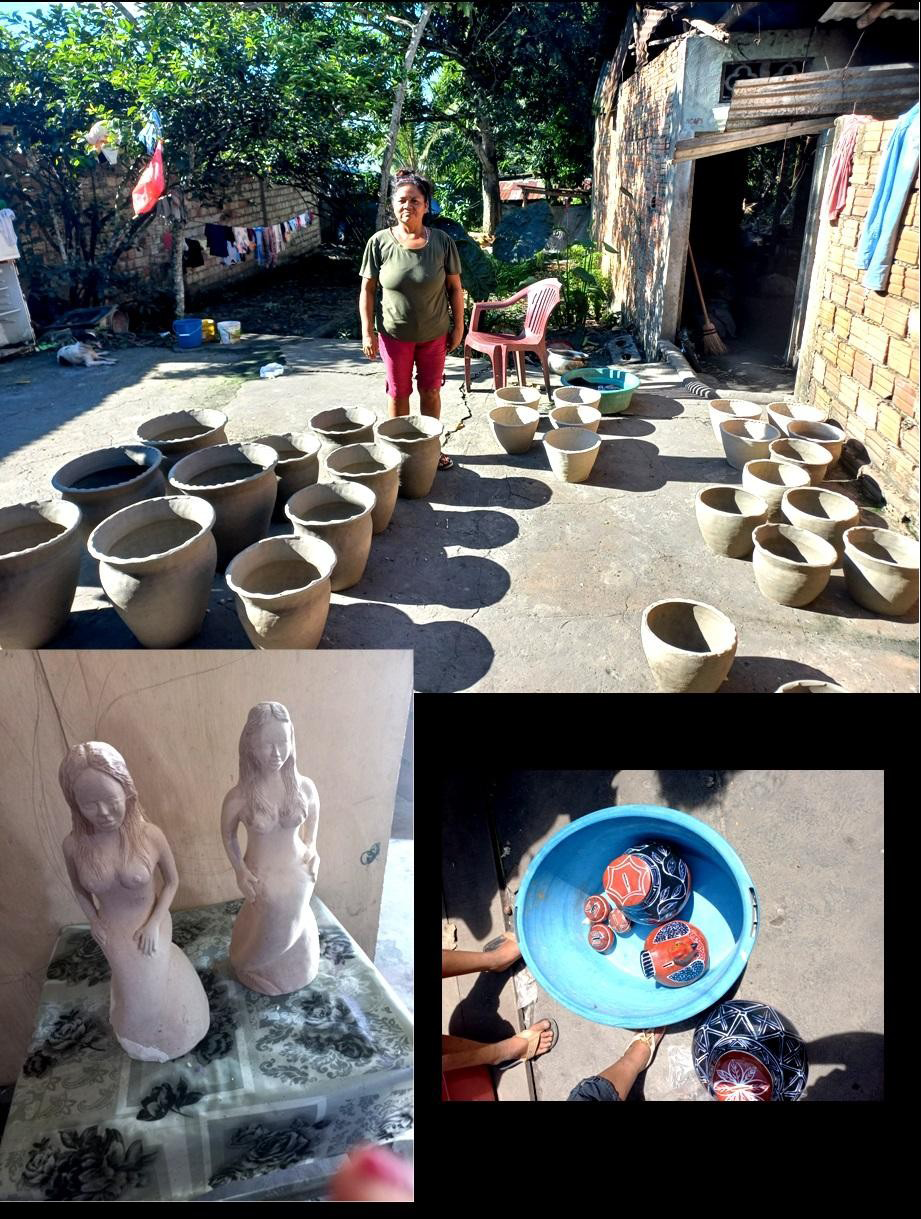
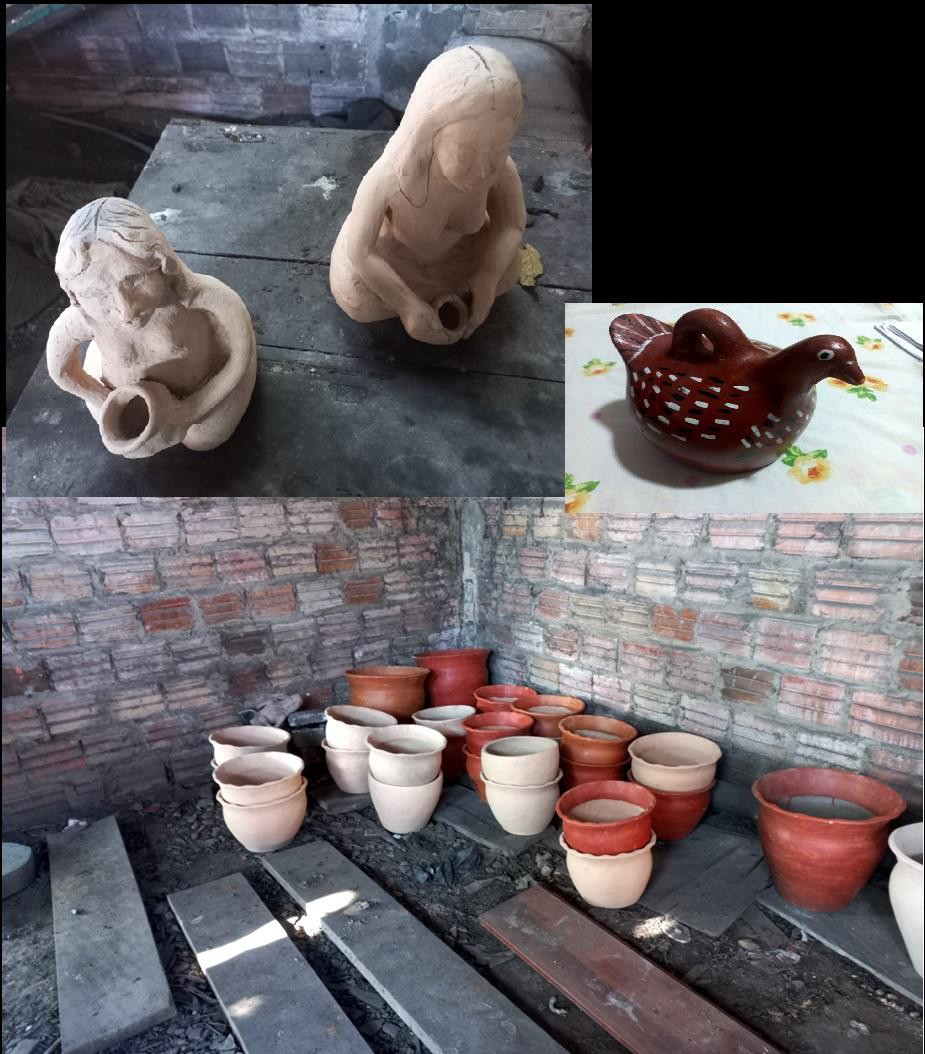
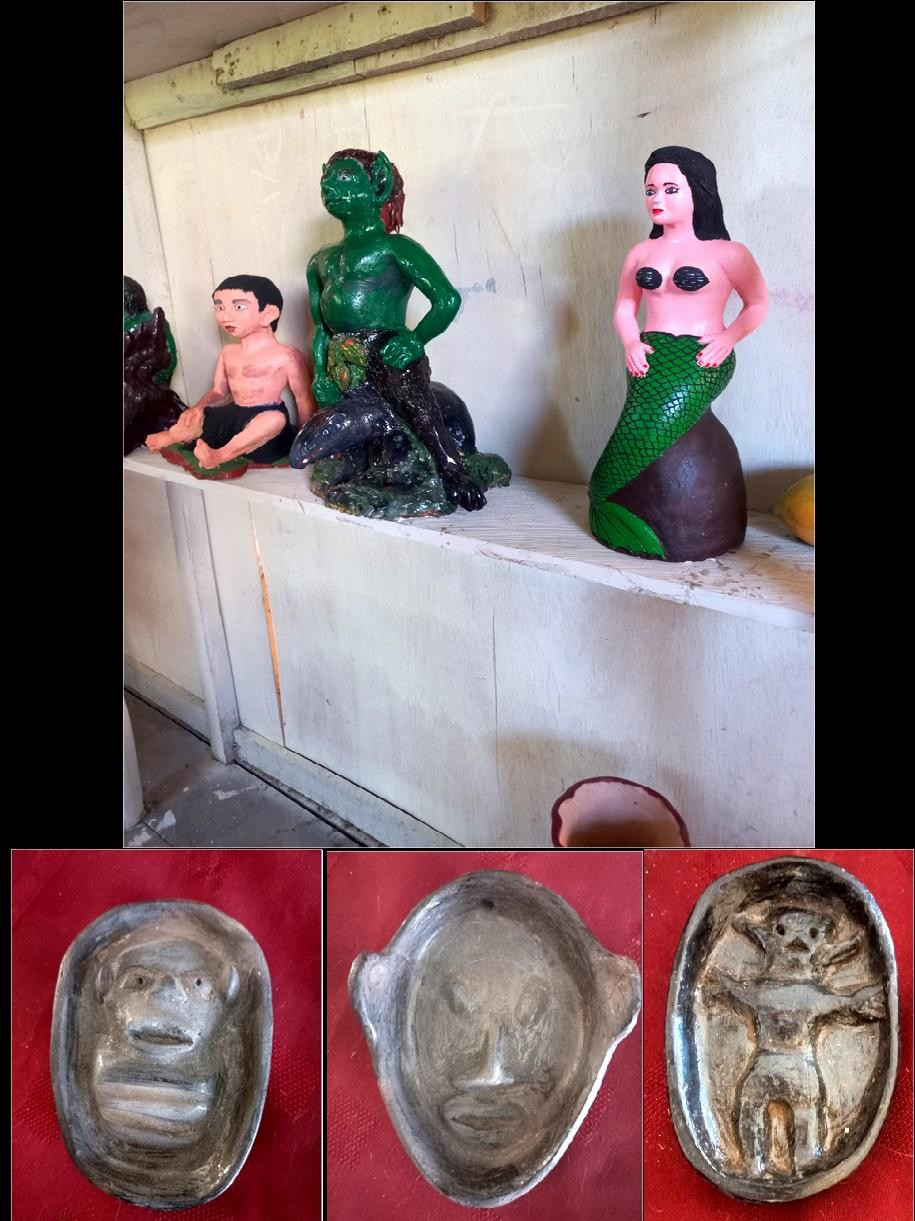
This fact also reveals the characteristics of an art that can also be described as “conceptual”, that is, an art in which the idea is superior to the work itself both in technique and in significance.
Synthetically: Kukama Kukamiria art synthesizes – from my perspective – three dimensions: libido or eroticism that emerges as a “non-thought” or “aesthetic unconscious”, “surrealism” in dream experimentation and, finally, “conceptualism” when perceiving the world. In a cosmic way. It supposes a metaphysics and epistemology that would be identifying if it were not shared by other indigenous groups (witotos, yaguas). Identity is positioned, on the contrary, in the thought and non-thought of its art, defining its authenticity, variation and artistic contingency. In a way of interpretation.
The Violence of Interpretation
Piera Castoiriadis Aulagnier [15] maintains that human psychic activity comprises a kind of metabolism in three stages: 1.original (which is called pictography), 2. Primary or fantasy and 3. Secondary or statement. He calls his subjective protagonists representative, fantasist and enunciator respectively. They are sequential in psychic formation and rapidly evolving: they can be established in the self or outside its field. The stages are linked to pleasure or suffering interchangeably and define the represent ability of the world and what is included in it or not.
Is there implicit violence in the act of interpreting (psychoanalytically or not)? And if there is, what does it consist of? Assuming that there is, it is possible that it is housed in the same work (pictographic, fantasizing, enunciating Kukama).
Think Animal and Think Fantastic
Taking the previous concepts as a reference axis, although not to treat this art from psychoanalysis but with the intention of integrating experiences such as animism, curanderismo, witchcraft and “charm” into the analysis, I try to outline an Amazonian thought that revolves around the “surplus”. Animal” and “fantastic surplus” based on the distinction I made before about the character of the works: although plants, especially their queen, ayahuasca, which is represented in ceramics, gourds and textiles, animals are the center of this plastic. In this way, the artist assumes a symmetrical character of representative, “fantasist” and “enunciator” whose object is the animals that he selects and the inverse of him, those that he does not.
Despite the often naive design and faithful copy of the animal represented, it can be described as an intense and ambiguous art: a fantasy of charm, of spell.
Imposing an animal form on ceramic clay or wood is equivalent – in my interpretation – to a metaphysical excess in Amazonian thought, within which everything has a mother or soul, everything can be transformed (a healer into a boa, for example). Everything that exists is wonderful, the product of a mystery and has the power to cause the alternatives of a destiny. A kind of “fourth” dimension of the world [11, 16].
The pleasure or displeasure of inscribing in clay or wood (for example, a feeling of pleasure in achieving the form or excess of work to obtain it) is not an addition to the manufacture but an application of the artist’s emotional energy.
The Charm
The technical formula that produces the objects – small and fragile sculptures – is the basis of charm but it is not charm itself because it is put at the service of the world of the living animal and its potential quality of producing “luck” or “damage”, of “cure” or get sick. The trajectory of the object is also important: once completed and on the shelf of the carver, potter or merchant, its “purpose” begins: an ornament in a house in a distant country, an amulet, a carefully delivered gift (turtles wish fortune and health; bufeos, erotic luck). Each intentional perspective opens a semantic field of aesthetic representation but also of suspicion (of witchcraft) because the emotional energy of the context corresponds to the emotional dynamics of the artist.
Structure and Difference
The structuralists whose rise took place in the 50s, 60s and 70s of the 20th century, among whom Lévi-Strauss [17] stood out, emphasized that reality could be explained in terms of the displacement of conscious language towards the unconscious and through the opposition of immanent binary categories in human thought of the feminine/masculine type. They were displaced from scientific attention by post-structuralists – the most influential, Derrida – who postulated that structures are contingent, that binarism is cultural-European and that no development is linear and determined. Its consequence was to draw attention to one of the systemic relations of language: difference.
The Amazon Difference
Whether in the original representation, in the fantasizing, or in the enunciating, there are both the Levi- Straussian binary categories and the difference surplus to the structure. The inscription of the animal form in clay or wood is constituted as a specific thought: the ambiguity of charm. Able to reward and harm at the same time, to delight and terrify reality. Lacan [18] maintained that the symbolic order (source and reason of the subject) could be terrifying. In the Kukama Kukamiria case, this ambiguity can be condensed in “cultural forgetting”: a dramatic rupture (due to loss) and learning always threatened by disappearance. A threatened art always lacks certainty but does not stagnate its imagination [19].
Conclusions
A non-evaluative but interpretive analysis of popular art (in this case the Kukama Kukamiria) leads to a description of cultural formation in both structure and difference as well as its characteristics of authenticity and singularity (not its beauty or ugliness). The interpretive violence that compromises is anchored in the works themselves for the sole fact that – in its fantasizing psychic depth – it includes the thought/non-thought antinomy. In it the interpretation is stripped of security and truth although it assumes some founding intuitions.
References
-
Nimuendaju CU (1914) as legends of creation and destruction of the world as the foundation of the Apapocúva – Guaraní religion. HUCITEC, University of San Pablo.
-
Metraux A (1927) Historical migrations of the Tupi – Guarani. Journal of the Society of Americanists 19: 1-45.
-
Clastres H (1989) the Land without Evil. Tupi – Guarani prophecy. Buenos Aires: Colihue.
-
Graneros SF (1990) Power, ideology and production rituals in Amazonian indigenous societies. Peruvian Amazon (19): 27-61.
-
Melia B (1995) The Land without Evil of the Guaraníes: economy and prophecy. In Riester J, et al. (Edt.) Chiriguanos. APCOB, pp: 291-319.
-
Combes I (2011) El Paititi and Guaraní migrations. Anthropological Supplement.
-
Villar D, Combes I (2013) The Land without Evil of the creation and destruction of a myth. Tellus 24: 201-225.
-
Palma TP (2021) Murutaka-rapan. Kukama kukamiria designs. Peruvian Amazon 17(34): 31-54.
-
Gasche J (2007) what is the purpose of the concept of “Forest Society”. Folia Amazonica 16 (1-2): 81-88.
-
Yopan VR (2014) the culture and history of Loreto. In Telephony Peru Publication, pp: 140-147.
-
Rocchietti AM (2018) Paquito Passage in Bethlehem. Loreto Department (Peru). In Brazil Meia, AG (Organizer), Philosophy and Religion. Religious phenomenon in the (post)secular world. ABEC, pp: 328-338.
-
Rocchietti AM (2021) Animal charm. ANTI 18(1): 116- 141.
-
Rocchietti AM Cardenas GA (2022) Amazonian art. ANTI 3: 25-31.
-
Ranciere J (2006) the aesthetic unconscious. Buenos Aires: From the Shelf.
-
Castoriadis AP (2014) the violence of interpretation. From the pictogram to the statement. Buenos Aires: Amorrurtu.
-
Chaparro AA (2013) Thinking cannibal. An Amerindian perspective on war, the sacred and coloniality. Buenos Aires: Katz.
-
Strauss LC (2007) the way of masks. Buenos Aires: 21st Century.
-
Lacan J (2008). Seminar 8. The Transfer. Buenos Aires: Paidós.
-
Millner JC (2003) the structural journey. Figures and paradigms. Buenos Aires: Amorrurtu.
- The Indispensable Role of Informal Caregivers in Supporting the Aging Population
- Socio-Religious Significance of Kamakhya Temple in Guwahati, Assam
- Is Anthropology Possible?
- A Contribution to the History and Paleobiology of Harput/Elazığ Türkiye and Its Surroundings
- A Study on the Cowrie Shells of the Dimasas in Assam
- The Significance of International Organizations Cooperation in the Efficient Resolution of Global Conflict