
Evolving COVID-19 Pandemic: The Lurking Dangers and Pillars of Hope
Introduction-The Unrestrained Pandemic: The emergence of the novel coronavirus, SARS-CoV-2 in December 2019, has had led to COVID-19 pandemic with devastating consequences. COVID-19, as the disease has unique clinical manifestations which are distinctive, yet bizarre. As the pandemic is spreading, the virus is continuing to evolve. In fact, this process of evolution is a continuum, allowing the virus to adapt to its environment by selecting mutations that make it replicate and transmit more efficiently. Lurking Dangers-The Evolving Variants: So far, Sars-CoV-2 has infected over million people worldwide and taken on many thousands of mutations. Most of those changes are slow and inconsequential evolutionary dead ends, but can potentially become more transmissible, more virulent, or more resistant to immune response to become unresponsive to the vaccines. Keeping ahead of the pace at which variants are evolving and influencing disease transmission and severity will be key issue for the coming phase of the pandemic. The Pillars of Hope-The Covid-19 Vaccines: The vaccination remains the most effective tool for protecting from COVID-19. New insights into the functioning of the immune system have made possible the rapid development of new vaccines to combat the raging pandemic and the pathogen and its variants. The vaccines provide us with much-needed hope for the COVID-19 prophylaxis as well as tools to limit the disease severity. World over, the major challenge is to provide equitable access to effective vaccines for masses. Conclusion-The Future Covid-19 Scenario: The researchers as well as medical community agree that the vaccination should be continued with the available vaccines. In general, the vaccines induce a more powerful immune response than a natural infection and the mass immunization is crucial to curb the spread of infection, break the transmission-infection cycle and retard the evolution of new variants as well. The on-going COVID-19 pandemic is a reminder of the need to prioritise health over other aspects of human life, as well.
Uncontrolled-Raging COVID-19 Pandemic
The Infection and SARS-CoV-2 Evolution
The emergence of the novel coronavirus, SARS-CoV-2 in December 2019, has had led to COVID-19 pandemic with devastating consequences. COVID-19, as the disease has unique clinical manifestations which are distinctive, yet bizarre. Most persons infected with the virus are often asymptomatic, yet they carry and emit high viral loads, being the major source and transmitters of viral spread. These factors have led to the current perpetuation of the infection, affliction and morbidity, hospitalization, and mortality. The COVID-19 related deaths are now a major cause of death in various countries such as Brazil and the United States, and the United Kingdom.
The world-wide, spread of SARS-CoV-2 has greatly been influenced by masking, social distancing, and lockdown measures. However, the differences in morbidity and mortality rates for given prevalence, cannot completely be explained by these variables. The D614G mutant of SARS- CoV-2 after evolving in Wuhan became rampant in various European and South American countries and in the USA. The implications about the clade-G viruses need to be emphasised. Both the older age and SARS-CoV-2 clade-G viral infections could explain 37.43% of the observed variability in cumulative mortality rates across 58 countries [1]. This could be related to the viral genome variations found across the globe and viral haplotype changes in combination with known host factors such as age, race, and presence of comorbid conditions.
In fact, as the SARS-CoV-2 virus infects more people and the pandemic spreads, it continues to evolve. This process of evolution is a continuum, allowing the virus to adapt to its ecosystem by selecting mutations that potentiate it replicate and transmit more efficiently. Any variation that gives the virus progeny a competitive growth advantage is likely to be selected over the parental genomic virus [2]. With the unrestricted and raging pandemic, the SARS-CoV-2 virus is demonstrating this feature with occurrence of new variants with adaptability and enhanced growth properties (Figure 1).

Whereas a drop in transmission rates means fewer infections as this is associated with less virus replication leading to fewer opportunities for the virus to mutate. With less opportunity to mutate, the evolution of the virus slows and there is a lower risk of new variants. In due course, this will reduce the chances of re-emergence and future outbreaks of COVID-19, as the population groups develop immunity due to infection or vaccine inoculation.
Thus, to be emphasised, lowering transmission rate is the key to control the pandemic [3]. The control measures such as the use of masks, physical distancing, testing of exposed or symptomatic persons, contact tracing, and isolation have helped limit the transmission wherever they have been rigorously applied. Simultaneously, there have been recurrent outbreaks and re-emergence of the disease in various regions due to laxity of the control measures and unrestricted travels in and outside countries. With the result, various regions have witnessed unmitigated spread of the virus and appear to have lost the grip on control of the COVID-19 pandemic. The persistence and exacerbation of the infection have occurred due to inconsistent adherence to effective public health measures, including wearing masks and maintaining social distancing, the non availability of effective treatment, and emergence of the virus variants with increased infectivity and ability to evade immunity.
Genomic Sequencing and Diagnostic Assay
From the applied research point of view, understanding the nature of the evolving changes in the SARS-CoV-2 genome provides guidance to develop countermeasures to control the infection as well as diagnostic tests. Further, it is important to monitor the virus for newer mutations which can make it more transmissible or virulent, or both. The random sequencing of the SARS-CoV-2 viruses from patient samples across diverse genetic backgrounds and geographical locations is also a method to look for emerging variants. The genomic sequencing data also guide in developing the diagnostic tests for detecting the virus variants, forecasting likely disease trends, and designing suitable and potent vaccines.
As reported recently the genomic surveillance, in mid- January, has picked up the E484K mutation in some of the cases with UK variant. The COG-UK dataset (total sequences 214,159) was analysed on 26/01/2021. The S protein mutation E484K (found in VOC 202012/02 B1.351 and VOC 202101/02 P1) has been detected in 11 B1.1.7 sequences. The preliminary data suggest more than one acquisition events [11]. The E484K mutation is also present in the South Africa variant and appears to help the virus evade the immune response. In fact, as the immunity to Sars-CoV-2 nurtures following infection and vaccine inoculation, the virus is pushed to find new adaptations to continue infecting and spreading. We are, thus, witnessing the SARS-CoV-2 virus evolution in real-time. It is feared that with persisting high rate of transmission, the virus will be having greater opportunities to mutate to novel variants and more stable genomic configurations.
The Lurking Dangers-SARS-CoV-2 Variants
SARS-CoV-2 may be the most sequenced virus in history. The first viral whole genome (RNA) sequence information was published on 5th of January 2020 [12]. So far more than 360,000 Sars-Cov-2 genomes have been sequenced and uploaded to GISAID, a platform for sharing viral genomes. So far, Sars-CoV-2 has infected over million people worldwide and carried on several thousands of mutations. Most of these mutations are insignificant and inconsequential evolutionary dead ends. Every time the virus infects a person, it has a novel opportunity to mutate. It can potentially become more transmissible, more virulent, or more resistant to immune response to become unresponsive to the vaccines. TheSARS-CoV-2 Variants Of Concern The SARS-CoV-2 variants are of concern if they are more transmissible, can cause more severe disease, or likely to evade immune responses to vaccines or make antibody products less effective. In fact, the speed at which variants are evolving and being transmitted will be key issue for the coming phase of the pandemic. Presently, there are four SARS-CoV-2 variants are of epidemiological importance (Figure 2).
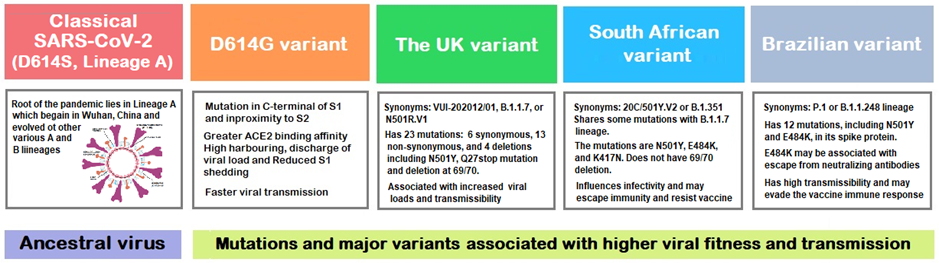
Out of the four variants, D614G or the clade-G variant has been present in various regions of the world and having been evolved soon after the beginning of the pandemic for about a year. Presently, three key SARS-CoV-2 variants of major concern include the variant of B.1.1.7 lineage, first detected in the UK in September 2020; the variant of B.1.351 lineage, was first detected in October 2020 in the Republic of South Africa (RSA); and the variant of P.1 lineage, detected recently in Brazil in December 2020. There has been recent rapid spread of the UK variant or B.1.1.7 and it has now been found in more than 75 countries and spreading locally in Brazil, Canada, China, the United States, and most of Europe.
Being over 70% more transmissible than other variants, the B.1.1.7 is now responsible for the vast majority of new cases in England [13]. The variant bears multiple additional spike protein mutations such as deletion 69-70, deletion145, N501Y (increased hACE2 binding affinity), A570D, P681H (Furin cleavage site), T716I, S982A, and D1118H on the background of the G614 mutation. There have been reported so far 21 cases in the UK of that variant having E484K mutation. The preliminary data suggests that the new variant may be 30percent more virulent than others. Further, it is transmitting more readily than other existing variants. Additionally, emerging data suggest that the B.1.1.7 lineage may cause more severe disease [14]. It is being predicted that it is likely to infect most of the world regions in near future [15].
The other variant, RSA variant of B.1.351 lineage, also known as 501.V2, has multiple mutations within two immunodominant domains in the S protein. The variant has been reported in 20 countries including the US, similarly the Brazil variant (P1 lineage) has been found in five countries including the US. The E484K mutation present in South African and in Brazilian variants potentially reduces the effect of neutralising antibodies. There is scientific data to suggest that the new variants may be more transmissible, prompting concerns that they could increasingly affect the populations world over. The distinctiveness of the B.1.1.7 variant which originated in Kent in the UK, points to two likely theories either the virus had mutated abroad and detected once it entered the UK, as most countries do not have a high level of genomic surveillance, or many of the mutations had happened within a single person [7]. As there are travel links with the UK with most countries affected by the new variant, it appears that the country of its origin is the UK. A third remote possibility is that the variant has emerged through recombination of the viral genomes of similar strain and pooling of mutations.
Evasion of Immunity by the Variants
The new variants evade the human immune response through a process called antigenic variation, whereby the change in the S protein prevents antibodies from binding and neutralizing the virus. The antigenic variation is measured by using known monoclonal antibodies to S protein or using sera from convalescent patients or those vaccinated with an available COVID-19 vaccine. There has emerged data in recent weeks to indicate that the UK variant (B.1.1.7 lineage) as well as the SA variant (B.1.351 lineage) can evade binding and neutralization by monoclonal antibodies to the S protein. Concerning the SA variant (B.1.351 lineage), a study has shown that this lineage exhibits complete escape from three classes of therapeutically relevant monoclonal antibodies and substantial escape from neutralizing antibodies in COVID-19 convalescent plasma. The variant has prospect of reinfection with antigenically distinct variants and may have reduced efficacy to currently available S protein-based vaccines [16].
The fast-spreading SARS-CoV-2 variant B.1.1.7 increases morbidity as well as the mortality risk from COVID-19 compared to previous variants for all age groups, genders, and ethnicities. But as expected, the B.1.1.7 variant does not hit all ages equally but has predisposition to those in the older age-groups. As per the latest analysis the average case fatality rate is around 36% higher for those infected with the new variant. Thus, those aged 70–84, the number who is likely to die from COVID-19 increases from roughly 5% for those infected with the older variant, to more than 6% for those confirmed to be infected with B.1.1.7. For those aged 85 or over, the risk of dying increases from about 17% to nearly 22% for those confirmed to be infected with the new variant [17].
Presently, the B.1.1.7 has become the dominant variant in the United Kingdom and has spread to other countries. Further, that B.1.1.7 has contributed to an increase in number of patients attending the hospitals and affected the quality of care [18]. Further, there is taking place a convergent evolution and it a small number of patients infected with B1.1.7 variants in the UK have been found to have developed the E484K mutation, which is also found in variants in Brazil and South Africa and may help SARS-CoV-2 partly to evade immunity.
A recent study involving the blood donors in Manaus, Brazil, has indicated that around 76% of the population had been infected with SARS-CoV-2 by October 2020, a proportion of the population well above the theoretical herd immunity threshold. However, the abrupt increase in COVID-19 hospitalisations during January 2021 indicated the higher transmissibility of the P1 variant and/or its potential capacity to escape from immunity [19].
Risk of Emergence of SARS-CoV-2 Mutations
There is a potential risk of emergence of new mutations during chronic SARS-CoV-2 infection or in lingering course of COVID-19 where treatment over an extended period and immune-compromised state can provide the virus multiple opportunities to evolve. Of particular concern are mutations that have impact on the S protein. The evolution of E484K mutation in the SA and Brazilian variants and potentiating the UK variant of B1.1.7 lineage may hamper effect of neutralizing antibodies. Further, most of the current vaccines in use or under development target the S protein and thus the mutations may affect the efficacy of these vaccines.
Relating to this issue, it has been claimed for the Moderna vaccine that it retains neutralising activity against the UK (B1.1.7) and SA (B1.351) variants. Further, though there was observed a six-fold reduction in virus neutralisation with the B1.351 variant, the titres of neutralising antibodies following two doses of the vaccine were at sufficient levels for protection [20]. As inferred from the preliminary data the mutations in B1.1.7 lineage do not affect recognition by antibodies produced following natural infection or immunisation with the Pfizer vaccine.
A particular variant with the ΔH69/ΔV70 amino acid deletion in part of the S protein appear to make the virus more infectious. The recent research indicates that the ΔH69/ ΔV70 deletion by itself can make the virus twice as infectious as the previously dominant variant. Whereas, as shown experimentally, the combined mutations the ΔH69/ΔV70 and D796H made the virus less sensitive to neutralization by convalescent plasma. There is possibility that the D796H mutation alone is responsible for the reduction in susceptibility to the antibodies in the plasma and the role of the ΔH69/ΔV70 deletion is to compensate for the loss of infectiousness due to the D796H mutation [21].
The Pillars of Hope-The Vaccines
Vaccination for Disease Prophylaxis
The vaccination remains the most effective tool for preventing infectious especially the viral diseases and safeguarding public health. New insights into the functioning of the immune system on a cellular and molecular level have made possible the rapid development of new vaccines. The future holds great promise for vaccine-mediated control of global pathogens and remarkable progress has been made in developing vaccines to combat rapidly emerging and changing pathogens and deal with the pandemics. Although the Covid-19 pandemic is currently raging, the prospects for control of this and future pandemics are bright. The vaccines provide us with much-needed hope, though a major challenge is to provide affordable access to effective vaccines for masses.
Vaccination as a means for COVID-19 prevention that is relevant to people of all ages. Further, vaccination can improve individual chances of survival, protect communities from new and re-emerging health threats, and enhance societal productivity. But achieving the promising benefit of vaccination requires much more than the vaccines themselves. There are required timely discovery and development of innovative, effective, safe, and affordable products; effective financing and delivery programs; and credible evidence- based policy recommendations to reassure the public about the value of the vaccines.
The safe and effective vaccines should be given first to those at high risk and later to those at low risk to cover the population to provide immunity at individual and mass level to control the viral transmission. The vaccines are needed to halt the COVID-19 pandemic and to protect persons who are at risk for the infection. Following the successful sequencing of SARS-CoV-2 virus, during January 2020, there has taken place prompt research to develop of COVID-19 vaccines through various vaccine development platforms such as mRNA, protein, viral vector, and others [22].
The Vaccine Development Platforms
There are multiple vaccine approaches utilised by various COVID-19 vaccines under development or given emergency use authorization (EUA). Most of the vaccines developed use the existing vaccine technology. In addition, there are novel genetic vaccine approaches paving the way for more efficient and rapid manufacture of the vaccines (Figure 3). Most of them require two doses to provide protection, and all of them aim to elicit immune response to the S protein of SARS-CoV-2 virus [23].
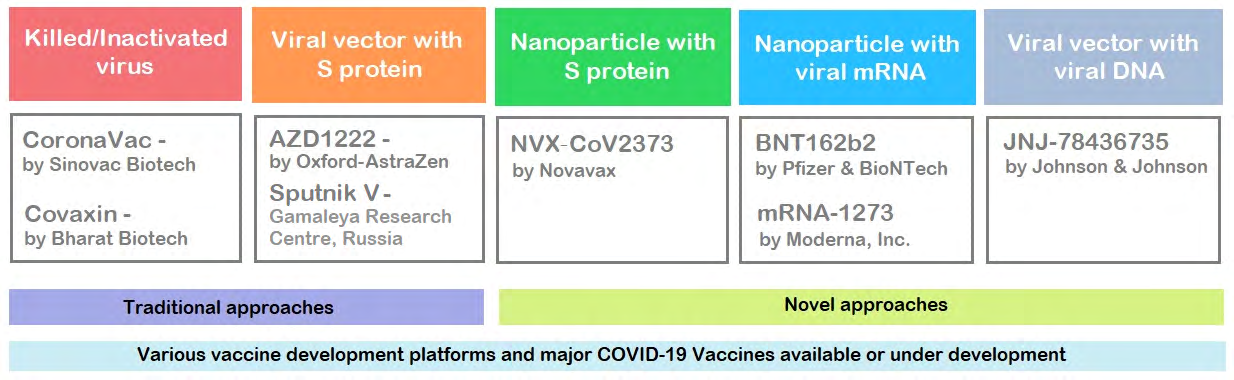
The Traditional Vaccine Approach: Inactivated virus vaccines are created by killing or deactivating the virus so that it is unable to replicate in host cells. The whole virus or a subunit of the virus can be used. These vaccines are generally safer than live vaccines as they can be given to everyone, including immunocompromised people. The immune response may not be strong or long-lasting and booster doses or an adjuvant may be required.
Live-attenuated virus vaccines induce a strong immune response and provide long-lasting immunity. They take longer and are more difficult to mass produce as the virus will have to be grown under enhanced biosafety protocols. Currently only one live attenuated COVID-19 vaccine being developed by Codagenix is registered for Phase 1 human trials.
COVID-19 Vaccines using S Protein: In viral vector vaccines the viral vector carries the full‐length coding sequence of SARS-CoV-2 spike protein as in Oxford University/Astra Zeneca COVID-19 vaccine (AZD1222), using a modified chimpanzee replication-deficient adenovirus, namely Titi monkey adenovirus ECC-201, and tissue plasminogen activator (tPA) leader sequence. Other viral vectors slowly replicate, carrying SARS-CoV-2 proteins on their surface (replicating viral vectors). Replicating viral vectors best mimic natural infection and hence produce a strong immune response and can be used in lower doses. Human adenoviruses, which cause common cold, have been used as viral vectors. The only one replicating viral vector vaccine candidate in Phase 1 clinical trials, being developed by the Institute Pasteur in France, is now abandoned. The Johnson & Johnson vaccine uses double-stranded DNA and modified adenovirus as carrier. While adenovirus vectors are well tolerated, pre-existing immunity to the viral vector may hamper the immune response to the vaccine.
As per the analysis of the trials for the Oxford /AZ vaccine, the vaccine efficacy after one dose of vaccine from day 22 to day 90 post vaccination was 76%; and, in the group that received two full doses, efficacy was higher with a longer interval between doses, 82% for a 12-week interval versus 55% for an interval of 6 weeks or less. Further, in the vaccine group after the initial 21-day exclusion period, there were no hospitalisations as compared to 15 in the control group. Compared to the Offord/AZ vaccine, the Russian vaccine, Sputnik V, has an efficacy greater than 90% against COVID-19. Sputnik V works by combining the SARS-CoV-2 S protein into a carrier virus, which is expressed when the virus enters human cells. It uses two different carrier viruses for the first and second doses. Shot and the booster shot. Thus, the possibility that subsequent use of same carrier virus could dampen the response to S protein is taken care of [24].
The nanoparticle-based vaccines use nanoparticles in place of viral vector, which are engineered highly stable nanoparticle (nanocarrier). The nanoparticle-S Protein- based vaccines include COVID-19 vaccines being developed by US-based Novavax and Canada-based Medicago which are in advanced Phase 3 clinical trials. Another vaccine, being developed by Flinders University and Vaxine, an Australia biotech Company. The Novavax COVID-19 vaccine is a nanoparticle vaccine containing S protein. As announced by Novavax, its vaccine showed an 89.3% efficacy in its trial in the UK, with over 15,000 participants between 18 and 84 years of age of 62 symptomatic cases, 56 (1 of them severe) were in the placebo and 6 in the vaccine group. Over 50% of cases were infected with the B1.1.7 variant, indicating that the vaccine also works against this variant. However, the efficacy dropped to 60% in a smaller trial (4,400 participants) in South Africa, where the B1.3.5 variant is circulating. The efficacy was further low (49.3%) when immune-deficient HIV-positive people were included in the trial [25].
COVID-19 Vaccines using Genetic Approach: The novel genetic vaccine approaches depend on the genetic sequence and more efficient way to produce the vaccine. They may be nanoparticle-based, using an engineered highly stable nanoparticle (Nano carrier). The Pfizer/BioNTech Moderna vaccines using mRNA-nanoparticle technology have 95% and 94.1% efficacy, respectively. Due to the instability of mRNA, these vaccines are difficult to transport and store. The Pfizer COVID-19 vaccine will need storage at -70°C, shipment on dry ice and will only last 24hrs when refrigerated. Whereas the Moderna COVID-19 vaccine is more stable and can be transported at -20°C and stored in a standard vaccine fridge (2-8°C) for 5-days. The COVID-19 mRNA vaccines are only capable of producing S protein and cannot be reversed back into DNA and hence unable to modify it. The mRNA vaccine platform has advantages as a pandemic-response strategy, given its flexibility and efficiency in immunogen design and manufacturing.
The Johnson & Johnson vaccine JNJ-78436735 or Ad26. COV2.S, uses double-stranded DNA through modified adenovirus, Adenovirus-26 with added gene for the S protein. After the vaccine injection, the adenovirus is engulfed by the host cell. Once inside, the adenovirus travels to the nucleus and leads the CoV gene for S protein to be read and copied into mRNA. The mRNA then leaves the nucleus and, in the cytoplasm, begins assembling spike proteins. Some of the spike proteins thus produced by the cell form spikes that migrate to its surface and stick out their tips. Further, the vaccinated cells may also break up to present on S protein on their surface. The S and S protein fragments are recognized by the immune system. In addition, the adenovirus also provokes the immune system by switching on the cell’s alarm systems and activates immune system to react strongly to the spike proteins [26].
The DNA is less fragile than mRNA and the adenovirus’s tough protein coat helps to protect the genetic material inside, thus the vaccine can be refrigerated for up to three months at 36-46°F (2-8°C). The single dose is effective, as the information persists in memory B cells and memory T cells for years or even decades. It has documented 72% efficacy in the United States, 66% in Latin America and 57% in South Africa, 28 days post-vaccination at preventing moderate to severe COVID-19 regardless of age, ethnicity, and presence of comorbidities. It has been claimed to be effective against the SARS-CoV-2 Variant from the B.1.351 Lineage (501Y.V2 variant) observed in South Africa. Further, it is 85% effective in preventing severe disease across all regions studied in all adults 18 years and older 28 days after vaccination. The other DNA vaccines under development include Inovio’s COVID-19 DNA vaccine. There are theoretical concerns about potential integration into the vaccine recipient’s DNA, but the risk is extremely low [27].
Vaccinating for COVID-19 Prophylaxis
Dosing for COVID-19 Vaccines in Practice
Most COVID-19 vaccines are given as two injections: an initial ‘prime’ dose followed by a ‘boost’ to stimulate the immune system’s memory cells and amplify the immune response. There are certain exceptions, such as the JNJ- 78436735 vaccine by Johnson & Johnson for which a single dose may be effective. Further, repeat booster doses may be required for COVID-19 vaccines as the immune response seen is a ‘labile immunity’ and at best will last for 6 to 8 months. Furthermore, in view of emerging more virulent variants, additional vaccine doses are being envisaged.
It has been conjectured and indicated by two small studies that people who have already had confirmed COVID-19 infection earlier, might need only a single dose of a mRNA vaccine [30]. Further, it has been noted that seropositive individuals witness a rapid antibody response after one dose of either the Pfizer-BioNTech or Moderna vaccines [31]. In another small study in HCW with prior COVID-19 infection, it was shown that there occurs a good antibody response to vaccination with IgG spike binding titers rapidly rising by 7 days and peaking by days 10 and 14 post-vaccination [32]. Compared to this, the HCW without h/o previous infection showed significantly lower antibody levels following the vaccination. Concept of Mix and Match for Vaccines The vaccine developers during the vaccine design and development phase often combine two vaccines to combat the same pathogen which is termed the heterologous prime boost. The researchers have tried to deploy the same approach against the SARS-CoV-2. In past, a heterologous prime-boost combination was earlier approved by European regulators to protect against Ebola, and experimental HIV vaccines. The concept is being planned to be explored for the vaccines against COVID-19, which are generally recommended to be given as a repeat injection of the same vaccine. It is being conjectured that combining two vaccines could achieve better results than the individual vaccine and strengthen immune responses by harnessing different mechanisms involved. As per the guidelines the vaccines are not inter-changeable in Britain and the U.S. but can be mixed if the same kind of vaccine is not available for the second dose. Further, the method to mix and match vaccines may make vaccination programmes more flexible and speed up immunization campaigns and reduce the impact of supply- chain disruptions.
In support of the concept, the animal studies have been cited which suggest that a strengthened immune response is possible. Spencer, et al. have reported that the antibody response in mice, following vaccination with a self- amplifying RNA (saRNA) vaccine and an adenoviral vectored vaccine (ChAdOx1 nCoV-19/AZD1222) against SARS-CoV-2 was higher in two dose heterologous vaccination regimens group than single dose regimens group, with the former group showing higher induced titre neutralising antibodies. Further, the cellular immune response after a heterologous regimen was found to be dominated by cytotoxic (CD8) T cells and CD4 T cells, being superior to the response induced in homologous vaccination regimens [33].
The researchers at Oxford have recently launched a study to test mixing and matching of COVID-19 vaccines by injecting AstraZeneca vaccine followed by the Pfizer vaccine, or vice versa [34]. The Oxford clinical trial aims to enrol 820 people and will test two dosing schedules: one with 4 weeks between the two injections, and another with a 12- week interval. The participants’ immune responses will be analysed after receiving one shot of Oxford-AstraZeneca COVID-19 vaccine and another shot of the mRNA vaccine by Pfizer. The trial by investigators at the University of Oxford was set to begin enrolment on 4 February. Other vaccine combinations may yield similar results and in fact, Oxford investigators have declared that they will enlist to test combination of the Oxford COVID-19 vaccine with Sputnik V, the Russian COVID-19 vaccine.
The Sputnik V is itself, in a way, a heterologous prime-boost vaccine, consisting of different carrier virus components in the first and second doses. It works by combining two vaccines that tuck the SARS-CoV-2 S protein into a harmless virus, which is expressed when the virus enters human cells and mounts immune response to the S protein. But if the same virus is used in subsequent shots, an immune response against the harmless virus itself could dampen the response to the S protein. Sputnik V addresses this problem by using two different shuttling viruses, one in each shot. Oxford-AstraZeneca’s vaccine uses only one, making the heterologous prime-boost studies with Pfizer’s vaccine or Sputnik V appealing. The results from the trial arm testing the four-week regimen may be available by June 2021.
Effects of Vaccination in Real-Life Scenario
The data from Israel, the country which has vaccinated a large proportion of its population, show that the COVID-19 vaccines are helping to curb infections and hospitalizations among older people, almost 6 weeks after the vaccination drive in that group. Close to 90% of people aged 60 and older in the country have received their first dose of Pfizer’s 2-dose vaccine so far. The data collected indicate a 41% drop in confirmed COVID-19 infections in the age group, and a 31% drop in hospitalization rates from mid-January to early February. In comparison, for people aged 59 and younger, about 30% have been vaccinated in this age group, the cases dropped by only 12% and hospitalizations by 5% over the same time [35]. Further, the difference in case numbers between people older than 60 and younger people was most pronounced in cities where at least 85% of older people had received their first vaccine dose by early January. But the drop in case numbers and hospitalizations might not be solely down to vaccines, as the government had imposed a nationwide lockdown in response to the country’s raging epidemic during January 2021. But so far, there is no evidence that vaccinated people, about 40% of Israel’s total population are indirectly protecting unvaccinated people and reducing the onward transmission.
Similarly, a group of researchers in the United Kingdom have noticed early signs that Pfizer’s vaccine has contributed to a drop in health-care workers testing positive for the virus. The vaccinated health-care workers were 53% less likely to test positive for SARS-CoV-2 12days after their first dose than the unvaccinated workers, as per the preliminary results presented in an online webinar on 3 February. The analysis was based on about 13,000 vaccinated people and about 33,000 unvaccinated people who reported their results using a mobile-phone app. This is the first sign in real life, outside trials, about the effect of a single dose. In another study in Israeli health workers, the effectiveness of 51% of BNT162b2 vaccine against SARS-CoV-2 infection 13-24 days after immunization with the first dose was documented [36].
SARS-COV-2 Variants and Efficacy of Vaccines
As new variants of the SARS-CoV-2 continue to emerge, concerns have been raised about efficacy of the currently available COVID-19 vaccines. Recently, South Africa has temporarily halted the rollout of the Oxford-Astra Zeneca vaccine following results from a study showing that the vaccine provided diminished protection against the variant. In this light, we need to religiously follow the public health measures to reduce transmission and circulation of the virus and the vaccines manufacturers will have to adjust their products to the evolving mutants and variants.
The recent South African study involving 2,026 participants, has indicated that the vaccine was minimally effective at preventing mild to moderate illness caused by the 501Y.V2 variant [37]. As opposed to the overall efficacy of the Oxford-AstraZeneca vaccine being 66% in the larger study that included the UK, Brazil and South Africa, the data from the South African study showed only 22% efficacy against the SA variant.
Whereas a further analysis of the AstraZeneca/Oxford vaccine trial indicates that, although vaccine-induced antibodies were less effective in neutralising the B1.1.7 variant in experimental studies, its efficacy against symptomatic infections caused by the variant was only slightly lower (75% vs 84%). Still, it is hoped that the vaccine may protect against severe illness, hospitalisation, and death. The WHO has a tracking and evaluating tool for COVID-19 variants, which is being expanded to provide guidance to vaccines manufacturers about the changes that may be needed.
There is focus on the T-cell response also. It appears that the T cells could be key to boosting immune response. Experimentally, the RNA vaccines generate powerful antibody responses to the SARS-CoV-2 but fail to stimulate the CD8+T
cells like the Oxford-AstraZeneca vaccine. It has been shown that the CD8+ T cells can strengthen an immune response by identifying and destroying cells infected with the virus. Further, there is a broad functional diversity of T cells, which recognise a broad range of SARS-CoV-2 S protein epitopes, at least 30 to 4o epitopes. These epitopes are separate from the epitopes recognised by the antibodies. This observation raises the possibility that new variants may not be able to escape T cell immunity.
Conclusion-Future Scenario for the Pandemic
The currently available vaccines induce the immune system to produce antibodies that recognize and target the S protein, which is essential for the virus to invade the host cells. Similar to the UK variant, there is accumulation of multiple mutations in the S protein in the SA variant. These mutations allow the virus to attach more strongly to the ACE2 receptor and successfully enter and infect human cells and enhance its transmissibility. There is an emerging possibility that with multiple mutations in the S protein, the COVID-19 vaccines may not be able to generate a strong immune response and protect the recipients from the new variants.
Continuing the COVID-19 Vaccination
The researchers as well as the medical community agree that the vaccination should be continued with the available COVID-19 vaccines and there should be a constant effort to get as many people vaccinated and thus protected as possible. In general, the vaccines induce a more powerful immune response to SARS-CoV-2 than what results following a natural infection. The efficacy of the vaccines may be lower than the claimed especially against the variants, still the mass immunization of population groups by the COVID-19 vaccines is important to curb the spread of infection. Curtailing the transmission and breaking the transmission-infection cycle seem to be the only plausible solution not only to control the pandemic, but also to stop evolution of new variants as well.
In addition, there is evidence from studies of sera from individuals vaccinated with the mRNA COVID-19 vaccines suggesting that the vaccines continue to induce a high level of neutralization when tested against the UK variant. When tested against the SA variant, the mRNA vaccines induced a lower level of neutralization, still the vaccines are expected to continue to protect against symptomatic and severe COVID-19 disease [38]. It has been claimed that the mRNA vaccines are 95 percent effective against symptomatic COVID-19 and nearly 100 percent effective against severe COVID-19 disease. Therefore, even if the variants cause a modest reduction in the antibody levels generated upon vaccination, the vaccines may continue to provide a significant level of protection against COVID-19. Further, the generation of neutralizing antibodies is one aspect of the immune response to protect against the severe disease; the vaccines also induce T-cell responses, which contribute to protection against symptomatic and severe COVID-19 disease along with the neutralizing antibodies.
Keeping Ahead of the Future Variants
World-over the efforts are going on to limit the COVID-19 pandemic. The WHO is keeping a watch on the epidemic, providing guidance and infrastructure support for the genomic sequencing, and facilitating the availability of COVID-19 vaccines to countries with limited resources through COVAX [39]. The COVAX is co-led by Gavi, the Coalition for Epidemic Preparedness Innovations (CEPI) and WHO, with the aim to accelerate the development and manufacture of COVID-19 vaccines, and to guarantee fair and equitable access for every country in the world.
The researchers as well as the vaccine manufacturers are monitoring how well the COVID-19 vaccines can control these new variants and searching for the ways for the vaccines to work either by rescheduling the vaccine doses or modifying the vaccine design. In nutshell, we need to keep ahead of future variants of SARS-CoV-2. Moderna, inc. for example, has stated that it will adjust the second or booster injection to match the sequence of the South African variant more closely [40]. With the availability of more genomic sequencing data, the vaccine developers will be able to respond in advance to the evolving variants and major mutations in the SARS-CoV-2 virus population.
The on-going COVID-19 pandemic is a reminder of the need to prioritise health over other facets of human life. With the fast-changing world with its connected societies and economies, the human population in various countries or regions can-not be regarded to exist in isolation. A local outbreak of a disease, an endemic, or a pandemic in present times demands the global attention. As far as the COVID-19 pandemic is concerned, there is required support for the frontline health workers, help to strengthen the supply chains for health-related products, and boosting for the COVID-19 vaccine availability to the countries with limited resources.
References
-
Pandit B, Bhattacharjee S, Bhattacharjee B (2021) Association of clade-G SARS-CoV-2 viruses and age with increased mortality rates across 57 countries and India. Infect Genet Evol 90: 104734.
-
Kuhn R (2021) The Science of Coronavirus Variants, Viral Mutation and COVID-19 Vaccines. Science the Wire.
-
Prem K, Liu Y, Russell TW, Kucharski AJ, Eggo RM, et al. (2020) The effect of control strategies to reduce social mixing on outcomes of the COVID-19 epidemic in Wuhan, China: a modelling study. Lancet Pub Health 5(5): e261-e270.
-
Monod M, Blenkinsop A, Xi X, Hebert D, Bershan S, et al. (2021) Age groups that sustain resurging COVID-19 epidemics in the United States. Science eabe8372.
-
Marks M, Millat-Martinez P, Ouchi D, Roberts CH, Alemany A, et al. (2020) Transmission of COVID-19 in 282 clusters in Catalonia, Spain: a cohort study. Lacet Inf Dis.
-
Vibholm LK, Nielsen SSF, Pahus MH, Frattari GS, Olesen R, et al. (2021) SARS-CoV-2 persistence is associated with antigen-specific CD8 T-cell responses. EBioMedicine 64: 103230.
-
Reynolds M (2021) A lone infection may have changed the course of the pandemic. Wired.
-
Robson F, Khan KS, Le TK, Paris C, Demirbag S, et al. (2020) Coronavirus RNA Proofreading: Molecular Basis and Therapeutic Targeting. Mol Cell 79(5): 710-727.
-
Pérez-Losada M, Arenas M, Galáne JC, Bracho MA, Hillung J, et al. (2020) High-throughput sequencing (HTS) for the analysis of viral populations. Infection, Genetics and Evolution 80: 104208.
-
Cevik M, Kuppalli K, Kindrachuk J, Peiris M, et al. (2020) Virology, transmission, and pathogenesis of SARS-CoV-2. BMJ 371: m3862.
-
Investigation of novel SARS-CoV-2 variant - Variant of Concern 202012/01. Technical briefing 5. Public Health England.
-
Wu F, Zhao S, Yu B, Chen YM, Wang W, et al. A new coronavirus associated with human respiratory disease in China. Nature 579(7798): 265-269.
-
Grubaugh ND, Hodcroft EB, Fauver JR, Phelan AL, Cevik M, et al. (2021) Public health actions to control new SARS-CoV-2 variants. Cell 184: 1-6.
-
Davies NG, Barnard RC, Jarvis CI, Kucharski AJ, Munday J, et al. (2020) Estimated transmissibility and severity of novel SARSCoV-2 Variant of Concern 202012/01 in England. medRxiv Preprint.
-
Faulconbridge G (2021) UK’s mutating variant a concern as it might undermine vaccines, scientist says. Reuters.
-
Wibmer CK, Ayres F, Hermanus T, Madzivhandila M, Kgagudi P, et al. (2021) SARS-CoV-2 501Y.V2 escapes neutralization by South African COVID-19 donor plasma. bioRxiv Preprint.
-
(2021) Seminar Centre for statistical Methodology series event. Recent advances in causal mediation analysis by researchers at the London School of Hygiene & Tropical Medicine.
-
Davies NG, Jarvis CI, Edmunds WJ, Jewell NP, Diaz-Ordaz K, et al. (2021) Increased hazard of death in community- tested cases of SARS-CoV-2 Variant of Concern 202012/01. medRxiv preprint.
-
Sabino EC, Buss LF, Carvalho MPS (2021) Resurgence of COVID-19 in Manaus, Brazil, despite high Seroprevalence. Lancet 397(10273): 452-455.
-
Wu K, Werner AP, Molivam JI, Koch M, Choi A, et al. (2021) mRNA-1273 vaccine induces neutralizing antibodies against spike mutants from global SARS-CoV-2 variants. bioRxix preprint.
-
Kemp SA, Collier DA, Datir RP, Ferreira I, Gayed S, et al. (2021) SARS-CoV-2 evolution during treatment of chronic infection. Nature.
-
Ball P (2020) The lightning-fast quest for COVID vaccines-and what it means for other diseases. Nature 589(7840): 16-18.
-
Arashkia A, Jalilvand S, Mohajel N, Afchangi A, Azadmanesh K, et al. (2020) Severe acute respiratory syndrome‐coronavirus‐2 spike (S) protein based vaccine candidates: State of the art and future prospects. Rev Med Virol e2183.
-
Logunov Y, Dolzhikova IV, Shcheblyakov DV, Tukhvatulin AI, Zubkova OV, et al. (2021) Safety and efficacy of an rAd26 and rAd5 vector-based heterologous prime-boost COVID-19 vaccine: an interim analysis of a randomised controlled phase 3 trial in Russia. Lancet 397(10275): 671-681.
-
Callaway E, Mallapaty S (2021) Novavax offers first evidence that COVID vaccines protect people against variants. Nature 590(7844): 17.
-
Corum J, Zimmer C (2021) How the Johnson & Johnson Vaccine Works.
-
Liu MA (2019) A Comparison of Plasmid DNA and mRNA as Vaccine Technologies. Vaccines (Basel) 7(2): 37.
-
Nikhra V (2020) Stages in COVID-19 vaccine development: The Nemesis, the Hubris, and the Elpis. Int J Clin Virol 4(1): 126-135.
-
Baden LR, El Sahly HM, Essink B, Kotloff K, Frey S, et al. (2021) Efficacy and Safety of the mRNA-1273 SARS- CoV-2 Vaccine. N Engl J Med 384: 403-416.
-
Wise J (2021) Covid-19: People who have had infection might only need one dose of mRNA vaccine. BMJ 372: n308.
-
Krammer F, Srivastava K, Simon V (2021) Robust spike antibody responses and increased reactogenicity in seropositive individuals after a single dose of SARS- CoV-2 mRNA vaccine. MedRxiv Preprint.
-
Saadat S, Rikhtegaran Tehrani Z, Logue J, Newman M, et al. (2021) Single dose vaccination in healthcare workers previously infected with SARS-CoV-2. medRxiv Preprint.
-
Spencer AJ, McKay PF, Belij Rammerstorfer S, Ulaszewska M, Bissett CD, et al. (2021) Heterologous vaccination regimens with self-amplifying RNA and Adenoviral COVID vaccines induce superior immune responses than single dose vaccine regimens in mice. bioRxiv Preprint.
-
(2021) Britain to test mixing and matching of COVID-19 vaccines.
-
(2021) Vaccines are curbing COVID: Data from Israel show drop in infections. Nature 590: 197.
-
Chodick G, Tene L, Patalon T, Gazit S, Ben Tov A, et al. (2021) The effectiveness of the first dose of BNT162b2 vaccine in reducing SARS-CoV-2 infection 13-24 days after immunization: real-world evidence. medRxiv preprint.
-
Fontanet A, Autran B, Lina B, Kieny MP, Sridhar D, et al. (2021) SARS-CoV-2 variants and ending the COVID-19 pandemic. Lancet.
-
(2021) Bulletin-Update on SARS-CoV-2 Variants. National Institute of Allergy and Infectious Diseases.
-
COVAX: Working for global equitable access to COVID-19 vaccines. World Health Organization.
-
(2021) Coronavirus variants, viral mutations and COVID-19 vaccines: The science you need to understand. The conversation.
- Are the Vaccines the Only Solution to Prevent the COVID-19 Pandemic? Part Two
- Clinical Characteristics of Women in this New Global Immunodeficiency
- Cell Dynamics in HIV Pathogenesis: Insights and Implications
- Determination of the CDR (CDR1, CDR2) « Complementary- Determining Region Invertebrate Primitive Antibody from Sea Star »
- Prioritizing Care for High-Risk COVID-19 Patients in the EU: 10 Civic Recommendations to the Institutions
- Comprehensive Insights into ModRNA Vaccines: Persistent PP-Spike Recombinant Protein, Hyperimmune/Inflammatory Reactions, Thrombotic Vasculopathy, Chronic Organ Complications and Excess Deaths