
Estimation of Sex Hormone, Blood Profiling, and Histopathological Analysis after Treatment with the Biofield Energy Treated Proprietary Test Formulation in Unpredictable Chronic Stress (UCS)- Induced Sprague Dawley Rats
The present study aimed to evaluate the haematology, biochemistry, testosterone level, and histopathological analysis of Consciousness Energy Healing Treatment (the Trivedi Effect®) based test formulation in the unpredictable chronic stress (UCS) male Sprague Dawley (SD) rat model. The novel test formulation was composition of minerals (magnesium, zinc, copper, calcium, selenium, and iron), vitamins (ascorbic acid, pyridoxine HCl, alpha tocopherol, cyanocobalamin, and cholecalciferol), Panax ginseng extract, β-carotene, and cannabidiol isolate. All the test formulation constituents were divided into two parts; one portion was defined as the untreated test formulation, while the other portion of the test formulation and the animals received Biofield Energy Healing Treatment by a renowned Biofield Energy Healer, Mr. Mahendra Kumar Trivedi. Haematology parameters such as red blood corpuscles (RBC) count was significantly (p≤0.001) improved by 6.61% and 9.37% in the Biofield Energy Treated Test formulation to the untreated rats (G5) and Biofield Energy Treatment per se to the rats (G6) groups, respectively as compared with the G2 group. The red blood cell distribution width (RDW-CV) level was significantly (p≤0.001) increased by 14.04%, 12.49%, and 11.85% in the 15 days pre-treatment of Biofield Energy Treated test formulation (G7), 15 days pre-treatment of Biofield Energy Treated test formulation to the Biofield Energy Treatment per se to rats (G8), and untreated test formulation to the Biofield Energy Treated rats (G9) groups, respectively as compared with the G2 group. The level of platelet count was significantly increased by 13.60% (p≤0.001) and 10.94% in the G6 and G9 groups, respectively as compared with the G2 group. Biochemical blood profile showed improved parameters with respect to magnesium, calcium, creatinine, phosphorus, uric acid, blood urea, sodium, potassium, and chloride level. Similarly, testosterone level was significantly increased by 476.39% (p≤0.05), 142.86%, 181.93%, and 234.46% (p≤0.05) in the G5, G6, G8, and G9 groups, respectively as compared with the untreated test formulation (G4) group. Overall, the data suggested that Biofield Energy Treatment per se showed significant improved blood profile along with preventive measure on the animal. Overall, the results showed the significant improve the human body immune responses, enhance resistance towards diseases, allergies, lethargic conditions, energy booster action, and its various immune deficiency diseases along with its associated complications/ symptoms can be preventive using Biofield Energy Treatment per se and/or Biofield Energy Treated Test formulation groups.
Introduction
“Psychosocial stress” is a term that is well known these days in this challenging modern society along with the unidentified chronic stress (UCS). Studies reported the two major components of the stress system, among which the first one include the hypothalamic-pituitary-adrenal axis while the second one is the sympathetic nervous system [1]. Both of these systems constitute the stress response, which may involve the release of key peripheral mediators such as, glucocorticoids and catecholamines [2]. Besides, there are several events that may prove to be life-changing or threatening and hence, considered to be “stressors”. Such factors are considered as acute or chronic, which mainly depends upon the duration of their interaction and may cause several immune system dysfunctions [3]. The scientific studies reported that the state of stress and depression mainly involve some changes in the brain areas including frontal cortex, hippocampus and striatum [1, 4]. Although, some reports also denoted the impact of depression on heart; however, very few reports are available on its impact on other organs of the body [5]. One among such organs is liver, which is known as a center of substrate and energy metabolism; plays various biological roles as well as, affects other systems of the body. The studies reported that the patients suffering with acute toxic hepatic injury [6], chronic liver disease [7], non-alcoholic fatty liver and liver cirrhosis show different degrees of depression and anxiety [8, 9]. Some scientists suggested that stress may affect the hepatic blood flow by the process of vasospasm and centri-lobular hypoxia, which further become the reason for liver damage [10, 11]. In recent years, more studies have been done on understanding the role of stress mediators and their impact on the onset and development of liver damage during acute and chronic liver diseases [2, 12]. The pathophysiology involves stimulation of the locus coeruleus-norepinephrine system due to stress, which activates the central nerve pathways, and thereby affecting the peripheral sympathetic outflow. Moreover, this process triggers the release of catecholamine from autonomic nerve endings and adrenal medulla, which may affect the hepatic inflammatory response by changing the hemodynamics [2, 10].
Besides, there are recent research studies that suggest the impact of stress on the testosterone levels in the body. Testosterone, which is a steroid hormone, is secreted by the testicles and has powerful anabolic effects on the skeletal muscle [13]. The scientific studies reported that during stress conditions such as, physical stress, psychological stress, and actual stress (such as surgery), there might be low levels of serum testosterone in the body [14]. Also, the men with low testosterone levels might show more anxiety and irritability unlike those with normal testosterone levels [15]. The pre-clinical studies involve the animal models of depression, which are induced by creating chronic stress in their body. Such treatment involves treating mice or rats for 10 to 30days with chronic unpredictable stress [16, 17], restraint stress [18], or social defeat stress [19, 20], thereby producing lasting depression-like behaviours. In modern science, the scientists use chronic unpredictable mild stress (CUMS) model as a validated animal model that helps in producing a series of abnormal physiological and behavioural responses similar to the depressive symptoms in humans [21]. Moreover, the studies on metabolic disorders of CUMS-treated rat, along with its urine [22, 23, 24], hippocampus [25], serum and plasma [26, 27, 28], and heart [5], may help in understanding the mechanisms of disease and drug treatment. This current research project involves the study of the impact of a novel test formulation on the UCS-induced stress in Sprague Dawley rats. For this, the novel test formulation was formed which contains the combination of minerals such as, selenium, iron, copper, zinc, calcium, and magnesium; vitamins such as pyridoxine HCl, cyanocobalamin, ascorbic acid, cholecalciferol, and alpha tocopherol; along with β-carotene, Ginseng, and cannabidiol isolate (CBD). Further, the novel test formulation was treated with the Biofield Energy Healing Treatment, which is considered as a Complementary and Alternative Medicine (CAM).
Biofield Energy Healing therapy is now considered and accepted as one of the best alternative treatment approach, which has been repeorted with significant results impact against various clinical conditions [29]. CAM therapies are accepted by the National Center for Complementary/ Alternative Medicine (NCCAM) [30], because of its huge number of clinical significance as compared with the traditional treatment approach [31]. Various other forms of CAM therapies includes Tai Chi, deep breathing, yoga, chiropractic manipulation, special diets, meditation, therapeutic touch, Qi Gong, Reiki, pranic healing, progressive relaxation, movement therapy, polarity therapy, natural products, homeopathy, mindfulness, pilates, Ayurvedic medicine, and traditional Chinese herbs and medicines in biological systems [32, 33]. The Trivedi Effect®-Consciousness Energy Healing therapy has been known worldwide as a conventional therapy with significant impact in various living and non-living objects. The impact of the Trivedi Effect® has been scientifically studied in various scientific fields such as materials science [34, 35], agriculture science [36], antiaging [37], gut health [38], nutraceuticals [39], pharmaceuticals [40], overall human health and wellness. The authors want to evaluate the impact of the Biofield Energy Treated (the Trivedi Effect®) novel test formulation for its impact on blood biochemical and haematological analysis after oral administration during the experimental period. Besides, the level of testosterone was estimated in all the animals in order to evaluate its role in sexual disorders.
Material and Methods
Chemicals and Reagents
Pyridoxine hydrochloride (vitamin B6), calcitriol, zinc chloride, magnesium (II) gluconate, and β-carotene (retinol, provit A) were purchased from TCI, Japan. Copper chloride, cyanocobalamin (vitamin B12), calcium chloride, vitamin E (Alpha-Tocopherol), cholecalciferol (vitamin D3), iron (II) sulfate, and sodium carboxymethyl cellulose (Na-CMC) were procured from Sigma-Aldrich, USA. Ascorbic acid (vitamin C) and sodium selenate were obtained from Alfa Aesar, India. Cannabidiol isolate and Panax ginseng extract were obtained from Panacea Phytoextracts, India and Standard Hemp Company, USA, respectively. Imipramine Hydrochloride was purchased from Sigma, USA.
Study Design
The current experiment was designed to fulfil the study protocol; animals were assigned into nine (9) groups. G1: Normal control; G2: Disease control (UCS: Unpredictable chronic stress+0.5%CMC); G3: Reference item (UCS + Imipramine hydrochloride 30mg/kg); G4: (UCS + Untreated test formulation); G5: (UCS + Biofield Energy Treated test formulation); G6: (UCS + Biofield Energy Treatment per se to animals from day -15; G7: (UCS + Biofield Energy Treated test formulation from day -15); G8: (UCS + Biofield Energy Treatment per se plus Biofield Energy Treated test formulation from day -15), and G9: (UCS + Biofield Energy Treatment per se animals plus untreated test formulation).
Maintenance of Animal
Randomly breed male Sprague Dawley (SD) rats with body weight ranges from 200 to 300gm were used in this study. The animals were purchased from M/s. Vivo Bio Tech, Hyderabad, India. Animals were randomly divided into nine groups based on their body weights consist of 6 animals of each group. They were kept individually in sterilized polypropylene cages with stainless steel top grill having provision for holding pellet feed and drinking water bottle fitted with stainless steel sipper tube. The animals were maintained as per standard protocol of the Committee for the Purpose of Control and Supervision of Experiments on Animals (CPCSEA), Ministry of Environment and Forest, Govt. of India. The test facility is registered (registration no. 64/PO/br/s/99/CPCSEA) for animal experiments with the CPCSEA. The animals were procured using protocol approved by the Animal Ethics Committee (IAEC/41/505) and the husbandry conditions were maintained as per the recommendations of the CPCSEA.
Consciousness Energy Healing Strategies
Each ingredient of the novel test formulation was divided into two parts, one part of the test compound was not received any sort of treatment and defined as the untreated or control sample. The second part of the test formulation was treated with the Trivedi Effect® -Energy of Consciousness Healing Treatment (Biofield Energy Treatment) by a renowned Biofield Energy Healer, Mr. Mahendra Kumar Trivedi under laboratory conditions for ~3 minutes. Besides, three group of animals also received Biofield Energy Healing Treatment by Mr. Mahendra Kumar Trivedi under similar laboratory conditions for ~3 minutes. The Biofield Energy Healer was located in the USA; however the test formulation were located in the research laboratory of Dabur Research Foundation, New Delhi, India. The energy transmission was done without touching the samples or animals. After that, the Biofield Energy Treated samples was kept in the similar sealed condition and used as per the study plan. In the same manner, the control test formulation group was subjected to “sham” healer for ~3 minutes energy treatment, under the same laboratory conditions. The “sham” healer not has any knowledge about the Biofield Energy Treatment. The Biofield Energy Treated animals were also taken back to experimental room for further proceedings.
Detailed Experimental Procedure
Seven days after acclimatization, animals were randomized and grouped based on the body weight. The test formulation was prepared freshly prior to dosing and administered to the animals using an oral intubation needle attached to an appropriately graduated disposable syringe. The dose volume was 10mL/kg in morning and evening based on body weight. The experimental groups were divided as G1 as normal control; G2 as disease control (UCS: Unpredictable chronic stress with 0.5% CMC); G3 as reference item (UCS along with imipramine hydrochloride, 30 mg/kg); G4 includes UCS along with the untreated test formulation; G5 as UCS along with Biofield Energy Treated
test formulation); G6 group includes UCS along with Biofield Energy Treatment per se to animals from day -15; G7 as UCS along with Biofield Energy Treated test formulation from day -15; G8 group includes UCS along with Biofield Energy Treatment per se plus Biofield Energy Treated test formulation from day -15), and G9 group denoted UCS along with Biofield Energy Treatment per se animals plus untreated test formulation. G1 and G2 animals were treated orally with 0.5%w/v CMC-Na in distilled water for 8 weeks (from day 1 to 56). Group G3 animal was treated orally with reference item, imipramine hydrochloride at a dose of 30 mg/kg body weight for 8 weeks. The freshly prepared suspensions of the untreated test formulation and Biofield Energy Treated Proprietary Product was administered orally to the G4 and G5 group animals, respectively at a dose of 1257.80mg/kg body weight in the morning and 2012.75mg/kg body weight in the evening, respectively for 8 weeks. G6 group was not to be dosed with the test formulation. In addition; G7 and G8 groups were dosed similar to the G4 and G5 dosing regimen, but from the day of Biofield Energy Treatment (i.e. from day- 15 to day 56). G9 group, Biofield Energy Treated per se animal was treated with untreated test formulation for 8 weeks. Body weight and clinical signs were taken daily throughout the experimental period. All the animals except G1 group received stress induced procedures such as sound stress, tilted cages and crowd stress, cold and warm water swim stress, food and water deprivation, stress due to change in the light and dark cycle were undergo seven different types of unpredictable stress procedures after scheduled dosing daily at specified interval to the end of the experiment for 8 weeks after the initiation of stress, which vary every week interval i.e. shuffling of stress type. At the end of (8 week) experimental period, all the animals were individually subjected for blood collection from retro-orbital route to the experimental purpose such as hematology and biochemistry.
Determination of Hematological and Biochemical Parameters
An aliquot of blood were directly subjected for the estimation of various hematological parameters using standard instrument. Remaining volume of blood was used for the isolation of serum and stored for biochemical analysis. The various hematological parameters were measured such as haemoglobin (Hb), red blood count (RBC), packed cell volume (PCV), mean corpuscular volume (MCV), mean corpuscular haemoglobin (MCH), mean corpuscular haemoglobin concentration (MCHC) and platelets. Further, the levels of magnesium, blood urea nitrogen (BUN), and creatinine, uric acid, calcium, phosphorus, potassium, sodium, and chloride ion concentration were analyzed in serum sample using Hematology analyzer (Abbott Model- CD-3700) [41].
Measurement of Histopathological Analysis
At the end of the experiment, rats were dissected and various organs viz. whole liver, lungs, kidneys, brain, hearts, eyes, spleens, duodenum, jejunum, ileum, caecum, colon, rectum, testis, prostate, epididymis, vas-deference, and pancreas were isolated and kept for histopathological examination. Defined samples were placed in 10% neutral buffered formalin (NBF) for histopathological examination. Eyes and testes were fixed in Davidson’s fixative and modified Davidson fluid, respectively at least for 24hours and followed by 70% alcohol at least for next 24 to 48hour. After that, both organs were washed in tap water for 10-15minutes and were transferred to 10% NBF or processed directly as per the requirement. All organs from found dead (if any) animal(s) were collected. Organs from moribund animal(s) (if any) were collected at the discretion. Section was cut at an approximate thickness of 4 to 5microns with the help of microtome and sprayed on flotation work station and collected on double frosted slide dried at room temperature or with the slide dryer if required. All the sections were stained with the help of hematoxylin and eosin staining method. The instruments details were incorporated in study report. Histopathological examination and reading was performed on all the preserved organs slides. The representative histopathological slide figure of each organ from each group was incorporated in the report.
Clinical Sign and Symptoms
All the animals in different test groups were analysed for various clinical signs and symptoms in accordance with in- house protocol. Abnormal behavior in animals was recorded with the time of onset and disappearance.
Statistical Analysis
The data were represented as mean ± standard error of mean (SEM) and subjected to statistical analysis using Sigma-Plot statistical software (Version 11.0). For multiple comparison One-way analysis of variance (ANOVA) followed by post-hoc analysis by Dunnett’s test and for between two groups comparison Student’s t-test was performed. The p≤0.05 was considered as statistically significant.
Results and Discussion
Evaluation of Haematological Parameters
Biofield Energy Healing Treatment per se and Biofield Energy Treated test formulation significantly improved the haematological parameters with respect to the untreated test formulation. The experimental results showed an important haematology profile in different groups (G1 to G9), which are summarized in Table 1. The study showed that the Biofield Energy Treated test formulation showed an improved animal hematology profile as compared with the disease control group. The UCS group significantly decreased the level of RBC, RDW-CV, and platelet count by 5.19%, 6.16%, and 24.17% (p≤0.001), respectively in the G2 group as compared with the normal control (G1) group. Hematology parameters such as RBC count were improved by 6.61%, 9.37%, and 4.73% in the G5, G6, and G7 groups, respectively as compared with the G2 group. Similarly, 4.64%, 7.04%, and 3.97% increase the level of haemoglobin was reported in the G5, G6, and G7 groups, respectively, as compared with the G2 group.
However, RDW-CV were also found to be significantly increased by 5.38%, 3.74%, 14.04% (p≤0.001), 12.49% (p≤0.001), and 11.85% (p≤0.001) in the G5, G6, G7, G8, and G9 groups respectively, as compared with the G2 group. Similarly, 5.13%, 13.60% (p≤0.001), 1.93%, 2.99%, and 10.94% improved the level of platelet count was reported in the G5, G6, G7, G8, and G9 groups, respectively, as compared with the G2 group. It suggests that the chronic stress significantly reduced the blood parameters, which were significantly improved after treatment with the Biofield Energy Healing Treatment, which showed the significant capacity to improve the blood immunity related parameters.
| Gr. | RBC | Hb | HCT | MCV | MCH | MCHC | RDW-CV (fL) | Platelet Count (thousand/ mm3) |
|---|---|---|---|---|---|---|---|---|
| (106/𝜇L) | (gm/dL) | (%) | (fl) | (pg) | (%) | |||
| G1 | 9.40 ± 0.12 | 15.13 ± 0.27 | 38.10 ± 0.75 | 40.61 ± 0.89 | 16.13 ± 0.34 | 39.71 ± 0.12 | 14.61 ± 0.21 | 1329.38 ± 25.23 |
| G2 | 8.91 ± 0.07 | 15.10 ± 0.13 | 37.81 ± 0.25 | 42.46 ± 0.43 | 16.96 ± 0.18 | 39.95 ± 0.12 | 13.71 ± 0.22 | 1008.00 ± 56.33*** |
| G3 | 9.16 ± 0.11 | 15.03 ± 0.33 | 38.41 ± 0.84 | 41.95 ± 0.72 | 16.39 ± 0.31 | 39.06 ± 0.12 | 15.20 ± 0.24 | 1068.38 ± 50.34 |
| G4 | 9.62 ± 0.12 | 16.18 ± 0.23 | 40.99 ± 0.58 | 42.60 ± 0.38 | 16.83 ± 0.13 | 39.49 ± 0.19 | 14.71 ± 0.24 | 1199.50 ± 177.27 |
| G5 | 9.50 ± 0.14*** | 15.80 ± 0.19 | 39.93 ± 0.51 | 42.08 ± 0.50 | 16.64 ± 0.19 | 39.58 ± 0.12 | 14.45 ± 0.24 | 1059.75 ± 34.61 |
| G6 | 9.75 ± 0.23*** | 16.16 ± 0.20 | 40.78 ± 0.51 | 42.01 ± 0.99 | 16.65 ± 0.40 | 39.64 ± 0.11 | 14.23 ± 0.25 | 1145.13 ± 95.56 |
| G7 | 9.33 ± 0.12 | 15.70 ± 0.22 | 40.09 ± 0.55 | 42.95 ± 0.41 | 16.80 ± 0.18 | 39.21 ± 0.20 | 15.64 ± 0.35*** | 1027.50 ± 85.97 |
| G8 | 9.02 ± 0.15 | 15.15 ± 0.22 | 38.30 ± 0.57 | 42.54 ± 0.74 | 16.85 ± 0.31 | 39.61 ± 0.14 | 15.43 ± 0.21*** | 1038.13 ± 33.84 |
| G9 | 9.17 ± 0.11 | 15.61 ± 0.07 | 39.31 ± 0.23 | 42.90 ± 0.41 | 17.03 ± 0.19 | 39.71 ± 0.14 | 15.34 ± 0.28*** | 1329.38 ± 36.88*** |
Table 1: Evaluation of hematology parameters assessed after Biofield Energy Treatment on the test formulation in male Sprague Daw
Table 1: Evaluation of hematology parameters assessed after Biofield Energy Treatment on the test formulation in male Sprague Dawley rats. G: Group; G1: Normal control; G2: Disease control (UCS: Unpredictable chronic stress + 0.5% CMC); G3: Reference item (UCS + Imipramine hydrochloride 30 mg/kg); G4: (UCS + Untreated test formulation); G5: (UCS + Biofield Energy Treated test formulation); G6: (UCS + Biofield Energy Treatment per se to animals from day -15; G7: (UCS + Biofield Energy Treated test formulation from day -15); G8: (UCS + Biofield Energy Treatment per se plus Biofield Energy Treated test formulation from day -15), and G9: (UCS + Biofield Energy Treatment per se animals plus untreated test formulation). Values are presented as mean ± SEM (n=6). *p≤0.001 vs. G1; *p≤0.001 vs. G2 Overall, the treatment showed improved haematology parameters, which results in an improved major immune blood marker. RBC, Hb, and platelet count were improved after treatment, which suggest the role of novel test formulation in chronic stress conditions. Various growth factors are also associated with the blood biomarkers that improve the overall immunity against various level of stress [42, 43]. Similarly, a reduced level of platelet count results in various immune-related disorders and in many viral infections, which was significantly improved and results in normal range after treatment with the Biofield Energy Treated test formulation. Overall, the Biofield Energy Treated test formulation significantly improved the hematology profile, which suggests that the Trivedi Effect® has the capacity to improve the immunomodulatory potential of the test formulation.
Measurement of Blood Biochemical Biomarkers
Blood biomarkers analysis was performed after treatment with the Biofield Energy Treated and untreated test formulations are summarized in the Table 2. The blood biochemistry test was performed which includes magnesium, calcium, creatinine, phosphorus, uric acid, blood urea, sodium, potassium, and chloride level. The experimental data showed that the concentration of major ions were significantly altered in the UCS groups, which was managed and significantly altered in the experimental test groups such as G4, G5, G6, G7, G8, and G9 group as compared with the both G2 and G4 groups. The level of potassium was slightly increased by 13.82%, 11.81%, 7.17%, and 7.52% in the G5, G6, G7, and G8 groups, respectively, as compared with the G4 group. Therefore, the Biofield Energy Treated test formulation showed an-altered blood biochemistry, which might be useful in overall immunomodulation action.
| Groups | Magnesium (mg/dL) | Calcium (mg/dL) | Creatinine (mg/dL) | Phosphorus (mg/dL) | Uric Acid (mg/dL) | Blood Urea (mg/ dL) | Na+ (Meq/L) | K+ (mEq/L) | Cl- (mEq/L) |
| G1 | 1.64 ± 0.04 | 16.36 ± 0.64 | 0.51 ± 0.01 | 7.21 ± 0.10 | 1.30 ± 0.06 | 35.50 ± 1.35 | 141.49 ± 0.31 | 4.93 ± 0.04 | 96.76 ± 0.63 |
| G2 | 1.58 ± 0.07 | 13.92 ± 1.24 | 0.49 ± 0.01 | 6.76 ± 0.13 | 1.21 ± 0.10 | 32.90 ± 2.29 | 140.70 ± 0.29 | 4.74 ± 0.08 | 97.55 ± 0.33 |
| G3 | 1.51 ± 0.07 | 12.67 ± 1.17 | 0.52 ± 0.01 | 6.37 ± 0.22 | 1.39 ± 0.06 | 30.87 ± 1.46 | 141.59 ± 0.64 | 5.34 ± 0.12 | 96.16 ± 0.36 |
| G4 | 1.16 ± 0.05 | 13.12 ± 0.24 | 0.46 ± 0.00 | 6.57 ± 0.12 | 1.19 ± 0.05 | 26.43 ± 1.26 | 139.49 ± 0.25 | 4.34 ± 0.12 | 98.34 ± 0.41 |
| G5 | 1.19 ± 0.03 | 12.26 ± 0.36 | 0.46 ± 0.02 | 6.90 ± 0.15 | 1.24 ± 0.10 | 27.66 ± 1.57 | 139.09 ± 0.31 | 4.94 ± 0.14 | 100.21 ± 0.59 |
| G6 | 1.50 ± 0.07 | 10.43 ± 0.07 | 0.60 ± 0.00 | 6.68 ± 0.04 | 1.24 ± 0.07 | 34.93 ± 1.23 | 137.88 ± 0.22 | 4.85 ± 0.08 | 94.04 ± 0.27 |
| G7 | 1.74 ± 0.08 | 11.17 ± 0.14 | 0.62 ± 0.01 | 6.42 ± 0.22 | 1.38 ± 0.07 | 33.61 ± 1.79 | 138.10 ± 0.23 | 4.65 ± 0.11 | 93.94 ± 0.50 |
| G8 | 1.73 ± 0.09 | 11.60 ± 0.19 | 0.60 ± 0.01 | 6.33 ± 0.18 | 1.29 ± 0.07 | 38.06 ± 2.16 | 138.98 ± 0.39 | 4.67 ± 0.11 | 94.86 ± 0.56 |
| G9 | 1.79 ± 0.02 | 11.82 ± 0.20 | 0.58 ± 0.01 | 6.48 ± 0.18 | 1.24 ± 0.04 | 34.09 ± 1.18 | 138.74 ± 0.41 | 4.33 ± 0.07 | 94.08 ± 0.35 |
Table 2: Evaluation of biochemical biomarkers after treatment with the test formulation on male Sprague Dawley rats. G: Group; G1
Table 2: Evaluation of biochemical biomarkers after treatment with the test formulation on male Sprague Dawley rats. G: Group; G1: Normal control; G2: Disease control (UCS: Unpredictable chronic stress + 0.5% CMC); G3: Reference item (UCS + Imipramine hydrochloride 30 mg/kg); G4: (UCS + Untreated test formulation); G5: (UCS + Biofield Energy Treated test formulation); G6: (UCS + Biofield Energy Treatment per se to animals from day -15; G7: (UCS + Biofield Energy Treated test formulation from day -15); G8: (UCS + Biofield Energy Treatment per se plus Biofield Energy Treated test formulation from day -15), and G9: (UCS + Biofield Energy Treatment per se animals plus untreated test formulation). Values are presented as mean ± SEM (n=6).
Biofield Energy Healing Treatment has the significant capacity to improve the magnesium, calcium, creatinine, phosphorus, uric acid, blood urea, sodium, potassium, and chloride profile, which suggests that Biofield Energy Treated test formulation can be used to improve the overall biochemical profile. The test formulation components such as vitamins, minerals, and important extracts have been reported with significant improved serum biochemistry [44, 45]. Therefore, Biofield Energy Healing Treatment and Biofield Energy Treated test formulation significantly regulates the serum biochemistry after oral administration of Biofield Energy Treated test formulation, which might suggest its role in immunomodulation against many autoimmune and inflammatory disorders.
Estimation of Sex Hormone-Testosterone
The serum testosterone level was estimated in all the experimental groups in male SD rats after oral administration of the test formulation. The study data suggested that the serum testosterone level was altered after treatment as compared with the normal control and disease control groups (Figure 1). The level of testosterone was significantly increased by 476.34% (p≤0.05), 142.84%, 181.91%, and 234.43% (p≤0.05) in the G5, G6, G8, and G9 groups, respectively compared with the untreated test formulation (G4). This suggests that the Biofield Energy Healing Treatment and the test formulation have significant capacity to regulate the sex hormone level. Thus, the data suggested that novel test formulation is composed of minerals, vitamins, and plant extracts, which has the significant capacity to regulate the testosterone level [46, 47, 48, 49]. However, it was found that when the data was compared with the untreated test formulation, Biofield Energy Healing further significantly improved the sex hormone level. Similarly, minerals also aid in various testicular disorders [50, 51, 52], thus it can be concluded an improved testosterone level after Biofield Energy Treatment (the Trivedi Effect®) on test formulation has the significant capacity to improve the level of sex hormone that supports its use in various sexual disorders.
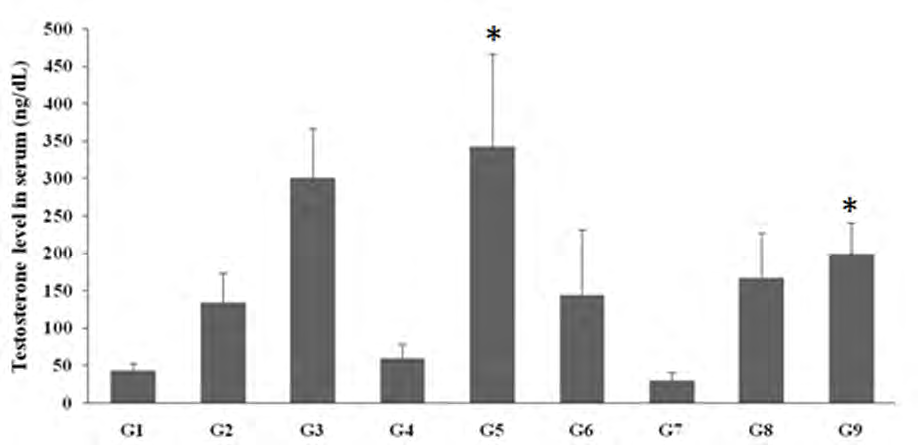
Figure 1: Evaluation of sex hormone-testosterone after treatment with the test formulation on male Sprague Dawley rats. G: Group; G1: Normal control; G2: Disease control (UCS: Unpredictable chronic stress + 0.5% CMC); G3: Reference item (UCS + Imipramine hydrochloride 30 mg/kg); G4: (UCS + Untreated test formulation); G5: (UCS + Biofield Energy Treated test formulation); G6: (UCS + Biofield Energy Treatment per se to animals from day -15; G7: (UCS + Biofield Energy Treated test formulation from day -15); G8: (UCS + Biofield Energy Treatment per se plus Biofield Energy Treated test formulation from day -15), and G9: (UCS + Biofield Energy Treatment per se animals plus untreated test formulation). Values are presented as mean ± SEM (n=6). *p≤0.05 vs. G4.
In this research plan, four groups were considered as preventive maintenance groups. These groups were G6 (Biofield Energy Treatment per se to animals at -15days), G7 (Biofield Energy Treated test formulation from day -15), G8 (Biofield Energy Treatment per se to animals along with Biofield Treated test formulation from day -15), and G9 (Biofield treatment per se at -15days to animals with the untreated test formulation). The results showed the significant slowdown of the disease progression, disease-related all other symptoms/complications and also reduced the chances of disease susceptibility in these groups. Specifically, group G6 (preventive Biofield Energy Treatment group per se at -15days) showed the best results as a prophylactic/ preventive treatment group compared to the other groups. Based on the overall data, it suggests that the Biofield Energy Healing Therapy was found to be most effective and benefited in order to prevent and protect from the occurrence of any type of diseases in rat model. It indicated that this therapy can act as a preventive maintenance therapy to prevent the occurrence of the disease, slowdown the disease progression and disease-related complications of the existing ailments that will ultimately improve the overall health and quality of life in human.
Conclusion
Unpredictable chronic stress (UCS) animal model was used for studying the effect of oral administration of Biofield Energy Treated test formulation and Consciousness Energy Healing Treatment (the Trivedi Effect®) for the estimation of haematology and biochemical biomarkers. Haematology biomarker data suggested that RBC count was significantly increased by 9.37% in the G6 group as compared with the G2. RDW-CV was significantly increased by 14.04%, 12.49%, and 11.85% in the G7, G8, and G9 groups, respectively as compared with the G2, while platelet count was significantly increased by 13.60% and 10.94% in the G6 and G9 groups, respectively as compared with the G2 group. Biochemical analysis showed that the level of magnesium, calcium, creatinine, phosphorus, uric acid, blood urea, sodium, potassium, and chloride level was significantly altered after treatment with the test formulation. However, the level of testosterone was significantly increased after the experimental period, which showed an increased level by 476.39%, 142.86%, 181.93%, and 234.46% in the G5, G6, G8, and G9 groups, respectively compared with the untreated test formulation (G4). Therefore, the Biofield Energy Treatment might act as a preventive maintenance therapy in order to maintain good health, or full restoration of health or improve the overall health and quality of life in human. This therapy might also reduce the severity of any type of acute/chronic disease related to blood biochemical profile such as anaemia, bleeding disorders along with improved sexual hormonal level. In addition, the test formulation can be also used to improve the altered blood biochemistry that suggests its important role in neuromuscular diseases and acute myocardial infarction. Similarly, this test formulation can be used for autoimmune-related and inflammatory towards diseases, cancer, Hashimoto’s thyroiditis, allergies, lethargic conditions, energy booster action, Crohn’s disease, autoimmune diseases, and its various immune deficiency diseases. Overall, the data suggested the Biofield Energy Treated test formulation and Biofield Energy Treatment per se in showed significant action on haematology, biochemistry, and testosterone level.
Acknowledgements
The authors are grateful to Dabur Research Foundation, Trivedi Science, Trivedi Global, Inc., and Trivedi Master Wellness for the assistance and support during the work.
References
-
MacMaster FP, Carrey N, Langevin LM, Jaworska N, Crawford S (2014) Disorder-specific volumetric brain difference in adolescent major depressive disorder and bipolar depression. Brain Imaging Behav 8(1): 119-127.
-
Swain MG I (2000) Stress and hepatic inflammation. Am J Physiol Gastrointest Liver Physiol 279(6): G1135-G1138.
-
Segerstrom SC, Miller GE (2004) Psychological stress and the human immune system: A meta-analytic study of 30 years of inquiry. Psychol Bull 130(4): 601-630.
-
Che Y, Zhou Z, Shu Y, Zhai C, Zhu Y, et al. (2015) Chronic unpredictable stress impairs endogenous antioxidant defense in rat brain. Neurosci Lett 584: 208-213.
-
Burnham B, Wallington S, Jillson IA, Trandafili H, Shetty K, et al. (2014) Knowledge, attitudes and beliefs of patients with chronic liver disease. Am J Health Behav 38(5): 737-744.
-
Youssef NA, Abdelmalek MF, Binks M, Guy CD, Omenetti A, et al. (2013) Associations of depression, anxiety and antidepressants with histological severity of nonalcoholic fatty liver disease. Liver Int 33(7): 1062- 1070.
-
Suh JI, Sakong JK, Lee K, Lee YK, Park JB, et al. (2013) Anxiety and depression propensities in patients with acute toxic liver injury. World J Gastroenterol 19(47): 9069-9076.
-
Nardelli S, Pentassuglio I, Pasquale C, Ridola L, Moscucci F, et al. (2013) Depression, anxiety and alexithymia symptoms are major determinants of health related quality of life (HRQoL) in cirrhotic patients. Metab Brain Dis 28(2): 239-243.
-
González-Flecha B, Cutrin JC, Boveris A (1993) Time course and mechanism of oxidative stress and tissue damage in rat liver subjected to _in vivo_ ischemia- reperfusion. J Clin Invest 91(2): 456-464.
-
Hirose S, Hirayama C, Ikemi Y (1961) The influence of emotional stress on the liver blood flow. Kyushu J Med Sci 12: 319-323.
-
Kaplan MH, Wheeler WF (1983) Stress and diseases of the upper gut. I. Stress and liver disease. Mt Sinai J Med 50(3): 225-227.
-
Chida Y, Sudo N, Kubo C (2006) Does stress exacerbate liver diseases?. J Gastroenterol Hepatol 21(1): 202-208.
-
Spratt DI, O’Dea LS, Schoenfeld D, Butler J, Rao PN, et al. (1988) Neuroendocrine-gonadal axis in men: Frequent sampling of LH, FSH, and testosterone. Am J Physiol 254(5): E658-E666.
-
Choi JC, Chung M, Lee Y (2012) Modulation of pain sensation by stress-related testosterone and cortisol. Anaesthesia 67(10): 1146-1151.
-
Sternbach H (1998) Age-associated testosterone decline in men: Clinical issues for psychiatry. Am J Psychiatry 155(10): 1310-1318.
-
Banasr M, Valentine GW, Li XY, Gourley SL, Taylor JR, et al. (2007) Chronic unpredictable stress decreases cell proliferation in the cerebral cortex of the adult rat. Biol Psychiatry 62(5): 496-504.
-
Li N, Liu RJ, Dwyer JM, Banasr M, Lee B, et al. (2011) Glutamate N-methyl-D-aspartate receptor antagonists rapidly reverse behavioral and synaptic deficits caused by chronic stress exposure. Biol Psychiatry 69(8): 754- 761.
-
Seo JS, Park JY, Choi J, Kim TK, Shin JH, et al. (2012) NADPH oxidase mediates depressive behavior induced by chronic stress in mice. J Neurosci 32(28): 9690-9699.
-
Berton O, McClung CA, Dileone RJ, Krishnan V, Renthal W, et al. (2006) Essential role of BDNF in the mesolimbic dopamine pathway in social defeat stress. Science 311(5762): 864-868.
-
Krishnan V, Han MH, Graham DL, Berton O, Renthal W, et al. (2007) Molecular adaptations underlying susceptibility and resistance to social defeat in brain reward regions. Cell 131(2): 391-404.
-
Jia HM, Feng Y, Liu Y, Chang X, Chen L, et al. (2013) Integration of ¹H NMR and UPLC-Q-TOF/MS for a comprehensive urinary metabonomics study on a rat model of depression induced by chronic unpredictable mild stress. Plos One 8(5): e63624.
-
Zheng S, Yu M, Lu X, Huo T, Ge L, et al. (2010) Urinary metabonomic study on biochemical changes in chronic unpredictable mild stress model of depression. Clin Chim Acta 411(3-4): 204-209.
-
Dai Y, Li Z, Xue L, Dou C, Zhou Y, et al. (2010) Metabonomics study on the anti-depression effect of xiaoyaosan on rat model of chronic unpredictable mild stress. J Ethnopharmacol 128(2): 482-489.
-
Liu XJ, Li ZY, Li ZF, Gao XX, Zhou YZ, et al. (2012) Urinary metabonomic study using a CUMS rat model of depression. Magn Reson Chem 50(3): 187-192.
-
Zhang WY, Liu S, Li HD, Cai HL (2012) Chronic unpredictable mild stress affects myocardial metabolic profiling of SD rats. J Pharm Biomed Anal 70: 534-538.
-
Gao, X, Zheng X, Li Z, Zhou Y, Sun H, et al. (2011) Metabonomic study on chronic unpredictable mild stress and intervention effects of Xiaoyaosan in rats using gas chromatography coupled with mass spectrometry. J Ethnopharmacol 137(1): 690-699.
-
Shi B, Tian J, Xiang H, Guo X, Zhang L, et al. (2013) A 1H-NMR plasma metabonomic study of acute and chronic stress models of depression in rats. Behav Brain Res 241: 86-91.
-
Ni Y, Su M, Lin J, Wang X, Qiu Y, et al. (2008) Metabolic profiling reveals disorder of amino acid metabolism in four brain regions from a rat model of chronic unpredictable mild stress. FEBS Lett 582(17): 2627- 2636.
-
Rubik B (2002) The biofield hypothesis: Its biophysical basis and role in medicine. J Altern Complement Med 8(6): 703-717.
-
Jain S, Hammerschlag R, Mills P, Cohen L, Krieger R, et al. (2015) Clinical studies of biofield therapies: Summary, methodological challenges, and recommendations. Glob Adv Health Med 4: 58-66.
-
Evans M, Shaw A, Thompson EA, Falk S, Turton P, et al. (2007) Decisions to use complementary and alternative medicine (CAM) by male cancer patients: Information- seeking roles and types of evidence used. BMC Complement Altern Med 7: 25.
-
Gu S, Pei J (2017) Innovating Chinese herbal medicine: From traditional health practice to scientific drug discovery. Front Pharmacol 8: 381.
-
O’Mathúna D (2001) The best of both approaches. The role of science in complementary and alternative medicine. EMBO Rep 2(12): 1054-1057.
-
Mahendra Kumar T, Alice B, Dahryn T, Snehasis J (2021) Effect of consciousness energy healing treatment on the metal profile and properties of tellurium. Eng Technol Open Acc 3(5): 555623.
-
Mahendra KT, Alice B, Dahryn T, Snehasis J (2021) Consciousness energy healing treatment impacted the isotopic abundance ratio of 6-Mercaptopurine (6-MP). Nov Appro Drug Des Dev 5(5): 555673.
-
Trivedi MK, Branton A, Trivedi D, Nayak G, Mondal SC, et al. (2015) Morphological characterization, quality, yield and DNA fingerprinting of biofield energy treated alphonso mango (_Mangifera indica_ L.). Journal of Food and Nutrition Sciences 3(6): 245-250.
-
Trivedi MK, Jana S (2021) Anti-aging activity of biofield energy treated novel proprietary test formulation by assessment of vital biomarkers in cerebrospinal fluid (CSF) in Sprague Dawley rats. On J Neur & Br Disord 5(2).
-
Mahendra Kumar T, Snehasis J (2021) Evaluation of biofield energy healing treatment based proprietary test formulation on gut health potential in colon cancer cell line (HT-29). J Pharmacol Clin Res 8(4): 555743.
-
Trivedi MK, Branton A, Trivedi D, Jana S (2021) Isotopic abundance ratio analysis of consciousness energy healing treated folic acid. Food Nutr Current Res 4(2): 290-295.
-
Trivedi MK, Branton A, Trivedi D, Jana S (2020) The consciousness energy healing treatment and its impact on the isotopic abundance ratio analysis of flutamide. Drug Des Int Prop Int J 3(5).
-
Feldman BF, Zinkl JG, Jain VC (2000) Laboratory techniques for avian hematology,” In Schalm’s Veterinary Hematology, (5th Edn.), Lippincott Williams & Wilkins, Toronto, Canada.
-
Rosenberg IH, Miller JW (1992) Nutritional factors in physical and cognitive functions of elderly people. Am J Clin Nutr 55(6): 1237-1243.
-
Stover PJ (2004) Physiology of folate and vitamin B12 in health and disease. Nutr Rev 62(6 Pt 2): 3-12.
-
Shenkin A (2006) Micronutrients in health and disease. Postgrad Med J 82(971): 559-567.
-
Ward E (2014) Addressing nutritional gaps with multivitamin and mineral supplements. Nutr J 13:72.
-
Pilz S, Frisch S, Koertke H, Kuhn J, Dreier J, et al. (2011) Effect of vitamin D supplementation on testosterone levels in men. Horm Metab Res 43(3): 223-225.
-
Sim MY, Kim SH, Kim KM (2017) Seasonal variations and correlations between vitamin D and total testosterone levels. Korean J Fam Med 38(5): 270-275.
-
Asadi N, Bahmani M, Kheradmand A, Rafieian-Kopaei M (2017) The impact of oxidative stress on testicular function and the role of antioxidants in improving it: A review. J Clin Diagn Res 11(5): IE01-IE05.
-
Dissanayake D, Wijesinghe PS, Ratnasooriya WD, Wimalasena S (2009) Effects of zinc supplementation on sexual behavior of male rats. J Hum Reprod Sci 2(2): 57-61.
-
Shafiei Neek L, Gaeini AA, Choobineh S (2011) Effect of zinc and selenium supplementation on serum testosterone and plasma lactate in cyclist after an exhaustive exercise bout. Biol Trace Elem Res 144(1-3): 454-462.
-
Cinar V, Polat Y, Baltaci AK, Mogulkoc R (2011) Effects of magnesium supplementation on testosterone levels of athletes and sedentary subjects at rest and after exhaustion. Biol Trace Elem Res 140(1): 18-23.
-
Jana K, Samanta PK, Manna I, Ghosh P, Singh N, et al. (2008) Protective effect of sodium selenite and zinc sulfate on intensive swimming-induced testicular gamatogenic and steroidogenic disorders in mature male rats. Appl Physiol Nutr Metab 33(5): 903-914.
- Are the Vaccines the Only Solution to Prevent the COVID-19 Pandemic? Part Two
- Clinical Characteristics of Women in this New Global Immunodeficiency
- Cell Dynamics in HIV Pathogenesis: Insights and Implications
- Determination of the CDR (CDR1, CDR2) « Complementary- Determining Region Invertebrate Primitive Antibody from Sea Star »
- Prioritizing Care for High-Risk COVID-19 Patients in the EU: 10 Civic Recommendations to the Institutions
- Comprehensive Insights into ModRNA Vaccines: Persistent PP-Spike Recombinant Protein, Hyperimmune/Inflammatory Reactions, Thrombotic Vasculopathy, Chronic Organ Complications and Excess Deaths