
Evaluation of Multiple Vital Serum Biomarkers after Treatment with the Consciousness Energy Healing Based Proprietary Test Formulation on L-NAME and High Fat Diet-Induced Cardiovascular Disorders in Sprague Dawley Rats
The experiment was aimed to evaluate the effect of Biofield Energy Treated/Blessed Proprietary Test Formulation and Biofield Energy Treatment/Blessing per se on different vital functional serum biomarkers to the animals on L-NAME and high fat diet (HFD)-induced cardiovascular disorders in Sprague Dawley rats. In this experiment, the functional serum biomarkers such as epinephrine/adrenaline, inducible nitric oxide synthase (iNOS), endothelial NOS (eNOS), plasminogen activator inhibitor-1 (PAI-1), intercellular adhesion molecule-1 (ICAM-1), glycated hemoglobin (HbA1c), and insulin were measured using ELISA assay. A test formulation was formulated including minerals (magnesium, zinc, copper, calcium, selenium, and iron), vitamins (ascorbic acid, pyridoxine HCl, vitamin B9 , vitamin B12, and vitamin D3 ), cannabidiol (CBD) isolate, Panax ginseng extract, and β-carotene. The constituents of the test formulation were divided into two parts; one portion was referred as the untreated test formulation, while the other portion and three groups of animals received Biofield Energy Healing/Blessing Treatment remotely for about 3 minutes by a renowned spiritual healer, Mr. Mahendra Kumar Trivedi. The results showed that the level of adrenaline was reduced by 29.25%, 20.33%, 31.36%, and 41.97% in the G5 (L-NAME + HFD + the Biofield Energy Treated test formulation), G6 (L-NAME + HFD + Biofield Energy Treatment per se to animals from day -15), G7 (L-NAME + HFD + the Biofield Energy Treated test formulation from day -15), and G8 (L-NAME + HFD + Biofield Energy Treatment per se plus the Biofield Energy Treated test formulation from day -15) groups, respectively as compared to the untreated test formulation group (G4). Moreover, the level of iNOS was reduced by 53.09%, 51.32%, 33.87%, 39.88%, and 40.02% in the G5, G6, G7, G8, and G9 (L-NAME + HFD + Biofield Energy Treatment per se animals plus the untreated test formulation) groups, respectively, as compared to the disease control group (G2). Additionally, the level of eNOS was increased by 83.65%, 94.93%, 71.48%, 48.64%, and 61.12% in the G5, G6, G7, G8, and G9 groups, respectively, as compared to the G2 group. The level of PAI-1 was decreased by 56.10%, 56.57%, 55.28%, 49.28%, and 57.84% in the G5, G6, G7, G8, and G9 groups, respectively as compared to the G2 group. Besides, the level of ICAM-1 was decreased by 20.99%, 20.74%, 18.85%, and 17.89% in the G5, G6, G7, and G8 groups, respectively as compared to the G2 group. Level of HbA1c was decreased by 28.50%, 44.07%, 25.30%, 22.70%, and 48.79% in the G5, G6, G7, G8, and G9 groups, respectively as compared to the G2 group. Further, the level of insulin was decreased by 26.09%, 21.24%, 5.41%, 23.61%, and 24.59% in the G5, G6, G7, G8, and G9 groups, respectively as compared to the G2 group. Overall, the data suggested significance improvement of vital functional biomarkers of the Biofield Energy Treated test formulation and Biofield Energy Treatment per se along with preventive measure on the animal with respect to various pathological conditions that might be beneficial various types of cardiovascular disorders. Therefore, the results showed the significant slowdown the inflammation-related cardiovascular disease progression and its symptoms in the preventive maintenance groups (viz. G6, G7, G8, and G9).
Introduction
Cardiovascular diseases (CVDs) are the leading cause of death worldwide. A randomized controlled trial indicates that epinephrine increases return of pulses for cardiac arrest patients. Despite increases in return of pulses, it reduces long-term survival and functional recovery after cardiopulmonary resuscitation (CPR). Laboratory data also suggest that it induced reductions in microvascular blood flow during and after CPR [1]. Nitric oxide (NO) is produced in almost all tissues and organs by 3 distinct NO synthase (NOS) isoforms (neuronal, inducible, and endothelial NOS), all the enzymes are expressed in the human cardiovascular system [2]. Abnormal generation of NO is considered as a major cause of coronary heart disease (CHD). It has been shown that endothelial disfunction is characterized by reduced endothelial NO synthesis by constitutive NOS (cNOS) and increased systemic NO synthesis due to increased iNOS activity can leads to cardiovascular disorders [3]. Plasminogen activator inhibitor-1 (PAI-1) antigen levels are predictive risk factors for CVDs. Increase in PAI- 1 is associated with a further increase in risk of CVDs [4]. Moreover, increase plasma levels of ICAM-1 may serve as risk markers for future coronary events [5].Coronary Heart Disease Glycated hemoglobin (HbA1c) is considered as a biomarker and predictor of CVDs. In 2009 the International Expert Committee recommended the use of HbA1c for the diagonosis of diabetes with a cut-off of 6.5%. It also reported that the cut-off range of 5.5% to 6.5% HbA1c as a high risk of morbidity and mortality due to cardiovascular disease [6]. The animal studies suggest that insulin can protects the heart from stresses, whereas clinical studies suggest that high levels of insulin in the blood causes heart failure [7, 8].
Thus, in order to study the change in serum vital functional biomarker in presence of L-NAME and High Fat Diet (HFD)- Induced Cardiovascular Disorders in Sprague Dawley Rats, a novel test formulation was designed with the combination of vital minerals (selenium, zinc, iron, calcium, copper, and magnesium), essential vitamins (cyanocobalamin, ascorbic acid, pyridoxine HCl, vitamin B9, and cholecalciferol), and nutraceuticals (β-carotene, Ginseng, cannabidiol isolate (CBD)). All the minerals and vitamins used in the test formulation have significant functional role to provide vital physiological roles [9, 10, 11]. Besides, cannabidiol itself has wide range of pharmacological profile and has been reported to role in different disorders [12, 13], while ginseng extract is regarded as the one of the best immune boosters for overall immunity [14]. The present study was aimed to evaluate the vital functional biomarker on the Biofield Energy Treated Proprietary Test Formulation and Biofield Energy Treatment per se to the animals under L-NAME and high fat diet (HFD)- induced cardiovascular disorders in Sprague Dawley rats.
Biofield Energy Healing Treatment has been reported with significant effects against various disorders, and defined as one of the best Complementary and Alternative Medicine (CAM) treatment approach [15, 16, 17]. National Center for Complementary/Alternative Medicine (NCCAM) recommended CAM with several clinical benefits as compared with the conventional treatment approach [18]. National Centre of Complementary and Integrative Health (NCCIH) accepted Biofield Energy Healing as a CAM health care approach in addition to other therapies such as deep breathing, natural products, Tai Chi, yoga, therapeutic touch, Johrei, Reiki, pranic healing, chiropractic/ osteopathic manipulation, guided imagery, meditation, massage, homeopathy, hypnotherapy, special diets, relaxation techniques, movement therapy, mindfulness, Ayurvedic medicine, traditional Chinese herbs and medicines in biological systems [19, 20]. The Trivedi Effect®- Consciousness Energy Healing was scientifically reported on various disciplines such as in the materials science [21, 22], agriculture science [23], antiaging [24], Gut health [25], nutraceuticals [26], pharmaceuticals [27], cardiac health [28], overall human health and wellness. In this study, the authors sought to study the impact of the Biofield Energy Treatment (the Trivedi Effect®) on the given novel test formulation and Biofield Energy Treatment per se to the animals on serum vital functional biomarkers in presence of L-NAME and High Fat Diet-Induced Cardiovascular Disorders in Sprague Dawley Rats using standard ELISA assay.
Material and Methods
Chemicals and Reagents
Pyridoxine hydrochloride (vitamin B6), atorvastatin, zinc chloride, magnesium (II) gluconate, and β-carotene (retinol, provit A) were purchased from TCI, Japan. Copper chloride, cyanocobalamin (vitamin B12), calcium chloride, vitamin E (Alpha-Tocopherol), cholecalciferol (vitamin D3), iron (II) sulfate, captopril, L-NAME, and sodium carboxymethyl cellulose (Na-CMC) were procured from Sigma-Aldrich, USA. Ascorbic acid (vitamin C) and sodium selenate were obtained from Alfa Aesar, India. Cannabidiol isolate and Panax ginseng extract were obtained from Panacea Phytoextracts, India and Standard Hemp Company, USA, respectively. Standard normal chow diet and high fat diet were purchased from Altromin, USA and Research Diets, USA. For the estimation of serum biomarker panels specific ELISA kits were used such as for detection of epinephrine (CSB-E08678r), inducible nitric oxide synthase (iNOS; CSB-E08325r), endothelial NOS (eNOS; CSB-E08323r), plasminogen activator inhibitor-1 (PAI-1; CSB-E07948r), intercellular adhesion molecule-1 (ICAM-1; CSB-E04576r), glycated hemoglobin (HbA1c; CSB- E08140r), and insulin (CSB-E05070r), were procured from CUSABIO, USA.
Maintenance of Animal
Randomly breed male Sprague Dawley (SD) rats with body weight ranges from 200 to 300gm were used in this study. The animals were purchased from M/s. HYLASCO Biotechnology (India) Pvt. Ltd., India. Animals were randomly divided into nine groups based on their body weights consist of 15 animals of each group (at the time of induction period) and 10 animals of each group (at the time of treatment period). They were kept individually in sterilized polypropylene cages with stainless steel top grill having provision for holding pellet feed and drinking water bottle fitted with stainless steel sipper tube. The animals were maintained as per standard protocol throughout the experiment.
Consciousness Energy Healing Strategies
Each ingredient of the proprietary test formulation was divided into two parts. One part of the test compound did not receive any sort of treatment/Blessing and were defined as the untreated or control sample. The second part of the test formulation was treated with the Trivedi Effect®-Energy of Consciousness Healing Treatment/Blessing (Biofield Energy Treatment) by a renowned Biofield Energy Healer, Mr. Mahendra Kumar Trivedi under laboratory conditions for ~3 minutes. Besides, three group of animals also received Biofield Energy Healing/Blessing Treatment (known as the Trivedi Effect®) by Mr. Mahendra Kumar Trivedi under similar laboratory conditions for ~3 minutes. The Biofield Energy Healer was located in the USA, however the test formulation was located in the research laboratory of Dabur Research Foundation, New Delhi, India. The Biofield Energy Healing Treatment/ Blessing (prayer) was done remotely, for about 3 minutes via online web-conferencing platform. After that, the Biofield Energy Treated/Blessed samples was kept in the similar sealed condition and used as per the study plan. In the same manner, the control test formulation group was subjected to “sham” healer for ~3 minutes treatment, under the same laboratory conditions. The “sham” healer did not have any knowledge about the Biofield Energy Treatment/Blessing. The Biofield Energy Treated/Blessed animals were also taken back to experimental room for further proceedings.
Experimental Procedure
Seven days after acclimatization, animals were randomized and grouped based on the body weight. The test formulation was prepared freshly prior to dosing and administered to the animals using an oral intubation needle attached to an appropriately graduated disposable syringe. The dose volume was 10 mL/kg in morning and evening based on body weight. The experimental groups were divided as G1 as normal control (vehicle, 0.5% w/v CMC-Na); G2 as disease control (L-NAME + HFD + 0.5% CMC); G3 as reference item (L-NAME + HFD + Captopril + Atorvastatin); G4 includes L-NAME + HFD along with untreated test formulation; G5 as L-NAME + HFD along with the Biofield Energy Treated test formulation; G6 group includes L-NAME + HFD along with Biofield Energy Treatment per se to animals from day -15; G7 as L-NAME + HFD along with the Biofield Energy Treated test formulation from day -15; G8 group includes L-NAME + HFD along with Biofield Energy Treatment per se plus the Biofield Energy Treated test formulation from day -15, and G9 group denoted L-NAME + HFD along with Biofield Energy Treatment per se animals plus the untreated test formulation. The normal control animals’ group (G1) was receiving normal drinking water and a normal diet throughout the experimental period. The animals in groups G2-G9 were received L-NAME (20 mg/kg, i.p.) and a HFD throughout the experimental period. At the end of the experimental period (8 weeks treatment), the animals were sacrifice and blood was collected, and separate serum subjected for the estimation of epinephrine, iNOS, eNOS, PAI-1, ICAM-1, HbA1c, and insulin.
Preparation of Serum for the Estimation of Functional Biomarkers
With the continued treatment to the respective groups of 8th week of the experimental period, all the animals were individually subjected for blood collection using retro-orbital route and the blood was collected in the plain vial, which was used for the separation of serum in all the animals of different experimental groups. The serum from all the groups was stored at -20°C for further estimation. Alternatively, aliquot all the samples and store samples at -20°C or -80°C. Avoid repeated freeze-thaw cycles, which may alter the level of serum biomarkers during final calculations.
Estimation of Different Biomarkers in Serum
The serum from all the groups was subjected for the estimation of level of various vital biomarkers such as epinephrine, iNOS, eNOS, PAI-1, ICAM-1, HbA1c, and insulin. The entire serum biomarker panel was estimation using ELISA method as per manufacturer’s recommended standard procedure. This was a quantitative method, and the principle was based on the binding of antigen and antibody in sandwich manner assay.
Statistical Analysis
The data were represented as mean ± standard error of mean (SEM) and subjected to statistical analysis using Sigma-Plot statistical software (Version 11.0). For multiple comparison One-way analysis of variance (ANOVA) followed by post-hoc analysis by Dunnett’s test and for between two groups comparison Student’s t-test was performed. The p≤0.05 was considered as statistically significant.
Results and Discussion
Estimation of Serum Epinephrine/Adrenaline
Serum adrenaline was measured in the presence of the effect of the test formulation in the experimental groups and was graphically presented in the Figure 1. The data suggested that the disease control (L-NAME + high fat diet (HFD) + 0.5% CMC) group (G2) showed value of adrenaline as 20.75 ± 1.17 pg/mL, which was increased by 96.83% as compared with the normal control (G1, 10.54 ± 1.25 pg/mL). However, positive control (captopril + atorvastatin) treatment (G3) showed the level of serum adrenaline i.e., 15.02 ± 2.54 pg/ mL, which was deceased by 27.63% as compared to the G2 group. The level of adrenaline was decreased by 18.72%, 8.46%, 21.14%, and 33.33% in the G5 (L-NAME + HFD + the Biofield Energy Treated test formulation), G6 (L-NAME + HFD + Biofield Energy Treatment per se to animals from day -15), G7 (L-NAME + HFD + the Biofield Energy Treated test formulation from day -15), and G8 (L-NAME + HFD + Biofield Energy Treatment per se plus the Biofield Energy Treated test formulation from day -15) groups, respectively, as compared to the disease control group (G2). On the other hand, the level of adrenaline was reduced by 29.25%, 20.33%, 31.36%, and 41.97% in the G5, G6, G7, and G8 groups, respectively as compared to the untreated test formulation (G4) group (Figure 1). Based on the existed literature envisaged that continuous secretion of adrenaline during stress conditions can damage blood vessels, elevated blood pressure, and increased the severity of heart attacks or stroke [29]. Overall, in this experiment the Biofield Energy Treated/Blessed test formulation and Biofield Energy Treatment per se reduced the level of adrenaline, which might be helpful for the management of cardiovascular disorders.
![Figure 1: The data suggested that the disease control (L-NAME + high fat diet (HFD) + 0.5% CMC) group (G2) showed value of adrenaline as 20.75 ± 1.17 pg/mL, which was increased by 96.83% as compared with the normal control (G1, 10.54 ± 1.25 pg/mL). However, positive control (captopril + atorvastatin) treatment (G3) showed the level of serum adrenaline i.e., 15.02 ± 2.54 pg/ mL, which was deceased by 27.63% as compared to the G2 group. The level of adrenaline was decreased by 18.72%, 8.46%, 21.14%, and 33.33% in the G5 (L-NAME + HFD + the Biofield Energy Treated test formulation), G6 (L-NAME + HFD + Biofield Energy Treatment per se to animals from day -15), G7 (L-NAME + HFD + the Biofield Energy Treated test formulation from day -15), and G8 (L-NAME + HFD + Biofield Energy Treatment per se plus the Biofield Energy Treated test formulation from day -15) groups, respectively, as compared to the disease control group (G2). On the other hand, the level of adrenaline was reduced by 29.25%, 20.33%, 31.36%, and 41.97% in the G5, G6, G7, and G8 groups, respectively as compared to the untreated test formulation (G4) group (Figure 1). Based on the existed literature envisaged that continuous secretion of adrenaline during stress conditions can damage blood vessels, elevated blood pressure, and increased the severity of heart attacks or stroke [29]. Overall, in this experiment the Biofield Energy Treated/Blessed test formulation and Biofield Energy Treatment per se reduced the level of adrenaline, which might be helpful for the management of cardiovascular disorders.](/fulltextimages/7492/fig_1.png)
Figure 1: The effect of the test formulation on the level of serum adrenaline in Sprague Dawley rats. G1 as normal control (vehicle, 0.5% w/v CMC-Na); G2 as disease control (L-NAME + high fat diet (HFD) + 0.5% CMC); G3 as reference item (L-NAME + HFD + Captopril + Atorvastatin); G4 includes L-NAME + HFD along with untreated test formulation; G5 as L-NAME + HFD along with the Biofield Energy Treated test formulation; G6 group includes L-NAME + HFD along with Biofield Energy Treatment per se to animals from day -15; G7 as L-NAME + HFD along with the Biofield Energy Treated test formulation from day -15; G8 group includes L-NAME + HFD along with Biofield Energy Treatment per se plus the Biofield Energy Treated test formulation from day -15, and G9 group denoted L-NAME + HFD along with Biofield Energy Treatment per se animals plus the untreated test formulation. Values are presented as mean ± SEM (n=10).
Estimation of Serum iNOS and eNOS
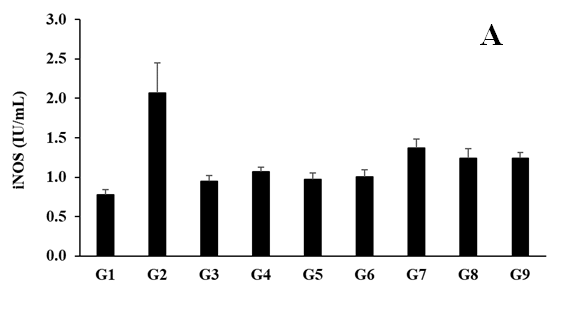
The effect of the test formulation and Biofield Energy Treatment per se on the level of serum induced nitric oxide synthase (iNOS) and endothelial NOS is shown in Figure 2. The data suggested that the disease control (L-NAME + high fat diet (HFD) + 0.5% CMC) group (G2) showed value of iNOS as 2.07 ± 0.38 IU/mL, which was increased by 166.13% as compared with the normal control (G1, 0.78 ± 0.07 IU/ mL). However, positive control (captopril + atorvastatin) treatment group (G3) showed decreased serum iNOS level by 54.10% i.e., 0.95 ± 0.07 IU/mL was compared to the G2. The level of iNOS in serum was decreased by 48.42%, 53.09%, 51.32%, 33.87%, 39.88%, and 40.02% in the G4 (L-NAME + HFD + untreated test formulation), G5 (L-NAME + HFD + the Biofield Energy Treated test formulation), G6 (L-NAME + HFD + Biofield Energy Treatment per se to animals from day -15), G7 (L-NAME + HFD + the Biofield Energy Treated test formulation from day -15), G8 (L-NAME + HFD + Biofield Energy Treatment per se plus the Biofield Energy Treated test formulation from day -15), and G9 (L-NAME + HFD + Biofield Energy Treatment per se animals plus the untreated test formulation) groups, respectively, as compared to the disease control group (G2). Further, the level of iNOS was reduced by 9.24% and 5.83% in the G5 and G6 groups, respectively as compared to the untreated test formulation (G4) group (Figure 2A).
Besides, the disease control (L-NAME + high fat diet (HFD) + 0.5% CMC) group (G2) showed value of eNOS as 3.62 ± 0.28 µIU/mL, which was decreased by 53.06% as compared with the normal control (G1, 7.70 ± 0.56 µIU/ mL). However, positive control (captopril + atorvastatin) treatment group (G3) showed increased serum eNOS level by 116.99% i.e. 7.85 ± 0.31 µIU/mL as compared to the G2. The level of eNOS in serum was increased by 80.50%, 83.65%, 94.93%, 71.48%, 48.64%, and 61.12% in the G4 (L-NAME + HFD + untreated test formulation), G5 (L-NAME + HFD + the Biofield Energy Treated test formulation), G6 (L-NAME + HFD + Biofield Energy Treatment per se to animals from day -15), G7 (L-NAME + HFD + the Biofield Energy Treated test formulation from day -15), G8 (L-NAME + HFD + Biofield Energy Treatment per se plus the Biofield Energy Treated test formulation from day -15), and G9 (L-NAME + HFD + Biofield Energy Treatment per se animals plus the untreated test formulation) groups, respectively, as compared to the disease control group (G2). Further, the level of eNOS was increased by 1.81% and 8.06% in the G5 and G6 groups, respectively as compared to the untreated test formulation (G4) group (Figure 2B). Nitric oxide (NO) is the key endothelium- derived relaxing factor that maintains the vascular tone and reactivity. More generation of NO by the stimulation of iNOS have been proposed as a major mechanism of endothelial dysfunction, and that causes cardiovascular abnormalities [30, 31]. Besides, iNOS is expressed because of proinflammatory cytokines and can release more NO than other isoform of nitric oxide synthase enzymes [32]. Overall, in this study the Biofield Energy Treated test formulation and Biofield Energy Treatment per se significantly reduced the level of iNOS, which was increased due to cardiovascular disease condition, induced by L-NAME and HFD, which could be beneficial in the cardiovascular patients.
Estimation of Serum Plasminogen Activator Inhibitor-1 (PAI-1)
The level of serum plasminogen activator inhibitor-1 (PAI-1) was measured in all the experimental groups and the data are shown in Figure 3. The data suggested that the disease control (L-NAME + high fat diet, HFD + 0.5% CMC) group (G2) showed value of PAI-1 as 4.68 ± 1.08 ng/ mL, which was increased by 161.98% as compared with the normal control (G1, 1.78 ± 0.31 ng/mL) group. While, in the positive control (captopril + atorvastatin) treatment (G3) the level of PAI-1 was decreased by 59.82% i.e., 1.88 ± 0.30 ng/ mL. The level of PAI-1 was decreased by 57.25%, 56.10%, 56.57%, 55.28%, 49.28%, and 57.84% in the G4 (L-NAME + HFD + untreated test formulation), G5 (L-NAME + HFD + the Biofield Energy Treated test formulation), G6 (L-NAME + HFD + Biofield Energy Treatment per se to animals from day -15), G7 (L-NAME + HFD + the Biofield Energy Treated test formulation from day -15), G8 (L-NAME + HFD + Biofield Energy Treatment per se plus the Biofield Energy Treated test formulation from day -15), and G9 (L-NAME + HFD + Biofield Energy Treatment per se animals plus the untreated test formulation) groups, respectively, as compared to the disease control group (G2). Moreover, the level of PAI-1 was reduced by 1.34% G9 group as compared to the untreated test formulation (G4) group (Figure 3). PAI-1 level is considered as a predictive indicator of cardiovascular diseases (CVDs). An increase the level of PAI-1 is associated with the increased risk of CVDs [4, 33]. Overall, here the Biofield Energy Treated test formulation and Biofield Energy Treatment per se significantly reduced the level of PAI-1, which could be beneficial in the cardiovascular symptoms.
![Figure 3: The data suggested that the disease control (L-NAME + high fat diet, HFD + 0.5% CMC) group (G2) showed value of PAI-1 as 4.68 ± 1.08 ng/ mL, which was increased by 161.98% as compared with the normal control (G1, 1.78 ± 0.31 ng/mL) group. While, in the positive control (captopril + atorvastatin) treatment (G3) the level of PAI-1 was decreased by 59.82% i.e., 1.88 ± 0.30 ng/ mL. The level of PAI-1 was decreased by 57.25%, 56.10%, 56.57%, 55.28%, 49.28%, and 57.84% in the G4 (L-NAME + HFD + untreated test formulation), G5 (L-NAME + HFD + the Biofield Energy Treated test formulation), G6 (L-NAME + HFD + Biofield Energy Treatment per se to animals from day -15), G7 (L-NAME + HFD + the Biofield Energy Treated test formulation from day -15), G8 (L-NAME + HFD + Biofield Energy Treatment per se plus the Biofield Energy Treated test formulation from day -15), and G9 (L-NAME + HFD + Biofield Energy Treatment per se animals plus the untreated test formulation) groups, respectively, as compared to the disease control group (G2). Moreover, the level of PAI-1 was reduced by 1.34% G9 group as compared to the untreated test formulation (G4) group (Figure 3). PAI-1 level is considered as a predictive indicator of cardiovascular diseases (CVDs). An increase the level of PAI-1 is associated with the increased risk of CVDs [4,33]. Overall, here the Biofield Energy Treated test formulation and Biofield Energy Treatment per se significantly reduced the level of PAI-1, which could be beneficial in the cardiovascular symptoms.](/fulltextimages/7492/fig_3.png)
Estimation of Serum Intercellular Adhesion Molecule-1 (ICAM-1)
The effect of the test formulation and Biofield Energy Treatment per se on the level of serum intercellular adhesion molecule-1 (ICAM-1), and the results are graphically shown in Figure 4. The disease control (L-NAME + high fat diet, HFD + 0.5% CMC) group (G2) showed value of ICAM-1 as 123.53 ± 8.11 pg/mL, which was increased by 30.36% as compared with the normal control (G1, 94.76 ± 7.51 pg/ mL). Further, the positive control (captopril + atorvastatin) treatment (G3) showed decreased serum ICAM-1 level by 21.10% i.e., 97.46 ± 15.59 pg/mL as compared to the G2 group. The level of ICAM-1 was decreased by 9.62%, 20.99%, 20.74%, 18.85%, 17.89%, and 9.61% in the G4 (L-NAME + HFD + untreated test formulation), G5 (L-NAME + HFD + the Biofield Energy Treated test formulation), G6 (L-NAME + HFD + Biofield Energy Treatment per se to animals from day -15), G7 (L-NAME + HFD + the Biofield Energy Treated test formulation from day -15), G8 (L-NAME + HFD + Biofield Energy Treatment per se plus the Biofield Energy Treated test formulation from day -15), and G9 (L-NAME + HFD + Biofield Energy Treatment per se animals plus the untreated test formulation) groups, respectively, as compared to the disease control group (G2). Similarly, ICAM-1 level was decreased by 12.57%, 12.29%, 10.21% and 9.15% in the G5, G6, G7, and G8 groups, respectively as compared to the untreated test formulation (G4) group (Figure 4). Based on the literature data indicates that increase plasma levels of ICAM-1 may serve as risk markers for future coronary events [34]. It also supported that ICAM-1 variants may modulate atherosclerosis in humans by influencing inflammatory gene polymorphisms [35]. Therefore, in this experiment the Biofield Energy Treated test formulation and Biofield Energy Treatment per se reduced the level of ICAM-1, which could be beneficial to improve the cardiovascular disease conditions.
![Figure 4: The disease control (L-NAME + high fat diet, HFD + 0.5% CMC) group (G2) showed value of ICAM-1 as 123.53 ± 8.11 pg/mL, which was increased by 30.36% as compared with the normal control (G1, 94.76 ± 7.51 pg/ mL). Further, the positive control (captopril + atorvastatin) treatment (G3) showed decreased serum ICAM-1 level by 21.10% i.e., 97.46 ± 15.59 pg/mL as compared to the G2 group. The level of ICAM-1 was decreased by 9.62%, 20.99%, 20.74%, 18.85%, 17.89%, and 9.61% in the G4 (L-NAME + HFD + untreated test formulation), G5 (L-NAME + HFD + the Biofield Energy Treated test formulation), G6 (L-NAME + HFD + Biofield Energy Treatment per se to animals from day -15), G7 (L-NAME + HFD + the Biofield Energy Treated test formulation from day -15), G8 (L-NAME + HFD + Biofield Energy Treatment per se plus the Biofield Energy Treated test formulation from day -15), and G9 (L-NAME + HFD + Biofield Energy Treatment per se animals plus the untreated test formulation) groups, respectively, as compared to the disease control group (G2). Similarly, ICAM-1 level was decreased by 12.57%, 12.29%, 10.21% and 9.15% in the G5, G6, G7, and G8 groups, respectively as compared to the untreated test formulation (G4) group (Figure 4). Based on the literature data indicates that increase plasma levels of ICAM-1 may serve as risk markers for future coronary events [34]. It also supported that ICAM-1 variants may modulate atherosclerosis in humans by influencing inflammatory gene polymorphisms [35]. Therefore, in this experiment the Biofield Energy Treated test formulation and Biofield Energy Treatment per se reduced the level of ICAM-1, which could be beneficial to improve the cardiovascular disease conditions.](/fulltextimages/7492/fig_4.png)
Estimation of Serum Glycated Hemoglobin (HbA1c)
The effect of the test formulation and Biofield Energy Treatment per se on the level of serum glycated hemoglobin (HbA1c) and the results are graphically shown in Figure 5. The level of serum HbA1c in the disease control (L-NAME + high fat diet, HFD + 0.5% CMC) group (G2) was 0.11 ± 0.02 ng/mL, which was increased by 30.26% as compared with the normal control (G1, 0.08 ± 0.01 ng/mL). Further, the positive control (captopril + atorvastatin) treatment (G3) showed decreased serum HbA1c level by 28.64%, i.e., 0.08 ± 0.01 ng/mL as compared with the G2. The level of HbA1c was decreased by 35.19%, 28.50%, 44.07%, 25.30%, 22.70%, and 48.79% in the G4 (L-NAME + HFD + untreated test formulation), G5 (L-NAME + HFD + the Biofield Energy Treated test formulation), G6 (L-NAME + HFD + Biofield Energy Treatment per se to animals from day -15), G7 (L-NAME + HFD + the Biofield Energy Treated test formulation from day -15), G8 (L-NAME + HFD + Biofield Energy Treatment per se plus the Biofield Energy Treated test formulation from day -15), and G9 (L-NAME + HFD + Biofield Energy Treatment per se animals plus the untreated test formulation) groups, respectively, as compared to the disease control group (G2). Besides, the level of HbA1c was decreased by 12.11% and 19.53% in the G6, and G9 groups, respectively, as compared to the untreated test formulation (G4) group (Figure 5). An increase in HbA1c possesses more risk of cardiovascular disease [36]. Based on one study it has been found that HbA1c likely to causes coronary artery disease (CAD) in human [37, 6]. Overall, in this experiment the Biofield Energy Treated test formulation and Biofield Energy Treatment per se significantly reduced the level of HbA1c, which could reduce the risks of cardiovascular diseases.
![Figure 5: The level of serum HbA1c in the disease control (L-NAME + high fat diet, HFD + 0.5% CMC) group (G2) was 0.11 ± 0.02 ng/mL, which was increased by 30.26% as compared with the normal control (G1, 0.08 ± 0.01 ng/mL). Further, the positive control (captopril + atorvastatin) treatment (G3) showed decreased serum HbA1c level by 28.64%, i.e., 0.08 ± 0.01 ng/mL as compared with the G2. The level of HbA1c was decreased by 35.19%, 28.50%, 44.07%, 25.30%, 22.70%, and 48.79% in the G4 (L-NAME + HFD + untreated test formulation), G5 (L-NAME + HFD + the Biofield Energy Treated test formulation), G6 (L-NAME + HFD + Biofield Energy Treatment per se to animals from day -15), G7 (L-NAME + HFD + the Biofield Energy Treated test formulation from day -15), G8 (L-NAME + HFD + Biofield Energy Treatment per se plus the Biofield Energy Treated test formulation from day -15), and G9 (L-NAME + HFD + Biofield Energy Treatment per se animals plus the untreated test formulation) groups, respectively, as compared to the disease control group (G2). Besides, the level of HbA1c was decreased by 12.11% and 19.53% in the G6, and G9 groups, respectively, as compared to the untreated test formulation (G4) group (Figure 5). An increase in HbA1c possesses more risk of cardiovascular disease [36]. Based on one study it has been found that HbA1c likely to causes coronary artery disease (CAD) in human [37,6]. Overall, in this experiment the Biofield Energy Treated test formulation and Biofield Energy Treatment per se significantly reduced the level of HbA1c, which could reduce the risks of cardiovascular diseases.](/fulltextimages/7492/fig_5.png)
Estimation of Serum Insulin
The effect of the test formulation and Biofield Energy Treatment per se on the level of serum insulin and the results are graphically shown in Figure 6. The level of serum insulin in the disease control (L-NAME + high fat diet, HFD + 0.5% CMC) group (G2) was 159.88 ± 9.96 nIU/mL, which was increased by 98.78% as compared with the normal control (G1, 80.43 ± 5.38 nIU/mL). Further, the positive control (captopril + atorvastatin) treatment (G3) showed decreased serum insulin level by 28.13%, i.e., 114.90 ± 7.07 nIU/mL as compared with the G2. The level of insulin was decreased by 23.71%, 26.09%, 21.24%, 5.41%, 23.61%, and 24.59% in the G4 (L-NAME + HFD + untreated test formulation), G5 (L-NAME + HFD + the Biofield Energy Treated test formulation), G6 (L-NAME + HFD + Biofield Energy Treatment per se to animals from day -15), G7 (L-NAME + HFD + the Biofield Energy Treated test formulation from day -15), G8 (L-NAME + HFD + Biofield Energy Treatment per se plus the Biofield Energy Treated test formulation from day -15), and G9 (L-NAME + HFD + Biofield Energy Treatment per se animals plus the untreated test formulation) groups, respectively, as compared to the disease control group (G2). Besides, the level of insulin was decreased by 3.13% and 1.15% in the G5, and G9 groups, respectively, as compared to the untreated test formulation (G4) group (Figure 6). The studies in humans and animal models have revealed that heart failure is associated with insulin resistance and the interaction between systemic insulin resistance and myocardial insulin signalling, that leads to heart failure [8]. Overall, in this experiment the Biofield Energy Treated/ Blessed test formulation and Biofield Energy Treatment/ Blessing per se significantly reduced the level of insulin, which could reduce the risks of cardiovascular diseases.
![Figure 6: The level of serum insulin in the disease control (L-NAME + high fat diet, HFD + 0.5% CMC) group (G2) was 159.88 ± 9.96 nIU/mL, which was increased by 98.78% as compared with the normal control (G1, 80.43 ± 5.38 nIU/mL). Further, the positive control (captopril + atorvastatin) treatment (G3) showed decreased serum insulin level by 28.13%, i.e., 114.90 ± 7.07 nIU/mL as compared with the G2. The level of insulin was decreased by 23.71%, 26.09%, 21.24%, 5.41%, 23.61%, and 24.59% in the G4 (L-NAME + HFD + untreated test formulation), G5 (L-NAME + HFD + the Biofield Energy Treated test formulation), G6 (L-NAME + HFD + Biofield Energy Treatment per se to animals from day -15), G7 (L-NAME + HFD + the Biofield Energy Treated test formulation from day -15), G8 (L-NAME + HFD + Biofield Energy Treatment per se plus the Biofield Energy Treated test formulation from day -15), and G9 (L-NAME + HFD + Biofield Energy Treatment per se animals plus the untreated test formulation) groups, respectively, as compared to the disease control group (G2). Besides, the level of insulin was decreased by 3.13% and 1.15% in the G5, and G9 groups, respectively, as compared to the untreated test formulation (G4) group (Figure 6). The studies in humans and animal models have revealed that heart failure is associated with insulin resistance and the interaction between systemic insulin resistance and myocardial insulin signalling, that leads to heart failure [8]. Overall, in this experiment the Biofield Energy Treated/ Blessed test formulation and Biofield Energy Treatment/ Blessing per se significantly reduced the level of insulin, which could reduce the risks of cardiovascular diseases.](/fulltextimages/7492/fig_6.png)
Experiment includes four preventive maintenance groups (G6, G7, G8 and G9). The findings showed the significant slowdown of cardiovascular-related symptoms and also reduced the chances of disease susceptibility. Based on the overall data, it suggests that Mr. Trivedi’s Biofield Therapy was found to be most effective and benefited to protect from the manifestation of the existing aliments that will ultimately improve the overall health and quality of life in human.
Conclusion
The level of adrenaline was decreased by 29.25%, 20.33%, 31.36%, and 41.97% in the G5 (L-NAME + HFD + the Biofield Energy Treated test formulation), G6 (L-NAME + HFD + Biofield Energy Treatment per se to animals from day -15), G7 (L-NAME + HFD + the Biofield Energy Treated test formulation from day -15), and G8 (L-NAME + HFD + Biofield Energy Treatment per se plus the Biofield Energy Treated test formulation from day -15) groups, respectively with respect to untreated test formulation group (G4). However, the level of serum inducible nitric oxide synthase (iNOS) was significantly reduced by 53.09%, 51.32%, 33.87%, 39.88%, and 40.02% in the G5, G6, G7, G8, and G9 (L-NAME + HFD + Biofield Energy Treatment per se animals plus the untreated test formulation) groups, respectively, than disease control group (G2). Additionally, the level of endothelial NOS was increased by 83.65%, 94.93%, 71.48%, 48.64%, and 61.12% in the G5, G6, G7, G8, and G9 groups, respectively than G2 group. On the other hand, estimation of serum plasminogen activator inhibitor-1 (PAI-1) data showed that the level was decreased by 56.10%, 56.57%, 55.28%, 49.28%, and 57.84% in the G5, G6, G7, G8, and G9 groups, respectively than G2 group. The level of intercellular adhesion molecule-1 (ICAM-1) was decreased by 20.99%, 20.74%, 18.85%, and 17.89% in the G5, G6, G7, and G8 groups, respectively as compared to the G2 group. Serum biomarker like glycated hemoglobin (HbA1c) was reduced by 28.50%, 44.07%, 25.30%, 22.70%, and 48.79% in the G5, G6, G7, G8, and G9 groups, respectively as compared to the G2 group. Besides, serum insulin expression was decreased by 26.09%, 21.24%, 5.41%, 23.61%, and 24.59% in the G5, G6, G7, G8, and G9 groups, respectively as compared to the G2 group. Altogether, the Biofield Energy Treated/Blessed test formulation and Biofield Energy Healing/Blessing Treatment (the Trivedi Effect®) per se to the animals showed significant results with respect to different inflammatory biomarkers in the only blessing preventive maintenance group (G6) as well as other preventive maintenance groups (G7, G8, and G9). It can help to slowdown the cardiovascular disease progression and disease-related complications of the overall animal’s health. Therefore, the Biofield Energy Treatment might act as a preventive maintenance therapy in order to maintain good health, or full restoration of health or improve the overall health and quality of life in human. Mr. Trivedi’s Biofield Therapy might also reduce the severity of any type of acute/ chronic disease (auto-immune related and inflammatory disorders) progression rate. Further, Mr. Trivedi’s Biofield Energy Healing Therapy/Blessing could be utilised as a CAM approach for the management of multiple disorders viz. rheumatoid arthritis, myasthenia gravis, fibromyalgia, Addison disease, multiple sclerosis, aplastic anemia, psoriasis, Crohn’s disease, vitiligo, ulcerative colitis, alopecia areata, dermatitis, hepatitis, diverticulitis, Parkinson’s, and stroke, many more. This therapy might also reduce the severity of any type of acute/chronic diseases (auto-immune related and inflammatory disorders) progression rate and can be used both before and after the manifestation of any symptoms of disease in healthy and unhealthy/ill people alike.
Acknowledgements
The authors are grateful to Dabur Research Foundation, Trivedi Science, Trivedi Global, Inc., and Trivedi Master Wellness for the assistance and support during the work.
References
-
Clifton CW (2013) Epinephrine for cardiac arrest. Current Opinion in Cardiology 28(1): 36-42.
-
Tsutsui M, Shimokawa H, Otsuji Y, Ueta Y, Sasaguri Y, et al. (2009) Nitric oxide synthases and cardiovascular diseases: Insights from genetically modified mice. Circ J 73(6): 986-993.
-
Besedina A (2016) NO-synthase activity in patients with coronary heart disease associated with hypertension of different age groups. J Med Biochem 35(1): 43-49.
-
Tofler GH, Massaro J, O’Donnell CJ, Wilson PWF, Sutherland PA, et al. (2016) Plasminogen activator inhibitor and the risk of cardiovascular disease: The Framingham Heart Study. Thromb Res 140: 30-35.
-
Luc G, Arveiler D, Evans A, Amouyel P, Ferrieres J, et al. (2003) Circulating soluble adhesion molecules ICAM-1 and VCAM-1 and incident coronary heart disease: The PRIME study. Atherosclerosis 170(1): 169-176.
-
Syed IA, Khan WA (2011) Glycated haemoglobin--a marker and predictor of cardiovascular disease. J Pak Med Assoc 61(7): 690-695.
-
Dongerkery SP, Schroeder PR, Shomali ME (2017) Insulin and its cardiovascular effects: What is the current evidence?. Curr Diab Rep 17(12): 120.
-
Velez M, Kohli S, Sabbah HN (2014) Animal models of insulin resistance and heart failure. Heart Fail Rev 19(1): 1-13.
-
Byrne JH, Voogt M, Turner KM, Eyles DW, McGrath JJ, et al. (2013) The impact of adult vitamin D deficiency on behaviour and brain function in male Sprague-Dawley rats. PLoS One 8(8): e71593.
-
Rayman MP (2000) The importance of selenium to human health. Lancet 356(9225): 233-241.
-
Beard JL, Connor JR (2003) Iron status and neural functioning. Ann Rev Nutr 23: 41-58.
-
Peres FF, Lima AC, Hallak JEC, Crippa JA, Silva RH, et al. (2018) Cannabidiol as a Promising Strategy to Treat and Prevent Movement Disorders?. Front Pharmacol 9: 482.
-
Nagarkatti P, Pandey R, Rieder SA, Hegde VL, Nagarkatti M (2009) Cannabinoids as novel anti-inflammatory drugs. Future Med Chem 1(7): 1333-1349.
-
Kang S, Min H (2012) Ginseng, the ‘Immunity Boost’: The Effects of Panax ginseng on Immune System. J Ginseng Res 36(4): 354-368.
-
Maizes V, Rakel D, Niemiec C (2009) Integrative medicine and patient-centered care. Explore (NY) 5(5): 277-289.
-
Bischof M, Del Giudice E (2013) Communication and the emergence of collective behavior in living organisms: A quantum approach. Mol Biol Int 2013: 987549.
-
Cassidy CM (2004) What does it mean to practice an energy medicine?. J Altern Complement Med 10(1): 79-
-
Barnes PM, Bloom B, Nahin RL (2008) Complementary and alternative medicine use among adults and children: United States, 2007. Natl Health Stat Report 12: 1-23.
-
Fan K wai (2005) National Center for Complementary and Alternative Medicine Website. J Med Libr Assoc 93: 410-412.
-
Wisneski L, Anderson L (2009) The Scientific Basis of Integrative Medicine. 2nd (Edn.), Boca Raton, FL: CRC Press.
-
Trivedi MK, Branton A, Trivedi D, Jana S (2021) Effect of consciousness energy healing treatment on the metal profile and properties of tellurium. Eng Technol Open Acc 3(5): 555623.
-
Mahendra KT, Alice B, Dahryn T, Snehasis J (2021) Consciousness energy healing treatment impacted the isotopic abundance ratio of 6-Mercaptopurine (6-MP). Nov Appro Drug Des Dev 5(5): 555673.
-
Trivedi MK, Branton A, Trivedi D, Nayak G, Jana S, et al. (2015) Morphological characterization, quality, yield and DNA fingerprinting of biofield energy treated alphonso mango (Mangifera indica L.). Journal of Food and Nutrition Sciences 3: 245-250.
-
Trivedi MK, Jana S (2021) Anti-aging activity of biofield energy treated novel proprietary test formulation by assessment of vital biomarkers in cerebrospinal fluid (CSF) in Sprague Dawley rats. On J Neur & Br Disord 5(2).
-
Trivedi MK, Jana S (2021) Evaluation of biofield energy healing treatment based proprietary test formulation on gut health potential in colon cancer cell line (HT-29). J Pharmacol Clin Res 8(4): 555743.
-
Trivedi MK, Branton A, Trivedi D, Jana S (2021) Isotopic abundance ratio analysis of consciousness energy healing treated folic acid. Food Nutr Current Res 4(2): 290-295.
-
Trivedi MK, Branton A, Trivedi D, Jana S (2020) The consciousness energy healing treatment and its impact on the isotopic abundance ratio analysis of flutamide. Drug Des Int Prop Int J 3(5): 427-439.
-
Trivedi MK, Jana S (2019) In vitro assessment of the biofield treated test item on cardiac function using rat cardiomyocytes cell line (H9c2) via multiparametric analysis. Journal of Hypertension and Cardiology 2(4): 1-12.
-
De Lucia C, Femminella GD, Gambino G, Pagano G, Allocca E, et al. (2014) Adrenal adrenoceptors in heart failure. Front Physiol 5: 246.
-
Tang EH, Vanhoutte PM (2010) Endothelial dysfunction: A strategic target in the treatment of hypertension?. Pflugers Arch 459(6): 995-1004.
-
Raddino R, Caretta G, Teli M, Bonadei I, Robba D, et al. (2007) Nitric oxide and cardiovascular risk factors. Heart Int 3(1): 18.
-
Besedina A (2016) NO-synthase activity in patients with coronary heart disease associated with hypertension of different age groups. J Med Biochem 35(1): 43-49.
-
Jung RG, Motazedian P, Ramirez FD, Simard T, Santo PD, et al. (2018) Association between plasminogen activator inhibitor-1 and cardiovascular events: A systematic review and meta-analysis. Thromb J 16: 12.
-
Luc G, Arveiler D, Evans A, Amouyel P, Ferrieres J, et al. (2003) Circulating soluble adhesion molecules ICAM-1 and VCAM-1 and incident coronary heart disease: The PRIME study. Atherosclerosis 170(1): 169-176.
-
Reilly MP, Wolfe ML, Dykhouse J, Reddy K, Localio AR, et al. (2004) Intercellular adhesion molecule 1 (ICAM- 1) gene variant is associated with coronary artery calcification independent of soluble ICAM-1 levels. J Investig Med 52(8): 515-522.
-
Mc Namara K, Alzubaidi H, Jackson JK (2019) Cardiovascular disease as a leading cause of death: How are pharmacists getting involved?. Integr Pharm Res Pract 8: 1-11.
-
Au Yeung SL, Luo S, Schooling CM (2018) The impact of glycated hemoglobin (HbA1c) on cardiovascular disease risk: A Mendelian randomization study using UK Biobank. Diabetes Care 41(9): 1991-1997.
- Are the Vaccines the Only Solution to Prevent the COVID-19 Pandemic? Part Two
- Clinical Characteristics of Women in this New Global Immunodeficiency
- Cell Dynamics in HIV Pathogenesis: Insights and Implications
- Determination of the CDR (CDR1, CDR2) « Complementary- Determining Region Invertebrate Primitive Antibody from Sea Star »
- Prioritizing Care for High-Risk COVID-19 Patients in the EU: 10 Civic Recommendations to the Institutions
- Comprehensive Insights into ModRNA Vaccines: Persistent PP-Spike Recombinant Protein, Hyperimmune/Inflammatory Reactions, Thrombotic Vasculopathy, Chronic Organ Complications and Excess Deaths