
Efficacy of Modified Spray-Stretch Technique in Osteoarthritis Knee Associated with Pes Anserine Pain Syndrome on Pain, Flexibility and Balance
Pes Anserine tendinopathies are also associated with Knee Osteoarthritis and may be cause of the knee pain. Unfortunately this is one of the most ignored causes of the knee which can be easily treatable. According to previous literature, there were around 183 cases were found to have Pes Anserine pain syndromes among 314 Osteoarthritis knees (i.e. 58.3%). Studies also available that Anserine bursitis was diagnosed clinically in 46.8% with O.A knee patients. According to clinical studies and less accessible assets, risk factors for Pes Anserine tendino- bursitis include female gender, overweight, raised blood sugar levels, knee osteoarthritis and knee structural abnormality. A static stretch lengthens a shortened muscle-tendon unit and connective tissues by the movement of a joint. Static stretching helps to increase muscle flexibility and joint range of motion. Muscle fibers, golgi tendon organs and other proprioceptors helps in maintaining balance and apprehension of position of body also called as proprioception. Spray and stretch is a technique which is performed by applying vapocoolant spray or analgesic spray to the pain region. Spray is applied in the parallel strokes.
Introduction
Dr. Travell described that, when spraying the skin surface the sudden decrease in skin temperature in thought to produce a temporary anesthesia allowing the muscle to passively stretched. The spray and stretch technique uses a vapocoolant or analgesic spray as a counterirritant to pain. This technique helps in to decrease muscle pain and restricted range of motion. An objectives of the study are to determine the Efficacy of Modified Spray-Stretch technique in osteoarthritis associated with Pes Anserine pain syndrome on Pain, Dynamic Balance and flexibility using Numerical Pain Rating Scale (NPRS), Sit and reach test and Y-balance test respectively. In this study we are trying to establish the influence of stretching on Pes Anserine. Since this is a common tendon of three different groups of muscles unlike elsewhere in the body it is obvious that regular hamstring or quadriceps or adductors stretching will not have any influence in this regard.
We have added some components in the conventional hamstring stretching with the use of analgesic spray (diclofenac 1%, methyl salicilate10%) in the OA patients. So here we are targeting soft tissues which are expected to be damaged in osteoarthritis rather than the actual arthritic damage.
Materials and Methodology
Ethical clearance was obtained by the institutional ethical committee. This study was a Comparative study designed as a randomized Clinical trial. Subjects were recruited for this study from Physiotherapy outpatient unit. Total 30 samples of unilateral Osteoarthritis knee associated with Pes Anserine pain syndrome samples were screened according to the inclusion and exclusion criteria. Inclusion
criteria were age between-40-70years, Both genders, Pain initiated or increased with knee activity and decreased with knee rest (≥ 3 weeks), Exacerbation of knee pain: walking, standing, sitting with flexed knee, ascending stairs and descending stairs (≥ 3 weeks), Crepitus on knee motion (≥ 3 weeks), Morning stiffness < 30min., Tenderness at infer medial side of the knee joint, 3-5cm below the joint line, stage -1 osteoarthritis. Exclusion criteria were Signs of redness, swelling, warmth at knee joint, obese patients (BMI-grade 2 and above i.e.> 30Kg/m2), uncontrolled diabetes, rheumatic Disease, malignancy, infective Arthritis, recent fracture at the knee, patients with history of knee Arthroplasty.
The subjects were assigned into two groups, Group A and Group B by Simple random sampling using lottery method. Participants were assessed with the following outcome measures assessed at 1st day pretreatment, 10th day post intervention.
- Numerical Pain Rating Scale(NPRS)
- Sit And Reach Test
- Y-Balance Test
Intervention
Ultrasound was given in both groups (3MHz, 1.5W/cm2, 5 min. for 10 sessions) with that Conventional hamstring stretching was given in the Group A and Modified spray and stretch technique was given in Group B.
Conventional Hamstring Stretching
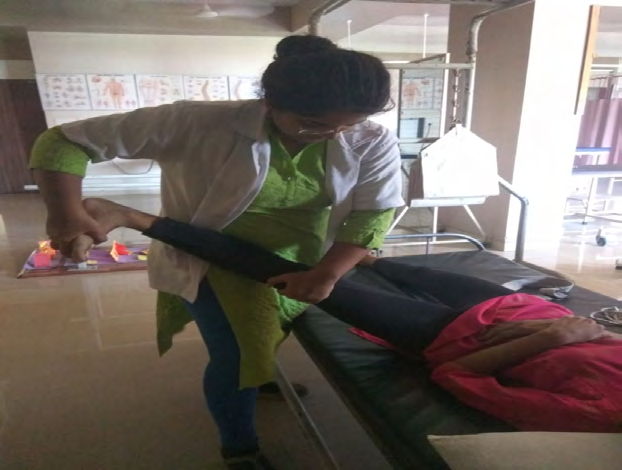
Patient was in supine lying position and therapist was on the affected side of the patient’s leg. Therapist kneeled on the plinth and placed the placed the patient’s leg against therapist’s shoulder. Kept both hands along the anterior side of the thigh and the knee extended position. The opposite leg was stabilized in extension position by towel around the distal end of the thigh and kept in place by the therapist’s knee. Flexed the hip till patient gets stretch under the thigh. This position was hold for 25-30 seconds with 5-6 repetitions (Figure 1).
Modified Spray-Stretching
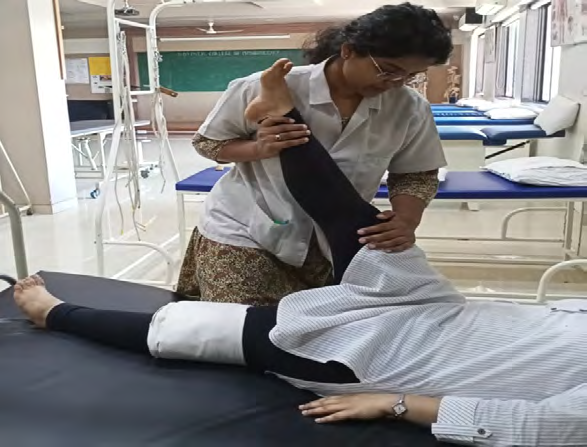
Patient was in supine lying position whereas therapist was on the affected side of the patient’s leg and unaffected leg was stabilized by assistant. Took the hip in flexion with knee extension then hip in abduction till the range permits and hip in external rotation gently overstretch for knee extension at this position. We applied analgesic spray (Omnigel Diciofenac1%, methyl salicilate10%) over the affected tendon in this stretched position. This position was hold for 25-30 seconds with 5-6 repetitions (Figure 2).
Results
The data was entered in excel and was analyzed in a statistical software. The data was presented using descriptive statistics (mean. median, standard deviation).
The amount of change in the Numeric Pain Rating Scale, Sit and reach test, Y-balance test were all evaluated by the paired t test for comparing within the groups and Mann Whitney Rank Sum Test was used to compare the results in between both the groups.
Demographic characteristics of the participants are presented in Table 1.
| Group A | Group B | |
|---|---|---|
| Characteristics | N=15 | N=15 |
| Age(years) | 48.5 | 49.6 |
| Male(n) | 5 | 4 |
| Females(n) | 10 | 11 |
Table 1: Demographic data.
Post interventional values between the groups in Table 2.
| NPRS | Sit and Reach Test | Y-Balance Test | ||||
|---|---|---|---|---|---|---|
| Mean | SD | Mean | SD | Mean | SD | |
| Group A | 4 | 1 | 0.13 | 1.06 | 3.27 | 1.98 |
| Group B | 5 | 1.36 | 1.6 | 0.63 | 4.03 | 4.22 |
| P-value | P<0.05 | P<0.05 | P<0.05 |
Table 2: Post interventional values between the group.
Table 2 explains the mean post treatment NPRS, Sit and reach, Y-balance test value analysis which are strongly significant as confirmed by p<0.005. The result shows there is decrease NPRS and increase in flexibility and balance.
Discussion
Knee pain is a typical condition and is commonly seen in the Osteoarthritis of the knee. Osteoarthritis knee and Pes Anserine pain can co-exist, and in that case, anserine tendinopathy may be the reason for knee pain. A review of the literature shows a scantiness of data on the incidences of this problem in the older population. Pes Anserine syndrome is a clinically analyzed if patient having tenderness over approximately 2 to 3 inches below the knee joint [1, 2, 3, 4, 5].
Uysal F, et al. [2] did ultra sonographic study on the prevalence of Pes Anserine bursitis in denotative knee Osteoarthritis patients the ratio they found is 1:5 that is one of every five Osteoarthritis patients and is mostly common in elder age [6]. Glenn HS, et al. [6] reported that, there is a connection between Pes Anserine syndrome and knee Osteoarthritis. Researcher said there are 20% to 46% of patients with knee arthritis are having Pes Anserine syndrome.
Sarifakioglu B, et al. [1] Physiotherapy has a major role in the treatment of Pes Anserine syndrome, like cryotherapy, anti-inflammatory drugs, avoiding painful activities of daily living, followed by strength eningexercises. Ultrasound has also been reported as useful in reduction of inflammation [1].
Kaynoosh H, et al. [7] did study on the effect of kinesiotaping over the Pes Anserine tendon for the Pes Anserine pain syndrome with Osteoarthritis which shows kinesiotaping shows better result than the naproxen in decrease in pain and swelling on Pes Anserine tendon.
Speed CA, et al. [8] says, Ultrasound induces thermal effects in tissue this thermal effect increases blood flow, reduction in muscle spasm, increased in collagen extensibility which ultimately relives pain. Therefore ultrasound can be used with the stretching to relive pain, muscle spasm and to gain tissue extensibility and optimal tissue length.
Sarifakioglu B, et al. [1] had studies the effect of ultrasound (3 Mz. 1.5 W/cm2, 5 min). The results of study show that corticosteroid injection therapy for Pes Anserine tendon has significant effects similar to physical therapy modalities. Although there is no remarkable effect over conventional methods of physical therapy, corticosteroid injections can be the alternative method of treatment.
Young K, et al. [9] studied that_, by applying_ static stretching technique for shortened hamstring muscles gives effect on muscle extensibility without reducing muscle activity in OA knee.
Peteret JM, et al. [10] has discussed the effect of stretching on the material properties of muscles. He says that peak tension get diminished with repeated stretches. Which ultimately leads to, viascoelastic stress relaxation of the muscle also static stretching reduces the reflex activity of muscles. The study also says there in increase in the plasma beta-endorphine level which increases the pain threshold of the patient. Ultimately there are possibilities that the nociceptive nerve endings in the joints and muscles have the pain gate control. This helps to reduce pain.
David GB, et al. [11] suggested that stiffness of muscle tendon unit assimilate the muscle, tendon and other connective tissue. Among the functions of intrafusal muscle fibers, golgi tendon organs and proprioceptors works to maintain the balance. So his study shows that there is less but does help in improving balance.
Simons, et al. [12] propose the use of vapocoolant spray to improve hip flexion. Vapocoolant spray provides sudden cold and the tactile stimulations, which helps in inhibition of pain the reflex motor and autonomic feedbacks in the central nervous system. As the pain stimuli get diminished muscle relaxation occurs which allows the further lengthening of the muscle.
Kostopoulos D, et al. [13] found that, the findings of the study show the use of aerosol skin refrigerants as a therapeutic technique to gain hip flexion range of motion.
Stretching decreases peak tension in the muscle which leads to viscoelastic stress relaxation of the muscle, but addition of analgesic spray gives additional effect on pain by acting on the pain receptors. Spray provides sudden cold and the tactile stimulations, which helps in inhibition of pain the reflex motor and autonomic feedback in the central nervous system. This helps to increase the flexibility of the tissue.
When there is decrease in pain and improvement in flexibility gives results in improving balance.
Conclusion
When there is decrease in pain and improvement in flexibility gives results in improving balance.
It can be concluded from the above study that both conventional stretching and modified spray stretching proved to be effective on the pain, flexibility and balance in Osteoarthritis knee associated with Pes Anserine pain syndrome But modified spray -stretch technique proved to be more effective than conventional hamstring stretching. Hence Alternative hypothesis is proved.
References
-
Banu S, Afser Sl, Yalbuzdag SA, Ustaömer K, Bayramoğlu M (2016) Comparison of the efficacy of physical therapy and corticosteroid injection in the treatment of Pes Anserine tendino-bursitis. J PhysTher sci 28(7): 1993- 1997.
-
Uysal F, Akbal A, Gökmen F, Adam G, Reşorlu M (2017) Prevalence of Pes Anserine bursitis in symptomatic Osteoarthritis patients: an ultrasonographic prospective study. Clin Rheumatol 34(3): 529-533.
-
Brookler MI, Mongan ES (1973) Anserine bursitis. A treatable cause of knee pain in patients with degenerative arthritis. Calif Med 119: 8-10.
-
Duncan AR (2010) Effects of an acute hamstring stretch in people with and without Osteoarthritis of the knee. Physiotherapy 96(1): 14-21.
-
Forbes JR, Helms CA, Janzen DL (1995) Acute Pes Anserine bursitis: MR imaging. Radiology 194: 525-527.
-
Glenn HS, Daniel CH (2018) Pay Attention to the Pes Anserine in Knee Osteoarthritis. acsm 17(2): 41.
-
Kaynoosh H, Foruzi S, Kalhor F (2016) Effect of kinesiotaping versus non-steroidal anti-inflammatory drugs and physical therapy for treatment of pesanserinustendino-bursitis: A randomized comparative clinical trial. The physician and sportsmedicine 44(3): 252-256.
-
Speed CA (2001) Therapeutic ultrasound in soft tissue lesions. Rheumatology 40: 1331-1336.
-
Lim Y, Nam HC, Jung KS (2014) Effects on Hamstring Muscle Extensibility, Muscle Activity, and Balance of Different Stretching Techniques. J Phys Ther Sci 26: 209- 213.
-
Duncan AR, Peter JM (2010) Effects of an acute hamstring stretch in people with and without osteoarthritis of the knee. Physiotherapy 96: 14-21.
-
David G. B, Andrew B, Farrell C (2004) Effect of acute static stretching on force, balance, reaction time, and movement time JACSM 36(8): 1397-1402.
-
Simons DG, Mense S (2003) Diagnosis and therapy of myofascial trigger points. Shmerz 17 (6): 419-424.
-
Kostopoulos D, Konstantine R (2008) Effect of topical aerosol skin refrigerant (Spray and Stretch technique) on passive and active stretching Journal of Bodywork and Movement Therapies 12(2): 96-104.
- Electrolyte Considerations for Athletes
- Comprehensive Rehabilitation in Adults with Diabetic Peripheral Neuropathy: A Literature Review on Frequency, Intensity, and Duration Parameters
- Exercise Duration and Its Association with ADHD Symptom Severity in Children and Adolescents: A Parent-Reported Survey Study
- Adaptation of the Adult Neurophysiology of Pain Questionnaire for Use in Pediatrics
- A Non-Pharmacological Multidisciplinary Pain Program within a Hospital Wellness Program: A Mixed Methods Study
- The Effect of Frenkel's Exercise with PNF on Functional Reach in Stroke Survivors: A Randomized Control Trial