
Physical Condition, as an Indicator of Well-Being and Quality of Life
One of the most important problems that society has today is raising life expectancy and its quality in the population, as well as mitigating the effects of aging, mainly through natural means. The research is carried out in the Circle of Grandparents: "La flor de Guines", of the Combinado Deportivo "Martires de Quemado" in the Popular Council "La Puya", Quemado de Guines municipality, where there are a total of 105 elderly dispensed in Medical Office 5.5 of the aforementioned council; Quemado de Guines municipality, Villa Clara province. The 15 grandparents of the Circle, who carry out physical activity systematically, possessing osteoporosis, were chosen as a sample. The objective is to verify the status of some indicators of the physical condition of the selected adults, as an indicator of well-being and quality of life. The research was made possible thanks to the use of theoretical and empirical research methods such as documentary analysis, the survey, the interview, the criteria of specialists, the physical condition test. The main results are framed in obtaining the real state indicators such as: flexibility, strength, speed and balance through the applied tests, which allow having a starting point for the design of physical activity based on the decrease of the consequences of osteoporosis and drug use in the population studied.
Introduction
The accelerated increase in the population included in the category of older adults, whose dimensions are worldwide, is a global problem for Organizations such as the World Health Organization (WHO), the United Nations (UN); which implement actions aimed at helping people age with safety and dignity, with active participation in society, with full citizen rights.
The elderly population today offers greater diversity than it had at any other stage in human history. The main differences lie in the economic situation, the social and family framework, health, the personal and professional history of each individual, their past and present relationship with education and culture, and so on.
The aging of the human organism, in addition to constituting a normal and irreversible stage of life, is a complex and varied process that depends not only on biological causes, but also on socioeconomic conditions in which the individual develops as a social being. It is considered a current phenomenon of great significance; it must be approached from the orientation, prevention and intervention.
In Cuba, population aging reaches an important development, since there is a very high percentage of the elderly, of whom are 60 years or older, a figure that is estimated to increase faster in 2025, making it the seventh oldest country on the planet. For these reasons, the country annually spends 2,200.3 million pesos in pensions and 80.9 million pesos to social assistance, despite how severely damaged the economy has been in recent years.
One of the diseases that most cause physical disability in this population sector is osteoporosis; disease present mainly in the adult population, because of it the bones become fragile and more prone to break. Women are four times more likely to develop osteoporosis. Osteoporosis is more common in women age 50 and older because estrogen levels decline with age and a lack of estrogen makes the cells that create new bones less active than the cells that shed aging bones. Consequently, bones wear out faster than they are created.
Research carried out by authors from different countries, such as Arancibia R, et al. [1] and Roman, et al. [2] coincide in stating that the practice of physical activities promotes the improvement of functional capacity and mental health, in addition to create a healthier and more independent lifestyle for the elderly. These studies also corroborate the active aging criterion through the incorporation of physical activities.
In the context of Physical Culture in Cuba, among the investigations considered antecedents of this study, are Mesa J, et al. [3]; Rondon E, et al. [4]. These authors agree in demonstrating in their studies the effectiveness of the systematic practice of physical activity in the health of older adults.
In the Circle of Grandparents: “La flor de Guines”, of the Combinado Deportivo “Mártires de Quemado”, in the Popular Council (CP) La Puya, Quemado de Güines municipality, a large part of the elderly dispensed in the Medical Clinic 5.5, does not attend the practice of physical activity, being in inactivity conditions; among the latter are grandparents with osteoporosis, which is why its consequences are exacerbated.
The aforementioned situation has been verified in practice, and experienced by the author as a teacher of Combined Sports and Physical Education of the Elderly, who tries to resolve the contradiction between the need for physical activity of adults and the lack of adapted physical activities, specifically for those suffering from osteoporosis.
Taking into account the above, the objective of this study is formulated: to diagnose the state of physical condition of older adults with osteoporosis, from the Circle of Grandparents: “La flor de Guines”, from the Combinado Deportivo “Mártires de Quemado” in the Quemado de Güines municipality.
Materials and Methods
In the development of the research, theoretical and empirical methods were used. The analytical and synthetic in the conceptual interpretation of empirical data. The inductive-deductive in the generation of conclusions. Among the empirical methods: observation of subjects during the development of activities. The survey of the elderly to know the psychosocial characteristics. The interview to know your needs and interests for the practice of physical activity. The methodological triangulation and the criteria of specialists. For statistical processing, the frequency distribution.
For the development of this work, the 105 grandparents of the Medical Office were used as population Medical 5.5. A sample of 16 older adults is selected through an intentional non-probabilistic sampling. All women, the average age is 68.9 years. All of them had osteoporosis, with an average of 6.5 years of being incorporated into systematic physical activities. The 15 belong to the Circle of Grandparents “La flor de Guines” of the Combinado Deportivo Mártires de Quemado in the La puya Popular Council, Quemado de Güines municipality. They also include: three (3) teachers of Physical Culture of the Combinado Deportivo, one (1) municipality methodologist.
The intentional selection of the sample obeys the following criteria:
- Having osteoporosis
- Join the group
- Be willing to research
- Protocol for the Elderly Test [5].
Composed of seven tests which represent different physical capacities that are very important for working with older adults; strength, aerobic endurance, flexibility, speed and balance. It is recommended to measure the participant’s height and weight. The tests are samples of activities of daily living. It also allows to identify how many of them have lost independence in these activities. It should begin with the warm-up of the test. With free movements of body expression, for five minutes, then simple stretches lasting ten seconds. Insist that they do not go beyond normal limits.
Test list: (test items)
- 1st Test: Sit and stand from the chair for 30sec: to measure the strength of the lower limbs.
- 2nd Test: Biceps: to measure the strength of the upper limbs.
- 3rd test: Steps in place for 2 min: to measure aerobic endurance.
- 4th test: Seated stretch: to measure the flexibility of the lower body, specifically the muscles of the leg.
- 5th test: Get up and walk: for speed and balance.
- 6th test: Touching the back: for the flexibility of the upper limbs specifically the shoulder, the only thing we will need is a 20cm ruler.
- 7th test: 6 min walk: to measure aerobic endurance
Results and Discussion
As a result of the methodological triangulation, carried out with the methods: observation of the subjects during the development of the activities; the survey of the elderly and their families; the following regularities are synthesized.
An average age of 68.9 years, the average height of 1.69, in the group the HR Max., Is 130 as average; 64 kg of body weight; 23, 6 BMI, and 13.6 PE. All were female, 10 were associated with HT and 6 with visual impairment (Graph 1 & Table 1).
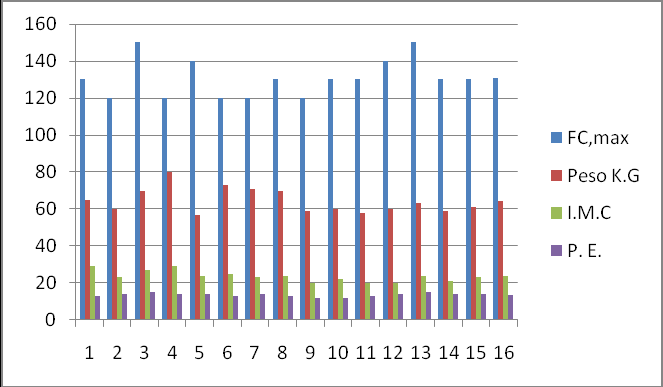
Graph 1: Data of some morpho-functional indicators of the physical condition of adults m Results of the physical condition test of older women.
The measurement presented was carried out in September 2018, the material conditions for the seven tests were guaranteed. Their presence during the measurements was coordinated with the office nurse.
| Test 1 | Test 2 | Test 3 | Test 4 | Test 5 | Test 6 | Test 7 | ||||||||
|---|---|---|---|---|---|---|---|---|---|---|---|---|---|---|
| # | Res. | Ev. | Res. | Ev. | Res. | Ev. | Res. | Ev. | Res. | Ev. | Res. | Ev. | Res. | Ev. |
| 1 | 17 | MB | 23 | MB | 8 | MB | -10 | R | 70 | B | -6 | B | 490 | MB |
| 2 | 16 | B | 20 | MB | 7 | B | -8 | R | 77 | B | -4 | B | 460 | MB |
| 3 | 18 | MB | 22 | MB | 5 | MB | -12 | R | 70 | B | -7 | B | 570 | MB |
| 4 | 13 | B | 18 | MB | 7 | B | -6 | R | 83 | MB | -8 | R | 510 | MB |
| 5 | 18 | MB | 19 | MB | 8 | B | -14 | R | 62 | B | -10 | R | 490 | MB |
| 6 | 20 | MB | 22 | MB | 5 | MB | -14 | R | 92 | MB | -11 | R | 477 | B |
| 7 | 18 | MB | 25 | MB | 6 | MB | -7 | R | 90 | MB | -6 | B | 370 | B |
| 8 | 19 | MB | 18 | MB | 7 | B | 0 | MB | 82 | MB | -10 | R | 590 | MB |
| 9 | 17 | MB | 18 | MB | 8 | B | -9 | R | 80 | B | -12 | R | 540 | MB |
| 10 | 14 | MB | 14 | B | 8 | B | -6 | R | 59 | B | -12 | R | 505 | MB |
| 11 | 10 | B | 17 | MB | 8 | B | -12 | R | 70 | B | -5 | B | 500 | MB |
| 12 | 17 | MB | 23 | MB | 8 | MB | -10 | R | 70 | B | -6 | B | 490 | MB |
| 13 | 16 | B | 20 | MB | 7 | B | -8 | R | 77 | B | -4 | B | 460 | MB |
| 14 | 18 | MB | 22 | MB | 5 | MB | -12 | R | 70 | B | -7 | B | 570 | MB |
| 15 | 15 | MB | 15 | B | 9 | B | -6 | R | 59 | B | -12 | R | 508 | MB |
| 16 | 16 | B | 20 | MB | 7 | B | -8 | R | 77 | B | -4 | B | 460 | MB |
| 16,4 | 19,7 | 7,0 | -8,9 | 74,1 | -8 | 502 |
Table 1: Results of the tests that make up the physical condition test.
Source: self-made. Table 1: Results of the tests that make up the physical condition test.
As can be seen in table # 1, test # 1 referred to sitting and standing from the chair for 30sec; the average number of squats performed by the group was 16.4. Previously, the older adults were instructed by explaining to them that they sit in the middle of the chair, with their legs shoulder-width apart, their hands folded close to their chest, in order to get them to do the most squats in 30 seconds. The teacher initially checked with one of them if they had understood the exercise correctly. They all tried to stand up and sit down, as many times as they could, until the teacher’s signal (30sec). At the end of the test, 9 of the women performed very well, and 7 received the evaluation of good, as they presented some balance problems and performed the least amount of squats, that is, below the group average. From this result it can be intuited that the leg strength of the studied group is susceptible to improvement.
In the case of the results of test # 2 concerning the strength of the upper limbs, a timer and a 5lbs dumbbell were guaranteed; The teacher made sure that they held it with the dominant hand, that they were correctly seated, with the legs at a 90 degree angle, when starting the arm perpendicular to the floor, he indicated to perform the full flexion and extension of the arm, we will perform a slight rotation During the extension and the fist must be in front of the shoulder when flexing, it is important that during the execution the movement is slow. As seen in table # 2, the older women performed an average of 19.7 push-ups. Remaining below this figure, 7 of them reported tiredness and painful sensations at the end.
Test # 3 referred to steps in place for 2 minutes, to measure aerobic resistance, an adhesive tape, a stopwatch, and a tape measure were used. The step height was measured for the test, we placed the adult next to the wall and there it was marked as far as the knee should reach. Begin the exercise with your right leg and will do the most over a two minute period, your knee must reach the mark for this step to be counted as correct. As shown in table # 2, the women performed an average of 7 steps in the indicated time, 8 were below this figure, which was associated with not maintaining the required height, and in three of them they had to restart the test.
As can be seen in test # 4 related to the seated stretch, to measure the flexibility of the lower part of the body in the adults, specifically of the leg muscles, a chair placed next to the wall and a ruler were used at least 20 centimeters. The participant positioned in the front of the chair, with the leg fully extended in front and the foot at a 90 degree angle, the other leg flat on the floor, one hand on top of the other with the middle fingers close together. Start with a forward movement trying to touch the toe as much as possible or pass it if possible. Two measurements were run and the best one was recorded, even so, 14 of them did not reach the tip of their feet, only one reached the tip of their feet and none went over the tip.
In table # 2, the data from test # 5 referred to getting up and walking, to evaluate speed and balance. They began the test sitting on the chair, one foot in front of the other in the form of passing hands on top of the thighs. At the teacher’s signal they get up and walk out as fast as possible, go around the cone and sit down. The time was measured at the starting signal and the stopwatch was stopped when he sat down again, it will be done twice and the best time was recorded. As a result, 7 of the adults were evaluated as fair; they were below the group average: 74. 1; and 8 of them exceeded the figure, so they were evaluated well. When analyzing the purpose of this test, it can be stated that speed and balance in adults behave adequately.
As can be seen in table # 2, test # 6 refers to the flexibility of the upper limbs, specifically the shoulder. A 20cm rule is used for this, the participant must extend the arm up and flex it from the back and slide the fingers down as far as possible and the other hand at the elbow will be flexed behind the back seeking to join fingers or swiping. Try to make two attempts to. To register the best, the goal is to join the fingers, or to pass them. The results of this test reflect limitations in the flexibility of the upper limbs, as none of them surpassed or joined the fingers in either of the two opportunities.
For its part, the result of test # 7 in which aerobic resistance is measured showed how the group obtained an average of 505 yards traveled, only 2 participants remaining below that figure and 13 of them exceeding it. This data reflects a favorable aerobic resistance in the studied adults.
Conclusion
In the adult women studied, the need for improvement in the strength indicator of the lower and upper limbs was verified, as they experienced fatigue and painful sensations in the final stage of the test.
The state of flexibility in the physical condition of the studied older adults was insufficient, both in the lower part of the body and in the shoulder joint, as most of the group did not reach the required amplitude.
The development of aerobic endurance capacity, measured in place for 2 minutes in the women in the study, was insufficient, in relation to that shown in movement for 6 minutes.
The state of speed and balance capacities in older adults behave appropriately, based on the result of the applied test.
References
-
Arencibia R (2016) Nutritional Status and Physical Activity in the Elderly in a Reference Population of the Ciego de Ávila Province, Cuba. Thesis as an option to the Scientific Degree of Doctor in Physical Culture Sciences. Havana, University of the Sciences of Physical Culture and Sports 8(1): 4227.
-
Román R (2005) A gerontagogic didactic modality to meet the educational needs of the elderly in Villa Clara. Thesis as an option to the Scientific Degree of Doctor of Pedagogical Sciences. Villa Clara. Central University “Marta Abreu de Las Villas.
-
Mesa J (2011) Set of activities to meet the educational needs of the elderly with Diabetes Mellitus in the La Palma Popular Council. Optional thesis for the Master’s Degree in Physical Activity in the Community. Villa Clara. University of the Sciences of Physical Culture and Sports.
-
Rondon E (2016) Activities to achieve the incorporation of the elderly to the circles of grandparents in the George Washington Popular Council. Villa Clara. University of the Sciences of Physical Culture and Sports.
-
WHO (2017) Protocol for the Physical Condition Test in the Elderly.
- Electrolyte Considerations for Athletes
- Comprehensive Rehabilitation in Adults with Diabetic Peripheral Neuropathy: A Literature Review on Frequency, Intensity, and Duration Parameters
- Exercise Duration and Its Association with ADHD Symptom Severity in Children and Adolescents: A Parent-Reported Survey Study
- Adaptation of the Adult Neurophysiology of Pain Questionnaire for Use in Pediatrics
- A Non-Pharmacological Multidisciplinary Pain Program within a Hospital Wellness Program: A Mixed Methods Study
- The Effect of Frenkel's Exercise with PNF on Functional Reach in Stroke Survivors: A Randomized Control Trial