
Ethical Objection on COVID-19 Informed Consent in Bangladesh
The recent unethical COVID-19 informed consent in Bangladesh focuses on the weakness of the unethical healthcare system in this country. After 50 years when Bangladesh celebrated its Golden Jubilee of independence, the Corona crisis opened our eyes once again - how weak the countries’ policymaking system is! We try to figure out the ethical gap of the corona vaccines’ informed consent which is used by the government of Bangladesh.
Perspective
After the end of the second world war, the first potential code for ethics was the Nuremberg code where the first principle is about consent. According to the UK article 4(11), the definition of consent is “any freely given, specific, informed and unambiguous indication of the data subject’s wishes by which he or she, by a statement or by a clear affirmative action, signifies agreement to the processing of personal data relating to him or her”[1]. As stated by the WHO “Consent is the principle wherein individuals must give their permission before receiving a medical intervention or procedure” [2]. In 1972 the informed consent came in front as a result of the unethical work of the Tuskegee syphilis study and now it is supported by the jurisdictions and international laws [3]. According to the Cambridge dictionary, informed consent is an “agreement or permission to do something from someone who has been given full information about the possible effects or results” [4]. Appropriate readability is one of the ideal points of informed consent to share and discuss the risk and benefits of the processes [5]. To influence the respondents’ understanding, the subjects’ own level of literacy is also an Perspective important factor here [5].
In Bangladesh corona vaccine informed consent form is not okay. It is questionable. The director of the Institute of Epidemiology Disease Control and Research (IEDCR) agreed upon the error of this informed consent form and proclaimed that we should rectify it soon [6] according to the Daily Prothom-Alo; but after even a couple of months has gone, there has been no change. The prominent policymakers are still in silent mode in this case.
The informed consent that we used now is like a ticket- shaped form (Figure 1) where only five points of agreement have been mentioned in five sentences (Table 1), where there is no Infos related to the vaccine, there is no point to understand for which case a person will sign here [6]. And a big question is - when this informed consent form has a huge mistake, how does the authority explain the pros and cons of the vaccines by following that form? This is an issue of ethics and scientific logic, and the policymakers can’t deny their responsibility for it.
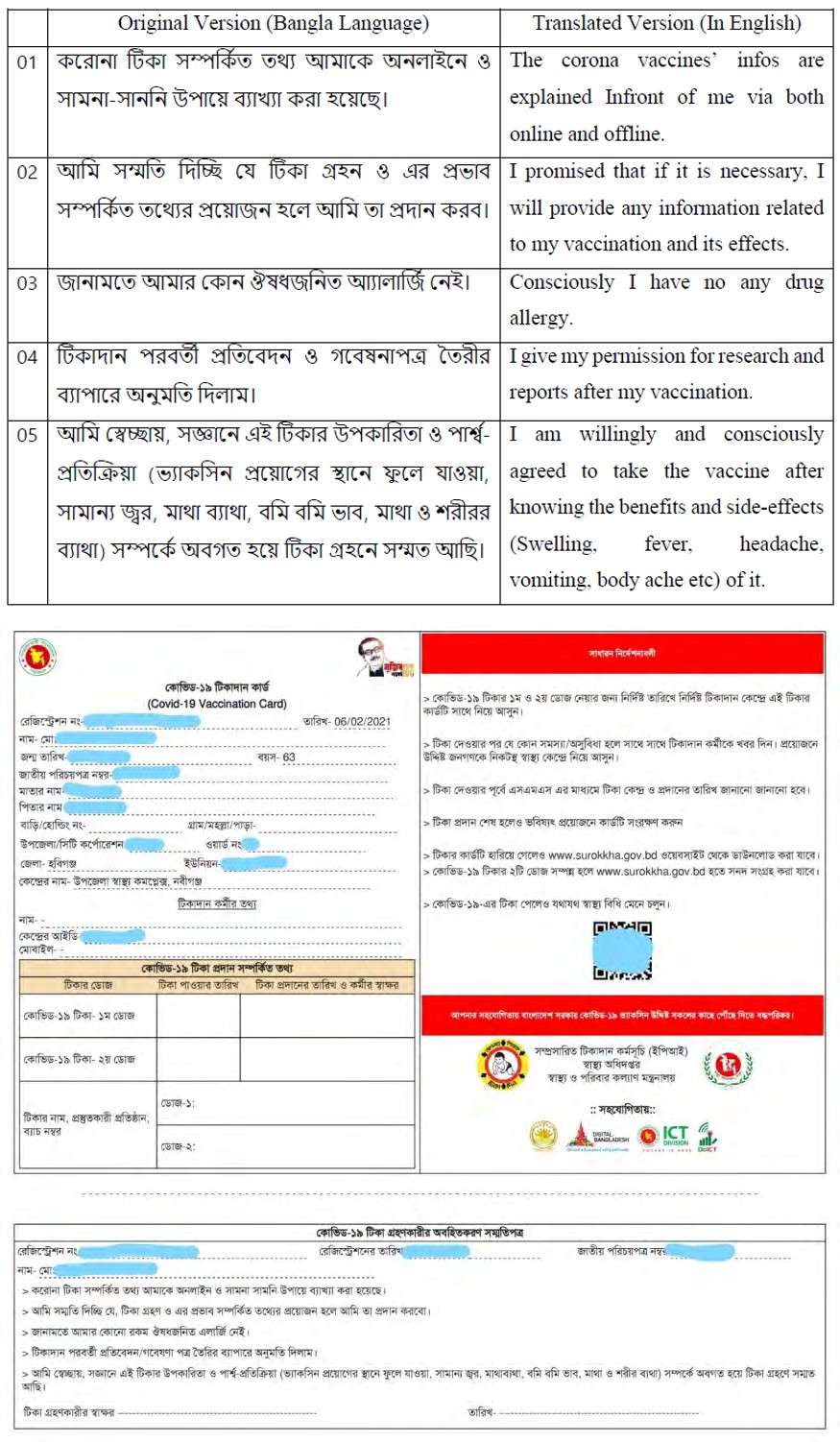
On the other hand, still, there are millions of people who are not able to read and write. And if it is - then how could we say that this informed consent is participant-friendly? The problem is how do illiterate people understand and give their agreement upon the whole concept by reading the corona vaccine informed consent form, which is available in Bangladesh now? Have there any alternatives? In the case of mentally disabled elderly people, how do we claim that this consent would maintain its equal understanding for everyone? On that point videotape explanation, picture presentation or multimedia technology could be the relevant approaches [5]. In India, we noticed they have projected the recording informed consent system by audio and video technology [7], but in Bangladesh, it seems that it is far away to think about.
Informed consent is defined as “voluntary agreement given by a person or a patient’s responsible proxy for participation in a study, immunization program, treatment regimen, invasive procedure, etc., after being informed of the purpose, methods, procedures, benefits and risks” [3] and this consent would be invalid if it is given under fear, misconception, or misrepresentation, or not informed and even if there is no coercion and if they signed, it will be considered invalid [1]. According to the previous Cambridge definition and these statements, it is clear now that the Bangladesh government does not use the informed consent policy to vaccinate the peoples. Even then if the authority forcefully claims that they used it, then the objection is - Why should they (authority/policymaker) not be punished, when they used an unethical informed consent?
The vaccination was started on 27 January 2021 in Bangladesh [8]. On 31st January the country’s prominent newspaper The Daily Prothom-Alo published the feature titled “Countries’ Corona consent is incomplete” in Bengali [6]. But still, after two months later respondents have been signing on to the same paper. Up to the 5th March 2021; 5,539,494 participants get the vaccine [9] by signing on the same form. When the IEDCR director agreed upon the fault, when the newspaper published about its unethical uses and when we stated here the exact points of reasons, how could we call that it is an informed consent form? And if it is the problem, then it is clear that this huge amount of people in Bangladesh are getting their vaccines without their informed consent.
Another objection on informed consent is the procedure of the data reservation system. It is also questionable. According to a feature published in the international magazine Economist in May 2017, the worth of wealth in the world is now not the fuel, but the information [10]. The United Nations Conference on Trade and Development (UNCTAD) stated that, among 194 countries, 128 countries have their Confidentiality and Privacy of Personal Data and information protection act [11]. There is also a legal concern regulated by the Data Protection Act (DPA) and European Union’s General Data Protection Regulation (GDPR) [12]. Now, what are the countries’ (Bangladesh) footsteps regarding this policy? During the biometrical registration initiative in 2015, we had an example to understand this problem. To buy a mobile subscriber identity module (SIM) card, a person gives his personal information with his fingerprint. According to the CID investigation later we see that their data and fingerprint were leaked and used by the criminals for multiple offensive and criminal purposes, which raised the question - “How safe is your biometric data?”[13]. We need to ensure data anonymization and confidentiality for our allocation strategy in COVID-19. Data anonymization is the way to protect privacy and process to sanitize information (the process of removing sensitive information, e.g. - name, phone number, NID no. etc.). How would it be ensured that the respondent’s privacy would be protected? Is it not a risk to de-anonymize the data again by following the direct and indirect identifiers (like - sex, date of birth, age, ethnicity, drug history, and so on)? So, what are the laws and practices surrounding the use of data in this country?
The violation of the principles that occurred by the Nazi’s experiment during world war II and later in the Tuskegee syphilis study, influences us to make the Nuremberg code, the Helsinki Declaration, and the Belmont Report where informed consent was the key concept. If this (COVID-19) informed consent goes invalid, is it not the turn to go back to the bad history again?
References
-
(2021) What is valid consent? ICO.
-
WHO, Considerations regarding consent in vaccinating children and adolescents between 6 and 17 years old.
-
Mamun KT, Mahboob N, Mahmud MAA, Zaman K (2020) Knowledge about informed consent among doctors in postgraduate courses in Bangladesh. IMC J Med Sci 14(1): 26-35.
-
Informed Consent. Cambridge Dictionary.
-
Muir KW, Lee PP (2009) Literacy and Informed Consent. Arch Ophthalmo 127(5): 698-699.
-
(2021) দেশে করোনার টিকার সম্মতিপত্র অসম্পূর্ণ.
-
Bhuyan A (2021) India begins COVID 19 vaccination amid trial allegations. The Lancet 397(10271): 264.
-
(2021) PM to launch Covid 19 vaccination at Dhaka’s Kurmitola General Hospital on Jan 27. The Daily Star.
-
Owid/covid 19 data.
-
(2017) The world’s most valuable resource is no longer oil, but data. The Economist.
-
Data Protection and Privacy Legislation Worldwide.
-
Data protection in the EU. European Commission.
-
(2017) How safe is your biometric data?
- Electrolyte Considerations for Athletes
- Comprehensive Rehabilitation in Adults with Diabetic Peripheral Neuropathy: A Literature Review on Frequency, Intensity, and Duration Parameters
- Exercise Duration and Its Association with ADHD Symptom Severity in Children and Adolescents: A Parent-Reported Survey Study
- Adaptation of the Adult Neurophysiology of Pain Questionnaire for Use in Pediatrics
- A Non-Pharmacological Multidisciplinary Pain Program within a Hospital Wellness Program: A Mixed Methods Study
- The Effect of Frenkel's Exercise with PNF on Functional Reach in Stroke Survivors: A Randomized Control Trial