
Os Trigonum Syndrome A Single Case Study
Background: The Os Trigonum Syndrome refers to pain in the posterior of the ankle and restriction of plantar flexion caused by “the nutcracker-phenomenon”. It can be wedged between the tibia, talus and calcaneus and inflammation of the involved structures. Commonly seen in ballet dancer and runners. Objective: The purpose of this study is to determine the effect of physiotherapy in Os Trigonum syndrome. Setting: Department of Orthopeadic physiotherapy, Saveetha medical college Hospital Chennai in the year of 2019. Patient and an Examination: A 24 year old female ballet dancer came to SMCH with complain of pain and stiffness behind posterior ankle for past 1 month. Swelling was observed at posterior ankle and passive forced plantar flexion test grinds the ossicle between tibia and calcaneus. Plantar flexion range was limited to 30°, pain of 8/10 on numerical pain rating scale. Physiotherapy intervention was given for 4 weeks. Result: The Treatment Program Was Given To This Patient Continuously For 4 Weeks, Pain Was Decreased To 0/10 and there was increase in plantar flexion movement range upto 45º. Conclusion: By application of physiotherapy in Os trigonum syndrome, it was found that pain was decreased and subsequent increase in ankle plantar flexion.
Senthilkumar*1 and sreyans kumar2
Keywords: Os trigonum syndrome.
Introduction
Os trigonum syndrome is a uncommon condition which is relatively painful and it results from compression of a congenital bony anomaly which is known as an Os trigonum. Os trigonum is found at the posterolateral aspect of the talus and nearby soft tissue in the posterior tibiocalcaneal interval [1, 2]. Os trigonum syndrome comes into a broader diagnostic umbrella of posterior ankle impingement syndrome. The term posterior ankle impingement syndrome encircles any condition characterized by posterior ankle pain aggravated with plantar flexion of the ankle [3, 4]. The Os trigonum Syndrome refers to pain at posterior aspect of the ankle and also leads to reduced plantar flexion movement caused by “the nutcracker-phenomenon”. When an Os trigonum is present, this accessory ossicle together with surrounding soft tissues can become wedged between the tibia, talus and calcaneus and this can lead to inflammation of the involved structures [5, 6]. The Os trigonum is usually seen as an individual bone, but can also be present in two or more pieces. It is less than 1cm in size, although small variation can be seen [7, 8]. Mechanisms for the development of an Os trigonum fusion failure are that of an ossification center, fracture of the posterior margin of the tibia and fracture of the posterior process of the talus [9]. The Os trigonum syndrome can be as a result of overuse injury or trauma. When it’s due to overuse, it is mostly seen in ballet dancers and runners. The forceful plantar flexion that happens during an “en pointe” or “demi-pointe” position in ballet dancers while dancing and as well as by running downhill, produces compression on the posterior aspect of the ankle joint. During trauma, the Os trigonum can be displaced by forced plantar flexion [6]. A load-dependent and persistent pain between the Achilles tendon and the peroneal tendons is the primary indicator of Os trigonum syndrome. Stiffness, weakness and swelling can also be present in this region. Another important symptom is decrease in plantar flexion of affected ankle when compared with the unaffected ankle. In some cases, the bony prominence of Os trigonum can be palpated. Eversion or inversion movements can also lead to discomfort. Pain at the posterior aspect of the ankle is experienced by performing plantar flexion of the foot or dorsiflexion of the great toe [7, 9, 10]. The presence of an Os trigonum is a relatively common occurrence in the general population, with an estimated prevalence of 9% to 25% in normal feet and ankles, often observed bilaterally [11, 12, 13]. The presence of an Os trigonum alone is not considered sufficient to produce Posterior ankle impingement syndrome, it is considered an incidental finding. It is the combination of pain in plantar flexion and exposure to repetitive loading in positions of hyper plantar flexion that is believed to contribute to development of Posterior ankle impingement syndrome [14]. The close proximity of the flexor hallucis longus tendon, which passes in the fibrous-osseous tunnel posterior to the medial malleolus and course through groove between the medial and lateral posterior talar tubercles, predisposes this tissue to stenosing tenosynovitis in the presence of an Os trigonum – a common concomitant condition. Due to constant pressure exerted on the Os trigonum by the Flexor hallucis longus tendon, a chronic irritation of the Flexor hallucis longus tendon inside its sheath can result in compression, synovitis, nodules, and partial tearing [1, 2, 15, 16, 17]. Posterior ankle impingement syndrome is well appreciated and described in ballet dancers, gymnasts, soccer players, and runners [3].
Objective of the Study
The purpose of this study is to determine the effect of physiotherapy in Os trigonum syndrome.
Methodology
A 24 year old female ballet dancer came to Saveetha Medical College and Hospital with complain of pain, swelling and stiffness at posterior ankle for past 1 month. She consulted Orthopeadic surgeon and took an X-ray. X- Ray finding showed presence of a small bone behind the talus. Patient came to physiotherapy outpatient department and consulted Orthopeadic physical therapist. On observation; swelling was noted at posterior aspect of ankle. On palpation, Grade 3 tenderness and swelling was present. Numerical pain rating scale was used to measure pain. Patient rated 8/10 on NPRS. Range of motion was examined. Plantar flexion range was painful and limited to 30°. Outcome measures used in this study were numerical pain rating scale and range of motion which were collected at baseline and after 4 weeks of intervention.
Procedure
For physiotherapy program, patient visited the outpatient department for a period of 28 day. The physiotherapy was responsible for administering the rehabilitative protocol and he demonstrated all the exercise and made clinic-based decisions about the progression of exercise. Treatment for day 0 to day 4 included Ultrasound Intensity- 0.8 w/cm2, Frequency of 3MHZ, Duration of 8min. Patient was advice to take rest and apply ice pack over pain region. For day 5 – day 10 treatment includes along with ultrasound, Passive Stretching exercises were given (3 reps, 15 sec hold), Self stretching taught (2 sets, 3 reps), Open kinetic exercise to ankle in all direction (3 sets, 10 reps), Walking for 15 to 20 minutes encouraged. For day 11 – day 15 treatment included Toe rise (10 reps, 2 sets), Unilateral toe rise (10 reps, 2 sets), Theraband exercises (in all 4 motion). For day 16 - day 2-8 treatment included Bipedal isometrics hold with forefoot on steps (10 sec hold, 5 reps, 2 sets), Unipedal isometric hold with forefoot on steps (10 sec hold, 5 rep, 2 sets), Toe rise with forefoot on steps (10 reps, 2 sets), Unilateral toe rise with forefoot on steps (10 reps, 2 sets).
Results
| Intervention | Pain | Range of Motion(Planter Flexion) | |
|---|---|---|---|
| PRE Intervention | 8/10 | 30° | |
| Pain Intervention | 0/10 | 45° |
Table 1: comparison of pain and range of motion in pre- intervention and post-intervention.
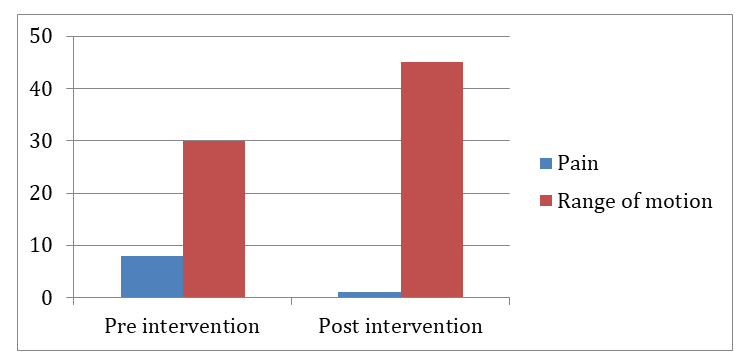
Graphical Representation.
Discussion
Os trigonum syndrome is the result of an overuse injury of the posterior ankle caused by repetitive plantar flexion stress among dancers. Nault ML, Kocher MS, Micheli LJ states that Os trigonum is predominantly seen in ballet dancers and soccer players and is primarily a clinical diagnosis of exaggerated posterior ankle pain This syndrome also occurs by repeated downward pointing of the toes, which is common among ballet dancers. For the person who has an Os trigonum, pointing the toes downward can result in a nutcracker injury [2]. In this study, Results shows decrease in pain and improve in range of motion after physiotherapy intervention. Os trigonum leads to persistent pain behind ankle and also cause reduced plantar flexion. This reduction in movement along with pain provided discomfort to the patient and also reduces the participation of patient in dancing activity. A literature review on conservative treatment of the Posterior ankle impingement syndrome in professional ballet dancers and expert consensus by Soler et al., suggested that initial treatment of the Posterior ankle impingement syndrome should be focused upon reducing inflammation and activity restriction (avoidance of hyper plantar flexion) [19]. After initial treatment, physiotherapy was given which included soft tissue therapy, stretching and mobilizations of restricted joints of the lower kinetic chain should be done in conjunction with a progressive strengthening, balance and Proprioception program [9, 19]. Wredmark T revealed that Thirteen Swedish National classic ballet dancers were non surgically treated for an Os trigonum syndrome. Their main symptom was an impingement pain in the posterior aspect of foot when plantar flexing the ankle during ballet dancing [18]. In this study, Physiotherapy intervention for this patient has proved to reduction of pain and plantar flexion r motion was improved.
References
-
Spencer Bell, Cameron Borody (2018) Symptomatic ostrigonum in national level javelin thrower: a case report. J Can Chiropr Assoc 62(3): 202-210.
-
Nault ML, Kocher MS, Micheli LJ (2014) Ostrigonum syndrome. J Am AcadOrthop Surg 22(9): 545-553.
-
Roche AJ, Calder JD, Lloyd Williams R (2013) Posterior ankle impingement in dancers and athletes. Foot Ankle Clin 18(2): 301-318.
-
Ribbans WJ, Ribbans HA, Cruickshank JA, Wood EV (2015) The management of posterior ankle impingement syndrome in sport: a review. Foot Ankle Surg 21(1): 1-10.
-
Russell JA, Kruse DW, Koutedakis YI, Mcewan IM, Wyon MA (2010) Pathoanatomy of Posterior Ankle Impingement in Ballet Dancers. Clinical Anatomy 23(6): 613-621.
-
Nyska M, Mann G (2002) Unstable Ankle. Leeds: Human Kinetics Publisher S.
-
Zeichen J, Schratt E, BoschU, Thermann H (1999) Os trigonum-syndrom. Unfallchirurg 102: 320-323.
-
D. Karasick D, Schweitzer ME (1996) The Os Trigonum Syndrome: Imaging Features. AJR 166(1): 125-129.
-
Albisetti W, Ometti M, Pascale V, Bartolomeo OD (2008) Clinical Evaluation and Treatment of Posterior Impingement in Dancers. Am J Phys Med Rehabil 88(5): 349-354.
-
Tollafield DR, Merriman LM (1997) Clinical skills in treating the foot. London: Churchill Livingstone.
-
Lawson JP (1985) Symptomatic radiographic variants in extremities. Radiology 157(3): 625-631.
-
Malone TR, Hardaker WT (1990) Rehabilitation of foot and ankle injuries in ballet dancers. J Orthop Sports Phys Ther 11(8): 335-361.
-
Brodsky AE, Khalil MA (1986) Talar compression syndrome. Am J Sports Med 14(6): 472-476.
-
Russo A, Zappia M, Reginelli A, Carfora M, D’Agosto GF, et al. (2013) Ankle impingement: a review of multimodality imaging approach. Musculoskelet Surg 97(Suppl 2): S161-S168.
-
Rungprai C, Tennant JN, Phisitkul P (2015) Disorders of the flexor hallucis longus and os trigonum. Clin Sports Med 34(4): 741-759.
-
Corte Real NM, Moreira RM, Guerra Pinto F (2012) Arthroscopic treatment of tenosynovitis of the flexor hallucis longus tendon. Foot Ankle Int 33(12): 1108- 1112.
-
Uzel M, Cetinus E, Bilgic E, Karaoguz A, Kanber Y (2005) Bilateral os trigonum syndrome associated with bilateral tenosynovitis of the flexor hallucis longus muscle. Foot Ankle Int 26(10): 894-898.
-
Wredmark T, Carlstedt CA, Bauer H, Saartok T (1991) Os trigonum syndrome: a clinical entity in ballet dancers. Foot Ankle 11(6): 404-406.
-
Soler T, Jezerskyte Banfi R, Katsmen L (2011) The conservative treatment of posterior ankle impingement syndrome in professional ballet dancers: a literature review and experts consensus. European School of Physiotherapy.
- Electrolyte Considerations for Athletes
- Comprehensive Rehabilitation in Adults with Diabetic Peripheral Neuropathy: A Literature Review on Frequency, Intensity, and Duration Parameters
- Exercise Duration and Its Association with ADHD Symptom Severity in Children and Adolescents: A Parent-Reported Survey Study
- Adaptation of the Adult Neurophysiology of Pain Questionnaire for Use in Pediatrics
- A Non-Pharmacological Multidisciplinary Pain Program within a Hospital Wellness Program: A Mixed Methods Study
- The Effect of Frenkel's Exercise with PNF on Functional Reach in Stroke Survivors: A Randomized Control Trial