
Reasons for Non-Adherence to Home Physiotherapy in Paediatrics
Background: Success outcome of an intervention not only depends upon the treatment but also on the rate upon which the advised and prescribed exercises are being followed by the patients. Adherence refers to the rate to which the prescribed exercises are followed. This may get affected due to various reasons which may invariably affect the success rates of the applied treatment. Objectives: This study aims to find the reasons for non-adherence to home Physiotherapy in Paediatrics Methodology: It is an observational study done with convenient sampling carried out in Physiotherapy outpatient department. Based on the selection criteria, 30 Children were selected and their parents were asked to fill the questionnaire. Results: The primary reason started for Non-adherence was there isn’t enough time to perform the exercise (n=13; 43.33%). The next commonest reason being said was that it interferes with their social life (n=9; 26.66%). Conclusion: This study concludes that there were various reasons for non-adherence to home physiotherapy in Pediatrics. Among which the most common reasons claimed by the parent’s was insufficient time to perform exercises and it interferes with their social life.
Introduction
Adherence is defined as the extent to which the patients are able to follow the prescribed treatments. Non-adherence to the prescribed exercises may occur due to various reasons such as forgetfulness, laziness or not knowing how to perform the exercise etc. This may ultimately lead to a fall in the success rates of the treatment [1]. Studies suggest that Non-adherence to home physiotherapy exercises in Musculoskeletal problems is 30%- 50% and thus leads to a poor treatment outcome [2]. This is because the effectiveness of a specific physiotherapy intervention not only depends upon the treatment but also upon the rate of adherence from the patient’s side. Noncompliance leads to inappropriate judgment on the efficacy of the provided treatment.
Physiotherapy aims to provide improvement in muscle strength and to increase the joint mobility which requires a significant amount of contributions from the patients for a period of time. Sociological researches say that the patient’s failure to follow prescribed advice may also be due to reasoned decisions on medication taking, depending on their own beliefs and experiences [3]. Adherence to physiotherapy in Paediatrics may get affected more commonly as it involves both the child and their parents. Non-adherence becomes the chief cause for the delay or failure in treatment in Paediatrics long-term conditions. Thus more prone to a delayed progress and hence an alteration in the treatment regimen is needed. Also from previous studies it is evident that the rates for non-adherence among children with long-term conditions are higher than adults [4]. Hence this study aims to find out the reasons for the non-adherence to home physiotherapy in Paediatrics. Also this study helps us to gain knowledge on various factors that influence adherence to exercises and aids in a successful treatment outcome.
Materials and Methods
It is an observational study with convenient sampling. Prior to the study, Departmental ethical committee approval was obtained and then study was initiated. Based on the selection criteria 30 children of both the genders aged up to 16 years attending physiotherapy treatment in outpatient department were selected. Parents of the children were asked to fill the consent form after being clearly explained about the objectives of the study. Later the parents were When your child misses home exercises it is sometime because?
provided with the questionnaire and were asked to fill it.
Results
The data’s were collected and the graphs was obtained using Microsoft excel.
- Reasons for Non-adherence-The main reason being stated for Non-adherence was that there isn’t enough time to perform the exercises (n=13; 43.33%). The second most common reason said was that it interferes with their social life (n=8; 26.66%). No parents claimed the reason that either them or their children simply forgets or neither both can be bothered always or that they give least importance to physiotherapy nor the child finds it embarrassing.
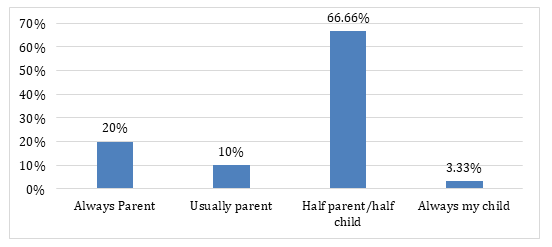
- Models of responsibility- More than half of the parents (n=20; 66.66%) says that it half parents/half child who decides the time to perform the exercises. Also 20 parents says that they are the one who usually performs physiotherapy (66.66%)
- Thought on physiotherapy- About 20 parents (66.66%) expressed that physiotherapy helps in a great deal in their child’s improvement. Whereas the remaining said that it only helps a bit (n=10; 33.33%). None of the parents reported that it does not make any difference or it makes the child worse.
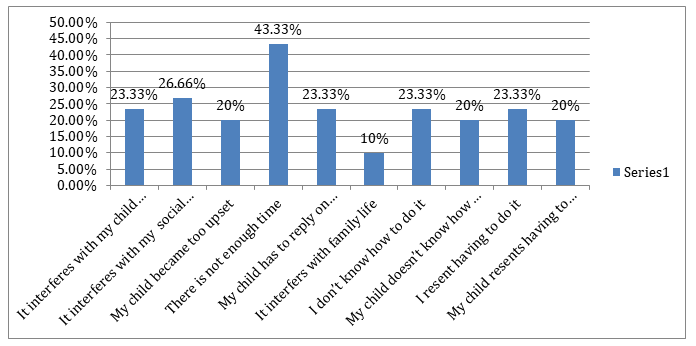
Figure1: Response in Percentage
Who decide when it is time to do exercise?
Discussion
The term Adherence defined as continued observance comes more relevant in modern Physiotherapy. A number of factors were found to have an effect on Patients’ adherence to Physiotherapy home exercises which includes Personal variables, Treatment variables and Patient-Therapist interaction [5].
Research Studies shows that Patients were reported to miss one or two days of their medical treatment mean while 47% reported that they missed Physiotherapy treatment more frequently than other medical regimens. Non-adherence in Pediatric Physiotherapy might result in reduced treatment outcomes, unnecessary changes in the Treatment schedule and delay in the progress of the Therapy [1]. It is known that the range to which Physiotherapy helps in establishing the treatment protocol for the children may play a direct role in raising the level of adherence. However increased awareness and education may be helpful to certainly lower the rates of Non-adherence [6]. Out of the 50 children targeted for study purpose, only 30 children filled the questionnaire based on the selection criteria. Average age group of the children in the study is 7 years (0-16) including 17 boys and 13 girls.
Considering the age group of the children it is not surprising to see that only 3.3% of children decide when to do exercises. Whereas in 66% of study population the exercise is timing is decided by half parent/ half child. 20% of the subjects timing is decided always by the parent. Since Child age was also an important adherence indicator for each advancing year, privacy concern, lack of time, competing priorities all these factors can result in non-adherence [7].
Most parents reported that lack of time was the reason for Non-adherence which could be due to their failure to balance both the social and personal responsibilities. Most parents reported that the exercise regime interferes with their social life and this point adds to the fact of previous reason.
Another reason stating for non-adherence was that the child has to rely on someone for help during exercise. It indicates that it is essential for Physiotherapists to help patients and their families in education, establishment and performance of treatment regimen. This initiation would be helpful in reducing the rates of non-adherence [8]. Parents also stated that either parent or the child resents having to perform the exercise which explains the factor of delay in the progress of the therapy and poor outcome measures. The reason was parents’ resents might be due to depressive symptoms towards their ward health which may have direct influence on adherence. The child becomes too upset may be it has not adhered to home regimen [7].
Majority of the subjects reported that they don’t know how to perform the exercise correctly. The reason includes pain, aggrevating symptoms and lack of adequate feedback to the parents from the Therapists which results in non- adherence [8].
About 60% of the parents expressed that Physiotherapy helps a great deal in their child’s improvement. Whereas 33% believed that it helps only a little bit and none of the parents responded that it does not bring any improvement or makes the condition of the child worse. Parental beliefs of Physiotherapy were found to correlate with parental perceptions of adherence.
About half of the respondents claimed that their child does physiotherapy every day, but not to the agreed number of times which may have direct influence on the treatment outcomes. Also of the 30 participants, 11 respondents reported that the amount of home physiotherapy provided is mere enough. Hence it is essential for both the Therapists and the parents to know about the above mentioned reasons for non-adherence as knowing the extent to which Physiotherapy will have influence on child’s health is not the only factor to be considered.
This study concludes that there are many proven reasons for non-adherence among children receiving home Physiotherapy treatment program. To overcome the non- adherence Physiotherapists must aid in providing education of the condition to their parents especially enlightening the need and importance of the Physiotherapy [9]. Parent’s knowledge and perception of barriers does appear to have a role in promoting adherence [1, 10].
Conclusion
This study concludes that there were various reasons for non-adherence to home Physiotherapy in Pediatrics. Among which the most common reasons claimed by the parent was t insufficient time to perform exercises and also it interferes with their social life.
The limitation of the study is that there were only limited numbers of samples available as only educated parents were considered. And the recommendation of the study is, studies can be done with more sample size to support the reasons stated in our study of paediatric population.
Acknowledgements
The author extends heartfelt gratitude towards all the parents who patiently spent their time to answer all the questions and for extending their support to complete this study.
Conflict of Interest
Nil
References
-
Chappell Faye, Brian Williams (2002) Rates and reasons for non-adherence to home physiotherapy in paediatrics: pilot study. Physiotherapy 88(3): 138-147.
-
Argent R, Daly A, Caulfield B (2018) Patient Involvement With Home-Based Exercise Programs: Can Connected Health Interventions Influence Adherence? JMIR Mhealth Uhealth 6(3): e47.
-
Campbell R, Evans M, Tucker M, Quilty B, Dieppe P, et al. (2001) Why don’t patients do their exercises? Understanding non-compliance with physiotherapy in patients with osteoarthritis of the knee. J Epidemiol Community Health 55(2): 132-138.
-
Santer M, Ring N, Yardley L, Geraghty AW, Wyke S (2014) Treatment non-adherence in pediatric long-term medical conditions: systematic review and synthesis of qualitative studies of caregivers’ views. BMC Pediatr 14: 63.
-
Chan Dmitry, Filiz Can (2010) Patients’ adherence/ compliance to physical therapy home exercises. Fizyoterapi Rehabilitasyon 3 (2010): 132-139.
-
Fielding D, Duff A (1999) Compliance with treatment protocols: interventions for children with chronic illness. Arch Dis Child 80(2): 196-200.
-
Goodfellow NA, Hawwa AF, Reid AJ, Horne R, Shields MD, et al. (2015) Adherence to treatment in children and adolescents with cystic fibrosis: a cross-sectional, multi- method study investigating the influence of beliefs about treatment and parental depressive symptoms. BMC Pulm Med 15: 43.
-
Bassett, Sandra (2012) Measuring Patient Adherence to Physiotherapy.” Journal of Novel Physiotherapies 2(7).
-
Usman, Mahmoud Y, Aisha Abdulmanaf, Muhammad A Abba, Musa Z Kani (2017) Factors affecting adherence to physiotherapy appointments for caregivers of children with cerebral palsy in Kano metropolis. Archives of Physiotherapy & Global Researches 21(2): 13-19.
-
Lillo Navarro C, Montilla Herrador J, Escolar Reina P, Oliveira Sousa SL, Garcia Vidal JA, et al. (2019) Factors Associated with Parents’ Adherence to Different Types of Exercises in Home Programs for Children with Disabilities. J Clin Med 8(4): 456.
- Electrolyte Considerations for Athletes
- Comprehensive Rehabilitation in Adults with Diabetic Peripheral Neuropathy: A Literature Review on Frequency, Intensity, and Duration Parameters
- Exercise Duration and Its Association with ADHD Symptom Severity in Children and Adolescents: A Parent-Reported Survey Study
- Adaptation of the Adult Neurophysiology of Pain Questionnaire for Use in Pediatrics
- A Non-Pharmacological Multidisciplinary Pain Program within a Hospital Wellness Program: A Mixed Methods Study
- The Effect of Frenkel's Exercise with PNF on Functional Reach in Stroke Survivors: A Randomized Control Trial