
Bioequivalence Study of Two Etoricoxib 90 mg Film-Coated Tablet Formulations
The present study was conducted to compare the bioavailability of two etoricoxib 90 mg film-coated tablet formulations (test formulation and reference formulation). This study was an open-label, randomized, single-dose, two-periods, twotreatments, and crossover study which included 24 healthy adult male and female subjects under fasting conditions. Each of the two study periods was separated by a 7 days washout. A single dose of test or reference drug was administered to the subject in each period based on the randomization scheme. Plasma concentrations of the drug were determined by LC-MS/MS method. The pharmacokinetic parameters assessed in this study were the area under the plasma concentration-time curve from time zero to 96 h (AUC0-96h), area under the plasma concentration-time curve from time zero to infinity (AUC0-∞), the peak plasma concentration of the drug (Cmax), time needed to achieve the peak plasma concentration (Tmax), and the elimination half-life (T1/2). The geometric mean ratios (90% CI) of the test drug/reference drug for etoricoxib were 102.39% (97.63% – 107.38%) for AUC0-96h and 93.23% (86.54% – 100.43%) for Cmax. The 90% Confidence Intervals (CI) calculated for AUC0-96h and Cmax of etoricoxib were within the standard bioequivalence range (80.00– 125.00% for AUC0-t and Cmax). It was concluded that the two etoricoxib film-coated tablets (test and reference drug) were bioequivalent in terms of the rate and extent of absorption.
Introduction
Over the past three decades, the global regulatory requirement for bioequivalence of generic pharmaceutical drugs has grown significantly [1]. Studies on bioequivalence are widely acknowledged and play a significant part in the approval and marketing of both new and generic medicinal products [2]. Therefore, in this study, we compared two formulations of etoricoxib film-coated tablets i.e. the reference and test drugs.
Etoricoxib is a potent selective cyclo-oxygenase 2 inhibitor with anti-inflammatory and analgesic properties. The therapeutic indications of etoricoxib in different countries include treatment for osteoarthritis, rheumatoid arthritis, ankylosing spondylitis, acute gouty arthritis, chronic low back pain, acute pain, chronic musculoskeletal pain, and primary dysmenorrhea. Etoricoxib is available at the strengths of 30, 60, 90, and 120 mg [3].
The various doses of etoricoxib are indicated for certain diagnostic conditions. For osteoarthritis, the recommended dose is 60 mg once daily, for rheumatoid arthritis and ankylosing spondylitis is 90 mg once daily, and short-term relief of acute pain is 90 mg or up to 120 mg once daily limited to a maximum of 8 days of treatment, Postoperative dental pain is 90 mg once daily, and for primary dysmenorrhea is 120 mg once daily [4].
Etoricoxib (CAS 202409-33-4) is 5-chloro-2-(6- methylpyridine-3-yl)-3-(4-methylsulfonyl phenyl) pyridine with the empirical formula C18H15ClN2O2S [5]. The molecular weight of Etoricoxib is 358.8 g/mol. The solubility of Etoricoxib in water is 0.0033 g/L in water [6].
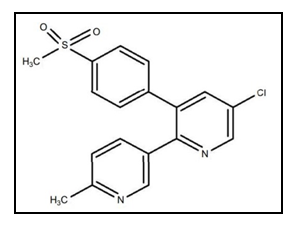
Orally administered etoricoxib is well absorbed. The mean oral bioavailability is approximately 100%. Etoricoxib is approximately 92% bound to human plasma protein over the range of concentrations of 0.05 to 5 mcg/mL. The volume of distribution at steady state (Vdss) is approximately 120 L in humans. Etoricoxib is extensively metabolized with < 1 % of a dose recovered in urine as the parent drug. The major route of metabolism to form the 6’- hydroxymethyl derivative is catalyzed by CYP3A4. Elimination of etoricoxib occurs almost exclusively through metabolism followed by renal excretion [7]. The elimination half-life of etoricoxib 90 mg is approximately 22 hours [8].
This study was conducted to investigate the bioequivalence of Etoricoxib 90 mg film-coated tablet manufactured by PT Otto Pharmaceutical Industries to the reference drug, Etoricoxib 90 mg film-coated tablet, ArcoxiaTM manufactured by Frosst Iberica, S.A., registered and packed by PT Merck Sharp Dohme Pharma Tbk Pasuruan, East Java.
Subjects, Materials, and Methods
Subjects and Study Design
Twenty-four (24) healthy subjects, which consist of twenty-one (21) male subjects and three (3) female subjects, 24-52 years old, and Body Mass Index (BMI) between 18.95 kg/m2 – 25.64 kg/m2 were enrolled in the study. All subjects should pass the screening and selection phase with inclusion and exclusion criteria based on Covid- 19 testing, physical examination, vital signs (blood pressure, pulse/heart rate, respiratory rate, and body temperature), electrocardiogram (ECG), blood biochemistry including glucose, liver function (AP, SGPT, SGOT, and total/direct bilirubin), renal function (serum creatinine and urea), sero-immunology (HBsAg, anti- HCV, and anti-HIV), routine hematology (hemoglobin and leucocyte), blood glucose, and urinalysis (specific gravity, pH, leukocyte esterase, nitrite, albumin, glucose, ketones, urobilinogen, bilirubin, occult blood, tubular and sediment). A pregnancy test (for women) was performed for female subjects in the screening phase and before taking the drug in each period.
This study was an open-label, randomized, single- dose, two-periods, two-treatments, cross-over study in fasting conditions with 7 days washout between each period. The study was performed in accordance with The International Council for Harmonization (ICH) guidelines for Good Clinical Practice (GCP) and the declaration of Helsinki provisions [9, 10]. This study was approved by the Indonesian Food and Drug Regulatory Authority and the Ethics Committee of the Medical Faculty University of Indonesia which was certified by the Forum for Ethical Review Committee in the Asia and Western Pacific Region (FERCAP). Treatment Phase and Blood Sampling Subjects attended PT Biometrik Riset Indonesia a night before drug administration and conducted rapid test antigen for Covid-19 in each period, only the subject with a negative result of Covid-19 was allowed to continue in this study. The subjects were requested to fast from any food and drink except mineral water from 9 p.m. In the next morning (approximately 6 a.m.) of the dosing day, after an overnight fast, a pre-dose blood sample amount of 5 mL was taken one hour before drug administration for each period. The study drug (one film-coated tablet of the test or the reference drug) was given at 7 a.m. with 250 mL of water.
After drug administration, a 5 mL blood samples were taken at 0.25, 0.5, 0.75, 1, 1.5, 2, 3, 4, 6, 8, 12, 18, 24, 36, 48, 72, and 96 hours for each period. Seven days after the first drug administration (washout period), the same procedure was repeated with the alternate drug to complete the crossover design. Plasma was separated from the blood samples by centrifuging at 4000 rpm for 10 minutes in a room with a temperature range of 20 - 30°C and humidity range of 35 - 70%. Samples for analysis were stored at (-20)oC and the retained samples were stored at (-80)oC. The date and the time of drug administration (dosing) and taking of each blood sample (sampling) were recorded in the Case Report Form (CRF) for each subject.
Statistical Analysis
EquivTestPK software was used to perform the statistical analysis of AUC0-96h, AUC0-∞, and Cmax using analysis of variance (ANOVA) after the transformation of the data to their logarithmic (ln) values. Using the error variance (S2) obtained from the ANOVA; the 90% CI with α = 5.00% was calculated from the following equation:
1 1 90%CI=(X -X )±t S ( + ) n n
2 T R 0.1(v) TR RT
- ̅XT, X̅ R: the means of in transformed values for the test drug [T] and the reference drug [R].
- S2: the error variance obtained from the ANOVA.
- nTR, nRT: the number of subjects of sequence TR and RT.
- t0.1: the t-value for 90% CI with α = 5.00%.
- v: the degree of freedom of the error variance from ANOVA.
The anti (ln) of the above confidence intervals (CIs) are the 90% CIs with α = 5.00% of the ratios of the test/ the reference geometric means. The power of the study should be 80% with α = 5.00%. The acceptance criterion of the bioequivalence study is the value of a 90% confidence interval with α = 5.00% of the test/reference geometric means ratio must be in the range of 80.00-125.00% for AUC0-
The differences between drugs (T/R) in Tmax and T1/2 parameters were analyzed nonparametric ally on the original data using Wilcoxon Test.
Assay Methodology and Validation
Prior to the assay of Etoricoxib in the sample, bioanalytical method validation was evaluated for anticoagulant effect (i.e. comparing the effect of CPDA anticoagulant used in blank plasma bought from Indonesian Red Cross for method validation towards anticoagulant used in K3EDTA anticoagulant used in blood collection tube to collect blood samples); selectivity; carry- over effect; calibration curve and Lower Limit of Quantification (LLOQ); precision and accuracy; matrix effect; dilution integrity; and stabilities (i.e. short term stability at room temperature and post- preparative/auto- sampler batch integrity, freeze-thawed stability, also long term stability). An assay of Etoricoxib concentration in plasma was carried out by a fully validated LC-MS/MS with LLOQ 5.00 ng/mL. During the bioanalytical phase of the plasma samples, the analysis was monitored by the quality control process including system suitability test, linearity of a calibration curve, and quality control samples (Low QC, Medium QC, and High QC) referred to requirements described in European Medicinal Agency (EMA) guideline 2011 [14].
Result and Discussion
There were 24 subjects who finished the study, consisting of 21 male and 3 female subjects. There were no adverse events reported in this study. The demographic data of the subjects enrolled in this study are tabulated in Table 1.
| MIN | MAX | |
|---|---|---|
| Age (year) | 24 | 52 |
| BMI (kg/m2) | 18.95 | 25.64 |
| Pulse (bpm) | 60 | 90 |
| Respiratory Rate (x/minute) | 16 | 18 |
| Blood Pressure (mm/Hg) | 101/62 | 130/90 |
Table 1: Demographic Data of the Subject.
Pharmacokinetic Analysis
The blood samples from 24 subjects were analyzed for plasma concentrations of Etoricoxib. Mean plasma concentrations versus time profiles of etoricoxib in human subjects (n = 24) after oral administration of 90 mg etoricoxib film-coated tablet of test drug and reference drug are shown in Figure 2.
![Figure 2: Geometric Means of Plasma Concentration vs. Time Profiles after Dosing of Test Drug [T]:Etoricoxib and Reference Drug [R]: ArcoxiaTM.](/fulltextimages/9160/fig_2.png)
The pharmacokinetic parameters (AUC0-96h, AUC0-∞, Cmax) of the test drug (T) and reference drug (R) were calculated and compared to assess bioequivalence. The calculated 90% CI with α = 5.00% for the geometric mean of individual and the ratios of AUC0-96h and AUC0-∞ as well as Cmax for the test drug: Etoricoxib (BN: 21F6011) and reference drug: ArcoxiaTM (BN: U003194) were all within 80.00 - 125.00% interval. This was in accordance with the standard guideline for bioequivalence study [13]. The main pharmacokinetic parameters drug of study Etoricoxib was obtained from 24 subjects after oral administration of the test drug and the reference drug is shown in Table 2. Meanwhile, the result of Tmax and T1/2 is shown in Table 3.
| Mean (SD) | |||||
|---|---|---|---|---|---|
| Parameter | Test | Reference | Geometric Mean Ratio of T/R (90% CI) | % Intrasubject CV | Statistical Power (%) |
| AUC (ng.h/mL) 0-96h | 34,497.48 (12,409.05) | 33,359.65 (11,295.36) | 102.39% (97.63% – 107.38%) | 9.59% | 100% |
| C (ng/mL) max | 1,816.3 (447.24) | 1,925.97 (404.79) | 93.23% (86.54% – 100.43%) | 15.00% | 100% |
| AUC (ng.h/mL) 0-∞ | 37,346.34 (15,175.45) | 35,528.75 (13,451.49) | 103.73% (98.53% – 109.20%) | 10.34% | 100% |
Table 2: Pharmacokinetic Parameters of Etoricoxib after a Single-Dose Oral Administration of Test & Reference Drug.
| Parameter | Test | Reference |
|---|---|---|
| T (hours) max | 1.50 (0.75 –4.00) | 1.00 (0.50 - 3.00) |
| T (hours) 1/2 | 21.57 ± 7.97 | 19.89 ± 7.22 |
Table 3: The Result of Tmax and T1/2.
Bioanalytical Result
Result of applying the bioanalytical method validation of the bioequivalence study of Etoricoxib (BN: 21F6011) manufactured by PT Otto Pharmaceutical Industries in twenty-four (24) healthy subjects were all calibration curves of the subject showed good linearity within the range of 5-5000 ng/mL with the coefficient of correlation (R2) ≥ 0.9900. For accuracy and precision of three levels (low, medium and high) of concentration QC samples and LLOQ were provided in Table 4.
| QC | LLOQ | |||
|---|---|---|---|---|
| Low | Medium | High | ||
| Concentration (ng/mL) | 15.06 | 2,509.98 | 3,764.97 | 4.99 |
| Precision (% CV) | 9.93% | 7.82% | 7.57% | 0.58% |
| Accuracy (% deviation) | 0.20% | 5.71% | 7.13% | 0.99% |
Table 4: Accuracy and Precision.
After all study phases are completed, remaining samples and data management should be maintained. The rest of the plasma samples analysis was destroyed following the stability long-term validated method, while retain samples were destroyed for at least 1 (one) year after the final reports had been sent to the Sponsor.
A copy of CRF and all source data were retained in the investigator’s files. Other copies were given to the Sponsor as needed. Copies of all pertinent information including raw data of bioanalysis were retained by the Responsible Investigator until the study drug is destroyed. Additional consideration was made about complying with applicable local laws, guidelines, etc. Study document binders were provided for all required study documents.
Conclusion
Based on pharmacokinetics and results of this study, it is concluded that the test drug Etoricoxib (BN: 21F6011) manufactured by PT Otto Pharmaceutical Industries has a similar pharmacokinetic profile in terms of both rate and extent of absorption with the reference drug ArcoxiaTM (BN: U003194) manufactured by Frosst Iberica, S.A., registered and packed by PT Merck Sharp Dohme Pharma Tbk Pasuruan, East Java with geometric mean ratio and 90% confidence interval for AUC0-96 and Cmax parameters were 102.39% (97.63% – 107.38%) and 93.23% (86.54% –100.43%) respectively (requirement 80.00 – 125.00% for AUC0-t and Cmax) and the intra-subject coefficient of variation is 9.59% and 15.00%. Therefore, it can be concluded that the two formulations of etoricoxib are pharmacokinetically equivalent and interchangeable.
References
-
Tjandrawinata RR, Setiawati A, Nofiarny D, Susanto LW, Setiawati E (2018) Pharmacokinetic Equivalence Study of Nonsteroidal Anti-Inflammatory Drug Etoricoxib. Clinical Pharmacology: Advances and Applications 10: 43-51.
-
Miao L, Mousa YM, Zhao L, Raines K, Seo P, et al. (2020) Using A Physiologically Based Pharmacokinetic Absorption Model to Establish Dissolution Bioequivalence Safe Space For Oseltamivir In Adult And Pediatric Populations. The AAPS Journal 22(5): 1-10.
-
Medina-Nolasco AG, Ortiz-Campos KL, Lopez-Bojorquez E, Arellano-Ibañez MA, Burke- Fraga V, et al (2018). Bioequivalence of Two Oral Formulations of Etoricoxib 60 Mg Tablets in Healthy Mexican Adults. Am J Bioavailab Bioequiv 1: 10-14.
-
Lambert L (2022) Etoricoxib. South African Pharmaceutical Journal 89(3): 35-38.
-
(2020) Compound Summary, Etoricoxib. PubChem.
-
Etoricoxib Human Metabolome Data Base (2020) Showing Metabocard for Etoricoxib (HMDB0015565).
-
(2019) Arcoxia: Australian Product Information. Merck Sharp & Dohme Pharma Corporation, pp: 1-27.
-
Drescher MJ, Wimpfheimer Z, Abu Khalef S, Gammaitoni A, Shehadeh N, et al. (2012) Prophylactic Etoricoxib Is Effective In Preventing “First of Ramadan” Headache: A Placebo‐Controlled Double‐ Blind and Randomized Trial Of Prophylactic Etoricoxib for Ritual Fasting Headache. Headache: The Journal of Head and Face Pain 52(4): 573-581.
-
(2015) Guidelines for Good Clinical Practices. Indonesian Food & Drug Regulatory Authority (BPOM RI).
-
Williams JR (2008) The Declaration of Helsinki and public health. Bull World Health Organ 86(8): 650-652.
-
(2015) Bioequivalence Study Guidelines. Indonesian Food & Drug Regulatory Authority (BPOM RI).
-
(2015) ASEAN Guidelines for the Conduct of Bioequivalence Studies, pp: 1-27.
-
(2010) Guideline on the Investigation of Bioequivalence. European Medicines Agency.
-
(2011) Guideline on Bioanalytical Method Validation. European Medicines Agency.
- Effects of 5-HTP and Melatonin on the Sleep Cycle of Medical Students
- Adsorption of Bisphenol A on NH4OH- Modified Rice Husk and Sugar Cane Bagasse Biochar
- Comparative Assessment of the Reinforcement Efficiency of Palm Fruit Fibre and Coconut Fibre in High Density Polyethylene (HDPE) Matrix Composite
- Importance of Bio Compounds Naturally Present in Food with Functionality in Animal Metabolism
- Sub-Acute Study on the Cardiotoxic Effects of Monosodium Glutamate Ingestion in Albino Rat
- Weight Management and Its Natural Solutions: A Review