
Number of Contiguous Amino Acids in Nanon of 16A Diameter
Introduction
According to nature of interactions there are quite a few workouts that seemed good in understanding biomolecules. Recently it has been reported that carbon alone dealing with internals of biomolecules in general [1, 2, 3, 4, 5]. Having said that it is mandatory to validate and assess all other factors which are associated with basic carbon force. Dealing so it is said that a diameter of 16Å is determining factor in rounding up a carbon value which will equal to 0.3144 [6, 7, 8, 9, 10, 11, 12, 13, 14, 15]. When adopt to this value one would say domain follows [5]. Otherwise call it as non-carbon optimized domain (non COD) where other interacting elements can interfere in its activity which are buried inside mostly. Elements which are good in neighboring residue altogether call it as active for available interaction specifically [1]. In this way one understands the organizations of amino acids in proteins for revealing interactive elements and domain one. One would wonder what will be the extent by which the linear chain of amino acids cooperate carbon value with in the diameter of 16Å. This is taken up here for understanding how long and probable stretch that accommodate within this diameter value. Accordingly it is to be tested for alteration is required and so forth. Given the scenario one can be analyzed for all available proteins. One has to understand that the amino acids are varying in different species. Accordingly analyzed are selected few in example and available in this paper is one. Carbon factor of available interacting elements are captured and revealed here.
Calculations
The number of contiguous amino acids in nanon of diameter 16Å is computed for protein super oxide dismutase. The ID is 1DSW. It is a monomeric protein having 153 amino acids in it. The Card-3D program has been modified for specific calculation of this number of contiguous amino acid which may be domain or non-domain. All elements are considered in evaluation of adjacent amino acids
Results and Discussion
involvement in domain and non-domain. Accordingly it is analyzed for contiguous amino acids for each atom of amino acids with dia of 16Å. Based on the number of amino acids it is grouped. That is to say how many atoms having one amino acid in the dia or in two, three, four, five, six and so forth. These obtained numbers in each group of category is understandably reported by making graph and so forth.
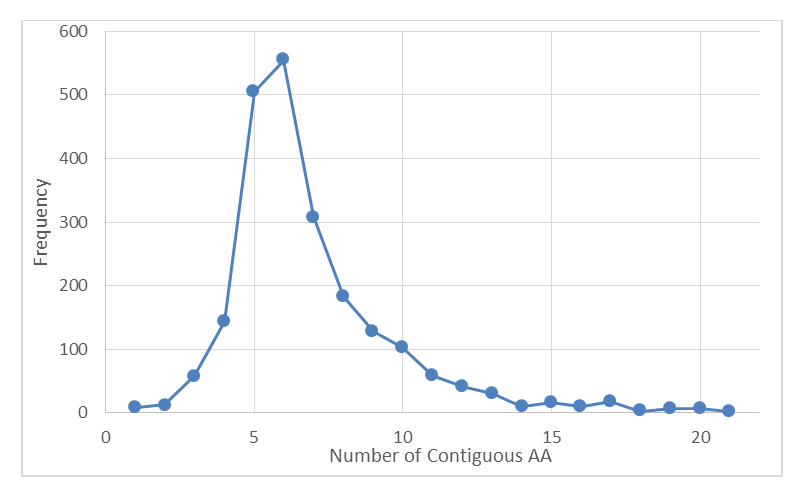
The plot of number of contiguous amino acids versus frequency of appearance is shown in figure1. From this it is reported that the value of 5 is probable one. It appears that 5.5 is actual. Given this probable value of 5 amino acids in 16Å understanding can be done accordingly. Otherwise the length goes above 22 amino acids. Understandably it is maximum in domain regions where as it is lower in non-COD regions. One can go on analyzing this number of amino acids in dia of 16Å for probable domain and non-COD.
The probable number of amino acids in domain and non- COD are maximum in 5, 6 and 7. Otherwise it is less important in other higher number of contiguous amino acids. Over and above one may analyze higher end for mutual cooperation among amino acids of adjoining portions. The lower numbers may be fit to water borne amino acid side chains. One can draw inferences from these numbers of amino acids involved in domain and so forth.
The probable 5 leads to assess the adjoining amino acids involvement in stability factor 9 where 5th amino acid may have adjoining 2 amino acids. So totally 9 amino acids be part of this 5 contiguous amino acid. That is contiguous 9 amino acids are in important in understanding 5 amino acid length. A group of nine 9 may have adjoining 9 amino acids that is taken here as pattern of 27 amino acids. Having this fractional value of 5.5 may lead to overall factor of 10 to be considered. At any cost it breaks off at 11. One can understand that any amino acids are taken the adjoining 5 amino acids are important in assessment of its stability factor. Otherwise it’s going to be useless in analysis and all.
Pattern can be look upon based on adjoining amino acids. Pattern of carbon value focus may be useful in understanding of mutational one and all. Very many patterns are altered in proteins of disordered one. One can go and check these numbers for any alteration that may give solution for human diseases and all. Predominantly protein prefers to have this significant number of carbon score that require to be altered for significant applications. Meanwhile alteration can be done based on domain values but require analysis of 3D structure. Otherwise it’s going to be easier here in adjoining one from carbon factor of contiguous one.
Conclusion
The carbon factor protein value has been evaluated in terms of contiguous amino acids length. It is observed to be 5. Otherwise going to be stretch length of 10 is important in local stability. Otherwise going to be amino acid lengths 5 or 9 are crucial in determining stability of local structure. There are wide applications expected to be coming out from this crucial value of pattern length. Patterns are crucial in mutational study leading to stability and all. Pattern of carbon value are crucial in dealing all applications leading to protein stability, function and all. Factors such as protein binding and protein folding are determined from this number of carbon value which can be assessed from neighboring amino acid factor of assessment.
References
-
Rajasekaran E (2021) Nanone interactions in antibody of living systems. Modern Health Science 4(2): 1-5.
-
Rajasekaran E (2021) Inter carbon distance from nearest atom reveal presence of various functional units in proteins. Bioinform Proteom Opn Acc J 5(1): 000144.
-
Devprakash R, Akila K, Senthil R, Indupriya R, Meenal R, et al. (2021) Distribution statistics on carbon value points out good and bad portions of proteins: A viral sample in study. Challenges in disease and health research 6: 1-6.
-
Rajasekaran E, Indupriya R (2020) Nano level force in protein plays applications of maximum untold understanding of life form. Recent developments in engineering research. Book publisher international 1: 106-112.
-
Rajasekaran E (2018) Domains based in carbon dictate here the possible arrangement of all chemistry for biology. Int J Mol Biol-Open Access 3(5): 240-243.
-
Rajasekaran E, Akila K, Vijayasarathy M, Vinobha CS, Senthil R, et al. (2014) CARd-3D: Carbon distribution in 3D structure program for globular proteins. Bioinformation 10(3): 138-143.
-
Rajasekaran E (2013) Scale for nature of hydrophobic interactions in proteins. J Proteomics Bioinform 6(7): 31.
-
Rajasekaran E (2013) Carbon distribution in protein structure might influence thermo stability of modified form. J Adv Biotech 12(9): 9-10.
-
Rajasekaran E (2012) CARd: Carbon distribution analysis program for protein sequences. Bioinformation 8(11): 508-512.
-
Akila K, John SN, Rajasekaran E (2012) Study on carbon distribution at protein regions of disorder. International Journal of Bioscience, Biochemistry and Bioinformatics 2(2): 68-70.
-
Akila K, Rajendran K, Rajasekaran E (2012) Carbon distribution to toxic effect of toxin proteins. Bioinformation 8(15): 720-721.
-
Rajasekaran E, John SN, Vennila J (2012) Carbon distribution in protein local structure direct superoxide dismutase to disease way. Journal of Proteins and Proteomics 3(2): 99-104.
-
Akila K, Balamurugan P, Rajasekaran E (2012) The nature of proteins in Influenza. Health 4(10): 991-994.
-
Rajasekaran E, Akila K, Vijayasarathy M (2011) Allotment of carbon is responsible for disorders in proteins. Bioinformation 6(8): 291-292.
-
Rajasekaran E, Vijayasarathy M, Senthil R, Veerasamy J, Rajendran G (2009) Pattern recognition in proteins based on carbon content. Journal of Computational Intelligence in Bioinformatics 2(2): 99-102.
- Carbon Code for Analysis of Protein Stability in Protein Mutation
- Identification of Hub Genes and Pathways in Cervical Cancer by Statistical and Bioinformatics Analysis
- Effect of Dietary Inclusion Levels of Moringa Olerifera Oil on the Growth Performance and Nutrient Retention of Broiler Starter Chicks
- Proteomics Loans in Kinetoplastids during the Last Decade
- “Identification of SARS-CoV-2 in Human Genome based on Protein Dynamics Conversion and Target Genes Marking via Bioinformatics Approaches”
- Loud Noises Lead to Dementia