
Carbon Code for Analysis of Protein Stability in Protein Mutation
Carbon mode analysis can be of great use in determining protein stability in the vicinity of protein mutation where carbons alone determine to be involved in mutational part. Varying parameter of interest are determined from this variable analysis where and all code of carbon force determine the mutational one. Varying values of parameter in crucial in determining the fact of carbon mode analysis in mutational one where and all value varies significantly with variable value of carbon mode analysis where values actual in determined parameter alone. Very few instances of parameter changes where variation can included in the calculation. Varying parameter is determined to be of useful in denaturation and all. Very well accord with verifiable value of experimental one reported in the literature. Values are accurate in determining variable value of mutation in protein site of interest where stability is factor of interest in determination. Very well accord with experimental values reported by various method and analysis. Good in terms of carbon mode analysis in determining mutational part for stability and all. One would go for futuristic applications involving carbon mode analysis in determining mutational one leading to vaccine one and stability one.
Background
Important found from carbon analysis is that carbon force of interaction can be of one of the most fundamental concept arising these days [1, 2, 3, 4]. One of main focus of the carbon value is active one where carbon form collapsed carbon at the centre and stabilised at higher order of contribution coming from neighbouring amino acids [5, 6, 7]. Given that the active one where and all carbon alone is responsible for activity, it is also proven that stability comes from carbon factor of arrangements in carbon molecules including proteins [8, 9, 10, 11, 12]. Very many carbon force analysis were conducted in previous years [10, 11, 12, 13]. Given the scenario what could be the deciding force of attraction the vicinity of alternative protein. Based on the previous analysis where and all carbon force of interaction decides binding and internal structure [5, 7, 12, 13], it is extended here to see the role of carbon on mutational one where internal arrangements can be crucial one in deciding stability of the mutated one where a new force of attraction leads to internal force different that may stabilise or destabilise. Initial calculations and all carried out with very many amino acids changes in different proteins [9, 14, 15, 16]. All in support of the existence of carbon force of interaction in these carbon based molecules. Here an amino acid mutation that stabilises and destabilise a given protein is taken for demonstration. To do the task of mutational value finding an enzymatic protein is taken here.
Methodology
RNA Polymerase Sequence Taken for Carbon Analysis is Shown Below.
MNTINIAKNDFSDIELAAIPFNTLADHYGERLAREQLALEH- ESYEMGEARFRKMFERQLKAGEVADNAAAKPLITTLLPKMI- ARINDWFEEVKAKRGKRPTAFQFLQEIKPEAVAYITIKTTLA- CLTSADNTTVQAVASAIGRAIEDEARFGRIRDLEAKHFKKNVE- EQLNKRVGHVYKKAFMQVVEADMLSKGLLGGEAWSSWH- KEDSIHVGVRCIEMLIESTGMVSLHRQNAGVVGQDSETIE- LAPEYAEAIATRAGALAGISPMFQPCVVPPKPWTGITGGGY- WANGRRPLALVRTHSKKALMRYEDVYMPEVYKAINIAQN- TAWKINKKVLAVANVITKWKHCPVEDIPAIEREELPMKPED- IDMNPEALTAWKRAAAAVYRKDKARKSRRISLEFMLEQANK- FANHKAIWFPYNMDWRGRVYAVSMFNPQGNDMTKGLLT- LAKGKPIGKEGYYWLKIHGANCAGVDKVPFPERIKFIEENHEN- IMACAKSPLENTWWAEQDSPFCFLAFCFEYAGVQHHGLSYNC- SLPLAFDGSCSGIQHFSAMLRDEVGGRAVNLLPSETVQDIY- GIVAKKVNEILQADAINGTDNEVVTVTDENTGEISEKVKLGT- KALAGQWLAYGVTRSVTKRSVMTLAYGSKEFGFRQQVLED- TIQPAIDSGKGLMFTQPNQAAGYMAKLIWESVSVTVVAA- VEAMNWLKSAAKLLAAEVKDKKTGEILRKRCAVHWVTPDG- FPVWQEYKKPIQTRLNLMFLGQFRLQPTINTNKDSEIDAH- KQESGIAPNFVHSQDGSHLRKTVVWAHEKYGIESFALIHDS- FGTIPADAANLFKAVRETMVDTYESCDVLADFYDQFADQL- HESQLDKMPALPAKGNLNLRDILESDFAFA The amino acids (S430 and H772) marked in colour are taken for mutational study where carbon force of interaction comes from intervening amino acids of neighbour one. It is considered that 3 amino acids may be opting for lowest one for distribution values. Highest may be up to 45 window lengths. Homemade program derived from CARd [17] is taken here for any other substitution is considered whereas for mutational value in the middle of sequence is taken up here in windows where window means amino acid count in to atomic one which means one amino acid counted to 15.55 atoms equally. On obtaining the result from CARd one it is tested with experimental values which is given in Table 1.
T7 RNAP clones with suppressor mutations: activity and stability data Variant Amino Acid substitution Codon substitution Specific activity (kU/mg) Relative activity (%) Ti1/2 10 min (8ºC) ΔTi1/2 (8ºC) WT 430 100 43.5 s1 K392M AAG!ATG 30 7 45 1.5 s2 S430P TCA!CCA 170 40 44.5 1 s3 C510R TGC!CGC 62 14 44.5 1 s4 S633P TCA!CCA 239 56 44.5 1 s5 K713E AAG!GAG 110 26 44 0.5 s6r Q744R CAG!CGG 589 137 43.5 0 s7 S767G AGC!GGC 230 53 44 0.5 s8 H772R CAC!CGC 300 70 43 -0.5 s9 Q786L CAA!CTA 96 22 46.5 3 s10 F849I TTC!ATC 380 88 45 1.5 s11 F880Y TTC!TAC 160 37 44.5 1
- Stabilizing mutations previously described are shown in italics.
Table 1: Mutational stability values are shown here, taken on [16]. Note that mutation S430P is stabilising while H772R is not.
Results and Discussion
Carbon code of operation exist in protein is counted by CARd analysis one in this calculations. Very few incidences are found to be unobvious in this way of finding alteration in amino acid positions. Over and above very well expressed in graphical and end result. Graphically one would go with decision of alteration meeting the stability or not. One may go alternative way of finding stability in terms of carbon mode of operation in the vicinity. Very well represented are the carbon path breaking results of carbon mode analysis in terms of overall mode of operation in terms of carbon value and distribution factor of carbon collapse where and all counted as standard deviation statistically. Very few incidences are found to be intriguing in test results where acceptance based on carbon mode distribution rather than its value where carbon force of interactions varies. Sample mode analysis shown below for a RNA polymerase one where alteration alters stability of protein internally. Accordingly it is known that S430P (Figures 1 & 2) stabilise the local one and H772R (Figures 3 & 4) destabilise other way around. Below one depict the variation on carbon value and also the carbon distribution factor value. Various parameter and all discussed in code of contact in CARd one. Varying parameters are used to mitigate the inappropriate results obtainable from carbon mode of analysis. Varying values may appropriate to determine the fact of carbon one and all. All these are standardised in this one to determine the stability factor in sequence one. Varying parameters are crucial one to determine the fact of alignment in dealing with varying fact of all atom analysis in carbon one fact.
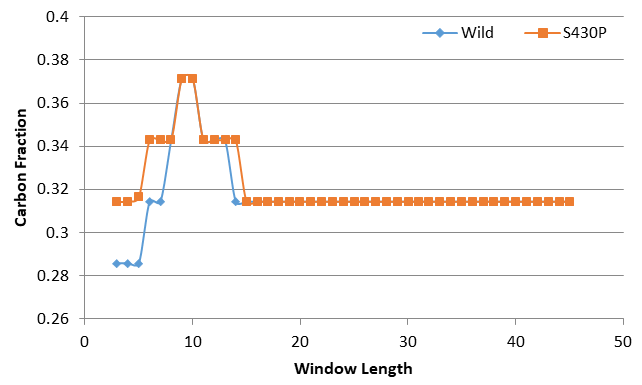
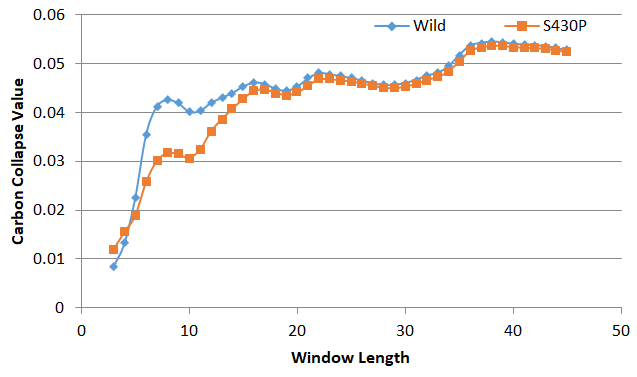
Carbon point of view there is no change in optimum line in mutation of S430 with P. However the distribution values are reduced which is considered to be stable.
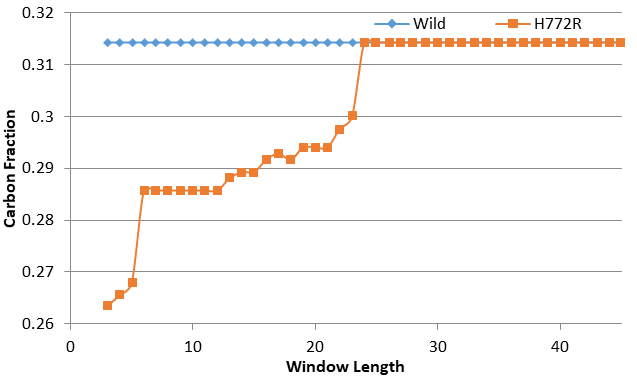
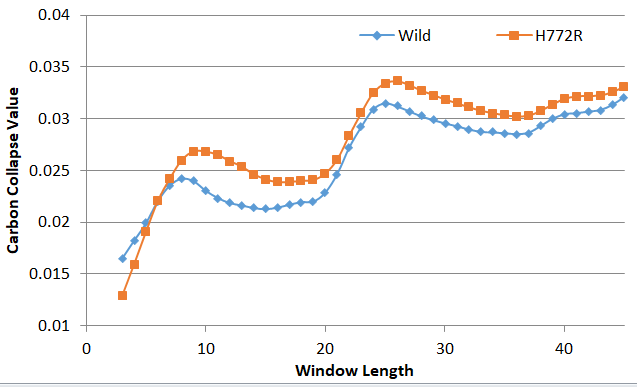
Both carbon value and distribution protocol are unfavourable in terms of carbon force of interaction in this mutational site H772 where alteration with amino acid R replaces domain with hydrophilic nature. Accordingly in carbon mode alteration all atoms taken into account including hydrogen counts to be 50% in total. Alteration accounts for carbon mode possibilities. Otherwise all atoms are arranged in total with cobweb form nest like structure with the protein 3D structure. According to alteration all atoms are counted but arrangements are equivalent to elemental value coming out to be 0.3144 for carbon. Any alteration accounted in this way in such way that carbon meets out equivalently to substitute in any way for engineered protein one. All and all considered to be equivalent in terms of carbon force of attraction in the vicinity of intended amino acid position equivalent in carbon mode analysis where varying degree of other atoms which are factually ignored in this calculation. Very few incidents of covalent one interfering in the cobweb structure where one neighbour could not come close to one another. Whereas it is in mode operation in vicinity of flexible one where cobweb formation easily favourable very much. The results on other mutations are not discussed here. Otherwise the melting temperature seems to be better in terms of stability is concerned which are reproducible in terms of carbon one.
Conclusion
Carbon mode analysis leading to vicinity alteration is evaluated in this work of carbon based mutational one. It is understood that carbon mode of operation alone is determined to be of great use one and all. Otherwise going to be in operational in any other mode of calculations involving merely bond and non-bonded interactions. Equivalent in way of doing this calculation in mutagenesis one can be operation in this point of view. One should go with carbon force of interaction internally in the vicinity or externally. Interesting to note that carbon based mutation can be very much useful in vaccine generation, validation of proteome mutation and all.
References
-
Rajasekaran E, Indupriya R, Meenal R,Devprakash R (2022) Number of contiguous amino acids in nanon of 16Å diameter. Bioinform Proteom Opn Acc J 6(1): 1-3.
-
Rajasekaran E, Indupriya R, Devprakash R, Meenal R (2022) Computation of amazing network of carbon internal that reveal the fact of mutational changes in evolution of protein nature. Marvels of artificial and computational intelligence in life sciences.
-
Rajasekaran E, Indupriya R (2022) Carbon rule of law that determines to be the one in genome based remedy: Viral one under study Current Practice in Medical Science. Current Practice in Medical Science 10: 37-45.
-
Rajasekaran E (2021) Inter carbon distance from nearest atom reveal presence of various functional units in proteins. Bioinform Proteom Opn Acc J 5(1): 1-4.
-
Rajasekaran E, kambaram J (2022) Protein alteration accordance to the carbon interactions internally. Cell Science & Therapy 13(5).
-
Rajasekaran E (2021) Nanone interactions in antibody of living systems. Modern health science 4 (2): 1-5.
-
Rajasekaran E, Indupriya R, Meenal R (2019) Domain formation in regions of protein probe interaction. Int J Mol Biol Open Access 4(5): 167-169.
-
Indupriya R, Devprakash R, Rajasekaran E (2021) Mutated protein’s stability accordance to carbon force of interaction. British J Med and Health Sci 3(6): 977-980.
-
Rajasekaran E (2013) Carbon distribution in protein structure might influences thermostability of modified form. J Adv Biotech 12(9): 9.
-
Rajasekaran E, Indupriya R (2020)Nano level force in protein plays applications of maximum untold understanding of life form. Recent developments in engineering research Book publisher international 1: 106-112.
-
Rajasekaran E, Meenal R, Prawin MA, Indupriya R (2019) Existence of nano level force in protein plays applications of maximum untold understanding of life form. Int J Eng Adv Tech 9(2): 3722-3726.
-
Rajasekaran E, Kavitha V, Ganeshbabu P, Prabakaran R, Meenal R, et al. (2019) Nature of amino acid sequence instruct carbon value to be adopted in protein 3D structure. IEEE Access, pp: 1054-1060.
-
Rajasekaran E (2018) Domains based in carbon dictate here the possible arrangement of all chemistry for biology. Int J Mol Biol Open Access 3(5): 240-243.
-
Rajasekaran E, Indupriya R (2019) Who power sickle cell disease: Carbon domain analysis tells all because of design in protein 3D arbitrary internal carbon domain (COD) arrangement. Int J Mol Biol Open Access 4(3): 85- 88.
-
Rajasekaran E, Sneha NJ, Vennila JJ (2012) Carbon distribution in protein local structure direct superoxide dismutase to disease way. Proteins and Proteomics 3(2): 99-104.
-
Boulain JC, DassaJ, Mesta L, Savatier A, Costa N, et al. (2013) Mutants with higher stability and specific activity from a single thermosensitive variant of T7 RNA polymerase. Protein Engineering Design & Selection 26(11): 725-734.
-
Rajasekaran E (2012) CARd: Carbon distribution analysis program for protein sequences Bioinformation 8(11): 508-512.
- Number of Contiguous Amino Acids in Nanon of 16A Diameter
- Identification of Hub Genes and Pathways in Cervical Cancer by Statistical and Bioinformatics Analysis
- Effect of Dietary Inclusion Levels of Moringa Olerifera Oil on the Growth Performance and Nutrient Retention of Broiler Starter Chicks
- Proteomics Loans in Kinetoplastids during the Last Decade
- “Identification of SARS-CoV-2 in Human Genome based on Protein Dynamics Conversion and Target Genes Marking via Bioinformatics Approaches”
- Loud Noises Lead to Dementia