
Epidemiological Profile of Patients under Chemical Dependence Treatment and Applicability of the Urica Questionnaire as a Tool for Behavior Change
Chemical dependents commonly have difficulty in abandoning the dependence on the substances they use, which is an important challenge to be overcome in order to maximize the effectiveness and evolution in the treatment time and in the process of abandoning the disorder. In this sense, the use of useful tools to define the level of readiness for change, despite not being a widely used procedure, is an important strategy to assist in decision-making aimed at abandoning addiction. The present study aimed, through the application of the model questionnaire - URICA, to analyze the motivation to change the behavior-problem of chemical dependents hospitalized in a clinic specialized in the treatment of chemical dependence, in the city of Caçapava-SP. For this purpose, 40 inmates were approached and, by signing a consent form, they were invited to answer a socio-epidemiological questionnaire and a questionnaire specially developed to better assess their addict behavior (URICA model), so that, with the answers obtained through the use of the two questionnaires made it possible to identify a profile of male chemical dependents (94,37% of the participants), with an average age of 38.5 years and complete high school, as well as showing the average level of readiness to change, with a predominance of inmates in the action phase (26,79%). Based on the results obtained, it is possible to highlight the applicability of the tools used in order to better assist the teams of therapists in the search for healing and advancement, together with the inmates, through the stages of abandoning their dependence.
Introduction
Chronic illness due to the deliberate use of a substance corresponds to chemical dependence and is followed by compulsive, obsessive and egocentric behavior to achieve pleasure and well-being, as a way of anesthetizing the inability to deal with the daily feelings that weaken the individual, such as past resentments, present anger and fear of the future, among others [1]. Chemical dependence on a substance is commonly linked to the tolerance that is established when the effect of the drug is dynamically diminished due to the prolonged use of the same amount of substance, thus triggering in the patient the need to increase the amount, gradually, to obtain the same effects as the previous use [2].
When deciding to stop using a substance, the withdrawal syndrome can be established, which consists of a set of physical and psychological signs and symptoms that manifest when there is cessation of use or even reduction in consumption of a substance. It should be noted that the severity of the psychopathology of consumption will depend on the action of each substance and its effects [3]. Chemical dependence consists of a disease that is included in the International Classification of Diseases-ICD-10, and such diagnosis may be applicable when consuming any class of substance in which the manifested or experienced criteria are established, namely:
- Compulsion and desire strong for the substance;
- Difficulty controlling the consumption of the drug;
- State of physiological abstinence;
- Substance tolerance;
- Abandonment of daily tasks (addictive behavior) for greater consumption to seek the effects of the substance and
- Persistence to the substance use even with harmful effects [4].
The diagnosis of chemical dependency is comprised of biopsychosocial aspects, and the definition of the period of treatment and therapeutic intervention is based on the measurement of the psychological characteristics of individuals (psychometry) and biological, psychological and social aspects of the health and disease process must be considered [5, 6]. According to Szupszynski, et al. [3], in order to establish an effective therapeutic intervention, which allows the addict to have greater adherence to the proposed actions, it is essential to evaluate and access the stage of readiness for change of the subjects in treatment, so that they come to better adapt therapeutic interventions [3].
The determination of the addictive behavior of chemical dependents is based on the use of several scales, among which the Dependence Severity Scale [7], the SAAD scale [8], the SOCRATES scale [8], the Readiness to Change Questionnaire-RCQ [9] and the URICA method [5, 9], which allows to frame the patient in one of 5 phases, namely: pre- contemplation, contemplation, preparation, action and maintenance, so that in each of these phases the patient has different characteristics.
Among the methods for psychometric assessment of drug addicts, the URICA (University of Road Island Change Assessment) method stands out. It was developed for users of illicit substances, which is applied to determine the motivational state of patients, and allows to accurately determining the stage of motivation that the patient is to change and get out of the state of addictive behavior and, consequently, move towards the cessation of dependence [6].
According to Felix IJ, et al. [10], Pre-contemplation is characterized as a stage in which the person does not see that there is problems and does not consider the change. At this stage, the person is often unconvinced that his behavior pattern is causing him trouble and so is hardly willing to consider change. The Contemplation stage is where the feeling of ambivalence between wanting to change or maintain the behavior is configured. The person begins to think about the possibility of modifying their behavior. Preparation is the next stage after Contemplation, once the individual may have found reasons to change and begins to plan for the change, making a “commitment” to the treatment. Action is the stage in which it is characterized by the chosen strategies put into practice. In the Maintenance stage, the individual works and consolidates the gains obtained in the Action and prevents relapse.
The URICA scale seeks to assess the addict’s motivational stages and how much he is available for a change in his problem behavior. The final result of this scale demonstrates the number of points achieved in each of the stages of change and whether there is a significant predominance in any of these. The calculation of readiness for change is based on the sum of the average scores of contemplation, action and maintenance, subtracted from the average score of pre-contemplation. This scale is composed of four subscales of eight items (statements) each, which indicate the motivational stages called: pre-contemplation, contemplation, action and maintenance. The addict should consider how much he or she agrees with each statement, scoring from 1 (strongly disagree) to 5 (strongly agree). Due to the dynamics attributed to the motivational stages, each subject will obtain a minimum score of eight points and a maximum of 40 points in each of the subscales, making it possible to identify the stages that are predominant at the time of the investigation [5].
According to Sousa PF, et al. [5], the URICA method makes it possible to precisely identify the stage of motivation for change, in which the recovering user is and can be a decisive part in the evaluation process, since it allows the application of the right strategies at the right time and can also help to monitor the evolution of the treatment. Therefore, the present study aimed to demonstrate the importance of applying the URICA model questionnaire, in order to allow a better analysis of the motivation to change the behavior- problem of chemical dependents hospitalized in specialized clinics in the treatment of chemical dependence, in the municipality from Caçapava-SP, as well as to trace a socio- epidemiological profile of these.
Methodology
The execution of this research took place after submission and approval by the Ethics Committee in Research with Human Beings, via the Brazil platform, under CAAE protocol number: 48155921.3.0000.8116. This is a quantitative exploratory cross-sectional study that was developed in a clinic specialized in the treatment of chemical dependence in the city of Caçapava-SP that offers physical, mental and spiritual care in which the work is composed of a multidisciplinary team with a psychiatrist, psychologist, therapist, nurse, nursing technicians, nutritionist and physical educator. It is noteworthy that in this clinic, the systematization of psychometric assessment is still in the process of being implemented, as well as in several rehabilitation clinics in Brazil, highlighting the need to implement effective assessment methods that identify the stage of readiness for addicts change.
Participated in the research 40 inmates in treatment with problems related to the abuse of licit or illicit drug substances, female and male, aged between 18 and 60 years. For the characterization of the participants, a questionnaire (Annex 1) was applied related to the sociodemographic profile (gender, age, education, profession, socioeconomic level and race) and to the history of consumption of chemical substances. Then, to collect data for the research, the model questionnaire of the University Of Rhode Island Change Assessment (Urica) (appendix 1) was used.
| Socio-Demographic Questionnaire | |
|---|---|
| Filling date: __/__/__ Schedule:____ | |
| Age: | Gender: |
| 1. Marital status: | ( ) not married |
| ( ) married | |
| ( ) divorced | |
| ( ) widower | |
| 2. Education: | ( ) illiterate |
| ( ) primary school | |
| ( ) ensino secundário | |
| ( ) high school | |
| ( ) technical education | |
| ( ) university education | |
| 3. Profession: | |
| 4. Socioeconomic level: | ( ) High |
| ( ) medium-high | |
| ( ) medium | |
| ( ) medium-low | |
| ( ) low | |
| 5. Race: | ( ) white |
| ( ) black | |
| ( ) yellow | |
| ( ) brown | |
| ( ) indigenous | |
| Consumption period: | |
| Kind of chemistry: | ( ) legal |
| ( ) illegal | |
| Abstinence time: |
Annex 1: Socio-demographic questionnaire.
It is important to note that the scores achieved for each level of dependence are related to the scores achieved in each response, and that the responses are grouped according to their correlation with their respective levels of readiness, so that certain questions are related to a certain level of readiness, as follows: a) pre-contemplation: questions 1, 5, 7, 16, 19 and 22; b) contemplation: questions 3, 6, 9, 13, 14 and 17; c) action: questions 2, 4, 8, 11, 18 and 23 and maintenance: 10, 12, 15, 20, 21 and 24. The data obtained through the questionnaires answered by the inmates was tabulated and organized into tables so that the objectives of the study can be examined, being finally evaluated statistically, to determine the variance (Kruskal-Wallis test followed by the Dunn method), and to determine the association between variables (Chi-square test), using the software bioestat 5.0, as a support tool.
Results
Regarding the age of hospitalized patients, 6 of them preferred not to respond, and among those who responded, the mean age observed was 38.12 years. 34.21% (13/38) were married, 18.42% (7/38) were divorced and 44.73% (17/38) were single, with a significant predominance of married and single people (p<0.01/ Chi-square). With regard to gender, there was a significant predominance (p<0.0001/ chi-square) of male patients, corresponding to 94.73% of the inmates. Still with regard to socio-demographic data, regarding the education of the inmates, it was observed that 23.68% (9/38) had a degree, 5.26% (2/38) had completed a technical course and the significant majority (P <0.0001/chi- square), equivalent to 71.05% (27/38) had only completed high school. As for the duration of drug use, 76.31% (29/38) of the inmates reported the time of drug use, with an average of 16.17 years, with 34.1% (13/38) of addicts of illicit drugs, 15.78% (6/38) of licit drugs and 50% (19/38) of licit and illicit drugs, with abstinence time ranging from three days to one year and seven months.
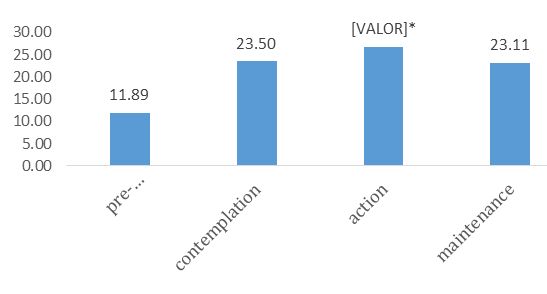
*significant difference in relation to the pre-contemplation stage (p<0.0001/Kruskal- Wallis and Dunn’s method) and to the other stages (p<0.05/Kruskal-Wallis and Dunn’s method). Figure 1: Average level of readiness for change among survey participants.
After analysing the responses obtained in the URICA questionnaire, an average score of readiness for change of 61.5 was observed, with greater predominance in the action stage, particularly in relation to the pre-contemplation stage (p<0.0001/Kruskal- Wallis and Dunn’s method) and to the other stages (p<0.05/Kruskal-Wallis and Dunn’s method), as shown in Figure 1.
Discussion
With regard to epidemiological data, the results presented in the present study, regarding the age of addicted patients, with a mean of 38.12 years, agree with those observed by Capistrano FC, et al. [11], who identified a mean age of 35.8 years for chemically dependent patients, under care at a Psychiatric Hospital, located in the metropolitan region of Curitiba. An approximate mean age was also identified by Napper LE, et al. [9], who found it to be 43.3 years, among patients served by a food bank program for indigent active drug users in California. The high average age of addicts is probably due to the fact that most users end up feeding for a long time self-deception and the illusion of pleasure that the drug provides them. Morales LA [12] mentions that many users indulge in drug use for a long time, given the fact that the craving for ecstasy, or vital intensity or paradisiacal state cannot be predicted, is never supplied and is inherent to human beings.
In fact, it is only with maturity and possibly experiencing serious setbacks resulting from addiction that the addict ends up realizing the need to live without the drug and ends up realizing that it is useless to pursue the false ideal of pleasure resulting from drug consumption. According to Morales LA [12], as in all situations of dependence, users end up realizing only belatedly that this artificial resource is a dangerous trap and a tragic mistake. The significant predominance, among addicts, of men to the detriment of women, agrees with what was exposed by several researchers, including Santos JAG, et al. [13]. These authors determined the profile of psychoactive substance users treated at a psychosocial care center in the state of Acre-BR, and observed a predominance of men, corresponding to 87.1% of users. With similar evidence, Almeida RA, et al. [14] and Cantarelli NDC, et al. [15], in two different epidemiological surveys, observed, respectively, that 94.4% and 86.7% of psychoactive substance users were men. The prevalence of male addicts is largely probably related to biological factors, including the induction of dopamine production in response to drug use.
This hypothesis has already been confirmed by Urban NBL, et al. [16] who evaluated the pattern of dopaminergic response after alcohol consumption in patients and identified differences in the magnitude of dopamine release in the striatum region, but more significantly in the striatal regions involved in reward and motivation. Such differences have also been observed after amphetamine use [17], thus exposing an important factor that justifies the greater tendency of men to develop affinity and dependence on drugs. Regarding the schooling of drug addicts, there was a predominance of those who had completed high school, representing a low level of schooling, in relation to the other participants who had already completed higher or technical education. Such results agree with those presented by Santos JAG, et al. [13], who identified a greater proportion (45.2%) of addicted patients who had only finished high school.
According to Almeida RA, et al. [14], low schooling and adherence to the consumption of psychotropic drugs and narcotics is a consensus in epidemiological studies, because drugs cause cognitive impairment in perceptions, memory and thinking, culminating in learning and performance deficits, with consequent abandonment of school activities.
As for the time of drug use, an average of 16.17 years was observed, a time that, by subtracting from the average age of the research participants (38.12 years), allows identifying that there was a predominance of onset of drug use in young adulthood, aged around 22 years. Several contexts can influence the establishment of drug use in this age group, including the expectation of effect, immaturity, curiosity and the influence of friends and family [15, 18].
In this sense, non-consumption of psychoactive substances by parents implies a greater possibility of non- consumption among children, since social behaviors are developed from primary socialization relationships with family, school and friends, in a way that dysfunctional families can transmit deviant norms of behavior from parents to children [15], and such evidence can be extrapolated when it comes to friendship ties in adolescence and young adulthood.
Regarding the application of the URICA questionnaire, as already mentioned, an average of 59.36 of readiness for change was observed, in agreement with the results obtained by Felix IJ, et al. [10], who evaluated the motivation for change in addict adults, with a mean age of 35.21 years, referred by the court and identified an average readiness equal to 58.48 among inpatients. Otherwise, the results of the present study differed from those observed by Zambom LF, et al. [19], who identified an average readiness equal to 38.15 at the beginning of the intervention and of only 38.42 after 3 years of the beginning of the intervention.
It should be noted that this discrepancy is probably related to the epidemiological characteristics of the research participants, since in the study by Zambom LF, et al. [19] the population assisted consisted of young offenders, who, as already mentioned, probably experience an initial moment of search for pleasure that the drug provides, not yet being able to perceive the harm resulting from the consumption of such substances.
Finally, it was observed that, after application of the URICA questionnaire, there was a predominance of patients in the action phase, particularly to the detriment of the pre-contemplation phase, which demonstrates a greater awareness of the disease and a desire to seek a cure, culminating in a greater willingness to complete the treatment and reflecting the effectiveness of measures to approach the Addicts treated at the clinic in which the present study was developed, allowing us to infer that it is of great importance to reinforce psychological and motivational aspects , linked to the assessment of the motivational stage, as a way of overcoming possible resistance to treatment.
Conclusion
The results obtained in the present study showed a predominance of male addicts, with a mean age of 38.5 years, with complete high school. It was also possible to conclude that the application of the URICA questionnaire allowed the identification of a high average of readiness for change among the participants, serving as an important tool for the team of therapists, nurses, pharmacists, psychologists, doctors and other health professionals, to evaluate the effectiveness of the intervention methods used in the clinic, as well as to assist in the decision making aimed at promotion of a better quality of life for the chemically dependent.
References
-
Pratta EMM, Santos MA (2009) The health-disease process and chemical dependence: interfaces and evolution. Psychology: Theory and Research 25(2): 203- 211.
-
Szupszynski MSOKDR, DiClemente C (2010) Study of motivational stages in the treatment of adolescent users of illicit psychoactive substances. Study of motivation for treatment in teenagers users of illicit substances. Psico 41(1): 40-46.
-
Szupszynski KPDR, Oliveira MSO (2008) The Transtheoretical Model in the treatment of chemical dependence. Psychology: theory and practice 10(1): 162-173.
-
Szupszynski KPDR, Oliveira MSO (2008) Brazilian adaptation of the University of Rhode Island Change Assessment (URICA) for users of illicit substances. Psycho-USF 13(1): 31-39.
-
Sousa PF, Ribeiro LCM, Melo JRF, Maciel SC, Oliveira MX (2013) Drug Addicts in Treatment: A Study on the Motivation for Change. Themes in Psychology 21(1): 259-268.
-
Figle NB (2004) Motivation for the treatment of alcoholism. Thesis-Federal University of São Paulo 1(1): 1-144.
-
Kessler F, Faller S, Formigoni MLOS, Cruz MS, Brasiliano S, et al. (2010) Multidimensional assessment of drug users and the Dependence Severity Scale. Journal of Psychiatry of Rio Grande do Sul 32(2): 48-56.
-
Resende GLO, Amaral VLAR, Bandeira M, Gomide ATS, Andrade EMR (2005) Analysis of readiness for treatment in alcoholics in a treatment center. Arch Clin Psychiatry 32(4): 211-217.
-
Napper LE, Wood MM, Jaffe A, Fisher DG, Reynolds GL, et al. (2009) Convergent and discriminant validity of three measures of stage of change. Psychologic of Addictive Behaviors 22(3): 362-371.
-
Felix IJ, Calheiros PRV, Crispim PTB (2018) Motivation for Change in Substance Use among Justice-Referred Drug Users. Trends in Psychology 26(3): 1363-1378.
-
Capistrano FC, Ferreira ACZ, Silva TL, Kalinke LP, Maftum MA (2013) Sociodemographic and clinical profile of drug addicts undergoing treatment: analysis of medical records. Anna Nery School 17(2): 234-241.
-
Morales LA (2012) An analysis of current drug use. Aurora Magazine 5(1): 119-138.
-
Santos JAG, Lima FS, Silva TS, Izel RTL, Arruda ED (2019) Profile of Psychoactive Substance Users Seen at a Psychosocial Care Center in Acre. Biosphere Encyclopedia 16(30): 459-469.
-
Cantarelli NDC, Marchesan EKR, Amaral MC, Lemos JC (2014) Profile of Users of Psychoactive Substances in a University Hospital in Rio Grande Do Sul. Health (Santta Maria) 40(1): 85-90.
-
Almeida RA, Anjos UU, Vianna RPT, Pequeno GA (2014) Profile of users of psychoactive substances in João Pessoa. Health in Debate 38(102): 526-538.
-
Urban NBL, Kegeles LS, Slifstein M, Xu X, Martinez D, et al. (2010) Sex differences in striatal dopamine release in young adults after oral alcohol challenge: A PET imaging study with [C] raclopride. Biological Psychiatry 68(8): 689-696.
-
Munro CA, McCaul ME, Wong DE, Oswald LM, Zhou Y, et al. (2006) Sex differences in striatal dopamine release in health adults. Biological Psychiatry 59(10): 966-974.
-
Faria Filho EA (2014) Profile of alcohol and drug use in adolescent pupils in a Brazilian State capital. SMAD Electronic magazine mental health alcohol and drugs 10(2): 78-84.
-
Zambom LF, Silva JG, Andretta I, Oliveira MS (2011) Motivation for change in adolescent marijuana users: a longitudinal study. Psychology Bulletin 61(135): 193- 206.
- Epidemiological Surveillance and Rumors on Social Media
- Awareness and Treatment of Uncontrolled Hypertension in US Overweight/Obese Youths Aged 16–24 Years, NHANES 2021–2023
- Strengthening EPI Through Parental Engagement: Lessons from Dhaka Slums for IA-2030
- Mothers Knowledge of the Prevalence, Causes, Effects, Prevention and Control of Diarrhoea among Children in Ife East Local Government Area, Ile Ife, Osun State, Nigeria
- Covid-19 Reinfections Case Series from October 2023 to October 2024 in A General Medicine Office in Toledo (Spain)
- Water Contact! One Risk Too Many: Risk Factors Associated with Schistosoma haematobium infection in Osun State, Nigeria