
Segmental Proportions Based on Anthropometry of Female Agricultural Workers, India
Women play a major role in the development of rural and national economies of India through their agricultural operation. For proper design of farm equipment for women workers, it is necessary to collect anthropometric data on farm women. But not much of information is available regarding their anthropometric data. Therefore, an anthropometric survey was carried out for female agricultural workers of Gujarat state, wherein 382 female agricultural workers were selected and 38 body dimensions were precisely measured and recorded from each subject. The data measured were statistically analyzed for mean, standard deviation, 5th and 95th percentile values which are used indesign. For making the data comprehensive and more useful, a set of 19 body dimensions, which are having direct implications on agricultural tool/implement design were selected, and compared with data of different states of India and also with other countries female workers. The mean weight and stature of female agricultural workers were found to be 48 kg and 1522 mm, respectively. A large variation in anthropometric dimensions was observed in the anthropometric data of female farm workers of different states of India and other countries. The data as obtained are intended to be used for the design and modifications of agricultural hand tools/implements with a view to reduce drudgery and at the same time increase efficiency, safety and comfort of operators in agriculture operation.
Introduction
The word ‘anthropometry’ means measurement of the human body. Anthropometry is the science of measurement and the art of application that establishes the physical geometry, mass properties, and strength capabilities of the human body [1]. It involves the systematic measurement of the physical properties of the human body, primarily dimensional descriptors of body size and shape. The knowledge of body dimensions is essential for designers of equipment and work places. The anthropometric measurements are essential for the correct design of the work areas [2, 3, 4].
India is an agriculture-based country. A large section of Indian population engages in agriculture. Although agriculture is generally recognized as the nation’s most hazardous industry and displays high rates of MSDs with evidence in which the ergonomic risk factors are involved and be pointed out, there is very little history of application of ergonomic approaches in agricultural equipment design. About 6.5% of the power used in crop production and related activities in the country is contributed by about 241 million workers, of which about 42% (i.e. 101 million) are female workers. Thus, the human workers play a major role in the country’s agriculture and due to that, attention needs to be given to their capabilities and limitations during design and operation of various farm equipment’s, so as to get higher productivity, enhanced comfort and ensure better safety [5, 6]. Manually operated equipment’s are extensively used in Indian agriculture for various farm operations starting from seedbed preparation to post-harvest operations.
The ergonomic principles or human factors are considered in machine design to enhance effectiveness, efficiency, safety and comfort of the users/operators of the equipment. In most cases, constraints are been experienced in adoption of improved machineries being utilized in other parts of the country; the adopted equipment at times need to be modified before being introduced into other countries or regions to suit agricultural workers of the region for which body dimensions limits of local populations was required. Because of Yadav, et al. [7] pointed out that there was considerable difference between the anthropometric data of Indian and westerns. To design any product for human use, engineers have to rely on anthropometric data, otherwise the resulting product may turn out to be ergonomically incompatible [8].
Gite and Yadav [9] noted that the design and dimensions of agricultural tools and implements have great bearing on the body dimensions and physical built of the users, requiring compatibility essentially between machine devices and worker body dimensions. Dewangan, et al. [10] suggested that the only way to fulfill this objective is to create database of anthropometric dimensions of the user population. Therefore, a sample study was conducted to collect and analyse the anthropometric data of female agricultural workers of Gujarat state for the ergonomic design of farm equipment and workplaces.
Materials and Methods
An anthropometric survey was carried out in Gujarat states of India. For the collection of data, survey was carried out in all the districts of the Gujarat states. Total 382 subjects in the age group 22–54 years of age were randomly chosen from state. Simple random sampling was used to select farm women. The selected female workers were engaged in various agricultural operations on the farms. Subjects were screened so that those in normal health without any serious disease or physical handicapped were selected. Total 38 body dimensions including weight were identified for measurement, which were important in the design of agricultural equipment and workplace.
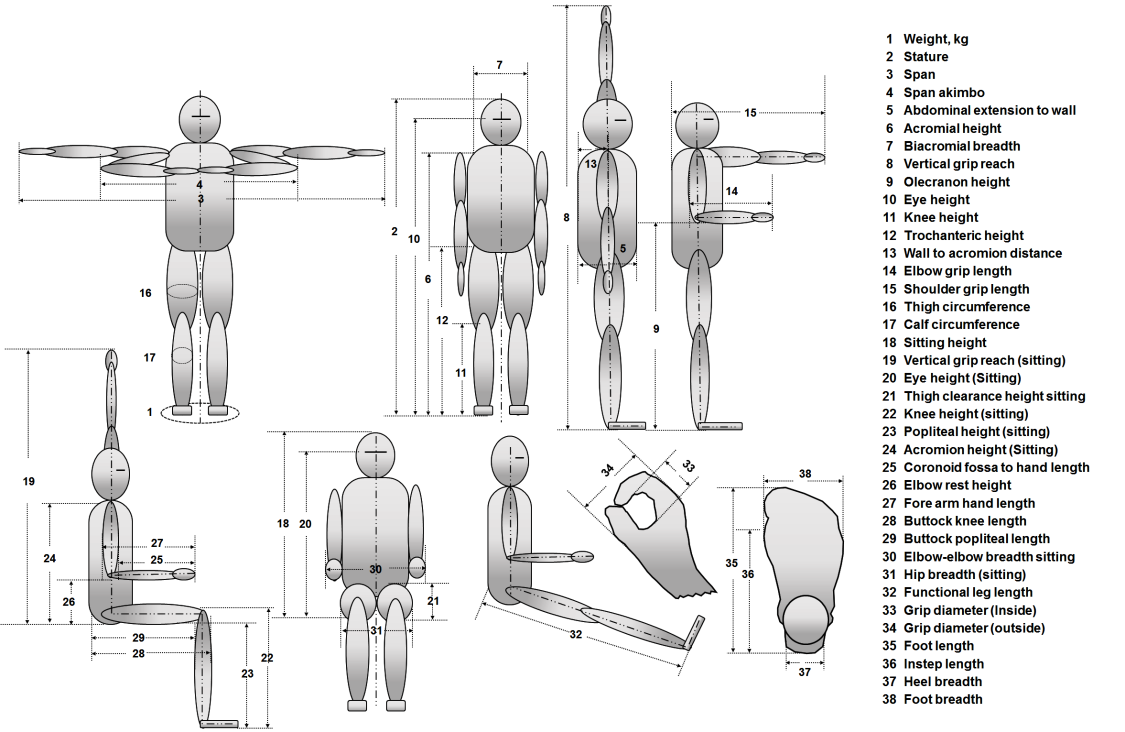
The standard terminologies of selected anthropometric dimensions and measurement landmarks for as suggested in the anthropometric source book are shown in Figure 1 [11, 12]. The team of researchers was trained for a week on how to recognize the dimensions to be measured, to use measuring instruments and to record data into a log sheet. Subjects were chosen randomly, having normal appearance and having no physical disabilities. Before the measurements were made, the subjects were given an explanation about the purpose of the study. Only subjects who gave their consent were considered further. All subjects wore light clothing without foot wears. For standing dimensions, subjects were asked to stand upright on the base of the anthropometer, facing forward, and arms hanging beside the body. For sitting dimensions, subjects were asked to sit erect on a chair without armrests, with knees bent 90°and feet flat on the surface, facing forward, and arms hanging beside the body.
Forty (40) anthropometric body dimensions considered useful for design of agricultural equipment/machines. There were 17 body measurements in standing posture, 15 measurements in sitting posture and six measurements in either sitting or standing posture. In addition, two antropometric indices viz. body mass index (BMI) and relative sitting height (RSH) were calculated from the measured anthropometric data. The BMI is defined as the body mass (kg) divided by the square of the stature (m), whereas the RSH is the ratio of sitting height to stature. All the measurements of each subject were taken three times.
The data was further analysed and in addition to the descriptive values, 5thand 95thpercentile values were also calculated. Each group of data was included in statistical analysis. Collected data were first entered in Microsoft Excel and then for statistical analysis were transferred to
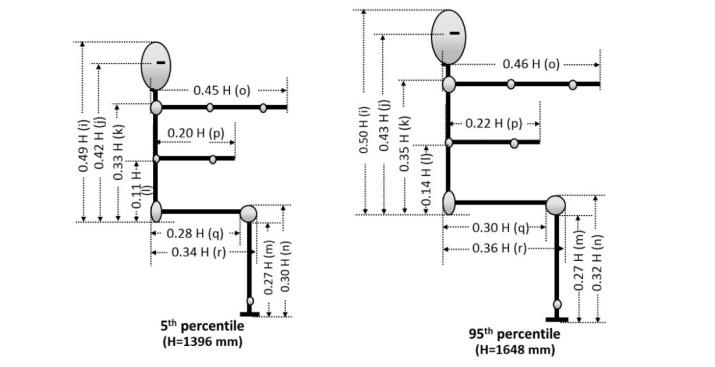
Figure 3: Segmental proportions as a function of stature (H) for different percentile female agricultural workers of central India in sitting posture. (i: sitting height, j: eye height (sitting), k: acromion height (sitting), l: elbow rest height, m: popliteal height (sitting), n: knee height (sitting), o: shoulder grip length, p: elbow grip length, q: buttock popliteal length, r: buttock knee length).
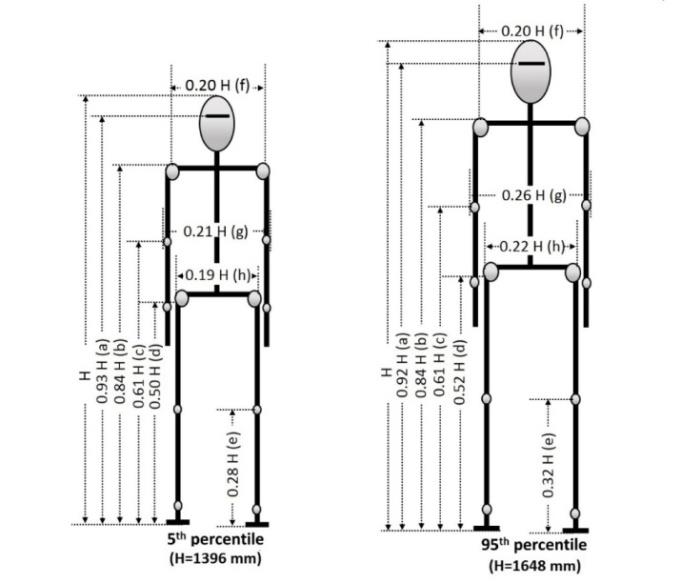
The data set for each dimension in the sample’s group were checked to ensure that they represent a normal distribution. Furthermore, 18 particular body dimensions were chosen to illustrate the differences of segment proportions of 5th and 95th percentile female agricultural workers in both standing posture namely eye height, acromial height, olecranon height, trochanteric height, knee height, biacromial breadth, elbow-elbow breadth and hip breadth were selected (Figure 2). In addition, ten body dimension measured in sitting posture namely sitting height, eye height (sitting), shoulder grip length, elbow grip length, buttock popliteal length and buttock knee length were selected (Figure 3).
Results and Discussion
Anthropometric Data of Female Agricultural Workers
Various Anthropometric Measurements had been taken for the designing of Agricultural tools and equipment for the drudgery reduction of Farm women. Further, observations were analysed and mean, standard deviation (SD), percentile values (5th and 95th) of anthropometric data of selected female agricultural workers are calculated and shown in Table 1.
| Sr. No. | Acronym | Measurement | Mean | SD (±) | 5th per | 95th per | ||||||||||||||
|---|---|---|---|---|---|---|---|---|---|---|---|---|---|---|---|---|---|---|---|---|
| 1 | WT | Weight, kg | 48 | 82 | 35 | 62 | ||||||||||||||
| 2 | ST | Stature | 1522 | 76 | 1396 | 1648 | ||||||||||||||
| 3 | SP | Span | 1562 | 76 | 1437 | 1687 | ||||||||||||||
| 4 | SPA | Span akimbo | 776 | 62 | 674 | 878 | ||||||||||||||
| 5 | AE | Abdominal extension to wall | 219 | 37 | 159 | 280 | ||||||||||||||
| 6 | AH | Acromial height | 1274 | 62 | 1171 | 1377 | ||||||||||||||
| 7 | BB | Biacromial breadth | 303 | 18 | 273 | 332 | ||||||||||||||
| 8 | VGR | Vertical grip reach | 1863 | 84 | 1802 | 2080 | ||||||||||||||
| 9 | OH | Olecranon height | 929 | 47 | 851 | 1006 | ||||||||||||||
| 10 | EH | Eye height | 1410 | 67 | 1300 | 1519 | ||||||||||||||
| 11 | KH | Knee height | 458 | 40 | 392 | 525 | ||||||||||||||
| 12 | TH | Trochanteric height | 777 | 48 | 698 | 856 | ||||||||||||||
| 13 | WAD | Wall to acromion distance | 95 | 12 | 74 | 115 | ||||||||||||||
| 14 | EGL | Elbow grip length | 321 | 27 | 275 | 366 | ||||||||||||||
| 15 | SGL | Shoulder grip length | 690 | 38 | 627 | 754 | ||||||||||||||
| 16 | TC | Thigh circumference | 410 | 42 | 341 | 480 | ||||||||||||||
| 17 | CC | Calf circumference | 276 | 26 | 234 | 319 | ||||||||||||||
| 18 | SH | Sitting height | 750 | 40 | 685 | 816 | ||||||||||||||
| 19 | VGRS | Vertical grip reach (sitting) | 1097 | 56 | 1004 | 1190 | ||||||||||||||
| 20 | EHS | Eye height (Sitting) | 651 | 37 | 590 | 712 | ||||||||||||||
| 21 | TCH | Thigh clearance height sitting | 132 | 19 | 101 | 163 | ||||||||||||||
| 22 | KHS | Knee height (sitting) | 475 | 30 | 424 | 525 | ||||||||||||||
| 23 | PHS | Popliteal height (sitting) | 416 | 21 | 381 | 451 | ||||||||||||||
| 24 | AHS | Acromion height (Sitting) | 513 | 36 | 454 | 572 | ||||||||||||||
| 25 | CFHL | Coronoid fossa to hand length | 367 | 33 | 312 | 421 | ||||||||||||||
| 26 | ERH | Elbow rest height | 191 | 24 | 152 | 230 | ||||||||||||||
| 27 | FAHL | Fore arm hand length | 321 | 29 | 365 | 460 | ||||||||||||||
| 28 | BKL | Buttock knee length | 529 | 36 | 470 | 589 | ||||||||||||||
| 29 | BPL | Buttock popliteal length | 439 | 30 | 389 | 488 | ||||||||||||||
| 30 | EEBS | Elbow-elbow breadth sitting | 363 | 39 | 299 | 426 |
| 31 | HBS | Hip breadth (sitting) | 316 | 27 | 272 | 360 |
|---|---|---|---|---|---|---|
| 32 | FLL | Functional leg length | 906 | 46 | 829 | 983 |
| 33 | GDI | Grip diameter (Inside) | 53 | 6 | 43 | 63 |
| 34 | GDO | Grip diameter (outside) | 85 | 8 | 72 | 98 |
| 35 | FL | Foot length | 228 | 14 | 204 | 251 |
| 36 | ISL | Instep length | 147 | 12 | 128 | 167 |
| 37 | HL | Heel breadth | 59 | 6 | 50 | 69 |
| 38 | FB | Foot breadth | 89 | 7 | 78 | 100 |
| 39 | BMI | Body mass index | 20.7 | 4.7 | 17.9 | 22.8 |
| 40 | RSH | Relative sitting height | 0.49 | 0.03 | 0.49 | 0.52 |
Table 2: Anthropometric data of female agricultural workers (n = 382).
Table 1: Anthropometric data of female agricultural workers (n = 382). Measurement unit: mm, unless otherwise specified During the design of equipment or workplace, the 5th percentile value should be used, where lower limit is the restrictive factor such as control reach, height of display, operating forces etc. The 95th percentile value should be used in design where the upper limit is restrictive factor such as design of clearances, seat dimensions, height of the door etc. According to Pheasant [13], the smaller subjects having values of relative sitting height (RSH) less than 0.50 are categorized as “long legged”, whereas the taller ones having RSH between 0.53-0.55 are categorized as “short legged”. The average group having RSH between 0.51-0.53 is categorized as between short and long legged. From the Table 1, it is observed that subjects (Mean, 5thand 95thpercentile) having RSH less than 0.50 so they categorized as “long legged” persons.
Segmental Proportions of Different Anthropometric Dimensions as a Function of Stature
The segmental proportions of 5th and 95th percentile values of different anthropometric data as function of stature (H) of selected female agricultural workers in both standing and sitting postures are depicted in Figure 2 and 3, respectively. Figure 2 indicated that the segmental proportions of selected subjects in standing posture namely knee height, elbow-elbow breadth and hip breadth increased considerably with increase in percentile values of stature from 5th to 95th. Similarly, Figure 3 indicated that the segmental proportions of selected subjects in sitting posture namely elbow rest height increased with increase in stature (5th to 95th percentile values). However, there is no significant difference in segmental proportions of other body dimensions with increase in stature of subjects.
Comparison of Anthropometry Data across States of India and Other Countries
Nineteen different anthropometric data of female agricultural workers were compared with data of 14 states of India and presented in Table 2. From the Table 2, it was observed that the statures of female workers of Maharashtra, Meghalaya, Odisha, Sikkim, Tamil Nadu, Uttar Pradesh and west Bengal are smaller than the stature of selected workers in the study. However, female farm workers of Himachal Pradesh, Madhya Pradesh, Mizoram, Jammu and Kashmir and Punjab are taller in stature as compared to female farm workers of Gujarat collected in the study. The RSH value for Gujarat, Punjab state is 0.49 indicating that they are “long legged”. Similarly, the RSH value for Arunachal Pradesh state is 0.53 indicating that they are “short legged”. For rest of the states, the RSH value ranges within 0.50-0.52 indicated that they may be categorized between short and long legged.
The mean values of anthropometric data collected in the study were also compared with anthropometric data of female workers of 14 countries and reported in Table 3. It can be seen that the Gujarat female workers are smaller in stature, sitting height, buttock knee length, buttock popliteal length and hip breadth than the American, British, Polish, Dutch, Portuguese, Swedish, Turkish and Nigerian population. This variation among anthropometric data could be due to the differences in body build-up of female workers from other countries. The differences found in the anthropometric dimensions of the different population groups emphasize the usefulness of this study in the context of design of agricultural hand tools and implements. Most of the agricultural tools/machinery used in India are based on body dimensions of foreign workers. Designs that once suited the British population are followed in India [14]. This implies that the devices and implements designed abroad should be suitably modified before introducing these to the Indian farm workers.
- Anthropometric
- Present
- Arunachal
- Himachal
- Jammu &
- Madhya
- Pradesh Maharashtra MeghalayaMizoramOdisha Punjab Rajasthan Sikkim Tamil dimensions study
- Pradesh
- Pradesh
- Kashmir
- Stature
- 1522
- 1525
- 1573
- 1538
- 1538
- 1504
- 1507
- 1552
- 1516
- 1542
- 1528
- 1510
- 1508
- 1508
- 1499
- Sitting height
- 750
- 801
- 787
- 777
- 784
- 767
- 784
- 804
- 784
- 763
- 782
- 789
- 754
- 780
- 764
- Wall to acromion distance
- 95
- 118
- 103
- 101
- 96
- 97
- 105
- 116
- 76
- 105
- 92
- 103
- 107
- 101
- 92
- Sitting acromion height
- 513
- 548
- 549
- 531
- 534
- 518
- 534
- 547
- 541
- 541
- 532
- 538
- 521
- 522
- 513
- Elbow rest height
- 191
- 236
- 216
- 200
- 205
- 206
- 228
- 230
- 221
- 207
- 222
- 231
- 187
- 208
- 210
- Shoulder grip length
- 690
- 672
- 647
- 686
- 670
- 676
- 667
- 655
- 630
- 706
- 685
- 698
- 619
- 698
- 680
- Elbow grip length
- 321
- 330
- 344
- 324
- 328
- 310
- 305
- 323
- 335
- 332
- 329
- 325
- 329
- 332
- 299
- Biacromial breadth
- 303
- 335
- 351
- 315
- 292
- 272
- 287
- 336
- 281
- 331
- 262
- 300
- 282
- 284
- 288
- Elbow-elbow breadth
- 363
- 374
- 398
- 338
- 366
- 323
- 349
- 382
- 351
- 406
- 363
- 418
- 357
- 357
- 330
- Abdominal extension
- 219
- 212
- 245
- 238
- 226
- 209
- 185
- 208
- 209
- 213
- 228
- 267
- 196
- 217
- 213
- Thigh clearance sitting
- 132
- 140
- 126
- 124
- 117
- 131
- 135
- 151
- 104
- 144
- 128
- 140
- 110
- 123
- 117
- Knee height sitting
- 475
- 448
- 472
- 484
- 473
- 461
- 469
- 463
- 475
- 460
- 492
- 465
- 475
- 470
- 450
- Popliteal height sitting
- 416
- 351
- 423
- 404
- 392
- 386
- 395
- 356
- 415
- 359
- 416
- 375
- 394
- 402
- 384
- Buttock-knee length
- 529
- 504
- 486
- 499
- 522
- 519
- 512
- 512
- 460
- 521
- 483
- 503
- 525
- 509
- 524
- Buttock-popliteal length 439
- 378
- 429
- 419
- 450
- 438
- 424
- 391
- 399
- 435
- 415
- 425
- 441
- 435
- 408
- Foot length
- 228
- 227
- 208
- 236
- 229
- 223
- 221
- 226
- 223
- 234
- 231
- 219
- 218
- 228
- 227
- Hip breadth sitting
- 316
- 307
- 332
- 330
- 312
- 296
- 310
- 323
- 267
- 331
- 314
- 363
- 286
- 304
- 310
- Foot breadth
- 89
- 91
- 87
- 92
- 88
- 91
- 88
- 86
- 91
- 88
- 94
- 90
- 83
- 88
- 88
- Functional leg length
- 906
- 898
- 881
- 931
- 939
- 935
- 958
- 907
- 910
- 968
- 960
- 866
- 987
- 934
- 899
- RSH*
- 0.49
- 0.53
- 0.50
- 0.51
- 0.51
- 0.51
- 0.52
- 0.52
- 0.52
- 0.49
- 0.51
- 0.52
- 0.50
- 0.52
- 0.51
Table 3: Mean values of important standing and sitting anthropometric dimensions of female agricultural workers of different states of India (Gite, et al.
| Presen | t | ||||||||||||||||||||||||||||||||||||||||||||
|---|---|---|---|---|---|---|---|---|---|---|---|---|---|---|---|---|---|---|---|---|---|---|---|---|---|---|---|---|---|---|---|---|---|---|---|---|---|---|---|---|---|---|---|---|---|
| Body feature | USAa | UKab | Polandb | Holland | b | Portugal | b | Sweden | c | Turkish | e | Nigeria | f | I | ndonesia | e | Taiwand | China | d | J | apan | d | Korea | d | Filipino | e | |||||||||||||||||||
| study | |||||||||||||||||||||||||||||||||||||||||||||
| Stature | 1522 | 1626 | 1610 | 1575 | 1650 | 1565 | 1674 | 1598 | 1600 | 1525 | 1573 | 1576 | 1569 | 1588 | 1539 | ||||||||||||||||||||||||||||||
| Sitting height | 750 | 861 | 850 | 825 | 875 | 865 | 892 | 848 | 770 | 774 | 848 | 855 | 850 | 866 | 799 | ||||||||||||||||||||||||||||||
| Wall to acromion distance | 95 | NA | NA | NA | NA | NA | NA | NA | NA | NA | NA | NA | NA | NA | NA | ||||||||||||||||||||||||||||||
| Sitting acromion height | 513 | 564 | 555 | 565 | 565 | 595 | 577 | 558 | 560 | 506 | NA | NA | NA | NA | NA | ||||||||||||||||||||||||||||||
| Elbow rest height | 191 | 236 | 235 | 230 | 240 | 250 | 238 | 232 | 170 | 205 | 254 | 251 | 253 | 263 | 219 | ||||||||||||||||||||||||||||||
| Shoulder grip length | 690 | 711 | 705 | 735 | 705 | 675 | NA | 695 | 670 | 667 | NA | NA | NA | NA | NA | ||||||||||||||||||||||||||||||
| Elbow grip length | 321 | NA | NA | NA | NA | NA | NA | NA | NA | NA | NA | NA | NA | NA | NA | ||||||||||||||||||||||||||||||
| Biacromial breadth | 303 | NA | 355 | 350 | 360 | 300 | 356 | NA | 240 | NA | 331 | 351 | 348 | 352 | NA | ||||||||||||||||||||||||||||||
| Elbow-elbow breadth | 363 | NA | NA | NA | NA | NA | 444 | NA | NA | NA | NA | NA | NA | NA | NA | ||||||||||||||||||||||||||||||
| Abdominal extension | 219 | NA | 255 | 250 | 295 | 260 | 227 | NA | 250 | NA | NA | NA | NA | NA | NA | ||||||||||||||||||||||||||||||
| Thigh clearance sitting | 132 | NA | 155 | 140 | 150 | 165 | 145 | NA | 14.2 | NA | NA | NA | NA | NA | NA | ||||||||||||||||||||||||||||||
| Knee height sitting | 475 | 505 | 500 | 485 | 505 | 480 | 521 | 494 | 490 | 490 | 472 | 458 | NA | 470 | 470 | ||||||||||||||||||||||||||||||
| Popliteal height sitting | 416 | NA | 400 | 420 | 405 | 365 | 444 | NA | 420 | NA | 379 | 382 | 362 | 384 | NA | ||||||||||||||||||||||||||||||
| Buttock-knee length | 529 | 574 | 570 | 565 | 600 | 570 | 596 | NA | 590 | 527 | 530 | 529 | 531 | 528 | 527 | ||||||||||||||||||||||||||||||
| Buttock-popliteal length | 439 | 490 | 480 | 450 | 495 | 470 | 477 | NA | 490 | 451 | 439 | 433 | 437 | 449 | 451 | ||||||||||||||||||||||||||||||
| Foot length | 228 | 239 | NA | NA | NA | NA | 243 | 232 | 235 | 223 | NA | NA | NA | NA | NA | ||||||||||||||||||||||||||||||
| Hip breadth sitting | 316 | 376 | 370 | 360 | 395 | 400 | 416 | 308 | 410 | 299 | 322 | 317 | 333 | 319 | 364 | ||||||||||||||||||||||||||||||
| Foot breadth | 89 | 8.9 | NA | NA | NA | NA | 90 | 88 | 90 | 97 | NA | NA | NA | NA | NA | ||||||||||||||||||||||||||||||
| Functional leg length | 906 | NA | NA | NA | NA | NA | NA | NA | NA | NA | NA | NA | NA | NA | NA | ||||||||||||||||||||||||||||||
| RSH* | 0.49 | 0.53 | 0.53 | 0.52 | 0.53 | 0.55 | 0.53 | 0.53 | 0.48 | 0.51 | 0.54 | 0.54 | 0.54 | 0.55 | 0.52 |
Table 4: Mean values of important standing and sitting anthropometric dimensions of female agricultural workers of different coun
Table 3: Mean values of important standing and sitting anthropometric dimensions of female agricultural workers of different countries. Measurement unit: mm, unless otherwise specified. *Ratio of sitting height to stature (unitless) a: MacLeo [15]. b: Barroso, et al. [16] c: Hanson, et al. [17] d: Lin, et al. [18]e: Syuaib [19]. f: Obi, et al. [20]. NA: no data available
Conclusions
Total 382 healthy female agricultural workers were selected as subjects for taking anthropometric data. They were in the age group of 22-54 years. During the survey, all together 38 body dimensions were precisely recorded from each subject. The segmental proportions of anthropometric data as a function of stature, in standing posture namely knee height, elbow-elbow breadth and hip breadth; and in sitting posture namely elbow rest height increased considerably with measure of stature from 5th to 95th percentile. It was observed that there was a large variation in the anthropometric data when the results were compared with the anthropometric data of different states of India. The selected subjects were taller than female agricultural workers from north-eastern and eastern states of India but shorter than the northern states of India. The similar trend was observed for most of the body dimensions. When anthropometric data compared to the American, British, Portuguese, Swedish, Turkish and Nigerian female workers it can be seen that Indian female population are shorter in stature, sitting height, buttock knee length, buttock popliteal length and hip breadth. The large difference found in anthropometric dimensions of different population groups indicated that a distinctive nature of the anthropometry. Therefore, there is requirement of suitably modifying or redesigning of existing farm equipment before introducing these to the Indian farm workers.
References
-
Pradu-Lu JLD (2007) Anthropometric measurement of Filipino manufacturing workers. International Journal of Industrial Ergonomics 37(6): 497-503.
-
Ray GG, Ghosh S, Atreya V (1995) An anthropometric survey of Indian schoolchildren aged 3-5 years. Applied Ergonomics 26(1): 67-72.
-
Yadav R, Gite LP, Kaur N, Randhava J (2000) An anthropometry of Indian female agricultural workers. Agricultural Mechanization of Asia, Africa and Latin America 31(3): 56-60.
-
Mehta CR, Chandel NS, Senthilkumar T, Singh K (2014) Status, challenges and strategies for farm mechanization in India. Agricultural Mechanization in Asia, Africa, and Latin America 45(4): 43-50.
-
Woodson WE, Conover DW (1973) Human Engineering Guide for Equipment Designers. 2nd (Edn.), University of California Press.
-
Yadav R, Pund S, Patel NC, Gite LP (2010) Analytical Study of Strength Parameters of Indian Farm Workers and its Implication in Equipment Design, Agricultural Engineering International: the CIGR E-journal 12(2): 49-54.
-
Yadav R, Tewari VK, Prasad N (1997) Anthropometric data of Indian farm workers-a module analysis. Applied Ergonomics 28(1): 69-71.
-
Lewis WG, Narayan CV (1993) Design and sizing of ergonomic handles for hand tools. Applied Ergonomics 24(5): 351-356.
-
Gite LP, Yadav BG (1989) Anthropometric survey for agricultural machinery design. Applied Ergonomics 20(3): 191-196.
-
Dewangan KN, Prasannakumar GV, Suja PL, Choudhury MD (2005) Anthropometric dimensions of farm youth of the north-eastern region of India. International Journal of Industrial Ergonomics 35(11): 979-989.
-
NASA (1978) Anthropometric Source Book, Volume I: Anthropometry for Designers. NASA, Washington, USA.
-
Gite LP, Majumdar J, Mehta CR, Khadatkar A (2009) Anthropometric and strength data of Indian agricultural workers for farm equipment design. Book no. CIAE/2009/4, Central Institute of Agricultural Engineering, Bhopal, India.
-
Pheasant ST (2003) Body space: Anthropometric Ergonomics and the Design of Work. Taylor and Francis, London, pp: 257.
-
Chakrabarti Debkumar (1997) Indian Anthropometric Dimensions for Ergonomic Design Practice. National Institute of Design, Ahmedabad, India.
-
MacLeod D (2000) The rules of work, A Practical Engineering Guide to Ergonomics. Taylor and Francis, Florida.
-
Barroso MP, Arezes PM, Costa LG, Miguel AS (2005) Anthropometric study of Portuguese workers. International Journal of Industrial Ergonomics 35(5): 401-410.
-
Hanson L, Sperling L, Gard G, Ipsen S, Vergara CO (2009) Swedish anthropometrics for product and workplace design. Applied Ergonomics 40(4): 797- 806.
-
Lin YC, Wang MJ, Wang EM (2004) The comparisons of anthropometric characteristics among four people in East Asia. Applied Ergonomics 35(2): 173-178.
-
Syuaib MF (2015) Anthropometric study of farm workers on Java Island, Indonesia, and its implications for the design of farm tools and equipment. Applied Ergonomics 51: 222-235.
-
Obi OF, Ugwuishiwu BO, Adeboye BS (2015) A survey of anthropometry of rural agricultural workers in Enugu State, south-eastern Nigeria. Ergonomics 58(6): 1032-1044.
- The Expanding Landscape of Road Rage: A Systematic Review of Conflicts Involving Drivers, Pedestrians, and Micromobility
- Validating Cognitive Models of Royal Navy Performance on Control Systems
- Comparing Standard and State-of-the-art Firefighter Coats on Postural Balance and Gait in a Live Burn Environment
- Investigating the Integration of Telemedicine into Clinicians Workflow: A Review of Methods
- Risk Assessment of Ergonomic Factors in a Textile Firm by RULA, REBA and Fine Kinney Methods
- Impact of Self-Esteem Training on Individuals with Disabilities Aged 17-30