
Comparative Study on Design Elements of Namghars in Urban, Rural and Semi-Urban Region using Visual Approach
Rising inequality and suppression of people belonging to lower class led to Vaishnavite movement, which in turn resulted in creation of “Namgharâ€. Namghars are an important socio-cultural institution, whose design elements are essential and symbolic for binding the entire community especially belonging to rural areas. However, rapid urbanization and changing lifestyle has led to variations in design elements of Namghar. This study on these variations in design elements will be essential in preserving the essence, harmony among diverse communities as well as heritage of Assam. The objectives of this study are to compare variations in design elements of Namghar located at three different locations: 1) Urban (Zoo Road, Guwahati) 2) Semi-Urban (Sualkuchi) and 3) Rural (Hajo). Field observations of outer overall structure, elements as well as interior structure were made using high-resolution camera. The visuals were analyzed and similarities and differences among key architectural design elements (outer gate, main door, pillars, prayer hall, relief work; Manikut) were compared and discussed. It was found that among all architectural elements; Manikut was found to have least variation (or most preserved). Other elements have drastic variations in size, material as well as form. The design of outer main gate, which was adorned with Vaisnava elements and floral design work for rural and semi-urban areas, is now almost plain without any significant decorations. Similarly, Pillars, which were carved with complex design of Vaisnava elements (Bhakat or Lord Krishna) and also floral work in case of semi-urban and rural Namghars seems to change to much simpler design form (plain round shape) in case of urban Namghars. Overall, there is strong indication of increasing essence of modernization, energy efficiency along with security as compared to relief and decorative work (Vaisnava sect elements) in design of architectural elements of Namghar in Urban location.
Introduction
Namgharsare social-cultural institutions that came into existence as a consequence of Vaishanava Bhakti movement, which initiated after inequality; suppression of lower class and mal-practices in Hinduism reached its peak in 15th Century [1]. These were introduced in Assam by the Vaisnavite Saint Srimanta Shankardeva between 12th and 15th century AD. This movement aims to bring everyone into the same level and gave birth to equality [2]. During that period, Namghars were essential structures, which are basic building blocks of Assamese society [3]. It is not only a place of worship but also a central meeting point, where all the people discuss about the issues related to their society. Namghar also called kirtanghar functions as meeting points of congregations, as well as theatre of dramatic performances like Bhoana, Raas Lila and many others [1, 4, 5].
The Satrasare unique institutions with multidisciplinary socio-religious and architectural domain with its distinctive characteristics [6]. “The Satras also served as so many centers of literary production and mainly of religious type” [1]. Gogoi [4] presented very detailed description on architectural components of typical Namghar. “There are various art forms practiced in the Satras, notably the art of wood carving, manuscript writing, paintings, mask making, and mask performance” [7]. The unique architectural forms and details of the Satrascreated lot of interest in minds of the Kings, nobles, and devotees as well. As discussed in Neog [1], numerous stylish features, unique motifs, highly decorative, varied ranges of colour, secular and religious themes, precisely arrangement compositions and particularized characters can be observed in architectural forms of typical Namghar.“The organic body of Satra is composed of several essential elements based on the environmental sphere, cultural domain, religious realm and materials availability which unite to form the basic structure” [7].
However, rapid urbanization in Assam has to lead to changes in lifestyle and socio-cultural and economic aspects of larger sections of society in Assam [8, 9]. This changing culture might influence the development of Namghars in terms of socio-cultural activities and also architectural elements design. The Satras architectural contributions towards the socio-cultural values are worthy ancient treasures, which must be preserved and protected. Neog and Gogoi [1, 7]discussed briefly on evolution of architectural form of Satras and Namghar. “The Satras in the new areas were equipped with some integral parts like the Bhagawata-griha, sabha-griha, rangialghar, guru-grihaatithisala, dhan-bharal, caul- bharal library, patchang, math, and other structures wherever necessary, and the functionaries like the Bhagowati, pathak, medhi, rajmedhi, bar-medhi, sajtula and pacani were employed under the head of the Satras to run the respective branches and department” [10]. They pointed out differences in various Satras, however, any visual reporting and hence in depth interpretation of art was not discussed.
The objectives of this study are to explore variation in architectural design elements of Namghars located in different urbanization areas (rural, semi-urban and urban). Three different Namghars Zoo Road Namghar, Sualkuchi Namghar, Hajo Pakhmela Namghar were selected for study. Field observations were conducted using high resolution cameras to capture the changes in design elements of different Namghars. Interior as well as exterior elements of these institutions with that of Namghar are compared. Any similarities and differences along with their significance are discussed.
Methodology
The methodology includes literature review on design elements of selected Namghars. Apart from analyzing findings on design elements comparisons of selected Namghar from literature, field observations were conducted using high-resolution cameras to capture exterior as well as interior elements of these four countries. Images were compared and visually analyzed to identify and compare the key architectural (outer and inner) elements of Namghar.
Results and Discussion
In this section, high resolution captured images were analyzed. Results are categorized into outer and inner architectural design elements.
Comparison of Exterior Design Elements
Figure 1 shows the comparison of overview of outer main gate of namghars locatedin rural (a), semi-urban (b) and urban areas (c). As seen from the figure, the span for outer gate in rural area is much larger than that of semi- urban and urban area. It is consistent with the notion that there is lack of space for construction due to increase in population in urban areas. Secondly, it can be seen that that arches of outer gate for rural is polylobed, which is normally found in many hindu architecture [11]. Whereas for semi-urban it is semi-circular. The gate arch is of semi- Monga C and Das AK. Comparative Study on Design Elements of Namghars in Urban, Rural and Semi-Urban Region using Visual Approach. Ergonomics Int J 2018, 2(5): 000178.
hexagonal shape with a pediment shape of semi- hexagonal. There is a trend of simplification of arch from rural to urban namghars. Only one main entrance is there for semi-urban and urban as compared to rural Namghars. In addition, on a close look, one can identify that the walls of outer gate in rural and semi-urban namghars are adorned with other elements of Namghar (Sarai, Bhakat) while for urban case, such decorations are missing. Based on interview with locals, it was found that there is tendency for cost cutting in newly formed Namghars in urban areas.
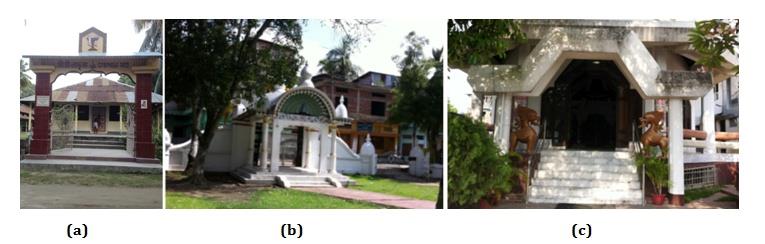
Figure 2 shows the comparison of overview of roof top of namghars located in rural (a), semi-urban (b) and urban areas (c). As seen from the figure, the shape of roof top appears to be similar to that of gable shape in case of Namghars in all three cases. While, there is a diffrence in material used. For older namghars in rural and semi- urban areas, tin sheet is used while for urban Namghar, concrete is used. The entire roof top is enclosed with no passage of light for rural and semi-urban namghars, while for urban namghar, there are three openings made to allow light to pass. It implies that there is a special attention paid to increase light efficiency in case of urban namghars. Three opennings have dome with shape that of Guru Asana in case of urban namghars. This also indicates the need to showcase and maitain identity of Namghar in urban densely located area, where there are numerous temples are located near by.
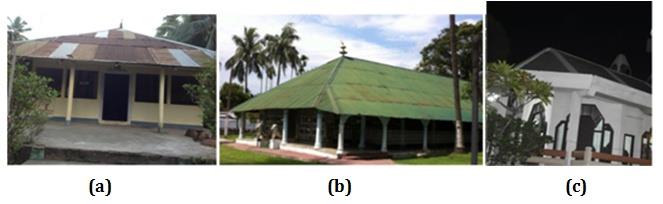
Figure 3 shows the comparison of overview of main door of namghars locatedin rural (a), semi-urban (b) and urban areas (c). The signifiance of main door lies in the fact that it is the first architectural element, where vaisanava sect is depicted for bhakats to visualize. As seen from the figure, the main door in case of rural and semi- urban are similar in shape (rectangular) with a presence of crown at the top. The transom is flat in shape. The door in rural area is divided into 6 panes while in semi-urban area into 8 panes. These doors are adorned with paintings of dasavathar of Lord Vishnu, which is integral part of vaisanava sect [12].
Monga C and Das AK. Comparative Study on Design Elements of Namghars in Urban, Rural and Semi-Urban Region using Visual Approach. Ergonomics Int J 2018, 2(5): 000178.
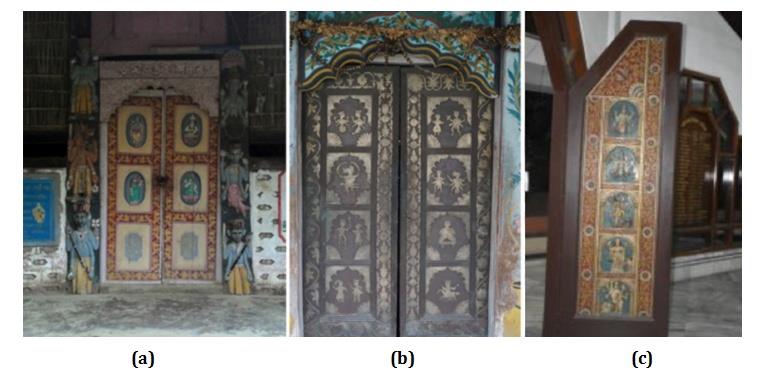
Whereas for the urban door is hexagonal in shape. The transom is polygonal in shape. It has fifteen wooden panels (on which decorations of dasavatar is done; not shown here) and fourteen glass panels around the boundary of wooden door. The glass panels are placed as to instead of crown to provide a modern look to the crown (which was mainly wooden or metal in case of rural and semi-urban Namghars). The width of trim in the panels of wooden door is thin so as to allow carvings of dasavatar (relief work instead of mere paintings) within the panel. The double door is different from other urban Namghars as it has mix of both glass and wooden panels. The presence of glass needs lower maintenance and also meant to attract people in urban area.This shows that despite lack of space, the dasavathar form is preserved while there is change in illustration (use of more relief work than painting). In addition, the use of glass panels is becoming more common for asthetic and modern look.
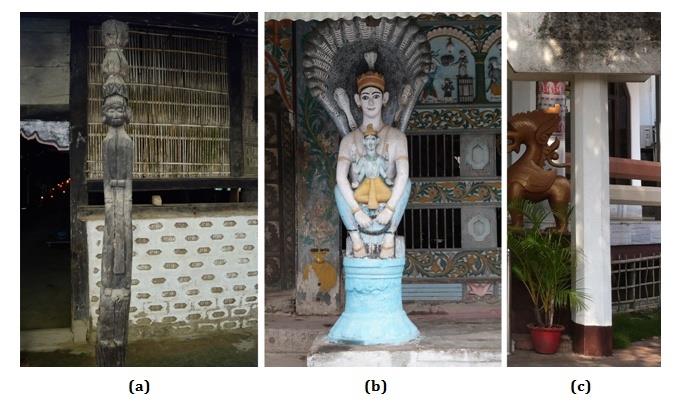
Figure 4 shows the comparison of overview of pillars in namghars locatedin rural (a), semi-urban (b) and urban areas (c). The pillars also forms the important element of Namghar as introduced by Neog [13]. It can be clearly seen from figure 4 that the pillars in case of rural and semi-urban namghars are more adorned with Vaisnava elements (Bhakat (Figure 4(a)) and incident of Lord Krishna with father Vasudeva (Figure 4(b)) than that of contrastingly plain pillar in case of Namghar in Urban area (Figure 4 (c)).
Monga C and Das AK. Comparative Study on Design Elements of Namghars in Urban, Rural and Semi-Urban Region using Visual Approach. Ergonomics Int J 2018, 2(5): 000178.
For pillar in rural namghar,there is no distinctive pedestal whereas, the capital is adorned with pot shape hat, over bhakat head. This pillar signified importance of Bhakat in Vaisnava sect, on which Namghar is based.Whereas, in case of semi-urban Namghar, the shaft of pillar represents one of the incidents of Shree Krishna. The incident indicates that Lord Krishna was carried by his father Vasudeva to protect his baby life. The pillar is completely different from all other namghars. Here, the pedestal is also larger in size and has carvings. The pillar is relatively shorter than other pillars in namghar. In contrast, the pillar in namghar located in Urban area is plain with pentagonal shape. There is absence of any sort of decoration and also, there is no clear distinction of abaqus, annulus and also fluting are absent.This shows that with time and space, there is loss of decorations and representations of Vaisnava sect on architectural elements [14]. This might be due to lack of funds and also lack of preservation of associated elements.
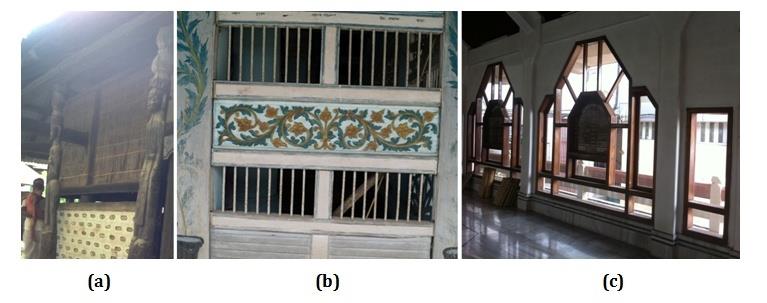
Figure 5 shows the comparison of windows in namghars locatedin rural (a), semi-urban (b) and urban areas (c). These windows are important architectural element and is not only meant for light passage but also carry significance in terms of watching kirtan (Naam) from outside especially by women. It can be clearly seen from figure 5 that the windows in case of rural was porous and was made of thatch. There are vertical gaps between thin elements of thatch to allow outsiders to visualize kirtan inside. In addition, there is a gap left between the top portion of windo and lower portion for light passage as well as visualization. Whereas in case of semi-urban areas, the windows are made of door and again divided into top and bottom portion using a trim. The trim is adored with floral design mainly depicitng lotus (associated with Lord Vishnu of Vaisnava sect). The steel grills are provided in vertical alignement for security reason and also for visualization. This may be also because with modern times, the threat of theft has increased.
When compared to that of urban Namghar (Figure 5 (c)), the windows are modern with glass panels. The shape is also hexagonal with trims dividing it into seven parts. In the center of window, there is wooden panel where decorations of elements of Vaisnava sects are done. This outlook of window in modern Namghar is meant to suit to younger and new generation audience. Windows size also appears to be bigger than rural and semi-urban namghar to allow more passage of lights. This shows that with time and space, there is a special focus being put to modernize material and also attention to make it more energy efficient.
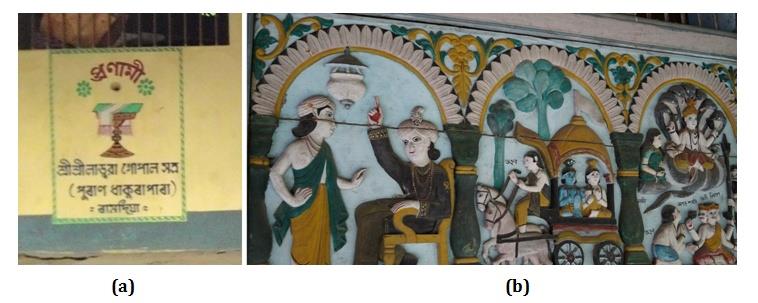
For urban Namghar, there was almost no relief work on outer walls; hence it is not shown in this paper. For rural and semi-urban Namghars, the decorations on outer wall are show in figure 6(a) and 6(b) respectively. As seen from figure 6(a), the illustration in rural Namghar is of “Sarai” with “Bhagvad (holy book)”. This is one of the most important element of Vaisnava sect also promoted Saint Sankradeva [15, 16]. As per Vaisnava sect, there is no worshipping of idol (as done in other hindu temples) in case of Namghars. The colors use to depict holy book is green (importance to Lord Krishna) and that of Sarai is brown. The entire illustration is enclosed in a rectangle and a text is written in local (assamese) language signifying the holy book. There is a presence of floral design (lotus petals) above the holy book painting. This floral design is also associated with dasavathar of Lord Monga C and Das AK. Comparative Study on Design Elements of Namghars in Urban, Rural and Semi-Urban Region using Visual Approach. Ergonomics Int J 2018, 2(5): 000178.
Vishnu (integral element of Vaisnava sect). The only idol is the holy book “Bhagvad”, which is writing of stories of Lord Krishna. Whereas, for the semi-urban Namghar, instead of showcasing holy book, the incidents mentioned in it are showcased through relief work. The incidents of Lord Krishna in Mahabharata are shown in outer walls of semi-urban Namghar. The illustrations in both rural and semi-urban Namghars are significant as people (especially women and children) can visualize the Krishna Leela that is going to take place inside Namghar in form of Kirtan. The women were prohibited in some Namghars in olden times. The background colos is blue (depicting sea in Mahabharata) with presence of other elements associate with dasavatar of Lord Vishnu of Vaisnava sect. The absence of these illustrations on outer wall in case of urban Namghar might be because of cost cutting and it can be also due to lesser need to visually present Mahabharata, whose material in visual forms are highly accessible now in form of digital and print media already to public in urban area.
Comparison of Interior Design Elements
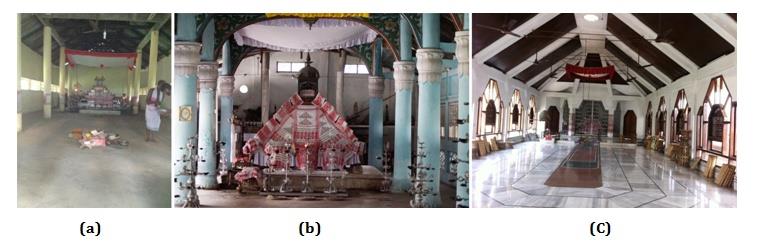
Figure 7 shows the comparison of overview of prayer hall in namghars locatedin rural (a), semi-urban (b) and urban areas (c). As seen from the figure, the prayer hall in case of rural and semi urban Namghars is mostly made of mud floor. In both Namghars (Figure 7(a) and 7(b)), series of pillars run parallel along the length of hall. Manikut is kept in the center and back end of Prayer hall of both Namghars. This Manikut is meant to place idol (Bhagvad) to be worshipped. The pillar closes to Manikut attaches importance and is generally known as “Lai Khutta”. The term “Lai Khutta” originates from Ahom kingdom. Also, one can observe, the presence of canopy (Chandrataap) over manikut. The chandrataap signifies the respect for idol to be worshipped. The ceiling in case of rural and semi-urban Namghar is mainly of tin sheet without any passage of light.
Monga C and Das AK. Comparative Study on Design Elements of Namghars in Urban, Rural and Semi-Urban Region using Visual Approach. Ergonomics Int J 2018, 2(5): 000178.
As compared to prayer hall of urban Namghar, the floor is made of marble. Unlike rural and semi-urban, there are no presence of pillars . Large section of outer wall is built with windows of glass panels, which were completely absent in rural and semi-urban Namghars. This indicates that there is lot of attention being paid to make inner hall light efficient. There is special pathway made (red color marble) for emphasising the stitting arrangement of pujaris and bhakats while doing Naam (Kirtan) in Urban Namghar. This was missing in case of rural and semi-urban Namghar (Figure 7(a) and 7(b)). The ceiling is made of polished wooden with white color wooden beams for lateral support. There is a small opening (light is coming) present at the ceiling to allow further light passage. The manikut unlike in rural and semi-urban Namghar is kept inside another room towards the end of prayer hall. The room is generally known as “Jewel hut”. Due to security reasons, the Manikut is enclosed inside a door made of steel. This is different from that of rural and semi-urban Namghars, where Manikut was kept in open in prayer hall. This shows that with time and space, there is a special focus being put to modernize material and also attention to make architectural elements more energy efficient and security measures. The importance of pillars seem to be lost in urban Namghars as compared to rural and semi-urban namghars.
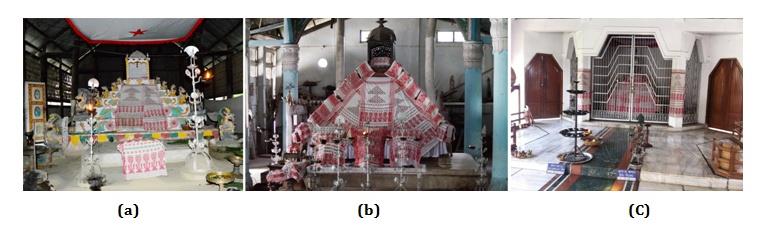
Figure 8 shows the comparison of Manikut in namghars locatedin rural (a), semi-urban (b) and urban areas (c). As seen from the figure, the Manikut is present in the prayer hall for rural and semi-urban namghars, while it is present inside a separate room (secured with grill door) in case of Urban Namghar. The manikut is seven tired structure with a Guru Asana at the topmost tier. The seven tier represents seven steps that are required to reach Mukti (or God) as per hindu mythology [17]. On these seven steps, the motifs of lion is present. At the bottom most tier, the motif of lion over elephant is carved. This indicates the victory of good (lion) over evil (elephant). The overall shape of manikut is triangular in all three cases (i.e., rural, semi-urban and urban). The seven tier structure is usually overlaid by Gohain (sacred cloth). Here, the gohain is similar to that Gamcha of Assamese tradition. The canopy (cloth) over Manikut is to show respect and honor to idol worshipped (Bhagvad; holy book) in Namghar. The overall structure of Namghar is similar in all three Namghars. There is diya (lampstand) present infront of Manikut for offering prayers for worshipping. The similar structure of Manikut that the extent of preservation and importance is maitained across different locations. As compared to other architectural elements such as door, gate, pillars, illustrations on walls and prayer hall, the manikut is much more similar and seems to be preserved even in Urban Namghar. This indicates the essentiality of components associated with Namghar.
Summary and Conclusion
A visual study was conducted to analyse the variations in design of architectural elements such as outer gate, main door pillars, prayer hall and Manikut of Namghars (Social-cultural institutions) located in urban, rural and semi-urban areas. It was found from the study that there is a huge variation in terms of relief work and decorations on these architectural elements between these three Namghars. The relief work and decorations seems to Monga C and Das AK. Comparative Study on Design Elements of Namghars in Urban, Rural and Semi-Urban Region using Visual Approach. Ergonomics Int J 2018, 2(5): 000178.
minimize with urbanization. The shape (design) of outer gate has changed from polylobed (rural) to simpler hexagonal shape (urban). The illustration on outer wall in terms of Krishna leela (incidents of Lord Krishna) is no longer present in Urban Namghar. This might be due to availability of Bhagvad in modern times in various other forms of visual media (Digital, print etc) [18, 19, 20].
The design of outer main gate, which was adorned with Vaisnava elements and floral design work for rural and semi-urban areas, is now almost plain without any significant decorations. Similarly, Pillars, which were carved with complex design of Vaisnava elements (Bhakat or Lord Krishna) and also floral work in case of semi- urban and rural Namghars seems to change to much simpler design form (plain round shape) in case of urban Namghars. The material has changed from less durable to more durable. For example, the mud floor (rural) is changed to marble (urban); the wooden doors to mix wooden/glass doors and thatch roof to tin roof. Prayer hall pillars, which were carved at top portion (capital) and pedestal (bottom) is no longer decorated. In terms of relief work, it has almost vanished on outer walls for urban Namghar. The entire illustration of Vaisnava sect elements is now depicted in only main door for urban Namghars [21, 22].
The openings in terms of using glass panels in doors, windows and ceilings. In urban Namghar as compared to rural Namghar indicates inclination of architectural design towards energy efficient structure. Among all the architectural elements, Manikut structure and also form shape and color seems to be preserved the most. Overall, there is strong indication of increasing essence of modernization, energy efficiency along with security as compared to relief and decorative work (Vaisnava sect elements) in design of architectural elements of Namghar in Urban location.
References
-
Neog M (1998) Sankaradeva and the Vaishnava Renaissance in Assam. Sankaradeva : studies in culture, 2nd (Edn.), Srimanta Sankaradeva-Sangha, Guwahati, pp: 46-55.
-
Mahanta PJ (2007) The Sankaradeva Movement-Its Cultural Horizons. Purbanchal Prakashan, Guwahati.
-
Rahman MS (2015) Role of Satra & Namghar in the Evolution of Genesis of Assamese Identity. International Journal of Social Sciences and Management 2(2): 108-113.
-
Gogoi N (2016) Bhaona: The Vaishnavite Theater of Assam. International Research Journal of Multidisciplinary Studies 2(6).
-
Gait E (2013) A History of Assam. Bina Library, Guwahati.
-
Borkakoti S (2005) Mahapurusha Srimanta.
-
Gogoi N (2016) An Aesthetical Study on the Unique Architectural Structural Representation of the Vaishnavite Monastaries of Assam. International Research Journal of Multidisciplinary Studies 2(5): 1- 11.
-
Indolia US (2012) Rural tourism in India: Potential and prospects. International Multidisciplinary e- journal 1: 201-211
-
Acharjee S, Goswami U, Saikia R (2013) Visual change detection study of some of the urban areas of Assam, India using Remote Sensing. International Journal of Geomatics and Geosciences 3(3): 500-510.
-
Borah R (2012) Growth and Development of the Satras in Historical Perspective. Australia.
-
Sohoni A (2011) Ganesh Temple at Tasgaon: Apotheosis of Maratha Temple Architecture. South Asian Studies 27(1): 51-73.
-
Varadpande ML (2009) Mythology of Vishnu and His Incarnations. Gyan Publishing House.
-
Neog M (2004) Cultural Heritage of Assam. 1st (Edn.), Omsons Publications, New Delhi.
-
Barkakoti K (2001) Art and Architecture in the Sattra Institutions of Assam. Glimpses of the Vaisnava Heritage of Assam 43: 168-175.
-
Neog M (2011) Sankaradeva-The Great Integrator. 1st (Edn.), Omsons Publication, New Delhi.
-
Neog M (2004) Sankaradeva and some aspects of Assam Vaisnavism. A creative vision: Essays on Sankaradeva and Neo-Vaisnava Movement in Assam, 1st (Edn.), Srimanta Sankar Kristi Bikashsamiti, Guwahati, pp: 43-59. Monga C and Das AK. Comparative Study on Design Elements of Namghars in Urban, Rural and Semi-Urban Region using Visual Approach. Ergonomics Int J 2018, 2(5): 000178.
-
Chakravarti SS (1991) Hinduism, a \way of life. Motilal Banarsidass Publ.
-
Monga C, Das AK (2018) A Comparative Visual Study of Design Elements of Social Cultural Institutions, 'Namghar' with Monuments in South East Asia. International Society for the Study of Vernacular Settlements 5(2): 31-41.
-
Monga C, Das KA (2017) Cultural Construction: Design Aesthetics, Semiotics and Semantics Associated with Masks in Namghar-The Study of Its Design Aspects in the Island of Majuli, India. Research into Design for Communities 2: 763-778.
-
Monga C, Das AK (2018) Namghar: Aesthetics and Identity of Social Cultural Institutional Architecture in Assam, India. Ergonomics International Journal 2(4): 1-8.
-
Sankardeva. Charitra Supan. (1st ed.), Bani Mandir, Guwahati.
-
Datta B (2012) Cultural Contours of North-east India. 1st (Ed.), Oxford University, India. Monga C and Das AK. Comparative Study on Design Elements of Namghars in Urban, Rural and Semi-Urban Region using Visual Approach. Ergonomics Int J 2018, 2(5): 000178.
- The Expanding Landscape of Road Rage: A Systematic Review of Conflicts Involving Drivers, Pedestrians, and Micromobility
- Validating Cognitive Models of Royal Navy Performance on Control Systems
- Comparing Standard and State-of-the-art Firefighter Coats on Postural Balance and Gait in a Live Burn Environment
- Investigating the Integration of Telemedicine into Clinicians Workflow: A Review of Methods
- Risk Assessment of Ergonomic Factors in a Textile Firm by RULA, REBA and Fine Kinney Methods
- Impact of Self-Esteem Training on Individuals with Disabilities Aged 17-30